


GCC Business Etiquette: Professional Overview
GCC Business Etiquette is important for anyone meeting clients, partners, investors or government representatives in the UAE, Saudi Arabia, Qatar, Bahrain, Oman or Kuwait. The Gulf has become one of the world’s most internationally connected business regions, but professional relationships are still influenced by local traditions, hospitality, respect for seniority and Islamic cultural practices.
- GCC Business Etiquette: Professional Overview
- Understanding Business Culture in the Gulf
- 1. Building Relationships Before Business
- 2. Using Respectful Greetings
- 3. Handling Handshakes Appropriately
- 4. Dressing Professionally and Modestly
- 5. Respecting Seniority and Hierarchy
- 6. Understanding Meeting Culture
- 7. Communicating With Patience and Diplomacy
- 8. Showing Respect During Ramadan
- 9. Understanding Arabic Hospitality
- 10. Using Business Cards and Professional Titles
- 11. Negotiating Without Creating Unnecessary Pressure
- 12. Following Up and Maintaining Relationships
- Business Etiquette in the UAE
- Business Etiquette in Saudi Arabia
- Business Etiquette in Qatar
- Business Etiquette in Bahrain
- Business Etiquette in Oman
- Business Etiquette in Kuwait
- Business Dining Etiquette in the GCC
- Business Etiquette for Women in the Gulf
- Business Etiquette for Foreign Entrepreneurs
- Online and Email Business Etiquette
- Common GCC Business Etiquette Mistakes
- GCC Business Etiquette Checklist
- Final Thoughts on GCC Business Etiquette
Understanding these customs does not mean trying to imitate local behaviour artificially.
It means knowing when to slow down, when to allow conversation before discussing business, how to greet someone respectfully and how to avoid behaviour that may appear too aggressive or informal.
The six GCC countries also should not be treated as culturally identical. Business environments in Dubai, Riyadh, Doha, Manama, Muscat and Kuwait City have their own character, and individual companies can range from traditional family businesses to highly international multinational workplaces.
Generational differences also matter.
A young technology founder in Dubai may communicate differently from the chairman of a long-established family company in Riyadh or Kuwait. International companies may follow global corporate procedures, while locally owned organisations may place greater emphasis on personal relationships and hierarchy.
The strongest approach is therefore not to memorise rigid rules.
It is to understand the major cultural principles and then observe how the people in front of you prefer to work.
GCC Business Etiquette: Professional Overview
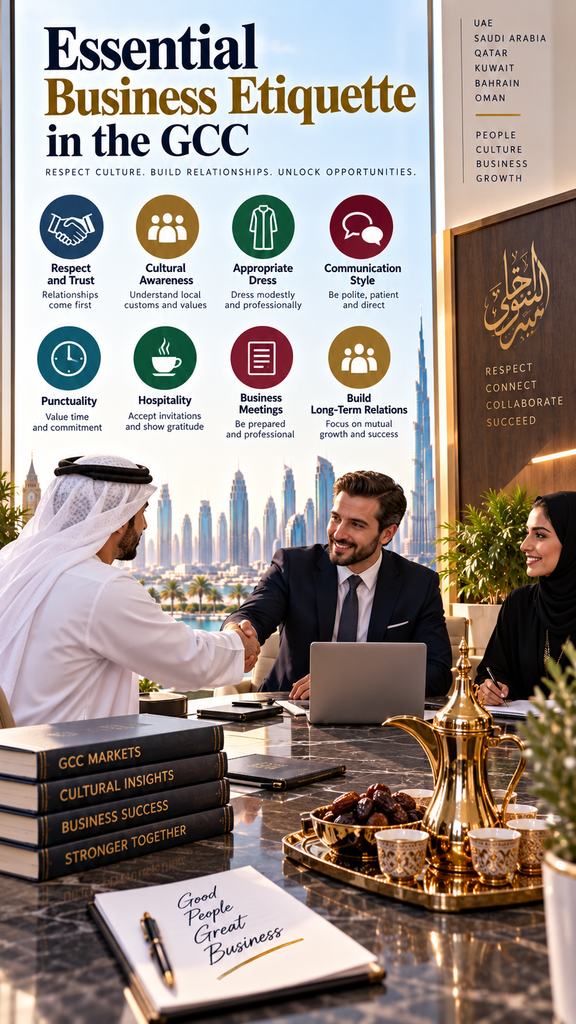
Several principles appear consistently across Gulf professional culture.
| Area | Recommended Approach |
|---|---|
| Greetings | Warm, respectful and professional |
| Relationships | Allow time to build trust |
| Hierarchy | Show respect to senior people |
| Meetings | Professional but often relationship-led |
| Dress | Conservative and polished |
| Communication | Diplomatic rather than confrontational |
| Hospitality | Accept reasonable offers of coffee or refreshments |
| Ramadan | Respect fasting and altered schedules |
| Negotiation | Patient and relationship-focused |
| Follow-up | Polite and professional |
| Titles | Use professional titles when appropriate |
| Gender interaction | Follow the other person’s lead with physical greetings |
These principles should be treated as guidance rather than assumptions about every Gulf national.
The region contains millions of expatriates and an enormous variety of workplace cultures.
A multinational finance company in the Dubai International Financial Centre may operate very differently from a traditional family enterprise.
The key is to combine cultural awareness with professional observation.
Understanding Business Culture in the Gulf
Relationships often matter significantly in Gulf business.
A meeting may begin with discussion about family, travel, the city or general wellbeing before moving into commercial topics.
To someone coming from a highly transactional business culture, this can initially feel inefficient.
It is often the opposite.
Conversation helps establish trust.
Long-term business relationships can matter more than winning one transaction quickly.
This is particularly important when dealing with family businesses, government-related organisations and long-established local companies.
Arabic hospitality also has deep cultural importance.
The UAE Government’s official cultural guidance notes that sharing food is regarded as an expression of friendship and advises guests to accept refreshments before moving directly into business when hosted.
Understanding this context can improve business relationships enormously.
1. Building Relationships Before Business
One of the biggest mistakes foreign executives make is moving immediately from introduction to sales pitch.
In many Gulf settings, spending several minutes getting to know the other person is perfectly normal.
Conversation might include:
- How long you have been in the country
- Your journey
- Your family in general terms
- Business developments
- The city
- Travel
- Shared professional connections
This should not become intrusive.
Personal topics involving religion, politics or family privacy should be approached carefully unless the other person introduces them.
The objective is simply to create human connection.
Trust can become especially important when a commercial relationship is expected to last for years.
A supplier selected purely on price may be replaced easily.
A trusted partner who understands the organisation and its people may become much harder to replace.
2. Using Respectful Greetings
Greetings matter because they establish the tone of the interaction.
A simple English greeting is perfectly acceptable in many Gulf business environments.
Learning a few Arabic phrases can nevertheless create a positive impression.
Common expressions include:
As-salamu alaykum
Peace be upon you.
Wa alaykum as-salam
And peace be upon you.
Marhaba
Hello or welcome.
Shukran
Thank you.
Saudi Arabia’s official tourism guidance identifies “salam alaykum” as one of the country’s most common greetings, while Visit Saudi also provides basic Arabic expressions for international visitors.
You do not need to speak fluent Arabic.
English is widely used in Gulf business, particularly in international companies.
Using a respectful Arabic greeting correctly can still help create warmth.
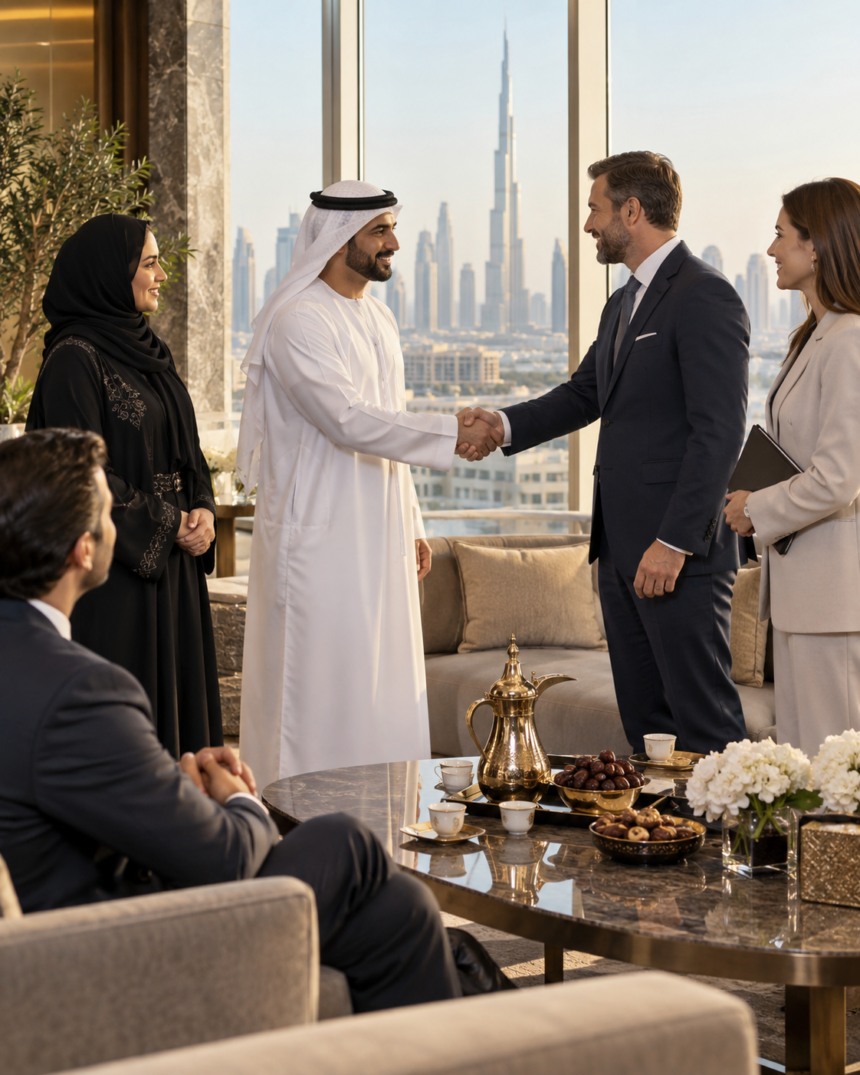
3. Handling Handshakes Appropriately
Handshakes require more awareness than in some Western business cultures.
Between people of the same gender, handshakes are common in many professional situations.
With someone of the opposite gender, the safest approach is to allow the other person to initiate physical contact.
The UAE Government explicitly advises that when greeting a Muslim member of the opposite gender, you should not automatically offer a handshake unless the other person extends a hand first.
Visit Qatar provides similar guidance, noting that some Qatari women do not shake hands with men and some men do not shake hands with women as a sign of religious respect.
If no handshake is offered, simply smile and greet the person verbally.
There is no need to make the moment awkward.
A slight nod with a warm greeting is enough.
4. Dressing Professionally and Modestly
Business dress across the Gulf is generally polished.
International executives commonly wear standard professional clothing.
For men, this can mean:
- Business suit
- Shirt and trousers
- Smart business-casual clothing where appropriate
For women, professional clothing that is not excessively revealing is generally the safest choice.
Visitors do not normally need to wear traditional Gulf clothing.
Local men may wear a kandura, thobe or dishdasha depending on the country, while local women may wear an abaya.
International professionals should usually wear their own professional clothing rather than attempting to copy local national dress.
The broader principle is modesty.
Visit Qatar recommends that visitors respect local culture by avoiding excessively revealing clothing and generally covering shoulders and knees in public.
Oman’s official visitor guidance similarly encourages conservative clothing covering the shoulders and knees.
Corporate environments may be more flexible, but conservative professional dress is rarely a bad choice for an important first meeting.
5. Respecting Seniority and Hierarchy
Seniority can carry significant importance in Gulf organisations.
This is particularly relevant in:
- Family businesses
- Government entities
- Large local corporations
- Traditional organisations
The UAE’s official etiquette guidance specifically recommends standing when older, senior or important guests arrive.
In business meetings, identify the senior decision-maker.
Do not assume that the person speaking most frequently has final authority.
Junior managers may lead the presentation while a senior executive makes the ultimate decision.
Professional titles can also matter.
Using:
- Doctor
- Engineer
- Chairman
- Sheikh
- Your Excellency
may be appropriate in specific contexts.
However, titles should be used accurately rather than guessed.
If the other person introduces themselves informally, follow their lead.
6. Understanding Meeting Culture
Gulf meetings can combine formality and hospitality.
The business presentation may be highly structured, while the conversation around it feels relaxed.
A typical meeting can involve:
- Greeting everyone
- Coffee or refreshments
- General conversation
- Introductions
- Business discussion
- Closing conversation
Do not become impatient because commercial discussion does not begin immediately.
The opening conversation may itself be part of the relationship-building process.
Punctuality is still recommended.
Arrive on time even if the meeting itself begins slightly later than expected.
Avoid scheduling extremely tight meetings back-to-back when developing senior relationships.
Also check the local working week and prayer schedules.
Qatar’s official visitor guidance notes that Friday morning activity is affected by Friday prayers, while many business environments operate Sunday to Thursday.
Scheduling important meetings around Friday prayer should generally be avoided.
7. Communicating With Patience and Diplomacy
Direct communication is valued in business, but unnecessary confrontation rarely helps.
A highly aggressive statement such as:
“This proposal makes no sense.”
can often be replaced with:
“We may need to look at another approach.”
The second version communicates the same commercial concern without creating unnecessary embarrassment.
This matters particularly when giving criticism in front of other people.
Avoid publicly humiliating a colleague, client or partner.
Sensitive disagreement is often better handled privately.
Tone matters as much as words.
A calm, respectful conversation can achieve more than visibly aggressive negotiating tactics.
This does not mean avoiding difficult discussions.
Contracts, pricing, performance and deadlines should still be addressed clearly.
The difference is in how those disagreements are expressed.
8. Showing Respect During Ramadan
Ramadan changes the rhythm of business across the Gulf.
Muslims fast from dawn to sunset during the holy month, and work schedules can be shorter or shifted.
The UAE officially reduces private-sector working hours by two hours per day during Ramadan.
The UAE Government also notes that non-Muslims are not required to fast but should be aware of the spiritual and social atmosphere of the month.
For business professionals, good Ramadan etiquette includes:
- Avoid scheduling unnecessary lunch meetings with fasting colleagues
- Expect shorter working days
- Be flexible with meeting times
- Understand that energy levels may change later in the day
- Avoid demanding immediate responses around Iftar
- Offer Ramadan greetings appropriately
Common greetings include:
Ramadan Kareem
or
Ramadan Mubarak
The UAE’s official Ramadan guidance confirms both are commonly used greetings.
Evening business activity can sometimes increase during Ramadan because life becomes more active after Iftar.
9. Understanding Arabic Hospitality
Coffee is much more than a drink in Gulf hospitality.
Arabic coffee and dates frequently appear when guests arrive.
Accepting them can be part of showing appreciation to the host.
Saudi cultural guidance describes coffee with dates as a signature form of hospitality offered to guests.
Qatar’s majlis tradition similarly includes serving visitors Arabic coffee and dates.
The UAE recommends accepting food or refreshments before rushing into business and using the right hand when accepting food and drink.
You do not need to consume large amounts.
Simply accepting a small coffee or date politely can acknowledge the hospitality.
If you genuinely do not want something, decline respectfully.
Hospitality should not be interpreted as wasted business time.
In many relationships, it is part of the business relationship itself.
10. Using Business Cards and Professional Titles
Business cards remain useful, particularly during formal meetings, conferences and introductions.
A good card should clearly show:
- Name
- Position
- Company
- Phone
- Website
For companies working heavily with local clients, having Arabic on one side and English on the other can be useful, although it is not essential in every industry.
Do not throw someone’s card immediately into a pocket without looking at it.
Take a moment to read the name and role.
Digital contact sharing is increasingly common, particularly among younger professionals and technology companies.
However, a traditional business card can still be useful when dealing with senior executives or more formal organisations.
Use professional titles appropriately until invited to become more informal.
11. Negotiating Without Creating Unnecessary Pressure
Negotiation can take time.
A business relationship should not automatically be treated like a one-meeting transaction.
Important deals may require:
- Several meetings
- Internal consultation
- Relationship building
- Senior approval
- Contract revision
Do not interpret silence immediately as rejection.
At the same time, avoid endless passive waiting.
Professional follow-up is entirely appropriate.
Price negotiation can also be expected in many commercial environments.
However, avoid becoming disrespectful.
Aggressive statements such as:
“This is our final price. Take it or leave it.”
can damage a relationship unnecessarily.
A better approach explains commercial constraints while leaving room for discussion.
Good negotiation protects both economics and the long-term relationship.
12. Following Up and Maintaining Relationships
The meeting does not end when everyone leaves the room.
Send a professional follow-up.
A useful message can include:
- Thanks for the meeting
- Short summary
- Agreed next steps
- Documents promised
- Timeline
Do not send five follow-up messages in two days unless the matter is genuinely urgent.
Relationship maintenance also matters beyond active transactions.
Simple professional contact around:
- Eid
- Ramadan
- Major company achievements
- National occasions
can help maintain long-term relationships when appropriate.
Avoid turning every message into a sales pitch.
Relationships become more credible when every interaction does not ask for something.
Business Etiquette in the UAE
The UAE has perhaps the GCC’s most internationally diverse corporate environment.
Dubai and Abu Dhabi contain businesses employing people from almost every region of the world.
As a result, workplace styles can range from highly international to strongly traditional.
The UAE Government nevertheless provides several useful etiquette principles.
It recommends standing for senior or older guests, following the other person’s lead regarding opposite-gender handshakes and accepting hospitality respectfully.
English is widely used in business.
Professional dress is expected in corporate environments, although standards can vary between sectors.
A technology startup may be relatively casual.
A meeting with a government entity, bank or major family company is likely to be considerably more formal.
Ramadan should also be factored into business schedules because private-sector working hours are reduced under UAE labour law.
Business Etiquette in Saudi Arabia
Saudi Arabia’s business environment is becoming increasingly international as foreign companies establish larger operations in Riyadh and other cities.
However, relationship building remains important.
A warm greeting and a period of general conversation before business can help establish trust.
Saudi hospitality frequently includes Arabic coffee and dates. Visit Saudi describes this as a traditional way of welcoming guests.
Learning simple Arabic phrases can also be appreciated.
Official Visit Saudi guidance lists useful expressions such as greetings and polite introductory phrases for international visitors.
Professional hierarchy should be observed carefully in larger organisations.
Formal meetings with government bodies or senior executives generally justify conservative business dress and respectful use of titles.
As throughout the region, let the other person guide physical greetings across genders.
Business Etiquette in Qatar
Qatar combines international corporate culture with strong local traditions.
Doha hosts multinational companies, international institutions and major Qatari business groups.
Visit Qatar advises visitors to dress respectfully and notes that some men and women may avoid handshakes with the opposite gender.
The majlis remains a particularly useful cultural reference.
Visit Qatar describes it as an important social space where guests are received and where coffee, conversation and hospitality play central roles.
This helps explain why relationship building can be important in business as well.
Friday scheduling also deserves attention because commercial activity can pause around Friday prayers.
Business Etiquette in Bahrain
Bahrain has a long history as a regional trading and financial centre and its corporate culture is often internationally oriented.
English is widely used in many business environments.
Meetings can feel relatively relaxed, but professionalism and respect for seniority remain important.
A friendly opening conversation is normal.
Business visitors should use conservative professional dress for formal meetings and remain attentive to religious holidays and Ramadan schedules.
Because Bahrain contains both long-established family enterprises and multinational organisations, there is no single meeting style.
Observe whether the other party communicates formally or casually and adapt accordingly.
Relationship building remains valuable even when the organisation itself uses highly international business practices.
Business Etiquette in Oman
Omani professional culture is often associated with courtesy, patience and calm communication.
Oman’s official tourism guidance asks visitors to respect local traditions through modest dress and consideration for the country’s calm social atmosphere.
Hospitality is also strongly embedded in Omani culture.
Official tourism material highlights coffee, conversation and welcoming visitors as important elements of social interaction.
For business visitors, aggressive or visibly impatient behaviour is unlikely to create a strong impression.
Allow the relationship to develop.
Professional meetings should be respectful, with appropriate recognition of senior participants.
Oman’s business environment is increasingly international, especially around logistics, energy, tourism and technology, but cultural courtesy remains highly valuable.
Business Etiquette in Kuwait
Kuwait has a deeply established merchant and family-business tradition.
Personal relationships can therefore play an important role alongside formal commercial considerations.
Kuwait Government Online highlights the close social ties that characterise Kuwaiti society, while KDIPA describes Kuwait’s entrepreneurial culture and the long-standing role of business families in industries including finance, telecom, logistics and retail.
Introductions through trusted contacts can be valuable, although they are not essential for every business relationship.
Allow conversation before moving directly into negotiations.
Seniority, professional reputation and trust can carry significant weight.
Formal dress is appropriate for important meetings.
As elsewhere in the Gulf, religious holidays and Ramadan can affect schedules.
Business Dining Etiquette in the GCC
Business relationships sometimes continue over lunch or dinner.
A few principles are useful.
Let the host guide seating
Do not immediately assume where to sit at a formal gathering.
Accept hospitality graciously
You do not need to eat everything offered.
Use the right hand when appropriate
The UAE’s official guidance specifically notes using the right hand for accepting and eating food in traditional settings.
Do not rush the meal
A business dinner can be as much about relationships as the transaction.
Be aware of alcohol rules
Never assume alcohol will be served or appropriate.
Many local partners do not drink alcohol for religious reasons.
If you are hosting, select a venue appropriate for everyone attending.
Business Etiquette for Women in the Gulf
Women play major roles across Gulf business, government, finance, entrepreneurship and professional services.
International businesswomen should generally follow the same principles of professional competence and respectful dress expected of male colleagues.
Gender-related physical greetings require slightly greater attention.
Do not automatically interpret the absence of a handshake negatively.
It may simply reflect religious practice.
Likewise, international men meeting local women should wait for the woman to initiate a handshake rather than automatically extending a hand. UAE and Qatar official guidance both support this approach.
Professional communication should remain direct and respectful.
Avoid relying on stereotypes about women’s roles in Gulf society.
The individual person’s position, seniority and professional authority matter far more.
Business Etiquette for Foreign Entrepreneurs
Foreign entrepreneurs often make one of two mistakes.
They either ignore local culture completely or become so worried about etiquette that every interaction feels unnatural.
Neither is necessary.
Use a few simple principles:
- Be respectful
- Dress professionally
- Listen carefully
- Follow the other person’s lead
- Avoid aggressive confrontation
- Learn basic cultural context
- Respect Ramadan
- Do not rush relationships
You do not need to pretend to be local.
Being professional, culturally aware and genuine is much more effective.
Also remember that many Gulf executives have studied or worked internationally.
They may understand your business culture extremely well.
Cultural respect should therefore be mutual rather than theatrical.
Online and Email Business Etiquette
Gulf business is increasingly conducted through email, WhatsApp, Teams and other digital platforms.
WhatsApp is commonly used for professional communication in many industries, but boundaries still matter.
Do not assume senior clients want messages late at night.
For formal matters, email remains useful because it creates a clearer record.
A professional message should be:
- Polite
- Short
- Clear
- Action-oriented
Avoid sending only:
“Hi”
and waiting for the recipient to respond before explaining why you contacted them.
Instead, provide context immediately.
Also consider weekends, prayer times and public holidays before expecting immediate responses.
Digital convenience should not eliminate professional courtesy.
Common GCC Business Etiquette Mistakes
Starting the sales pitch immediately
Allow some relationship-building conversation.
Automatically shaking hands with everyone
Follow the other person’s lead across genders.
Using overly casual clothing
Professional and modest dress is safer for first meetings.
Ignoring seniority
Know who the senior participants are.
Publicly criticising someone aggressively
Handle sensitive criticism diplomatically.
Scheduling important meetings during Friday prayers
Check local schedules.
Ignoring Ramadan
Business rhythms change during the holy month.
Refusing hospitality abruptly
Decline politely when necessary.
Treating every GCC country as culturally identical
There are significant national and organisational differences.
Assuming every local business is traditional
Many Gulf workplaces are highly international.
Sending excessive follow-ups
Persistence should remain professional.
Using local titles incorrectly
Verify formal titles instead of guessing.
GCC Business Etiquette Checklist
Before an important Gulf business meeting:
- Research the company
- Identify senior attendees
- Confirm names and titles
- Arrive on time
- Dress professionally
- Prepare a respectful greeting
- Allow the other person to initiate opposite-gender handshakes
- Accept reasonable hospitality politely
- Avoid rushing directly into business
- Keep communication diplomatic
- Present information clearly
- Avoid unnecessary public disagreement
- Check Ramadan schedules
- Check Friday prayer timing
- Consider local public holidays
- Keep business cards available
- Listen before negotiating
- Avoid overly aggressive closing tactics
- Confirm next steps
- Send a professional follow-up
- Maintain the relationship after the meeting
Final Thoughts on GCC Business Etiquette
Understanding GCC Business Etiquette can make business relationships across the Gulf easier, but success does not come from memorising a long list of cultural rules.
The most important principles are straightforward.
Build trust.
Show respect.
Pay attention to hierarchy.
Dress professionally.
Allow hospitality and conversation to form part of the meeting.
Follow the other person’s lead regarding physical greetings.
Communicate disagreement without unnecessary embarrassment or confrontation.
And recognise that Ramadan, Friday prayers and major religious occasions can affect the normal rhythm of work.
The UAE combines international business culture with traditional values around hospitality, seniority and respectful greetings. Official government guidance specifically highlights hospitality, standing for senior guests and sensitivity around opposite-gender handshakes.
Saudi Arabia places strong cultural value on hospitality, with Arabic coffee, dates and greetings forming familiar parts of welcoming visitors.
Qatar maintains important traditions around the majlis, hospitality and respectful social interaction while operating a highly international business environment.
Bahrain combines an established Gulf trading culture with a strongly international corporate environment.
Oman places particular value on courtesy, modesty and calm social interaction, themes also reflected in its official cultural guidance.
Kuwait combines modern corporate activity with a long merchant and family-business tradition in which relationships and reputation can carry substantial importance.
Foreign professionals should also avoid turning these cultural patterns into stereotypes.
Not every Saudi executive prefers the same meeting style. Not every Emirati company is hierarchical. Not every Qatari business relationship requires lengthy social interaction. Companies, generations and individuals differ enormously.
The most valuable etiquette skill is therefore observation.
Understand the broad culture, enter the room respectfully and then pay attention to how the people in front of you communicate.
Good business etiquette ultimately communicates one message:
You respect the people you want to do business with.
That principle works in every Gulf country and in almost every business culture around the world.
Do follow us on Instagram
Read More – GCC Corporate Tax: 12 Essential Rules for Successful Businesses in 2026