


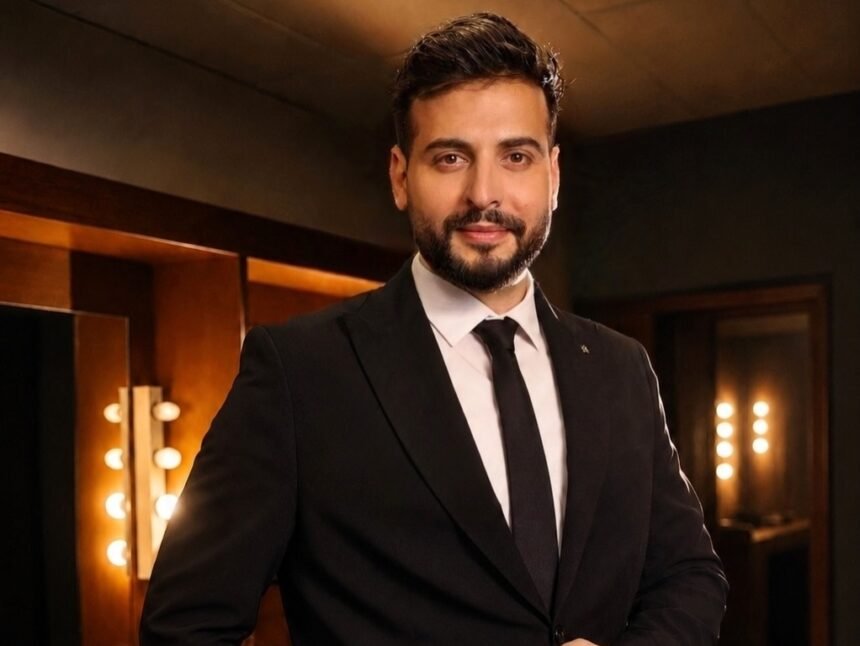
Opening a New Chapter With Jbeil Performances
George Nehme has spent much of his life around music, but his career has never been about simply inheriting a musical environment. The Lebanese singer, composer and director has worked to build a voice that respects the country’s musical memory while still sounding like his own.
- Growing Up Inside a Musical Family
- Learning From Lebanese Music Icons
- Choosing Education Alongside Talent
- Building an Independent Musical Identity
- Carrying Lebanese Music Into the Present
- Recognition Without Losing Direction
- The Stage Remains His Strongest Space
- Chapter 1 Opens a New Moment in Jbeil
- A Career Built on Roots and Reinvention
His journey began unusually early. He performed with legendary singer Wadih El Safi when he was only eleven and later joined projects connected with Fairuz and Ziad Rahbani while still very young. Those experiences placed him close to some of the most respected names in Lebanese music before he had fully developed his own artistic identity.
Today, George Nehme is known for a style that moves between traditional Lebanese emotion and a contemporary sound. His current profile also points to Chapter 1 in Jbeil, with dates announced for September 11, 18 and 25, 2026, showing that live performance remains central to his artistic life.
Growing Up Inside a Musical Family
Music was part of George Nehme’s environment from childhood. He grew up in a musical family of nine siblings, including acclaimed singer and musicologist Abeer Nehme.
Being surrounded by music created a natural education, but George still had to discover what made his own voice different. Over time, he developed a belief that Lebanese musical heritage should remain alive through reinvention rather than repetition.
Learning From Lebanese Music Icons
Few young performers get the chance to stand beside artists who shaped an entire national musical tradition.
George sang with Wadih El Safi at eleven. A few years later, he became involved in the Rahbani musical Sah El Nom alongside Fairuz and worked within the musical world of Ziad Rahbani.
Those experiences exposed him to discipline, rehearsal, stage presence and the responsibility that comes with performing music people deeply care about.
George has spoken about the precision and work ethic he witnessed around Fairuz and the artistic conscience he learned from Ziad Rahbani. Those lessons helped shape his understanding that being an artist requires more than having a good voice. It also requires responsibility toward the audience and the culture behind the music.
Choosing Education Alongside Talent
Natural ability was never enough for George Nehme.
He studied music at the Holy Spirit University of Kaslik and trained in piano, oud, oriental singing, orchestration, harmony, solfege, music history and analysis. He later completed a masters degree in cinema.
His interest in film also led him to direct the second season of Ethnopholia, a documentary exploring ethnic music and culture across several countries. Those experiences expanded his perspective while strengthening his connection to his own roots.
Building an Independent Musical Identity
In 2008, George formed his own band and began developing a live performance identity that could stand apart from the famous artists he had previously worked with.
Working with legends can open doors, but it can also create expectations. George needed to prove that he had something personal to say. Songs such as Ya Tafida helped introduce that independent identity to a wider audience.
He has also remained independent as an artist, choosing to make his own creative decisions rather than allowing trends to define his direction.
Carrying Lebanese Music Into the Present
George Nehme’s work often sits between two worlds.
He respects the musical giants who came before him, but he does not believe preserving heritage means recreating older music exactly as it was.
His approach is to understand the emotional language of Lebanon and allow it to develop naturally for a new generation.
That balance can be difficult. Move too far toward nostalgia and the music can feel trapped in the past. Chase every modern trend and the cultural identity can disappear.
George has built his career inside that tension, protecting authenticity while experimenting with contemporary arrangements and visual ideas.
Recognition Without Losing Direction
In 2018, George Nehme received the Murex d’Or for Rising Lebanese Male Artist, an important recognition in his developing solo career.
Recognition did not change the central direction of his work. His public conversations continue to return to identity, heritage and artistic truth.
That consistency has helped him build an audience that connects with both his songs and the atmosphere of his live performances.
The Stage Remains His Strongest Space
Live performance is one of the clearest expressions of George Nehme’s personality as an artist.
His concerts are known for interaction, improvisation and a close relationship with the band and audience. Instead of treating a performance as a fixed recording reproduced on stage, he allows music to breathe in the moment.
In May 2026, he performed at Casino du Liban in a charitable concert supporting an organisation serving people with special needs. The evening reflected another side of his artistic life. Music can entertain, but it can also create connection and community.
Chapter 1 Opens a New Moment in Jbeil
George Nehme’s current Instagram profile points toward Chapter 1 in Jbeil on September 11, 18 and 25, 2026.
The title suggests a beginning rather than a conclusion. For an artist who started performing as a child and has already moved through music, cinema, touring and independent releases, describing a current project as Chapter 1 feels meaningful.
It suggests that George still sees space to begin again, experiment and create without becoming trapped by what he has already achieved.
A Career Built on Roots and Reinvention
George Nehme’s journey is not simply the story of someone who grew up around famous musicians. It is the story of an artist who had early access to an extraordinary musical world but still had to study, work, perform and discover his own identity.
From Wadih El Safi and Fairuz to Ziad Rahbani, international music projects, cinema studies, independent releases and his own live shows, every stage has added another layer to his artistic direction.
His lifestyle today may include concerts, travel, studios and public recognition, but the foundation remains the same. He continues to return to Lebanese music, family, creativity and the responsibility of making something honest.
As Chapter 1 begins in Jbeil, George Nehme appears less interested in closing the story of what he has achieved and more interested in deciding what comes next.
For young artists, that may be the strongest lesson in his journey. Respect where you come from, keep learning and have the courage to create something that sounds like you.
Follow George Nehme on Instagram
Read More – Road Trips in Dubai: Amazing Scenic Drives and Weekend Escapes