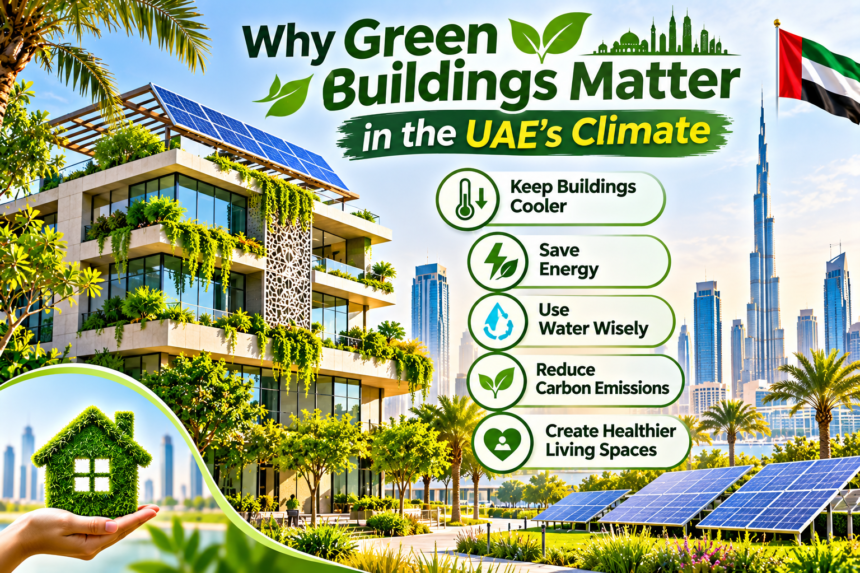
Why Green Buildings Matter in the UAE’s Climate
The United Arab Emirates is known for its modern architecture, impressive skyscrapers, luxury residential communities, and rapidly developing cities. However, building and maintaining comfortable spaces in the UAE presents a major environmental challenge. The country experiences long, hot summers, strong sunlight, high temperatures, limited freshwater resources, and occasional dust storms. In coastal areas, humidity can also make outdoor conditions uncomfortable.
- 1. Reducing Energy Consumption During Extremely Hot Summers
- 2. Improving Indoor Comfort Through Smart Building Design
- 3. Saving Water in a Water-Scarce Environment
- 4. Reducing Carbon Emissions and Supporting Net Zero 2050
- 5. Reducing the Urban Heat Island Effect
- 6. Using Solar Energy in a Country with Abundant Sunshine
- 7. Choosing Sustainable Materials for the UAE’s Climate
- 8. Making Buildings More Resilient to Climate Challenges
- 9. Reducing Long-Term Costs for Residents and Businesses
- 10. Supporting Healthier Communities and Better Quality of Life
- 11. Green Building Standards Are Transforming Construction Across the UAE
- 12. Existing Buildings Also Need to Become More Sustainable
- 13. Masdar City Shows How Climate-Sensitive Design Can Work
- 14. How Residents and Building Owners Can Support Green Living
- Conclusion: Green Buildings Are Essential for the UAE’s Sustainable Future
- Frequently Asked Questions (FAQs)
These climatic conditions influence almost every part of building design. Homes, offices, shopping centres, schools, hospitals, and hotels require effective cooling systems, suitable insulation, reliable water supplies, and materials that can withstand demanding weather.
This is where green buildings become especially important. A green building is designed, constructed, and operated to use resources efficiently while reducing its negative impact on the environment. It aims to save energy and water, reduce waste, improve indoor air quality, and provide healthier and more comfortable spaces for the people who use it.
Across the UAE, green building practices are becoming an important part of sustainable urban development. Abu Dhabi’s Estidama Pearl Rating System, Dubai’s Al Sa’fat Green Building System, and Ras Al Khaimah’s Barjeel Green Building Regulations encourage developers to consider sustainability when designing and operating buildings. These initiatives reflect a wider national direction towards resource efficiency and climate action.
The UAE’s Net Zero 2050 Strategy also identifies buildings as one of six key sectors for reducing emissions. This makes sustainable construction more than an architectural trend. It is an important part of the country’s long-term environmental and economic planning.
In this article, we explore why green buildings matter in the UAE’s climate, how they help manage heat, reduce energy and water consumption, improve living conditions, and support a more sustainable future.
1. Reducing Energy Consumption During Extremely Hot Summers
One of the biggest reasons green buildings matter in the UAE is the high demand for air conditioning.
During the summer, outdoor temperatures can rise significantly, making cooling systems essential in residential, commercial, and public buildings. Air conditioning helps people remain comfortable, but it also requires electricity. In buildings with poor insulation or inefficient cooling equipment, energy consumption can become unnecessarily high.
Green buildings help address this challenge through better design and energy-efficient technology.
For example, high-quality insulation can reduce the amount of heat entering a building through walls and roofs. Energy-efficient windows can limit unwanted solar heat gain, while external shading can reduce direct sunlight inside rooms.
Other useful features include:
- High-performance air conditioning systems.
- Energy-efficient lighting, including LED lights.
- Smart thermostats and temperature controls.
- Properly insulated walls and roofs.
- Sealed doors and windows to reduce unwanted air leakage.
- Automated systems that adjust cooling and lighting based on occupancy.
These improvements reduce the amount of energy needed to maintain comfortable indoor temperatures.
Green design is particularly useful in the UAE because cooling demand is strongly influenced by outdoor heat and the amount of solar radiation entering buildings. Reducing heat gain before it reaches indoor spaces can make cooling systems work more efficiently.
Intense summer heat causes massive demand for cooling and power. Green building designs—such as high-performance shading, smart lighting control, and efficient insulation—cut operational energy bills by 20% to 30%.
For residents and businesses, this can also mean lower electricity bills and reduced operating costs.
2. Improving Indoor Comfort Through Smart Building Design
A green building is not simply a structure that consumes less electricity. It should also provide a comfortable environment for the people who live, study, work, or spend time inside it.
In the UAE, indoor comfort depends on several factors, including temperature, humidity, ventilation, lighting, and air quality.
Poorly designed buildings may experience uneven cooling, uncomfortable indoor temperatures, excessive humidity, or insufficient fresh air. These problems can affect concentration, productivity, sleep, and general well-being.
Green buildings address these concerns by considering the indoor environment from the beginning of the design process.
Some important features include:
Natural daylight: Properly positioned windows and carefully designed openings can allow natural light into rooms and reduce the need for artificial lighting during daylight hours.
Effective ventilation: Suitable ventilation systems help maintain indoor air quality while managing the challenges of hot and humid outdoor conditions.
Temperature control: Efficient air conditioning systems and smart controls help maintain comfortable temperatures without unnecessary energy consumption.
Low-emission materials: Suitable paints, adhesives, flooring, and furniture can help reduce indoor exposure to certain harmful chemicals and pollutants.
Acoustic comfort: Good insulation and building design can reduce unwanted noise from traffic, machinery, and surrounding activities.
The goal is to create buildings that are comfortable and healthy without using excessive natural resources.
3. Saving Water in a Water-Scarce Environment
Water conservation is another major reason green buildings are important in the UAE. A large portion of fresh water relies on energy-intensive seawater desalination.
The country has limited natural freshwater resources, and a significant part of its drinking water supply depends on desalination. Desalination converts seawater into usable freshwater, but the process requires energy, infrastructure, and careful environmental management.
Buildings consume water every day for drinking, cooking, cleaning, bathing, irrigation, and other activities. As cities grow and more buildings are developed, managing water demand becomes increasingly important.
Only Agriculture consumes majority of water, It consumes approximately 56% to 60% of the country’s total water resources.
Green buildings can reduce water consumption through practical technologies and better planning.
Examples include:
- Low-flow taps and showerheads.
- Dual-flush toilets.
- Water-efficient washing machines and dishwashers.
- Leak detection systems.
- Smart water meters.
- Drip irrigation for landscaped areas.
- Suitable reuse of treated wastewater for permitted non-drinking purposes.
Water-efficient landscaping is particularly valuable in the UAE. Traditional lawns and water-intensive plants can require large quantities of irrigation water, especially during hot weather.
Using native or climate-adapted plants, efficient irrigation systems, and suitable soil treatments can reduce unnecessary water use.
The UAE’s National Water and Energy Demand Management Programme aims to reduce water demand and expand water reuse as part of its long-term sustainability targets. Its objectives include a 50% reduction in water demand and 95% expansion in water reuse by 2050, measured against the programme’s baseline.
Green buildings support these goals by managing water more responsibly at the building level.
4. Reducing Carbon Emissions and Supporting Net Zero 2050
Buildings affect the climate through the energy and materials used during construction and operation.
Electricity used for cooling, lighting, lifts, computers, and other equipment contributes to a building’s operational carbon footprint. Construction also requires materials such as cement, steel, glass, aluminium, and concrete, whose production and transportation can generate emissions.
Green buildings aim to reduce these impacts throughout their life cycle.
For example, energy-efficient cooling equipment can reduce electricity demand. Solar photovoltaic panels can generate renewable electricity, while sustainable material choices can reduce some environmental impacts associated with construction.
Other measures include:
- Using locally sourced materials where appropriate.
- Selecting durable materials that require less frequent replacement.
- Reducing construction waste.
- Improving building insulation.
- Using renewable energy where practical.
- Monitoring energy consumption throughout building operations.
The UAE’s Net Zero 2050 Strategy includes buildings among its six priority sectors, alongside power, industry, transport, waste, and agriculture. It promotes energy efficiency, renewable energy, sustainable building practices, and other measures to reduce emissions.
Green buildings therefore support the country’s wider climate ambitions by helping reduce the environmental impact of the places where people live and work.
5. Reducing the Urban Heat Island Effect
Large cities often experience higher temperatures than nearby less-developed areas. This is partly caused by the urban heat island effect.
Roads, concrete surfaces, roofs, parking areas, and other built materials absorb solar heat during the day and release it over time. Buildings and vehicles can also release additional heat into the urban environment.
In a hot country such as the UAE, this can make already warm urban areas less comfortable.
Green building design can help reduce some of these effects.
Cool roofs: Light-coloured roofing materials can reflect more sunlight and absorb less heat than many dark surfaces.
Shaded outdoor areas: Trees, pergolas, covered walkways, and shaded seating areas can reduce direct exposure to the sun.
Green spaces: Suitable landscaping can provide shade and contribute to local cooling through evapotranspiration.
Reflective surfaces: Carefully selected pavement and external materials can help reduce heat absorption.
Climate-sensitive planning: Building orientation, spacing, and street design can influence sunlight exposure and airflow.
Cover rooftops with the living plants and soil layers to insulate buildings that absorb rainwater and cool the enviroment.
Dubai’s Al Sa’fat Green Building System includes requirements and guidance related to building performance, resources, and sustainability. Its broader objectives include improving energy efficiency and reducing the environmental effects of buildings.
Reducing urban heat is not only about making buildings cooler. It can also improve outdoor comfort and help create more pleasant neighbourhoods.
6. Using Solar Energy in a Country with Abundant Sunshine
The UAE receives substantial sunlight throughout the year, making solar energy an important option for sustainable buildings.
Solar photovoltaic panels convert sunlight into electricity that can be used by homes, offices, schools, warehouses, and other facilities. This can reduce dependence on electricity supplied from the grid.
Solar energy can be particularly useful for buildings with suitable roof space and consistent daytime electricity demand.
Green buildings can include:
- Rooftop solar photovoltaic panels.
- Solar-powered outdoor lighting.
- Solar water-heating systems.
- Smart energy monitoring.
- Battery storage where technically and economically suitable.
Solar water heating is another useful application. Instead of using electricity or other conventional energy sources for all hot-water demand, a solar thermal system uses sunlight to heat water.
Ras Al Khaimah’s Barjeel Green Building Regulations include provisions for solar thermal or thermodynamic domestic hot-water systems for applicable building types.
However, installing solar equipment is not enough by itself. Panels need suitable orientation, safe installation, cleaning, and maintenance. Dust accumulation can reduce their performance, so regular inspection is important in the UAE environment.
When properly planned, solar technology can help buildings use the country’s natural solar resource more efficiently.
7. Choosing Sustainable Materials for the UAE’s Climate
Building materials influence how much heat enters a building, how long the structure lasts, and how much energy is required for maintenance and replacement.
In the UAE, materials must be able to handle high temperatures, strong sunlight, dust, and, in coastal locations, humid and potentially corrosive conditions.
Green building design encourages the selection of materials that provide good performance while reducing environmental impacts.
Examples include:
High-quality insulation: Suitable insulation materials reduce heat transfer through external walls and roofs.
Low-emission paints and finishes: Products with lower emissions of certain volatile organic compounds can support better indoor air quality.
Durable materials: Long-lasting materials can reduce the need for frequent repairs and replacements.
Recycled materials: Suitable recycled-content products can help reduce demand for newly extracted raw materials.
Responsible timber products: Wood sourced through responsible supply chains can support better forest management.
Locally available materials: When environmentally appropriate, local sourcing can reduce transport distances and support regional businesses.
Material selection should consider more than appearance or purchase price. Developers should also consider durability, maintenance needs, environmental impact, availability, and suitability for local weather conditions.
Dubai’s green building framework recognises materials and waste management as important parts of sustainable construction, while Abu Dhabi’s Estidama system also includes building materials among its sustainability categories.
8. Making Buildings More Resilient to Climate Challenges
Climate resilience means preparing buildings and communities to handle environmental conditions and changing risks.
In the UAE, buildings need to perform reliably during extreme summer heat, occasional heavy rainfall, dust storms, and periods of high humidity.
Green building design can support resilience by considering local weather conditions before construction begins.
For example, suitable roof drainage and waterproofing can reduce the risk of water entering buildings during heavy rainfall. Well-designed external façades can withstand sunlight and temperature changes. Appropriate ventilation and filtration can help maintain indoor comfort during dusty conditions.
Important resilience measures include:
- Durable roof and external wall systems.
- Suitable stormwater drainage.
- Reliable cooling and ventilation equipment.
- Effective window and façade protection.
- Water storage and leak management where appropriate.
- Regular inspection and preventive maintenance.
- Backup arrangements for critical building services.
Resilience also includes reducing dependence on resources that may become more expensive or difficult to manage.
A building that uses less electricity and water is better positioned to manage operating costs and resource pressures over time.
The UAE’s National Climate Change Plan identifies climate resilience, emissions management, and sustainable economic development as important parts of the country’s response to climate change.
9. Reducing Long-Term Costs for Residents and Businesses
Green buildings may require additional planning, specialised materials, or efficient equipment at the design and construction stage. However, they can deliver savings during their operating life.
For homeowners, lower electricity and water consumption may reduce monthly utility bills. For businesses, energy efficiency can reduce operating expenses, while better building systems may improve maintenance planning.
Consider an office building that uses traditional lighting and an inefficient cooling system. Replacing these with LED lighting, efficient cooling equipment, better controls, and improved insulation could reduce unnecessary energy consumption.
Similarly, installing low-flow taps, efficient toilets, and leak detection systems can reduce water waste.
Other potential long-term financial benefits include:
- Lower electricity consumption.
- Reduced water bills.
- Less unnecessary equipment operation.
- Improved durability of building components.
- Lower maintenance requirements when systems are properly designed.
- Better comfort for tenants and employees.
- Improved ability to meet sustainability requirements.
However, savings are not automatic. They depend on the building’s design, quality of installation, actual usage, equipment maintenance, and local utility tariffs.
Building owners should therefore evaluate green improvements through life-cycle cost analysis rather than looking only at the initial construction price.
10. Supporting Healthier Communities and Better Quality of Life
Buildings have a direct influence on people’s everyday experiences.
Most residents spend a large part of their lives inside homes, offices, schools, hospitals, shops, and other indoor environments. The quality of these spaces can affect comfort, health, and productivity.
Green buildings aim to create healthier environments by combining suitable ventilation, natural lighting, thermal comfort, and responsible material selection.
For example, schools with good daylight and comfortable classrooms can provide more pleasant learning environments. Offices with suitable ventilation and temperature control may support employee comfort and concentration.
Residential buildings can also benefit from:
- Reduced indoor heat.
- Improved ventilation and filtration.
- Lower exposure to certain indoor pollutants.
- Better access to natural daylight.
- Shaded outdoor spaces.
- More comfortable shared areas.
Green neighbourhood planning can add further benefits through walking paths, parks, trees, public transport connections, and access to everyday facilities.
In the UAE, these features are valuable because residents need protection from extreme outdoor heat while still having opportunities to enjoy community life.
A sustainable building should therefore be designed around both environmental performance and the needs of its occupants.
11. Green Building Standards Are Transforming Construction Across the UAE
Green buildings are becoming increasingly important because sustainability is being incorporated into construction standards and regulations across the country.
Different emirates have introduced their own systems, reflecting local development priorities and environmental conditions.
Abu Dhabi: Estidama Pearl Rating System
Estidama is an Arabic word meaning sustainability. Its Pearl Rating System assesses the sustainability performance of buildings, villas, and communities.
It considers areas such as:
- Energy efficiency.
- Water conservation.
- Natural systems.
- Indoor and outdoor living conditions.
- Building materials.
- Integrated design and development.
The system uses a rating scale from one to five pearls. Abu Dhabi City Municipality stated in January 2025 that privately funded projects must achieve at least one pearl, while government-funded projects must achieve at least two pearls to meet the relevant building-permit requirements.
Dubai: Al Sa’fat Green Building System
Dubai’s Al Sa’fat system encourages the development of buildings that use energy, water, and materials efficiently.
It includes three rating levels:
- Silver Sa’fa.
- Gold Sa’fa.
- Platinum Sa’fa.
According to Dubai Municipality, the Silver Sa’fa is mandatory for new buildings, while Gold and Platinum are higher-performance categories that building owners can pursue. The system also encourages improvements in occupant well-being and environmental performance.
Ras Al Khaimah: Barjeel Green Building Regulations
Ras Al Khaimah introduced Barjeel to improve sustainability in the construction sector.
The regulations focus on:
- Energy conservation.
- Water conservation.
- Renewable energy.
- Sustainable building materials.
- Waste reduction.
- Occupant comfort and well-being.
The UAE Government portal states that buildings approved under Barjeel are expected to use 30% less energy and water than a typical building in Ras Al Khaimah. The regulations became mandatory for new buildings in the emirate from January 2020.
Together, these systems show how sustainability is becoming part of the UAE’s construction approach rather than remaining an optional design preference.
12. Existing Buildings Also Need to Become More Sustainable
Green building development is not limited to new construction. Existing homes, offices, hotels, schools, shopping centres, and government facilities also use significant amounts of energy and water.
Improving these buildings is often called retrofitting.
A retrofit involves upgrading existing building systems or materials to improve performance. It can include replacing inefficient air conditioning equipment, improving insulation, installing LED lighting, repairing leaks, and adding energy monitoring systems.
This is particularly important because many buildings will remain in use for decades. Replacing them all is not practical, but improving their performance can reduce environmental impacts.
Dubai Municipality launched its Existing Buildings Greening Guide on 16 September 2026. The guide provides practical advice for building owners, operators, consultants, and investors looking to improve energy efficiency, water use, operational waste, and indoor environmental quality.
Dubai has also seen large-scale retrofit projects. In March 2025, DEWA announced the completion of a major energy-savings performance contract covering several of its facilities. The project included improvements to air conditioning, ventilation, lighting, water, and building insulation systems.
For existing building owners, useful improvement steps include:
- Conducting an energy audit.
- Checking air conditioning efficiency.
- Sealing gaps around doors and windows.
- Improving roof and wall insulation where appropriate.
- Replacing inefficient lights.
- Installing smart controls and meters.
- Repairing leaking pipes and fixtures.
- Monitoring water and electricity consumption.
Retrofitting can make a significant contribution to sustainability because it improves buildings that already form part of the country’s urban landscape.
13. Masdar City Shows How Climate-Sensitive Design Can Work
Masdar City in Abu Dhabi is a recognised example of sustainable urban planning and climate-conscious architecture.
Its approach places importance on passive design, which means using the layout and structure of buildings and public spaces to reduce the need for mechanical cooling and other energy-consuming systems.
The city uses building orientation, shaded streets, carefully planned public spaces, and design features intended to respond to local weather conditions.
According to Masdar City’s sustainable design information, its central area is raised on a seven-metre podium and designed to capture prevailing desert winds through narrow, shaded streets. The city reports that this design can make the area feel around 10°C cooler than downtown Abu Dhabi. It also reports more than 11 megawatts of photovoltaic panels installed throughout the development.
Masdar City demonstrates several principles that can be applied to other UAE developments:
- Design buildings around the local climate.
- Reduce direct sunlight entering indoor spaces.
- Use shaded walkways and public areas.
- Consider natural airflow where conditions allow.
- Combine passive design with modern technology.
- Include renewable energy in the wider development plan.
It is important to recognise that Masdar City is a particular development, not a solution that can be copied exactly everywhere. Each project must consider its location, building type, budget, and environmental conditions.
Nevertheless, it provides useful examples of how sustainable planning can be adapted to the UAE’s climate.
14. How Residents and Building Owners Can Support Green Living
Government regulations and large development projects are important, but residents and building owners also influence how efficiently buildings operate.
Even a well-designed green building can waste energy and water if its systems are not used properly.
Simple everyday actions can improve environmental performance.
At home
- Set air conditioning to a comfortable and sensible temperature.
- Keep doors and windows closed when cooling systems are operating.
- Switch off lights and appliances when they are not needed.
- Use LED lighting.
- Report water leaks quickly.
- Install water-efficient taps and showerheads.
- Choose suitable indoor and outdoor plants.
- Clean and maintain air conditioning filters.
In offices and commercial buildings
- Use occupancy sensors for lighting where appropriate.
- Monitor energy and water bills.
- Maintain cooling equipment regularly.
- Avoid cooling unused spaces unnecessarily.
- Encourage employees to reduce waste.
- Use digital monitoring systems to identify unusual consumption.
- Review equipment performance during regular maintenance.
During construction or renovation
- Check building insulation requirements.
- Choose suitable windows and shading systems.
- Select durable, climate-appropriate materials.
- Consider solar energy where practical.
- Include water-efficient fixtures.
- Work with qualified designers and contractors.
- Check applicable green building regulations before construction.
These actions may appear small individually, but collectively they can help reduce resource consumption across homes, offices, and communities.
Conclusion: Green Buildings Are Essential for the UAE’s Sustainable Future
Green buildings matter in the UAE because the country’s climate creates unique demands on energy, water, materials, and indoor comfort. Long, hot summers make cooling essential, while limited freshwater resources increase the importance of water efficiency. Urban development also creates opportunities to improve air quality, reduce heat absorption, and manage environmental impacts.
Through better insulation, efficient air conditioning, solar energy, water-saving technology, sustainable materials, and climate-sensitive planning, green buildings can help address these challenges.
The UAE’s Estidama, Al Sa’fat, and Barjeel systems demonstrate how sustainability is being incorporated into construction across different emirates. National climate and energy programmes also recognise the role of buildings in reducing emissions and improving resource efficiency.
Examples such as Masdar City show that architecture can respond to the local climate rather than simply relying on technology to solve every problem. Meanwhile, new initiatives for retrofitting existing buildings demonstrate that sustainability must extend beyond new developments.
The future of green buildings will depend on cooperation between governments, architects, engineers, developers, businesses, and residents. Everyone has a role in making buildings more efficient and comfortable.
In the UAE, green buildings are not just an environmental choice. They are an important investment in climate resilience, responsible resource use, healthier communities, and a more sustainable future for generations to come.
Frequently Asked Questions (FAQs)
1. What is a green building?
A green building is designed, constructed, and operated to reduce environmental impact. It aims to use energy, water, and materials efficiently while providing healthy and comfortable spaces for occupants.
2. Why are green buildings important in the UAE?
Green buildings are important because the UAE experiences extreme summer heat, high cooling demand, and limited natural freshwater resources. Sustainable building practices can reduce energy and water consumption while improving indoor comfort.
3. How do green buildings reduce electricity consumption?
They use insulation, energy-efficient air conditioning, LED lighting, smart controls, high-performance windows, shading, and renewable energy systems to reduce unnecessary electricity use.
4. How do green buildings save water?
Green buildings can use low-flow taps, efficient toilets, leak detection, smart meters, drip irrigation, climate-adapted landscaping, and suitable treated wastewater reuse systems.
5. What is Estidama in Abu Dhabi?
Estidama is Abu Dhabi’s sustainability framework. Its Pearl Rating System evaluates buildings and communities according to areas such as energy, water, materials, natural systems, and indoor and outdoor living conditions.
6. What is Al Sa’fat in Dubai?
Al Sa’fat is Dubai’s green building rating system. It encourages better building performance through energy efficiency, water conservation, sustainable materials, and improved environmental conditions.
Do follow us on Instagram
Read More – How Abu Dhabi Is Becoming a Centre for Arts and Creativity