

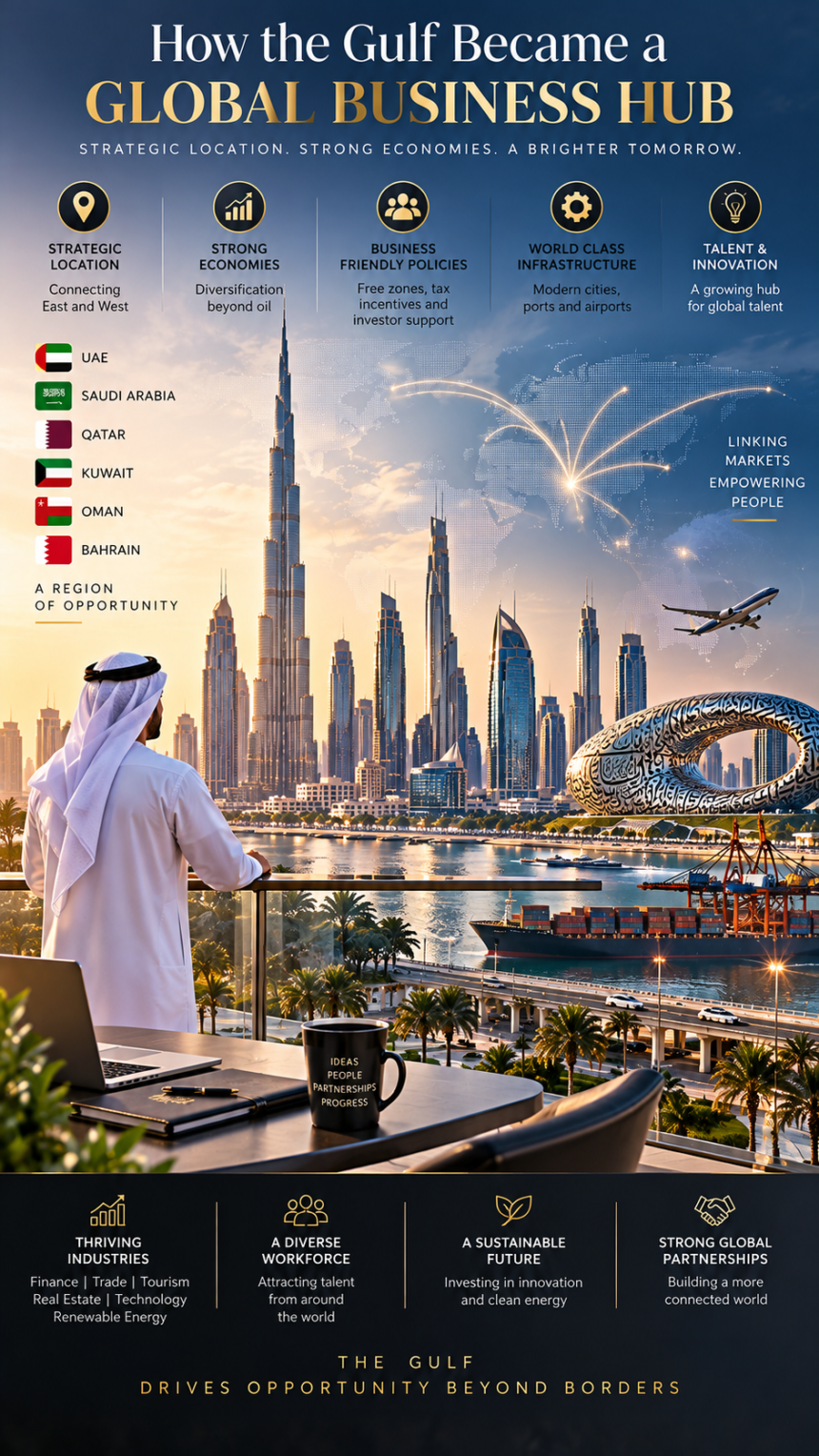
How the Gulf Business Economy Changed
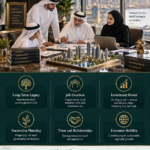
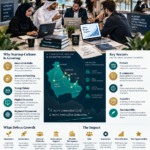
The Gulf Business Hub that international companies recognise today was built through several decades of investment, economic reform and global connectivity. The UAE, Saudi Arabia, Qatar, Bahrain, Oman and Kuwait have moved far beyond an economic model based mainly on exporting energy. Their cities now host international banks, technology companies, airlines, logistics operators, manufacturers, professional service firms, investors and regional headquarters serving markets far beyond the Arabian Peninsula.
- Gulf Business Hub: From Regional Trade to Global Commerce
- How the Gulf Business Economy Changed
- 1. Strategic Location Between Three Continents
- 2. Energy Wealth Financed Modern Development
- 3. World-Class Infrastructure Changed Connectivity
- 4. Free Zones Opened the Gulf to Global Business
- 5. Foreign Ownership Rules Became More Flexible
- 6. Competitive Tax Systems Attracted Companies
- 7. Gulf Financial Centres Became International
- 8. Aviation and Logistics Connected Global Markets
- 9. International Talent Built Diverse Workforces
- 10. Technology Created a New Digital Economy
- 11. Economic Diversification Opened New Industries
- 12. GCC Integration Strengthened Regional Scale
- The UAE as a Global Business Hub
- Saudi Arabia and the Rise of Riyadh
- Qatar as an Investment and Innovation Hub
- Bahrain as a Financial and Regional Gateway
- Oman as a Logistics and Industrial Hub
- Kuwait as a Capital and Investment Market
- Key Industries Driving the Gulf Business Hub
- The Role of Sovereign Wealth Funds
- Why International Companies Choose the Gulf
- Challenges Facing the GCC Business Model
- What Comes Next for the Gulf Economy
- Gulf Market Entry Checklist
- Final Thoughts on the Gulf Business Hub
The size of the transformation is significant. The GCC Secretariat reported that the combined GDP of the six member states reached approximately $2.3 trillion in 2024, placing the bloc ninth globally by economic size. Foreign trade reached around $1.5 trillion, while intra-GCC trade exceeded $145 billion.
More importantly, the economic structure itself has changed. The GCC Secretariat reported in late 2025 that non-oil sectors accounted for more than 76% of combined GCC GDP, reflecting decades of investment in finance, real estate, logistics, tourism, manufacturing and services. The region’s financial strength is also considerable, with GCC sovereign wealth funds estimated to hold approximately $4.8 trillion in assets.
The Gulf therefore did not become an international business centre because of one policy or one city. Its rise came from combining geography, capital, infrastructure, international talent and increasingly open investment systems.
Gulf Business Hub: From Regional Trade to Global Commerce
Trade existed in the Gulf long before the modern energy era. Ports connected merchants with India, East Africa, Persia and other parts of the Middle East, while communities built commercial networks around shipping, pearls, spices, textiles and regional trade.
The discovery and development of large oil and gas resources changed the economic scale dramatically. Energy exports created capital that governments could invest into roads, electricity, ports, airports, education, healthcare and modern cities.
The next transformation was even more important for today’s business environment. Gulf states began using energy wealth to create economies capable of attracting companies that had little or nothing to do with hydrocarbons.
The development can be viewed in four broad stages:
| Stage | Main Economic Development |
|---|---|
| Traditional Gulf economy | Maritime trade, fishing, pearling and regional commerce |
| Energy expansion | Oil and gas transformed government revenues |
| Infrastructure development | Cities, roads, ports, airports and utilities expanded |
| Diversified global economy | Finance, tourism, technology, logistics and manufacturing grew |
Modern Gulf business strategy increasingly focuses on the fourth stage. Governments want the region to remain commercially important even as the global energy system changes.
How the Gulf Business Economy Changed
One of the most important changes has been the shift from simply exporting resources to becoming a platform through which international business operates.
Dubai became a regional centre for trade, aviation and professional services. Abu Dhabi built major investment and financial institutions. Riyadh is developing into a headquarters and investment centre, while Doha has expanded its presence in aviation, finance and technology.
Bahrain developed a strong financial-services ecosystem, Oman invested in industrial and logistics hubs including Sohar, Salalah and Duqm, and Kuwait built considerable financial and investment capacity around its established merchant economy.
These cities compete with one another, but they also strengthen the Gulf as a whole. A multinational can now locate different functions in different GCC countries depending on where the strongest commercial advantage exists.
1. Strategic Location Between Three Continents
Geography is one of the Gulf’s oldest advantages.
The region sits between Asia, Europe and Africa, positioning Gulf cities near some of the world’s largest consumer, manufacturing and financial markets. This makes the GCC particularly valuable for companies managing international trade, aviation, logistics and regional headquarters.
The UAE Government notes that approximately one-third of the world’s population can reach the UAE within four hours by air and around two-thirds within eight hours.
This reach allows companies based in the Gulf to manage operations across several time zones from one regional office. An executive team in Dubai or Riyadh can communicate with Europe in the morning and South or East Asia later in the day.
Oman adds another geographic advantage because its Arabian Sea coastline gives ports direct access to major international maritime routes. Invest Oman highlights the country’s proximity to Asian, African and European markets as an important advantage for distribution and exports.
Geography alone does not create a business hub, but the Gulf successfully combined geography with infrastructure.
2. Energy Wealth Financed Modern Development
Oil and gas provided the financial foundation for much of the region’s transformation.
Instead of leaving energy income entirely inside traditional government budgets, Gulf countries invested substantial amounts into infrastructure, financial assets, companies and international investment portfolios.
The result is visible throughout the region. Modern airports, ports, highways, financial districts, universities and industrial areas were developed within a relatively short historical period.
Energy also created another advantage: financial resilience.
The GCC Secretariat estimated that the region’s sovereign wealth funds collectively managed approximately $4.8 trillion in assets, representing more than 32% of assets held by the world’s 100 largest sovereign funds.
These resources allow Gulf governments and investment institutions to participate directly in global finance while continuing to invest domestically in economic transformation.
The next challenge is using the wealth created by hydrocarbons to develop industries capable of generating long-term value independently of oil prices.
3. World-Class Infrastructure Changed Connectivity
International businesses need reliable physical infrastructure before they can establish serious regional operations.
The GCC invested heavily in:
- International airports
- Container ports
- Highways
- Industrial zones
- Telecommunications
- Financial districts
- Power and utilities
- Digital infrastructure
The UAE provides one of the clearest examples. Official government investment guidance describes the country as a major global logistics platform supported by advanced airports, ports, airlines and shipping companies.
Its industrial infrastructure includes multiple civilian airports, cargo operators and commercial seaports capable of handling significant international trade.
Saudi Arabia, Qatar and Oman are investing heavily in similar capabilities, while Bahrain’s compact geography allows companies to connect its airport, seaport and the King Fahd Causeway to Saudi Arabia relatively quickly. Bahrain EDB currently promotes this connectivity as one of its main advantages for regional operations.
Good infrastructure reduces the friction of doing business, which can matter as much as headline tax rates.
4. Free Zones Opened the Gulf to Global Business
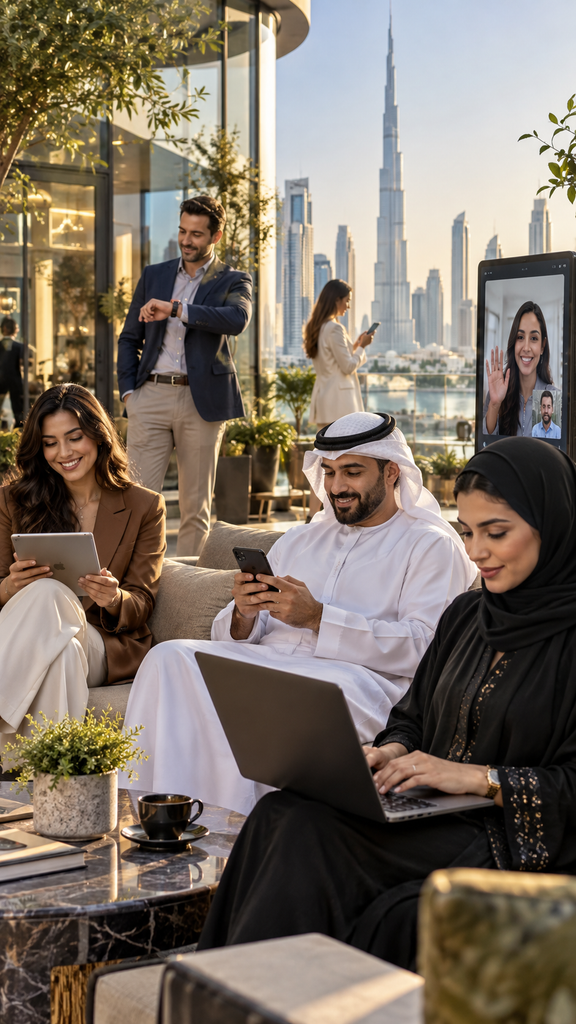
Free zones were one of the most influential innovations in the Gulf’s economic development.
These areas allowed governments to create specialised business environments with simplified licensing, foreign ownership and infrastructure designed around specific industries.
The UAE developed the most extensive free-zone ecosystem in the region, with specialised zones focusing on areas such as finance, commodities, media, technology, healthcare, aviation and logistics.
Free zones also became important re-export centres. Current UAE government guidance explains that companies can import goods into free zones without ordinary customs duties when goods remain in the zone or are later re-exported, making these areas valuable global distribution centres.
Oman has followed a similar strategy around locations such as Sohar, Salalah and Duqm. Its investment framework offers benefits that can include full foreign ownership, customs advantages and long-term tax incentives depending on the zone and activity.
The broader lesson is that the Gulf did not wait for companies to fit into existing systems. It built dedicated ecosystems around the types of businesses it wanted to attract.
5. Foreign Ownership Rules Became More Flexible
Foreign ownership was once one of the biggest barriers to expanding directly into Gulf economies.
Historically, international businesses often needed local shareholders to own significant parts of their companies.
That environment has changed substantially.
The UAE now allows complete foreign ownership across many mainland business activities in addition to its long-established free-zone model. Official UAE investment guidance identifies full foreign ownership as one of the country’s main investment advantages.
Oman has also liberalised its foreign investment framework. Invest Oman highlights the Foreign Capital Investment Law as an important reform enabling 100% foreign ownership and supporting international investors.
Bahrain permits full foreign ownership in most sectors, while Kuwait’s KDIPA framework allows qualifying international investors to establish businesses with up to 100% foreign equity.
These changes make it easier for multinational companies to integrate Gulf subsidiaries into their global corporate structures.
6. Competitive Tax Systems Attracted Companies
Tax policy has also helped make Gulf markets attractive.
The six GCC states do not have identical tax systems, but several offer comparatively competitive business taxation, particularly when viewed alongside infrastructure and regional market access.
The UAE generally applies 9% Corporate Tax above the applicable taxable-income threshold, while qualifying free-zone companies can receive special treatment on qualifying income.
Qatar generally applies a 10% corporate income tax regime, while Bahrain still does not impose a broad general corporate income tax on most ordinary domestic businesses in 2026, although separate rules apply to specified sectors and large multinational groups.
Oman applies a standard corporate income tax rate but provides incentives through qualifying economic zones. Kuwait and Saudi Arabia use different tax frameworks depending partly on foreign ownership, activities and investor status.
International companies therefore compare more than the headline tax percentage. They examine withholding tax, VAT, transfer pricing, incentives, customs, staff costs and the ability to move profits internationally.
The Gulf’s broader attraction is the combination of competitive taxation with sophisticated infrastructure and access to rapidly expanding markets.
7. Gulf Financial Centres Became International
Business hubs need capital.
The GCC developed financial centres capable of connecting regional wealth with international banking, asset management, insurance and investment markets.
Dubai International Financial Centre and Abu Dhabi Global Market have helped establish the UAE as a regional financial centre. Bahrain has a long history in Gulf banking and continues to promote financial services and fintech as core economic sectors.
Riyadh is now strengthening its own financial position as more institutions establish operations in Saudi Arabia. In August 2026, BNP Paribas received registration for a regional headquarters in the Kingdom, joining more than 750 companies participating in Saudi Arabia’s Regional Headquarters programme.
The wider GCC financial system is substantial. The GCC Secretariat reported market value exceeding $4.2 trillion across the region’s financial sector, alongside approximately $3.5 trillion in banking assets.
This pool of capital gives companies access to banks, investors, sovereign funds, family offices and increasingly sophisticated capital markets.
8. Aviation and Logistics Connected Global Markets
The Gulf’s rise cannot be separated from aviation.
International airlines turned Dubai, Doha and Abu Dhabi into major transit points between continents. Airports that initially served relatively small domestic populations became global gateways connecting passengers across Europe, Asia, Africa and the Americas.
The same model supports business.
Regional headquarters become more practical when executives can reach dozens of important markets directly. Tourism expands when visitors have easy international access, while air cargo supports pharmaceuticals, electronics, e-commerce and high-value trade.
Seaports play an equally important role.
The UAE has developed large-scale port and re-export operations, Oman has positioned Sohar, Salalah and Duqm around international shipping routes, and Bahrain uses its close proximity to Saudi Arabia to provide combined road, sea and air access.
This connectivity changed the Gulf from an economic destination into a global transfer point for people, goods and capital.
9. International Talent Built Diverse Workforces
Global companies need international talent.
Gulf economies responded by developing immigration and residency systems capable of supporting very large expatriate workforces.
Major GCC business cities now bring together professionals from Europe, South Asia, East Asia, Africa, North America and the wider Middle East.
This creates a multilingual and multicultural environment where a company can recruit employees familiar with many different customer markets.
The UAE explicitly identifies its ability to attract international talent, entrepreneurs and innovators as one of the foundations of its economic strategy.
Other Gulf countries are increasingly adopting similar policies, particularly for investors, technology specialists, entrepreneurs and senior executives.
The competition for talent is likely to intensify because future industries such as AI, advanced manufacturing, biotech and financial technology require specialist skills that cannot always be developed domestically at the speed governments want.
10. Technology Created a New Digital Economy
The latest stage in the Gulf’s business transformation is technological.
Governments are investing heavily in artificial intelligence, cloud computing, cybersecurity, fintech, smart cities, digital government and data infrastructure.
The UAE Digital Economy Strategy aims to double the digital economy’s contribution to national GDP from 9.7% when the strategy was launched to 19.4% within ten years.
Qatar is also actively targeting technology companies. Its $1 billion investment incentives programme includes dedicated support for technology activities such as AI, cloud computing, cybersecurity and data-driven innovation.
Technology is especially important because it changes the type of foreign investment the Gulf attracts. The objective is no longer simply to host sales offices for international companies.
Governments increasingly want:
- Research and development
- Regional technology centres
- Data infrastructure
- High-skilled employment
- Intellectual property
- Startup ecosystems
This moves the Gulf further into knowledge-based economic activity.
11. Economic Diversification Opened New Industries
Diversification may be the single most important reason the Gulf continues attracting international business.
Governments are deliberately creating new markets through national strategies and large investment programmes.
Saudi Arabia is investing heavily in tourism, entertainment, logistics, manufacturing, healthcare and technology. The UAE continues expanding digital industries, finance, manufacturing and advanced technology, while Qatar’s current investment incentives target advanced industries, logistics, digital technology and financial services.
Oman is developing industrial, tourism, logistics, mining and renewable-energy opportunities. Its Ministry of Commerce reported in June 2026 that foreign direct investment had reached approximately OMR 31 billion, with industrial investment playing a larger role in diversification.
These transformations create opportunities far beyond the headline sectors.
A new tourism destination creates business for hospitality operators, technology providers, construction companies, food suppliers and marketing agencies. A manufacturing strategy creates demand for logistics, insurance, finance, machinery and training.
Diversification therefore creates an entire ecosystem of secondary business opportunities.
12. GCC Integration Strengthened Regional Scale
The six GCC states are individual countries, but economic integration strengthens their collective attractiveness.
The region already operates through a Customs Union and Gulf Common Market framework, while governments continue working toward easier cross-border trade, investment and movement of services.
Intra-GCC trade exceeded $145 billion in 2024, representing growth of approximately 9.8% from the previous year.
The combined regional scale matters to international companies.
A multinational might establish its headquarters in the UAE, maintain a major operating subsidiary in Saudi Arabia, serve specialist clients from Qatar or Bahrain and use Oman for industrial or logistics operations.
This multi-country model allows companies to select the strongest location for each function while still operating within a geographically compact region.
Further GCC integration could make this model even more attractive.
The UAE as a Global Business Hub
The UAE provides perhaps the clearest example of how a Gulf country deliberately transformed itself into an international commercial centre.
Dubai’s development combined aviation, free zones, real estate, tourism, financial services and international trade. Abu Dhabi added sovereign capital, energy, manufacturing, finance and advanced technology.
Foreign investment data reflects the country’s global appeal. UAE Government figures show FDI inflows reached approximately $45.6 billion in 2024, an increase of 48.7% from 2023.
The country’s business model includes several major advantages:
| UAE Advantage | Business Impact |
|---|---|
| Strategic location | Regional management between Asia, Europe and Africa |
| International airports | Global executive and cargo connectivity |
| Free zones | Specialised business ecosystems |
| Foreign ownership | Full ownership available across many activities |
| Financial centres | Access to banks, funds and investors |
| International workforce | Deep multicultural talent pool |
| Logistics infrastructure | Strong trading and re-export capacity |
| Digital strategy | Growing technology and AI ecosystem |
Dubai’s D33 Economic Agenda aims to double the size of the emirate’s economy over a decade and strengthen its position among the world’s leading global cities.
The UAE is therefore still actively building on the business-hub model rather than treating its current position as complete.
Saudi Arabia and the Rise of Riyadh
Saudi Arabia brings a different advantage to the Gulf business landscape: enormous domestic scale.
The Kingdom represents the region’s largest individual economy and consumer market, while major government investment programmes are creating opportunities across construction, tourism, technology, finance and manufacturing.
Riyadh is increasingly becoming a centre for regional executive decision-making.
Saudi Arabia’s Regional Headquarters programme was launched to encourage multinational companies to place strategic management functions inside the Kingdom. By August 2026, more than 750 companies had joined the programme, already well above the original target of 500 companies by 2030.
This represents an important shift.
International companies are moving from serving Saudi Arabia remotely to placing management teams directly inside the market.
The growth of Riyadh therefore strengthens the GCC as a whole because the region increasingly contains more than one major headquarters city.
Qatar as an Investment and Innovation Hub
Qatar used its energy wealth to build infrastructure, aviation, financial capacity and international investment portfolios, but its current strategy increasingly focuses on advanced non-energy sectors.
Invest Qatar launched a $1 billion incentives programme in 2025 aimed at both foreign and domestic investment. The programme can support up to 40% of eligible local investment expenses over five years for qualifying projects.
Priority sectors include advanced manufacturing, logistics, technology and financial services.
The country attracted approximately $2.74 billion in FDI through 241 projects in 2024, according to Invest Qatar, with those projects associated with more than 9,000 jobs.
Doha therefore increasingly competes not only as an energy capital but also as a location for technology, investment and specialist regional operations.
Bahrain as a Financial and Regional Gateway
Bahrain developed one of the Gulf’s earliest modern financial sectors and continues using banking, fintech and its geographic proximity to Saudi Arabia as core advantages.
The country allows 100% foreign ownership in most sectors and promotes relatively competitive operating costs. Its location provides direct road access to Saudi Arabia through the King Fahd Causeway.
Bahrain’s smaller size can be an advantage for certain companies because the business ecosystem is compact and the regulatory environment can be easier to navigate than in larger markets.
Its investment strategy concentrates particularly on:
- Financial services
- ICT
- Manufacturing
- Logistics
- Tourism
Bahrain’s Gateway Gulf 2025 investment forum produced announcements, partnerships and deals valued at more than $17 billion, demonstrating continued international investor interest in the market.
For companies seeking access to Saudi Arabia while maintaining operations in a smaller financial and professional-services hub, Bahrain can be strategically attractive.
Oman as a Logistics and Industrial Hub
Oman has built a business proposition around geography, ports and long-term industrial development.
Its location outside the Strait of Hormuz on the Arabian Sea provides direct access to international shipping routes, while ports and economic zones in Sohar, Salalah and Duqm support manufacturing, logistics and trade.
Foreign investment rules have also become more flexible. Invest Oman identifies 100% foreign ownership as a major investor incentive, while qualifying projects can access tax, customs and residency benefits.
FDI reached approximately OMR 31 billion according to Oman’s Ministry of Commerce in June 2026, while 44 major investment projects were under implementation through Invest Oman at the time.
The country may not have the same headquarters concentration as Dubai or Riyadh, but it can offer stronger advantages for companies whose business depends on ports, land, manufacturing or industrial infrastructure.
Kuwait as a Capital and Investment Market
Kuwait combines substantial financial wealth with an established merchant economy and high consumer purchasing power.
The market remains particularly important in financial services, energy, consumer businesses, infrastructure and government-linked projects.
Its foreign investment framework includes a specific route through the Kuwait Direct Investment Promotion Authority. KDIPA states that international investors can establish qualifying businesses with up to 100% foreign equity under Law No. 116 of 2013.
Kuwait also benefits from strong sovereign financial capacity, which supports its position as an important capital market within the Gulf.
The opportunity for the coming years lies in converting more of that financial strength into private-sector diversification, technology investment and new industries.
Key Industries Driving the Gulf Business Hub
The Gulf business story is increasingly about industries beyond traditional energy.
| Industry | Major GCC Opportunity |
|---|---|
| Financial services | Wealth management, banking, fintech |
| Technology | AI, cloud, cybersecurity, data centres |
| Logistics | Global shipping, ports and regional distribution |
| Tourism | Hotels, attractions, aviation and entertainment |
| Manufacturing | Local production and advanced industries |
| Healthcare | Hospitals, health technology and pharmaceuticals |
| Renewable energy | Solar, hydrogen and clean technology |
| Real estate | Commercial, residential and tourism development |
| Professional services | Legal, consulting, accounting and recruitment |
| E-commerce | Digital retail and fulfilment |
| Education | Universities, training and digital learning |
| Creative industries | Media, gaming, content and entertainment |
Energy still matters enormously, but increasingly it provides capital and competitive advantages for a wider economic system rather than defining the entire economy.
That distinction is one of the most important changes in the Gulf’s modern business history.
The Role of Sovereign Wealth Funds
Few regions possess as much sovereign investment capital as the GCC.
Gulf sovereign funds invest globally in listed companies, infrastructure, property, technology, private equity and strategic industries.
Their estimated combined assets of approximately $4.8 trillion give the region substantial influence in global capital markets.
Sovereign capital also supports domestic transformation.
Funds can invest in new sectors that might require many years to become profitable, helping develop tourism destinations, technology ecosystems, industrial projects and infrastructure.
Their international investments create another important benefit: connections.
When Gulf funds invest in global companies, those relationships can later support partnerships, technology transfer and business expansion into GCC markets.
Capital therefore acts as both an investment tool and a bridge connecting Gulf economies with global corporations.
Why International Companies Choose the Gulf
Companies usually enter the GCC because several advantages combine in one location.
An international company may value Dubai’s global connectivity, Saudi Arabia’s market size, Qatar’s investment incentives, Bahrain’s financial ecosystem, Oman’s logistics position or Kuwait’s purchasing power.
The most common motivations include:
- Access to wealthy regional markets and government investment.
- Regional headquarters opportunities.
- Strong transport and logistics infrastructure.
- Full foreign ownership across many business activities.
- Competitive business taxation.
- Access to international and regional talent.
- Government support for priority sectors.
- Growing technology and digital economies.
- Strong banking and investment ecosystems.
- The ability to expand into multiple GCC markets from one regional base.
These advantages explain why the Gulf is increasingly treated as a strategic region rather than simply an export market.
Multinationals are moving more management, investment and operational responsibility into GCC cities.
Challenges Facing the GCC Business Model
The Gulf’s transformation has been impressive, but important challenges remain.
Economic diversification still needs to deepen. Hydrocarbon revenues continue to play a major role in several government budgets, meaning energy-price changes can still affect wider economic activity.
Competition between Gulf cities is also increasing. Dubai, Riyadh, Doha, Manama and Muscat all want investment and talent, which can create duplication in certain sectors.
Other challenges include:
| Challenge | Why It Matters |
|---|---|
| Talent competition | Advanced sectors need specialist workers |
| Business costs | Prime Gulf hubs can be expensive |
| Regulatory differences | Each GCC country has separate laws |
| Localisation policies | Companies need to develop national talent |
| Regional tensions | Trade and transport can face disruption |
| Water and climate | Sustainability affects long-term growth |
| Global competition | Other business hubs are also improving |
| Economic concentration | Some markets still depend heavily on state spending |
The next stage of Gulf development will therefore depend less on simply building infrastructure and more on productivity, education, innovation and private-sector competitiveness.
What Comes Next for the Gulf Economy
The next phase of the Gulf Business Hub is likely to be defined by technology and capital rather than only physical infrastructure.
Artificial intelligence is becoming a central investment theme. Data centres, cloud computing, semiconductors, robotics and cybersecurity are attracting increasing attention from governments and private investors.
Advanced manufacturing is another major opportunity as Gulf countries attempt to produce more goods domestically rather than relying almost entirely on imports.
Renewable energy and green industries will also become more significant. The region has substantial solar resources and is investing in technologies including hydrogen and low-carbon industrial production.
At the same time, competition between cities will intensify.
Dubai will continue defending its position as an international commercial platform, Riyadh will attract more regional decision-makers, Doha will compete through investment incentives and specialised sectors, while Oman and Bahrain will emphasise logistics, industry and cost competitiveness.
This competition can strengthen the wider GCC because each market is being pushed to improve.
Gulf Market Entry Checklist
Companies considering GCC expansion should evaluate the region strategically rather than simply choosing the city with the most familiar name.
- Identify where the largest customers are located.
- Compare UAE, Saudi Arabia, Qatar, Bahrain, Oman and Kuwait separately.
- Determine whether a regional headquarters is required.
- Check foreign ownership rules for the exact activity.
- Compare mainland, free-zone and economic-zone structures.
- Review Corporate Tax, VAT, withholding tax and customs.
- Compare staffing and localisation requirements.
- Calculate realistic office and operating costs.
- Review executive residency options.
- Examine international flight connectivity.
- Check port and logistics access if trading goods.
- Analyse government procurement opportunities.
- Identify investment incentives.
- Review banking and financing availability.
- Consider where future GCC expansion will occur.
- Develop a three-to-five-year regional strategy rather than choosing only for first-year setup cost.
The best Gulf location is the one that supports the company’s customers, talent and long-term operating model.
Final Thoughts on the Gulf Business Hub
The rise of the Gulf Business Hub is one of the most significant economic transformations of the modern Middle East.
The region used energy wealth to finance infrastructure, but infrastructure alone did not create a global business centre. Governments then opened economies to international investment, developed free zones, expanded aviation, modernised commercial laws and invested heavily in new industries.
The results are increasingly visible in the numbers. The GCC’s combined GDP reached approximately $2.3 trillion in 2024, while foreign trade was around $1.5 trillion and intra-regional trade exceeded $145 billion.
The UAE has become one of the world’s major FDI destinations, receiving approximately $45.6 billion of foreign investment in 2024. Saudi Arabia has attracted more than 750 companies into its Regional Headquarters programme as Riyadh develops into a major executive and financial centre.
Qatar is using investment incentives worth $1 billion to attract companies in technology, logistics, finance and advanced manufacturing, while Oman reported foreign investment of approximately OMR 31 billion as it develops industrial and logistics opportunities.
Bahrain continues positioning itself as a financially competitive gateway to Saudi Arabia and the wider region, while Kuwait provides significant investment opportunities supported by capital strength and a foreign-investment framework that can allow up to 100% international ownership for qualifying projects.
The next stage will be harder than the first.
Building airports, towers and financial districts can be achieved through capital and construction. Building globally competitive technology companies, research institutions, advanced industries and innovative private businesses requires talent, education and entrepreneurship over much longer periods.
That is the challenge the Gulf is now attempting to solve.
If the region can combine its existing strengths in capital, geography, infrastructure and global connectivity with stronger innovation, productivity and private-sector development, the Gulf’s role in international business could continue expanding far beyond the energy economy that originally financed its transformation.
The Gulf did not become a global business hub by accident. It was built deliberately, through decades of investment and economic strategy, and that transformation is still continuing.
Do follow us on Instagram
Read More – GCC Family Businesses: 12 Powerful Drivers of Successful Growth