How Gulf Cities Become Global Business Hubs
Introduction
Over the past few decades, Gulf cities have become important centres for international business, trade, finance, tourism, and technology. Cities such as Dubai, Abu Dhabi, Riyadh, Doha, Manama, Kuwait City, and Muscat now connect companies, investors, entrepreneurs, and customers from many parts of the world.
- Introduction
- 1. From Traditional Trade to Modern Business Centres
- 2. Strategic Location Between Asia, Europe and Africa
- 3. Modern Ports, Airports and Transport Networks
- 4. Business-Friendly Policies and Special Economic Zones
- 5. Foreign Investment and International Companies
- 6. Economic Diversification Beyond Oil
- 7. Banking, Finance and Professional Services
- 8. Technology, Innovation and Startup Growth
- 9. Why Major Gulf Cities Attract Different Types of Business
- 10. Positive Side: Seven Benefits of Gulf Business Hubs
- 11. Negative Side: Five Major Challenges Gulf Cities Face
- 12. The Future of Gulf Cities as International Business Hubs
- Conclusion
- Frequently Asked Questions (FAQs)
The Gulf region was once best known for pearl diving, fishing, traditional markets, and maritime trade. The discovery and growth of the oil industry brought major economic changes. Oil and natural gas revenues helped governments invest in roads, ports, airports, hospitals, schools, and modern business districts. These developments created the foundations for larger and more connected economies.
However, oil alone does not explain why Gulf cities became international business hubs. Their strategic location between Asia, Europe, and Africa, modern transport systems, investment policies, growing service industries, and international workforce have also played important roles.
Today, Gulf cities are attracting businesses in banking, logistics, tourism, manufacturing, e-commerce, artificial intelligence, and professional services. The region is also working to reduce its dependence on oil by developing new sources of economic growth.
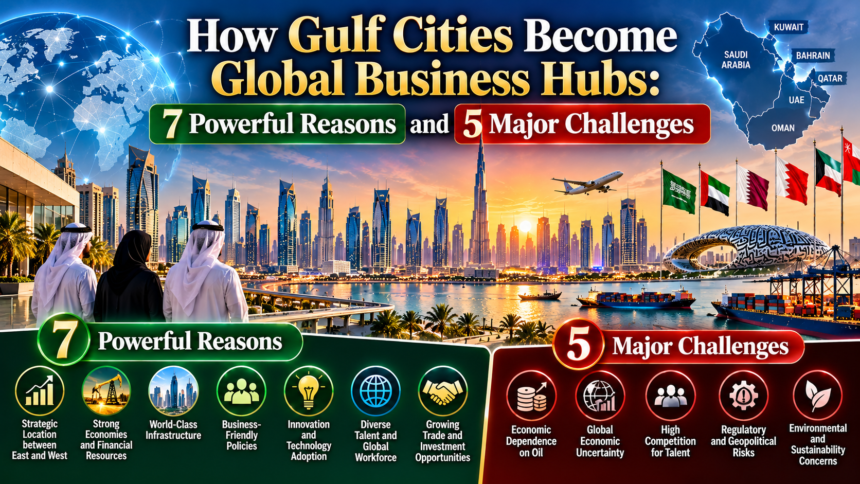
This article explores seven powerful reasons Gulf cities became international business hubs, the role of different GCC countries, the benefits of this transformation, and five major challenges that could affect their future growth.
1. From Traditional Trade to Modern Business Centres
The history of Gulf business began long before modern skyscrapers and international airports appeared.
For centuries, coastal settlements across the Gulf were connected to fishing, pearl diving, boatbuilding, and maritime trade. Merchants moved goods between the Arabian Peninsula, India, East Africa, Persia, and other trading regions. Traditional markets, known as souks, provided places where traders sold products, exchanged information, and developed business relationships.
These commercial connections helped many Gulf communities develop strong trading traditions. Family businesses and merchant networks became important parts of local economies.
The discovery and expansion of oil production during the twentieth century brought a new period of development. Governments invested in infrastructure and public services, while growing populations created demand for housing, transport, shops, construction, and professional services.
Over time, businesses began to serve markets beyond their own cities. International companies opened offices, traders expanded their operations, and investment increased across different industries.
The main transformation was not simply the construction of modern buildings. Gulf cities developed the transport links, financial services, public infrastructure, and commercial networks needed to support international business.
Traditional Trade Foundations
- Pearling industry: Served as the primary economic backbone for coastal communities before the 20th century.
- Maritime trade: Utilized wooden dhows to connect the Arabian Peninsula with India, East Africa, and Iraq.
- Oasis agriculture: Supported inland communities through date cultivation and seasonal camel herding.
- Barter economy: Relied heavily on the exchange of basic commodities like fish, dates, and textiles.
- Souq networks: Acted as the central physical marketplaces for social gathering and localized commerce.
- Seasonal migration: Dictated lifestyle patterns, shifting communities between coastlines and inland areas.
2. Strategic Location Between Asia, Europe and Africa
One of the biggest advantages of Gulf cities is their geographical location. The region sits near important air and sea routes connecting major markets in Asia, Europe, and Africa.
This position makes several Gulf cities useful locations for companies that need to manage international shipments, distribute products, travel frequently, or coordinate operations across different countries.
For example, a company can use a Gulf-based office to oversee sales in several Middle Eastern markets while maintaining connections with suppliers in Asia and customers in Europe or Africa.
Saudi Arabia’s Vision 2030 identifies the country’s position connecting three continents as an important economic advantage. The strategy aims to use this location to strengthen trade, investment, exports, and logistics.
The Gulf’s location can benefit businesses in several ways:
- Access to important international shipping routes.
- Convenient connections to regional and global markets.
- Opportunities to distribute goods across neighbouring countries.
- Business travel through international airports.
- Access to a wide range of suppliers and customers.
- Opportunities to develop regional headquarters and distribution centres.
However, location alone does not make a city successful. Efficient customs procedures, reliable transport, good infrastructure, skilled workers, and suitable regulations are also necessary.
3. Modern Ports, Airports and Transport Networks
International business depends on the movement of people, products, information, and money. Gulf cities have invested heavily in the infrastructure required to support these activities.
Dubai’s Jebel Ali Port and airport network have helped establish the emirate as a major centre for trade, distribution, aviation, and logistics. Doha’s international airport supports passenger travel and air cargo, while Saudi Arabia is developing its transport and logistics networks as part of its broader economic plans.
Oman also has an important role in maritime trade. Its ports, including Sohar, Salalah, and Duqm, support shipping, cargo handling, industrial activity, and connections with international markets. According to Oman’s Ministry of Foreign Affairs, maritime ports accounted for approximately OMR 16.5 billion, or 77% of the country’s total import and export trade in 2024. The figures underline the importance of ports to Oman’s economy.
Modern transport infrastructure helps businesses by:
- Moving goods between suppliers and customers.
- Reducing unnecessary delays in supply chains.
- Supporting international travel and business meetings.
- Connecting industrial areas with ports and airports.
- Creating employment in transport and logistics.
- Encouraging companies to establish regional distribution centres.
These investments also support smaller businesses, which depend on transport companies, warehouses, delivery services, and reliable suppliers.
Nevertheless, infrastructure requires continuous investment and maintenance. Traffic congestion, shipping disruption, higher transport costs, and changes in international trade can affect business performance.
4. Business-Friendly Policies and Special Economic Zones
Another reason Gulf cities attract international companies is the development of business zones and investment policies designed to support commercial activity.
The UAE has created specialised free zones for industries such as finance, logistics, technology, healthcare, media, and manufacturing. These zones can provide business registration services, offices, warehouses, and access to specialised facilities.
Dubai offers several well-known examples, including the Jebel Ali Free Zone, Dubai International Financial Centre, and Dubai Airport Free Zone.
According to the UAE government, free zones can offer integrated services for company registration, licensing, visas, business premises, and customs-related activities. The benefits and rules vary by zone and business activity.
Qatar has developed different platforms to support international businesses. The Qatar Financial Centre provides a business and financial services environment for local and international firms. Its activities include financial services, legal and professional services, and digital technology.
Such business zones can make it easier for companies to establish operations and connect with customers. However, choosing the right location requires research. Companies must understand licensing rules, ownership requirements, taxes, office costs, and whether they need additional permission to trade in a local market.
A business zone is useful only when its benefits match the company’s actual needs.
United Arab Emirates (Dubai & Abu Dhabi)
- 100% Foreign Ownership: Permits full expatriate ownership of companies within free zones without requiring a local Emirati sponsor.
- 0% Corporate and Income Tax: Offers long-term tax exemptions (often guaranteed for 15–50 years) for free zone entities.
- Full Capital Repatriation: Allows companies to transfer 100% of profits and capital back to their home countries freely.
Saudi Arabia (Riyadh & Coastal SEZs)
- Regional Headquarters (RHQ) Program: Mandates that multinational companies establish their Middle East headquarters in Riyadh to secure government contracts.
- Cloud Computing SEZ: Provides a specialized regulatory sandbox in Riyadh optimized for global data centers and tech infrastructure.
- Tax Incentives: Grants a 5% corporate income tax rate for up to 20 years within specific newly launched SEZs.
Qatar (Doha)
- Qatar Financial Centre (QFC): Provides its own legal, regulatory, and tax platform allowing 100% foreign ownership.
- Ras Bufontas SEZ: Positioned adjacent to Hamad International Airport, specializing in air freight, clean tech, and light manufacturing.
- Zero Customs Duties: Waives import duties on machinery, equipment, and spare parts utilized within the economic zones.
Oman & Bahrain
- Salalah Free Zone (Oman): Offers strategic access to Indian Ocean shipping lanes with low corporate tax thresholds.
- Duqm Special Economic Zone (Oman): Functions as a massive multi-sector hub featuring refinery, logistical, and residential sub-zones.
- Bahrain Logistics Zone (BLZ): Operates a dedicated customs-free logistics area with multi-modal transport links across the Gulf.
5. Foreign Investment and International Companies
Foreign investment has helped Gulf cities develop into major business centres. International companies bring capital, technology, expertise, management skills, and connections with overseas markets.
They may establish regional offices, factories, warehouses, research facilities, hotels, financial operations, or technology centres. Their presence can also create opportunities for local suppliers and service providers.
Recent investment figures show the scale of this activity. In its Gulf Cooperation Council Investment Report, published in October 2026, UN Trade and Development reported that foreign direct investment flowing into GCC countries rose by 18% to approximately US$99 billion in 2025. The United Arab Emirates received around US$48 billion, while Saudi Arabia accounted for much of the regional increase. These figures refer to investment flows and should not be confused with every announced business project being completed.
Foreign investment can support economic development in several ways:
- Creating jobs in different industries.
- Introducing new technology and working methods.
- Expanding manufacturing and service activities.
- Supporting local companies through supply contracts.
- Increasing demand for professional services.
- Connecting regional businesses to international markets.
However, countries compete to attract investment. Businesses compare costs, regulations, market size, infrastructure, available skills, and future growth opportunities before deciding where to operate.
To attract long-term investment, Gulf cities need clear regulations, efficient public services, skilled employees, and a business environment that rewards productive activity.
6. Economic Diversification Beyond Oil
Oil and natural gas remain important to many GCC economies, but governments are working to develop other industries that can provide long-term economic growth.
This process is called economic diversification. It involves increasing the contribution of industries such as tourism, finance, technology, logistics, manufacturing, healthcare, education, and renewable energy.
Dubai is a strong example of a city that has expanded into international trade, tourism, aviation, finance, and professional services. Saudi Arabia is promoting tourism, entertainment, manufacturing, technology, and logistics under Vision 2030. Qatar is developing business and financial services alongside its energy industry.
Bahrain has a long-established financial services sector, while Oman is investing in ports, manufacturing, tourism, and logistics. Kuwait is also working to expand business activity beyond its traditional dependence on oil.
Economic diversification matters because it can:
- Create a wider range of employment opportunities.
- Support entrepreneurship and small businesses.
- Attract investors from different industries.
- Reduce dependence on a limited number of income sources.
- Encourage innovation and skills development.
- Make economies more adaptable to market changes.
The process is still ongoing. The World Bank’s December 2025 Gulf Economic Update highlighted progress in diversification and digital transformation but also noted that oil and gas continue to influence government finances and economic planning across the region.
Diversification is therefore not a completed task. It requires continued investment, skilled workers, competitive businesses, and strong links between education and industry.
7. Banking, Finance and Professional Services
International business requires more than offices and transport. Companies also need banks, insurance providers, investment services, legal advice, accounting, consulting, and other forms of professional support.
Gulf cities have developed these services to meet the needs of local and international companies.
Dubai is known for its financial and commercial services, while Manama has a long history as a financial centre in the Gulf. Doha has developed business and financial platforms through institutions such as the Qatar Financial Centre.
These services help companies manage payments, raise capital, assess risks, complete transactions, and meet regulatory requirements. They also support entrepreneurs who need financial advice or assistance establishing and managing a business.
Financial technology is adding another layer of change. Digital payments, online banking, electronic invoicing, and financial management tools can make business transactions easier when the relevant services are available.
Professional services are also important because international businesses often need advice on employment rules, contracts, company structures, taxation, and cross-border operations.
A strong business hub needs reliable financial institutions and professional expertise. Without them, companies may find it harder to grow, manage risks, or work confidently across different markets.
Key Gulf Financial Cities
- Dubai (UAE): The premier financial hub of the Middle East, anchored by the Dubai International Financial Centre (DIFC).
- Riyadh (Saudi Arabia): The fastest-growing hub, powered by Vision 2030, massive sovereign wealth (PIF), and the King Abdullah Financial District (KAFD).
- Abu Dhabi (UAE): A capital-rich powerhouse centered around the Abu Dhabi Global Market (ADGM) and mega sovereign wealth funds like ADIA and Mubadala.
- Doha (Qatar): A specialized hub for Islamic finance, LNG wealth management, and infrastructure investment via the Qatar Financial Centre (QFC).
- Manama (Bahrain): A pioneering offshore banking hub with a highly developed regulatory framework and strong fintech ecosystem.
8. Technology, Innovation and Startup Growth
Technology is changing how companies operate across Gulf cities. Faster internet, cloud computing, digital payments, e-commerce, and artificial intelligence have created new ways to manage work and serve customers.
Businesses can use digital platforms to communicate with customers, monitor inventory, process orders, advertise products, and analyse sales. These tools can help smaller companies reach customers beyond their immediate neighbourhoods.
Gulf governments and businesses are also investing in digital infrastructure and emerging technologies. The World Bank reported in December 2025 that digital transformation and AI adoption were gaining momentum across GCC economies. It also noted that all GCC countries had advanced telecommunications networks, with 5G coverage exceeding 90%.
Potential business areas include:
- Artificial intelligence and automation.
- Financial technology and digital payments.
- E-commerce and online retail.
- Cybersecurity and business software.
- Healthcare and education technology.
- Smart-city systems and data services.
- Renewable energy and climate-related technology.
Startup growth can also help larger companies find innovative products and specialised services.
However, technology businesses need more than new ideas. They need funding, skilled employees, customers, reliable systems, and a business model that can generate sustainable income.
9. Why Major Gulf Cities Attract Different Types of Business
Although Gulf cities share important advantages, each has its own strengths. Businesses should compare their needs with the opportunities available in each location.
Dubai, United Arab Emirates
Dubai has developed a broad international business environment covering trade, logistics, aviation, tourism, finance, real estate, and professional services. Its free zones and international transport connections help companies serve regional and global markets.
The city’s diverse economy has reduced its direct dependence on oil compared with earlier periods. According to the Dubai government, more than 95% of Dubai’s GDP was non-oil-based in 2024.
Abu Dhabi, United Arab Emirates
Abu Dhabi combines the energy industry with investment, finance, manufacturing, advanced technology, and clean-energy initiatives. Its role as the UAE’s capital also supports government-related, professional, and corporate activity.
Riyadh, Saudi Arabia
Riyadh is a major administrative and commercial centre with a large domestic market. Its business environment includes finance, technology, retail, professional services, construction, and companies supporting national development projects.
Saudi Arabia’s Vision 2030 also aims to strengthen logistics and connect the country more closely with international trade networks.
Doha, Qatar
Doha has developed through energy, aviation, infrastructure, finance, education, sports, and tourism. The Qatar Financial Centre provides an established platform for financial and professional services businesses.
Manama, Bahrain
Manama is known for banking, financial services, fintech, professional services, manufacturing, and regional commerce. Bahrain’s location and business environment can appeal to companies seeking a base for serving nearby markets.
Muscat, Oman
Muscat is connected to Oman’s wider trade and investment network. Oman also uses ports such as Sohar, Salalah, and Duqm to support shipping, industrial activity, and logistics. These strengths can benefit businesses involved in trade, manufacturing, tourism, and distribution.
Kuwait City, Kuwait
Kuwait City remains a key centre for government, banking, retail, investment, professional services, and trading businesses. Its future business growth will depend partly on diversification, private-sector development, and the ability to attract new industries.
Together, these cities show that the GCC is not one single business market. Each location offers different opportunities, and companies should compare regulations, costs, customers, and infrastructure before choosing where to establish operations.
10. Positive Side: Seven Benefits of Gulf Business Hubs
The growth of Gulf cities as international business hubs has created several important benefits.
1. More employment opportunities: Businesses in finance, logistics, technology, hospitality, retail, and professional services provide a wider range of jobs.
2. More international investment: Foreign companies can bring capital, technology, skills, and overseas business connections.
3. Stronger trade networks: Modern transport and logistics infrastructure helps companies move goods and connect with customers.
4. Growth of small businesses: Large companies often need local suppliers, contractors, marketing agencies, technology firms, and specialist service providers.
5. Better business services: Financial institutions, professional advisers, digital platforms, and commercial facilities make it easier to conduct business.
6. Greater innovation: Startups and established firms can work on new technologies, products, and services.
7. Economic diversification: New industries can help reduce dependence on oil and create more balanced economies over time.
These benefits are not automatic. They depend on how well cities create opportunities for local businesses, workers, investors, and the wider community.
11. Negative Side: Five Major Challenges Gulf Cities Face
Despite their progress, Gulf business hubs also face challenges that could affect their future growth.
1. Dependence on oil and gas
Although economic diversification is progressing, oil and gas continue to influence government income and spending in much of the region. Changes in energy prices can affect economic planning and demand for some business services.
2. High operating costs
Rent, salaries, licences, transport, and commercial services can be expensive in certain locations. High costs may be particularly difficult for startups and small businesses with limited cash reserves.
3. Strong international competition
Gulf cities compete with one another and with established business centres elsewhere in the world. Companies consider not only tax or infrastructure but also talent, market access, regulations, and the total cost of doing business.
4. Geopolitical and supply-chain risks
Regional tensions, disruptions to shipping routes, and international economic uncertainty can affect trade, investor confidence, insurance costs, and delivery schedules. The Gulf’s global connections create opportunities, but they also mean that international disruptions can have local effects.
5. Environmental pressure
Extreme heat, water scarcity, energy demand, and rapid urban growth create long-term sustainability challenges. Business hubs need efficient buildings, responsible resource use, resilient infrastructure, and practical environmental planning.
Addressing these issues will be important for maintaining competitiveness. Strong business hubs need to manage risks as well as attract investment.
12. The Future of Gulf Cities as International Business Hubs
The next stage of Gulf business development will likely depend on innovation, economic diversification, sustainability, and the ability to build stronger international connections.
Digital technology may help companies improve customer service, automate routine work, and manage supply chains more effectively. Investments in AI, data centres, renewable energy, advanced manufacturing, and digital services may also create opportunities in new industries.
Logistics will remain important because businesses need reliable ways to move products across borders. Ports, airports, roads, warehouses, and digital customs systems can strengthen the region’s role in trade, provided they remain competitive and resilient.
There will also be a need for skilled workers. Businesses require people with experience in technology, finance, engineering, management, healthcare, and other specialised areas. Education and professional training can help meet this demand.
Finally, future growth will depend on building trust. Clear regulations, reliable public services, responsible business practices, and fair competition can make companies more confident about long-term investment.
The strongest Gulf business hubs will be those that combine modern infrastructure with productive industries, skilled people, strong institutions, and sustainable planning.
Conclusion
Gulf cities became international business hubs through a combination of historical trade, oil-funded infrastructure, strategic location, investment policies, modern transport systems, financial services, and economic diversification.
Dubai, Abu Dhabi, Riyadh, Doha, Manama, Kuwait City, and Muscat each offer different strengths. Together, they connect international companies and investors with markets across Asia, Europe, Africa, and the wider Middle East.
The transformation has supported employment, trade, investment, technology, and business growth. At the same time, challenges such as oil dependence, high operating costs, international competition, geopolitical uncertainty, and environmental pressures remain important.
The future success of these cities will depend on how well they address these challenges and develop industries that can grow over the long term. By investing in people, innovation, transport, digital systems, and sustainable infrastructure, Gulf cities can continue strengthening their position in the global economy.
Frequently Asked Questions (FAQs)
1. Why have Gulf cities become global business hubs?
Gulf cities have benefited from their strategic location, modern ports and airports, investment policies, international transport links, financial services, and efforts to diversify their economies beyond oil and gas.
2. Which Gulf city is best known for international business?
Dubai is widely recognised for international trade, logistics, tourism, aviation, finance, and business services. However, Riyadh, Abu Dhabi, Doha, Manama, Kuwait City, and Muscat also play important roles in their respective industries.
3. How has oil helped Gulf cities become business centres?
Oil revenue helped governments finance infrastructure such as roads, ports, airports, utilities, housing, and public services. These investments created the foundations for commercial growth and attracted new businesses.
4. What role do free zones play in Gulf business development?
Free zones provide designated environments for companies to register and operate businesses. Depending on the zone, they may offer licensing support, offices, warehouses, logistics services, and specific ownership or tax benefits subject to local rules.
5. Which industries are growing beyond oil in the GCC?
Important sectors include tourism, finance, technology, logistics, manufacturing, healthcare, education, renewable energy, and professional services. The pace of development varies across countries and industries.
6. What challenges do international companies face in Gulf cities?
Companies may face high operating costs, regulatory requirements, competition for talent, market differences, geopolitical uncertainty, and environmental pressures. They should assess these factors before selecting a location.
7. How do Gulf cities attract foreign investors?
They use infrastructure investment, business zones, investment promotion, digital services, commercial facilities, and economic reform programmes to attract companies. Investors also consider customer demand, regulations, skills, and long-term costs.
8. What is the future of Gulf cities as global business hubs?
Their future will depend on stronger non-oil industries, digital innovation, efficient logistics, skilled workers, sustainable infrastructure, and reliable business environments that support long-term investment.
Do follow us on Instagram
Read More – How Technology Is Changing Everyday Business in Gulf Cities