How Gulf Cities Changed Over the Past 50 Years
Introduction
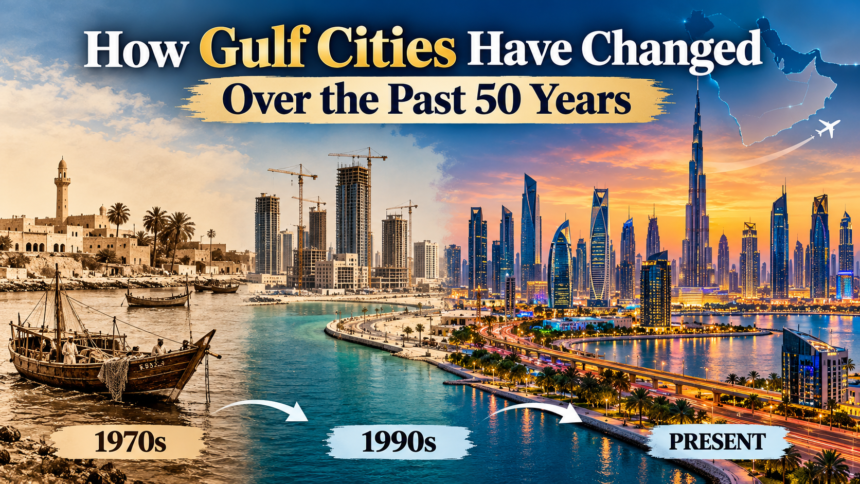
Over the past 50 years, Gulf cities have experienced one of the most remarkable urban transformations in the world. Cities that once depended mainly on fishing, pearl diving, small-scale trading, and traditional industries have developed into modern centres of business, tourism, education, technology, and international trade. Today, cities such as Dubai, Abu Dhabi, Doha, Riyadh, Kuwait City, and Muscat are known for their impressive skylines, modern roads, shopping malls, international airports, and growing business opportunities.
- Introduction
- 1. Gulf Cities Before the 1970s
- 2. The Oil Boom Changed the Future of Gulf Cities
- 3. From Small Towns to Modern Skylines
- 4. Roads, Airports, Ports, and Transportation
- 5. Economic Growth Beyond Oil
- 6. Changes in Housing and Everyday Life
- 7. Population Growth and Multicultural Communities
- 8. Education and Healthcare Have Improved
- 9. Tourism, Shopping, and Entertainment
- 10. Technology and the Rise of Smart Cities
- 11. Culture and Traditions in Modern Gulf Cities
- 12. Environmental Challenges and Sustainable Development
- 13. The Role of National Development Visions
- 14. What Does the Future Hold for Gulf Cities?
- Conclusion
- Frequently Asked Questions (FAQs)
The discovery of oil or natural gas has been a major factor in the transformation of Gulf cities. The revenue generated from these natural resources enables their governments to invest in infrastructure, housing, healthcare, education, and public services. At the same time, international trade, foreign investment, migration, and new economic policies encouraged cities to expand and welcome people from different parts of the world.
However, the growth of Gulf cities is not only about tall buildings and modern highways. It is also about changes in family life, employment, culture, transportation, technology, and the way people spend their free time.
This article explores how Gulf cities have changed over the past five decades, what has driven their development, and what challenges they may face in the future.
1. Gulf Cities Before the 1970s
To understand the development of Gulf cities, it is important to look at life before the major oil-funded construction boom.
Before rapid modernization, many Gulf settlements were relatively small and closely connected to the sea, desert, and surrounding natural environment. Local economies depended on traditional activities, including fishing, pearl diving, livestock farming, handicrafts, and regional trade.
Coastal towns played an important role in connecting merchants from the Arabian Peninsula with traders from India, East Africa, and other parts of Asia. Traditional markets, known as souks, were important places where people bought food, clothing, household goods, spices, and other products.
Housing and daily life were also different from what people experience today. Many families lived in simple homes built using locally available materials. Narrow streets provided shade, while courtyards and shared neighbourhood spaces helped people maintain close relationships.
Public services and transport were more limited than they are today. Long-distance journeys could be difficult, and access to modern healthcare, schools, electricity, and clean water varied between locations.
Some important features of Gulf cities before rapid modernization included:
- Small coastal settlements connected to fishing and trade.
- Traditional markets and local family businesses.
- Limited road networks and public transportation.
- Homes designed to suit the hot and dry climate.
- Strong family relationships and community traditions.
- Economies that depended on several traditional activities.
The region already had a rich history of trade, culture, and settlement. What changed during the following decades was the speed and scale of development.
2. The Oil Boom Changed the Future of Gulf Cities
The growth of the oil industry was one of the most important reasons behind the transformation of Gulf cities. Oil discoveries and expanding production brought new revenue, international business connections, and employment opportunities.
During the 1970s and the decades that followed, governments invested heavily in national development. Oil and gas income helped finance projects that would have been difficult to build using the resources available to smaller settlements.
New roads, hospitals, schools, ports, airports, electricity networks, and water systems were developed. Government offices and business districts expanded, while new residential areas were built for growing populations.
Oil also created demand for workers with different skills. Engineers, construction workers, teachers, doctors, administrators, and business professionals arrived from abroad to support development.
The impact of oil was different in each country. Some cities became important centres for petroleum production and industry, while others used their financial resources and geographical position to develop trade, tourism, aviation, and financial services.
According to research on urbanization in the Arabian Gulf, the region’s population and built-up areas grew substantially during the decades following the oil boom. This expansion changed the structure of coastal settlements and created new metropolitan areas.
Oil and gas therefore did more than increase national income. They helped create the foundations of modern Gulf cities.
Rapid Urbanization & Infrastructure
- Hyper-speed modernization: Cities like Dubai, Abu Dhabi, Doha, and Riyadh transformed from small trading posts to mega-cities in just a few decades.
- Architectural marvels: Oil wealth funded iconic, record-breaking skyscrapers, artificial islands, and advanced transit networks.
- Welfare states: Governments built comprehensive public housing, free healthcare, and top-tier educational institutions for citizens.
3. From Small Towns to Modern Skylines
One of the most visible changes in Gulf cities is their architecture. Traditional low-rise buildings and older neighbourhoods now stand alongside skyscrapers, modern residential towers, business centres, hotels, and large commercial developments.
Dubai is a well-known example of this transformation. Over the years, it has developed into an international business and tourism destination with major commercial districts, luxury hotels, modern residential communities, and large shopping centres.
Abu Dhabi has also expanded considerably, combining government and business districts with residential neighbourhoods, cultural institutions, waterfront developments, and modern infrastructure.
Doha has transformed through the development of new business areas, residential districts, transport systems, museums, and public spaces. Riyadh has expanded from a regional capital into a large metropolitan centre with major commercial and infrastructure projects.
Other Gulf cities have followed their own development paths. Kuwait City combines modern commercial buildings with established neighbourhoods and historic landmarks. Muscat has developed modern roads, housing, and public facilities while maintaining architectural features that reflect Omani culture.
Modern construction has introduced several changes:
- High-rise residential and office buildings.
- Large shopping malls and entertainment centres.
- New waterfront districts and mixed-use developments.
- Modern hotels and international business facilities.
- Planned residential communities.
- Cultural attractions and public gathering spaces.
Despite these changes, traditional neighbourhoods, historic markets, mosques, forts, and older buildings remain important parts of the region’s identity.
The challenge for Gulf cities is to continue modernizing without losing the architectural character and cultural heritage that make each place distinctive.
4. Roads, Airports, Ports, and Transportation
Transportation has changed dramatically over the past 50 years. In earlier decades, many journeys depended on smaller road networks, local transport, and travel between settlements that could take considerable time.
As cities expanded, governments invested in highways, bridges, tunnels, airports, seaports, and other transport facilities. These improvements helped people travel more easily and allowed businesses to move goods across the region and into international markets.
Dubai International Airport became an important international aviation hub, while Hamad International Airport in Doha and other regional airports strengthened connections between Gulf cities and the rest of the world.
Ports have also played a major role in economic growth. They support international trade, industrial activity, logistics, and the movement of essential goods.
Public transportation has developed as well. Dubai introduced its Metro system in 2009, providing an additional travel option for residents and visitors. Doha’s Metro, which opened in 2019, has improved connections between several important areas of the Qatari capital.
Modern transport systems offer several benefits:
- Faster journeys between major districts.
- Better connections with international markets.
- More opportunities for tourism and business travel.
- Improved movement of goods and services.
- Easier access to workplaces, schools, and hospitals.
- Support for expanding residential and commercial areas.
However, rapid urban expansion has also increased car use and traffic congestion in some places. Gulf cities continue to face the challenge of providing convenient transport while reducing travel times, emissions, and dependence on private vehicles.
5. Economic Growth Beyond Oil
For many years, oil and gas were central to the economies of Gulf countries. Although these industries remain important, governments have increasingly worked to develop other sources of income.
Economic diversification means building industries that can support growth beyond the traditional energy sector. This approach is important because oil prices can change significantly, affecting government revenue and economic planning.
Dubai has developed major activities in tourism, trade, logistics, aviation, real estate, and financial services. Abu Dhabi has invested in areas including industry, culture, clean energy, and advanced technology.
Saudi Arabia is pursuing economic diversification through Vision 2030, which includes plans for tourism, entertainment, manufacturing, investment, and new industries. Qatar has developed international aviation, sports, education, and cultural activities alongside its major natural gas industry.
Bahrain has established a role in financial services and other commercial activities, while Oman has continued developing logistics, tourism, manufacturing, and port-related industries. Kuwait is also working to expand economic opportunities beyond oil.
Important sectors contributing to the changing Gulf economy include:
- Tourism and hospitality.
- Banking and financial services.
- International trade and logistics.
- Information technology and digital services.
- Education and healthcare.
- Manufacturing and industrial development.
- Renewable energy and environmental technology.
- Entertainment, sports, and cultural events.
Economic diversification is still a work in progress. Oil and gas continue to influence government budgets and investment in many Gulf countries. Nevertheless, the growing range of industries has changed the types of jobs available and the role Gulf cities play in the global economy.
6. Changes in Housing and Everyday Life
Housing has changed significantly as Gulf cities have grown. Traditional homes were often designed around family life, privacy, and the local climate. Many included courtyards, shaded entrances, and spaces where relatives could gather.
Modern cities now offer a wider range of housing options, including apartments, villas, gated communities, high-rise residences, and planned suburban neighbourhoods.
New residential developments often include supermarkets, schools, parks, healthcare facilities, gyms, and other services. These facilities help residents manage everyday activities without travelling long distances for every need.
Air conditioning, modern plumbing, reliable electricity, and improved water infrastructure have also changed daily life. These services are particularly important in a region where summer temperatures can become extremely high.
At the same time, housing costs differ considerably between cities and neighbourhoods. Premium areas in major business and tourism centres can be expensive, while other districts offer more affordable accommodation.
The growth of modern housing has created new opportunities, but it has also raised questions about affordability, urban planning, and access to good-quality homes for people with different income levels.
7. Population Growth and Multicultural Communities
Gulf cities have become more diverse over the past five decades. Economic growth attracted workers, business owners, students, and professionals from many countries.
Today, cities such as Dubai and Doha contain communities with different languages, cultural backgrounds, and professional experiences. International workers contribute to construction, healthcare, education, hospitality, transport, technology, retail, and numerous other sectors.
This population growth has influenced restaurants, shops, entertainment, education, and daily communication. Residents can often find food and products from many parts of the world while also experiencing local traditions and customs.
However, the experiences of different groups are not always the same. Citizens, long-term residents, migrant workers, and temporary employees may have different access to housing, employment benefits, and social support.
Population growth also increases demand for public services, transport, schools, healthcare, and affordable accommodation.
For Gulf cities to remain attractive places to live and work, continued development needs to consider the needs and well-being of the different communities that contribute to urban life.
8. Education and Healthcare Have Improved
Education and healthcare are two important areas where many Gulf cities have experienced major changes.
As governments invested in public services, more schools, colleges, universities, and hospitals were established. These facilities helped improve access to education and medical care while supporting growing populations.
Modern educational institutions offer a wider range of subjects, including engineering, business, medicine, computer science, and other professional fields. Some cities have also attracted international universities and research organisations.
Healthcare facilities have expanded to include specialised hospitals, diagnostic centres, emergency services, and modern medical technology. Residents in many urban areas have greater access to healthcare services than previous generations had.
These improvements support economic development in several ways:
- Better education helps people gain professional skills.
- Universities support research and innovation.
- Healthcare facilities improve access to treatment.
- Skilled workers can contribute to growing industries.
- International institutions attract students and professionals.
- Public services can improve overall quality of life.
Even so, challenges remain. Access to services, their costs, and the quality of facilities can vary depending on location and individual circumstances.
Continued investment in education and healthcare will remain important as Gulf cities develop more knowledge-based economies.
9. Tourism, Shopping, and Entertainment
Tourism has become a major part of the identity of several Gulf cities. In the past, many settlements were better known for trade, local markets, religious sites, and traditional activities. Today, visitors can experience a much wider range of attractions.
Dubai is famous for its modern architecture, shopping malls, beaches, desert experiences, hotels, and entertainment facilities. Abu Dhabi offers cultural attractions, museums, major sporting events, and family activities.
Doha has invested in museums, waterfront spaces, sporting facilities, and cultural destinations. Riyadh has expanded its entertainment and cultural offerings, while Muscat attracts visitors interested in Omani heritage, historic forts, natural landscapes, and traditional markets.
Tourism helps cities create jobs and attract international spending. It also encourages investment in hotels, restaurants, transport, events, and public spaces.
Popular tourism experiences in Gulf cities include:
- Visiting traditional souks and historic districts.
- Exploring museums, forts, and cultural centres.
- Shopping in modern malls and local markets.
- Enjoying beaches and waterfront promenades.
- Attending sports competitions and cultural festivals.
- Taking desert trips and outdoor excursions.
- Experiencing local food and hospitality.
However, tourism development needs careful planning. Cities must balance visitor demand with the needs of residents, protect cultural heritage, manage waste, and use water and energy responsibly.
10. Technology and the Rise of Smart Cities
Technology has become an important part of modern urban life. Fifty years ago, many everyday activities required paper documents, physical visits to offices, and face-to-face transactions.
Today, residents can often pay bills online, access government services digitally, book transport, make appointments, and communicate through mobile applications.
Gulf governments and businesses have invested in digital infrastructure, high-speed internet, mobile networks, and electronic services. Some cities are also exploring smart traffic systems, digital planning tools, artificial intelligence, and data-based public services.
Technology is changing the way cities operate in several areas:
- Government services: Online platforms can make many administrative tasks faster.
- Transportation: Digital applications help users plan journeys and book rides.
- Business: Online payments and digital services support trade and commerce.
- Healthcare: Digital systems can improve appointment management and access to information.
- Education: Online learning expands access to courses and training.
- Urban management: Sensors and data can help monitor traffic, utilities, and public infrastructure.
Smart-city technology can improve efficiency, but it also creates responsibilities. Authorities must protect personal information, maintain cybersecurity, and ensure that digital services remain accessible to people with different levels of technical knowledge.
11. Culture and Traditions in Modern Gulf Cities
Modernization has changed the appearance and lifestyle of Gulf cities, but culture and traditions remain important.
Family relationships, hospitality, Arabic coffee, traditional food, religious celebrations, and local customs continue to influence social life. Ramadan and Eid celebrations remain important occasions for family gatherings and community activities.
Traditional markets and historic neighbourhoods also help connect modern cities with their past. Places such as old souks, heritage villages, forts, and restored districts offer visitors and younger generations opportunities to understand local history.
At the same time, global travel, social media, international education, and multicultural communities have introduced new influences. Residents can enjoy international restaurants, music, fashion, sports, and entertainment while continuing to celebrate local customs.
This combination of tradition and modernity is one of the defining characteristics of Gulf cities.
Preserving heritage is not only about protecting old buildings. It also involves supporting local crafts, traditional knowledge, historic neighbourhoods, and cultural activities that give each city its own identity.
12. Environmental Challenges and Sustainable Development
Rapid development has brought major benefits, but it has also created environmental challenges. Gulf cities are located in an arid region where water is limited, summers are hot, and natural ecosystems can be sensitive to construction and pollution.
Growing populations and expanding industries increase demand for electricity, drinking water, transport, and housing. Air conditioning is essential for comfort in many buildings, but it also requires substantial energy.
Urban expansion can affect coastal habitats, desert landscapes, and marine environments. Research examining coastal urbanization in the Arabian Gulf has documented major changes in land use, including coastal construction, land reclamation, and industrial development.
Key environmental challenges include:
- High energy use during hot summer months.
- Limited natural freshwater resources.
- Vehicle emissions and traffic congestion.
- Waste management and plastic pollution.
- Pressure on coastal and marine habitats.
- Urban heat and limited natural shade in some areas.
- The need for more sustainable construction.
To address these issues, Gulf cities are exploring renewable energy, green buildings, public transport, urban parks, improved recycling, and more efficient water systems.
Sustainable development means improving quality of life without placing unnecessary pressure on natural resources. It requires careful planning, long-term investment, and cooperation between governments, businesses, and residents.
13. The Role of National Development Visions
National development plans have become important guides for the future of Gulf cities. These plans aim to strengthen economies, improve public services, create employment, and prepare countries for changing global conditions.
Saudi Arabia’s Vision 2030 is a prominent example. It aims to diversify the economy and expand sectors such as tourism, entertainment, industry, and technology.
The UAE has pursued economic diversification through trade, tourism, finance, aviation, innovation, and investment. Qatar’s national development planning focuses on areas including economic development, human development, environmental protection, and social progress.
Oman, Bahrain, and Kuwait have also introduced strategies to develop non-oil industries, strengthen private-sector activity, and improve economic resilience.
Although the priorities differ between countries, common goals include:
- Creating more employment opportunities.
- Supporting entrepreneurs and private businesses.
- Attracting international investment.
- Improving education and workforce skills.
- Developing tourism and cultural industries.
- Expanding digital services and innovation.
- Improving environmental sustainability.
The success of these plans depends on implementation, investment, workforce development, and the ability to adapt to changing economic conditions.
14. What Does the Future Hold for Gulf Cities?
The next stage of development will involve more than building larger skyscrapers or new shopping centres. Gulf cities will need to focus on creating places that are efficient, inclusive, comfortable, and environmentally responsible.
Several trends are likely to influence their future.
More sustainable buildings: Energy-efficient designs, better insulation, shaded walkways, and renewable energy can help reduce environmental pressure.
Improved public transportation: Metro systems, buses, walking routes, and cycling facilities can provide alternatives to private cars where practical.
More technology-based services: Artificial intelligence, digital government platforms, and smart infrastructure may improve the delivery of public services.
Stronger non-oil industries: Tourism, technology, education, logistics, manufacturing, and finance can create a broader range of employment opportunities.
Better public spaces: Parks, waterfronts, cultural centres, and walkable neighbourhoods can improve everyday life.
Protection of local heritage: Historic buildings, traditional markets, and cultural activities will remain important as cities become more international.
Greater attention to affordability: Housing, transport, and essential services need to remain accessible to residents across different income groups.
The future of Gulf cities will depend on how well they balance economic growth with environmental protection, cultural identity, and the needs of their populations.
Conclusion
Over the past 50 years, Gulf cities have changed from relatively small settlements and trading centres into major urban hubs connected to the global economy. Oil and natural gas revenue helped finance roads, airports, schools, hospitals, housing, and other essential infrastructure. International trade, migration, tourism, and economic diversification further shaped their development.
Cities such as Dubai, Abu Dhabi, Doha, Riyadh, Kuwait City, and Muscat demonstrate different approaches to modernization. Each has developed its own mix of business, culture, infrastructure, and tourism while remaining connected to the wider Gulf region.
The transformation has improved access to many services and created new opportunities, but it has also brought challenges involving housing affordability, traffic, water use, energy demand, and environmental protection.
Looking ahead, the most successful Gulf cities will be those that combine modern infrastructure with thoughtful planning, strong communities, economic opportunity, and respect for local traditions. Their story is not simply about how cities have grown over the past five decades. It is also about how they can create a better and more sustainable future for the generations to come.
Frequently Asked Questions (FAQs)
1. How Gulf cities changed over the past 50 years?
Gulf cities have developed from smaller settlements and trading centres into modern urban areas with skyscrapers, highways, airports, universities, hospitals, shopping centres, and international businesses. Oil and gas revenue, trade, tourism, and investment helped drive this transformation.
2. What was the main reason for the growth of Gulf cities?
Oil and natural gas played a major role by providing revenue for infrastructure and public services. International trade, population growth, migration, government planning, and investment in non-oil industries also contributed to urban development.
3. Which Gulf cities have changed the most?
Dubai, Abu Dhabi, Doha, and Riyadh are well-known examples of rapid urban growth. However, cities such as Kuwait City, Manama, and Muscat have also experienced major changes in infrastructure, housing, services, and economic activity.
4. How has daily life changed in Gulf cities?
Daily life has changed through better roads, modern housing, air conditioning, expanded healthcare and education, digital services, shopping centres, and more entertainment options. International communities have also made many Gulf cities more multicultural.
5. Are Gulf cities still dependent on oil?
Oil and gas remain important to many Gulf economies, but governments are developing other industries, including tourism, finance, logistics, technology, manufacturing, and renewable energy. The level of diversification differs between countries.
6. What environmental problems do Gulf cities face?
Major challenges include high energy consumption, limited freshwater resources, traffic congestion, waste, air pollution, and pressure on coastal ecosystems. Sustainable buildings, renewable energy, efficient water use, and better transport planning can help address these problems.
7. What will Gulf cities look like in the future?
Gulf cities are likely to invest further in smart technology, public transport, tourism, modern infrastructure, and economic diversification. Greater attention to sustainability, affordable housing, public spaces, and cultural heritage will also be important.
Do follow us on Instagram
Read More – The Role of Ports and Trade in the Growth of Gulf Cities