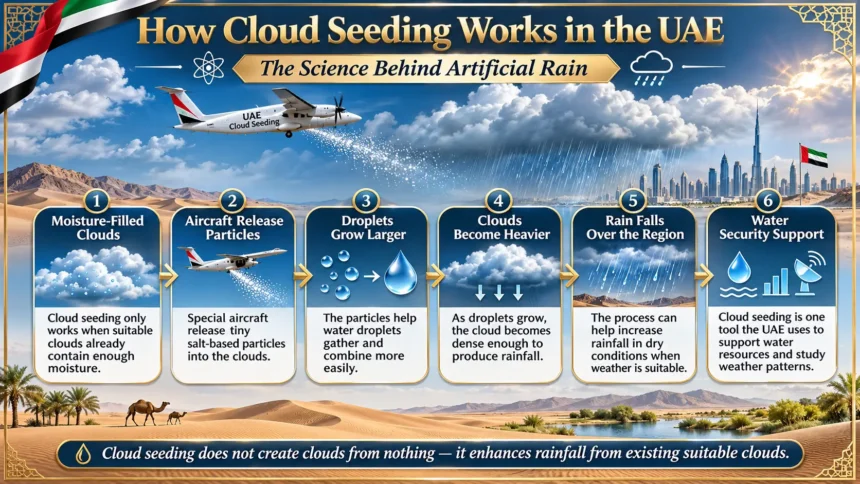
How Cloud Seeding Works in the UAE: A Complete Guide
Rain is often a welcome sight in the United Arab Emirates. In a country known for its vast deserts, extremely hot summers and limited natural freshwater resources, rainfall plays an important role in supporting the environment. However, natural rainfall alone is not always enough to meet the country’s growing water needs.
- 1. What Is Cloud Seeding and How Does It Work?
- 2. Why Does the UAE Use Cloud Seeding?
- 3. The Step-by-Step Cloud Seeding Process in the UAE
- 4. What Materials Are Used for Cloud Seeding in the UAE?
- 5. Where and When Does Cloud Seeding Take Place in the UAE?
- 6. How Effective Is Cloud Seeding in the UAE?
- 7. Is Cloud Seeding Safe, and Can It Cause Flooding?
- 8. The Future of Cloud Seeding and Rain Enhancement in the UAE
- Conclusion
- Frequently Asked Questions About Cloud Seeding in the UAE
To address this challenge, the UAE has invested in a scientific technique known as cloud seeding. This method aims to increase rainfall from existing clouds by introducing tiny particles that help water droplets grow.
Cloud seeding in the UAE has become an important part of the country’s efforts to improve water security, support environmental sustainability and explore new solutions to water scarcity.
Although the process is often described as artificial rain, it does not involve creating rain from an empty sky. Instead, scientists use advanced technology to encourage natural clouds to produce more rainfall under suitable weather conditions.
From specialised aircraft and weather radars to artificial intelligence and advanced research materials, understanding how cloud seeding works in the UAE reveals an interesting connection between science, technology and nature.
1. What Is Cloud Seeding and How Does It Work?
Cloud seeding is a technique used to increase rainfall or snowfall by adding tiny particles to existing clouds. It cannot create rain from a clear sky, but it helps moisture-filled clouds release rain or snow more easily.
Cloud seeding is a scientific weather modification technique designed to encourage rain or snow from suitable existing clouds. It involves introducing small particles into clouds to influence the natural processes that produce precipitation.
To understand cloud seeding, it is helpful to first understand how natural rainfall forms.
Clouds develop when moist air rises into the atmosphere and cools. Water vapour then changes into tiny water droplets or ice crystals. These particles come together to form clouds.
However, not every cloud produces rain. In some clouds, water droplets remain too small to fall towards the ground. Cloud seeding attempts to improve the chances of these droplets growing large enough to produce rainfall.
The UAE mainly uses a method known as hygroscopic cloud seeding. The word hygroscopic refers to the ability of certain materials to attract moisture.
Specialised aircraft release moisture-attracting particles into suitable clouds. These particles can help water droplets grow, collide and combine with one another.
When the droplets become sufficiently large and heavy, they may fall towards the ground as rain.
Quick Facts About Cloud Seeding in the UAE
| Feature | Details |
|---|---|
| Main purpose | Increasing rainfall from existing clouds |
| Responsible authority | National Center of Meteorology (NCM) |
| Beginning of UAE rain enhancement efforts | 1990 |
| Main technique | Hygroscopic cloud seeding |
| Common materials | Sodium chloride and potassium chloride |
| Main equipment | Specialised aircraft and ground generators |
| Supporting technology | Weather radars, satellites and computer models |
| Major objective | Improving water security |
| Main limitation | Requires suitable atmospheric conditions |
Cloud seeding does not guarantee rainfall. Its success depends on cloud structure, moisture levels, temperature, wind conditions and other natural factors.
2. Why Does the UAE Use Cloud Seeding?
The UAE uses cloud seeding mainly to help deal with water shortages and reduce its dependence on seawater desalination, which is an expensive process that uses a lot of energy.
The UAE is located in one of the world’s driest regions. Much of the country experiences an arid desert climate, with high temperatures, limited rainfall and no permanent natural rivers.
Rapid population growth, urban development, agriculture and industrial activities have increased the demand for reliable water resources.
The country depends heavily on seawater desalination, which involves removing salt and other substances from seawater to make it suitable for human use.
Although desalination provides a reliable source of freshwater, it requires significant infrastructure and energy.
Cloud seeding offers another opportunity to make better use of naturally available atmospheric moisture.
Main reasons behind cloud seeding in the UAE include:
- Increasing rainfall where atmospheric conditions are suitable.
- Addressing long-term water scarcity.
- Supporting groundwater recharge.
- Improving national water security.
- Supporting agricultural activities where additional water becomes available.
- Helping maintain natural vegetation.
- Diversifying the country’s water resources.
- Encouraging scientific research and technological innovation.
Rainwater can collect in reservoirs, dams and natural valleys. Under suitable geological conditions, some of this water gradually enters underground water reserves.
This process, known as groundwater recharge, is particularly important in countries with limited freshwater resources.
The UAE also introduced its Water Security Strategy 2036 in September 2017. The strategy aims to ensure reliable access to water during normal circumstances and emergencies.
Rain enhancement research complements these wider efforts, alongside desalination, wastewater treatment, water conservation and improved resource management.
However, cloud seeding cannot replace desalination because rainfall remains irregular and dependent on natural weather conditions.
3. The Step-by-Step Cloud Seeding Process in the UAE
Cloud seeding involves much more than sending an aircraft into the sky. Every operation requires scientific observations, weather monitoring, technical planning and coordination between meteorologists and trained pilots.
The National Center of Meteorology monitors atmospheric conditions to identify opportunities for rain enhancement.
Step 1: Monitoring weather conditions
Meteorologists use weather radars, satellite observations and monitoring stations to study cloud development across the country.
They examine factors such as temperature, humidity, wind direction, moisture availability and the growth of clouds.
This information helps determine whether atmospheric conditions are suitable for cloud seeding.
Step 2: Identifying suitable clouds
Not every cloud can be used for rain enhancement. Scientists look for developing clouds containing sufficient moisture and suitable upward air movement.
These upward air currents are known as updrafts. They can carry seeding particles into the cloud, where the particles interact with available moisture.
Step 3: Deploying cloud seeding aircraft
When favourable conditions are identified, specialised aircraft, and sometimes drones or ground equipment may be sent towards suitable clouds.
These aircraft and drones carry weather-monitoring instruments and equipment containing cloud seeding flares. Pilots coordinate with meteorologists on the ground throughout the operation.
Step 4: Releasing seeding materials
The aircraft releases tiny moisture-attracting particles into suitable areas of the cloud.
These particles are intended to encourage the development of larger water droplets.
Step 5: Formation of larger water droplets
Inside the cloud, water droplets may collide and combine. As they grow, they become more likely to fall towards the ground.
This natural process is known as collision and coalescence.
However, some droplets may evaporate before reaching the surface, particularly when the air below the cloud is extremely dry.
Step 6: Monitoring rainfall results
Meteorologists continue monitoring the cloud and surrounding areas after the operation.
Weather radars and rain gauges help scientists study cloud development, rainfall intensity and possible changes following seeding.
These observations contribute to long-term research into the effectiveness of cloud seeding technology.
| Stage | Main Activity |
|---|---|
| Weather monitoring | Identifying favourable atmospheric conditions |
| Cloud selection | Finding suitable moisture-rich clouds |
| Aircraft deployment | Sending specialised aircraft |
| Material release | Introducing moisture-attracting particles |
| Droplet development | Encouraging water droplets to combine |
| Rainfall monitoring | Measuring and studying precipitation |
Each stage plays an important role in helping scientists understand whether the operation may have contributed to additional rainfall.
4. What Materials Are Used for Cloud Seeding in the UAE?
One of the most common questions about artificial rain in the UAE concerns the materials released into the atmosphere.
The country’s conventional cloud seeding operations mainly use hygroscopic salt particles. These materials are selected because of their ability to attract water.
Common cloud seeding materials include sodium chloride and potassium chloride. These are familiar salt compounds, although the particles used for seeding are specially prepared for atmospheric applications.
Scientists are also investigating advanced materials that could improve the efficiency of rain enhancement.
Traditional salt-based cloud seeding
Salt particles attract moisture and may help larger water droplets develop within suitable clouds.
This technique is particularly relevant to the liquid-water processes found in developing clouds over the UAE.
Nanotechnology in cloud seeding
Researchers are exploring specially engineered particles that may interact more effectively with atmospheric moisture.
These materials are designed to improve water uptake and encourage droplet growth. However, their effectiveness must be tested through laboratory experiments, field research and environmental assessments.
Hygroscopic and ice-based cloud seeding
Different countries use different cloud seeding techniques depending on their climates and objectives.
| Feature | Hygroscopic Cloud Seeding | Ice-Based Cloud Seeding |
|---|---|---|
| Main target | Liquid water droplets | Ice formation in suitable cold clouds |
| Common materials | Sodium chloride and potassium chloride | Silver iodide or dry ice |
| Main purpose | Encouraging larger water droplets | Supporting ice crystal development |
| Typical application | Suitable rain-producing clouds | Cold clouds containing supercooled water |
| Use in the UAE | Main conventional approach | Not the main conventional approach |
In 2018, the UAE established the Emirates Weather Enhancement Factory in Abu Dhabi. The facility produces cloud seeding materials and flares for rain enhancement activities.
Local production supports research, technical development and the country’s operational requirements.
5. Where and When Does Cloud Seeding Take Place in the UAE?
Cloud seeding does not follow a fixed daily schedule. Operations depend on the availability of suitable clouds and changing atmospheric conditions.
The National Center of Meteorology monitors weather developments throughout the year to identify potential opportunities.
Why are mountainous regions important?
The eastern mountainous regions of the UAE are particularly valuable for rain enhancement research.
When moist air moves towards mountains, it can be forced upwards. As the air rises and cools, clouds may develop.
This natural process is known as orographic lifting.
The Hajar Mountains and surrounding eastern regions can provide favourable conditions for cloud development, especially during periods of atmospheric moisture and instability.
Areas associated with cloud development and rain enhancement opportunities include:
- Al Ain and surrounding inland regions.
- Fujairah and the eastern mountainous areas.
- Mountainous parts of Ras Al Khaimah.
- Eastern areas of Sharjah.
- Other locations experiencing suitable cloud formation.
However, cloud seeding is not limited to these locations. Operations may take place wherever suitable conditions develop within the country’s operational area.
Can cloud seeding happen during summer?
Yes. Although the UAE experiences much of its natural rainfall during the cooler months, summer thunderstorms can develop, particularly around eastern mountains.
These clouds may provide opportunities for rain enhancement.
Winter weather systems can also produce suitable clouds. The decision to conduct an operation depends on actual atmospheric conditions rather than the season alone.
Importantly, cloud seeding cannot produce rainfall from a clear blue sky. During extremely dry periods without suitable clouds, the technology has limited use.
6. How Effective Is Cloud Seeding in the UAE?
The effectiveness of cloud seeding remains an important subject of scientific research.
Measuring its exact contribution is difficult because clouds naturally change over time. Some seeded clouds might have produced rain even without human intervention.
Scientists must therefore compare observations, historical rainfall records and different weather events to estimate the possible contribution of cloud seeding.
A 2021 scientific study published in the journal Atmosphere examined long-term rainfall records and weather radar observations associated with the UAE’s cloud seeding programme.
The researchers estimated an average increase of approximately 23% in annual surface rainfall over the studied target area associated with seeding.
However, this finding should not be interpreted as a guaranteed 23% increase during every operation or across the entire country.
The World Meteorological Organization explains that cloud seeding can influence certain physical processes inside suitable clouds, but measuring additional precipitation remains challenging, particularly in complex thunderstorm systems.
Factors affecting cloud seeding effectiveness
| Factor | Why It Matters |
|---|---|
| Cloud moisture | Sufficient water must already exist |
| Atmospheric temperature | Influences droplet and ice formation |
| Wind direction | Affects the movement of clouds and particles |
| Updraft strength | Influences the movement of particles |
| Cloud lifetime | Determines how long droplets can develop |
| Air humidity | Affects whether falling droplets evaporate |
| Timing of the operation | Influences how particles interact with developing clouds |
Cloud seeding may produce different results even when operations appear similar.
This is why scientists continue to improve weather forecasting, observation systems and research methods.
The technology should be understood as a potential rainfall enhancement tool rather than a guaranteed method of controlling the weather.
7. Is Cloud Seeding Safe, and Can It Cause Flooding?
As cloud seeding becomes more widely discussed, questions about environmental safety and unexpected weather events have also increased.
The UAE’s conventional hygroscopic seeding operations primarily use salt-based materials introduced in relatively small quantities.
The World Meteorological Organization has reported that published studies of commonly used seeding agents at previously used levels have not demonstrated significant harm to human health or the environment.
Nevertheless, new materials, larger quantities and possible wider environmental effects require continued research and monitoring.
Did cloud seeding cause the Dubai floods in April 2024?
On April 16, 2024, the UAE experienced an exceptional rainfall event that caused widespread flooding and transportation disruptions.
The event led to considerable discussion on social media, with some people claiming that cloud seeding was responsible.
However, the National Center of Meteorology confirmed that cloud seeding operations had not taken place during the exceptional storm.
Meteorologists explained that the rainfall resulted from a large natural weather system carrying substantial atmospheric moisture across the region.
The storm also affected neighbouring countries, demonstrating that it was part of a much wider weather event.
According to weather experts, existing cloud seeding technology does not have the ability to create or substantially control storms of this scale.
Common cloud seeding myths and facts
| Myth | Fact |
|---|---|
| Cloud seeding creates clouds from nothing | It requires suitable existing clouds |
| Every cloud seeding mission produces rain | Results depend on atmospheric conditions |
| Scientists can make it rain anywhere | Natural moisture and cloud development are essential |
| All rainfall in Dubai is artificial | Most rainfall occurs through natural weather processes |
| Cloud seeding can control major storms | Current technology cannot control large weather systems |
| Cloud seeding is completely risk-free | Environmental research and monitoring remain important |
| Cloud seeding can solve all water shortages | It is only one part of wider water management |
Although cloud seeding can influence certain cloud processes, it cannot provide complete control over rainfall, thunderstorms or extreme weather.
Residents should always follow official UAE weather warnings and safety instructions during heavy rainfall, regardless of whether cloud seeding operations have occurred.
8. The Future of Cloud Seeding and Rain Enhancement in the UAE
The UAE continues to invest in scientific research to improve its understanding of rainfall and develop more effective rain enhancement methods.
In 2015, the country launched the UAE Research Program for Rain Enhancement Science (UAEREP), an international initiative managed by the National Center of Meteorology.
The programme supports researchers investigating atmospheric science, advanced materials, weather prediction and new rain enhancement technologies.
Artificial intelligence and weather forecasting
Artificial intelligence is becoming an important area of weather research.
By analysing large amounts of information from satellites, radars and monitoring stations, AI systems may help meteorologists identify suitable clouds more efficiently.
Improved forecasting could also help researchers select better opportunities for cloud seeding operations.
Drones and ground-based technology
Researchers are exploring unmanned aircraft, advanced sensors and ground generators as additional tools for rain enhancement.
These technologies could provide more flexible ways to observe clouds and deliver seeding materials. However, many newer approaches still require scientific testing before their effectiveness can be established.
Future research priorities include:
- Improving the accuracy of weather forecasts.
- Developing more effective cloud seeding materials.
- Exploring artificial intelligence applications.
- Testing unmanned aircraft and new delivery systems.
- Improving rainfall measurement techniques.
- Studying possible environmental effects.
- Supporting international scientific cooperation.
- Evaluating the economic benefits of rainfall enhancement.
The ultimate goal is not simply to produce additional rainfall. It is to determine whether rain enhancement can provide a reliable, environmentally responsible and economically useful contribution to water security.
Cloud seeding must therefore work alongside other solutions, including water conservation, efficient irrigation, desalination and wastewater recycling.
Conclusion
Understanding how cloud seeding works in the UAE reveals how science and technology can help address environmental challenges in dry regions.
By introducing moisture-attracting particles into suitable clouds, scientists attempt to improve natural rainfall processes without creating entirely new weather systems.
The UAE’s investment in specialised aircraft, weather monitoring, artificial intelligence and advanced research demonstrates its long-term interest in improving water security.
However, cloud seeding has limitations. It cannot guarantee rainfall, eliminate drought or control major storms. Its success depends largely on natural atmospheric conditions.
As research continues, cloud seeding could become a more effective part of the country’s wider water management strategy.
Combined with responsible water consumption, environmental protection and sustainable technology, rain enhancement offers another opportunity for the UAE to make better use of its limited natural water resources.
Frequently Asked Questions About Cloud Seeding in the UAE
What is cloud seeding in the UAE?
Cloud seeding is a scientific technique that introduces moisture-attracting particles into suitable existing clouds to encourage additional rainfall.
Who is responsible for cloud seeding in the UAE?
The National Center of Meteorology oversees the country’s operational cloud seeding activities and rain enhancement research.
Can cloud seeding create artificial rain without clouds?
No. Cloud seeding requires suitable existing clouds containing sufficient moisture.
What materials are used in UAE cloud seeding?
The UAE mainly uses specially prepared salt particles, including sodium chloride and potassium chloride, alongside research into advanced seeding materials.
Does cloud seeding cause all rainfall in Dubai?
No. Dubai experiences natural rainfall. Cloud seeding is only used when suitable atmospheric conditions provide opportunities for rain enhancement.
How successful is cloud seeding in the UAE?
Research suggests that cloud seeding can increase rainfall under certain conditions, but its effectiveness varies. There is no guaranteed success rate for every mission.
Which emirates experience cloud seeding?
Operations may occur across different emirates when suitable clouds develop. The eastern mountainous regions are particularly important for cloud development.
Can cloud seeding reduce water scarcity?
It may help increase available rainwater and support groundwater recharge. However, it cannot independently solve the UAE’s water scarcity challenges.
Is cloud seeding used only in the UAE?
No. Several countries around the world use or study cloud seeding for rainfall enhancement, snowfall enhancement and other weather modification purposes.
Do follow us on Instagram
Read More – The Secret Life of Dugongs in the Arabian Gulf