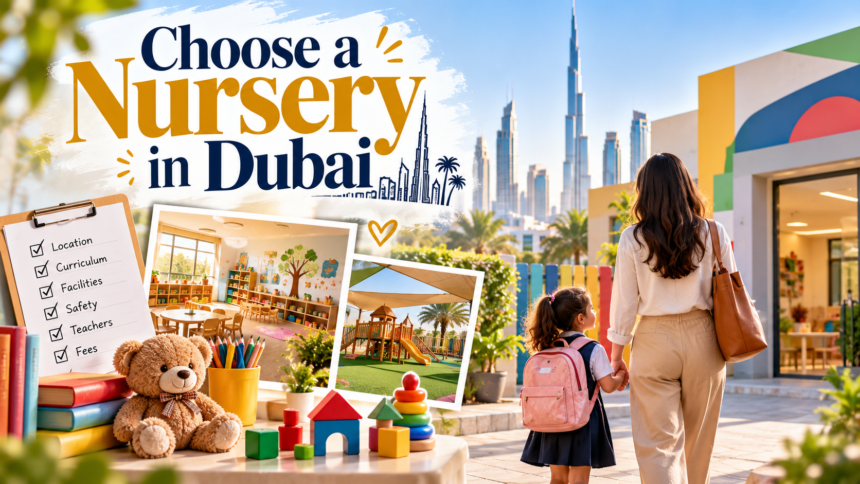
How to Choose a Nursery in Dubai: Final Parent Checklist
Learning how to choose a nursery in Dubai can feel overwhelming because parents have a large number of early childhood centres, different curricula, fee structures, schedules and teaching styles to compare. The right nursery should not simply look attractive online; it should provide a safe, nurturing and developmentally appropriate environment that fits your child’s personality and your family’s daily routine.
- Choose a Nursery in Dubai by Checking KHDA Licensing First
- Compare Nursery Curricula Without Choosing Only by the Label
- Look Closely at Teachers, Staff Stability and Child Interaction
- Safety and Safeguarding Should Be a Major Part of Your Decision
- Location and Daily Commute Matter More Than Many Parents Expect
- Understand Nursery Fees, Deposits and Refund Rules Before Enrolling
- Ask About Timings, Flexibility and Holiday Coverage
- Evaluate Meals, Allergies, Sleep and Everyday Care
- Check How the Nursery Handles Settling-In and Separation Anxiety
- Consider Language, Arabic Exposure and Your Child’s Future School
- Visit the Nursery in Person Before Making the Final Decision
- Use a Nursery Comparison Scorecard Before You Decide
- Common Mistakes Parents Make When Choosing a Nursery in Dubai
- How to Choose a Nursery in Dubai: Final Parent Checklist
Dubai’s Knowledge and Human Development Authority, or KHDA, regulates licensed Early Childhood Centres in the emirate. These centres can provide care and education from birth up to age six, including flexible attendance models such as full-time, part-time, sessional, hourly and package-based arrangements.
KHDA also introduced a dedicated Quality Framework for Early Childhood Care and Education in November 2025, setting expectations around the quality of learning, care, wellbeing and leadership in nurseries, preschools and early-years settings.
For parents, that means choosing a nursery should involve more than comparing fees or looking at colourful classrooms. Safety, staff quality, communication, curriculum, location, settling-in arrangements, meals, outdoor play and the emotional atmosphere of the centre all deserve attention.
A nursery that works perfectly for one family may not be the best fit for another. The strongest decision usually comes from combining official checks with an in-person visit and a clear understanding of what your child actually needs.
Choose a Nursery in Dubai by Checking KHDA Licensing First
The first step should be confirming that the nursery or Early Childhood Centre is properly licensed.
KHDA oversees private early learning in Dubai and requires Early Childhood Centres to obtain an Educational Services Permit before operating. The approval process includes checks around the education and care plan, centre manager, building readiness and approvals from relevant authorities.
This matters because a licensed centre is expected to follow Dubai’s regulations for early childhood education rather than operating as an informal childcare service.
KHDA regulations also require centres to implement approved curricula and care programmes, comply with quality standards and provide parents with information about their child’s rights and the curriculum being offered.
What parents should verify before paying a deposit:
- Is the centre KHDA licensed?
- Does the nursery name match the official licence?
- Is the branch you are visiting specifically covered?
- What age groups is the centre approved to accept?
- Is the curriculum officially approved?
- Who is the centre manager?
Do not assume a well-known brand automatically means every branch has exactly the same setup.
If a nursery cannot clearly explain its licensing and regulatory status, that should be treated as a warning sign.
Compare Nursery Curricula Without Choosing Only by the Label
Dubai nurseries may use different early-years philosophies and curricula.
Parents commonly encounter terms such as:
- British EYFS
- Montessori
- Reggio Emilia-inspired learning
- Play-based learning
- Inquiry-based learning
- Bilingual programmes
- Blended early-years approaches
The curriculum name matters, but how teachers actually use it matters more.
A nursery may advertise itself as Montessori, for example, but parents should ask what that means inside the classroom. Are children given meaningful independent choices? Are activities genuinely child-led? Is the environment designed around practical exploration?
Similarly, a British EYFS nursery should not be judged only because it uses the EYFS label. Parents should ask how communication, physical development, literacy, numeracy, creativity and social development are supported through everyday activities.
KHDA’s current approach increasingly emphasises quality of care, development and learning rather than simply the branding of a curriculum. Its 2025 Quality Framework was designed to create shared expectations across nurseries, preschools and early-years departments.
Curriculum comparison checklist
| Question | Why It Matters |
|---|---|
| Is learning mainly play-based? | Young children learn strongly through exploration and play |
| How much structured teaching is used? | Too much formality may not suit very young children |
| Is outdoor play included daily? | Supports physical and social development |
| Are activities adapted to individual needs? | Children develop at different speeds |
| How are language skills supported? | Important in Dubai’s multilingual environment |
| How are parents updated about progress? | Helps families understand development |
The most suitable nursery is not necessarily the one with the most impressive curriculum name. It is the one where teachers can clearly explain how learning happens throughout the day.
Look Closely at Teachers, Staff Stability and Child Interaction
Teachers have more influence on your child’s nursery experience than expensive furniture or decorative classrooms.
During a visit, watch how adults speak to children.
Are teachers warm and patient? Do they kneel to the child’s level? Do they respond when a child is upset? Are children being guided rather than constantly controlled?
These observations can reveal more than a polished brochure.
Ask about staff qualifications
Parents should ask about:
- Teacher qualifications
- Early-childhood experience
- First-aid training
- Safeguarding training
- Language abilities
- Staff turnover
A nursery with frequent staff changes can be difficult for young children because early childhood depends heavily on secure relationships and predictable routines.
Ask about child-to-adult ratios
Do not only ask for the nursery’s overall staffing number.
Ask specifically:
“How many children and adults will normally be in my child’s room?”
Younger babies require much closer supervision than older preschool children, so the appropriate ratio can differ according to age and the centre’s approved arrangements.
A smaller group can make it easier for teachers to notice children’s emotional, language and developmental needs.
However, ratio alone does not guarantee quality. A well-trained team managing a slightly larger group may provide better care than inexperienced staff supervising fewer children.
Safety and Safeguarding Should Be a Major Part of Your Decision
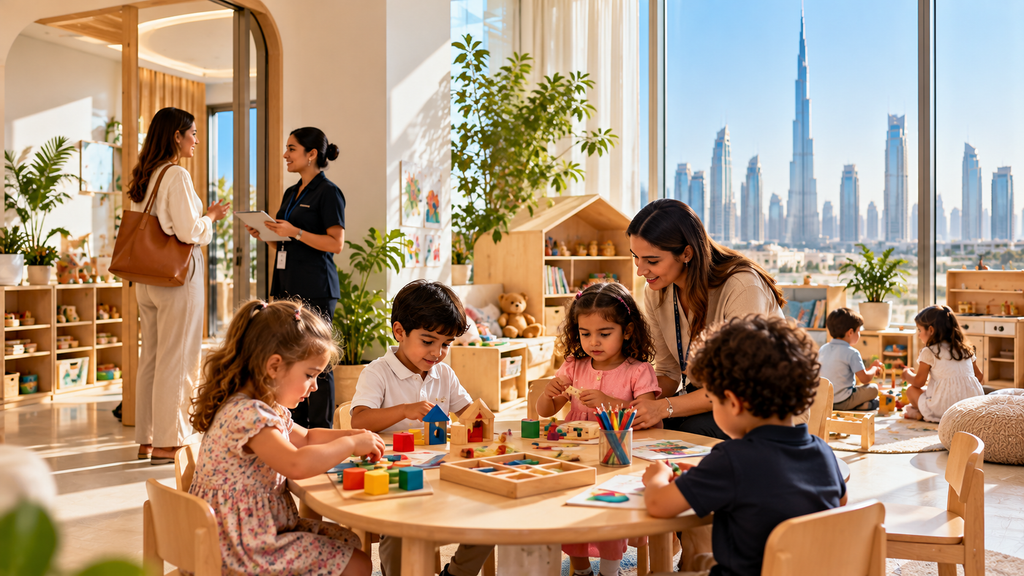
A nursery may look beautiful, but parents should examine how the environment actually functions.
KHDA’s approval process for Early Childhood Centres includes building-readiness requirements and approvals relating to the suitability of the premises, health and safety and, where applicable, clinic facilities.
During your visit, look beyond reception.
Ask to see the spaces your child will actually use.
Safety points worth checking
| Area | What Parents Should Look For |
|---|---|
| Entrance | Controlled access and secure collection procedures |
| Classrooms | Safe furniture and clear supervision |
| Bathrooms | Clean, child-appropriate facilities |
| Outdoor area | Shade, secure gates and safe equipment |
| Sleeping area | Appropriate supervision for younger children |
| Food area | Good hygiene practices |
| Emergency procedures | Fire drills and evacuation plans |
| Collection | Clear authorised-person policy |
Also ask what happens when a child becomes sick.
Does the nursery have a nurse or clinic arrangement? When are parents called? What happens if a child develops a fever? How does the centre manage allergies and emergency medication?
Safeguarding should be discussed openly rather than treated as something parents should not ask about.
A good nursery should be able to explain its procedures clearly and confidently.
Location and Daily Commute Matter More Than Many Parents Expect
Parents sometimes fall in love with a nursery because of its curriculum and facilities without considering what the daily journey will feel like.
That can become a problem very quickly.
A 25-minute journey during the afternoon may become a much longer drive during morning traffic.
For a small child, spending excessive time in the car twice every day can also become tiring.
Before enrolling, test the route during actual drop-off hours.
Consider:
- Home to nursery
- Nursery to workplace
- Nursery to older sibling’s school
- Afternoon pickup traffic
- Parking availability
A nursery five minutes from home may provide a better family experience than a highly rated option 35 minutes away.
This becomes especially important for working parents who need predictable pickup times.
Think about your full daily route
For example:
Home → Nursery → Office → Nursery → Home
may be very different from simply measuring the distance between home and nursery.
Parents should choose based on the routine they will actually live five days a week.
Understand Nursery Fees, Deposits and Refund Rules Before Enrolling
Nursery fees in Dubai can vary substantially depending on location, programme, age group and attendance schedule.
One centre may charge monthly, another termly, while others offer packages based on the number of days or hours attended.
KHDA’s current 2026 policy allows licensed Early Childhood Centres to offer multiple attendance models, including full-time, part-time, sessional, seasonal, hourly, drop-in and package-based arrangements, as long as these are clearly explained in the parent contract.
The same policy covers registration, withdrawal, transfers and refunds for KHDA-licensed centres.
Parents should therefore ask for the complete cost, not only the headline tuition fee.
Costs to check
- Application fee
- Registration deposit
- Programme fee
- Meals
- Transport
- Uniform
- Activities
- Holiday camps
- Extended hours
- Late pickup fees
A nursery that appears cheaper at first may become more expensive once optional and required charges are added.
Useful fee comparison table
| Nursery | Tuition | Meals | Transport | Extended Hours | Total Estimate |
|---|---|---|---|---|---|
| Nursery A | AED X | Included | Extra | Extra | AED X |
| Nursery B | AED X | Extra | Included | Included | AED X |
| Nursery C | AED X | Included | Extra | Included | AED X |
Creating a simple table like this prevents parents from comparing only tuition numbers.
Before paying any non-refundable amount, also read the withdrawal and refund rules carefully.
Ask About Timings, Flexibility and Holiday Coverage
Nursery operating hours can make a big difference for working parents.
One nursery may provide only a half-day programme, while another may offer early drop-off, extended afternoon care and holiday camps.
Before choosing, ask:
- What is the earliest drop-off time?
- What is the latest pickup time?
- Is extended care available daily?
- Is there a late pickup fee?
- Does the nursery close during school holidays?
- Are summer programmes available?
- Can attendance days be changed?
A flexible schedule can be valuable when parents work different hours or when grandparents and caregivers share pickup responsibilities.
However, longer opening hours do not automatically mean children should remain in nursery for the maximum possible time.
Consider the child’s age, temperament and energy level as well as the family’s practical needs.
A younger child may manage better with shorter days initially before gradually moving to a longer schedule.
Evaluate Meals, Allergies, Sleep and Everyday Care
The quality of a nursery is often visible in ordinary routines rather than headline educational activities.
Meals, sleep, toileting, handwashing and emotional comfort make up a large part of a young child’s day.
Parents should ask whether food is:
- Prepared onsite
- Delivered by an external supplier
- Included in the fees
- Adapted for allergies
- Suitable for different dietary requirements
If your child has a serious allergy, ask exactly how the nursery manages it.
Do not accept only a general statement that “we are allergy aware.”
Ask who keeps emergency medication, how staff are informed and how accidental exposure is prevented.
Sleep routines
For babies and toddlers, ask where and how children sleep.
Check whether sleep times are fixed or adapted to individual routines.
A nursery should be able to explain how children are supervised during naps.
Toilet training
Parents of toddlers should also ask how toilet training is handled.
A nursery and family should ideally use a consistent approach rather than creating two completely different routines.
These daily-care details can influence your child’s happiness far more than occasional special events.
Check How the Nursery Handles Settling-In and Separation Anxiety
The first weeks of nursery can be emotional for both children and parents.
A good centre should have a clear settling-in process rather than expecting every child to adapt in exactly the same way.
Some children walk into the classroom happily on the first morning.
Others need shorter initial sessions and gradual separation.
Ask whether the nursery allows:
- Short introductory sessions
- Parent-assisted settling
- Gradual extension of hours
- Comfort items from home
- Individual transition plans
The strongest centres understand that crying at drop-off does not automatically mean something is wrong, but they also recognise when a child needs more support.
Ask how parents are updated
Some nurseries may send:
- Photos
- Daily reports
- Meal updates
- Sleep information
- Activity summaries
Others may use an app.
Frequent communication can be particularly reassuring during the first few weeks.
However, communication quality matters more than the number of photos sent.
A teacher who can explain your child’s mood, friendships and development is more valuable than a stream of staged images.
Consider Language, Arabic Exposure and Your Child’s Future School
Dubai’s multilingual environment means many children grow up hearing several languages.
Nurseries may offer English alongside Arabic, French or other languages depending on the programme.
KHDA has introduced an Arabic language policy for early childhood settings. The first phase began in September 2025, with April 2026 implementation for relevant schools following April-to-March calendars, initially covering children aged four to six.
KHDA says the approach should be play- and inquiry-based and designed to build a positive relationship with Arabic rather than relying mainly on formal instruction.
Parents should therefore ask:
- How often is Arabic included?
- Is it taught through songs and play?
- Who teaches it?
- Is the programme different for Arabic and non-Arabic speakers?
You should also consider where your child may attend school later.
If the child is likely to enter a British-curriculum school, a nursery using EYFS may make the transition familiar. However, this does not mean children must attend the same curriculum at nursery to succeed later.
A nurturing nursery with excellent communication and play-based learning can be more important than curriculum continuity alone.
Visit the Nursery in Person Before Making the Final Decision
Websites and social media can help create a shortlist, but they cannot show the real atmosphere of a nursery.
An in-person visit is one of the most important steps.
Try to visit while children are present rather than only during an empty evening tour.
Observe the environment.
Do the children look engaged?
Are staff calm?
Is the room noisy because children are happily playing, or chaotic because adults are struggling to manage them?
Does the centre smell clean?
Are toys accessible to children?
Is children’s work displayed rather than only decorative posters?
Questions to ask during the tour
- How long have the teachers been here?
- How do you manage children who are upset?
- How often do children play outside?
- How are developmental concerns discussed with parents?
- What happens when a teacher is absent?
- How are incidents reported?
- How do you communicate with parents?
- What is the settling-in process?
- What is included in the fee?
- What happens if we withdraw?
Take notes immediately after leaving.
When parents visit several nurseries, the details can quickly become difficult to remember.
Use a Nursery Comparison Scorecard Before You Decide
Parents often make decisions emotionally after one attractive tour.
A simple comparison system can make the choice more objective.
Score each nursery from 1 to 5.
| Factor | Nursery A | Nursery B | Nursery C |
|---|---|---|---|
| KHDA/licensing confidence | |||
| Teacher quality | |||
| Staff warmth | |||
| Safety | |||
| Curriculum | |||
| Location | |||
| Fees | |||
| Timings | |||
| Outdoor play | |||
| Parent communication | |||
| Settling-in policy | |||
| Overall feeling |
The final column should include overall feeling because early childhood decisions cannot be reduced completely to numbers.
Parents should still trust what they observe.
If the nursery scores highly on paper but you feel uncomfortable with the way teachers interact with children, investigate that concern rather than ignoring it.
Common Mistakes Parents Make When Choosing a Nursery in Dubai
One common mistake is selecting a nursery only because it is close to home.
Location is important, but it should be combined with safety, teacher quality and the overall learning environment.
Another mistake is choosing based mainly on the building.
Large indoor play areas, colourful classrooms and premium interiors can be attractive, but young children benefit most from responsive adults, meaningful play and secure relationships.
Parents should also avoid assuming that the most expensive nursery is automatically the best.
Higher fees may reflect location, facilities, opening hours or branding rather than better day-to-day care.
Another mistake is ignoring the full fee structure.
Application fees, transport, meals and extended care can significantly change the total annual cost.
Finally, parents sometimes enrol immediately after the first tour because they are worried about losing a place.
Unless there is a genuine deadline, compare at least a few suitable centres first.
A nursery may become part of your family’s daily life for several years, so spending extra time making the choice is worthwhile.
How to Choose a Nursery in Dubai: Final Parent Checklist
Before completing enrolment, parents should be able to answer the following questions confidently.
| Area | Final Check |
|---|---|
| Licensing | Is the nursery KHDA licensed? |
| Curriculum | Do I understand how children actually learn here? |
| Teachers | Do staff seem qualified, warm and stable? |
| Safety | Are entry, collection and emergency procedures clear? |
| Group size | Do I understand the child-to-adult setup? |
| Location | Can our family manage the journey every day? |
| Fees | Do I know the complete cost, not only tuition? |
| Timings | Do the operating hours fit our schedule? |
| Meals | Are food and allergy procedures suitable? |
| Communication | How will I receive updates about my child? |
| Settling-in | Is the transition flexible and child-centred? |
| Outdoor play | Does the child get regular physical activity? |
| Refunds | Have I read withdrawal and refund terms? |
| Visit | Have I seen the nursery while children are present? |
Learning how to choose a nursery in Dubai ultimately requires balancing practical needs with the emotional quality of the environment.
KHDA regulates licensed Early Childhood Centres and has strengthened its quality framework for early childhood education, while its 2026 registration and refund policy provides clearer rules around enrolment, attendance models and parent-centre arrangements.
Parents should use those official protections as the starting point, but the final decision still depends on what happens inside the nursery every day.
Look carefully at teachers.
Watch how children are treated.
Understand the curriculum.
Check the full cost.
Test the commute.
Ask about safety, meals and communication.
A nursery does not need to have the most expensive facilities to be the right one.
The best nursery is the place where your child feels safe, supported, curious and comfortable enough to learn through everyday experiences.
Do follow us on Instagram
Read More – Moving to Dubai: 15 Things You Should Know Before Relocating