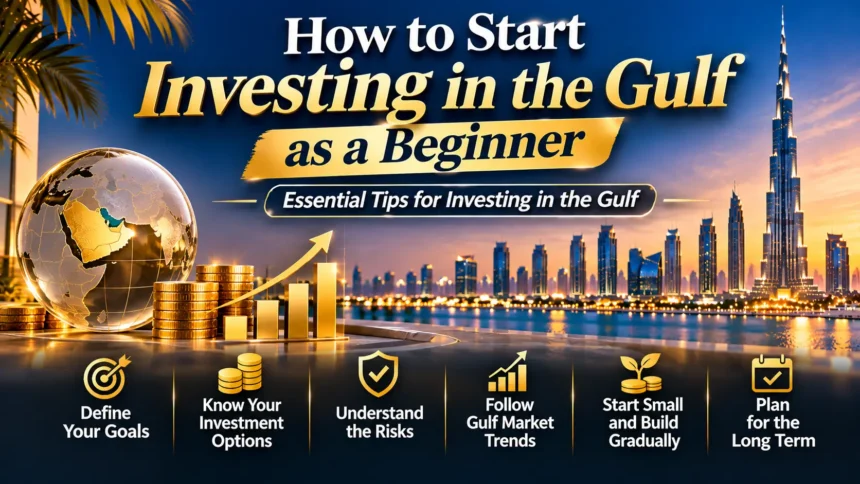
How to Start Investing in the Gulf as a Beginner
The Gulf region has become an important destination for investors looking to build wealth, establish financial security and explore new business opportunities. Countries such as the United Arab Emirates, Saudi Arabia, Qatar, Oman, Bahrain and Kuwait offer different investment options for residents and international investors.
- 1. Understanding the Investment Market in the Gulf
- 2. Build a Financial Plan Before You Start Investing
- 3. Explore the Best Investment Options in the Gulf for Beginners
- 4. How to Open an Investment Account in Gulf Countries
- 5. How Much Money Do You Need to Start Investing in the Gulf?
- 6. Understand Investment Risks and Avoid Common Beginner Mistakes
- 7. Understand Investment Regulations, Taxes and Islamic Finance
- 8. Create a Long-Term Investment Strategy and Start With Confidence
- Conclusion
- Frequently Asked Questions About Investing in the Gulf
From stock markets and real estate to mutual funds, gold and Islamic investments, there are several ways to start investing in the Gulf. However, beginners often find it difficult to understand where to begin, how much money they need and which investments are suitable for their financial goals.
Many people believe that investing requires a large amount of money or advanced financial knowledge. In reality, beginners can start with smaller amounts, provided they understand the risks and choose suitable financial products.
The most important step is to develop a clear financial plan rather than chasing quick profits. Understanding investment opportunities, choosing licensed financial institutions and managing risks can help beginners make better decisions.
Whether you are an expatriate working in Dubai, a resident of Saudi Arabia or an international investor interested in the Middle East, this guide explains how to start investing in the Gulf as a beginner.
1. Understanding the Investment Market in the Gulf
The Gulf Cooperation Council (GCC) consists of six countries: the UAE, Saudi Arabia, Qatar, Kuwait, Bahrain and Oman. Each country has its own financial markets, investment regulations and economic development strategies.
The Gulf investment market is worth around $4 trillion and is supported by sovereign wealth funds, currencies linked to the US dollar, and government-led efforts to grow different industries across the six GCC countries.
Gulf economies are strongly supported by large government investment funds, such as Saudi Arabia’s PIF and Abu Dhabi’s Mubadala and ADIA.
The region also has around $2.1 trillion in planned investments. Many listed companies work with the government or benefit from major projects in areas such as infrastructure, utilities, and tourism.
Historically, many Gulf economies depended heavily on oil and gas revenues. However, governments across the region have invested in tourism, technology, healthcare, infrastructure, renewable energy, logistics and financial services.
This economic diversification has created new investment opportunities across different industries.
The Gulf region also benefits from its geographical position between Asia, Europe and Africa. Its international connectivity, modern infrastructure and growing financial centres make it attractive to businesses and investors.
Major investment markets in the Gulf
| Country | Major Stock Exchange | Important Investment Sectors |
|---|---|---|
| UAE | Dubai Financial Market and Abu Dhabi Securities Exchange | Real estate, banking, tourism and technology |
| Saudi Arabia | Saudi Exchange (Tadawul) | Energy, infrastructure, banking and industrial development |
| Qatar | Qatar Stock Exchange | Natural gas, banking and telecommunications |
| Kuwait | Boursa Kuwait | Banking, financial services and real estate |
| Bahrain | Bahrain Bourse | Financial services, manufacturing and Islamic finance |
| Oman | Muscat Stock Exchange | Energy, logistics, tourism and industrial development |
For beginners, understanding these markets is important because investment performance depends on several factors, including economic conditions, government policies and business growth.
An investment that performs well in one country may not deliver similar results elsewhere.
Although Gulf countries offer attractive opportunities, investors should avoid assuming that every regional business or development project will generate profits.
2. Build a Financial Plan Before You Start Investing
Before investing money, beginners should understand their current financial situation. Investing without a clear plan can lead to unnecessary financial pressure, particularly when markets experience sudden changes.
The first step is to identify why you want to invest.
Some people invest to purchase a home, while others want to prepare for retirement, support their children’s education or build long-term wealth.
Your financial goals will influence the type of investments you choose and the amount of risk you can afford to take.
Set clear investment goals
| Financial Goal | Example Time Period | Possible Investment Approach |
|---|---|---|
| Emergency savings | Immediate | Accessible bank savings |
| Purchasing a vehicle | 1–3 years | Savings and suitable short-term deposits |
| Buying a home | 3–7 years | Lower-risk investments, depending on the timeline |
| Children’s education | 5–15 years | Diversified investments |
| Building long-term wealth | 10 years or more | Diversified funds and other suitable assets |
| Retirement planning | 15–30 years | Long-term diversified investment portfolio |
These are general examples. The right investment approach depends on individual financial circumstances.
Create an emergency fund
An emergency fund is money kept aside for unexpected expenses such as medical treatment, unemployment, urgent travel or family responsibilities.
A common financial planning approach is to maintain savings covering approximately three to six months of essential living expenses.
Expatriates in the Gulf may need additional emergency savings because employment changes can sometimes affect residency arrangements and relocation costs.
Before investing, beginners should:
- Calculate their monthly income and expenses.
- Identify unnecessary spending.
- Pay off expensive debts where possible.
- Build an emergency fund.
- Establish clear financial goals.
- Understand how much money they can afford to invest.
- Avoid investing money needed for immediate expenses.
A strong financial foundation allows investors to make decisions without being forced to sell investments during unfavourable market conditions.
3. Explore the Best Investment Options in the Gulf for Beginners
The Gulf offers several investment options suitable for different budgets, financial goals and risk levels.
Beginners should understand how each investment works before committing their money.
Stock market investments
Buying stocks means purchasing a small ownership share in a company. Investors may earn money when share prices increase or when companies distribute part of their profits through dividends.
Major Gulf stock markets include the Dubai Financial Market, Abu Dhabi Securities Exchange and Saudi Exchange.
However, stock prices can fall because of economic changes, business performance and international market conditions.
Beginners should research companies rather than purchasing shares simply because they are popular.
Mutual funds
Mutual funds collect money from multiple investors and use it to purchase different financial assets.
Professional fund managers oversee these investments according to the objectives of the fund.
Mutual funds can provide access to several companies or asset types without requiring investors to select every investment individually. However, management fees and market risks must be considered.
Exchange-traded funds (ETFs)
Exchange-traded funds are investment funds that can be purchased and sold on stock exchanges.
Many ETFs follow market indexes, allowing investors to gain exposure to multiple companies through a single investment.
Broadly diversified ETFs can be useful for beginners who want to reduce their dependence on the performance of individual companies.
However, not every ETF is diversified. Some focus on a single industry, country or commodity.
Real estate investment
Real estate remains a popular investment option in the Gulf, particularly in cities such as Dubai, Abu Dhabi, Riyadh and Doha.
Investors may earn rental income or benefit from an increase in property value.
However, direct property investment generally requires substantial capital. Maintenance costs, service charges, registration fees and periods without tenants can affect returns.
Real estate investment trusts, commonly known as REITs, may provide an alternative for investors who want exposure to property without purchasing an entire building or apartment.
Gold investment
Gold has strong cultural and financial importance across the Middle East. Investors can purchase gold bars, coins or suitable gold-backed investment products.
Gold may help diversify an investment portfolio, but its price can fluctuate, and physical gold does not normally generate regular income.
Bonds and Sukuk
Bonds generally allow investors to lend money to governments or companies in exchange for agreed payments.
Sukuk are Islamic financial certificates structured around eligible assets, ownership interests or investment arrangements that comply with relevant Islamic finance principles.
Both can provide income opportunities, but they carry risks related to the issuer, market conditions and the structure of the investment.
| Investment Option | General Risk Level | Main Purpose |
|---|---|---|
| Bank savings and deposits | Relatively low | Preserving capital and short-term savings |
| Government bonds and Sukuk | Low to moderate | Income and diversification |
| Diversified mutual funds | Varies by fund | Long-term financial goals |
| Broad-market ETFs | Moderate to high | Diversified market exposure |
| Individual stocks | Moderate to high | Capital growth and potential dividends |
| Gold | Moderate | Portfolio diversification |
| REITs | Moderate to high | Property market exposure |
| Direct real estate | Moderate to high | Rental income and potential growth |
| Cryptocurrency | Very high | Speculative investment |
Risk levels are general descriptions. Actual risks vary considerably depending on the individual product and market conditions.
4. How to Open an Investment Account in Gulf Countries
Opening an investment account is an important practical step for anyone interested in investing in the Gulf.
The exact process depends on the country, financial institution, investor’s nationality and residency status.
Many stock exchanges require investors to obtain an identification number before they can purchase and sell listed securities.
Investing in the UAE
Individuals interested in the UAE stock market can obtain an investor number through the Dubai Financial Market or Abu Dhabi Securities Exchange.
They can then open a trading account with an appropriately licensed brokerage firm.
Applications may be completed through official exchange applications, approved brokers or other authorised channels.
Investing in Saudi Arabia
Saudi Arabia has introduced several reforms to improve international investor participation.
From February 1, 2026, the Saudi Capital Market Authority opened direct access to its Main Market to all categories of foreign investors by removing the previous Qualified Foreign Investor requirements.
However, applicable ownership limits, account-opening procedures and restrictions on certain securities must still be followed.
Investing in other GCC countries
Qatar, Bahrain, Kuwait and Oman also provide access to their financial markets through approved exchanges and brokerage firms.
| Country | General Account-Opening Requirement |
|---|---|
| UAE | Exchange investor number and brokerage account |
| Saudi Arabia | Investment account through an authorised institution |
| Qatar | Securities depository registration and brokerage account |
| Bahrain | Investor account and approved broker |
| Kuwait | Trading account through approved market channels |
| Oman | Investor number and licensed brokerage account |
Common documents required may include:
- Valid passport.
- National identity card or residence permit, where applicable.
- Bank account information.
- Proof of residential address.
- Contact information.
- Tax residency details.
- Proof of income or source of funds, where required.
After opening an account, beginners should understand the platform’s charges, trading procedures and withdrawal conditions before making their first investment.
It is also important to check whether the platform allows investors to retain or transfer their investments if they move to another country.
5. How Much Money Do You Need to Start Investing in the Gulf?
One of the most common questions among beginners is how much money they need to start investing.
There is no universal minimum investment amount across the Gulf. Different banks, brokers and investment products have different requirements.
Some investment platforms allow relatively small contributions, while direct real estate investments and certain financial products require considerably larger amounts.
Rather than waiting until you have a large amount of money, consider whether smaller, regular investments are suitable for your financial situation.
Example monthly investment contributions
| Monthly Investment | Total After 1 Year | Total After 5 Years | Total After 10 Years |
|---|---|---|---|
| AED 100 | AED 1,200 | AED 6,000 | AED 12,000 |
| AED 250 | AED 3,000 | AED 15,000 | AED 30,000 |
| AED 500 | AED 6,000 | AED 30,000 | AED 60,000 |
| AED 1,000 | AED 12,000 | AED 60,000 | AED 120,000 |
| AED 2,000 | AED 24,000 | AED 120,000 | AED 240,000 |
These figures represent personal contributions only. They do not include investment returns, losses, fees or taxes.
Understanding compound growth
Compound growth occurs when investment earnings are reinvested and may generate additional earnings over time.
For example, if an individual invests AED 500 every month for 20 years, their total personal contributions will reach AED 120,000.
With positive investment returns that are reinvested, the final value could be higher. However, poor market performance, fees and other expenses could reduce the amount.
Investment returns are never guaranteed.
Beginners should also pay attention to minimum transaction charges. Investing very small amounts frequently may become expensive if the platform charges a fixed fee on every transaction.
Starting with an affordable amount and gradually increasing contributions as income improves can help develop sustainable financial habits.
6. Understand Investment Risks and Avoid Common Beginner Mistakes
To reduce risks when investing in the Gulf, avoid putting all your money into one industry. Always check whether an investment platform is properly licensed, and be aware of extra currency conversion fees and financial products that charge high commissions.
Every investment involves some level of risk. Even relatively conservative financial products may face challenges related to inflation, interest rates or the financial strength of the institution providing them.
The goal of investing is not to eliminate every risk but to understand and manage it.
Diversify your investment portfolio
Diversification means spreading money across different investments rather than placing everything into one company, industry or asset.
For example, an investor who places all their savings in a single Gulf real estate company could experience substantial losses if that company faces financial difficulties.
Investing across different companies, industries, countries and asset types can reduce dependence on one investment.
However, diversification does not guarantee profits or prevent all losses.
Common investment mistakes beginners should avoid
- Investing without an emergency fund.
- Borrowing money to invest in risky assets.
- Following unverified social media investment advice.
- Expecting guaranteed high returns.
- Investing all savings in one company.
- Ignoring management and trading fees.
- Making emotional decisions during market declines.
- Purchasing financial products without understanding them.
- Frequently buying and selling without a clear strategy.
- Ignoring currency exchange risks.
Be careful with investment scams
Investment scams can target residents through social media advertisements, messaging applications, telephone calls and fake financial websites.
Some fraudulent businesses promise unusually high returns or claim that their investments have no financial risk.
Warning signs may include pressure to invest immediately, requests to transfer money into personal bank accounts and promises of guaranteed daily or monthly profits.
Always verify the company’s licence directly through the relevant financial regulator. A professional-looking website, business registration or social media following does not prove that a company is authorised to provide investment services.
If an investment sounds too good to be true, take additional time to investigate before sending money.
7. Understand Investment Regulations, Taxes and Islamic Finance
The Gulf countries have established financial regulatory systems designed to supervise financial institutions and support investor protection.
Before investing, beginners should confirm that their chosen financial service provider holds the correct permission for the activity it offers.
Major financial regulators in the Gulf
| Country | Main Securities Market Regulator |
|---|---|
| UAE | Capital Market Authority (formerly SCA) |
| Saudi Arabia | Capital Market Authority |
| Qatar | Qatar Financial Markets Authority |
| Kuwait | Capital Markets Authority |
| Bahrain | Central Bank of Bahrain |
| Oman | Financial Services Authority |
The UAE also has separate financial regulatory authorities within its international financial centres.
The Dubai Financial Services Authority (DFSA) regulates financial services within the Dubai International Financial Centre, while the Financial Services Regulatory Authority (FSRA) operates within Abu Dhabi Global Market.
Understanding investment taxes
Tax rules vary across Gulf countries and depend on the investor’s residency status, investment type and financial activities.
In the UAE, qualifying personal investment income earned by individuals is generally excluded from corporate taxation. This can include dividends and capital gains from securities held in a personal capacity.
However, investments made through businesses may be subject to different tax rules.
International investors must also consider tax obligations in their home countries. Foreign dividend withholding taxes, reporting obligations and other charges may reduce actual investment returns.
Islamic investment options
Islamic finance is an important part of the Gulf’s financial industry.
Investors who prefer Sharia-compliant investments can explore products structured according to Islamic financial principles.
These may include:
- Sharia-compliant stocks.
- Islamic mutual funds.
- Sharia-compliant ETFs.
- Sukuk.
- Islamic bank investment accounts.
- Sharia-compliant real estate funds.
Beginners should review the product’s Sharia certification, financial structure, fees and risk information before investing.
A Sharia-compliant investment can still experience financial losses. Compliance with religious principles does not guarantee investment performance.
8. Create a Long-Term Investment Strategy and Start With Confidence
Successful investing generally requires patience, discipline and regular financial planning.
Beginners should focus on creating an investment strategy that matches their income, financial goals and ability to tolerate losses.
Rather than constantly searching for the next profitable investment, consider developing a consistent approach that can be maintained over several years.
Step-by-step investment checklist for beginners
- Set clear short-term and long-term financial goals.
- Build sufficient emergency savings.
- Reduce expensive debt.
- Decide how much money you can invest regularly.
- Learn about available investment options.
- Choose an appropriately licensed investment platform.
- Understand all fees and withdrawal conditions.
- Diversify across suitable investments.
- Monitor your investment portfolio periodically.
- Review your financial strategy when personal circumstances change.
Remember that a financial plan should remain flexible. Changes in employment, income, family responsibilities or residency status may require adjustments to your investment strategy.
Conclusion
Learning how to start investing in the Gulf as a beginner begins with understanding your financial goals, available investment options and the risks associated with each decision.
The UAE, Saudi Arabia, Qatar, Kuwait, Bahrain and Oman offer various opportunities for individuals interested in building long-term wealth.
From stock market investments and mutual funds to gold, real estate and Islamic finance, investors can explore different financial products according to their budgets and preferences.
However, successful investing is not about finding quick profits. It requires financial discipline, patience, research and responsible decision-making.
By starting with affordable amounts, using licensed financial institutions and maintaining a diversified investment portfolio, beginners can develop healthier financial habits and work towards long-term financial security.
The Gulf’s developing economies continue to create new opportunities, but the most valuable investment any beginner can make is in their own financial knowledge.
Frequently Asked Questions About Investing in the Gulf
Can expatriates invest in the Gulf countries?
Yes. Many Gulf countries allow expatriates and international investors to access financial markets, subject to local regulations and eligibility requirements.
Can I start investing with AED 100?
Some financial products and platforms may accept small investment amounts. However, minimum deposits, transaction fees and product availability vary.
What is the best investment for beginners in the Gulf?
There is no single best investment for everyone. Suitable options may include bank deposits, diversified funds, ETFs or Sukuk, depending on financial goals and risk tolerance.
Can foreigners invest in the Saudi stock market?
Yes. Saudi Arabia expanded direct Main Market access to all categories of foreign investors from February 1, 2026, subject to applicable regulations.
Is investing in Dubai tax-free?
Qualifying personal investment income is generally excluded from UAE corporate tax. However, foreign taxes, transaction fees and other financial obligations may apply.
Is real estate a good investment in the Gulf?
Real estate may generate rental income and capital growth, but property prices can decline, and ownership involves additional expenses.
Can I earn passive income through investments?
Certain investments may generate passive income through dividends, rental payments or other distributions. However, payments can change or stop.
Is cryptocurrency suitable for beginners?
Cryptocurrency carries significant financial risks because of price volatility, fraud risks and changing regulations. Beginners should not invest in products they do not understand.How to Start Investing in the Gulf as a Beginner
The Gulf region has become an important destination for investors looking to build wealth, establish financial security and explore new business opportunities. Countries such as the United Arab Emirates, Saudi Arabia, Qatar, Oman, Bahrain and Kuwait offer different investment options for residents and international investors.
From stock markets and real estate to mutual funds, gold and Islamic investments, there are several ways to start investing in the Gulf. However, beginners often find it difficult to understand where to begin, how much money they need and which investments are suitable for their financial goals.
Many people believe that investing requires a large amount of money or advanced financial knowledge. In reality, beginners can start with smaller amounts, provided they understand the risks and choose suitable financial products.
The most important step is to develop a clear financial plan rather than chasing quick profits. Understanding investment opportunities, choosing licensed financial institutions and managing risks can help beginners make better decisions.
Whether you are an expatriate working in Dubai, a resident of Saudi Arabia or an international investor interested in the Middle East, this guide explains how to start investing in the Gulf as a beginner.
1. Understanding the Investment Market in the Gulf
The Gulf Cooperation Council (GCC) consists of six countries: the UAE, Saudi Arabia, Qatar, Kuwait, Bahrain and Oman. Each country has its own financial markets, investment regulations and economic development strategies.
The Gulf investment market is worth around $4 trillion and is supported by sovereign wealth funds, currencies linked to the US dollar, and government-led efforts to grow different industries across the six GCC countries.
Gulf economies are strongly supported by large government investment funds, such as Saudi Arabia’s PIF and Abu Dhabi’s Mubadala and ADIA.
The region also has around $2.1 trillion in planned investments. Many listed companies work with the government or benefit from major projects in areas such as infrastructure, utilities, and tourism.
Historically, many Gulf economies depended heavily on oil and gas revenues. However, governments across the region have invested in tourism, technology, healthcare, infrastructure, renewable energy, logistics and financial services.
This economic diversification has created new investment opportunities across different industries.
The Gulf region also benefits from its geographical position between Asia, Europe and Africa. Its international connectivity, modern infrastructure and growing financial centres make it attractive to businesses and investors.
Major investment markets in the Gulf
| Country | Major Stock Exchange | Important Investment Sectors |
|---|---|---|
| UAE | Dubai Financial Market and Abu Dhabi Securities Exchange | Real estate, banking, tourism and technology |
| Saudi Arabia | Saudi Exchange (Tadawul) | Energy, infrastructure, banking and industrial development |
| Qatar | Qatar Stock Exchange | Natural gas, banking and telecommunications |
| Kuwait | Boursa Kuwait | Banking, financial services and real estate |
| Bahrain | Bahrain Bourse | Financial services, manufacturing and Islamic finance |
| Oman | Muscat Stock Exchange | Energy, logistics, tourism and industrial development |
For beginners, understanding these markets is important because investment performance depends on several factors, including economic conditions, government policies and business growth.
An investment that performs well in one country may not deliver similar results elsewhere.
Although Gulf countries offer attractive opportunities, investors should avoid assuming that every regional business or development project will generate profits.
2. Build a Financial Plan Before You Start Investing
Before investing money, beginners should understand their current financial situation. Investing without a clear plan can lead to unnecessary financial pressure, particularly when markets experience sudden changes.
The first step is to identify why you want to invest.
Some people invest to purchase a home, while others want to prepare for retirement, support their children’s education or build long-term wealth.
Your financial goals will influence the type of investments you choose and the amount of risk you can afford to take.
Set clear investment goals
| Financial Goal | Example Time Period | Possible Investment Approach |
|---|---|---|
| Emergency savings | Immediate | Accessible bank savings |
| Purchasing a vehicle | 1–3 years | Savings and suitable short-term deposits |
| Buying a home | 3–7 years | Lower-risk investments, depending on the timeline |
| Children’s education | 5–15 years | Diversified investments |
| Building long-term wealth | 10 years or more | Diversified funds and other suitable assets |
| Retirement planning | 15–30 years | Long-term diversified investment portfolio |
These are general examples. The right investment approach depends on individual financial circumstances.
Create an emergency fund
An emergency fund is money kept aside for unexpected expenses such as medical treatment, unemployment, urgent travel or family responsibilities.
A common financial planning approach is to maintain savings covering approximately three to six months of essential living expenses.
Expatriates in the Gulf may need additional emergency savings because employment changes can sometimes affect residency arrangements and relocation costs.
Before investing, beginners should:
- Calculate their monthly income and expenses.
- Identify unnecessary spending.
- Pay off expensive debts where possible.
- Build an emergency fund.
- Establish clear financial goals.
- Understand how much money they can afford to invest.
- Avoid investing money needed for immediate expenses.
A strong financial foundation allows investors to make decisions without being forced to sell investments during unfavourable market conditions.
3. Explore the Best Investment Options in the Gulf for Beginners
The Gulf offers several investment options suitable for different budgets, financial goals and risk levels.
Beginners should understand how each investment works before committing their money.
Stock market investments
Buying stocks means purchasing a small ownership share in a company. Investors may earn money when share prices increase or when companies distribute part of their profits through dividends.
Major Gulf stock markets include the Dubai Financial Market, Abu Dhabi Securities Exchange and Saudi Exchange.
However, stock prices can fall because of economic changes, business performance and international market conditions.
Beginners should research companies rather than purchasing shares simply because they are popular.
Mutual funds
Mutual funds collect money from multiple investors and use it to purchase different financial assets.
Professional fund managers oversee these investments according to the objectives of the fund.
Mutual funds can provide access to several companies or asset types without requiring investors to select every investment individually. However, management fees and market risks must be considered.
Exchange-traded funds (ETFs)
Exchange-traded funds are investment funds that can be purchased and sold on stock exchanges.
Many ETFs follow market indexes, allowing investors to gain exposure to multiple companies through a single investment.
Broadly diversified ETFs can be useful for beginners who want to reduce their dependence on the performance of individual companies.
However, not every ETF is diversified. Some focus on a single industry, country or commodity.
Real estate investment
Real estate remains a popular investment option in the Gulf, particularly in cities such as Dubai, Abu Dhabi, Riyadh and Doha.
Investors may earn rental income or benefit from an increase in property value.
However, direct property investment generally requires substantial capital. Maintenance costs, service charges, registration fees and periods without tenants can affect returns.
Real estate investment trusts, commonly known as REITs, may provide an alternative for investors who want exposure to property without purchasing an entire building or apartment.
Gold investment
Gold has strong cultural and financial importance across the Middle East. Investors can purchase gold bars, coins or suitable gold-backed investment products.
Gold may help diversify an investment portfolio, but its price can fluctuate, and physical gold does not normally generate regular income.
Bonds and Sukuk
Bonds generally allow investors to lend money to governments or companies in exchange for agreed payments.
Sukuk are Islamic financial certificates structured around eligible assets, ownership interests or investment arrangements that comply with relevant Islamic finance principles.
Both can provide income opportunities, but they carry risks related to the issuer, market conditions and the structure of the investment.
| Investment Option | General Risk Level | Main Purpose |
|---|---|---|
| Bank savings and deposits | Relatively low | Preserving capital and short-term savings |
| Government bonds and Sukuk | Low to moderate | Income and diversification |
| Diversified mutual funds | Varies by fund | Long-term financial goals |
| Broad-market ETFs | Moderate to high | Diversified market exposure |
| Individual stocks | Moderate to high | Capital growth and potential dividends |
| Gold | Moderate | Portfolio diversification |
| REITs | Moderate to high | Property market exposure |
| Direct real estate | Moderate to high | Rental income and potential growth |
| Cryptocurrency | Very high | Speculative investment |
Risk levels are general descriptions. Actual risks vary considerably depending on the individual product and market conditions.
4. How to Open an Investment Account in Gulf Countries
Opening an investment account is an important practical step for anyone interested in investing in the Gulf.
The exact process depends on the country, financial institution, investor’s nationality and residency status.
Many stock exchanges require investors to obtain an identification number before they can purchase and sell listed securities.
Investing in the UAE
Individuals interested in the UAE stock market can obtain an investor number through the Dubai Financial Market or Abu Dhabi Securities Exchange.
They can then open a trading account with an appropriately licensed brokerage firm.
Applications may be completed through official exchange applications, approved brokers or other authorised channels.
Investing in Saudi Arabia
Saudi Arabia has introduced several reforms to improve international investor participation.
From February 1, 2026, the Saudi Capital Market Authority opened direct access to its Main Market to all categories of foreign investors by removing the previous Qualified Foreign Investor requirements.
However, applicable ownership limits, account-opening procedures and restrictions on certain securities must still be followed.
Investing in other GCC countries
Qatar, Bahrain, Kuwait and Oman also provide access to their financial markets through approved exchanges and brokerage firms.
| Country | General Account-Opening Requirement |
|---|---|
| UAE | Exchange investor number and brokerage account |
| Saudi Arabia | Investment account through an authorised institution |
| Qatar | Securities depository registration and brokerage account |
| Bahrain | Investor account and approved broker |
| Kuwait | Trading account through approved market channels |
| Oman | Investor number and licensed brokerage account |
Common documents required may include:
- Valid passport.
- National identity card or residence permit, where applicable.
- Bank account information.
- Proof of residential address.
- Contact information.
- Tax residency details.
- Proof of income or source of funds, where required.
After opening an account, beginners should understand the platform’s charges, trading procedures and withdrawal conditions before making their first investment.
It is also important to check whether the platform allows investors to retain or transfer their investments if they move to another country.
5. How Much Money Do You Need to Start Investing in the Gulf?
One of the most common questions among beginners is how much money they need to start investing.
There is no universal minimum investment amount across the Gulf. Different banks, brokers and investment products have different requirements.
Some investment platforms allow relatively small contributions, while direct real estate investments and certain financial products require considerably larger amounts.
Rather than waiting until you have a large amount of money, consider whether smaller, regular investments are suitable for your financial situation.
Example monthly investment contributions
| Monthly Investment | Total After 1 Year | Total After 5 Years | Total After 10 Years |
|---|---|---|---|
| AED 100 | AED 1,200 | AED 6,000 | AED 12,000 |
| AED 250 | AED 3,000 | AED 15,000 | AED 30,000 |
| AED 500 | AED 6,000 | AED 30,000 | AED 60,000 |
| AED 1,000 | AED 12,000 | AED 60,000 | AED 120,000 |
| AED 2,000 | AED 24,000 | AED 120,000 | AED 240,000 |
These figures represent personal contributions only. They do not include investment returns, losses, fees or taxes.
Understanding compound growth
Compound growth occurs when investment earnings are reinvested and may generate additional earnings over time.
For example, if an individual invests AED 500 every month for 20 years, their total personal contributions will reach AED 120,000.
With positive investment returns that are reinvested, the final value could be higher. However, poor market performance, fees and other expenses could reduce the amount.
Investment returns are never guaranteed.
Beginners should also pay attention to minimum transaction charges. Investing very small amounts frequently may become expensive if the platform charges a fixed fee on every transaction.
Starting with an affordable amount and gradually increasing contributions as income improves can help develop sustainable financial habits.
6. Understand Investment Risks and Avoid Common Beginner Mistakes
To reduce risks when investing in the Gulf, avoid putting all your money into one industry. Always check whether an investment platform is properly licensed, and be aware of extra currency conversion fees and financial products that charge high commissions.
Every investment involves some level of risk. Even relatively conservative financial products may face challenges related to inflation, interest rates or the financial strength of the institution providing them.
The goal of investing is not to eliminate every risk but to understand and manage it.
Diversify your investment portfolio
Diversification means spreading money across different investments rather than placing everything into one company, industry or asset.
For example, an investor who places all their savings in a single Gulf real estate company could experience substantial losses if that company faces financial difficulties.
Investing across different companies, industries, countries and asset types can reduce dependence on one investment.
However, diversification does not guarantee profits or prevent all losses.
Common investment mistakes beginners should avoid
- Investing without an emergency fund.
- Borrowing money to invest in risky assets.
- Following unverified social media investment advice.
- Expecting guaranteed high returns.
- Investing all savings in one company.
- Ignoring management and trading fees.
- Making emotional decisions during market declines.
- Purchasing financial products without understanding them.
- Frequently buying and selling without a clear strategy.
- Ignoring currency exchange risks.
Be careful with investment scams
Investment scams can target residents through social media advertisements, messaging applications, telephone calls and fake financial websites.
Some fraudulent businesses promise unusually high returns or claim that their investments have no financial risk.
Warning signs may include pressure to invest immediately, requests to transfer money into personal bank accounts and promises of guaranteed daily or monthly profits.
Always verify the company’s licence directly through the relevant financial regulator. A professional-looking website, business registration or social media following does not prove that a company is authorised to provide investment services.
If an investment sounds too good to be true, take additional time to investigate before sending money.
7. Understand Investment Regulations, Taxes and Islamic Finance
The Gulf countries have established financial regulatory systems designed to supervise financial institutions and support investor protection.
Before investing, beginners should confirm that their chosen financial service provider holds the correct permission for the activity it offers.
Major financial regulators in the Gulf
| Country | Main Securities Market Regulator |
|---|---|
| UAE | Capital Market Authority (formerly SCA) |
| Saudi Arabia | Capital Market Authority |
| Qatar | Qatar Financial Markets Authority |
| Kuwait | Capital Markets Authority |
| Bahrain | Central Bank of Bahrain |
| Oman | Financial Services Authority |
The UAE also has separate financial regulatory authorities within its international financial centres.
The Dubai Financial Services Authority (DFSA) regulates financial services within the Dubai International Financial Centre, while the Financial Services Regulatory Authority (FSRA) operates within Abu Dhabi Global Market.
Understanding investment taxes
Tax rules vary across Gulf countries and depend on the investor’s residency status, investment type and financial activities.
In the UAE, qualifying personal investment income earned by individuals is generally excluded from corporate taxation. This can include dividends and capital gains from securities held in a personal capacity.
However, investments made through businesses may be subject to different tax rules.
International investors must also consider tax obligations in their home countries. Foreign dividend withholding taxes, reporting obligations and other charges may reduce actual investment returns.
Islamic investment options
Islamic finance is an important part of the Gulf’s financial industry.
Investors who prefer Sharia-compliant investments can explore products structured according to Islamic financial principles.
These may include:
- Sharia-compliant stocks.
- Islamic mutual funds.
- Sharia-compliant ETFs.
- Sukuk.
- Islamic bank investment accounts.
- Sharia-compliant real estate funds.
Beginners should review the product’s Sharia certification, financial structure, fees and risk information before investing.
A Sharia-compliant investment can still experience financial losses. Compliance with religious principles does not guarantee investment performance.
8. Create a Long-Term Investment Strategy and Start With Confidence
Successful investing generally requires patience, discipline and regular financial planning.
Beginners should focus on creating an investment strategy that matches their income, financial goals and ability to tolerate losses.
Rather than constantly searching for the next profitable investment, consider developing a consistent approach that can be maintained over several years.
Step-by-step investment checklist for beginners
- Set clear short-term and long-term financial goals.
- Build sufficient emergency savings.
- Reduce expensive debt.
- Decide how much money you can invest regularly.
- Learn about available investment options.
- Choose an appropriately licensed investment platform.
- Understand all fees and withdrawal conditions.
- Diversify across suitable investments.
- Monitor your investment portfolio periodically.
- Review your financial strategy when personal circumstances change.
Remember that a financial plan should remain flexible. Changes in employment, income, family responsibilities or residency status may require adjustments to your investment strategy.
Conclusion
Learning how to start investing in the Gulf as a beginner begins with understanding your financial goals, available investment options and the risks associated with each decision.
The UAE, Saudi Arabia, Qatar, Kuwait, Bahrain and Oman offer various opportunities for individuals interested in building long-term wealth.
From stock market investments and mutual funds to gold, real estate and Islamic finance, investors can explore different financial products according to their budgets and preferences.
However, successful investing is not about finding quick profits. It requires financial discipline, patience, research and responsible decision-making.
By starting with affordable amounts, using licensed financial institutions and maintaining a diversified investment portfolio, beginners can develop healthier financial habits and work towards long-term financial security.
The Gulf’s developing economies continue to create new opportunities, but the most valuable investment any beginner can make is in their own financial knowledge.
Frequently Asked Questions About Investing in the Gulf
Can expatriates invest in the Gulf countries?
Yes. Many Gulf countries allow expatriates and international investors to access financial markets, subject to local regulations and eligibility requirements.
Can I start investing with AED 100?
Some financial products and platforms may accept small investment amounts. However, minimum deposits, transaction fees and product availability vary.
What is the best investment for beginners in the Gulf?
There is no single best investment for everyone. Suitable options may include bank deposits, diversified funds, ETFs or Sukuk, depending on financial goals and risk tolerance.
Can foreigners invest in the Saudi stock market?
Yes. Saudi Arabia expanded direct Main Market access to all categories of foreign investors from February 1, 2026, subject to applicable regulations.
Is investing in Dubai tax-free?
Qualifying personal investment income is generally excluded from UAE corporate tax. However, foreign taxes, transaction fees and other financial obligations may apply.
Is real estate a good investment in the Gulf?
Real estate may generate rental income and capital growth, but property prices can decline, and ownership involves additional expenses.
Can I earn passive income through investments?
Certain investments may generate passive income through dividends, rental payments or other distributions. However, payments can change or stop.
Is cryptocurrency suitable for beginners?
Cryptocurrency carries significant financial risks because of price volatility, fraud risks and changing regulations. Beginners should not invest in products they do not understand.
Do follow us on Instagram
Read More – How Much Money Do You Need to Retire in Dubai?