



Complete Guide to Employee Rights and Employer Obligations: Labour Law in UAE 2026
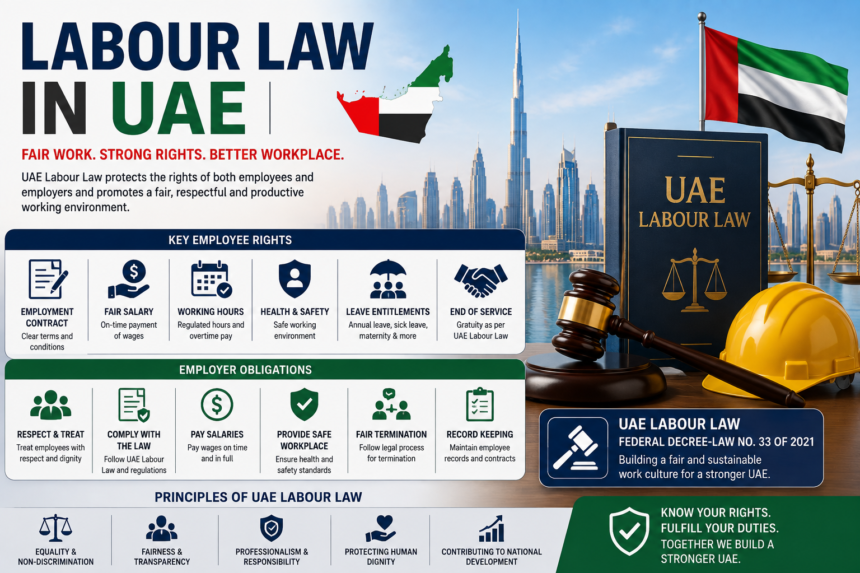
The Labour Law in UAE provides the legal framework governing employment relationships in the country’s private sector. It establishes important rights and responsibilities for employees and employers, covering employment contracts, working hours, salaries, overtime, annual leave, maternity leave, sick leave, workplace safety, discrimination, termination, end-of-service benefits and labour disputes.
- What Is the UAE Labour Law?
- Who Does the UAE Labour Law Apply To?
- Employment Contracts in the UAE
- What Employees Should Check
- Probation Period Under UAE Labour Law
- Working Hours Under UAE Labour Law
- Salary and Wage Protection in the UAE
- Annual Leave in the UAE
- Sick Leave Under UAE Labour Law
- Maternity Leave in the UAE
- Parental Leave in the UAE
- Compassionate and Other Types of Leave
- Equality and Non-Discrimination
- Protection Against Workplace Harassment and Abuse
- Workplace Health and Safety
- Termination of Employment Contracts
- Termination Without Notice
- Arbitrary or Unlawful Dismissal
- End-of-Service Gratuity in the UAE
- Labour Disputes in the UAE
- What Should Employees Do If Their Rights Are Violated?
- Employer Responsibilities Under UAE Labour Law
- Common UAE Labour Law Mistakes Employees Should Avoid
- Common Questions About Labour Law in UAE
- Why Understanding UAE Labour Law Matters
The main legislation governing private-sector employment is Federal Decree-Law No. 33 of 2021 Regarding the Regulation of Labour Relations, together with its amendments and implementing regulations. The law came into effect on 2 February 2022 and replaced the previous Federal Law No. 8 of 1980. It generally applies to private-sector employees in the UAE, including UAE nationals and expatriate workers, subject to specified exclusions.
For anyone working or planning to work in the UAE, understanding the country’s employment regulations is important. Employers also need to understand their obligations to ensure contracts, salaries, leave policies and workplace practices comply with applicable requirements.
This UAE Labour Law 2026 guide explains the key rules in simple language and highlights some of the most important employee rights and employer responsibilities.
What Is the UAE Labour Law?
The UAE Labour Law regulates the relationship between employers and employees in the private sector. It is designed to create a balanced employment environment while supporting an efficient labour market and protecting the rights of both parties.
The labour law in UAE covers areas including:
- Employment contracts
- Working hours
- Overtime
- Salaries and wage payments
- Annual leave
- Sick leave
- Maternity leave
- Parental leave
- Compassionate leave
- Workplace health and safety
- Work-related injuries
- Discrimination
- Harassment and workplace abuse
- Employment termination
- Notice periods
- End-of-service benefits
- Labour disputes
- Different work arrangements
The legislation also recognizes several employment models, including full-time, part-time, temporary, flexible, remote and job-sharing arrangements. It abolished the previous unlimited-contract model and provides for fixed-term employment contracts.
Who Does the UAE Labour Law Apply To?
The labour law in UAE generally applies to employees and employers in the private sector. It applies to both UAE nationals and expatriates working in covered private-sector employment.
However, not every worker in the UAE falls under the same legislation.
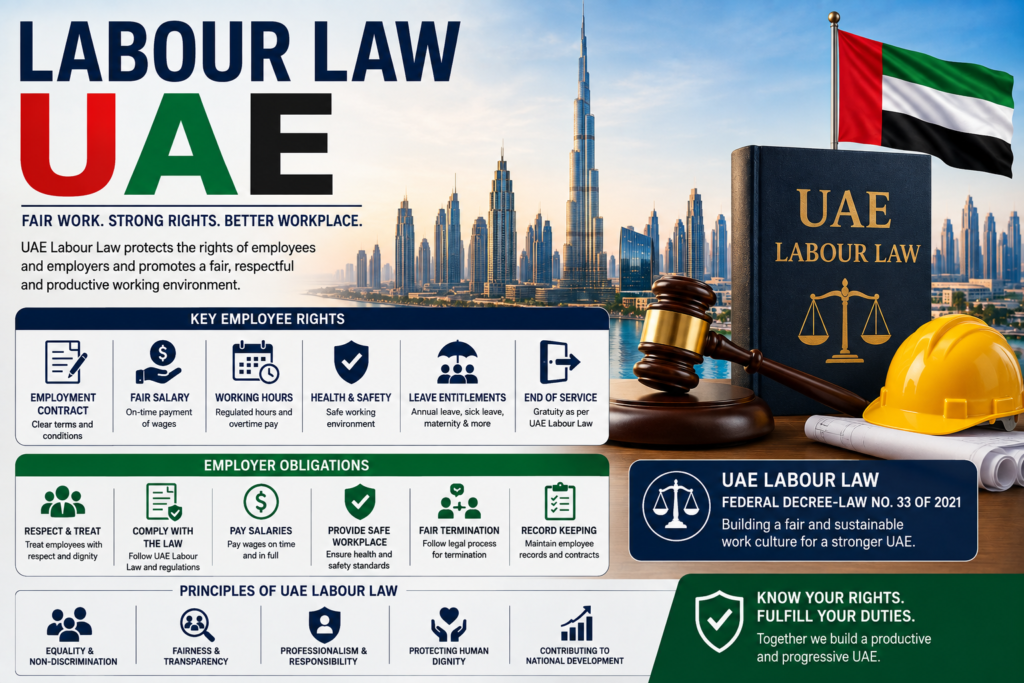
The official UAE Government platform states that the private-sector Labour Law does not apply to certain categories, including:
- Federal government employees
- Local government employees
- Members of the armed forces, police and security services
- Domestic workers
Domestic workers are regulated under separate legislation. Public-sector employees are also subject to different employment regulations.
Therefore, employees should first determine which employment law applies to their particular job before relying on general private-sector Labour Law provisions.
Employment Contracts in the UAE
A written employment contract is one of the most important documents in an employment relationship.
Under the current UAE employment framework, private-sector contracts are fixed-term contracts. A contract may be renewed or extended when the agreed term ends. If the parties continue to perform the contract after its expiry without formally renewing it, the contract can be treated as renewed under the applicable rules.
Employment arrangements can include:
- Full-time employment
- Part-time employment
- Temporary work
- Flexible work
- Remote work
- Job sharing
Employees should carefully review their contracts before accepting a position. The contract should clearly establish important terms such as job responsibilities, salary, benefits, working arrangements and notice requirements.
What Employees Should Check
Before signing an employment contract, employees should review:
- Job title and responsibilities
- Basic salary
- Allowances
- Payment schedule
- Working hours
- Overtime arrangements
- Annual leave
- Probation period
- Notice period
- Benefits
- Workplace location
- Contract duration
- Termination provisions
Keeping a copy of the signed contract is also important if a dispute arises later.
Probation Period Under UAE Labour Law
Employers may place an employee on probation, but the probation period cannot exceed six months.
If an employer terminates the employee during probation, the employer generally must provide written notice at least 14 days before termination. The law also establishes specific notice rules when a worker wants to move to another employer during probation or leave the UAE.
An employer cannot place the same worker on probation more than once with the same employer.
Employees should therefore understand their probation obligations before accepting another job during this period.
Working Hours Under UAE Labour Law
Normal working hours in the UAE private sector are generally eight hours per day or 48 hours per week.
Certain sectors and categories of workers may be subject to different arrangements under the implementing regulations. The law also provides specific rules for breaks and working patterns.
Workers generally should not work for more than five consecutive hours without one or more breaks totaling at least one hour, subject to applicable exceptions for certain work patterns and occupations.
During Ramadan, regular working hours are reduced by two hours per day under the applicable rules.
Overtime Rules
Employers may require overtime within the limits established by the law.
Generally, overtime should not exceed two hours per day, subject to specific exceptions. The total working hours are also subject to the statutory limits.
For eligible overtime, the worker is generally entitled to the normal hourly remuneration based on basic wage plus an additional amount of at least:
- 25% for ordinary overtime
- 50% for overtime worked between 10 pm and 4 am, subject to the rules and exclusions applicable to shift workers
- Work performed on the designated weekly rest day may qualify for a substitute rest day or additional payment under the law
These rules make it important for employees to understand how their employer calculates overtime.
Salary and Wage Protection in the UAE
One of the most important employee rights under UAE Labour Law is receiving wages on time.
Private-sector establishments registered with the Ministry of Human Resources and Emiratisation (MOHRE) are generally required to pay employees through the Wages Protection System (WPS) or another approved system.
The WPS helps monitor salary payments and reduces the risk of delayed or unpaid wages.
Employees who experience salary-payment problems can raise concerns with MOHRE and may register a salary complaint through the appropriate channels.
Why Salary Records Matter
Employees should retain:
- Employment contract
- Salary statements
- Bank records
- Payslips where available
- Written communications concerning salary
- Overtime records
- Leave records
These documents can become important evidence if a labour dispute occurs.
Annual Leave in the UAE
Annual leave is an important employee entitlement.
An employee who has completed at least one year of service is generally entitled to 30 days of fully paid annual leave. Employees whose service exceeds six months but is less than one year are generally entitled to two days of leave for each month of service.
Employees should coordinate annual leave with their employer according to workplace procedures and applicable legal requirements.
Unused leave may also have financial implications when employment ends, subject to the law and applicable calculations.
Sick Leave Under UAE Labour Law
After completing the probation period, an employee may generally receive up to 90 days of sick leave per year, whether continuous or intermittent.
The statutory payment structure is:
- First 15 days: full pay
- Next 30 days: half pay
- Remaining 45 days: unpaid
During probation, an employee is not entitled to paid sick leave, although an employer may grant unpaid sick leave based on a medical report from a recognized medical authority.
An employee should notify the employer about illness within the required period and provide the necessary medical documentation.
Maternity Leave in the UAE
Female employees in the private sector are entitled to 60 days of maternity leave.
The current statutory structure provides:
- 45 days of full-pay maternity leave
- 15 days of half-pay maternity leave
Additional leave may be available in certain circumstances involving illness related to pregnancy or childbirth, or where a newborn has a qualifying illness or disability, subject to the relevant medical documentation and legal conditions.
The law also provides nursing breaks after the employee returns to work. These breaks are paid and are available for six months following childbirth under the applicable rules.
Employers should ensure that workplace policies do not undermine statutory maternity rights.
Parental Leave in the UAE
The UAE private sector provides five working days of paid parental leave for eligible employees.
Both mothers and fathers may benefit from parental leave, which can generally be taken from the date of the child’s birth until the child reaches six months, subject to applicable requirements.
This provision is an important part of the UAE’s broader approach to supporting employees with family responsibilities.
Compassionate and Other Types of Leave
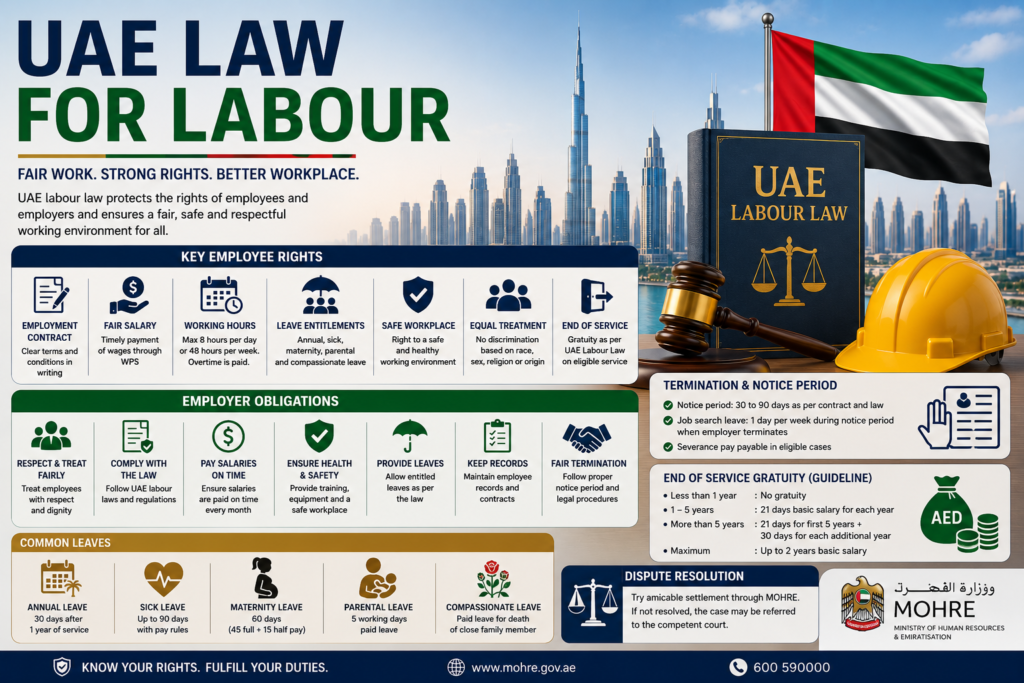
Private-sector employees may also be entitled to other types of leave under UAE employment regulations.
For example, compassionate leave includes:
- Five paid days following the death of a spouse
- Three paid days following the death of a parent, child, sibling, grandparent or grandchild
Other forms of leave may include study leave and leave associated with religious or national-service obligations, depending on eligibility.
Employees should check the applicable rules before making leave arrangements because eligibility and documentation requirements can differ depending on the type of leave.
Equality and Non-Discrimination
The UAE Labour Law prohibits discrimination in employment on several grounds.
The law prohibits discrimination based on factors including:
- Race
- Colour
- Sex
- Religion
- National or social origin
- Disability
The law also prohibits forced labour and provides protections concerning equal treatment and employment opportunities.
The Labour Law also provides that a woman must receive equal pay to a man when performing the same work or work of equal value, subject to the applicable legal framework.
These provisions are intended to promote a fairer and more balanced workplace.
Protection Against Workplace Harassment and Abuse
The UAE Labour Law addresses workplace conduct and provides protections against harassment, bullying, physical violence and psychological abuse.
Employers have a responsibility to maintain a safe and respectful working environment.
Employees who experience serious workplace misconduct should document relevant incidents and use appropriate internal and official reporting channels.
Keeping evidence such as emails, messages, written complaints and other relevant records can be important when dealing with an employment dispute.
Workplace Health and Safety
Employers are responsible for providing a safe working environment and complying with occupational health and safety requirements.
Work-related injuries and occupational illnesses are covered by specific protections under UAE law. Employers may be required to provide medical care, paid leave and compensation in qualifying cases.
For work-related incidents, employers also have reporting obligations. The official UAE Government platform states that employers are required to report work-related injuries or occupational illnesses to MOHRE within 48 hours of the incident under the applicable rules.
Employees should immediately report workplace accidents and seek appropriate medical assistance.
Termination of Employment Contracts
Either the employer or employee may terminate an employment contract, provided the applicable legal requirements and contractual notice provisions are followed.
Under the UAE Labour Law, the notice period generally must be:
At least 30 days and no more than 90 days.
During the notice period, the employment contract generally remains active and the employee is entitled to the applicable wage.
If one party fails to observe the required notice period, compensation may be payable to the other party.
Job Search Leave During Notice
When an employer terminates an employee’s contract, the worker is generally entitled to one unpaid day per week during the notice period to search for another job, subject to the conditions established by the law, including advance notification.
This provision can be particularly useful for employees who need time to attend interviews or explore new employment opportunities.
Termination Without Notice
The Labour Law also identifies circumstances in which an employer or employee may terminate the employment relationship without following the normal notice period.
For example, an employee may have grounds to terminate without notice when an employer seriously fails to meet contractual or legal obligations, or in certain cases involving assault, harassment, grave danger or fundamentally different work being assigned without the required consent.
Employers may also terminate without notice in specific serious misconduct situations defined by the law, subject to required procedures, including a written investigation.
Because termination without notice can have significant legal and financial consequences, employees and employers should obtain appropriate advice when the circumstances are disputed.
Arbitrary or Unlawful Dismissal
The Labour Law UAE protects employees from certain forms of retaliatory dismissal.
For example, termination may be considered unlawful if it occurs because an employee submitted a serious complaint to MOHRE or filed a lawsuit against the employer and the complaint or lawsuit is proven valid.
If arbitrary dismissal is established, compensation may be awarded by the competent court. The official UAE Government platform states that such compensation can be assessed based on factors including the type of work, damage suffered and duration of employment, subject to a maximum of three months’ wage under the relevant provision.
End-of-Service Gratuity in the UAE
End-of-service gratuity is one of the most searched aspects of UAE Labour Law.
For eligible full-time foreign workers in the private sector who have completed at least one year of continuous service, gratuity is generally calculated using the employee’s basic salary, rather than allowances such as housing or transportation.
The general calculation is:
- Less than one year of service: no statutory gratuity
- More than one year but less than five years: 21 days of basic wage for each year of service
- More than five years: 21 days for each of the first five years and 30 days for each additional year
The total gratuity is generally capped at the equivalent of two years’ wage.
Employers are required to settle outstanding wages, other applicable entitlements and end-of-service benefits within 14 days of termination of the employment contract, subject to the applicable rules.
Example of Gratuity Calculation
Suppose an eligible employee has:
- Basic salary: AED 10,000
- Continuous service: 3 years
For the first five years, the statutory formula is 21 days of basic wage per year.
The approximate daily basic wage would be:
AED 10,000 ÷ 30 = AED 333.33
Twenty-one days would therefore be approximately:
AED 333.33 × 21 = AED 7,000
For three years:
AED 7,000 × 3 = AED 21,000
This is a simplified illustration. Actual calculations can depend on the employee’s employment structure, service period, unpaid absences and applicable legal provisions.
Labour Disputes in the UAE
Employment disputes can involve salary payments, termination, leave, gratuity, contractual obligations or other employment rights.
The Ministry of Human Resources and Emiratisation plays an important role in resolving private-sector labour disputes.
An employee or employer can submit a labour complaint to MOHRE. The ministry examines the dispute and attempts to resolve it amicably. If an amicable settlement cannot be achieved within the applicable process, the dispute may be referred to the competent court.
MOHRE may also have authority to issue final decisions in certain disputes depending on the amount claimed and whether the parties reach a settlement. The official UAE Government platform currently states that MOHRE can issue a final decision where the amount claimed is below AED 50,000 or where the parties reach an amicable settlement, regardless of claim value.
What Should Employees Do If Their Rights Are Violated?
Employees who believe their employment rights have been violated should avoid ignoring the issue.
A sensible approach is to:
- Review the employment contract.
- Collect salary and employment records.
- Keep copies of relevant correspondence.
- Raise the issue with the employer where appropriate.
- Document the employer’s response.
- Contact MOHRE through official channels if the issue remains unresolved.
- Obtain legal advice for complex or high-value disputes.
Employees should avoid signing documents they do not understand, particularly documents relating to resignation, settlement or termination.
Employer Responsibilities Under UAE Labour Law
UAE Labour Law places several responsibilities on employers.
Important employer obligations include:
- Paying wages on time
- Following employment contract requirements
- Maintaining required employee records
- Providing a safe workplace
- Respecting statutory leave rights
- Complying with working-hour rules
- Paying applicable overtime
- Following lawful termination procedures
- Providing end-of-service benefits where applicable
- Avoiding discrimination
- Preventing workplace harassment and abuse
- Complying with wage-protection requirements
- Reporting applicable workplace injuries
Employers should also maintain clear HR policies and ensure managers understand applicable employment requirements.
Common UAE Labour Law Mistakes Employees Should Avoid
Employees can sometimes unintentionally weaken their position by failing to keep documentation or misunderstanding their contractual obligations.
Common mistakes include:
- Not reading the employment contract
- Assuming verbal promises are enough
- Ignoring unpaid salary issues
- Failing to keep salary records
- Resigning without understanding the notice period
- Leaving a job without following applicable procedures
- Signing a settlement without reviewing it
- Ignoring workplace safety issues
- Assuming every employee has identical benefits
- Confusing private-sector and government-sector rules
Understanding the law before a dispute occurs is usually much easier than trying to resolve a problem after it has escalated.
Common Questions About Labour Law in UAE
Q1. What is the normal working time in the UAE private sector?
Ans: The normal maximum working hours are generally eight hours per day or 48 hours per week, subject to statutory exceptions and special rules for certain categories and sectors.
Q2. How much annual leave do UAE private-sector employees receive?
Ans: Employees who complete one year of service are generally entitled to 30 days of paid annual leave. Those who have completed more than six months but less than one year generally receive two days for each month of service.
Q3. How long is the UAE Labour Law notice period?
Ans: The notice period is generally between 30 and 90 days, according to the applicable employment contract and legal requirements.
Q4. How much maternity leave is available in the UAE private sector?
Ans: Female private-sector employees are generally entitled to 60 days of maternity leave, consisting of 45 days at full pay and 15 days at half pay. Additional leave may be available in qualifying circumstances.
Q5. How many days of parental leave are available?
Ans: Eligible private-sector employees can receive five working days of paid parental leave, generally usable from the child’s birth until six months of age.
Q6. How is UAE end-of-service gratuity calculated?
Ans: For eligible full-time foreign workers with at least one year of continuous service, gratuity is generally based on basic salary: 21 days for each year during the first five years and 30 days for each additional year thereafter, subject to the statutory conditions and cap.
Why Understanding UAE Labour Law Matters
The UAE’s employment market includes millions of workers from different professional and cultural backgrounds. Clear labour regulations help establish expectations between employers and employees and provide mechanisms for addressing disputes.
For employees, understanding the Labour Law in UAE can help protect salary, leave, workplace safety and termination rights.
For employers, compliance can reduce disputes, improve workplace practices and support a more stable workforce.
The law is also important for businesses seeking to attract international talent. Clear employment contracts, reliable salary payments, fair treatment and professional HR policies can contribute to employee confidence and business reputation.
Final Thoughts on Labour Law in UAE
The UAE Labour Law 2026 provides a comprehensive framework for private-sector employment relationships. It covers nearly every major aspect of the employee-employer relationship, from hiring and working hours to leave, salary payments, workplace safety, termination and end-of-service benefits.
For employees, the most important step is to understand the terms of the employment contract and know the rights provided by applicable legislation. For employers, compliance should be treated as an ongoing responsibility rather than something considered only when a dispute occurs.
The UAE private-sector employment framework continues to evolve as the country’s labour market develops. Employees and businesses should therefore rely on current information from official UAE government and MOHRE sources when dealing with specific employment situations.
Most importantly, labour law is highly fact-specific. A general article cannot replace legal advice in a complex dispute, termination case, contractual disagreement or claim involving significant financial consequences.
Important Legal Disclaimer
This article is intended for general information and SEO/editorial purposes and does not constitute legal advice. UAE employment laws, regulations, ministerial decisions and administrative procedures may change. The article focuses primarily on the UAE private sector and does not cover every employment category or special regulatory regime. Readers should verify current requirements through official UAE government and MOHRE sources or consult a qualified UAE employment lawyer for individual cases.
Do follow us on Instagram
Read More – Your Complete UAE Labour Law Guide for Employees and Employers