Living in Bahrain for Expats in 2026
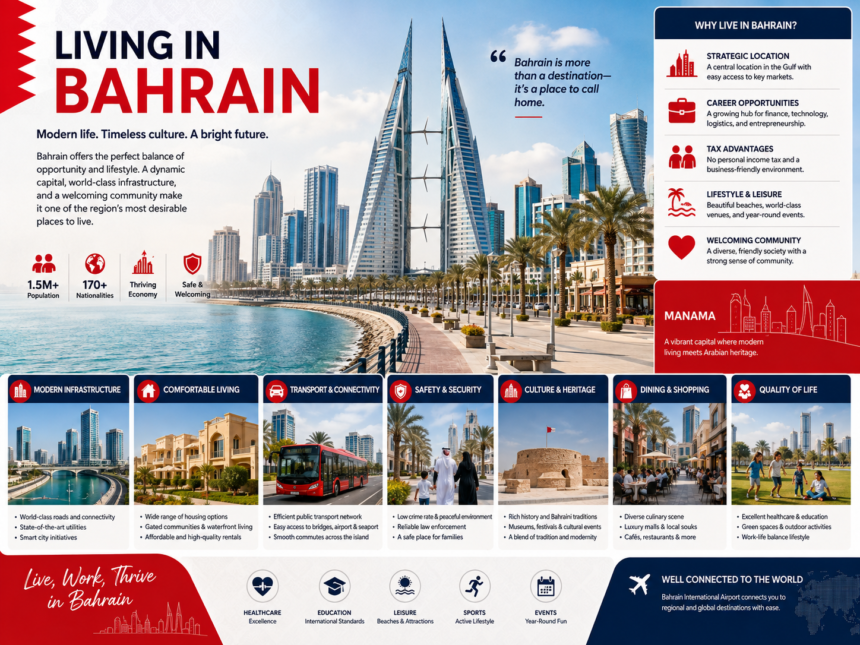
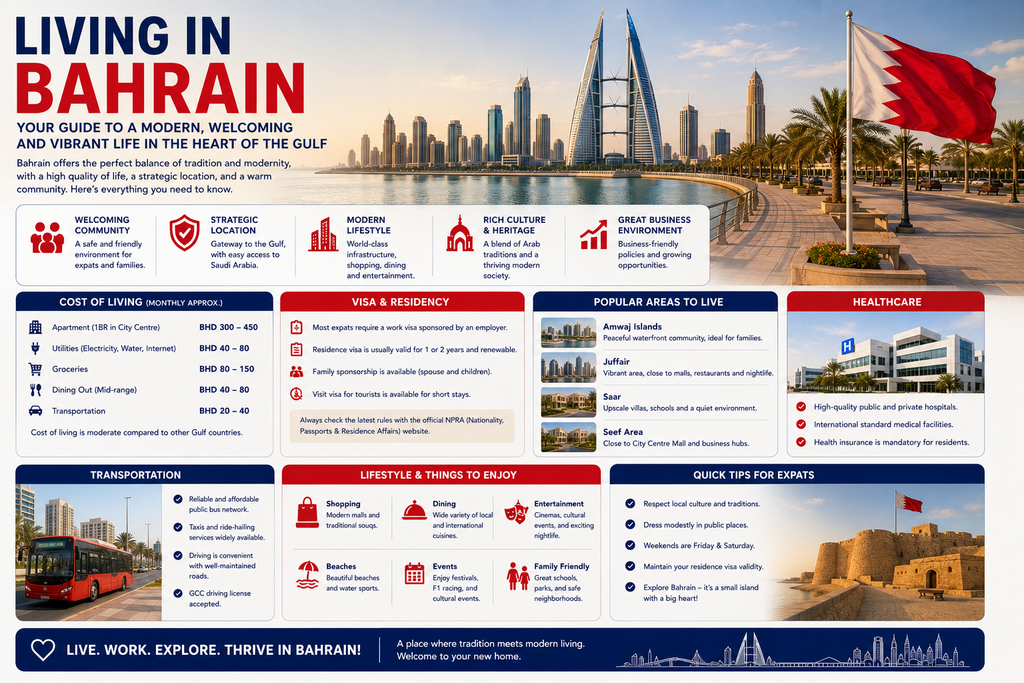
Living in Bahrain offers expatriates a combination of Gulf career opportunities, modern infrastructure, international communities and a relatively compact lifestyle. As one of the six GCC countries, Bahrain has developed into an important regional centre for finance, business, technology, hospitality and professional services.
- Living in Bahrain for Expats in 2026
- 1. Residence and Visas in Bahrain
- 2. Working in Bahrain
- 3. Housing in Bahrain
- 4. Cost of Living in Bahrain
- 5. Taxes and VAT in Bahrain
- 6. Healthcare in Bahrain
- 7. Education and Schools in Bahrain
- 8. Transportation and Driving
- 9. Family Life in Bahrain
- 10. Lifestyle and Social Life
- Food and Dining in Bahrain
- Banking for Expats
- Long Term Residency in Bahrain
- Starting Life in Bahrain
- Advantages of Living in Bahrain
- Challenges of Living in Bahrain
- Living in Bahrain Versus Other Gulf Countries
- Frequently Asked Questions About Living in Bahrain
- Conclusion
For newcomers, one of Bahrain’s biggest advantages is convenience. The country is geographically smaller than many of its Gulf neighbours, making daily travel between residential, commercial and leisure areas relatively manageable.
Bahrain’s official national portal highlights housing affordability, digital readiness, banking access and government services among factors supporting expatriate life in the Kingdom. Bahrain also operates residence, work permit and long term residency programmes for eligible foreigners.
However, moving to Bahrain requires more than finding a job. Expats should understand residence requirements, employment laws, housing, healthcare, education, taxation and the real cost of everyday life before relocating.
Living in Bahrain for Expats in 2026
Bahrain has hosted international workers and businesses for decades. This has created a multicultural environment where expatriates can find international schools, private healthcare, global companies, restaurants and communities representing many nationalities.
English is widely used in professional and commercial environments, although Arabic is the official language and remains valuable for anyone planning a long term career in the country.
The lifestyle can vary considerably depending on income and family size. A single professional may prioritise an apartment near a business district, while families may focus on larger homes, schools, healthcare and quieter residential communities.
1. Residence and Visas in Bahrain
Anyone planning on Living in Bahrain long term needs the correct legal residence status.
Bahrain provides dedicated government services for issuing and renewing residence permits through the Nationality, Passports and Residence Affairs system.
For most expatriate employees, employment and residence are closely connected with the Labour Market Regulatory Authority.
LMRA regulates work permits for expatriate employees and coordinates related processes such as entry visas, residence permits and identity documentation.
This means a tourist or short term visit arrangement should not be treated as a substitute for proper employment authorisation.
2. Working in Bahrain
Employment is one of the main reasons foreigners relocate to Bahrain.
Important sectors include banking and financial services, construction, hospitality, retail, healthcare, education, technology, professional services, logistics and industrial activities.
Foreign professionals working in specialised areas may need additional approval.
For example, Bahrain’s official work permit information states that specialised occupations including medical, educational and engineering professions may require approval from the relevant authority.
Before accepting a position, expatriates should review the complete package rather than focusing only on monthly salary.
Consider accommodation allowance, medical insurance, annual flights, transport, dependent benefits, school allowance and end of service arrangements.
3. Housing in Bahrain
Finding the right neighbourhood can make a major difference to everyday life.
Popular residential choices vary according to budget, workplace and lifestyle. Areas around Manama appeal to professionals who want convenient access to business districts, restaurants and entertainment.
Other residential areas can be more attractive to families looking for larger apartments, villas and quieter surroundings.
Before signing a lease, check what is included.
Some rental agreements may include utilities or building facilities, while others require the tenant to pay these costs separately.
Ask about:
Rent payment schedule
Security deposit
Electricity and water
Internet
Parking
Maintenance
Furnished or unfurnished status
Contract termination conditions
Distance from work and school
A cheaper apartment can become less attractive if the daily commute is inconvenient or additional charges are high.
4. Cost of Living in Bahrain
The cost of Living in Bahrain depends heavily on personal lifestyle.
Housing will usually be one of the biggest expenses, particularly for families.
Other regular costs include:
Groceries
Utilities
Internet and mobile plans
Transport
Health insurance
School fees
Restaurants and entertainment
Domestic services
Travel
Family residence expenses
Imported products and premium brands can significantly increase monthly spending.
A single professional sharing accommodation may maintain a very different budget from a family requiring a three bedroom home and international schooling.
5. Taxes and VAT in Bahrain
Taxation is another important consideration when planning expatriate finances.
Bahrain applies Value Added Tax to many goods and services.
The National Bureau for Revenue confirms that Bahrain’s standard VAT rate increased from 5 percent to 10 percent from 1 January 2022. Goods and services that qualify for zero rating or exemption are treated differently.
For consumers, this means VAT needs to be considered when budgeting for everyday purchases and services.
Certain areas, including qualifying healthcare and education supplies, can receive different VAT treatment under Bahrain’s rules.
6. Healthcare in Bahrain
Healthcare is an important part of expatriate planning, especially for families.
Bahrain has both public and private healthcare providers, and its long term national strategy includes maintaining access to quality healthcare for citizens and residents.
Expats should understand exactly what their employer’s medical insurance covers.
Check whether the policy includes:
Outpatient treatment
Hospitalisation
Emergency treatment
Dental care
Maternity
Prescription medicines
Specialist consultations
Children
International coverage
A strong salary package can lose some of its value if a family needs to purchase extensive private medical coverage separately.
7. Education and Schools in Bahrain
Families moving to Bahrain should research schools before selecting accommodation.
Bahrain has international education options serving different curricula and expatriate communities.
School location is important because morning travel can affect the family’s daily routine.
Parents should compare:
Curriculum
Tuition fees
Admission requirements
School transport
Location
Extracurricular activities
Academic calendar
Additional charges
Do not calculate education costs using tuition alone. Registration, transport, uniforms, books, activities and other charges can increase the annual total.
8. Transportation and Driving
A private car can be convenient for many Bahrain residents.
Because the country is relatively compact, living reasonably close to work can make commuting straightforward. However, traffic during busy periods should still be considered when choosing accommodation.
New residents planning to drive should check whether their existing licence can be used temporarily and what process applies for obtaining a Bahraini driving licence.
Vehicle expenses should also be included in relocation budgets.
These can include insurance, registration, maintenance, fuel and parking.
For professionals who do not want to own a vehicle immediately, taxis and app based transportation can provide alternatives.
9. Family Life in Bahrain
Bahrain can appeal to expatriate families because daily life combines residential communities, schools, shopping centres, healthcare facilities and leisure activities within a relatively small geographic area.
Weekends can include shopping, dining, beaches, sports, cultural attractions and family gatherings.
Families relocating from overseas should nevertheless calculate the complete cost before accepting a job.
A package that works comfortably for one person may become challenging after adding:
Larger accommodation
School fees
Dependent health insurance
Family residence costs
Air tickets
Childcare
Transportation
The total employment package matters more than the basic salary.
10. Lifestyle and Social Life
Bahrain has a diverse social environment shaped by both Bahraini traditions and its international population.
Manama provides restaurants, cafes, shopping centres, hotels and entertainment, while other areas offer quieter residential lifestyles.
Expats should also respect Bahrain’s culture and laws.
Dress, behaviour and social customs can differ from those in Western or Asian countries. Respect for local traditions is particularly important during Ramadan and religious occasions.
Learning a few Arabic phrases can also make everyday interactions easier and demonstrate cultural respect.
Food and Dining in Bahrain
Bahrain’s international population has created a varied dining scene.
Residents can find Bahraini and wider Gulf cuisine alongside Indian, Pakistani, Filipino, Lebanese, Turkish, European and East Asian food.
Local Gulf meals are worth exploring because food offers one of the easiest ways to understand Bahraini culture.
Dining costs vary considerably.
Local restaurants can be relatively accessible, while luxury hotels and premium restaurants can make eating out significantly more expensive.
Banking for Expats
Opening a local bank account is an important early step for most employees.
Employers commonly require banking information for salary payments.
Depending on the bank, residents may need:
Passport
Bahraini identity documentation
Residence permit
Employment information
Salary certificate
Address details
Once established, residents can access digital banking, transfers, cards and other financial services.
Before choosing a bank, compare account fees, international transfer costs, ATM access and credit card requirements.
Long Term Residency in Bahrain
Bahrain has also developed residence options for foreigners who want greater long term stability.
The country’s residency services include Golden Residency categories as well as self sponsorship arrangements for certain investors, retirees and property owners.
For example, the current self sponsorship residence route for qualifying foreign property owners can provide residence permits lasting two, five or ten years. The official service lists requirements including qualifying property ownership, valid medical insurance and evidence of stable income.
These routes can be attractive to people who want Bahrain to become more than a temporary employment destination.
Starting Life in Bahrain
The first few weeks after relocation are usually the busiest.
New residents may need to complete immigration, employment, identity, banking, housing and healthcare procedures.
A useful priority order is:
- Confirm legal work and residence status.
- Complete identity requirements.
- Arrange temporary or permanent accommodation.
- Activate health insurance.
- Open a bank account.
- Arrange mobile and internet services.
- Understand transport options.
- Complete family residence requirements.
- Research schools if moving with children.
- Create a realistic monthly budget.
Keeping digital copies of important documents can make administrative processes easier.
Advantages of Living in Bahrain
Bahrain offers several features that can appeal to international residents.
Its relatively compact geography can make everyday life convenient.
Its international workforce creates a multicultural environment.
The Kingdom also provides digital government services covering residency, employment, healthcare, education and other areas. Bahrain’s national portal specifically provides dedicated information and services for expatriates and migrant workers.
For professionals, Bahrain can also provide valuable experience in the wider GCC business environment.
Challenges of Living in Bahrain
Like any international relocation, Bahrain has challenges.
Summer temperatures can be difficult for newcomers.
Families may face significant costs for private education and larger housing.
Employment based residence also means job changes can affect immigration arrangements.
New residents may need time to understand local laws, workplace culture and administrative procedures.
The best way to manage these challenges is preparation.
Research the employment package before signing.
Understand residence conditions.
Compare housing carefully.
Budget for dependants.
Keep emergency savings.
And avoid making major financial commitments immediately after arriving.
Living in Bahrain Versus Other Gulf Countries
Bahrain offers a different experience from larger GCC destinations.
Dubai provides a much larger international commercial and entertainment environment.
Saudi Arabia offers a significantly larger employment market.
Qatar has developed rapidly around major infrastructure and energy related industries.
Bahrain’s appeal is often its combination of Gulf business opportunities with a smaller and more manageable environment.
The best destination ultimately depends on career sector, salary package, family requirements and preferred lifestyle.
Frequently Asked Questions About Living in Bahrain
Is Bahrain suitable for expatriates?
Bahrain has a large expatriate community and established government systems for foreign workers and residents. The national portal highlights its expatriate services, digital infrastructure and long term residency options.
Do expatriates need a work permit in Bahrain?
Foreign employees generally need the appropriate work authorisation. LMRA regulates expatriate work permits and coordinates related residence and identity procedures.
What is VAT in Bahrain?
The standard VAT rate is currently 10 percent, although some goods and services are zero rated or exempt.
Can foreigners get long term residence in Bahrain?
Yes. Bahrain provides Golden Residency and certain self sponsorship residence routes for qualifying applicants.
Can expats work in specialised professions?
Yes, but some professions require additional regulatory approval. Bahrain’s work permit information specifically identifies areas such as medicine, education and engineering among professions where relevant authority approval can be required.
Conclusion
Living in Bahrain can offer a rewarding Gulf experience for professionals, entrepreneurs and families who prepare properly before relocating.
The Kingdom combines international business opportunities with modern services, established expatriate communities and a relatively compact lifestyle. Bahrain also provides formal residence and work permit systems alongside longer term residency options for qualifying foreigners.
But successful relocation depends on more than receiving a job offer.
Understand your residence status before travelling. Review your full salary package. Compare housing carefully. Research schools if you have children. Confirm health insurance coverage and remember that Bahrain currently applies a standard VAT rate of 10 percent to most taxable supplies.
Most importantly, consider whether the opportunity works for your complete lifestyle rather than judging it only by salary.
For the right person, Bahrain can provide an attractive combination of career development, Gulf experience, family life and access to a diverse international community.
follow us on Instagram
Read More – Family Sponsorship Guide Gulf: 6 Essential Rules for 2026