The Benefits and Challenges of Micro-Credentials in GCC Healthcare
Healthcare systems around the world are changing rapidly as medical technologies, digital platforms, treatment methods and patient expectations continue to evolve. Across the Gulf Cooperation Council (GCC), countries such as the United Arab Emirates, Saudi Arabia, Qatar, Kuwait, Oman and Bahrain are investing in healthcare infrastructure, medical innovation and professional workforce development.
- 1. What Are Micro-Credentials and How Do They Work in Healthcare?
- 2. Why Specialised Healthcare Skills Are Becoming More Important Across the GCC
- 3. How Micro-Credentials Could Benefit Working Healthcare Professionals
- 4. The Role of Micro-Credentials in UAE, Saudi and Qatari Healthcare
- 5. How Healthcare Employers Could Use Micro-Credentials to Address Skill Gaps
- 6. What Challenges Could Limit the Value of Healthcare Micro-Credentials?
- 7. How Working Professionals Can Choose the Right Healthcare Micro-Credentials
- 8. The Future of Micro-Credentials in Middle Eastern Healthcare Education
- Conclusion
These developments are creating new learning requirements for doctors, nurses, pharmacists, allied health professionals and healthcare administrators. While traditional university degrees and professional qualifications remain essential, healthcare workers often need additional training to keep their knowledge relevant and strengthen their expertise in particular areas.
This is where micro-credentials in healthcare could offer an increasingly valuable learning opportunity.
Micro-credentials are focused educational qualifications that recognise specific knowledge or skills acquired through relatively short learning programmes. Unlike comprehensive degree programmes, they concentrate on clearly defined competencies that learners can develop and demonstrate through assessments.
For working healthcare professionals, this approach can offer greater flexibility. A nurse interested in digital patient monitoring, for example, might complete an assessed course focusing on the relevant technology without enrolling in another full-time academic programme.
Similarly, healthcare administrators may pursue specialised learning in quality improvement, clinical data management or healthcare cybersecurity.
UNESCO defines micro-credentials as records of focused learning achievements supported by assessment, trusted providers and appropriate quality assurance. They may have independent value or complement broader qualifications. UNESCO UIS
However, micro-credentials are not substitutes for professional medical licences, accredited degrees or mandatory clinical training. A short certificate does not automatically authorise someone to perform specialised medical procedures.
Their greatest potential lies in helping qualified professionals build additional competencies within their existing professional roles.
As Middle Eastern healthcare organisations expand their use of digital technology, specialised services and evidence-based practices, micro-credentials could become a useful part of continuous workforce development.
1. What Are Micro-Credentials and How Do They Work in Healthcare?
Micro-credentials are educational awards that recognise the successful completion of a focused learning experience.
They are generally smaller in scope than traditional degrees and are designed around specific learning outcomes.
A micro-credential programme may involve online lessons, practical workshops, case studies, supervised activities or assessments.
The essential feature is not simply the short duration of the course. It is the verified achievement of clearly defined knowledge or skills.
Understanding the difference between a certificate and a micro-credential
Not every short course certificate qualifies as a meaningful micro-credential.
A certificate of attendance may show that an individual participated in an educational activity.
A properly designed micro-credential should provide clearer evidence of what the learner has achieved.
For example, an attendance certificate might confirm participation in a workshop about infection prevention.
An assessed micro-credential could additionally require participants to demonstrate their understanding of infection-control procedures through a structured evaluation.
The value of the qualification depends on the quality of teaching, assessment and recognition.
How micro-credentials support working professionals
Healthcare workers frequently balance demanding schedules with professional education requirements.
Full-time academic programmes may be difficult to accommodate alongside clinical responsibilities.
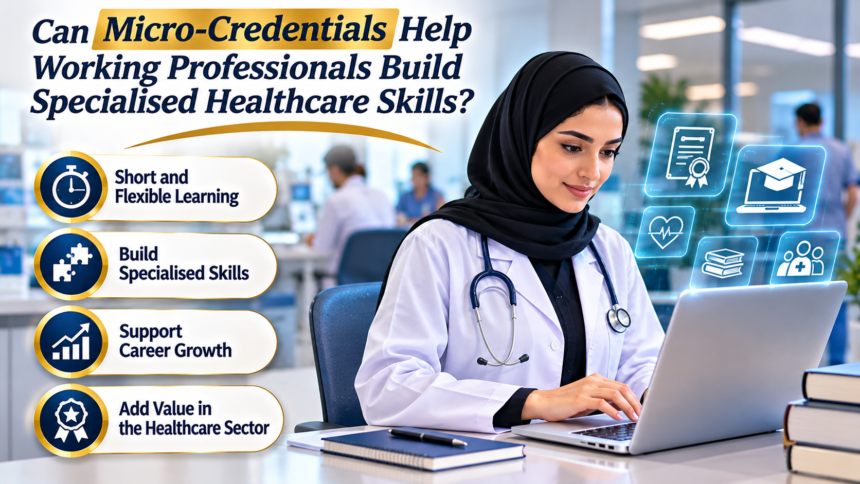
Micro-credentials can provide shorter and more focused learning pathways.
Some programmes may be completed through online study, while others combine digital lessons with practical training.
This flexibility can make specialised education more accessible to professionals who cannot take extended breaks from employment.
The concept of stackable learning
Certain educational institutions allow multiple micro-credentials to contribute toward a larger qualification.
This is sometimes called stackable learning.
For example, a professional might complete separate assessed programmes in healthcare analytics, digital records and quality management.
If an institution has established an approved pathway, those achievements may contribute toward a broader academic award.
However, not all micro-credentials are stackable, transferable or recognised for academic credit.
Learners must verify these arrangements before enrolling.
Comparing different professional learning options
| Learning pathway | Main purpose | Typical characteristic |
|---|---|---|
| University degree | Develops broad academic and professional foundations | Comprehensive programme |
| Postgraduate qualification | Provides advanced academic or professional study | Extended specialist education |
| Micro-credential | Verifies focused learning outcomes | Shorter, assessed programme |
| Continuing professional development | Maintains and improves professional competence | Ongoing professional learning |
| Attendance certificate | Confirms participation in an activity | Assessment may not be required |
| Professional licence | Provides legal authorisation for regulated practice | Issued or recognised by a relevant regulator |
UNESCO’s work on micro-credentials highlights their potential to provide flexible educational pathways while emphasising the importance of quality assurance and recognition. International Institute for Educational Planning
For healthcare professionals, understanding these distinctions helps prevent confusion about the actual value of different qualifications.
2. Why Specialised Healthcare Skills Are Becoming More Important Across the GCC
Healthcare organisations across the GCC are introducing new services and technologies that require employees to update their knowledge.
Modern hospitals increasingly rely on electronic medical records, connected medical devices, advanced diagnostics and multidisciplinary treatment approaches.
These developments can create skill requirements that were not covered in detail during a professional’s initial education.
The expansion of digital healthcare
Digital transformation is changing how healthcare information is collected, stored and used.
Doctors and nurses may need to understand digital documentation systems, remote patient monitoring and technology-supported care.
Healthcare administrators may require knowledge of data governance, information security and digital workflow management.
The World Health Organization’s 2026 analysis of digital health competency frameworks highlights the importance of clearly defined skills for using digital technologies safely and effectively in healthcare settings. World Health Organization
Focused educational programmes may help professionals develop selected competencies without repeating an entire degree.
Growing importance of patient safety
Patient safety remains central to healthcare quality.
Professionals may require additional training in medication safety, infection prevention, clinical communication and quality improvement.
Micro-credentials could support structured learning in these areas, particularly when programmes include practical assessment and relevant clinical examples.
However, a course completion certificate alone does not establish competence to perform advanced clinical procedures.
Specialisation in healthcare administration
Healthcare facilities require employees skilled in operations, compliance, patient experience and quality management.
Short assessed programmes could help administrators improve their understanding of particular responsibilities.
For example, a professional working in hospital operations may pursue focused training in healthcare data analysis or service improvement.
Responding to changing treatment methods
Clinical guidelines, medical technologies and healthcare delivery models continue to develop.
Qualified professionals need opportunities to update relevant knowledge throughout their careers.
The WHO identifies well-designed continuing education and digital learning as useful approaches for strengthening health workforce capacity. World Health Organization
Micro-credentials may complement these activities by providing structured evidence of specific learning achievements.
Healthcare areas where micro-credentials may be useful
| Specialised area | Potential learning focus | Relevant professionals |
|---|---|---|
| Digital health | Electronic records and digital workflows | Doctors, nurses, administrators |
| Patient safety | Incident prevention and quality improvement | Clinical and quality teams |
| Clinical research | Research documentation and Good Clinical Practice | Research professionals |
| Healthcare analytics | Data interpretation and reporting | Analysts and administrators |
| Infection prevention | Evidence-based prevention principles | Nurses and clinical staff |
| Telehealth | Remote consultation processes | Qualified healthcare professionals |
| Healthcare management | Operations and service improvement | Managers and supervisors |
These are potential educational applications rather than confirmation that every GCC regulator recognises a corresponding micro-credential.
3. How Micro-Credentials Could Benefit Working Healthcare Professionals
One of the strongest arguments for micro-credentials is their potential to make professional learning more flexible and focused.
Healthcare employees often work shifts, manage unpredictable schedules and balance professional commitments with personal responsibilities.
Traditional full-time study may not always be practical.
Flexible learning schedules
Many micro-credential programmes are designed for part-time participation.
Online modules may allow learners to complete certain activities outside regular working hours.
This flexibility can be valuable for professionals who cannot leave employment for extended periods.
However, flexibility should not compromise educational quality.
Programmes involving clinical skills may still require supervised practical assessments.
Focused knowledge development
Rather than covering a broad academic subject, micro-credentials generally concentrate on specific competencies.
For example, a pharmacist may want to strengthen knowledge of medication safety systems.
A healthcare administrator might focus on clinical quality indicators.
A nurse may pursue additional education in the operation of an approved digital patient monitoring platform.
This focused approach can help professionals connect learning with their existing responsibilities.
Supporting career development
Documented learning achievements may help professionals demonstrate interest and competence in specialised areas.
This can be relevant when applying for internal development opportunities or moving into related roles.
However, completing a micro-credential does not guarantee promotion, a higher salary or recognition by employers.
Its professional value depends on the programme’s credibility, the skills demonstrated and the requirements of the position.
Reducing some educational barriers
Shorter programmes may involve lower direct tuition costs than full academic degrees.
They may also reduce the need for extended study leave.
Nevertheless, cost effectiveness should be assessed carefully.
A collection of expensive short courses with limited recognition may offer less value than one well-established professional programme.
Encouraging lifelong learning
Healthcare knowledge changes throughout a professional’s career.
Micro-credentials may support a learning culture in which professionals regularly identify knowledge gaps and pursue appropriate education.
A 2025 scoping review of micro-credentials in health professions education found growing interest in the approach but also highlighted limited evidence about long-term effectiveness and the importance of sound educational design. PubMed Central (PMC)
Potential professional benefits
| Benefit | How micro-credentials may help | Important qualification |
|---|---|---|
| Flexibility | Supports shorter learning programmes | Scheduling varies by provider |
| Specialisation | Focuses on selected competencies | Must remain within professional scope |
| Career development | Documents additional learning | Recognition is not guaranteed |
| Accessibility | May offer remote participation | Digital access and costs still matter |
| Continuing education | Can complement professional development | CPD approval must be verified |
| Skills assessment | May demonstrate learning achievements | Assessment quality determines credibility |
These benefits suggest that micro-credentials can become useful professional development tools when programmes are credible, relevant and appropriately assessed.
4. The Role of Micro-Credentials in UAE, Saudi and Qatari Healthcare
The GCC already has established systems for continuing medical education and continuing professional development.
These systems create a relevant environment for focused professional learning.
However, micro-credentials and officially recognised continuing professional development credits are not automatically equivalent.
United Arab Emirates: Supporting continuous medical education
Abu Dhabi’s Department of Health maintains continuing professional development and continuing medical education frameworks for healthcare practitioners.
The authority explains that approved learning activities are intended to improve professional knowledge, skills, performance and patient outcomes while supporting relevant licensing requirements. Ministry of Health and Prevention
Micro-credential programmes could potentially complement these objectives.
For example, a qualified healthcare professional may complete focused training in patient safety or healthcare technology.
However, whether that programme qualifies for recognised CME or CPD credits depends on the applicable approval requirements.
A certificate issued by a university or private training company should not automatically be treated as a recognised licensing credit.
Saudi Arabia: Professional development through SCFHS
The Saudi Commission for Health Specialties (SCFHS) oversees important aspects of professional classification, registration and continuing development.
Its digital platforms include services supporting healthcare practitioners and accredited continuing professional development activities.
The Mustamir platform connects CPD providers, healthcare professionals and the commission. Saudi Commission for Health Specialties
Saudi Arabia also provides procedures for recognising eligible CPD hours obtained outside the Kingdom.
However, recognition depends on factors including relevance to the professional’s field and applicable accreditation requirements. Saudi Commission for Health Specialties+1
This distinction matters for professionals considering international micro-credential programmes.
Qatar: A structured continuing professional development system
Qatar’s Department of Healthcare Professions has established a national CPD framework for healthcare practitioners.
The framework supports ongoing professional education and links applicable CPD requirements with registration and licence renewal.
The department recognises different learning activities, subject to defined accreditation and documentation requirements. DHP
Qatar University also operates accredited continuing professional development activities for healthcare professionals. qu.edu.qa
Micro-credentials could potentially complement such learning opportunities when their educational outcomes and accreditation arrangements satisfy relevant requirements.
Opportunities for other GCC countries
Oman, Bahrain and Kuwait also have healthcare workforces that may benefit from specialised continuing education.
However, the recognition of short courses, micro-credentials and professional development activities varies between regulatory systems.
Professionals should verify requirements with the relevant authority before enrolling.
Regional professional development comparison
| Country | Relevant framework or authority | Main consideration |
|---|---|---|
| UAE | Relevant health regulators, including DoH Abu Dhabi | Approved CME/CPD and professional licensing requirements |
| Saudi Arabia | Saudi Commission for Health Specialties | CPD recognition and professional scope |
| Qatar | Department of Healthcare Professions | Accredited CPD requirements |
| Oman | Applicable healthcare professional regulators | Local education and licence requirements |
| Bahrain | National Health Regulatory Authority | Professional development and licensing rules |
| Kuwait | Relevant national health authorities | Recognition and professional requirements |
The opportunity for micro-credentials lies in complementing established professional development systems, not bypassing them.
5. How Healthcare Employers Could Use Micro-Credentials to Address Skill Gaps
Healthcare organisations increasingly need employees who can adapt to new technologies, policies and clinical practices.
Micro-credentials could help employers provide focused learning opportunities based on identified workforce requirements.
However, their effectiveness depends on how programmes are selected, delivered and evaluated.
Identifying actual workforce needs
Hospitals should begin by understanding which competencies require improvement.
For example, a healthcare facility introducing a new electronic documentation system may identify training needs among clinical and administrative staff.
A quality improvement department may need additional knowledge of incident analysis and patient safety measurement.
These requirements can help guide the selection of relevant micro-credential programmes.
Developing role-specific learning pathways
Rather than providing identical training to every employee, healthcare organisations could create pathways tailored to professional responsibilities.
For example, nurses might receive focused training in relevant monitoring systems, while administrators study healthcare data reporting.
However, role-specific education must remain consistent with professional qualifications and authorised practice.
Combining education with workplace experience
Online learning can improve theoretical knowledge, but healthcare competence often requires practical application.
Employers may therefore combine micro-credentials with supervised workplace activities.
For example, a programme on clinical quality improvement could include a practical project evaluating a specific hospital process.
This allows learners to demonstrate how their new knowledge applies to real healthcare operations.
Measuring training effectiveness
Organisations should evaluate more than course completion rates.
Useful measures include demonstrated competence, changes in work practices, employee feedback and relevant patient safety outcomes.
Not every educational programme will produce measurable changes in clinical results.
Where improvements are observed, organisations should consider whether other factors contributed to those outcomes.
Employer-focused learning model
| Workforce requirement | Potential micro-credential | Workplace application |
|---|---|---|
| Digital transformation | Healthcare information systems | Improved digital workflows |
| Patient safety | Clinical risk and safety improvement | Better incident management |
| Research development | Clinical research operations | More consistent study coordination |
| Quality management | Healthcare performance measurement | Improved service evaluation |
| Remote healthcare | Telehealth service delivery principles | Better virtual care coordination |
| Data protection | Healthcare information security | More responsible data handling |
Employers could also collaborate with universities and accredited training providers to design programmes aligned with real workplace needs.
This may improve the relevance of educational content while strengthening connections between healthcare institutions and academic organisations.
6. What Challenges Could Limit the Value of Healthcare Micro-Credentials?
Although micro-credentials offer promising opportunities, they also present important challenges.

Short educational programmes vary considerably in quality, assessment requirements, recognition and practical usefulness.
Without clear standards, professionals may struggle to distinguish valuable learning opportunities from certificates that provide limited evidence of competence.
Inconsistent quality assurance
Different organisations may use the term micro-credential for very different types of programmes.
Some may involve carefully designed assessments, while others provide certificates after minimal participation.
This inconsistency can make it difficult for employers to evaluate learning achievements.
UNESCO identifies quality assurance and trusted providers as important elements of credible micro-credentials. connect.unevoc.unesco.org
Uncertain professional recognition
A micro-credential issued by an educational institution may be academically credible without being recognised by a healthcare regulator.
This is particularly important for professionals working in regulated clinical roles.
A course on advanced clinical procedures does not automatically authorise a practitioner to perform those procedures.
Regulatory approval, professional licensing and appropriate supervised training remain essential.
Limited evidence about long-term outcomes
Micro-credentials may improve knowledge and demonstrate selected competencies.
However, evidence linking them to long-term improvements in healthcare performance remains developing.
The 2025 health professions education review cautions that poorly designed programmes may consume time and resources without delivering meaningful learning benefits. PubMed Central (PMC)
Digital accessibility and practical training
Online learning may increase flexibility, but some professionals may face difficulties involving internet access, technology skills or time availability.
Clinical competencies may also require physical simulation, supervised practice or practical assessment.
A fully online programme may therefore be unsuitable for certain learning objectives.
Cost and employer support
Although micro-credentials can be shorter than degrees, they are not always inexpensive.
Healthcare employees may need financial assistance or protected learning time.
Employers should consider whether the benefits justify the programme’s total cost.
Common challenges and possible solutions
| Challenge | Potential solution |
|---|---|
| Unclear recognition | Verify regulator and employer acceptance |
| Inconsistent assessment | Use programmes with defined competency evaluations |
| Limited practical training | Include supervised workplace learning |
| High course costs | Evaluate funding and employer partnerships |
| Uncertain career value | Select programmes aligned with actual job requirements |
| Poor educational design | Review provider quality and learning outcomes |
| Digital barriers | Offer suitable blended learning options |
Addressing these challenges is necessary if micro-credentials are to become trusted components of healthcare professional development.
7. How Working Professionals Can Choose the Right Healthcare Micro-Credentials
Healthcare professionals considering micro-credentials should evaluate programmes carefully before investing their time or money.
A course may appear attractive because of its subject or promotional claims, but its practical value depends on several factors.
Identify a clear learning objective
The first step is understanding which skill needs improvement.
A professional should consider their current role, responsibilities and career goals.
For example, a hospital administrator interested in healthcare analytics may benefit from structured learning in data interpretation.
A registered nurse seeking additional digital health knowledge may prefer a programme focused on technology used within nursing practice.
Evaluate the education provider
Learners should examine the provider’s academic or professional credibility.
Relevant considerations include the qualifications of instructors, the programme’s assessment methods and whether the institution has recognised quality assurance arrangements.
Check regulatory recognition
Healthcare professionals must verify whether the programme offers CPD or CME credits recognised by the authority responsible for their professional registration.
This is particularly important in the GCC, where licensing requirements differ between jurisdictions.
Saudi Arabia’s SCFHS and Qatar’s Department of Healthcare Professions provide official information about eligible continuing professional development activities. National Platform (National Portal)+1
Review practical learning requirements
Professionals should determine whether the programme includes assessments, simulations or supervised activities.
For subjects involving practical clinical skills, theoretical knowledge alone may be insufficient.
Consider transferability
Some micro-credentials may be accepted toward larger academic qualifications.
Others have independent value but cannot be transferred.
Learners should obtain written confirmation about credit recognition and stacking arrangements where relevant.
Healthcare micro-credential selection checklist
| Question | Why it matters |
|---|---|
| Is the provider credible? | Supports confidence in educational quality |
| Are the learning outcomes clear? | Shows what competencies will be developed |
| Is assessment included? | Provides evidence of learning achievement |
| Is the course relevant to my role? | Improves practical usefulness |
| Does it provide recognised CPD credits? | May support professional development requirements |
| Is practical training necessary? | Protects against inadequate skill preparation |
| Can it contribute to a larger qualification? | Clarifies future educational options |
| Is the total cost reasonable? | Supports informed financial decisions |
A useful micro-credential should provide meaningful learning rather than simply another certificate to display on a professional profile.
8. The Future of Micro-Credentials in Middle Eastern Healthcare Education
Micro-credentials could become an increasingly useful part of professional healthcare education as GCC countries strengthen workforce capabilities.
Their future will depend on cooperation between universities, healthcare institutions, regulators and professional education providers.
The most effective systems are likely to be those that combine flexible learning with reliable assessment and clear recognition.
Developing structured education pathways
Universities may create collections of focused programmes that build progressively toward broader qualifications.
For example, healthcare professionals could complete separate courses in healthcare data, digital operations and quality improvement.
Where formally approved, these may contribute to a larger academic programme.
Such pathways could support lifelong learning without requiring professionals to repeat content they have already mastered.
Connecting learning with healthcare workforce planning
Health authorities and employers may use workforce assessments to identify emerging skill requirements.
Education providers could then develop programmes addressing those needs.
This may be particularly relevant to digital health, clinical research, healthcare analytics and patient safety.
Strengthening practical competency assessment
Future programmes should focus not only on knowledge acquisition but also on demonstrating relevant abilities.
For healthcare professionals, this could involve case-based assessments, simulations or supervised projects.
Assessment methods should reflect the nature of the competency being taught.
Supporting responsible digital learning
Online education platforms can broaden access to professional development.
However, providers must consider educational quality, learner privacy, accessibility and the reliability of digital assessments.
The WHO’s work on health workforce education supports well-designed digital learning while recognising the importance of appropriate educational governance. World Health Organization
A practical development roadmap
- Identify workforce skill gaps: Use employer feedback and healthcare service requirements to establish learning priorities.
- Define competency standards: Specify what learners should know or demonstrate after completing a programme.
- Develop credible courses: Work with qualified educators and relevant healthcare professionals.
- Introduce meaningful assessments: Verify learning through appropriate evaluation methods.
- Clarify regulatory recognition: Explain whether programmes qualify for recognised CPD or CME credits.
- Provide practical learning opportunities: Include supervised activities where required.
- Measure outcomes: Evaluate learner competence and relevant workplace improvements.
- Expand successful programmes: Develop additional pathways based on demonstrated educational value.
Why long-term recognition matters
Micro-credentials are most valuable when employers and educational institutions understand what they represent.
Clear information about the awarding provider, workload, learning outcomes, assessment and quality assurance can improve transparency.
The OECD’s 2026 international review of micro-credential systems highlights the importance of connecting short learning programmes with workforce needs while addressing challenges involving quality assurance and recognition. OECD
For Middle Eastern healthcare education, establishing credible pathways could help professionals develop specialised skills while maintaining strong clinical standards.
Conclusion
Micro-credentials offer a promising approach to professional education in healthcare.
By providing focused learning opportunities, they may help working professionals strengthen specialised knowledge without committing to another comprehensive academic programme.
For doctors, nurses, pharmacists, healthcare administrators and other qualified professionals, micro-credentials could support ongoing development in areas such as digital health, patient safety, clinical research and quality management.
Across the GCC, established continuing professional development systems already demonstrate the importance of lifelong learning.
However, micro-credentials must complement rather than replace formal healthcare qualifications, professional licences and mandatory clinical training.
Their value depends on credible providers, meaningful assessments, appropriate recognition and practical relevance.
Healthcare employers and universities can strengthen this approach by developing programmes connected to real workforce requirements.
Ultimately, micro-credentials in healthcare could help working professionals develop specialised skills, adapt to changing medical technologies and contribute to more capable healthcare systems across the Middle East.
Do follow us on Instagram
Read More – The Growing Importance of Clinical Research Coordinators in Middle Eastern Healthcare