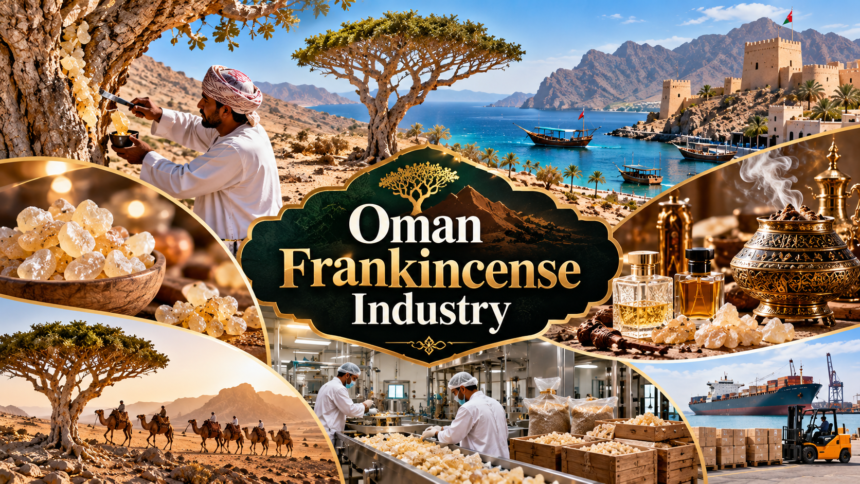
The Future of Oman’s Frankincense Industry and Global Market Opportunities
For centuries, the distinctive fragrance of frankincense has connected Oman with distant markets. Long before modern shipping networks, online retail and international luxury brands, traders transported the aromatic resin from southern Arabia to destinations across the ancient world.
- Oman Frankincense Industry: From Ancient Trade Routes to Modern Business
- How Big Is Oman’s Frankincense Export Market in 2026?
- 7 Global Market Opportunities for Omani Frankincense
- International Recognition: How Oman Is Protecting Its Frankincense Identity
- Sustainable Harvesting: Can Dhofar’s Frankincense Trees Meet Global Demand?
- The Business of Frankincense: Processing, Branding and Export Economics
- The Future of Oman’s Frankincense Industry and Global Market Opportunities
- Frequently Asked Questions About Oman’s Frankincense Industry
Today, frankincense remains an important part of Omani culture. Its familiar scent is associated with homes, hospitality, religious traditions and local identity. In Dhofar, where frankincense trees grow naturally, the resin also represents a living connection between the region’s environment, communities and trading history.
Yet an ancient product is now entering a new commercial era.
The Oman Frankincense Industry is attracting attention as producers, entrepreneurs and established companies explore opportunities in luxury perfumery, cosmetics, essential oils, heritage products and international retail.
What was traditionally sold as an aromatic resin can now become an ingredient in carefully formulated perfumes, premium personal-care products and branded gifts designed for consumers far beyond the Gulf.
Recent developments indicate that Oman is attempting to strengthen the commercial position of its frankincense through international recognition and improved production practices.
In April 2026, Oman announced that Omani frankincense had been registered internationally as a geographical indication through the World Intellectual Property Organization. The registration is intended to protect the product’s connection with its geographical origin and improve its competitiveness in international markets.
The country’s frankincense exports were valued at approximately OMR 471,400 in 2025, according to figures from the National Centre for Statistics and Information reported in April 2026.
Although this remains a relatively small export category compared with Oman’s major industries, it illustrates an established international market.
Saudi Arabia, Somalia and the United Arab Emirates were among the leading reported destinations.
At the same time, Omani luxury fragrance house Amouage is working on sustainable harvesting and traceable sourcing initiatives in Dhofar, potentially connecting local frankincense production with international perfume customers.
These developments raise an important question: can Oman transform a traditional natural resource into a higher-value global industry without compromising the trees and communities that sustain it?
The answer will depend on branding, quality standards, environmental protection and the ability to produce goods that international customers genuinely want.
Oman Frankincense Industry: From Ancient Trade Routes to Modern Business
Frankincense is an aromatic resin obtained from trees belonging to the Boswellia genus. In southern Oman, Boswellia sacra is particularly important because of its longstanding association with the Dhofar region.
The resin is collected through carefully managed incisions in the tree’s bark. Once exposed to air, the material hardens into aromatic pieces that can be sorted, sold or processed.
The substance has been traded for thousands of years, making it one of Oman’s most recognisable heritage products.
Dhofar’s Historical Importance
The region’s position in ancient trading networks helped frankincense reach markets across Arabia and beyond. The resin was valued for ceremonial, aromatic and cultural uses.
Archaeological remains in southern Oman demonstrate the scale of this historic trade.
UNESCO’s Land of Frankincense World Heritage property includes Wadi Dawkah, the caravan oasis of Shisr/Wubar and the historic ports of Khor Rori and Al-Baleed.
Together, these sites illustrate how frankincense production and distribution shaped regional commercial connections over many centuries.
Why Frankincense Still Matters
For local communities, frankincense is more than a historic commodity. It remains part of cultural practices and can provide income through harvesting, processing and sales.
For businesses, its distinctive origin offers a potential competitive advantage.
International consumers interested in premium fragrance ingredients may value products associated with a documented source and longstanding tradition.
However, heritage alone does not guarantee commercial success. Modern buyers also evaluate consistency, quality, safety and reliability.
Traditional and Modern Business Models
| Traditional Trade | Modern Commercial Opportunity |
|---|---|
| Loose resin sales | Premium packaged resin |
| Local market stalls | International e-commerce |
| Traditional incense | Luxury home fragrance |
| Small-scale extraction | Standardised essential oils |
| Informal sourcing relationships | Documented supply chains |
| Heritage reputation | Protected geographical identity |
The challenge is to preserve the product’s authenticity while developing the capabilities required for international commercial relationships.
How Big Is Oman’s Frankincense Export Market in 2026?
Recent export figures provide a useful starting point for understanding the industry’s current commercial position.
According to data from Oman’s National Centre for Statistics and Information reported by the Oman Observer, frankincense exports reached approximately OMR 471,400 in 2025.
This is the value reported for the specific export category, not the total revenue generated by every Omani perfume, cosmetics or heritage business using frankincense.
Leading Export Destinations
| Destination | Reported 2025 Export Value |
|---|---|
| Saudi Arabia | OMR 150,900 |
| Somalia | OMR 99,200 |
| United Arab Emirates | OMR 78,600 |
| Other Destinations Combined | OMR 142,700 |
| Total | OMR 471,400 |
Saudi Arabia accounted for approximately 32% of the reported total, while Somalia represented around 21% and the UAE around 17%.
These calculations illustrate the concentration of the reported market, but they do not establish the number of customers or the final value of products made using imported Omani resin.
What the Figures Reveal
The export data indicates that Omani frankincense already reaches international buyers.
However, the total value suggests that the commodity itself remains a relatively modest part of the country’s export economy.
One possible route to growth involves developing more finished products within Oman rather than exporting only unprocessed resin.
For example, a business selling purified essential oil or a branded perfume may participate in different stages of the value chain.
However, additional processing also introduces costs involving equipment, packaging, product testing and marketing.
Why Export Value Is Not the Same as Industry Revenue
A kilogram of frankincense sold to an international manufacturer can eventually become part of multiple finished products.
The final retail value of those products may be much higher than the original resin transaction.
Nevertheless, that additional value is shared across manufacturing, distribution, branding and retail activities.
It would therefore be misleading to assume that Oman could automatically capture the entire final selling price simply by processing more frankincense domestically.
The commercial opportunity depends on which activities Omani businesses can perform competitively and sustainably.
7 Global Market Opportunities for Omani Frankincense
The international potential of frankincense extends beyond traditional incense. Businesses can explore different product categories while recognising that each market has its own quality expectations and regulatory requirements.
Seven opportunities appear particularly relevant to the development of the industry.
1. Luxury Perfumes
High-end perfumery provides a visible opportunity because frankincense has a long history as an aromatic ingredient.
Its scent can contribute resinous, woody and warm characteristics to fragrance compositions.
Omani companies supplying premium perfume houses may be able to build commercial relationships around consistent quality, traceable sourcing and distinctive origin.
2. Premium Home Fragrances
Frankincense can be incorporated into incense products and selected home-fragrance formulations.
Luxury packaging, product presentation and authentic storytelling may help distinguish Omani products from generic alternatives.
However, products intended for indoor burning also require suitable safety information and should not make unsupported claims about purifying air.
3. Essential Oils and Fragrance Ingredients
Frankincense essential oil is used in fragrance applications and some personal-care formulations.
Commercial buyers may require technical documentation concerning chemical composition, purity and consistency.
Laboratory testing and standardised processing can become important competitive advantages.
4. Cosmetics and Personal Care
Cosmetic manufacturers may explore appropriately formulated products containing frankincense-derived ingredients.
Potential product categories include creams, cleansers and other personal-care items.
However, cosmetic claims must be supported by relevant evidence, and traditional use does not establish that an ingredient can treat skin conditions.
5. Premium Gifts and Heritage Products
Frankincense can be presented through carefully designed gift collections associated with Omani culture.
These products may appeal to international visitors, corporate buyers and consumers interested in regional craftsmanship.
The commercial value comes from packaging, product quality and customer experience rather than resin alone.
6. Cultural Tourism Experiences
Dhofar’s frankincense heritage provides opportunities for visitor experiences involving museums, demonstrations and guided cultural activities.
Tourism businesses can help explain the product’s history and connection with the local environment.
Such experiences must respect protected heritage sites and follow applicable conservation requirements.
7. Specialist International Ingredients
Fragrance manufacturers and other approved industrial users may purchase frankincense ingredients for specific applications.
Business-to-business supply contracts can provide opportunities for exporters capable of meeting documentation and consistency requirements.
However, products intended for food, supplements or medical uses may face additional regulatory barriers and should not be marketed without appropriate authorisation.
Market Opportunities Compared
| Market | Potential Value | Main Requirement |
|---|---|---|
| Luxury Perfumes | Premium ingredient demand | Traceability and consistency |
| Home Fragrance | Branded consumer products | Safe use and packaging |
| Essential Oils | Specialist manufacturing supply | Testing and specifications |
| Cosmetics | Product differentiation | Formulation and regulatory compliance |
| Heritage Gifts | Cultural identity | Design and distribution |
| Tourism | Visitor experiences | Authenticity and conservation |
| Industrial Ingredients | Business-to-business contracts | Reliable quality and supply |
The strongest growth may come from serving several carefully selected markets rather than trying to expand into every possible product category simultaneously.
International Recognition: How Oman Is Protecting Its Frankincense Identity
One of the biggest challenges for traditional products entering international markets is protecting their origin.
Without effective labelling and verification, buyers may struggle to distinguish genuine Omani frankincense from similar resin produced elsewhere or products marketed using Omani imagery.
Geographical Indication Registration in 2026

On April 20, 2026, Oman’s Ministry of Commerce, Industry and Investment Promotion announced the international registration of Omani frankincense as a geographical indication through the World Intellectual Property Organization.
A geographical indication connects a product with a defined origin and characteristics associated with that location.
The registration provides an important foundation for protecting commercial identity.
However, it does not automatically certify the quality of every individual product or grant unrestricted protection in every country. Businesses still need to follow the relevant standards and market requirements.
Why Origin Protection Matters
A recognised geographical identity may help producers explain what distinguishes their products.
For example, exporters can develop branding that identifies authentic sourcing, traditional harvesting knowledge and distinctive quality characteristics.
This could be valuable when negotiating with specialist ingredient buyers or premium retailers.
The commercial benefit depends on effective implementation, enforcement and consumer understanding.
Supporting Smaller Producers
The World Intellectual Property Organization has worked with Oman to help frankincense producers improve branding and commercial skills.
Its programme, launched in 2023, involved more than 40 producers and addressed packaging, identity and international market opportunities.
These initiatives can help smaller businesses participate in higher-value markets rather than relying entirely on unbranded commodity sales.
Building a Recognisable Omani Product
For international buyers, the distinction between different origins needs to be communicated clearly.
Brands should provide accurate information about sourcing, processing and product characteristics without claiming that every Omani product is automatically superior to resin from other countries.
International competitiveness requires a combination of authenticity and consistent commercial standards.
Sustainable Harvesting: Can Dhofar’s Frankincense Trees Meet Global Demand?
Expanding exports creates an environmental responsibility.
The resin comes from living trees that need sufficient time and suitable conditions to recover from harvesting.
If international demand encourages excessive tapping or poorly managed collection, commercial growth could damage the natural resource on which the industry depends.
The Conservation Challenge
The Environment Society of Oman identifies Boswellia sacra as Near Threatened on the IUCN Red List.
Its conservation work highlights risks including overharvesting, overgrazing, insect damage and environmental pressures.
However, the ecological situation is not uniform.
A 2025 study published in the Journal of Arid Environments found that population structure and regeneration varied across assessed locations and did not identify a broad decline across the entire study area.
This means conservation programmes should respond to site-specific conditions rather than assume that every frankincense population faces identical threats.
FairWild Certification at Wadi Dawkah
In August 2025, FairWild announced that the frankincense harvesting operation at Wadi Dawkah had received certification under its sustainability and ethical sourcing standard.
The initiative involves Amouage and represents an important development in documented sourcing.
Certification can help buyers assess harvesting practices and supply-chain transparency.
However, certification at one site does not establish that every frankincense supplier across Oman follows the same standard.
Expansion Into Wadi Gazelle
In June 2026, Oman’s Ministry of Agriculture, Fisheries and Water Resources announced a partnership with Amouage to develop responsible frankincense harvesting in Wadi Gazelle, Dhofar.
The initiative includes training, employment and monitoring activities involving local communities.
Future plans also involve processing frankincense for essential oils used in luxury perfumes.
The project illustrates an approach in which conservation and commercial development are designed to support one another.
Sustainability Priorities
| Challenge | Potential Impact | Management Approach |
|---|---|---|
| Excessive Tapping | Tree stress and reduced recovery | Controlled harvesting |
| Overgrazing | Damage to young trees | Site-specific protection |
| Insect Damage | Reduced tree health | Scientific monitoring |
| Limited Regeneration | Future supply concerns | Conservation programmes |
| Unverified Sourcing | Buyer uncertainty | Traceability systems |
| Weak Community Benefits | Unequal economic returns | Training and fair commercial arrangements |
Why Local Communities Matter
Harvesters possess knowledge developed through generations of working with the region’s trees.
Protecting this expertise is important, but it should be combined with contemporary environmental research.
Commercial expansion will be more sustainable when communities receive appropriate economic benefits from protecting the resource.
The Business of Frankincense: Processing, Branding and Export Economics
The commercial future of frankincense depends partly on how much value Omani businesses can create between harvesting the resin and selling a finished product.
Raw material exports remain relevant, but processing and branding may open additional revenue opportunities.
Moving Beyond Commodity Sales
Unprocessed frankincense competes primarily through characteristics such as grade, quality, origin and price.
A finished consumer product competes through additional features, including formulation, packaging, retail presence and brand identity.
For example, a manufacturer producing a premium home-fragrance collection may generate revenue from several activities beyond the original resin.
However, those activities introduce substantial costs and commercial risks.
Illustrative Small Business Financial Model
Consider a hypothetical Omani company developing packaged frankincense products for retail.
| Monthly Revenue or Expense | Illustrative Amount |
|---|---|
| Domestic Retail Sales | OMR 8,000 |
| Export Orders | OMR 6,000 |
| Corporate and Tourism Gifts | OMR 4,000 |
| Total Revenue | OMR 18,000 |
| Resin and Other Materials | OMR 4,500 |
| Processing and Packaging | OMR 3,000 |
| Staff and Operations | OMR 3,500 |
| Distribution and Logistics | OMR 2,000 |
| Marketing and Administration | OMR 2,000 |
| Operating Surplus Before Other Costs | OMR 3,000 |
These amounts are entirely hypothetical and do not represent actual Omani market prices or typical business margins.
The example excludes certain potential costs such as financing, taxation, depreciation and certification expenses.
Export Readiness and Standards
Exporters must consider more than finding a buyer.
International transactions may involve product documentation, packaging regulations, customs procedures, ingredient restrictions and testing.
Requirements differ depending on whether a company exports raw resin, fragrance ingredients, cosmetics or products intended for consumption.
A product legally sold in Oman may require changes before entering another market.
Why Medical Claims Require Caution
Frankincense is widely associated with traditional practices, but this history should not be treated as clinical proof that products prevent or treat disease.
The US National Center for Complementary and Integrative Health notes that research involving Boswellia serrata extracts remains insufficient to establish their usefulness for health conditions with confidence.
Research on one Boswellia species or extract also should not be automatically applied to Oman’s Boswellia sacra resin.
Businesses entering cosmetics, wellness or health-related markets must ensure that claims are supported by appropriate evidence and comply with applicable regulations.
Building Long-Term Customer Trust
A sustainable exporter should explain what the product contains, where it comes from and how it has been processed.
Clear specifications and reliable delivery may be more valuable to international customers than exaggerated promises about rarity or health benefits.
The most successful products are likely to combine heritage with consistent professional standards.
The Future of Oman’s Frankincense Industry and Global Market Opportunities
The next stage of Oman’s frankincense industry could involve closer cooperation between harvesters, manufacturers, research institutions and international distributors.
The country’s new geographical indication registration provides an opportunity to build a clearer identity around authentic Omani sourcing.
However, future growth will depend on translating that recognition into products that meet commercial expectations.
Premium Products Rather Than Volume Alone
Oman may benefit from focusing on higher-value products instead of relying exclusively on increased resin production.
Luxury perfumes, traceable essential oils and carefully developed heritage collections offer possible routes to differentiation.
Increasing harvest volumes without protecting tree populations could undermine the industry’s long-term future.
More Research and Product Innovation
Scientific research can help businesses understand the characteristics of frankincense from different locations and harvesting systems.
For example, an October 2025 study in Chemistry & Biodiversity examined the composition of essential oils from cultivated and wild-harvested Boswellia sacra in Oman.
Such research could support future work on ingredient quality and sustainable production.
Building International Distribution
Exporters may explore partnerships with specialist fragrance manufacturers, premium retailers and international ingredient distributors.
E-commerce can also help smaller brands reach customers directly, provided they can manage shipping, product compliance and customer service.
The priority should be developing dependable commercial relationships rather than pursuing every market simultaneously.
Practical Growth Checklist
- Protect the authenticity of Omani frankincense.
- Verify harvesting origins and maintain traceability.
- Follow sustainable collection practices.
- Improve grading and quality documentation.
- Develop commercially viable value-added products.
- Invest in appropriate packaging and branding.
- Check destination-market regulations.
- Avoid unsupported medical or cosmetic claims.
- Support local harvesting communities.
- Measure both export performance and environmental outcomes.
Frequently Asked Questions About Oman’s Frankincense Industry
What is Omani frankincense?
Omani frankincense is an aromatic resin traditionally harvested from Boswellia sacra trees, particularly in Dhofar. It is associated with Oman’s cultural history and ancient trading networks.
How much frankincense did Oman export in 2025?
Reported exports reached approximately OMR 471,400, with Saudi Arabia, Somalia and the UAE among the leading destinations.
Why is Dhofar famous for frankincense?
Dhofar provides suitable natural conditions for frankincense trees and has a long history of harvesting and trading the resin.
Has Omani frankincense received international protection?
Yes. Oman announced its international geographical indication registration through WIPO in April 2026.
Can frankincense be used in luxury perfumes?
Yes. Frankincense is an established aromatic ingredient in perfumery, and Omani fragrance companies are developing traceable sourcing and processing initiatives.
Is frankincense harvesting sustainable?
It can be managed responsibly, but sustainability depends on tapping practices, tree health, regeneration and local environmental conditions.
Can frankincense treat medical conditions?
Traditional uses and early research do not establish that Omani frankincense products can treat specific diseases. Health-related claims require appropriate scientific evidence.
Could Oman’s frankincense exports grow internationally?
They could, particularly through premium fragrance ingredients, branded products and improved distribution. Growth is not guaranteed and depends on demand, quality, regulation and sustainable supply.
Final Thoughts on Oman’s Frankincense Industry
Frankincense has connected Oman with the wider world for thousands of years. Today, the same aromatic resin is opening new conversations about luxury products, international trade, environmental conservation and entrepreneurship.
The country’s 2026 geographical indication registration and ongoing sustainable harvesting projects create useful foundations for future development.
Yet the industry will need to balance commercial ambition with the protection of Dhofar’s natural resources.
For producers, the opportunity lies in better quality, branding and fair market access. For businesses, it involves developing products that international customers value. For policymakers, the challenge is ensuring that economic development strengthens rather than threatens the resource.
Ultimately, the Oman Frankincense Industry could find new global markets by building on the qualities that made it valuable in the first place: its distinctive fragrance, cultural authenticity and close connection with the land.
Its future success will depend on preserving those strengths while adapting thoughtfully to modern international commerce.
Do follow us on Instagram
Read More – Why Qatar’s Sports Facilities Could Have a Second Life Beyond Major Tournaments