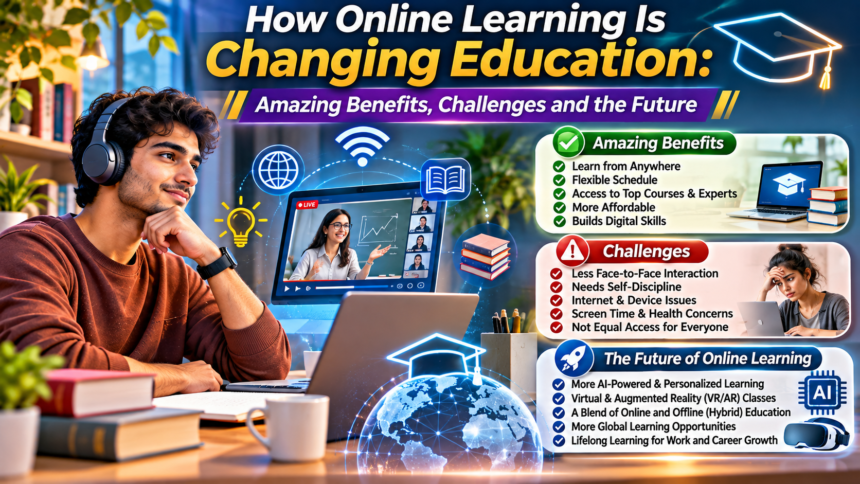
How Online Learning Is Changing Education
Education has changed significantly over the past few years. In the past, most students had to attend a school, college, or training centre to learn new subjects. Today, technology has made it possible to study from almost anywhere. With an internet connection and a suitable device, students can attend online classes, watch recorded lessons, read digital books, and communicate with teachers without always being present in a physical classroom.
- 1. Making Education More Accessible
- 2. Flexible Learning at Any Time
- 3. Changing the Role of Teachers
- 4. Personalised Learning for Different Students
- 5. Making Lessons More Interactive
- 6. Reducing Some Education Costs
- 7. Supporting Education Through Online Courses
- 8. Helping Students Develop Digital Skills
- 9. Making Education More Convenient for Working Professionals
- 10. Improving Communication Between Students and Teachers
- 11. The Growing Role of Artificial Intelligence in Online Learning
- 12. Supporting Students with Different Learning Needs
- 13. Challenges of Online Learning
- 14. The Digital Divide and Equal Opportunities
- 15. The Future of Online Learning
- Conclusion: Online Learning Is Creating New Possibilities for Education
- Frequently Asked Questions (FAQs)
This change is known as online learning, and it is becoming an important part of modern education. Schools, universities, training centres, and businesses are using digital platforms to provide lessons and learning materials. Students can choose courses, learn new skills, and study at a time that suits their daily routine.
Online learning is changing the way people study and gain knowledge. It allows students to learn from anywhere, reduces education costs, and makes lessons more flexible and suitable for each person’s learning needs.
Online learning became especially important during the COVID-19 pandemic, when many schools and universities moved their lessons online. Since then, digital education has continued to develop through video classes, learning applications, online tests, virtual classrooms, and artificial intelligence tools.
However, online learning is not only about using computers instead of books. It is changing how students learn, how teachers teach, and how educational institutions share knowledge.
In this article, we explore how online learning is changing education, including its benefits, challenges, effects on teachers and students, and the role it may play in the future.
1. Making Education More Accessible
One of the biggest changes brought by online learning is improved access to educational resources. In traditional education, students often need to travel to a school or college to attend lessons. This can be difficult for people who live in remote areas or far away from educational institutions.
Online learning allows students to access lessons from home or another suitable location. They can join virtual classrooms, download study materials, and learn from teachers who may live in a different city or country.
Students no longer need to follow fixed classroom schedules. Online learning allows them to study at their own pace and choose convenient times for lessons. This makes it easier to manage their studies along with work, family responsibilities, and other daily activities.
It can be especially useful for:
- Students living far from schools or colleges.
- People who cannot travel regularly.
- Working professionals who want to continue their education.
- Adults who want to learn new skills.
- Students looking for courses that are not available locally.
Online education does not solve every problem related to access, because students still need suitable devices, internet connections, and learning support. However, it creates additional ways for people to find educational opportunities.
2. Flexible Learning at Any Time
Traditional classroom education usually follows a fixed timetable. Students need to attend lessons at specific times and complete activities according to the school or college schedule.
Online learning offers more flexibility, especially when courses include recorded lessons and self-paced activities.
Students no longer need to follow fixed classroom schedules. Online learning allows them to study at their own pace and choose convenient times for lessons. This makes it easier to manage their studies along with work, family responsibilities, and other daily activities.
For example, a working professional can watch a recorded lecture after office hours. A college student can revise a difficult topic in the evening, while another learner may prefer studying early in the morning.
Some common flexible learning options include:
- Recorded video lessons.
- Downloadable notes and digital textbooks.
- Self-paced online courses.
- Recorded webinars.
- Online assignments and practice tests.
- Learning applications that allow regular revision.
Thisflexibility can help students balance education with work, family responsibilities, and personal activities. However, learners still need a timetable and regular study habits to complete their courses successfully.
3. Changing the Role of Teachers
Online learning is also changing the role of teachers. In a traditional classroom, teachers often explain lessons directly, write information on a board, and guide students through activities
Digital education gives teachers more ways to share information. They can use presentations, educational videos, online quizzes, discussion forums, and virtual classrooms to explain different subjects.
The role of teachers is changing from simply teaching lessons to guiding and supporting students in their learning journey. Instead of being the only source of information, teachers now help students understand topics, solve problems, and develop new skills. This change is happening because of new technology, changing job requirements, and a better understanding of how people learn.
The teacher’s role is also becoming more focused on guidance and support. Instead of only delivering information, teachers can help students understand difficult topics, develop problem-solving skills, and find reliable learning resources.
Teachers can use digital tools to:
- Share notes and assignments online.
- Conduct live lessons through video platforms.
- Record explanations for students to review.
- Provide feedback on digital assignments.
- Track student participation and progress.
- Arrange individual support sessions.
Technology does not remove the need for teachers. Good teaching still requires experience, communication, subject knowledge, and an understanding of students’ needs. Online platforms are most useful when they support these skills.
4. Personalised Learning for Different Students
Every student learns in a different way. Some understand a topic quickly after reading a textbook, while others need videos, examples, diagrams, or repeated explanations.
Online learning platforms can provide different types of learning materials to meet these needs.
For example, a student learning mathematics can watch a video explanation, practise questions, and repeat the lesson if necessary. Another student studying a language can listen to conversations, practise pronunciation, and complete vocabulary activities.
Some digital platforms also use learning data to suggest lessons based on a student’s progress.
Personalised learning may include:
- Lessons based on the learner’s current level.
- Practice questions for weak areas.
- Videos and diagrams for difficult topics.
- Individual progress reports.
- Different learning speeds.
- Suggestions for further study.
This approach can make learning more suitable for individual students. However, automated recommendations are not always correct. Teachers and learners should still decide which materials are useful and appropriate.
5. Making Lessons More Interactive
Traditional teaching often depends on textbooks, classroom explanations, and written exercises. Online learning introduces more interactive ways to understand subjects.
Students can watch demonstrations, answer questions during live classes, take part in online discussions, and use educational simulations.
For example, a science student may watch a digital demonstration of an experiment. A geography student can explore digital maps, while a language learner can practise speaking through online activities.
Interactive learning tools include:
- Educational videos and animations.
- Online quizzes and polls.
- Virtual laboratories and simulations.
- Digital flashcards.
- Group projects and discussion forums.
- Interactive presentations.
These activities can make lessons more interesting and help students understand complex information. However, interaction should support the learning goal rather than become a distraction.
6. Reducing Some Education Costs
Education can involve several expenses, including travel, accommodation, printed books, and classroom materials. Online learning can reduce some of these costs, depending on the course and the technology required.
Students who study from home may spend less on daily transport. Digital materials can also reduce the need to purchase certain printed resources.
Online education may be more affordable because it can offer:
- Free educational videos and study resources.
- Low-cost online courses.
- Digital books and notes.
- Flexible learning without daily travel.
- Remote training for working professionals.
However, online learning is not always free. Some courses require fees, subscriptions, devices, software, and reliable internet access. Students should compare the total cost and quality of a course before choosing it.
7. Supporting Education Through Online Courses
Online courses have created new opportunities for people who want to develop their knowledge beyond traditional school and college programmes.
Students can study subjects such as programming, digital marketing, business management, graphic design, communication, finance, and many other areas.
These courses can be useful for people who want to prepare for a career, improve their current skills, or explore a new area of interest.
Popular types of online courses include:
- Professional certification courses.
- Language-learning programmes.
- Computer and technology courses.
- Business and management training.
- Creative skills courses.
- Academic courses from universities.
Some courses provide certificates after completion. However, a certificate does not automatically guarantee employment. Learners should check the course provider, teaching quality, practical content, and value of the qualification.
8. Helping Students Develop Digital Skills
Digital skills are becoming important in education, work, and everyday life. Students need to know how to use computers, communicate online, search for information, and work with digital tools.
Online education gives learners regular opportunities to develop these abilities.
Students may learn how to:
- Use learning management systems.
- Attend online meetings.
- Create presentations and documents.
- Search for information responsibly.
- Submit assignments digitally.
- Work with others on online projects.
- Protect personal information online.
These skills can help students prepare for modern workplaces, where digital communication and technology are common.
However, using a device is not the same as being digitally skilled. Students must also learn how to check information, understand online risks, protect their privacy, and use technology responsibly.
9. Making Education More Convenient for Working Professionals

Online learning is useful not only for school and college students but also for people who already have jobs.
Many professionals need to update their skills because technology, business practices, and workplace requirements continue to change. Leaving a job or travelling to a training centre may not be practical for everyone.
Online learning allows employees to study while continuing their professional responsibilities.
For example:
- An office employee can learn advanced spreadsheet skills.
- A marketing professional can study search engine optimisation.
- A developer can learn a new programming language.
- A business owner can study financial management.
- A teacher can complete professional development courses.
This makes learning a continuous activity rather than something that ends after completing a degree.
10. Improving Communication Between Students and Teachers
Online education provides several ways for students and teachers to communicate outside regular classroom hours.
Students can ask questions through discussion boards, email, messaging systems, or online meetings. Teachers can share feedback, explain assignments, and provide additional learning materials.
This can be helpful for students who need more time to understand a topic or feel uncomfortable asking questions in front of a large class.
Good online communication depends on clear instructions and regular participation.
Students should:
- Ask questions when they do not understand a lesson.
- Follow online classroom rules.
- Check announcements regularly.
- Submit assignments on time.
- Communicate politely with teachers and classmates.
Online communication can support learning, but it should not completely replace meaningful interaction between students and teachers.
11. The Growing Role of Artificial Intelligence in Online Learning
Artificial intelligence (AI) is creating new possibilities in digital education. AI-powered tools can help students practise topics, receive explanations, improve writing, and find learning resources.
For example, an AI learning assistant may explain a mathematics problem step by step or help a language learner practise vocabulary. Some platforms can also provide feedback on answers and suggest additional practice.
Teachers may use AI tools to prepare lesson materials, organise information, or create practice questions.
Some possible uses of AI in education include:
- Personalised study recommendations.
- Writing and language support.
- Practice questions and explanations.
- Learning progress analysis.
- Assistance with lesson preparation.
- Educational chatbots.
However, AI tools can sometimes provide incorrect or misleading information. Students should check important facts using trusted sources and avoid submitting AI-generated work as their own.
Teachers also need to guide students on responsible AI use, academic honesty, and the importance of independent thinking.
12. Supporting Students with Different Learning Needs
Online learning can provide useful support for students with different abilities and learning needs.
Digital platforms may offer features that make educational materials easier to access. These include captions, audio lessons, adjustable text sizes, screen readers, keyboard navigation, and recorded explanations.
For students who find it difficult to attend regular classroom sessions, some online learning arrangements can offer greater flexibility.
Useful accessibility features include:
- Captions for recorded lessons.
- Audio versions of reading materials.
- Screen-reader support.
- Adjustable font sizes and display settings.
- Downloadable materials for offline study.
- Recorded lessons that can be replayed.
These tools can improve access, but not every online course is designed to support every learner. Educational institutions need to consider accessibility when choosing platforms and preparing content.
13. Challenges of Online Learning
Although online learning offers many benefits, it also comes with challenges. Digital education works best when students have the right equipment, suitable learning materials, and enough guidance.
Some learners may struggle to stay motivated without regular classroom interaction. Others may face internet problems or find it difficult to understand lessons without direct support.
Important challenges include:
Limited internet access: Students in some rural and low-income communities may not have reliable internet or suitable devices.
Lack of face-to-face interaction: Online students may miss direct conversations and social activities with teachers and classmates.
Distractions at home: Mobile phones, television, household responsibilities, and other activities can interrupt study time.
Screen fatigue: Spending long periods in front of a screen can cause tiredness and make it harder to concentrate.
Self-discipline: Self-paced courses require students to plan their time and complete lessons without constant reminders.
Quality concerns: Not every online course provides accurate information, good teaching, or recognised qualifications.
UNESCO’s 2023 Global Education Monitoring Report on technology in education highlights the importance of using technology in ways that are appropriate, fair, and supported by evidence. Technology alone does not guarantee better learning.
14. The Digital Divide and Equal Opportunities
One major concern about online learning is the digital divide. This refers to the gap between people who have access to digital technology and those who do not.
A student with a laptop, stable internet, and a quiet study space may have a different learning experience from someone who depends on a shared mobile phone or an unreliable connection.
The divide is not only about owning a device. It also includes digital skills, language, accessibility, and the ability to use online resources effectively.
To reduce this gap, educational institutions and governments can:
- Improve internet access in rural areas.
- Provide devices to students who need them.
- Offer downloadable and offline learning materials.
- Develop courses in different languages.
- Train teachers to use digital education tools.
- Design platforms for students with disabilities.
UNICEF’s 2025 report on childhood in a digital world also discusses differences in children’s digital access and skills. Making online education useful for everyone requires attention to these differences.
15. The Future of Online Learning
The future of online learning is likely to involve a combination of digital tools and traditional teaching methods. Schools and universities may continue to use online platforms for assignments, recorded lessons, communication, and additional learning activities.
Blended learning, which combines classroom teaching with digital learning, is one model that can provide both face-to-face interaction and online flexibility.
The European Commission’s report on digital transformation in blended learning discusses how digital tools can support student engagement, personalised education, and digital skills when they are used appropriately.
Future developments may include:
- More AI-supported learning tools.
- Interactive virtual classrooms.
- Better digital libraries.
- More flexible professional courses.
- Improved accessibility features.
- Online collaboration between students in different countries.
- Greater use of simulations and virtual laboratories.
The OECD’s Education Policy Outlook 2025 also highlights the importance of lifelong learning and preparing people to adapt to digital change.
However, the future of education should not depend on technology alone. Good teachers, suitable learning materials, student participation, and equal access will remain essential.
Conclusion: Online Learning Is Creating New Possibilities for Education
Online learning is changing education by making it more flexible, accessible, and connected. Students can study from different locations, use digital resources, join interactive lessons, and develop skills that are useful in modern workplaces.
It also gives teachers new ways to explain subjects, communicate with learners, and provide support. Artificial intelligence, virtual classrooms, and online courses are creating further opportunities for education.
At the same time, online learning has challenges. Poor internet access, limited devices, screen fatigue, and a lack of personal interaction can make learning difficult for some students. These problems need attention if digital education is to benefit everyone.
The future is not necessarily about replacing traditional classrooms with online platforms. It is about using the strengths of both methods to improve the learning experience.
Online learning is opening new doors for students, teachers, and working professionals. When technology is used responsibly and combined with good teaching, it can help make education more flexible, inclusive, and useful for future generations.
Frequently Asked Questions (FAQs)
1. What is online learning?
Online learning is a way of studying through the internet using digital platforms, video lessons, virtual classrooms, online courses, and electronic learning materials.
2. How is online learning changing education?
It is making education more flexible and accessible. Students can study from different locations, access recorded lessons, communicate online with teachers, and learn new skills at their own pace.
3. What are the main benefits of online learning?
The main benefits include flexible study schedules, access to digital resources, reduced travel, different course options, personalised practice, and opportunities to develop digital skills.
4. What are the disadvantages of online learning?
Some disadvantages include limited internet access, screen fatigue, distractions at home, reduced face-to-face interaction, and the need for strong self-discipline.
5. Is online learning effective for students?
Online learning can be effective when courses have clear goals, good teaching, suitable materials, regular feedback, and enough student support. Its effectiveness depends on how the course is designed and used.
6. How does online learning help working professionals?
It allows working professionals to study new subjects, improve existing skills, and complete training without necessarily leaving their jobs or travelling to a training centre.
7. What is blended learning?
Blended learning combines traditional classroom teaching with digital learning activities. Students may attend in-person lessons while also using online materials, assignments, and educational platforms.
8. How is AI changing online education?
AI can support personalised learning, provide practice questions, explain concepts, assist with writing, and help teachers prepare educational materials. Its answers should still be checked for accuracy.
9. What skills can students develop through online learning?
Students can develop digital literacy, communication, independent learning, time management, research, problem-solving, and subject-specific skills.
10. Will online learning replace traditional classrooms?
Online learning is unlikely to replace all traditional classrooms. A combination of classroom teaching and digital education can offer flexibility while preserving direct communication and social interaction.
Do follow us on Instagram
Read More – The Future of the Saudi Gaming Industry