



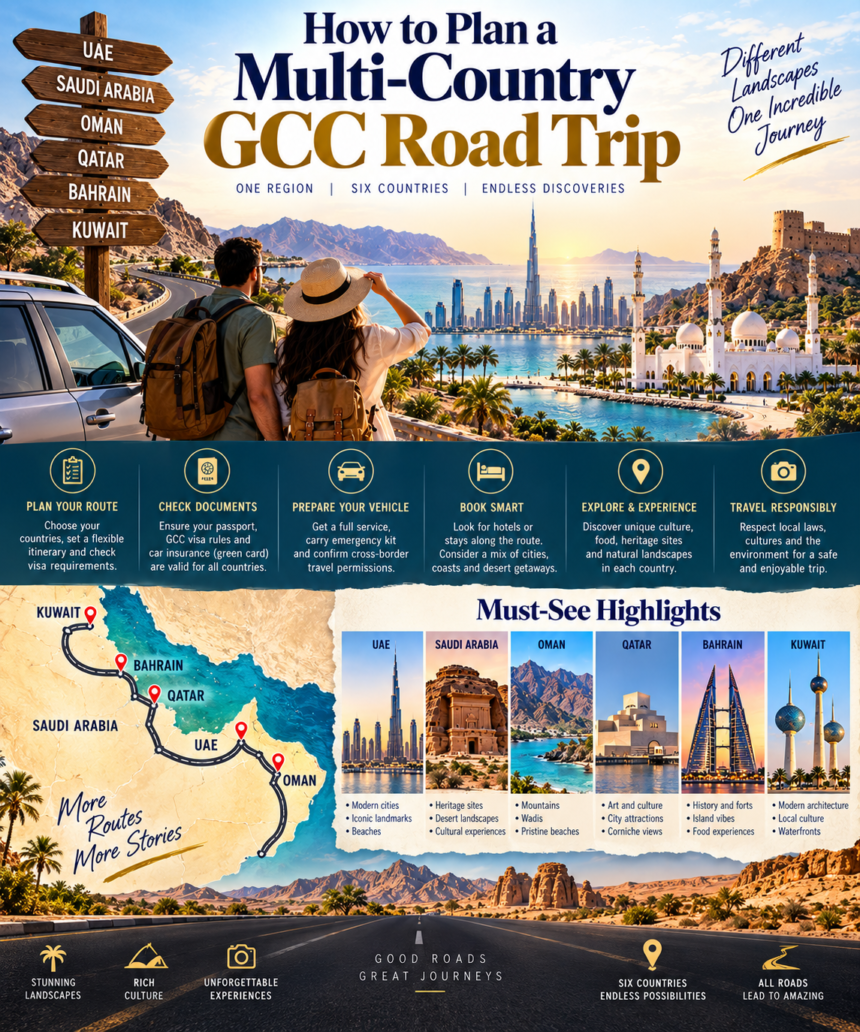
Best Route for a Multi-Country GCC Road Trip
Plan a Multi-Country GCC Road Trip can take travellers from Dubai’s futuristic skyline to Oman’s mountain roads, across the Empty Quarter into Saudi Arabia, through Doha’s modern streets, over the King Fahd Causeway to Bahrain and eventually north towards Kuwait.
- Is a Multi-Country GCC Road Trip Really Possible?
- Best Route for a Multi-Country GCC Road Trip
- How Many Days Do You Need for a GCC Road Trip?
- Check Visas Before Planning the Route
- Should You Use Your Own Car or Rent One?
- Vehicle Documents You May Need at GCC Borders
- Understand Cross-Border Car Insurance
- Driving from the UAE to Oman
- Driving from Oman to Saudi Arabia
- Driving from Saudi Arabia to Qatar
- Driving from Qatar to Bahrain
- Driving from Bahrain to Kuwait
- Best Stops for a GCC Road Trip
- How to Plan Fuel Stops Across the Gulf
- Choosing the Right Car for a GCC Road Trip
- Road Safety and Desert Driving
- Where to Stay During a GCC Road Trip
- How Much Should a Multi-Country GCC Road Trip Cost?
- Sample 21-Day GCC Road Trip Itinerary
- Common GCC Road Trip Mistakes to Avoid
- GCC Road Trip Checklist
- Best Time for a Multi-Country GCC Road Trip
- Final Thoughts on How to Plan a Multi-Country GCC Road Trip
Few regions offer this combination of desert, coast, mountains, ancient settlements and modern cities within a connected road network. But planning a multi-country GCC road trip requires more preparation than an ordinary holiday because every international border introduces immigration, insurance and vehicle requirements.
The Gulf Cooperation Council includes six countries: the United Arab Emirates, Oman, Saudi Arabia, Qatar, Bahrain and Kuwait. It is possible to link all six by road, although Saudi Arabia becomes the central country for several parts of the journey because Qatar, Bahrain and Kuwait connect overland through Saudi territory.
There is also an important visa update for anyone planning such a trip in 2026. The proposed GCC Grand Tours unified tourist visa has not yet officially launched as of September 2026. GCC Secretary-General Jasem Albudaiwi said recently that it would launch soon, but the authorities have not yet announced a firm launch date, fees, validity or final eligibility conditions. International tourists should therefore continue checking the individual entry requirements of every country on their route.
Is a Multi-Country GCC Road Trip Really Possible?
Yes. All six GCC countries can be incorporated into an overland itinerary, but the geography makes some combinations easier than others.
The UAE and Oman have several land connections. Oman also has a direct highway to Saudi Arabia through the Empty Quarter. Qatar’s only land border is with Saudi Arabia, while Bahrain connects with Saudi Arabia through the King Fahd Causeway. Kuwait also shares a land border with Saudi Arabia.
Qatar confirms that international visitors can enter by road through the Abu Samra border crossing with Saudi Arabia, located roughly an hour from Doha. Visit Qatar also allows travellers to pre-register vehicles through Hayya to help make land-border entry smoother.
Bahrain Tourism similarly confirms that the King Fahd Causeway provides the kingdom’s main road connection with Saudi Arabia and allows visitors from neighbouring Gulf countries to enter Bahrain by car.
The road infrastructure therefore exists. The more complicated part is making sure the driver, passengers and vehicle are legally allowed to cross every border.
Best Route for a Multi-Country GCC Road Trip
For travellers who want to visit all six countries, one logical route is:
| Stage | Route | Main Experience |
|---|---|---|
| 1 | Dubai to Muscat | UAE cities and Omani coast |
| 2 | Muscat to Saudi Arabia | Mountains and Empty Quarter highway |
| 3 | Saudi Arabia to Doha | Riyadh and Qatar |
| 4 | Doha to Bahrain via Saudi Arabia | Desert highway and King Fahd Causeway |
| 5 | Bahrain to Kuwait via Saudi Arabia | Northern Gulf road journey |
| 6 | Kuwait City | Final city stop |
This order avoids unnecessary backtracking through the UAE, although some retracing through Saudi Arabia is unavoidable because of Gulf geography.
Another option is to reverse the journey and start in Kuwait before driving south through Saudi Arabia, Bahrain, Qatar, Oman and the UAE.
Travellers interested primarily in scenery may prefer an UAE, Oman and Saudi Arabia itinerary. Those interested in cities and culture may find Saudi Arabia, Qatar, Bahrain and Kuwait easier to combine.
How Many Days Do You Need for a GCC Road Trip?
Trying to cover all six countries in seven or ten days would turn the holiday into a sequence of highways and immigration counters.
Around three weeks is a much more comfortable minimum for a complete six-country itinerary. Four weeks would be even better if AlUla, Jeddah, Oman’s mountains or the Saudi Red Sea are included.
A balanced plan could allocate:
| Country | Suggested Time |
|---|---|
| UAE | 3 days |
| Oman | 4 days |
| Saudi Arabia | 5 to 7 days |
| Qatar | 2 to 3 days |
| Bahrain | 2 days |
| Kuwait | 2 days |
| Border and transit time | 2 to 3 days |
Saudi Arabia deserves the largest allocation because it is geographically much larger than the other GCC countries.
The important principle is to count international driving days as travel days. A journey that appears to require six hours on a navigation application can take considerably longer once immigration, customs, rest breaks and traffic are included.
Check Visas Before Planning the Route
Visa planning should happen before hotels and rental cars are booked.
Entry policies depend on nationality, residency status, passport validity and sometimes existing visas or residence permits held in other countries.
Qatar, for example, currently provides visa-free entry to travellers from numerous nationalities while other visitors can use the Hayya e-visa system. GCC residents also have a dedicated A2 visa category.
Do not assume that obtaining permission to enter one GCC country automatically provides entry to another.
This matters particularly on routes such as Doha to Bahrain. The road journey passes through Saudi Arabia, so the traveller must be permitted to enter Saudi Arabia as well as Bahrain.
The same principle applies when returning through Saudi Arabia later in the itinerary. Your Saudi entry permission must support the number and type of entries required by the journey.
Important 2026 update: The planned GCC Grand Tours Visa is intended eventually to simplify multi-country Gulf tourism, but it is not yet available for travellers to purchase. Official details such as price and final eligibility remain unannounced.
Should You Use Your Own Car or Rent One?
This decision can determine whether the road trip is easy or frustrating.
Using your own GCC-registered vehicle is often simpler because there is no rental company restricting which countries the car may enter. You will still need to ensure that registration, insurance and any required authorisation are valid.
Rental cars require more care.
A company that allows its vehicles to travel between Dubai and Oman may not necessarily permit the same vehicle to continue into Saudi Arabia, Qatar, Bahrain and Kuwait.
Before paying for a rental, ask the company specifically:
“Can this exact vehicle cross into every country on my itinerary, and will you provide the required written authorisation and insurance documents?”
Do not rely on a verbal answer from a call centre.
Request confirmation in writing. Some companies restrict international travel entirely, while others permit only selected neighbouring countries or charge additional cross-border fees.
For a six-country journey, renting separately in different parts of the itinerary can sometimes be easier than finding one rental vehicle authorised for every border.
Vehicle Documents You May Need at GCC Borders

Requirements differ by country and can change, so travellers should confirm current rules shortly before departure.
A well-prepared road-trip document folder should generally include:
- Passport for every traveller
- Appropriate visas or entry permissions
- Driving licence
- International Driving Permit where required or requested
- Vehicle registration
- Proof of vehicle ownership
- Written authorisation if the driver is not the registered owner
- Rental company’s cross-border permission if applicable
- Motor insurance valid in the destination country
- Rental agreement
- Hotel details and travel itinerary
- Copies of important documents
- Digital backups stored securely
Qatar’s Hayya platform additionally offers vehicle pre-registration for travellers using the Abu Samra land border.
Having these documents organised before reaching immigration can save significant time at busy crossings.
Understand Cross-Border Car Insurance
Your normal car insurance may not automatically cover every GCC country.
Before departure, ask the insurer for a clear list of countries where the policy remains valid.
If additional border insurance is needed, check whether it can be arranged in advance. Do not assume that buying insurance at every border will always be quick or available under exactly the conditions you expect.
Drivers using rental vehicles should pay even closer attention. The rental company’s permission to take the car abroad and the insurance company’s permission to insure it there are two different questions.
Confirm both.
If the documentation does not clearly name a destination country, contact the provider before beginning the journey.
Driving from the UAE to Oman
The UAE and Oman are one of the easiest pairs to include in a GCC road trip because both countries share extensive road links.
A Dubai to Muscat journey can combine urban attractions with increasingly dramatic mountain scenery as travellers approach Oman.
Once inside Oman, the road-trip possibilities expand considerably. Visitors can continue towards Nizwa, Jabal Akhdar, Jabal Shams, Sur and A’Sharqiyah Sands before returning towards Muscat or heading west towards Saudi Arabia.
Oman’s Ministry of Heritage and Tourism advises drivers to inspect their vehicle and tyres, carry adequate fuel and take particular care in mountain areas, rain and fog. It also recommends specialised guides, GPS equipment and more than one vehicle for serious desert journeys.
This distinction matters. Driving on paved highways through Oman does not normally require a four-wheel-drive vehicle. Driving into dunes or certain remote mountain tracks is a very different activity.
Driving from Oman to Saudi Arabia
One of the most impressive modern road links in the region crosses the Rub Al Khali, or Empty Quarter, between Oman and Saudi Arabia.
This direct connection has made an Oman to Saudi road itinerary significantly more practical than routes that previously required lengthy detours.
The landscape is extraordinary but remote. Long sections pass through enormous desert environments where drivers should not treat fuel, water and mobile connectivity as casually as they would inside Muscat, Dubai or Riyadh.
Saudi Arabia’s official road-trip guidance advises travellers to keep the fuel tank topped up on long journeys, check brakes, tyres and batteries, carry a functioning spare tyre and remain prepared for long distances between services.
For this stage, start early and treat the journey as a full travel day rather than trying to add major sightseeing after arrival.
Driving from Saudi Arabia to Qatar
Qatar has only one land border, so every international road arrival enters through Saudi Arabia.
The Abu Samra border crossing is approximately an hour from Doha, according to Visit Qatar. International visitors should ensure all visa and entry requirements are complete before reaching the checkpoint. Vehicle pre-registration through Hayya can also help simplify processing.
Once inside Qatar, driving becomes considerably easier because the country is compact.
Doha can serve as a two or three-night base before continuing north.
Travellers with suitable vehicles may also explore locations such as Qatar’s desert, although Khor Al Adaid should not be treated as an ordinary road destination. Visit Qatar describes it as a 4×4 adventure area known for dunes reaching up to around 40 metres.
Driving from Qatar to Bahrain
This is where first-time GCC road-trippers sometimes misunderstand the map.
Qatar and Bahrain are geographically close, but there is currently no direct road bridge connecting them.
To drive from Doha to Manama, travellers must leave Qatar through Abu Samra, enter Saudi Arabia, drive across Saudi territory and then enter Bahrain through the King Fahd Causeway.
This means a single travel day involves two international borders.
The King Fahd Causeway is the established land connection between Saudi Arabia and Bahrain, and Bahrain Tourism specifically identifies it as the main route for travellers entering the kingdom by car.
Allow plenty of time rather than planning a fixed dinner reservation immediately after your expected arrival.
Weekends and holiday periods can also make international crossings busier.
Driving from Bahrain to Kuwait
The Bahrain to Kuwait road journey again requires travelling through Saudi Arabia.
After leaving Bahrain over the King Fahd Causeway, travellers head north through eastern Saudi Arabia before crossing into Kuwait.
This section can be useful for breaking up the itinerary with an overnight stop in Saudi Arabia’s Eastern Province rather than driving directly from Manama to Kuwait City.
For example:
Manama → Al Khobar or Dammam → Kuwait City
That creates a more comfortable travel pace while adding another side of Saudi Arabia to the trip.
Kuwait City then makes a natural final destination for a south-to-north itinerary.
Best Stops for a GCC Road Trip
The strongest road trip is not simply about collecting six country stamps. The route should showcase how different the Gulf landscapes can be.
| Stop | Why Include It |
|---|---|
| Dubai | Architecture, food and city life |
| Abu Dhabi | Culture, mosques and islands |
| Hatta | Mountain landscape |
| Muscat | Coast, culture and old souqs |
| Nizwa | Forts and Omani heritage |
| Jabal Akhdar | Mountain scenery |
| A’Sharqiyah Sands | Desert experience |
| Riyadh | Modern Saudi capital |
| AlUla | Archaeology and desert landscapes |
| Doha | Museums, souqs and waterfront |
| Manama | Food and urban culture |
| Muharraq | Bahraini heritage |
| Kuwait City | Waterfront and cultural attractions |
Do not add every destination simply because it looks interesting. A six-country road trip already involves substantial driving, so adding too many detours can make the holiday exhausting.
How to Plan Fuel Stops Across the Gulf
Fuel stations are easy to find around major Gulf cities and highways, but remote desert sections need more attention.
The safest habit is simple: do not wait for the fuel warning light.
When entering long-distance Saudi or Omani routes, refill whenever a convenient major service station appears.
Saudi Arabia’s road-trip guidance specifically advises drivers to keep tanks full because petrol stations can be widely separated on remote routes.
Carry drinking water as well.
The vehicle may have excellent air conditioning, but breakdowns, punctures and unexpected delays can leave travellers outside the car in an environment where heat becomes dangerous very quickly.
Choosing the Right Car for a GCC Road Trip
A large four-wheel-drive SUV looks appropriate for a Gulf road trip, but it is not automatically necessary.
For a route staying completely on paved roads, a comfortable sedan or crossover can be perfectly adequate.
A larger SUV becomes more valuable when:
- Travelling with four or five people and luggage
- Visiting remote mountain areas
- Carrying additional camping equipment
- Driving long distances over rougher roads
- Planning authorised off-road activities
However, owning a 4×4 does not make an inexperienced driver qualified for dune driving.
Oman’s official tourism guidance recommends specialist support for desert travel, along with GPS equipment and more than one vehicle for backup.
For serious dunes, use a licensed local operator unless you have appropriate off-road experience.
Road Safety and Desert Driving
Gulf highways are generally modern, but the environment creates challenges that may be unfamiliar to overseas visitors.
Long straight roads can cause fatigue. Sand can move onto the road. Animals may occasionally cross. Visibility can deteriorate in dust, fog or heavy rain, while high temperatures place additional stress on tyres and cooling systems.
Saudi road-trip guidance emphasises checking tyre pressure, battery condition, brakes and the spare tyre before long-distance travel.
Oman’s tourism authority similarly advises careful driving during fog, rain and mountain conditions.
Avoid setting unrealistic daily kilometre targets.
Two drivers are preferable for the longest stages, but both must be legally permitted and insured to operate the vehicle.
Where to Stay During a GCC Road Trip
Hotels do not need to be luxurious, but parking matters.
A beautiful city-centre hotel can become inconvenient if parking costs are high or vehicle access is difficult.
Before booking, check:
| Question | Why It Matters |
|---|---|
| Is parking available? | Essential with a road-trip vehicle |
| Is parking free? | Charges accumulate over long stays |
| Is the car park height restricted? | Important for large SUVs |
| Can luggage remain secure? | Useful during transit stops |
| Is the property close to the highway? | Saves time on driving days |
| Is late check-in available? | Borders may delay arrival |
For city stays in Dubai, Doha or Riyadh, it can sometimes make sense to park the car for a day and use Metro or taxis instead of driving through urban traffic.
How Much Should a Multi-Country GCC Road Trip Cost?
There is no useful universal price because the cost changes dramatically according to vehicle, hotel category, nationality, visas and route length.
Instead of setting one daily figure, divide the budget into major categories.
| Expense | What Changes the Cost |
|---|---|
| Vehicle | Rental class and cross-border fees |
| Fuel | Distance and vehicle efficiency |
| Visas | Nationality and entry type |
| Insurance | Number of countries covered |
| Hotels | Season and city |
| Tolls | Route and country |
| Parking | Hotel and city centre location |
| Food | Local restaurants vs premium dining |
| Attractions | Number of paid activities |
| Border fees | Country and vehicle requirements |
Set aside an additional contingency fund for unexpected border charges, tyre repairs, hotel changes or route diversions.
A road trip should never be budgeted so tightly that one unplanned overnight stay creates a problem.
Sample 21-Day GCC Road Trip Itinerary
A three-week itinerary offers enough time to experience all six countries without turning every morning into another long drive.
Days 1 to 3: UAE
Start in Dubai. Explore the city, then consider Abu Dhabi or Hatta before heading towards Oman.
Days 4 to 7: Oman
Drive to Muscat and spend time exploring the capital. Continue towards Nizwa or the mountains, with an optional desert experience before preparing for the long journey towards Saudi Arabia.
Day 8: Oman to Saudi Arabia
Use the direct Empty Quarter highway. Treat this as a dedicated driving and border-crossing day.
Days 9 to 12: Saudi Arabia
Spend time in Riyadh and add another destination if the schedule allows. Avoid building such a complicated Saudi itinerary that the rest of the GCC trip becomes rushed.
Day 13: Riyadh to Doha
Drive towards Qatar and enter through Abu Samra.
Days 14 to 15: Qatar
Explore Doha, Souq Waqif, the Corniche, museums and nearby attractions.
Day 16: Doha to Bahrain
Return through Saudi Arabia before using the King Fahd Causeway into Bahrain.
Days 17 to 18: Bahrain
Explore Manama, Muharraq, Bahrain Fort and the waterfront.
Day 19: Bahrain to Eastern Saudi Arabia
Cross the causeway and stay around Al Khobar or Dammam.
Day 20: Saudi Arabia to Kuwait
Continue north and cross into Kuwait.
Day 21: Kuwait City
Finish with a relaxed city day before flying home or beginning the return journey.
For a more comfortable holiday, extend this schedule to 25 or 28 days.
Common GCC Road Trip Mistakes to Avoid
A successful cross-Gulf drive is usually determined before the car starts moving.
| Mistake | Better Approach |
|---|---|
| Assuming one visa covers the GCC | Check every country’s entry requirements |
| Booking a rental before checking borders | Get written cross-border approval first |
| Ignoring Saudi transit needs | Remember several routes pass through Saudi Arabia |
| Planning too much driving | Add proper rest and sightseeing days |
| Relying entirely on mobile navigation | Download offline maps |
| Waiting until the tank is almost empty | Refill early on remote routes |
| Taking an ordinary car into dunes | Use a suitable 4×4 and professional guidance |
| Booking fixed activities after border crossings | Keep arrival evenings flexible |
| Assuming insurance works everywhere | Confirm every destination in writing |
| Leaving vehicle checks until departure | Inspect tyres, brakes, battery and spare tyre |
The most expensive road-trip mistake is often not fuel or accommodation. It is reaching a border and discovering that the vehicle cannot legally continue.
GCC Road Trip Checklist
Before leaving for a multi-country journey, confirm the following:
- Passport validity for every traveller
- Visa eligibility for all six countries on the route
- Number of entries permitted on each visa
- Driving licence validity
- International Driving Permit requirements
- Vehicle registration
- Vehicle ownership or authorisation papers
- Rental company cross-border approval
- Insurance coverage for every country
- Tyre condition and spare tyre
- Battery and brake condition
- Emergency equipment
- Drinking water
- First-aid supplies
- Phone chargers and power bank
- Offline navigation maps
- Hotel parking
- Border operating information
- Local emergency numbers
- Fuel stops on remote sections
- Enough flexibility for border delays
Keep physical documents together but also maintain encrypted digital copies in case anything is lost.
Best Time for a Multi-Country GCC Road Trip
For most travellers, November through March offers the easiest conditions for a road journey covering several GCC countries.
Winter allows visitors to walk through cities, explore forts, hike in Oman, camp in deserts and stop at roadside viewpoints without dealing with the most intense summer temperatures.
January and February can feel surprisingly cool in northern Saudi Arabia, Bahrain and Kuwait, while Omani and UAE mountain areas can also become cold at night.
Summer road trips remain possible because cars, hotels and attractions are heavily air-conditioned, but vehicle preparation becomes much more important. Qatar notes that summer temperatures can exceed 40°C, demonstrating the type of conditions travellers may encounter across parts of the Gulf.
For a first complete GCC road trip, winter is the much easier choice.
Final Thoughts on How to Plan a Multi-Country GCC Road Trip
Learning how to plan a multi-country GCC road trip is mainly about getting the logistics right before departure.
The roads themselves can connect six remarkably different destinations. The UAE provides futuristic cities and mountain escapes. Oman brings rugged peaks, wadis and traditional towns. Saudi Arabia provides enormous landscapes and acts as the central overland link. Qatar offers a compact city and desert break, Bahrain adds island culture, and Kuwait creates a natural northern finish.
The most important planning rule is to treat every international crossing seriously. Check visas individually, verify that the vehicle is permitted to leave its country of registration, confirm insurance coverage and keep enough flexibility for border delays.
As of September 2026, travellers should also avoid planning around the proposed GCC Grand Tours Visa. Officials say the unified visa is coming soon, but its final launch date and operating rules have not yet been announced. Until that changes, a successful Gulf road trip still depends on checking each country’s entry rules separately.
With the paperwork organised, a GCC road trip can become one of the most varied journeys in the region, moving from skyscrapers to mountains, vast desert highways, ancient heritage districts and Gulf coastlines without giving up the freedom of travelling at your own pace.
Do follow us on Instagram
Read More – Luxury Travel Experiences Across Gulf Countries: 18 Unforgettable Escapes