Smart Lockers and Parcel Collection: Changing UAE Last-Mile Delivery
Imagine entering a convenience store, picking up a bottle of water and a snack, and leaving without standing in a checkout queue. Or collecting an online shopping order from a secure locker late at night, without arranging a delivery appointment or speaking to a courier.
- What Are Self-Service Businesses in UAE and How Do They Work?
- Smart Lockers and Parcel Collection: Changing UAE Last-Mile Delivery
- Unmanned Stores in Dubai: Carrefour City+ and e& EASE
- 7 Reasons Self-Service Businesses Are Growing Across the UAE
- How Self-Service Businesses Make Money: Costs and Profitability
- UAE Government Smart Kiosks and the Shift Towards Digital Services
- Challenges, Privacy Rules and Risks of Unmanned Stores
- The Future of Self-Service Businesses in UAE: Opportunities and FAQs
These experiences are no longer limited to futuristic retail concepts. They are part of the development of Self-Service Businesses in UAE, where digital payments, artificial intelligence, automated machines and connected infrastructure are changing how consumers access everyday products and services.
Across Dubai, Abu Dhabi and other emirates, businesses are exploring ways to make transactions faster, more flexible and less dependent on traditional service counters.
The trend includes smart parcel lockers, automated vending machines, cashierless convenience stores, self-service telecommunications outlets, digital government kiosks and automated collection points.
Instead of requiring a staff member for every transaction, these systems allow customers to complete selected activities themselves.
The UAE has already introduced several examples. Carrefour launched its AI-powered City+ checkout-free store in Dubai in 2021, while e& introduced its EASE autonomous telecommunications retail concept in 2023 and expanded it to Dubai Mall in 2024.
In April 2026, ENOC Group and logistics company 7X announced plans to explore integrating smart lockers and collection services into ENOC’s retail network.
Government services are also demonstrating the potential of automation. Dubai’s Roads and Transport Authority reported that transactions through its smart kiosks exceeded one million in 2025.
These developments reflect an important commercial shift. Businesses are increasingly evaluating whether routine transactions can be completed through technology while employees focus on activities requiring human judgment and support.
However, self-service does not automatically mean lower costs or greater profitability.
Automated operations require investment in equipment, software, cybersecurity, maintenance and customer assistance. Businesses must also consider accessibility, data privacy and the consequences of technical failures.
Understanding these opportunities and limitations is essential for entrepreneurs considering automated retail in the UAE.
What Are Self-Service Businesses in UAE and How Do They Work?
Self-service businesses allow customers to complete purchases, collections, payments or other transactions without requiring direct assistance from an employee at every stage.
The concept is not entirely new. ATMs, ticket machines and vending machines have provided automated services for decades.
What has changed is the range of activities that modern technology can support.
Today, artificial intelligence, mobile applications, connected sensors and digital payment systems can enable more complicated transactions with limited staff involvement.
How Automated Services Operate
A typical self-service transaction begins with identification or product selection.
Customers may scan a QR code, enter a collection number, use a mobile application or choose an item from a digital screen.
The system verifies the request, processes payment when necessary and provides access to the product or service.
A connected platform records the transaction and updates relevant information.
Behind this simple customer experience, businesses need systems for stock monitoring, maintenance, security and customer support.
Common Self-Service Business Models
| Business Model | How It Works | Typical Application |
|---|---|---|
| Smart Parcel Lockers | Secure compartments opened through a code or application | Online order collection |
| Automated Vending Machines | Customers select and pay for products through a machine | Snacks, drinks and essentials |
| Cashierless Stores | Technology identifies purchases without conventional checkout | Convenience retail |
| Self-Service Kiosks | Digital interfaces process selected transactions | Payments and public services |
| Automated Collection Points | Customers retrieve prepared orders | Retail and logistics |
| Smart Service Outlets | Connected systems support product purchases and transactions | Telecommunications |
Self-Service Does Not Mean Completely Staff-Free
An unmanned shop still requires employees or contractors for cleaning, restocking, technical support and security.
A parcel locker needs a logistics network that delivers packages into its compartments.
The visible customer interaction may be automated, but human involvement remains essential behind the scenes.
The distinction matters because automation changes staffing requirements rather than necessarily eliminating them.
Smart Lockers and Parcel Collection: Changing UAE Last-Mile Delivery
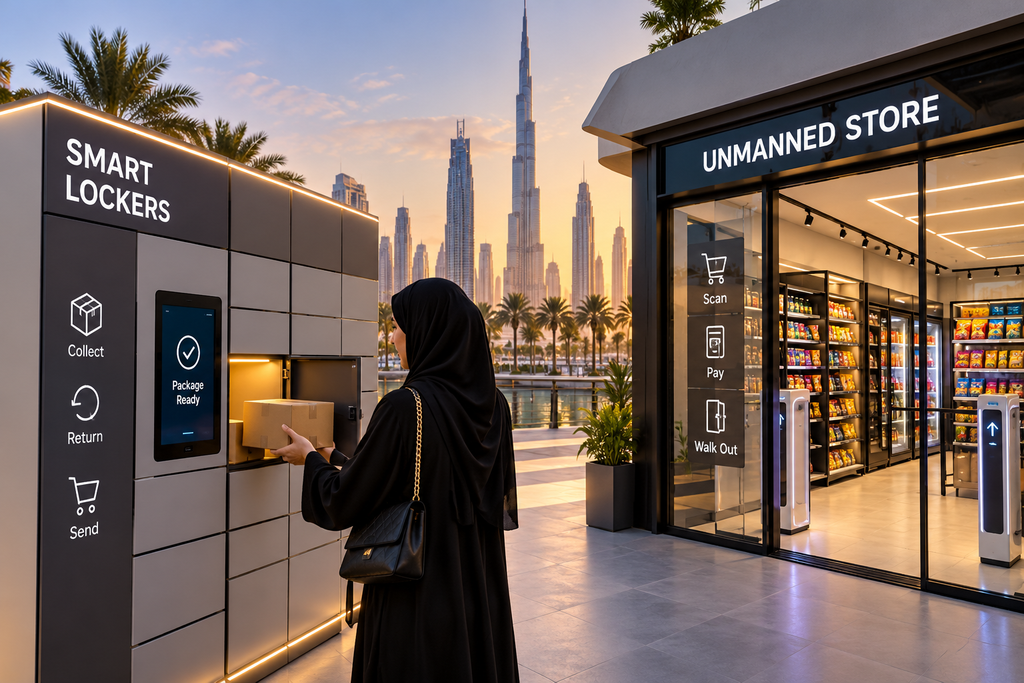
Smart lockers are among the most practical forms of automated service infrastructure.
They allow consumers to collect parcels from secure compartments at a convenient location.
Instead of waiting for a courier at home, a customer receives a collection notification and retrieves the package using an authorised code or application.
How Parcel Lockers Work
When a customer chooses locker collection, the delivery company transports the parcel to the designated installation.
The locker system assigns a compartment and sends access details to the customer.
Once the code is verified, the correct compartment opens.
The system records collection and updates the delivery status.
Why Logistics Companies Are Interested
Home delivery can involve repeated attempts when recipients are unavailable.
An appropriately located locker may allow couriers to deliver several parcels at one stop.
This can reduce some last-mile delivery complexity, particularly in areas with concentrated customer demand.
However, the savings depend on parcel volume, installation costs, locker occupancy and collection behaviour.
Smart Lockers in the UAE
Emirates Post announced parcel lockers and additional collection points in 2021, including plans for installations at post offices and selected petrol stations.
In April 2026, ENOC Group and 7X signed a memorandum of understanding covering several potential areas of cooperation.
One area involved evaluating integration of 7X’s pickup-and-drop-off services and smart lockers into ENOC’s retail network.
This was an exploration of potential deployment, not confirmation that every proposed location was operational.
Smart Lockers vs Home Delivery
| Factor | Smart Parcel Locker | Home Delivery |
|---|---|---|
| Customer Collection | Customer visits locker | Courier visits address |
| Scheduling | Collection within permitted window | Delivery coordination may be needed |
| Courier Efficiency | Several parcels at one stop | Multiple individual stops |
| Customer Convenience | Depends on locker location | Convenient for customers at home |
| Infrastructure | Installation and maintenance | Vehicles, drivers and routing |
| Suitable Products | Depends on compartment size and handling requirements | Broader range depending on courier |
Where Smart Lockers Could Work
Potentially suitable locations include residential communities, office districts, shopping centres, university campuses and petrol stations.
The commercial attractiveness of each location depends on regular parcel demand and convenient access.
Businesses also need to consider security, electricity, connectivity and agreements with property owners.
Unmanned Stores in Dubai: Carrefour City+ and e& EASE
Unmanned and cashierless stores are among the most visible examples of retail automation.
They seek to remove some of the steps associated with conventional shopping, especially waiting in payment queues.
The UAE has introduced several pioneering concepts in this area.
Carrefour City+: Shopping Without Conventional Checkout
In September 2021, Majid Al Futtaim launched Carrefour City+ at Mall of the Emirates.
The concept allowed customers to enter using the Carrefour application, select products and leave without passing through a conventional checkout counter.
Artificial intelligence and store-monitoring technology identified selected products and linked purchases to a digital shopping basket.
The store’s launch demonstrated how automated checkout could work in a convenience-retail environment.
It was an early regional example rather than evidence that all supermarkets were moving to cashierless operations.
e& EASE: Automated Telecommunications Retail
In October 2023, e& launched EASE, its AI-powered autonomous telecommunications retail concept.
The store combined technologies such as artificial intelligence, smart shelves, robotics and automated dispensing.
Customers could access services and purchase eligible products through a digitally supported shopping experience.
In September 2024, e& opened a second EASE location at Dubai Mall.
Its expansion demonstrated that self-service retail concepts were being explored beyond groceries and convenience products.
Comparing Automated Retail Concepts
| Feature | Carrefour City+ | e& EASE |
|---|---|---|
| Sector | Grocery and convenience retail | Telecommunications |
| First Announced | 2021 | 2023 |
| Technology | AI-assisted product recognition and app access | AI, robotics and smart shelves |
| Customer Focus | Faster everyday shopping | Automated product and service transactions |
| Main Benefit Sought | Reduced checkout friction | Simplified telecom retail experience |
What These Examples Reveal
The most important feature of these businesses is not the absence of cashiers.
It is the redesign of the customer journey.
Instead of using technology only at the payment stage, operators connect entry, product selection, inventory and transactions.
Nevertheless, retailers must ensure that automated purchases are accurate and that customers can resolve billing disputes or product-related problems.
7 Reasons Self-Service Businesses Are Growing Across the UAE
Several commercial and technological factors are encouraging companies to explore self-service models.
The following seven factors help explain their appeal.
1. Demand for Convenience
Consumers often value services that save time.
For routine transactions, an automated process may be more convenient than waiting for assistance.
However, convenience depends on the system working reliably and being easy to understand.
2. Greater Flexibility in Service Hours
Some automated facilities can operate outside conventional business hours.
Smart lockers, for example, may allow customers to collect packages at different times, subject to the location’s access arrangements.
This flexibility can be valuable for people with demanding work schedules.
3. Digital Payment Infrastructure
Card payments, mobile wallets and integrated payment systems make automated transactions easier to implement.
Customers can complete purchases without requiring a cashier to handle cash.
However, businesses must support secure payments and provide suitable alternatives where necessary.
4. More Efficient Use of Commercial Space
A compact vending machine or collection locker may occupy less space than a traditional shop.
This creates opportunities to provide selected products or services in locations where a full retail unit would be impractical.
Space savings must still be weighed against equipment and servicing costs.
5. Better Inventory Visibility
Connected machines can report stock levels and transaction activity.
Operators may use this information to identify popular products, plan replenishment and detect unusual demand patterns.
Accurate data can support better commercial decisions.
6. Advances in Artificial Intelligence
AI can assist with product recognition, demand forecasting and automated customer assistance.
More advanced systems may help identify items selected from shelves or detect operational abnormalities.
However, AI systems require oversight and testing to limit errors.
7. Changing Customer Expectations
As customers become familiar with digital services, they may become more comfortable completing routine transactions independently.
The shift is not universal. Some customers continue to prefer personal assistance, particularly for complex purchases or unfamiliar technology.
Seven Growth Drivers Compared
| Growth Driver | Business Opportunity | Main Consideration |
|---|---|---|
| Convenience | Faster transactions | Reliable user experience |
| Flexible Hours | Extended service access | Maintenance and security |
| Digital Payments | Simplified checkout | Payment security |
| Compact Infrastructure | Efficient use of space | Location economics |
| Inventory Data | Better replenishment | Data accuracy |
| AI Technology | More sophisticated automation | System reliability |
| Digital Familiarity | Greater customer adoption | Accessibility and assistance |
The most successful model will depend on the nature of the product or service rather than technology alone.
How Self-Service Businesses Make Money: Costs and Profitability
Self-service operations can generate revenue through direct product sales, transaction fees, service contracts or recurring commercial agreements.
Some businesses own and operate their machines, while others provide automated technology to retailers or property managers.
Common Revenue Models
A vending machine operator earns revenue from products purchased through the machine.
A locker-network operator may receive fees from logistics companies or retailers for parcel handling and collection services.
A technology provider may charge retailers for installation, software access, maintenance and support.
An automated store earns revenue through product sales, similar to a conventional retailer.
Understanding the Costs
Entrepreneurs should calculate the complete cost of ownership rather than focusing only on the equipment purchase price.
Expenses may include installation, rent, connectivity, electricity, maintenance, insurance, payment processing, inventory and technical support.
Unmanned systems may also require remote monitoring and physical security.
Illustrative Vending Machine Economics
| Monthly Item | Hypothetical Amount |
|---|---|
| Product Sales | AED 15,000 |
| Product Cost | AED 6,000 |
| Location Fee | AED 2,000 |
| Restocking and Transport | AED 1,500 |
| Maintenance and Connectivity | AED 600 |
| Payment and Miscellaneous Costs | AED 500 |
| Operating Surplus Before Other Costs | AED 4,400 |
This example is hypothetical. It excludes equipment depreciation, financing, taxes and certain other possible expenses.
A machine with weak sales could generate a loss even if it operates without an employee permanently stationed beside it.
Why Location Can Determine Profitability
A vending machine in a busy building may receive substantially more transactions than an identical machine in a poorly positioned location.
However, attractive locations can command higher fees.
The operator must evaluate expected sales against the cost of access to the site.
Key Metrics for Operators
- Transactions per day and average transaction value.
- Gross margin after product costs.
- Equipment uptime and breakdown frequency.
- Replenishment and maintenance expenses.
- Payment success rates and customer complaints.
- Return on equipment investment.
Automated businesses should be assessed through the same financial discipline as conventional retail operations.
UAE Government Smart Kiosks and the Shift Towards Digital Services
Self-service technology is not limited to commercial shops.
Government authorities in the UAE have introduced digital kiosks to help residents complete administrative transactions more conveniently.
These systems demonstrate how automation can reduce reliance on traditional counters for selected services.
Dubai RTA’s Smart Kiosk Network
In September 2023, Dubai’s Roads and Transport Authority announced a new generation of 32 smart kiosks across 21 locations.
The machines were designed to offer services involving vehicle licensing, drivers, payments and other transactions.
In its 2025 performance reporting, RTA said smart-kiosk transactions had increased by 17.3% compared with 2024, exceeding one million.
Revenue through this channel exceeded AED 425 million.
These figures describe government-service transactions and should not be interpreted as profits earned by private kiosk businesses.
Smart Services at Public Transport Facilities
In May 2026, RTA announced a smart bus station at Mall of the Emirates.
The facility included interactive digital services, ticketing and top-up facilities, as well as a smart vending machine.
Such projects demonstrate how self-service equipment can be integrated into existing public infrastructure.
Tourist VAT Refund Kiosks
The Federal Tax Authority reported in January 2026 that its tourist tax refund system had expanded to 103 self-service kiosks by the end of 2025.
These kiosks were located across selected shopping malls, hotels and tourist departure points.
The system supports eligible visitors completing relevant refund procedures.
Public and Commercial Self-Service Compared
| Application | Operator Type | Main Purpose |
|---|---|---|
| RTA Smart Kiosks | Government | Administrative transactions |
| VAT Refund Kiosks | Government-linked service system | Tourist refund processing |
| Smart Parcel Lockers | Logistics and retail operators | Parcel collection |
| Automated Stores | Private retailers | Product sales |
| Vending Machines | Commercial operators | Automated purchases |
Government adoption illustrates the practical possibilities of self-service infrastructure, although public-service objectives differ from commercial profitability.
Challenges, Privacy Rules and Risks of Unmanned Stores
Despite the advantages of automated services, businesses face important operational responsibilities.
A self-service system that is unreliable or confusing can create customer frustration.
Technical Failures
Payment terminals, locking mechanisms, sensors and network connections can malfunction.
An unsuccessful transaction may prevent a customer from collecting a package or completing a purchase.
Operators need monitoring systems and clear procedures for resolving failures.
Customer Support
Not every customer is comfortable using applications or automated interfaces.
Businesses should consider language options, accessibility and assistance for customers who encounter difficulties.
A fully automated sales process does not remove the need for customer service.
Data Privacy
Some autonomous retail systems use cameras, digital identities or other technologies that can process personal information.
Federal Decree-Law No. 45 of 2021 concerning the Protection of Personal Data establishes an important UAE framework for the handling of personal information, subject to its scope and exemptions.
Businesses must determine which privacy requirements apply to their operations and ensure that personal data is handled lawfully.
Where biometric information is involved, additional care is particularly important.
Security and Product Loss
Unmanned stores need systems to address theft, damage and unauthorised access.
Smart lockers must protect parcels against incorrect collection and tampering.
Security measures should be proportionate and consistent with applicable privacy requirements.
Regulatory Considerations
Depending on the business activity, operators may need trade licences, food-related approvals, suitable premises and authorisation from property owners.
A machine selling packaged beverages may have different compliance requirements from a fully automated grocery store or medical-product dispenser.
Businesses should verify the applicable requirements before installation.
Risk Management Table
| Challenge | Possible Consequence | Suggested Safeguard |
|---|---|---|
| Equipment Breakdown | Interrupted transactions | Maintenance and monitoring |
| Payment Failure | Customer disputes | Secure payment and refund procedures |
| Data Privacy Issues | Legal and reputational risks | Compliant data governance |
| Theft or Tampering | Product losses | Appropriate physical security |
| Poor Accessibility | Excluded customers | Inclusive interface design |
| Weak Location Demand | Low revenue | Site feasibility assessment |
| Complex Licensing | Delayed opening | Early regulatory consultation |
The objective should not be to remove people from every interaction, but to automate suitable tasks responsibly.
The Future of Self-Service Businesses in UAE: Opportunities and FAQs
Self-service technology could become increasingly relevant to retail, logistics and everyday services as digital infrastructure develops.
However, widespread adoption is not guaranteed.
Businesses must demonstrate that automated systems improve customer experiences while remaining financially sustainable.
Potential Growth in Residential Communities
Parcel lockers and automated collection points may become useful amenities in residential developments.
Such facilities could support residents who are frequently away during conventional delivery hours.
Their value will depend on demand, secure access and effective coordination with delivery partners.
Smaller Automated Retail Formats
Compact stores and specialised vending machines may offer convenient access to selected products.
Potential locations include office developments, transport hubs and educational campuses.
Operators will need to balance customer accessibility with product quality and replenishment requirements.
More Integrated Digital Systems
Future automated services may connect inventory, payments, collection and customer support within unified platforms.
This could help businesses identify operational problems more quickly.
Nevertheless, systems must remain secure and manageable.
Practical Checklist Before Launching
- Identify a clear customer need.
- Research expected transaction volume.
- Compare equipment and operating costs.
- Confirm business licensing and location permissions.
- Review payment and privacy requirements.
- Arrange technical support and maintenance.
- Design accessible customer instructions.
- Test security and emergency procedures.
- Establish refund and complaint processes.
- Pilot the concept before expanding.
Frequently Asked Questions
What are self-service businesses in the UAE?
They are businesses that use technology to let customers complete selected transactions without direct staff assistance. Examples include smart lockers, vending machines and automated stores.
Are there unmanned stores in Dubai?
Yes. Carrefour City+ and e& EASE are documented examples of autonomous retail concepts introduced in Dubai.
How do smart lockers work?
Customers receive authorised access details and use them to retrieve parcels from secure compartments at designated collection points.
Are vending machines profitable in Dubai?
They can be profitable, but results depend on sales volume, product margins, location costs and maintenance expenses.
Do unmanned businesses need licences?
Yes. Applicable licensing and approvals depend on the commercial activity, premises and products or services involved.
Do automated stores completely eliminate employees?
No. They generally still require people for restocking, maintenance, customer service, monitoring and other operational tasks.
Are self-service systems safe for personal information?
They can be operated securely, but businesses must implement appropriate controls and comply with relevant privacy and cybersecurity requirements.
Final Thoughts on Self-Service Businesses in UAE
The rise of self-service businesses reflects a wider transformation in how the UAE approaches retail, logistics and customer convenience.
From parcel lockers to cashierless stores, businesses are experimenting with technologies that reduce routine waiting times and make selected services more accessible.
Projects introduced by Carrefour, e& and logistics operators illustrate the range of possibilities, while government smart kiosks demonstrate the growing role of digital infrastructure in everyday transactions.
However, automation is not automatically a better business model.
Technology investments must be supported by customer demand, reliable operations, appropriate security and sustainable financial planning.
The most practical opportunities may lie in combining automation with human support rather than attempting to eliminate personal service entirely.
For entrepreneurs, Self-Service Businesses in UAE offer opportunities to rethink how products and services reach customers.
Their long-term importance will depend on a straightforward principle: technology should make everyday transactions easier, more reliable and more useful for the people who depend on them.
Do follow us on Instagram
Read More – Reverse Logistics in Gulf: Why It Is Becoming Essential for Online Retailers