



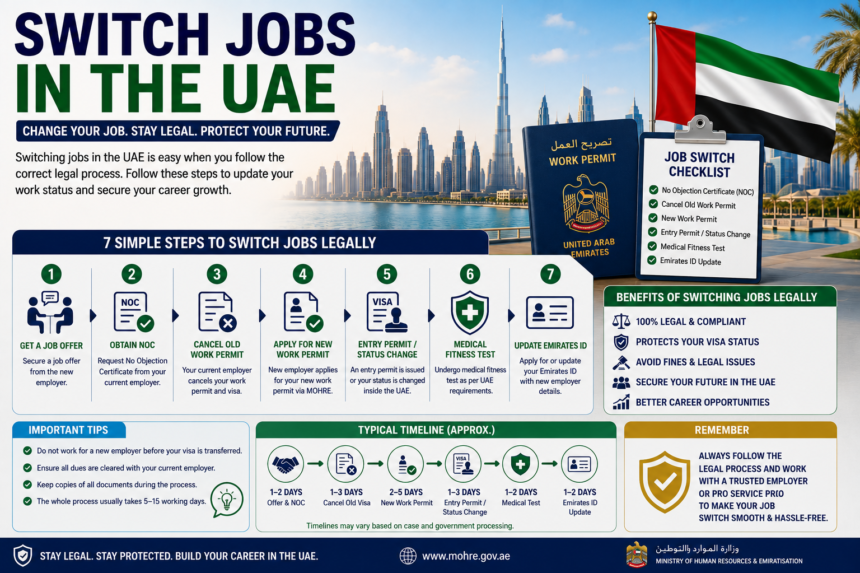
How to Switch Jobs in the UAE Legally in 2026: Complete Guide
Switching jobs is a common part of career growth in the UAE. Professionals may decide to change employers for a higher salary, better career opportunities, improved working conditions, a different industry, or a role that better matches their skills. However, employees working in the UAE need to follow the correct legal procedures when moving from one employer to another.
- Can You Switch Jobs in the UAE?
- Step 1: Secure a New Job Offer
- Step 2: Review Your Current Employment Contract
- Step 3: Submit Your Resignation Properly
- Step 4: Complete Your Current Employer’s Exit Process
- Step 5: Settle Outstanding Financial Matters
- Step 6: New Employer Applies for the Work Permit
- Can You Start the New Job Before the Work Permit Is Updated?
- Step 7: Update Your Residence and Employment Status
- Step 8: Complete Required Medical and Emirates ID Procedures
- Switching Jobs During Probation
- Is There a One-Year Work Permit Ban?
- Can You Change Jobs Without an NOC?
- What Happens to Your UAE Visa When You Change Jobs?
- Can You Stay in the UAE After Leaving Your Job?
- Documents to Keep When Switching Jobs
- Common Mistakes When Switching Jobs in the UAE
- How to Switch Jobs in the UAE Smoothly
- Benefits of Switching Jobs Legally
- What If Your Employer Refuses to Accept Your Resignation?
- What If Your Employer Has Not Paid Your Salary?
- What If the Employer Breaches the Employment Contract?
- Can You Work for Two Companies at the Same Time?
- UAE Job Switching Checklist for 2026
- Frequently Asked Questions About Switching Jobs in the UAE
Understanding how to switch jobs in the UAE legally is particularly important for expatriate employees because employment status, work permits and residence arrangements may be connected to the employer. Leaving a job without following the required process can create unnecessary complications, while completing the correct procedures can make the transition much smoother.
The UAE’s private-sector employment framework allows workers to change employers in a number of circumstances. A dedicated transfer work permit is also available for non-UAE workers moving between establishments registered with the Ministry of Human Resources and Emiratisation (MOHRE).
This guide explains the major steps involved in switching jobs in the UAE in 2026, including notice periods, probation rules, work permits, employment contracts, visa procedures, final settlements and common mistakes to avoid.
Can You Switch Jobs in the UAE?
Yes. Employees in the UAE private sector can generally change employers when they follow the applicable Labour Law, contractual and work-permit requirements.
The UAE Labour Law allows an employment relationship to end in several circumstances, including mutual agreement, expiry of the contract, termination by either party in accordance with the law and notice requirements, and certain other legally recognized situations.
After a lawful end to the employment relationship, an eligible worker may move to another employer subject to the requirements for obtaining the appropriate work permit.
This means that changing jobs is not inherently a problem. The important issue is how the employee leaves the existing employer and how the new employment is processed.
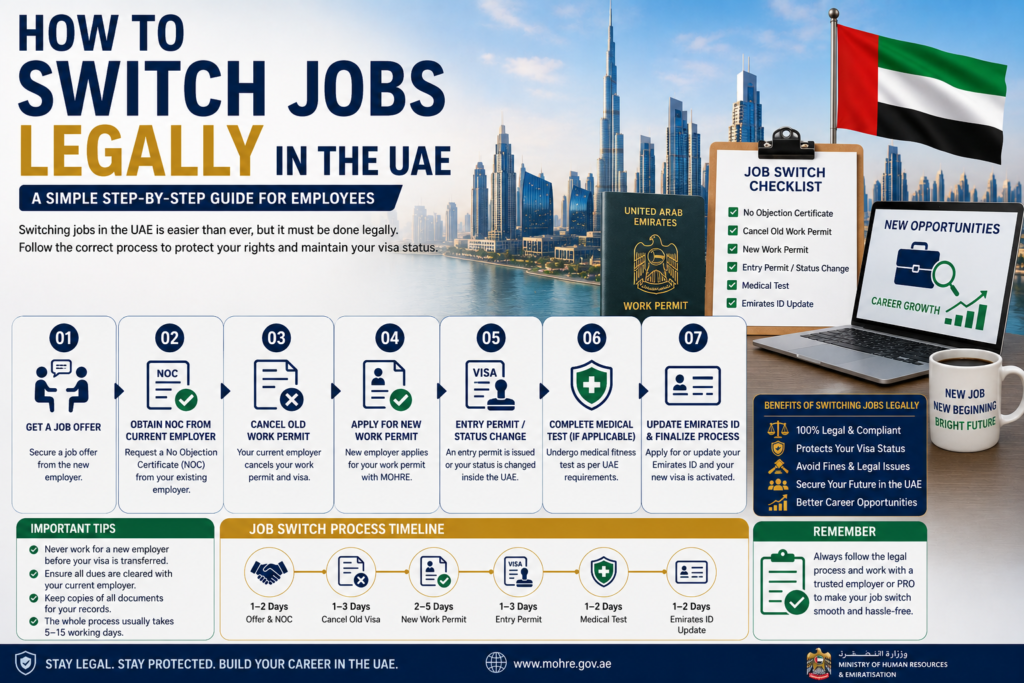
Step 1: Secure a New Job Offer
Before resigning, it is generally sensible to secure a formal offer from the new employer.
A UAE private-sector job offer should clearly establish the main employment terms and should be consistent with the employment contract. The UAE Government states that job offers contain details about the rights and obligations of both parties, while the employment contract specifies matters such as the start date, type of work, workplace, terms, duration and salary.
Before accepting a new position, carefully compare your current employment package with the proposed offer.
Look at:
- Basic salary
- Housing allowance
- Transportation allowance
- Other benefits
- Working hours
- Annual leave
- Medical insurance
- Job title
- Responsibilities
- Location
- Probation terms
- Notice period
- Commission or bonus structure
- Working arrangement
- Contract duration
Do not make a career decision based only on the headline salary. A job with a slightly higher salary may provide fewer benefits or involve substantially higher living and commuting costs.
Step 2: Review Your Current Employment Contract
Before submitting your resignation, read your current employment contract carefully.
Your contract can contain important information about your notice period, job responsibilities, compensation and other employment terms.
Under UAE Labour Law, the notice period for termination generally cannot be less than 30 days or more than 90 days. The applicable period is normally the one agreed in the employment contract within those statutory limits.
Check the contract for:
- Notice period
- Probation status
- Salary and benefits
- Outstanding leave
- Commission arrangements
- Company property
- Confidentiality obligations
- Final settlement procedures
- Any other contractual obligations
If you are uncertain about a particular clause, consider getting professional advice before resigning.
Step 3: Submit Your Resignation Properly
Once you decide to leave, submit your resignation in writing.
A written resignation creates a clear record of when you notified your employer and can help prevent misunderstandings about the notice period.
Your resignation should normally include:
- Your name
- Position
- Date of resignation
- Intended final working date
- A brief statement confirming your decision to resign
Keep a copy of the resignation and the employer’s acknowledgement.
Avoid simply stopping attendance at work. Failing to follow the proper process can create employment and work-permit complications.
Understanding the UAE Notice Period
One of the most important rules when switching jobs in the UAE is the notice period.
Under Article 43 of the UAE Labour Law, either party can terminate an employment contract for a legitimate reason by providing written notice, with the notice period generally being between 30 and 90 days. The contract remains in force during the notice period, and the employee is generally entitled to their full wage for that period.
The employer and employee may agree to reduce or waive the notice period while preserving the applicable rights, subject to the law.
What happens if you do not serve the notice period?
The party that does not comply with the notice period may be required to pay notice-period compensation to the other party.
The compensation is generally calculated according to the employee’s last wage and the remaining portion of the required notice period.
Therefore, employees should not assume that they can simply leave immediately because they have received another job offer.
Job Search Leave During Notice
If the employer terminates the employment contract, the employee is entitled under the Labour Law to one unpaid working day per week during the notice period to search for another job.
The employee can choose the day, but must notify the employer at least three days in advance.
This provision is particularly useful for employees who are attending interviews while completing their notice period.
Step 4: Complete Your Current Employer’s Exit Process
Before leaving your current employer, make sure the exit process is properly documented.
The company may need to complete procedures relating to your work permit and residence status, depending on your employment and sponsorship arrangements.
You should also return company property and complete any required handover.
Common items may include:
- Laptop
- Mobile phone
- Access cards
- Company documents
- Keys
- Equipment
- Company vehicle
- Other business property
Ask the HR department for confirmation of your final working date and details of the cancellation or transfer procedures applicable to your case.
Step 5: Settle Outstanding Financial Matters
Before joining your new employer, make sure your final financial settlement with the previous employer is properly addressed.
Depending on your circumstances, this can include:
- Final salary
- Unpaid overtime
- Approved expenses
- Accrued annual leave
- End-of-service benefits
- Other contractual payments
For eligible employees, end-of-service benefits may be payable when employment ends, subject to the applicable legal requirements.
Keep copies of your final settlement documents, salary records and other relevant paperwork.
Step 6: New Employer Applies for the Work Permit
After the previous employment relationship has ended and the applicable procedures have been completed, the new employer can process the employee’s work authorization.
MOHRE provides a specific transfer work permit for non-UAE workers moving from one establishment to another. The official UAE Government platform currently lists this as one of the available work-permit categories.
The new employer is responsible for completing the required work-permit procedures.
The employee should not simply begin working for the new company before the appropriate authorization is in place.
Can You Start the New Job Before the Work Permit Is Updated?
Employees should not assume that receiving a job offer gives them automatic permission to start working for another employer.
The UAE Government specifically states that workers must comply with the relevant rules and procedures when joining another establishment. The law also identifies joining another establishment without following the applicable rules as a serious matter.
Therefore, coordinate your start date with the new employer’s HR team and make sure the required employment and work-permit procedures are properly completed.
Step 7: Update Your Residence and Employment Status
For expatriate employees, changing employers may involve updating the employment-linked residence arrangements.
The exact procedure can depend on your visa and sponsorship situation, employer type and the authorities involved.
MOHRE handles private-sector employment and work-permit processes, while residence and immigration matters may involve the Federal Authority for Identity, Citizenship, Customs and Port Security (ICP) or the relevant General Directorate of Residency and Foreigners Affairs (GDRFA).
The UAE Government advises workers to consult MOHRE and ICP regarding applicable grace periods, new work permits and residence procedures after employment ends.
Step 8: Complete Required Medical and Emirates ID Procedures
When the new employment and residence process requires it, employees may need to complete the relevant medical fitness procedures and Emirates ID processes.
The UAE’s Work Bundle initiative integrates several employment and residency procedures, including work-permit issuance, residency procedures, Emirates ID issuance, medical fitness examinations and employment-contract procedures.
The new employer’s HR or PRO team should guide the employee through the procedures applicable to the individual case.
Switching Jobs During Probation
Switching jobs during probation requires special attention.
Under UAE Labour Law, an employer can place an employee on probation for a period of up to six months. The employee cannot generally be placed on probation more than once by the same employer.
If an employee wants to move to another employer in the UAE during probation, the law requires the employee to notify the original employer in writing at least one month before the intended termination date. The new employer is generally responsible for compensating the original employer for recruitment or contracting costs, unless otherwise agreed.
This is an area where employees should be particularly careful.
Leaving the UAE During Probation
If an employee wants to terminate employment during probation in order to leave the UAE, the employee generally must provide written notice at least 14 days before the intended termination date.
Because probation-related rules can have consequences for future work permits, employees should understand their specific circumstances before resigning.
Is There a One-Year Work Permit Ban?
Employees sometimes hear that anyone who changes jobs in the UAE automatically receives a work ban.
That is not an accurate description of the current rules.
A one-year ban on obtaining a new work permit can apply in specific circumstances. The official UAE Government guidance identifies situations including terminating the employment relationship during probation when the employer has not breached its contractual obligations, and a proven work-abandonment report.
Therefore, employees should not abandon their jobs or leave employment without following the required legal procedures.
A lawful job change following the applicable rules is fundamentally different from an unlawful abandonment of employment.
Can You Change Jobs Without an NOC?
The UAE’s modern employment framework should not be understood as requiring a traditional No Objection Certificate for every job change.
The key issue is whether the employee has lawfully ended the previous employment relationship and meets the requirements for the new work permit.
The UAE has a transfer work-permit category specifically for moving non-UAE workers between establishments.
However, individual cases can vary depending on the employment status, contract, probation situation and circumstances of termination.
Employees should therefore verify their specific situation with MOHRE rather than relying on informal advice or outdated information about NOCs.
What Happens to Your UAE Visa When You Change Jobs?
Changing jobs can involve changes to your employment-linked residence arrangements.
The exact process depends on the type of residence status you hold and how the new employer sponsors your employment.
For employees whose residence is connected to the previous employer, the old employer may need to complete the relevant cancellation process before the new employer can complete the new employment and residence procedures.
Some workers may have other forms of residence, such as family sponsorship or other qualifying residence categories.
Because visa rules can differ according to individual circumstances, employees should confirm the correct procedure with their employer’s HR team and the relevant immigration authority.
Can You Stay in the UAE After Leaving Your Job?
After an employment relationship ends, an individual may have a specified grace period during which they can search for a new job, obtain a new work permit or leave the UAE.
The applicable period can depend on the person’s residence category and circumstances. The UAE Government advises individuals to check the current grace-period rules with MOHRE and ICP.
Employees should never assume that their previous visa remains valid indefinitely after employment ends.
Before leaving the old job, ask HR for clear information about the status of your residence and work authorization.
Documents to Keep When Switching Jobs
Maintaining proper documentation can make the job-change process much easier.
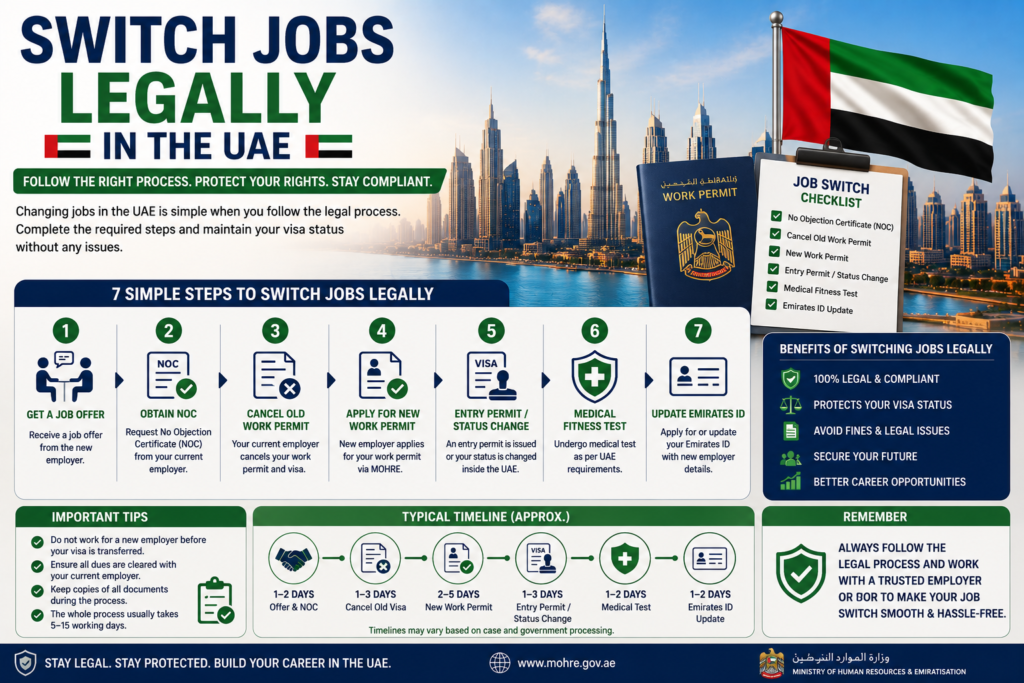
Keep digital and physical copies of:
- Current employment contract
- New job offer
- Resignation letter
- Resignation acceptance
- Notice-period confirmation
- Final settlement
- Salary records
- Work permit information
- Passport
- Emirates ID
- Residence documentation
- Medical fitness documents where applicable
- New employment contract
- Relevant MOHRE correspondence
Do not rely entirely on your employer to retain these records.
Common Mistakes When Switching Jobs in the UAE
A job change can become complicated when an employee ignores the legal process.
1. Resigning without checking the notice period: Always check your employment contract first.
2. Joining the new employer too early: Do not begin working for the new company until the required authorization is properly arranged.
3. Abandoning the current job: Stopping work without following the correct process can create serious complications.
4. Ignoring probation rules: Probation has specific notice and transfer requirements.
5. Failing to document the resignation: A verbal resignation can create uncertainty about dates and obligations.
6. Not checking the final settlement: Make sure salary, leave and other applicable dues are properly addressed.
7. Signing documents without reading them: Carefully review resignation acknowledgements, settlement documents and new employment contracts.
8. Relying on outdated information: UAE employment and immigration procedures can change. Always check current government guidance.
How to Switch Jobs in the UAE Smoothly
A well-planned transition can reduce stress and protect your professional interests.
Follow this practical checklist:
- Research the new employer.
- Receive a formal job offer.
- Compare salary and benefits.
- Review your existing employment contract.
- Confirm the notice period.
- Submit your resignation in writing.
- Complete the notice period unless legally or contractually waived.
- Complete your employer’s exit procedures.
- Collect your final settlement documents.
- Allow the new employer to process the required work permit.
- Complete applicable residence and immigration procedures.
- Complete medical and Emirates ID requirements where applicable.
- Start the new position only after the required authorization is in place.
Benefits of Switching Jobs Legally
Following the correct procedure is not simply about avoiding penalties.
It can also provide important professional benefits.
Legal compliance: A properly completed job transfer reduces the risk of employment-related complications.
Protection of employment rights: Following the correct process helps preserve applicable salary, leave and end-of-service claims.
Better career opportunities: Changing employers can allow professionals to access higher-level positions, better compensation and new industries.
Cleaner employment records: Proper documentation creates a clear record of the end of one employment relationship and the beginning of another.
Reduced visa complications: Coordinating work-permit and residence procedures can help prevent unnecessary immigration problems.
What If Your Employer Refuses to Accept Your Resignation?
An employer generally cannot simply prevent an employee from terminating an employment contract when the employee is following the applicable legal and contractual requirements.
The Labour Law provides mechanisms for termination by either party, subject to legitimate reasons, written notice and applicable contractual requirements.
If there is a dispute over resignation, notice, unpaid wages, cancellation or another employment matter, the employee can seek assistance through MOHRE.
The employee should maintain copies of all relevant communications and documents.
What If Your Employer Has Not Paid Your Salary?
Unpaid or delayed salary can create serious financial pressure.
Employees should document the issue and raise it through the appropriate channels.
The UAE has the Wages Protection System (WPS) for covered private-sector employers, designed to facilitate monitoring of wage payments. Official UAE Government information also provides channels for reporting unpaid or delayed salaries.
If salary problems are connected to a planned resignation or job change, employees should obtain appropriate guidance before taking action.
What If the Employer Breaches the Employment Contract?
The Labour Law provides circumstances in which an employee may terminate employment without notice while retaining applicable end-of-service rights.
For example, where an employer fails to meet contractual or legal obligations, the employee may have specific rights after following the required notification process involving MOHRE. There are also special provisions relating to assault, harassment, fundamentally different work and serious workplace safety risks.
Because these situations can be legally sensitive, employees should not assume that they automatically qualify for immediate resignation without notice.
Professional advice or guidance from MOHRE can help determine the correct procedure.
Can You Work for Two Companies at the Same Time?
Changing jobs is not the only option.
The UAE employment framework also allows certain employees to work for more than one employer under approved arrangements.
For example, eligible workers can work part-time for another establishment after obtaining the appropriate MoHRE work permit.
This can be useful for professionals who want to take on additional work without immediately leaving their primary employer.
However, employees must obtain the appropriate authorization and comply with the relevant employment rules.
UAE Job Switching Checklist for 2026
Before leaving your current employer, make sure you have considered the following:
Before resigning
- New job offer received
- Salary and benefits confirmed
- Employment contract reviewed
- Notice period confirmed
- Probation status checked
- Start date agreed with new employer
During the resignation
- Written resignation submitted
- Notice period documented
- Handover completed
- Company property returned
- Outstanding financial matters reviewed
During the transfer
- Previous employment procedures completed
- Work permit process coordinated
- New employment contract completed
- Residence status checked
- Medical fitness completed if required
- Emirates ID procedures completed if required
Before starting the new job
- Work authorization confirmed
- Residence status confirmed
- New employment contract understood
- Start date confirmed
- Copies of important documents retained
Frequently Asked Questions About Switching Jobs in the UAE
Q1. Can I change jobs in the UAE without leaving the country?
Ans: In many circumstances, yes. The UAE has work-permit mechanisms that allow eligible non-UAE workers to transfer between establishments within the country. The exact process depends on the employee’s circumstances and applicable requirements.
Q2. How long is the UAE notice period?
Ans: The statutory notice period is generally between 30 and 90 days, depending on the employment contract and applicable law.
Q3. Can I switch jobs during probation?
Ans: Yes, but special rules apply. An employee moving to another employer in the UAE during probation generally needs to provide the original employer with at least one month’s written notice, while other probationary termination situations have different notice requirements.
Q4. Can I start my new job before my old work permit is cancelled or transferred?
Ans: Employees should not assume that they can legally begin working for the new employer before the required work authorization is completed. The new employer should process the appropriate permit and confirm when the employee can legally commence work.
Q5. Is an NOC always required to change jobs in the UAE?
Ans: The modern UAE employment system includes a transfer work permit for eligible non-UAE workers moving between establishments. Whether any additional document is required depends on the individual’s circumstances and applicable procedures.
Q6. Will I get a work ban if I resign?
Ans: Not every resignation results in a work ban. A one-year restriction can apply in specific circumstances, including certain probationary terminations and proven work-abandonment cases.
Q7. Can I stay in the UAE after leaving my job?
Ans: Eligible individuals may have a specified grace period after employment ends to search for work, obtain a new work permit or leave the UAE. The applicable period depends on the individual’s circumstances and residence status.
Final Thoughts
Knowing how to switch jobs in the UAE legally is essential for employees who want to advance their careers without creating unnecessary legal, employment or immigration problems.
The safest approach is to plan the transition before resigning, secure a formal job offer, review your employment contract, follow the applicable notice period, complete your existing employer’s exit procedures and allow the new employer to process the required work permit and residence procedures.
Employees should pay particular attention to probation rules because changing employers during probation involves different notification requirements and can have consequences in certain circumstances.
Most importantly, do not rely on outdated information or informal advice from colleagues and social media. UAE employment regulations and administrative procedures can be updated, so employees should verify their specific circumstances with MOHRE, ICP or the relevant UAE authority.
A legally compliant job switch can provide a smoother transition, protect your employment rights and allow you to move forward with your career confidently.
Important Disclaimer
This article is for general informational and editorial purposes and is focused primarily on private-sector employment. Individual cases can differ depending on the employment contract, probation status, work permit, residence status, employer classification and circumstances of termination. UAE employment and immigration rules may change, so readers should verify current requirements with the relevant UAE authorities or seek qualified legal advice for a specific case.
Do follow us on Instagram
Read More – Top 15 Websites to Find Jobs in UAE in 2026