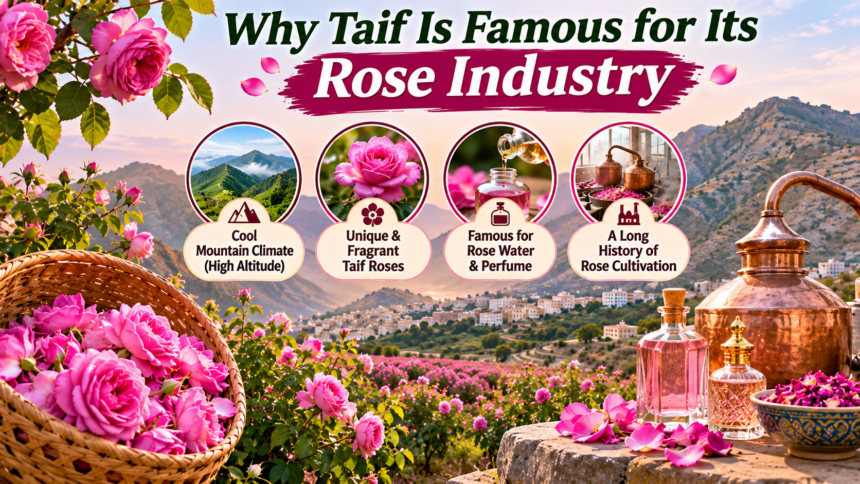
Why Taif Is Famous for Its Rose Industry: The Story Behind Saudi Arabia’s Famous Roses
Taif is one of the most beautiful cities in Saudi Arabia, known for its pleasant weather, mountain views, fruit farms, and fresh air. However, there is something else that makes this city special: its famous rose industry. Every spring, the hills and valleys around Taif become filled with beautiful pink roses and a sweet fragrance that attracts farmers, visitors, and perfume lovers.
- 1. Why Is Taif Famous for Its Roses?
- 2. The History of Rose Cultivation in Taif
- 3. The Mountain Climate That Helps Taif Roses Grow
- 4. Where Are Taif Roses Grown?
- 5. When Is the Taif Rose Harvest Season?
- 6. How Are Taif Roses Grown and Cared for?
- 7. How Are Taif Roses Turned into Rose Water and Rose Oil?
- 8. Popular Products Made from Taif Roses
- 9. Why Is Taif Rose Oil So Valuable?
- 10. The Cultural Importance of Taif Roses
- 11. How the Rose Industry Supports Taif’s Local Economy
- 12. Taif Rose Season and Tourism
- 13. The Future of Taif’s Rose Industry
- Conclusion: Taif’s Roses Are More Than Beautiful Flowers
- Frequently Asked Questions (FAQs)
Taif roses are not just flowers. They are an important part of the city’s history, culture, agriculture, and local economy. For generations, families have grown these roses, collected their petals, and used traditional methods to produce rose water and rose oil. These products are popular in perfumes, cosmetics, traditional dishes, and local celebrations.
The rose-growing areas around Al-Hada, Al-Shafa, and nearby valleys are especially important to this industry. The city’s mountain climate and growing conditions support the production of fragrant roses that have become a recognised symbol of Taif.
But why is Taif so famous for its roses? How are these flowers grown, harvested, and turned into valuable products? Let’s explore the history, seasonal harvest, traditional production methods, and cultural importance of Taif’s rose industry.
1. Why Is Taif Famous for Its Roses?
Taif is famous for its roses because of its natural growing conditions and long history of rose cultivation. Located in the mountains of western Saudi Arabia, the city has a different climate from many of the country’s hotter lowland areas.
Its higher elevation, moderate temperatures, suitable soil, and available water sources create good conditions for growing fragrant roses. The mountain areas of Al-Hada and Al-Shafa, along with nearby valleys, are among the main rose-growing locations.
The Taif rose is recognised for its attractive pink or reddish colour and strong fragrance. Farmers have developed their knowledge of growing and caring for these plants over many generations.
More than 910 rose farms in the area grow over 1.1 million rose bushes. Together, they produce around 550 million roses every year during the short spring season, which lasts about 35 to 45 days from early March to April.
The flowers are used to produce several valuable products, especially rose water and rose oil. These products have made Taif an important centre for rose cultivation and perfume production in Saudi Arabia.
2. The History of Rose Cultivation in Taif
The History of Rose cultivation in Taif is around 500 years.
The most widely believed theory is that Ottoman Turks brought the rose plants from the Balkans. The Taif rose is believed to be the same variety as the famous Kazanlik rose grown in Bulgaria and Turkey.
Rose cultivation in Taif is a tradition that has been passed down through generations. Local families have grown roses, collected flowers, and prepared rose products using knowledge shared between parents and children.
In earlier times, rose farming was mainly a family activity. Farmers looked after their plants throughout the year and prepared for the short flowering season. When the flowers appeared, family members and workers gathered them by hand before taking them for distillation.
Traditional rose distillation also became an important skill. Farmers learned how to use copper pots, heat, water, and cooling pipes to extract fragrant rose water and oil from fresh petals.
Over time, this small-scale activity developed into a wider agricultural and commercial industry. Farms, workshops, factories, and perfume businesses began to support the production and sale of Taif rose products.
Today, rose cultivation remains closely connected to the identity of the city. The tradition is also recognised in the cultural heritage record of UNESCO, which documents the cultural practices related to Taif roses.
3. The Mountain Climate That Helps Taif Roses Grow
One of the main reasons behind the success of the Taif rose industry is the local climate.
Many parts of Saudi Arabia experience very high temperatures, but Taif’s mountain location gives it comparatively moderate weather. The surrounding highlands also provide growing conditions that help farmers cultivate aromatic plants.
The areas around Al-Hada and Al-Shafa are particularly important for rose farming.
These regions are located about 2,000 to 2,500 metres above sea level. Their cool mountain weather and natural growing conditions help the roses develop their unique fragrance and quality, unlike roses grown in the hotter desert areas nearby.
Their mountain slopes, valleys, and agricultural land support rose cultivation and other types of farming.
Several natural factors help make Taif suitable for roses:
- Moderate temperatures: The cooler mountain climate supports the seasonal growth of rose bushes.
- Suitable soil: Local agricultural land provides conditions that farmers can use for growing rose plants.
- Water availability: Irrigation sources help farms maintain their plants during the growing season.
- Mountain environment: The highland conditions distinguish Taif from many hotter areas in the region.
- Seasonal weather: The change from winter preparation to spring flowering creates a clear agricultural cycle.
These conditions do not mean that roses grow without care. Farmers still need to prepare the soil, water the plants, remove unwanted growth, and protect the bushes throughout the year.
4. Where Are Taif Roses Grown?
Taif roses are grown in several agricultural areas across Taif Governorate. Many farms are located in mountain regions and valleys where the natural conditions are suitable for rose cultivation.
Some well-known rose-growing areas include:
- Al-Hada: A popular mountain area known for its scenic landscape and agricultural farms.
- Al-Shafa: One of the important highland areas associated with Taif rose cultivation.
- Wadi Muharram: A valley included among the recognised rose-growing areas around Taif.
- Wadi Al-Amq: Another agricultural area connected with local rose production.
- Surrounding villages and valleys: Smaller farming communities also contribute to the local rose industry.
These areas become especially attractive during the flowering season. Visitors can see rows of rose bushes, watch farmers collect flowers, and learn about the traditional production process.
The Saudi Press Agency’s report on Taif roses describes the importance of Al-Hada, Al-Shafa, Wadi Muharram, and surrounding areas in the city’s rose production.
5. When Is the Taif Rose Harvest Season?
The rose harvest is one of the most important periods in Taif’s agricultural calendar. It usually takes place during spring, when the rose bushes produce large numbers of flowers.
The picking season generally begins around the end of March and continues for approximately 35 to 45 days, depending on weather and growing conditions. During this period, farms become busy as workers and families collect fresh roses.
Harvesting often starts early in the morning. This helps farmers collect the flowers while they are fresh and before the heat of the day affects their delicate fragrance.
The work requires care and speed because freshly picked roses are taken for processing soon after collection.
During the season, visitors can experience:
- Fields filled with pink and red roses.
- Farmers collecting flowers by hand.
- Fresh petals being carried in baskets and containers.
- Traditional rose distillation.
- Local markets selling rose water, perfumes, and other products.
The harvest season is not only important for farmers. It also brings attention to Taif’s cultural identity and attracts people who want to experience the city’s famous rose tradition.
6. How Are Taif Roses Grown and Cared for?
Rose farming requires attention throughout the year. Farmers cannot simply wait for spring and collect the flowers. They must prepare the land and care for the rose bushes during different stages of growth.
According to Saudipedia’s guide to rose cultivation in Saudi Arabia, Taif farmers begin preparing rose fields in December. This includes activities such as ploughing, fertilising, and watering the land.
Pruning is also an important part of the process. Farmers remove selected branches to help maintain the shape of the plants and prepare them for new growth.
The main stages of rose cultivation include:
- Preparing the soil: Farmers prepare the land and add suitable fertiliser.
- Planting and caring for bushes: Young plants and established bushes receive regular attention.
- Watering: Farmers provide water according to the needs of the plants and local conditions.
- Pruning: Selected branches are trimmed to support healthy growth.
- Flowering: Rose buds develop and open as the spring season approaches.
- Harvesting: Farmers collect the flowers when they are ready for processing.
This year-round work is one reason the rose industry depends so strongly on the experience and knowledge of local farming families.
7. How Are Taif Roses Turned into Rose Water and Rose Oil?
One of the most interesting parts of the Taif rose industry is the traditional distillation process. Fresh rose petals are not sold only as flowers. They are also used to produce rose water and concentrated rose oil.
The process uses a traditional technique involving copper pots, water, heat, and cooling pipes. Although equipment may differ between workshops, the basic method has remained important to local rose production.
Here is how the process generally works:
Step 1: Collecting fresh roses
Farmers pick the roses early in the morning and collect them in baskets or containers. The flowers are transported to a workshop or distillery for processing.
Step 2: Preparing the copper pot
The fresh petals are placed inside a large copper vessel with a measured amount of water. The pot is closed carefully before heating begins.
Step 3: Heating the mixture
A controlled fire heats the mixture. As the water boils, steam carries aromatic compounds from the rose petals.
Step 4: Cooling the steam
The steam passes through a pipe connected to a cooling vessel. As it cools, it changes back into liquid.
Step 5: Collecting the rose products
The resulting liquid is collected, and the fragrant rose oil can be separated from the rose water. The products are then prepared for storage, sale, or further processing.
The process requires experience because the amount of roses, water, heat, and processing time all affect the final product.
The Saudi Press Agency’s 2026 report on Taif rosewater production describes this traditional craft and its importance during the spring harvest.
8. Popular Products Made from Taif Roses
Taif’s rose industry produces more than fresh flowers. The petals are used to make different products for personal care, fragrance, food, and traditional occasions.
Some of the best-known products include:
- Taif rose oil: A concentrated aromatic oil used in perfumes and fragrance products.
- Rose water: A fragrant liquid used in beauty care, food preparation, and traditional hospitality.
- Perfumes: Rose extracts are used in local and commercial fragrance blends.
- Soaps: Rose ingredients are added to scented soaps and personal care products.
- Cosmetics: Rose water and rose extracts are used in selected skincare and beauty products.
- Incense and fragrance products: Rose scents are included in products used to perfume homes and clothing.
- Food and drinks: Rose water can be used to add fragrance to sweets, desserts, and beverages.
The strength and type of fragrance can differ depending on the production method and concentration. This variety allows Taif rose products to reach different customers and markets.
9. Why Is Taif Rose Oil So Valuable?
Taif rose oil is considered a special product because it takes a large amount of fresh flowers and careful processing to produce a small quantity of concentrated oil.
Unlike ordinary fragrance products, pure rose oil comes from the aromatic material found in the flowers. Extracting it requires the right equipment, time, and knowledge.
Several factors contribute to its value:
- Large quantities of flowers: Many fresh roses are needed to produce a small amount of concentrated oil.
- Seasonal production: The main harvest takes place during a limited period each spring.
- Traditional skills: Distillation requires experience and careful handling.
- Strong fragrance: Taif roses are known for their distinctive scent.
- Demand for natural fragrance ingredients: Rose oil is used in perfumes and other scented products.
These factors help explain why Taif rose oil is treated as a premium product. It is also a symbol of the city’s agricultural skill and traditional craftsmanship.
10. The Cultural Importance of Taif Roses
Taif roses are closely connected to the culture and daily life of local communities. They are more than agricultural products because they play a role in family traditions, hospitality, celebrations, and social customs.
For generations, families have passed down the knowledge of planting, harvesting, and distilling roses. Children may learn these skills by watching and helping their parents during the growing and harvest seasons.
Roses are also used to welcome guests and show appreciation. Fresh flowers or petals may be offered during special visits and celebrations. Rose water and rose-based perfumes are also popular gifts for relatives and friends.
Some cultural uses include:
- Welcoming guests with fresh roses or rose petals.
- Giving rose water and perfume as gifts.
- Using rose products during family and social celebrations.
- Adding rose water to traditional dishes and drinks.
- Passing rose-growing knowledge from one generation to another.
These practices connect the rose industry with the social identity of Taif. UNESCO’s record of cultural practices related to Taif roses describes how cultivation, harvesting, distillation, and the use of rose products help strengthen community relationships.
11. How the Rose Industry Supports Taif’s Local Economy
The rose industry is an important part of Taif’s agricultural economy. It provides work for farmers, seasonal workers, distillery owners, product manufacturers, sellers, and people involved in tourism.
The industry also supports businesses that sell perfumes, rose water, soaps, and other products. Small family workshops can turn locally grown flowers into products that customers buy throughout the year.
A March 2026 report from the Saudi Press Agency, based on figures from the Sustainable Agricultural Rural Development Program (Saudi Reef), reported around 500 million roses produced annually across approximately 700 hectares and 1,300 properties in Taif Governorate. It also reported 36 perfume factories valued at SAR 52 million. These figures reflect the report’s stated scope and should be understood as reported estimates rather than fixed annual totals.
Government programmes have also supported rose farmers through technical guidance, financing, marketing assistance, and efforts to strengthen producer organisations.
The growth of the industry can help:
- Create seasonal and long-term employment.
- Support small farms and family businesses.
- Increase demand for local agricultural products.
- Encourage investment in perfume production.
- Provide opportunities for rural communities.
- Promote Taif’s identity in local and international markets.
12. Taif Rose Season and Tourism
The rose season has become an attractive time for visitors interested in nature, culture, farming, and local products.
During spring, rose farms around Taif receive visitors who want to see the flowers and learn how they are transformed into rose water and perfume. Some farms and workshops offer visitors an opportunity to understand the traditional distillation process.
Tourists can enjoy several activities during the rose season:
- Visiting rose farms in Al-Hada and Al-Shafa.
- Watching farmers collect fresh flowers.
- Learning about traditional distillation methods.
- Buying rose water and local perfumes.
- Taking photographs of blooming rose fields.
- Exploring nearby mountain scenery and agricultural areas.
The experience gives visitors a chance to understand a side of Saudi Arabia that goes beyond modern cities and large shopping centres. It also helps local farms and businesses connect with more customers.
13. The Future of Taif’s Rose Industry
Taif’s rose industry has a long history, but it also faces the need to adapt to changing conditions. Farmers must manage water supplies, plant health, production costs, and changing market demand.
Improving farming methods and supporting local producers can help the industry remain strong. Better training, research, quality control, packaging, and marketing may also create new opportunities for small businesses.
Some areas that can support future growth include:
- Modern farming methods: Better cultivation techniques can help farmers improve plant care and production.
- Research and training: Scientific support can help address farming challenges and improve rose varieties.
- Product development: Businesses can create new perfumes, cosmetics, soaps, and food products.
- Better marketing: Strong branding can help more customers recognise authentic Taif rose products.
- Responsible water use: Efficient irrigation can help farms manage a valuable natural resource.
- Cultural tourism: Farm visits and distillation demonstrations can help preserve traditional knowledge while supporting local businesses.
The future of the industry will depend on balancing modern business opportunities with the traditional skills that make Taif roses special.
Conclusion: Taif’s Roses Are More Than Beautiful Flowers
Taif is known for its rose industry because of its mountain climate, suitable growing areas, long farming tradition, and skilled local producers. Every spring, farmers collect millions of flowers and turn them into rose water, rose oil, perfumes, and other valuable products.
The industry is also an important part of Taif’s culture. Rose-growing knowledge is passed from one generation to another, while rose products continue to play a role in hospitality, celebrations, and everyday life.
Beyond their fragrance, Taif roses support farmers, small businesses, tourism, and the local economy. They also help introduce visitors to the traditions and agricultural heritage of Saudi Arabia.
Taif’s rose industry shows how a natural product can become an important part of a city’s identity. Its flowers connect the land, people, culture, and economy through a tradition that continues to grow with every spring season.
Frequently Asked Questions (FAQs)
1. Why is Taif famous for roses?
Taif is famous for roses because its mountain climate, suitable growing conditions, and long history of rose cultivation make it an important centre for fragrant rose production in Saudi Arabia.
2. When is the Taif rose season?
The main rose harvest usually begins around the end of March and lasts approximately 35 to 45 days. The exact timing can change depending on weather and growing conditions.
3. Where are Taif roses grown?
Taif roses are grown in several areas, including Al-Hada, Al-Shafa, Wadi Muharram, and other nearby valleys and agricultural communities.
4. What are Taif roses used for?
Taif roses are used to make rose water, rose oil, perfumes, soaps, cosmetics, incense products, and ingredients for certain foods and drinks.
5. How is Taif rose oil made?
Fresh rose petals are heated with water in a distillation vessel. The steam passes through cooling pipes and turns into liquid. The fragrant oil is then separated from the rose water.
6. Why is Taif rose oil expensive?
Taif rose oil is valuable because a large quantity of fresh flowers and a careful extraction process are needed to produce a small amount of concentrated oil.
7. Can visitors explore Taif rose farms?
Yes. During the spring season, visitors may be able to explore selected rose farms and workshops, watch harvesting, and learn about rosewater production. Availability depends on the farm and its visiting arrangements.
8. How does the rose industry help Taif’s economy?
The industry supports farmers, seasonal workers, distilleries, perfume manufacturers, product sellers, and tourism businesses. It also creates opportunities for small family-owned enterprises.
9. What makes Taif roses different from other roses?
Taif roses are known for their distinctive fragrance and their long connection with the mountain agriculture and cultural traditions of the region.
10. Are Taif roses part of Saudi Arabia’s cultural heritage?
Yes. The cultivation, harvesting, distillation, and social uses of Taif roses are documented by UNESCO as cultural practices connected with the local community.
Do follow us on Instagram
Read More – How the Arabian Oryx Survived in the Desert