



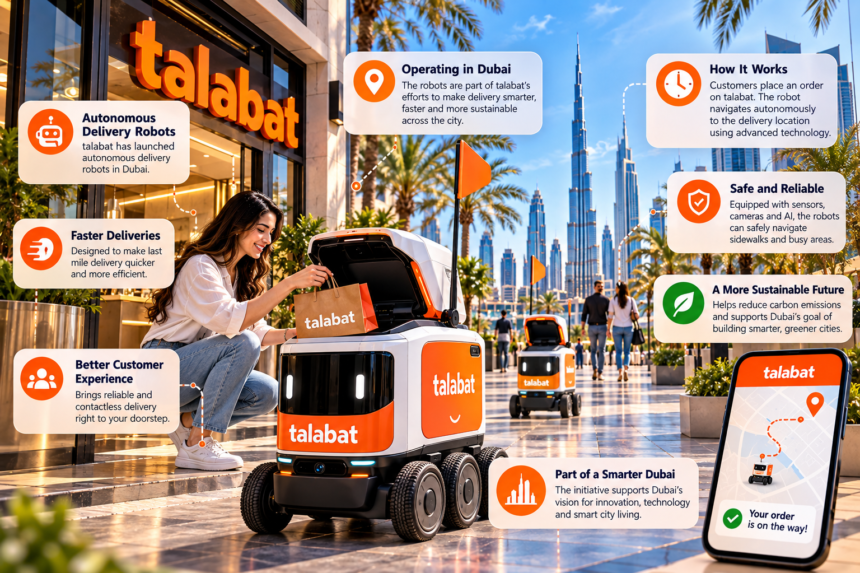
Talabat Brings Autonomous Delivery Robots To Dubai
Talabat autonomous delivery robots in Dubai are taking food delivery beyond roads and building entrances. In a new pilot with Singapore-headquartered robotics company QuikBot, talabat is testing robots that can take over one of the most time-consuming parts of a high-rise delivery: getting an order from the building entrance, into the elevator and all the way to the customer’s door.
- Talabat Autonomous Delivery Robots in Dubai: What Has Been Announced?
- How Does the Robot Delivery Actually Work?
- Why High-Rise Buildings Are the Focus
- The Robot Can Use Elevators, and That Is the Important Part
- Is the Robot Replacing the talabat Rider?
- What Could This Mean for Delivery Times?
- Security Will Matter Just as Much as Speed
- This Is Not Dubai’s First Experiment With talabat Robots
- Dubai Silicon Oasis Is Becoming a Testing Ground for Delivery Technology
- Dubai Is Building a Much Wider Autonomous Mobility Ecosystem
- Dubai Has Also Strengthened Its Rules for Autonomous Vehicles
- Why Buildings Could Become Part of the Delivery Network
- What Happens If the Elevator Is Busy?
- Could Autonomous Robots Make Deliveries More Sustainable?
- What Customers Could Notice First
- What the Pilot Still Needs to Prove
- Could We See These Robots Across Dubai?
- Talabat Delivery Robots: Quick Takeaways
- Frequently Asked Questions About talabat Autonomous Delivery Robots in Dubai
- Why talabat’s Dubai Robot Pilot Could Matter Beyond Food Delivery
The live pilot is taking place at the A6 commercial building in Dubai Digital Park, Dubai Silicon Oasis. A talabat rider still handles the main journey to the building, but instead of entering, waiting for an elevator and travelling to the customer’s floor, the rider can hand the order to a QuikBot at a designated point. The robot then completes the indoor section of the delivery autonomously.
The idea is not simply to make deliveries look futuristic. It is designed to solve a very practical problem in a city filled with high-rise buildings, where the final few hundred metres of a delivery can sometimes consume a surprising amount of a rider’s time. If the trial works effectively at scale, the model could create a new partnership between people and robots rather than simply replacing one with the other.
Talabat Autonomous Delivery Robots in Dubai: What Has Been Announced?
Talabat and QuikBot have signed a Memorandum of Understanding to explore autonomous robot deliveries inside high-rise buildings. talabat confirmed that a live pilot has already been completed at Dubai Digital Park, with the companies evaluating how robotics can make high-rise delivery quicker and more efficient.
Unlike some autonomous delivery systems that travel several kilometres outdoors, this trial focuses specifically on what happens after the rider reaches the destination building. The robot is intended to navigate the building itself, including elevators and corridors, before reaching the customer’s door.
Here is a quick overview of the current trial:
| Detail | What We Know |
|---|---|
| Delivery company | talabat UAE |
| Robotics partner | QuikBot |
| Pilot location | A6, Dubai Digital Park |
| Area | Dubai Silicon Oasis |
| Main purpose | High-rise indoor delivery |
| Rider’s role | Brings the order to the building |
| Robot’s role | Takes the order from handover point to customer |
| Elevator use | Yes |
| Customer collection | Secured using a one-time password |
| Wider rollout | Not yet confirmed |
The companies have not publicly announced a citywide rollout date, the number of robots that could ultimately be deployed or exactly which residential and commercial towers could receive the technology next. For now, this remains a live pilot designed to test the operating model before decisions about broader deployment are made.
How Does the Robot Delivery Actually Work?
The customer experience begins in almost the same way as an ordinary talabat order. A rider collects the food or other items and travels to the customer’s building, meaning robots are not currently handling the complete restaurant-to-door journey in this particular trial.
The difference begins once the rider reaches the building. Instead of spending additional time entering the property, completing reception procedures, waiting for the elevator and finding the correct office or unit, the rider transfers the order to the autonomous robot at a designated handover location.
From there, the QuikBot completes the remaining journey. The robot is designed to interact with the building environment, travel using the elevator and navigate to the customer’s door. When it arrives, the customer retrieves the order using a one-time password, adding a security layer intended to make sure the delivery reaches the correct person.
In simple terms, the model works like this:
Restaurant or store → talabat rider → building handover point → QuikBot → elevator → customer’s floor → doorstep
This creates a hybrid model in which the rider handles the longer and more complex outdoor journey, while the robot handles a repetitive indoor stage that can take valuable time.
Why High-Rise Buildings Are the Focus
To understand why talabat is testing this system, consider what happens when a rider arrives at a large Dubai tower. Reaching the building does not necessarily mean the delivery is almost complete.
Depending on the property, a rider may need to park, locate the correct entrance, check in with security, wait for elevator access and travel dozens of floors before walking through corridors to reach the correct unit. The same process must then be completed in reverse before the rider can begin another delivery.
A few additional minutes may not appear significant when looking at one order. Across hundreds or thousands of deliveries, however, those minutes become a substantial operational issue.
| Traditional High-Rise Delivery | Rider + Robot Model |
|---|---|
| Rider reaches building | Rider reaches building |
| Rider enters lobby | Rider reaches handover point |
| Rider may check in | Order transferred to robot |
| Rider waits for elevator | Rider can leave for next task |
| Rider travels to floor | Robot uses elevator |
| Rider finds customer | Robot navigates to customer |
| Rider returns downstairs | Robot completes indoor process |
| Rider begins next delivery | Rider may already be moving again |
talabat says the pilot is intended to determine how much rider time can be saved and how effectively the two companies’ technologies can operate together in a real delivery environment.
That makes the trial less about replacing the entire delivery process and more about redesigning one inefficient part of it.
The Robot Can Use Elevators, and That Is the Important Part
A robot moving along a pavement is no longer particularly unusual. Autonomous delivery robots have already been tested in several cities around the world, including earlier projects in Dubai.
Operating independently inside a high-rise creates a different challenge. A useful robot must do more than recognise walls and avoid obstacles. It needs to work with the building’s infrastructure and understand where it is allowed to go.
QuikBot says its technology is designed around connecting robots with buildings, access systems and other infrastructure. In the Dubai pilot, that capability allows the robot to move through the building and use elevators rather than simply operating on one floor.
That building integration could ultimately be more important than the appearance of the robot itself. If autonomous delivery systems are going to operate regularly inside towers, hotels, offices, hospitals or mixed-use developments, they need reliable ways to interact with lifts, security controls and building-management systems.
Dubai, with its dense collection of high-rise properties, offers an obvious environment in which to test that technology.
Is the Robot Replacing the talabat Rider?
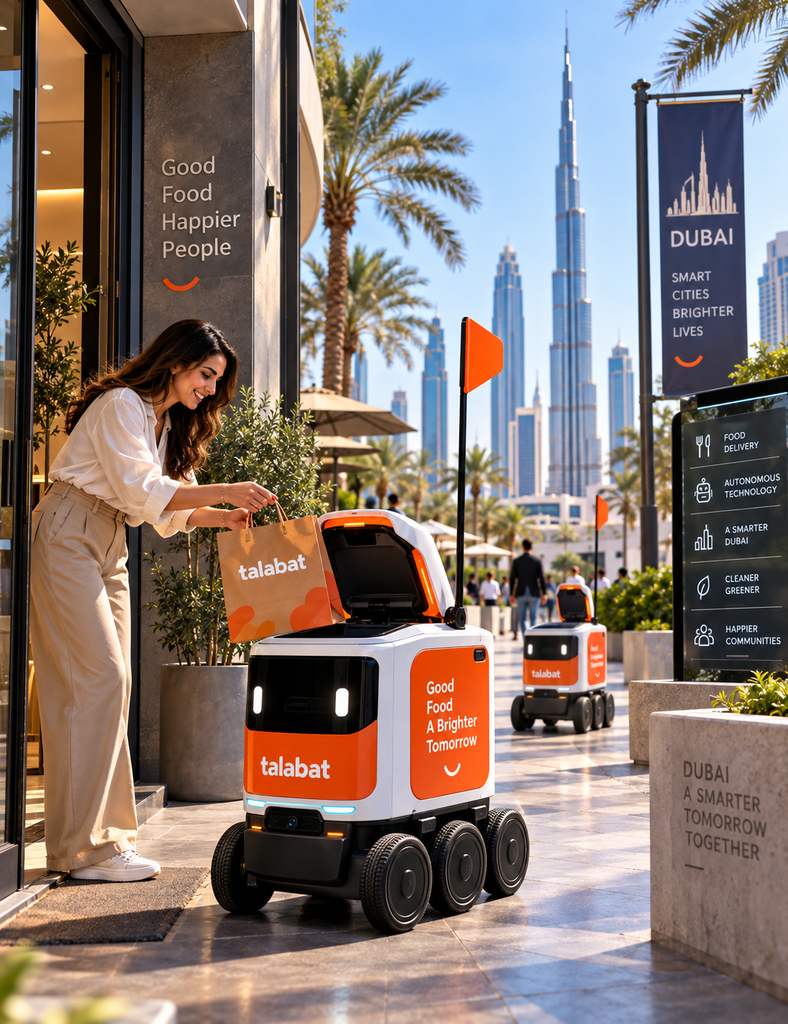
Based on the current pilot, the answer is no. The rider remains an essential part of the delivery journey and is responsible for bringing the order to the building.
The robot takes over a specific final section after the rider arrives. QuikBot has described the system as technology intended to augment riders rather than replace them, while talabat says the partnership is exploring ways to save rider time and get orders to customers more efficiently.
The difference is important because autonomous-delivery technology is sometimes discussed as though an entire human delivery workforce will suddenly disappear. The system being tested in Dubai is much closer to a division of tasks.
The rider remains better suited to:
- Collecting orders from different restaurants and shops
- Travelling through changing road conditions
- Handling the main outdoor journey
- Managing situations that require human judgement
The robot is being tested for:
- Moving through a controlled building environment
- Taking repetitive elevator journeys
- Navigating corridors
- Completing the final indoor handoff
This type of human-machine collaboration could become more common as companies identify individual tasks where automation provides the greatest practical benefit.
What Could This Mean for Delivery Times?
One of the clearest potential advantages is reducing the amount of time a rider spends inside each high-rise building.
Imagine a rider arriving at a tower where entering, waiting for an elevator, completing the delivery and getting back downstairs takes 10 minutes. If that indoor journey can instead be assigned to a robot, the rider could potentially begin travelling toward another pickup significantly earlier.
The actual savings will depend on the building, elevator traffic, security procedures and robot performance. talabat has not yet announced verified time-saving results from the new high-rise pilot, so it would be premature to claim that every delivery will suddenly become a certain number of minutes faster.
However, the operating logic is clear. The technology is designed to remove a point where riders can be temporarily unavailable for other orders even though they have already reached the customer’s location.
If that model proves reliable, the benefit may be visible not only to the customer receiving the robot delivery but also to customers elsewhere, because riders could spend a greater proportion of their shifts moving between restaurants, stores and buildings.
Security Will Matter Just as Much as Speed
Faster delivery will not be enough if customers cannot trust the system.
That is why the one-time password used in the trial is an important detail. When the QuikBot reaches the customer, the order is not simply available for anyone passing through the corridor to take. Customers use an OTP to retrieve their delivery.
Secure compartments are already a common feature of autonomous-delivery systems. Dubai Future Labs, for example, has previously developed delivery robots with compartments that can only be opened by the intended customer, alongside real-time fleet tracking and remote-response capabilities.
For large-scale deployment, operators would need to maintain confidence across several parts of the process, including order handover, navigation, building access and customer collection. A reliable robot needs to be more than autonomous. It also needs to be predictable, secure and easy for ordinary customers to use.
This Is Not Dubai’s First Experiment With talabat Robots
The 2026 QuikBot pilot represents a new type of high-rise application, but talabat has experimented with autonomous delivery in Dubai before.
In February 2023, Dubai’s Roads and Transport Authority, Dubai Integrated Economic Zones Authority and talabat UAE launched a pilot involving autonomous delivery robots known as talabots in Dubai Silicon Oasis. Three robots were initially deployed to serve residents of Cedre Villas, travelling within a three-kilometre radius from Cedre Shopping Centre.
That project concentrated on outdoor neighbourhood delivery and was designed to test short-distance, zero-emission autonomous transport. The authorities said at the time that the robots were expected to support riders, improve fleet efficiency and contribute to lower carbon emissions.
The new QuikBot pilot addresses a different part of the journey.
| Earlier talabot Pilot | New QuikBot Pilot |
|---|---|
| Announced in 2023 | Announced in 2026 |
| Dubai Silicon Oasis | Dubai Silicon Oasis |
| Mainly outdoor delivery | Primarily indoor high-rise delivery |
| Cedre Villas | Dubai Digital Park A6 |
| Robot travels through community | Rider brings order to building |
| Focus on short-distance last mile | Focus on elevator and floor delivery |
| Residential neighbourhood trial | Commercial high-rise pilot |
Seen together, the projects show how Dubai’s approach to autonomous logistics is evolving from simply testing whether robots can move around neighbourhoods to examining how they can interact with complex buildings.
Dubai Silicon Oasis Is Becoming a Testing Ground for Delivery Technology
It is not accidental that both projects have taken place in Dubai Silicon Oasis.
The area is designed around technology, innovation and smart-city development, making it a practical location for companies to test new forms of mobility and logistics in real operating environments.
Other autonomous logistics projects have also been tested there. In 2024, DIEZ and Aramex began testing a multi-cabin autonomous delivery robot in Cedre Villas, with the robot capable of handling multiple deliveries during a single trip.
The repeated use of Dubai Silicon Oasis for such trials creates something valuable for technology companies: an environment where autonomous systems can move beyond controlled demonstrations and interact with real customers, roads, buildings and operational processes.
That is essential because autonomous technology can perform well in a laboratory but still face unexpected problems when placed inside a busy building or neighbourhood.
Dubai Is Building a Much Wider Autonomous Mobility Ecosystem
talabat’s robot experiment also sits inside a much bigger transformation taking place across Dubai.
The emirate’s Self-Driving Transport Strategy aims for 25% of transportation trips in Dubai to be autonomous by 2030. The target includes multiple forms of mobility rather than being limited to delivery robots.
Dubai has already expanded trials and commercial operations involving autonomous taxis. In 2026, Dubai Taxi Company and Baidu’s Apollo Go launched fully driverless commercial ride-hailing services, with an initial plan for 50 vehicles in the first year and a phased expansion to more than 1,000 vehicles over the following years.
RTA reported in August 2026 that Robotaxi operations in Dubai had exceeded 4 million kilometres, while 7,613 passenger journeys had been recorded since launch.
Delivery robots therefore represent only one part of a wider autonomous-mobility environment involving public transport, taxis, logistics and smart-city infrastructure.
Dubai Has Also Strengthened Its Rules for Autonomous Vehicles
Innovation can move quickly, but autonomous technology also needs rules around safety, responsibility and permitted operations.
Dubai introduced a regulatory framework governing autonomous vehicles and has continued developing its implementation. In May 2026, Executive Council Resolution No. 14 of 2026 established operational phases that move from data and mapping verification to operation with a safety operator and eventually operation without one, subject to RTA requirements and permits.
Not every rule applying to road-going autonomous vehicles necessarily applies in the same way to a small indoor delivery robot. However, the wider regulatory development demonstrates that Dubai is attempting to build a structured framework around autonomous mobility rather than relying only on experimental demonstrations.
For companies developing delivery robots, this broader ecosystem matters. Large-scale automation requires cooperation between technology developers, delivery platforms, property owners, infrastructure operators and regulators.
Why Buildings Could Become Part of the Delivery Network
One of the most interesting consequences of this technology may have little to do with robots themselves.
Buildings could eventually become active participants in logistics.
Today, many towers are passive destinations. A delivery arrives, and the rider must work out how to complete the rest of the process using reception, lifts and corridors designed primarily for people.
A robot-ready building would operate differently. Elevators, access systems and designated handover areas could communicate with autonomous delivery platforms, allowing deliveries to move through the property with less human coordination.
That could create new features inside future developments, such as:
| Smart Building Feature | Possible Delivery Benefit |
|---|---|
| Robot handover zones | Faster rider-to-robot transfer |
| Connected elevators | Autonomous floor access |
| Digital building permissions | Controlled robot movement |
| Secure delivery lockers | Flexible collection |
| Robot charging areas | Longer autonomous operation |
| Building management integration | Easier monitoring and access |
| Dedicated service routes | Less interference with residents |
This does not mean every Dubai tower will suddenly be redesigned for robots. Existing buildings vary enormously in layout, elevator systems and access controls.
But if autonomous delivery becomes commercially valuable, developers could eventually begin considering robot compatibility in the same way they now think about EV charging, smart-home technology and digital access.
What Happens If the Elevator Is Busy?
Real buildings are rarely as predictable as technology demonstrations.
Elevators become crowded during office rush hours. Doors are held open. Maintenance takes lifts out of service. Visitors stand in corridors, deliveries arrive simultaneously and building access rules can change.
These conditions are exactly why a live pilot matters.
The success of high-rise robots will depend on how consistently they handle normal urban complications, not simply whether they can successfully complete one programmed journey.
Important questions include how the robot responds when an elevator is unavailable, whether it can operate around crowds, how it handles connectivity interruptions and what happens when a customer does not answer immediately.
These details will determine whether the system remains an interesting demonstration or becomes reliable infrastructure.
Could Autonomous Robots Make Deliveries More Sustainable?
Autonomous delivery systems are often connected with sustainability because small electric robots can potentially handle some journeys with lower direct emissions than conventional vehicles.
Dubai’s earlier talabot project was explicitly linked with encouraging zero-emission delivery methods and reducing carbon emissions.
However, the sustainability case for the new indoor QuikBot model is slightly different. The robot is not replacing the rider’s main vehicle journey in the current trial. Its most immediate environmental benefit would therefore be indirect, potentially helping the overall delivery fleet operate more efficiently.
Efficiency could matter at scale. If riders can complete more useful movement without spending long periods waiting inside buildings, delivery networks may require fewer unnecessary movements and less idle time.
Actual environmental benefits would still need to be measured rather than assumed, taking into account robot manufacturing, charging, maintenance and the wider fleet operation.
What Customers Could Notice First
For most customers, the technology behind the system will matter less than whether the experience is simple.
A successful robot delivery should not require customers to understand robotics, building automation or artificial intelligence. The ideal experience would be straightforward: place an order, receive an update, wait for the robot and securely collect the delivery.
The most noticeable differences could eventually include more accurate delivery timing, fewer delays after the rider reaches the building and a different final handoff at the door.
There may also be an adjustment period. Some customers will find a robot arriving at their office or apartment exciting, while others may prefer a human interaction or need clear instructions the first time they use the service.
That means user experience will be just as important as engineering.
What the Pilot Still Needs to Prove
There is a difference between a robot being capable of completing a delivery and a robot making commercial sense across thousands of deliveries.
The pilot will need to provide answers around reliability, time savings and integration with actual talabat operations. talabat has specifically said it is assessing how much time the system can save riders and how the two companies’ technology works together in a live environment.
Some of the biggest questions are still open:
- How much time does each robotic handover actually save?
- How many deliveries can one robot handle during busy periods?
- What happens when several customers need deliveries simultaneously?
- How easily can the system work with different elevator brands and building layouts?
- How quickly can a technical problem be resolved?
- What does installation cost for a building?
- Will the economics work outside very busy towers?
- How will property managers and residents respond?
- Can the model operate at scale without creating new bottlenecks?
These questions do not represent weaknesses in the project. They are precisely what pilot programmes are designed to answer.
Could We See These Robots Across Dubai?
Wider deployment is possible, but talabat has not announced a confirmed citywide rollout timetable.
The current agreement is focused on exploring whether the technology can improve high-rise delivery and potentially support broader operations in the future. Any expansion would likely depend on the pilot’s performance, building partnerships, technical integration and commercial viability.
If the concept succeeds, areas containing large concentrations of residential and commercial towers could be logical environments for future testing. However, no specific communities beyond the current pilot should be treated as confirmed until talabat or QuikBot announces them.
The more significant point is that the technology is being tested in a genuine delivery workflow rather than simply displayed at an exhibition.
That brings autonomous doorstep delivery one step closer to becoming part of everyday city infrastructure.
Talabat Delivery Robots: Quick Takeaways
| Question | Answer |
|---|---|
| Are talabat robots operating in Dubai? | A high-rise delivery pilot is being tested |
| Where is the current trial? | Dubai Digital Park, Dubai Silicon Oasis |
| Who developed the robot system? | QuikBot |
| Does the robot replace the rider? | Not in the current model |
| What does the rider do? | Brings the order to the building |
| What does the robot do? | Handles the indoor final stage |
| Can it use elevators? | Yes, that is central to the pilot |
| How does the customer unlock the order? | With a one-time password |
| Is it available across Dubai? | No citywide rollout has been announced |
| Is this talabat’s first Dubai robot project? | No, talabat tested talabots in DSO in 2023 |
The key difference is that this is not a robot travelling independently across all of Dubai. The system divides the journey between a human rider and an autonomous machine, using each where it may be most efficient.
Frequently Asked Questions About talabat Autonomous Delivery Robots in Dubai
Where is talabat testing its new delivery robots in Dubai?
The current QuikBot pilot is taking place at the A6 commercial building in Dubai Digital Park, which is located in Dubai Silicon Oasis. The building is being used as a live environment to test rider handoffs, elevator navigation and final delivery to customers.
Will the robot collect my food directly from the restaurant?
Not under the current high-rise pilot model. A talabat rider collects and transports the order to the destination building before handing it to a QuikBot. The robot then manages the remaining indoor journey from the designated transfer point to the customer’s door.
How does the robot reach the correct floor?
The system is designed to interact with building infrastructure so that the robot can navigate elevators as part of the autonomous delivery process. This building integration is one of the important differences between the current QuikBot trial and earlier outdoor delivery-robot experiments.
How does the customer collect the order?
Customers use a one-time password to access their order when the robot arrives. This provides a controlled handoff rather than leaving the delivery compartment openly accessible.
Are talabat riders being replaced by robots?
The present model does not remove riders from the delivery process. Riders continue handling the restaurant-to-building journey, while the robots are being tested for the final indoor section. QuikBot describes the technology as supporting or augmenting riders rather than simply replacing them.
When will robot delivery become available across Dubai?
No confirmed citywide launch date has been announced. The companies are currently using the Dubai Digital Park pilot to evaluate performance and potential time savings before deciding how the technology could be expanded.
Why talabat’s Dubai Robot Pilot Could Matter Beyond Food Delivery
The most interesting part of talabat’s autonomous delivery robots in Dubai may not be watching a machine arrive with someone’s lunch. The bigger story is how physical spaces, delivery platforms and autonomous technology could begin working together.
Dubai’s logistics sector has already experimented with outdoor delivery robots, while the city is simultaneously expanding autonomous taxis and building a regulatory environment around driverless mobility. The QuikBot trial moves that experimentation deeper into buildings, addressing elevators, corridors and the final journey to the customer’s door.
If this type of system proves reliable, the idea could eventually extend beyond restaurant orders. Groceries, pharmacy products, parcels and other small deliveries could potentially use similar building-integrated logistics systems where regulations, property infrastructure and commercial arrangements permit.
For now, however, this is still a pilot rather than a Dubai-wide transformation. The technology needs to prove that it can save meaningful time, operate reliably in real buildings and provide an experience that works for riders, customers and property managers.
What makes the project worth watching is that it is targeting a real problem rather than introducing automation simply for novelty. In a vertical city where the final elevator journey can be one of the slowest parts of doorstep delivery, a robot that handles those repetitive minutes could become surprisingly useful.
Do follow us on Instagram
Read More – Customer Experience: 7 Powerful Ways to Stop Customers Walking Away