



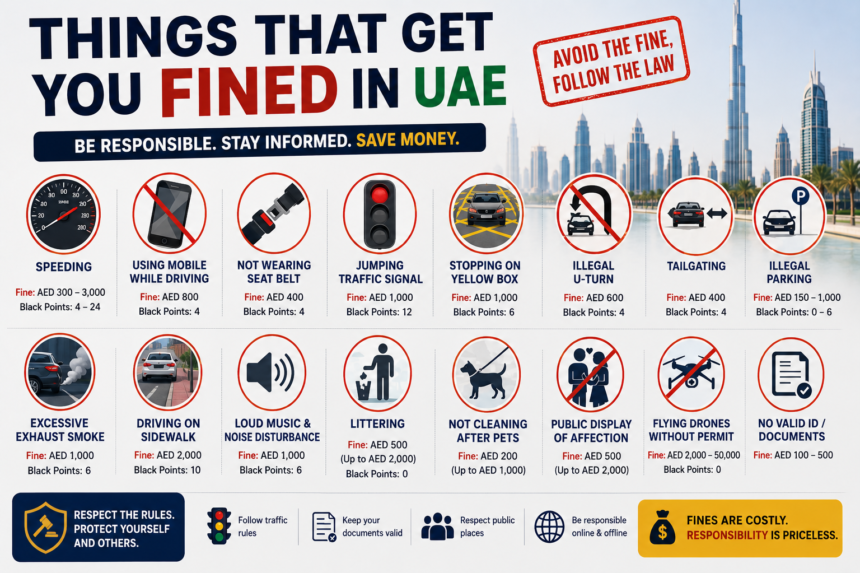
Things That Get You Fined in UAE: Common Rules, Offences and Penalties
The United Arab Emirates is known for its modern infrastructure, high standards of public safety and well-regulated cities. Whether you live in Dubai, Abu Dhabi, Sharjah or another emirate, understanding local laws can help you avoid unnecessary fines and legal problems. Many things that get you fined in the UAE are everyday activities that residents, tourists and expatriates may overlook, including traffic violations, illegal parking, littering, visa overstays, inappropriate online behaviour and certain violations involving public spaces.
- Why Is It Important to Know UAE Fines and Laws?
- 1. Things That Get You Fined in UAE: Speeding
- 2. Using a Mobile Phone While Driving
- 3. Not Wearing a Seat Belt
- 4. Jumping a Red Traffic Light
- 5. Illegal Parking
- 6. Driving on the Pavement or Sidewalk
- 7. Tailgating and Dangerous Driving
- 8. Driving Under the Influence of Alcohol or Drugs
- 9. Littering in Public Places
- 10. Smoking in Prohibited Areas
- 11. Visa Overstay
- 12. Working Without the Correct Authorization
- 13. Flying a Drone Without Following UAE Rules
- 14. Misusing Cameras or Photographing People Without Permission
- 15. Posting Defamatory or Harmful Content Online
- 16. Creating Excessive Noise or Disturbing Others
- 17. Damaging Public Property
- 18. Ignoring Public Conduct Rules
- 19. Misusing Public Transport
- 20. Parking or Driving in Specially Reserved Spaces
- 21. Ignoring Salik and Road-Toll Requirements
- 22. Failing to Keep Important Documents Valid
- 23. Ignoring Environmental and Waste Regulations
- 24. Breaking Rules in Beaches, Parks and Recreational Areas
- 25. Assuming Every Fine Is the Same Across the UAE
- How to Avoid Fines in the UAE
- What Should You Do If You Receive a Fine?
- Common Mistakes That Lead to UAE Fines
- UAE Fines: Frequently Asked Questions
UAE authorities use fines as an important tool to encourage responsible behaviour and maintain public safety. Traffic fines are particularly common, but penalties are not limited to driving. Residency violations, environmental offences, public conduct, smoking restrictions, drone regulations and digital activities can also result in penalties under applicable federal or local laws.
The exact amount of a fine depends on the offence, emirate, circumstances and applicable legislation. Some violations may also involve black points, vehicle impoundment, licence suspension or other consequences. Therefore, residents should not rely on old social media posts or unofficial lists of UAE fines. The official UAE legislation platform and relevant government authorities should be checked for the latest rules.
This guide explains the common things that can get you fined in the UAE, why these rules matter and how residents and visitors can avoid unnecessary penalties.
Why Is It Important to Know UAE Fines and Laws?
The UAE has laws covering transportation, public behaviour, residency, employment, environmental protection, online activities and many other aspects of daily life. A person who is unfamiliar with local regulations may unintentionally commit an offence.
For example, a driver might receive a traffic fine for speeding, using a mobile phone while driving or failing to wear a seat belt. A resident could face a residency-related fine for overstaying a visa. Someone flying a drone without meeting the required registration and operating rules could also face regulatory consequences.
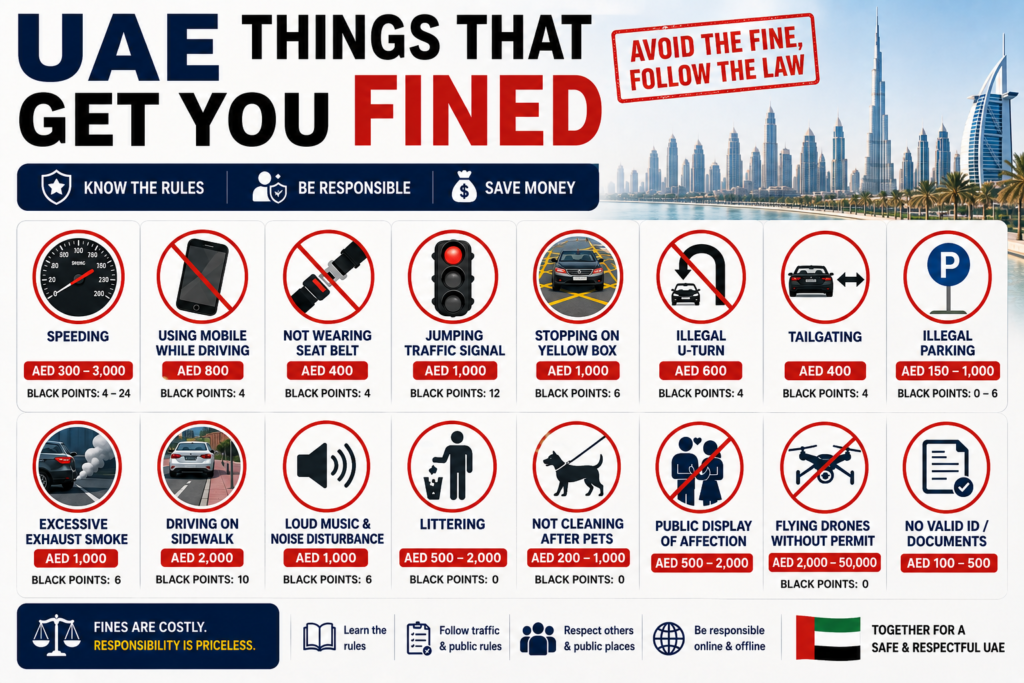
Understanding the rules is particularly important for expatriates and tourists because regulations can differ from those in their home countries.
Before doing something that involves a legal or regulatory requirement, it is sensible to check the latest official guidance.
1. Things That Get You Fined in UAE: Speeding
Speeding is one of the most common reasons drivers receive fines in the UAE. The country’s major roads are designed for efficient traffic movement, but drivers are expected to follow posted speed limits.
The official UAE traffic schedule includes different penalties depending on how far a vehicle exceeds the maximum speed limit. For example, the listed fines increase from AED 300 for exceeding the limit by up to 20 km/h to AED 3,000 for exceeding it by more than 80 km/h. Serious speeding violations can also result in black points and vehicle retention.
Drivers should pay attention to:
- Posted speed limits
- Variable speed-limit signs
- School-zone restrictions
- Roadworks
- Residential areas
- Speed cameras
- Changes in speed limits between road sections
Do not assume that driving slightly above the posted limit is always acceptable. Tolerance practices can vary, and the safest approach is to follow the displayed speed limit.
How to avoid the fine: Use your vehicle’s speedometer and pay attention to road signs rather than relying on assumptions about speed-camera tolerance.
2. Using a Mobile Phone While Driving
Using a mobile phone while driving can create a serious safety risk and may result in a traffic penalty.
Activities such as holding a phone, texting or manually interacting with a device while driving can distract motorists. Even when traffic appears light, drivers should avoid using their phones.
Instead:
- Use hands-free systems where legally permitted.
- Set navigation before starting the journey.
- Pull over safely if you need to use your phone.
- Avoid texting while driving.
- Do not record videos while operating a vehicle.
The safest approach is simple: keep your attention on the road.
3. Not Wearing a Seat Belt
Seat belts are mandatory safety equipment, and failing to use them can result in a traffic fine and black points under applicable UAE traffic rules.
Drivers should ensure that passengers also follow applicable seat-belt requirements. Parents should pay particular attention to child-safety rules and approved child seats.
Before starting your journey, make sure:
- The driver is wearing a seat belt.
- Front passengers are properly restrained.
- Children are secured using appropriate safety systems.
- Seat belts are not intentionally disabled.
A few seconds spent putting on a seat belt can prevent serious injuries and help you avoid a fine.
4. Jumping a Red Traffic Light
Ignoring a red traffic signal is a serious traffic violation because it can put pedestrians and other road users at significant risk.
The official UAE traffic schedule lists substantial penalties for certain red-light violations, including fines and black points, with additional consequences depending on the circumstances and vehicle category.
Drivers should never attempt to cross an intersection after the light has turned red.
Even if you are running late, it is better to wait for the next signal cycle.
5. Illegal Parking
Parking in prohibited locations can lead to fines across UAE cities. Drivers should always check parking signs and road markings before leaving their vehicles.
Common parking-related mistakes include:
- Parking in a no-parking zone
- Blocking entrances
- Parking in front of emergency access areas
- Misusing designated spaces
- Blocking pedestrian routes
- Parking in prohibited areas
- Failing to follow paid-parking requirements
Parking rules can vary between emirates and specific zones. Dubai, Abu Dhabi and other municipalities operate their own parking systems and regulations.
Tip: Always check the local parking signs and payment requirements before leaving your vehicle.
6. Driving on the Pavement or Sidewalk
Driving a vehicle onto a pavement or pedestrian area can be dangerous and is subject to traffic penalties.
Pedestrians need clear and safe pathways, so motorists should never use sidewalks as shortcuts or parking areas unless specifically authorized.
This is particularly important around:
- Residential communities
- Schools
- Shopping areas
- Parks
- Public facilities
- Pedestrian zones
Drivers should remain on designated roads and use approved parking areas.
7. Tailgating and Dangerous Driving
Driving too closely behind another vehicle, sudden lane changes and aggressive driving can increase the risk of accidents.
The UAE traffic rules contain penalties for behaviours that endanger road users. Certain dangerous-driving offences can result in substantial fines, black points and vehicle retention.
Drivers should maintain a safe following distance and avoid aggressive manoeuvres.
Responsible driving means:
- Keeping a safe distance
- Using indicators
- Checking blind spots
- Avoiding sudden lane changes
- Following speed limits
- Allowing emergency vehicles to pass
- Remaining patient in traffic
8. Driving Under the Influence of Alcohol or Drugs
Driving under the influence of alcohol or drugs is among the most serious road-safety offences in the UAE.
The official traffic regulations identify driving under the influence of alcohol or drugs as a serious violation, with penalties that can involve court decisions, black points and other measures.
Do not drive if you are impaired.
If you have consumed alcohol or taken a substance that affects your ability to drive, arrange alternative transportation or use an appropriate taxi or ride-hailing service.
This is not an area where drivers should take risks.
9. Littering in Public Places
Keeping public areas clean is an important part of life in the UAE. Throwing rubbish on roads, beaches, parks or other public places can result in a fine under applicable local regulations.
Examples of irresponsible behaviour include:
- Throwing bottles on the street
- Leaving food packaging behind
- Dropping cigarette butts
- Dumping waste in unauthorized areas
- Leaving rubbish at beaches
- Disposing of household waste incorrectly
Instead, use designated bins and follow waste-disposal requirements.
A clean public environment benefits residents, tourists and businesses alike.
10. Smoking in Prohibited Areas
Smoking restrictions apply to certain public places and facilities in the UAE. Federal tobacco-control rules prohibit smoking in various closed public spaces and certain facilities, with additional restrictions applying in specific circumstances.
The official UAE Government guidance also states that smoking in private cars when a child under 12 is present is prohibited.
Rules may also apply to:
- Schools and educational facilities
- Places of worship
- Health facilities
- Sports facilities
- Public transportation
- Certain enclosed public areas
- Specific recreational locations
Dubai and other emirates may have additional local restrictions.
How to avoid problems: Only smoke in designated areas and follow posted signs.
11. Visa Overstay
Visa and residency violations can result in fines, making it essential for visitors and residents to monitor their legal status.
The UAE Government confirms that fines apply for overstaying and provides official channels for checking and paying applicable visa or residence violation fines.
People can make the mistake of assuming that a visa automatically receives a grace period or that an expired document does not matter.
Before your visa or residence status expires:
- Check the exact expiry date.
- Understand the applicable renewal or cancellation process.
- Confirm whether a grace period applies to your specific category.
- Keep copies of relevant documents.
- Use official ICP or GDRFA channels where applicable.
Visa rules can differ according to the type of visa and individual circumstances, so do not rely on advice intended for someone with a different visa category.
12. Working Without the Correct Authorization
Another serious mistake is working without the required authorization.
A person may have entered the UAE legally as a visitor but that does not automatically mean they have permission to work.
Similarly, residents should understand the requirements applicable when changing employers, taking additional employment or undertaking certain freelance activities.
Before accepting employment, verify:
- Work permit requirements
- Employment contract
- Employer authorization
- Residence status
- Applicable professional licensing
- Additional work-permit requirements
If you are unsure, consult the appropriate UAE government authority rather than relying on informal advice.
13. Flying a Drone Without Following UAE Rules
Drones are increasingly popular for photography and recreation, but they are regulated in the UAE.
The UAE Government states that private recreational drone users must follow specific requirements, including registering the drone with the General Civil Aviation Authority and operating within approved zones. Rules also restrict flying near airports, heliports and certain controlled areas.
Depending on the operation, additional permissions or security approvals may be required.
Before flying a drone, check:
- Whether the drone must be registered.
- Whether the location is an approved flying zone.
- Whether permission is required.
- Whether the operation is recreational or commercial.
- Whether filming or photography creates additional requirements.
- Whether weather and operating conditions meet the rules.
Never assume that an open area automatically means drones can be flown there.
14. Misusing Cameras or Photographing People Without Permission
Photography is a major part of modern life, particularly in a city as visually impressive as Dubai. However, residents and visitors should be careful about privacy.
Problems can arise when people photograph or record others without appropriate permission, particularly in sensitive situations.
Before photographing or recording:
- Respect people’s privacy.
- Avoid recording private incidents without permission.
- Be careful when photographing government or security-sensitive locations.
- Do not publish private images of others irresponsibly.
- Think carefully before sharing recordings online.
Privacy and cybercrime laws apply to digital content in the UAE. The UAE Government identifies Federal Decree-Law No. 34 of 2021 on Combatting Rumours and Cybercrimes among the laws governing online activities.
15. Posting Defamatory or Harmful Content Online
Social media activity can create legal problems if users publish prohibited or harmful content.
The UAE’s cybercrime framework addresses matters including online rumours, privacy, personal rights, fraud and other digital offences.
Think carefully before:
- Accusing someone publicly of wrongdoing
- Sharing unverified rumours
- Publishing private photographs
- Sharing confidential information
- Insulting another person online
- Publishing content that violates privacy
- Forwarding potentially illegal content
A private disagreement can become a much bigger issue when it is posted publicly.
Best practice: If you have a dispute, use appropriate legal or official channels instead of trying to resolve it through social media.
16. Creating Excessive Noise or Disturbing Others
Residents should respect neighbours and public spaces. Excessive noise can cause complaints and, depending on the circumstances and local regulations, may lead to enforcement action.
Potential problems include:
- Extremely loud music
- Excessive vehicle noise
- Repeated disturbances
- Loud behaviour in residential areas
- Noise late at night
Apartment residents should also check their building or community regulations.
Being considerate of neighbours is one of the easiest ways to avoid unnecessary disputes.
17. Damaging Public Property
Public infrastructure belongs to the community, and damaging it can result in penalties or more serious legal consequences.
Do not damage:
- Bus shelters
- Road signs
- Public benches
- Parks
- Street furniture
- Public transport facilities
- Building property
- Government infrastructure
Even seemingly minor vandalism can become a serious matter when property damage is involved.
18. Ignoring Public Conduct Rules
The UAE has specific expectations concerning public behaviour. Residents and visitors should act respectfully in public places.
This includes being cautious about:
- Offensive gestures
- Abusive language
- Aggressive behaviour
- Public disturbances
- Disrespectful conduct
- Behaviour that violates applicable cultural or legal standards
The exact legal consequences depend on the conduct and circumstances, so it is better not to rely on simplified internet lists.
Respectful behaviour is particularly important in places such as shopping centres, government buildings, airports, public transport and religious locations.
19. Misusing Public Transport
Public transport systems in the UAE have their own rules. Passengers can face penalties for certain prohibited behaviours.
Depending on the emirate and transport system, rules may cover:
- Eating or drinking in prohibited areas
- Smoking
- Damaging facilities
- Misusing designated spaces
- Entering restricted areas
- Failing to pay the required fare
- Misusing public transport cards
- Causing disturbances
Dubai Metro, buses, trams and other public transport facilities have clearly posted regulations.
Always check the rules displayed at stations and inside vehicles.
20. Parking or Driving in Specially Reserved Spaces
Using spaces reserved for specific groups without authorization can result in penalties.
Examples can include:
- Accessible parking spaces
- Emergency spaces
- Fire lanes
- Loading areas
- Reserved government spaces
- Special permit areas
A parking space being empty does not necessarily mean it is available for general use.
Always check the sign before parking.
21. Ignoring Salik and Road-Toll Requirements
Drivers using Dubai’s Salik system need to understand the applicable account and toll requirements.
The UAE Government explains that passing through Salik gates without the required setup or failing to maintain sufficient balance and replenish it within the applicable period can result in a fine.
Drivers should:
- Register their vehicle where required.
- Keep their Salik account active.
- Monitor their balance.
- Understand current toll rules.
- Check their account regularly.
Since road-toll systems can be updated, motorists should consult official Salik information for current requirements.
22. Failing to Keep Important Documents Valid
Expired or invalid documents can create problems, particularly when they are required for driving, residency, employment or other regulated activities.
Important documents may include:
- Passport
- Emirates ID
- Residence permit
- Driving licence
- Vehicle registration
- Insurance documents
- Work permit
Do not wait until the last minute to renew important documents.
Set calendar reminders several weeks before expiration dates and use official government platforms for renewal.
23. Ignoring Environmental and Waste Regulations
The UAE has invested heavily in environmental protection and sustainable development. Certain environmental violations can result in fines or other enforcement action.
Residents should avoid:
- Illegal dumping
- Disposing of waste in unauthorized areas
- Damaging protected areas
- Polluting public spaces
- Mishandling hazardous materials
- Ignoring local environmental rules
Specific requirements vary by emirate and activity.
If you operate a business, construction site or industrial activity, additional environmental permits and regulations may apply.
24. Breaking Rules in Beaches, Parks and Recreational Areas
Dubai and other UAE emirates offer extensive public beaches, parks and recreational facilities. These areas often have specific rules designed to protect visitors and the environment.
Depending on the location, prohibited activities may include:
- Littering
- Smoking in restricted areas
- Damaging plants
- Entering restricted zones
- Unsafe recreational activities
- Ignoring swimming restrictions
- Damaging public facilities
Always follow signs displayed at the specific location because rules can differ from one facility to another.
25. Assuming Every Fine Is the Same Across the UAE
One important point that residents should remember is that the UAE consists of seven emirates, and local authorities may have their own regulations and enforcement systems in addition to federal legislation.
A rule or fine in Dubai may not necessarily be identical to one in Abu Dhabi, Sharjah, Ajman, Ras Al Khaimah, Fujairah or Umm Al Quwain.
Therefore, when searching for information about a particular violation, include the relevant emirate in your search.
For example:
- Dubai parking fines
- Abu Dhabi traffic fines
- Sharjah municipality fines
- Dubai public-behaviour rules
- Abu Dhabi parking regulations
This helps prevent confusion caused by outdated or location-specific information.
How to Avoid Fines in the UAE
Avoiding fines does not require memorizing hundreds of laws. A few simple habits can significantly reduce the risk of violations.
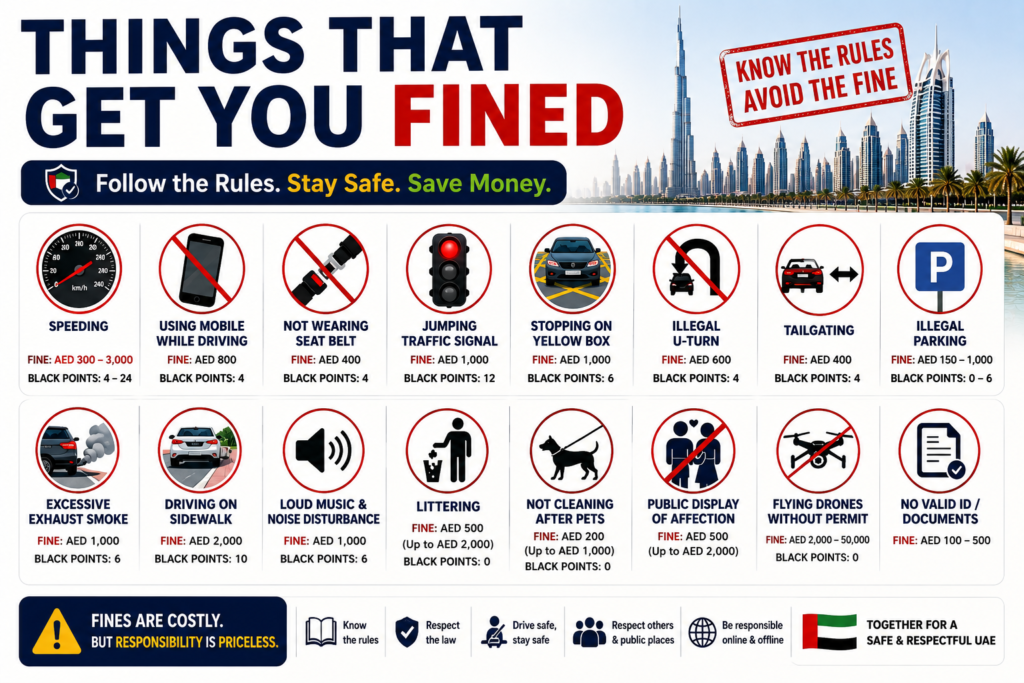
1. Follow Traffic Rules: Stay within speed limits, wear seat belts, obey signals and avoid distracted driving.
2. Check Your Documents: Keep your passport, Emirates ID, residence status, driving licence and vehicle documents valid.
3. Respect Public Spaces: Do not litter, damage property or disturb other people.
4. Think Before Posting Online: Avoid publishing private, defamatory, threatening or misleading content.
5. Follow Local Signs: Parking, beaches, parks, public transport and recreational facilities may have specific rules.
6. Use Official Government Information: For current laws and penalties, use official government sources rather than old social media posts.
The UAE’s official legislation platform provides federal legislation and updates, while local authorities provide information about emirate-specific regulations.
What Should You Do If You Receive a Fine?
Receiving a fine does not necessarily mean that you should ignore it.
First, identify the authority that issued the penalty and understand the reason for the violation.
Depending on the type of fine, you may be able to:
- Check the violation online.
- Review the details.
- Pay the fine through an official channel.
- Challenge or appeal the penalty where an appeal process is available.
- Contact the relevant authority for clarification.
For traffic violations, the UAE Government provides multiple official channels for checking and paying fines, including relevant police and transport authorities.
Always use official websites and applications when making payments. Be cautious of suspicious messages asking you to transfer money to unofficial accounts.
Common Mistakes That Lead to UAE Fines
Many fines can be avoided simply by changing everyday habits.
Some of the most common mistakes include:
- Driving too fast
- Using a phone while driving
- Parking without checking signs
- Ignoring traffic signals
- Forgetting visa expiry dates
- Working without the required authorization
- Littering
- Smoking in prohibited locations
- Flying drones without following applicable rules
- Sharing private information online
- Recording people without appropriate consideration for privacy
- Damaging public property
- Ignoring public transport regulations
- Failing to maintain vehicle documents
- Assuming outdated information is still valid
The common theme is lack of awareness. Many penalties can be prevented by taking a few minutes to check the applicable rules.
UAE Fines: Frequently Asked Questions
Q1. What are the most common things that get you fined in the UAE?
Ans: Traffic violations are among the most common sources of fines. Speeding, parking violations, mobile-phone use while driving, seat-belt violations and other road offences can result in penalties. Other areas include residency violations, littering, smoking in restricted areas and certain online or public-conduct violations.
Q2. Can tourists be fined in the UAE?
Ans: Yes. UAE laws generally apply to visitors as well as residents. Tourists should understand traffic, public behaviour, visa and other applicable rules during their stay.
Q3. Can I be fined for overstaying my UAE visa?
Ans: Yes. The UAE Government confirms that overstay fines apply. The exact rules depend on the type of visa or residence status and the applicable procedures.
Q4. Can I fly a drone anywhere in the UAE?
Ans: No. Drone operations are subject to registration, approved flying zones and other requirements. The GCAA rules also contain restrictions concerning airports, controlled areas, private property and other locations.
Q5. Can social media activity result in a fine or legal action?
Ans: Yes. UAE cybercrime and media regulations can apply to online activities, including content involving privacy, rumours, reputation and other prohibited conduct.
Q6. Are traffic fines the same in every emirate?
Ans: Not necessarily. Federal traffic regulations apply nationally, while local authorities may administer specific systems and local rules. Drivers should check the authority responsible for the emirate where the violation occurred.
Q7. Where can I check current UAE laws?
Ans: The UAE Government’s official legislation platform provides federal laws, regulations and legislative updates.
Final Thoughts
Knowing the things that get you fined in the UAE is an important part of living, working or travelling in the country. UAE regulations cover much more than traffic. Everyday activities involving driving, parking, residency, employment, public spaces, smoking, drones, photography and online communication can all be subject to specific rules.
The best way to avoid fines is to develop a habit of checking the rules before taking action. Drivers should follow speed limits and road regulations. Residents should monitor their visa and document validity. Visitors should respect local customs and public-space regulations. Social media users should think carefully before posting or sharing content, and drone operators should follow GCAA requirements.
It is also important to remember that fine amounts and regulations can change. Some penalties may depend on the emirate, circumstances or specific legislation. Therefore, this guide should be treated as general information rather than a complete legal schedule.
For the latest requirements, always verify information through the relevant official UAE government authority. The UAE Government’s legislation platform is an important source for federal laws and legislative updates.
Ultimately, avoiding fines is about more than saving money. Following UAE laws helps protect you, other people and the wider community. By driving responsibly, respecting public spaces, keeping documents valid, using technology responsibly and staying informed about current regulations, residents and visitors can enjoy a safer and more comfortable experience in the UAE.
Do follow us on Instagram
Read More – Can You Drink Alcohol in the UAE?