



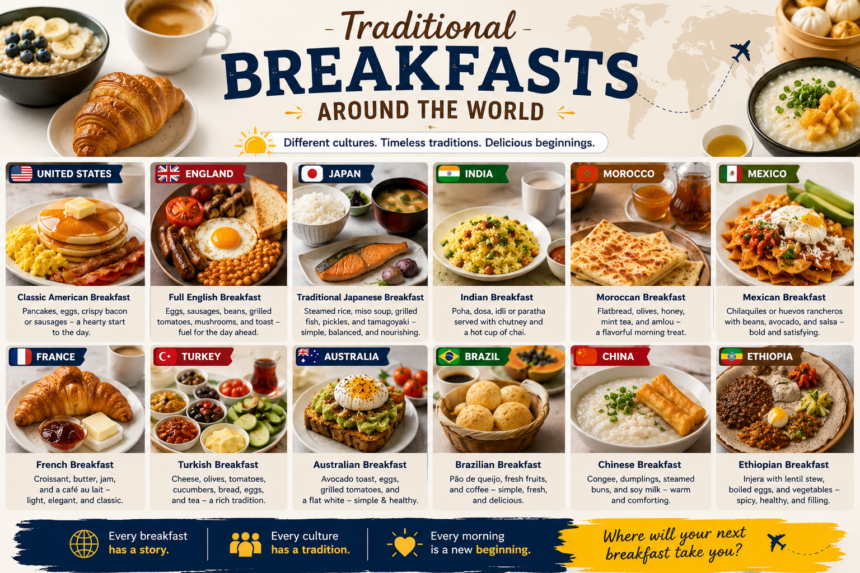
Amazing Morning Foods and Cultures
Breakfast may be the first meal of the day, but it is also one of the easiest ways to understand a culture.
- Traditional Breakfasts Around the World Reflect Local Culture
- 1. Türkiye: A Breakfast Designed for Sharing
- 2. Japan: Rice, Miso Soup and Grilled Fish
- 3. Egypt: Ful Medames
- 4. Mexico: Chilaquiles
- 5. UAE: Chebab and Traditional Emirati Flavours
- 6. England: The Full English Breakfast
- 7. France: Bread, Pastries and Coffee
- 8. India: A Country With Countless Breakfast Traditions
- 9. China: Congee and Regional Morning Foods
- 10. Malaysia: Nasi Lemak
- 11. Vietnam: Pho for Breakfast
- 12. Philippines: Silog Breakfasts
- 13. Costa Rica: Gallo Pinto
- 14. Colombia: Arepas and Changua
- 15. Spain: Pan con Tomate and Churros
- 16. Italy: Cornetto and Cappuccino
- 17. Morocco: Bread, Msemen and Mint Tea
- 18. Brazil: Pão de Queijo and Coffee
- 19. Jamaica: Ackee and Saltfish
- 20. United States: Pancakes, Eggs and Regional Variety
- Why Traditional Breakfasts Matter
- Breakfast Traditions Are Changing
- Final Thoughts on Traditional Breakfasts Around the World
Travel from one country to another and the meaning of breakfast can change completely. In one place, the morning begins with bread, cheese and tea. Somewhere else, people eat rice, fish and soup. Another country may start the day with beans, eggs, tortillas or sweet pastries.
Traditional Breakfasts Around the World tell stories about local ingredients, family habits, history and climate. Many breakfast dishes developed from foods that were affordable, available locally and filling enough to prepare people for a long working day.
Today, some of these meals have become famous far beyond their countries of origin.
From the colourful Turkish breakfast table to Japanese rice and miso soup, Egyptian ful medames and Mexican chilaquiles, here are 20 traditional breakfasts worth discovering.
Traditional Breakfasts Around the World Reflect Local Culture
There is no universal definition of breakfast.
In many Western countries, eggs, bread, cereal and coffee are common. Across large parts of Asia, however, rice, noodles, soup and savoury dishes can appear early in the morning.
Climate also influences breakfast.
Warmer regions may rely heavily on fruits, vegetables and lighter ingredients, while colder climates have historically encouraged heavier meals.
Religion, trade and migration have shaped breakfast traditions too.
The result is an extraordinary variety of morning meals that reveal something about the people and places behind them.
1. Türkiye: A Breakfast Designed for Sharing
Few breakfast traditions create a table as impressive as the Turkish breakfast.
Known as kahvaltı, the meal can include several small dishes rather than one main plate.
Cheeses, tomatoes, cucumbers, olives, honey, jam, butter and fresh bread are common.
Egg dishes can include menemen, made with eggs, tomatoes and peppers. Sucuk, a seasoned sausage, may also appear.
Simit, the sesame covered circular bread, is another favourite.
Turkish tea served in small glasses completes the experience.
Perhaps the most important part is not one ingredient.
It is sharing.
A traditional Turkish breakfast can become a long social occasion where family and friends sit together and enjoy multiple dishes slowly.
2. Japan: Rice, Miso Soup and Grilled Fish
A traditional Japanese breakfast can look surprisingly similar to lunch or dinner for visitors accustomed to sweet morning foods.
Steamed rice forms the foundation.
Miso soup is commonly served alongside it, together with grilled fish, pickled vegetables, seaweed, tofu or an egg dish.
Instead of one large plate, several smaller dishes create balance.
Presentation is also important.
The combination reflects major principles of Japanese cuisine, including seasonality, simplicity and respect for individual ingredients.
Traditional Japanese breakfast can still be experienced in ryokan inns and other accommodation throughout the country.
It provides a calm, savoury and balanced beginning to the day.
3. Egypt: Ful Medames
In Egypt, one of the most recognizable breakfast foods is ful medames.
The dish is based on slowly cooked fava beans.
The beans can be seasoned with ingredients such as cumin, lemon and olive oil, with variations depending on the cook and region.
Ful may be served alongside bread, eggs, vegetables, tahini or pickles.
Its popularity is easy to understand.
The ingredients are simple, the dish is filling and it provides the energy needed for the morning.
Ful is much more than a restaurant speciality.
It is deeply connected with everyday Egyptian food culture and can be found everywhere from family kitchens to street food establishments.
4. Mexico: Chilaquiles
Mexican breakfast can be colourful, spicy and extremely satisfying.
Chilaquiles are one of its most recognizable dishes.
Corn tortillas are cut and cooked before being covered with red or green salsa.
Depending on the preparation, they can be topped with eggs, cheese, cream, onions, avocado or other ingredients.
Chicken may also be added.
One reason chilaquiles became such a practical traditional dish is their ability to transform tortillas into a completely new meal.
The final result can vary greatly depending on the salsa and toppings.
For travellers who enjoy bold flavours early in the day, Mexican breakfast offers plenty of possibilities.
5. UAE: Chebab and Traditional Emirati Flavours
Traditional Emirati breakfast reflects the Gulf’s history of trade and cultural exchange.
Chebab is one of the best known morning dishes.
These thin Emirati pancakes are prepared with ingredients that can include cardamom and turmeric.
They are commonly served with date syrup or other sweet accompaniments.
Another traditional favourite is balaleet, which combines sweet vermicelli noodles with eggs.
Khameer bread can also form part of an Emirati breakfast.
These dishes show the importance of dates, spices, breads and simple ingredients within traditional Gulf cooking.
Although international breakfast cafes are now everywhere in cities such as Dubai and Abu Dhabi, traditional Emirati dishes continue to offer a connection with the country’s culinary heritage.
6. England: The Full English Breakfast
Few breakfast plates are as internationally recognizable as the full English.
A traditional version can include eggs, sausages, bacon, baked beans, grilled tomatoes, mushrooms and toast.
Black pudding may also be included.
It is a substantial meal.
Historically, a heavy breakfast made sense for people preparing for long days of physical work.
Today, many people do not eat a full English every morning.
It is more commonly associated with weekends, hotels, cafes and leisurely mornings.
Nevertheless, it remains one of Britain’s most famous culinary traditions and has influenced breakfast menus around the world.
7. France: Bread, Pastries and Coffee
French breakfast offers a contrast to heavier British morning meals.
A traditional breakfast can be relatively simple.
Bread with butter and jam is common, while croissants and other pastries are closely associated with the French morning experience.
Coffee, tea or hot chocolate usually accompanies the food.
The emphasis is often less on creating a large cooked meal and more on enjoying good bread or pastry with a hot drink.
The croissant has become so internationally connected with France that it appears on breakfast menus across the world.
Yet in everyday life, a simple piece of bread can be just as representative of the French morning routine.
8. India: A Country With Countless Breakfast Traditions
It is impossible to describe Indian breakfast with one dish.
The country’s enormous regional diversity creates completely different morning traditions.
In South India, idli and dosa are among the most recognizable breakfast foods.
Idli consists of soft steamed cakes usually made from fermented rice and lentil batter.
Dosa uses fermented batter to create a thin savoury crepe.
Both can be served with sambar and chutneys.
In northern regions, paratha is a popular choice and may be stuffed with potato, paneer or other fillings.
Poha, upma and many additional dishes appear across different states.
Indian breakfast demonstrates how dramatically morning food can change within a single country.
9. China: Congee and Regional Morning Foods
Chinese breakfast is another tradition that cannot be reduced to one universal plate.
Congee is one of the most widely recognized morning dishes.
This soft rice porridge can be eaten plain or accompanied by vegetables, eggs, preserved ingredients, meat or other toppings.
Youtiao, long pieces of fried dough, are another familiar breakfast food and can be paired with soy milk.
Different regions have their own morning specialties.
Noodles, steamed buns, dumplings and savoury pancakes may all appear.
Chinese breakfast highlights something seen throughout Asia.
There is no rule saying breakfast has to be sweet or based around familiar Western breakfast ingredients.
10. Malaysia: Nasi Lemak
Nasi lemak is one of Malaysia’s most famous foods and has strong roots as a traditional breakfast.
Rice is cooked with coconut milk and often pandan leaves, giving it a rich aroma.
It is commonly served with sambal, anchovies, peanuts, cucumber and egg.
Additional accompaniments can turn it into an even larger meal.
The combination brings together creamy, spicy, salty and fresh flavours.
Although nasi lemak began as a morning meal, its popularity means it can now be eaten throughout the day.
It represents the ability of a traditional breakfast dish to become part of a country’s wider national food identity.
11. Vietnam: Pho for Breakfast
Soup may seem unusual for breakfast to some travellers, but in Vietnam it makes perfect sense.
Pho is one of the country’s most internationally famous dishes and is commonly enjoyed in the morning as well as at other times.
The dish combines rice noodles with an aromatic broth and meat, usually beef or chicken.
Fresh herbs and other accompaniments add brightness.
A warm bowl of pho provides both hydration and nourishment at the beginning of the day.
Street food culture makes the experience particularly memorable.
Watching a steaming bowl arrive early in the morning is one of the classic food experiences visitors can enjoy in Vietnam.
12. Philippines: Silog Breakfasts

Rice plays a major role in Filipino breakfast.
A popular style of morning meal combines garlic fried rice, known as sinangag, with an egg and a protein.
These combinations are often referred to as silog meals.
The meat can vary considerably.
Longganisa sausage creates longsilog.
Beef tapa creates tapsilog.
Other versions use fish, pork or different proteins.
The concept is simple but satisfying.
Garlic rice provides a strong savoury foundation, while the egg and protein make the meal substantial.
For many Filipinos, rice is not something reserved for lunch or dinner.
It is a natural way to begin the day.
13. Costa Rica: Gallo Pinto
Rice and beans form the foundation of one of Costa Rica’s most famous breakfasts.
Gallo pinto combines cooked rice and beans with seasonings and other ingredients.
It is commonly served with eggs, cheese, plantains or tortillas.
The meal is filling without requiring expensive ingredients.
Variations can be found throughout Central America, with Nicaragua having its own strong gallo pinto tradition.
The dish demonstrates how traditional breakfasts often develop from staple foods already available in the household.
Instead of creating an entirely separate category of morning ingredients, people build breakfast around the foods central to their everyday cuisine.
14. Colombia: Arepas and Changua
Colombian breakfast varies significantly by region.
Arepas are among the most recognizable choices.
These corn based cakes can be grilled or cooked in different ways and served with cheese, eggs or other accompaniments.
Bogotá has another particularly interesting breakfast tradition called changua.
This warm soup typically combines milk, water, eggs and herbs and is served with bread.
For travellers accustomed to cold cereal or toast, soup for breakfast may initially seem surprising.
But that is exactly what makes exploring breakfast culture interesting.
Foods considered normal in one country can completely challenge expectations formed somewhere else.
15. Spain: Pan con Tomate and Churros
Spanish mornings can take several forms.
Pan con tomate is one of the simplest and most satisfying options.
Bread is rubbed or topped with ripe tomato and usually finished with olive oil and salt.
The result depends heavily on the quality of a few basic ingredients.
For a sweeter experience, churros with thick hot chocolate are internationally famous.
Coffee also plays an important role in everyday Spanish breakfast culture.
Like many European countries, breakfast may be lighter than lunch, which traditionally carries greater importance.
16. Italy: Cornetto and Cappuccino
Italian breakfast is often quick and sweet.
A cornetto is a common morning pastry and may be plain or filled with cream, jam or chocolate.
It is frequently paired with cappuccino or another coffee.
Many Italians enjoy breakfast at a bar rather than sitting down for a large cooked meal.
This creates a morning ritual built around simplicity.
Order coffee, enjoy a pastry and continue with the day.
For visitors, experiencing this routine can reveal as much about Italian daily life as eating a complicated restaurant meal.
17. Morocco: Bread, Msemen and Mint Tea
Moroccan breakfast frequently revolves around bread.
Msemen is a layered flatbread with a rich texture and is commonly served with honey, butter, jam or cheese.
Different breads and pancakes can also appear.
Mint tea or coffee accompanies the meal.
Olives and other savoury ingredients may be included depending on the household.
The breakfast reflects ingredients and traditions that appear throughout Moroccan cuisine while offering both sweet and savoury possibilities.
Fresh bread remains particularly important.
18. Brazil: Pão de Queijo and Coffee
Brazilian breakfast can vary enormously across the country’s regions.
One famous morning favourite is pão de queijo.
These small cheese breads have a distinctive chewy texture and are particularly associated with Minas Gerais.
Coffee naturally plays a major role in Brazilian mornings.
Bread, butter, cheese, fruit and cakes can also be found on breakfast tables.
Brazil’s tropical climate means fresh fruits and juices are widely incorporated into morning meals.
The combination can range from a quick coffee and bread before work to a much larger hotel or weekend breakfast.
19. Jamaica: Ackee and Saltfish
Jamaica offers one of the world’s most distinctive savoury breakfasts.
Ackee and saltfish combines Jamaica’s national fruit with salted cod and seasonings.
The meal can be accompanied by foods such as boiled green bananas, dumplings, plantains or callaloo.
The combination carries strong historical and cultural significance.
It is also another reminder that breakfast around the world frequently uses ingredients outsiders may associate more strongly with lunch or dinner.
In Jamaica, a rich savoury plate can be a completely natural start to the morning.
20. United States: Pancakes, Eggs and Regional Variety
The United States has no single traditional breakfast.
Pancakes with maple syrup are internationally recognizable.
Eggs, bacon, toast, waffles, breakfast potatoes and cereals are also common.
Bagels have a particularly strong connection with cities such as New York, while biscuits and gravy are associated with Southern food traditions.
Modern American breakfast has become even more diverse through immigration.
Breakfast burritos, avocado toast and dishes influenced by Latin American, Asian and Mediterranean cuisines now sit alongside older favourites.
The result reflects the wider diversity of American food culture.
Why Traditional Breakfasts Matter
Traditional breakfast is about much more than what appears on a plate.
It tells us which crops grow locally.
It shows how people historically worked.
It reveals the influence of migration and trade.
It can even show how families structure their mornings.
Turkish breakfast emphasizes sharing.
Japanese breakfast demonstrates balance and careful presentation.
Egyptian ful shows how a simple staple can become a national favourite.
Indian breakfast reveals enormous regional diversity.
Malaysia’s nasi lemak demonstrates how a breakfast can become an internationally recognized national dish.
Food becomes a form of cultural memory.
Breakfast Traditions Are Changing
Modern lifestyles are changing breakfast around the world.
People have less time in the morning.
International cafe chains have spread across major cities.
Social media has made dishes such as avocado toast, smoothie bowls and speciality coffee globally recognizable.
Traditional meals have not disappeared, but many are now more likely to be enjoyed on weekends, holidays or special family mornings.
At the same time, globalization works in both directions.
Someone in London can eat shakshuka.
A cafe in Dubai can serve Japanese breakfast.
A restaurant in New York can specialize in Turkish breakfast.
Traditional dishes are travelling farther than ever.
Final Thoughts on Traditional Breakfasts Around the World
Traditional Breakfasts Around the World show that there is no correct way to begin the day.
Breakfast can be sweet or savoury.
It can be a small pastry eaten with coffee or a table filled with ten different dishes.
It can include rice, beans, noodles, fish, soup, bread, eggs or fruit.
What matters is the culture behind it.
Türkiye turns breakfast into a social experience.
Japan creates balance through rice, soup and carefully prepared side dishes.
Egypt begins the day with hearty ful medames.
Mexico brings colour and spice through chilaquiles.
India offers completely different breakfasts as you move from one region to another.
The UAE preserves Gulf flavours through foods such as chebab.
Every breakfast carries a story.
For travellers, trying the local morning meal can therefore be one of the simplest ways to understand a destination.
Instead of ordering the same familiar breakfast everywhere you go, try what local people eat.
You may discover that some of the world’s most memorable culinary experiences happen before the day has even properly begun.
Follow us on Instagram
Read More – Best Areas to Live in Kuwait: 12 Powerful Choices for 2026