



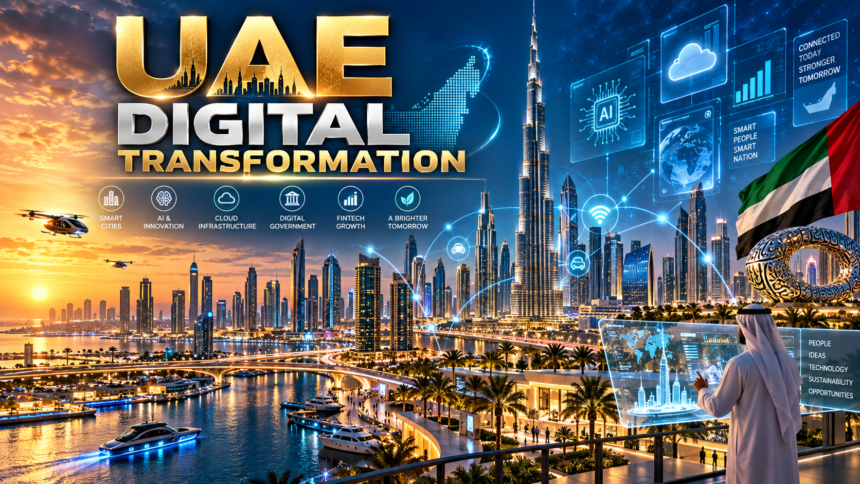
UAE Digital Transformation: How Is the UAE Building a Smarter Digital Future?
How is the UAE digital transformation changing the way people, businesses, and government services operate? The United Arab Emirates has emerged as a major technology and innovation hub, investing heavily in digital infrastructure, artificial intelligence, cloud computing, smart services, cybersecurity, blockchain, and data-driven solutions. Digital transformation in the UAE is not limited to adopting new technologies; it is also about creating faster, more connected, and more efficient ways to deliver services and support economic growth.
- What Is UAE Digital Transformation?
- Why Is Digital Transformation Important for the UAE?
- How Is the UAE Government Supporting Digital Transformation?
- What Role Does Artificial Intelligence Play in UAE Digital Transformation?
- How Are Smart Cities Supporting UAE Digital Transformation?
- How Is Cloud Computing Changing UAE Businesses?
- What Is the Role of Blockchain in UAE Digital Transformation?
- How Is Digital Transformation Changing the UAE Banking Sector?
- How Is E-Commerce Growing Through Digital Transformation?
- How Is Digital Transformation Affecting Healthcare in the UAE?
- How Is Education Becoming More Digital in the UAE?
- What Benefits Does Digital Transformation Offer UAE Businesses?
- What Challenges Can UAE Companies Face During Digital Transformation?
- Why Is Cybersecurity Important for UAE Digital Transformation?
- What Digital Skills Are Needed for the UAE’s Future?
- How Can Small Businesses Participate in UAE Digital Transformation?
- What Role Does Data Play in UAE Digital Transformation?
- How Is Digital Transformation Supporting the UAE’s Economy?
- What Does the Future of UAE Digital Transformation Look Like?
- Why Should Businesses Prepare for the UAE’s Digital Future?
- Is UAE Digital Transformation Only About Technology?
- What Makes the UAE a Significant Digital Transformation Market?
From smart government platforms to digital banking, e-commerce, intelligent transportation, and AI-powered business solutions, technology has become an important part of everyday life in the UAE. Cities such as Dubai and Abu Dhabi are developing advanced digital ecosystems designed to support innovation and improve the experience of residents, visitors, entrepreneurs, and companies.
What Is UAE Digital Transformation?
UAE digital transformation refers to the process of using digital technologies to improve government services, business operations, customer experiences, infrastructure, and economic activities across the United Arab Emirates. It includes the adoption of technologies such as artificial intelligence, machine learning, cloud computing, big data, Internet of Things (IoT), blockchain, automation, and advanced digital platforms.
Unlike simple digitization, which converts traditional information or processes into digital formats, digital transformation involves changing how organizations operate and deliver value. A company moving from paper invoices to electronic invoices is an example of digitization, while redesigning its entire financial operation around automated cloud-based systems represents a broader digital transformation.
In the UAE, digital transformation is taking place across both public and private sectors. Government departments are increasingly offering services through online platforms, while businesses are adopting digital tools to improve productivity, communication, customer service, and decision-making.
Why Is Digital Transformation Important for the UAE?
Why has digital transformation become such an important priority for the UAE? One major reason is the country’s ambition to build a diversified, knowledge-based economy that is less dependent on traditional economic sectors. Digital technology can help create new industries, attract investment, increase productivity, and support entrepreneurship.
A digitally connected economy can also make it easier for businesses to serve customers, manage operations, access international markets, and introduce new products and services. For government institutions, digital platforms can simplify administrative procedures and make public services more accessible.
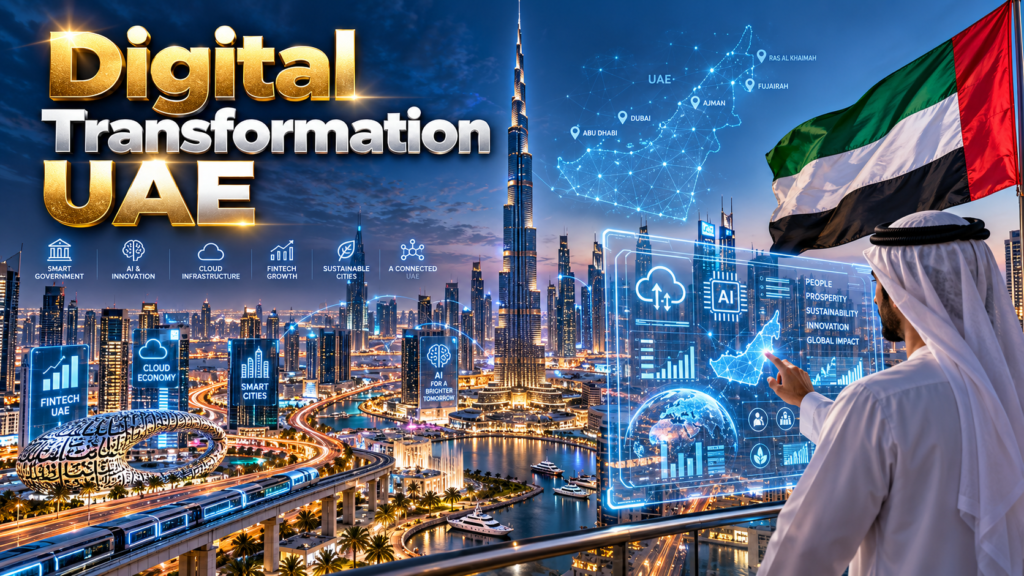
The importance of UAE digital transformation can be seen in several areas:
- Improved government services
- Greater business efficiency
- Growth of technology and innovation sectors
- Development of smart cities
- Expansion of digital payments
- Growth of e-commerce
- Better use of data and analytics
- Creation of new technology-focused jobs
- Improved customer experiences
- Stronger digital infrastructure
These developments are contributing to the UAE’s broader economic and technological ambitions.
How Is the UAE Government Supporting Digital Transformation?
How is the UAE government encouraging digital transformation across the country? Digital transformation has become an important component of national development strategies and government modernization initiatives. Federal and local authorities have introduced digital platforms, smart applications, electronic identification systems, and integrated government services.
The goal is to reduce unnecessary paperwork and provide services through convenient digital channels. Residents and businesses can access many government services online rather than visiting physical offices for every transaction.
Government digital transformation can involve areas such as:
- Online licensing and registration
- Digital identity services
- Electronic document processing
- Digital payments
- Online visa and residency services
- Smart transportation services
- Digital healthcare platforms
- Online education services
- Business and investment portals
- Automated government processes
The expansion of these services demonstrates how technology can be integrated into everyday administrative activities.
What Role Does Artificial Intelligence Play in UAE Digital Transformation?
How is artificial intelligence (AI) contributing to digital transformation in the UAE? AI is one of the most significant technologies influencing the country’s digital economy. Organizations can use AI to analyze large volumes of information, automate repetitive tasks, identify patterns, improve customer experiences, and support decision-making.
AI applications can be found across numerous industries. Financial institutions can use AI for fraud detection and customer service. Retail businesses can use intelligent systems for recommendations and inventory planning. Healthcare organizations can apply AI to support diagnostics and operational management, subject to applicable regulations and professional oversight.
Government organizations can also use AI to improve service delivery and process large amounts of data. Chatbots and virtual assistants, for example, can help users find information and complete certain routine tasks.
For businesses considering digital transformation, AI can provide opportunities to:
- Automate repetitive processes
- Analyze business data
- Improve customer support
- Personalize digital experiences
- Detect potential risks
- Forecast demand
- Improve operational efficiency
- Support strategic decision-making
The growing adoption of AI makes digital skills and responsible technology management increasingly important for UAE organizations.
How Are Smart Cities Supporting UAE Digital Transformation?
How are smart cities changing the UAE’s digital landscape? Smart city development combines digital infrastructure, connected devices, data analytics, automation, and intelligent services to improve urban environments.
Dubai has become widely associated with smart-city development, with digital technologies being applied to areas such as transportation, government services, utilities, tourism, and public infrastructure. Abu Dhabi has also invested in digital infrastructure and smart government services.
A smart city can use connected technologies to collect information from roads, buildings, vehicles, public facilities, and other infrastructure. This information can then help organizations understand how systems are performing and identify opportunities for improvement.
Smart-city technologies may support:
- Intelligent traffic management
- Smart parking
- Connected public transportation
- Energy management
- Digital government services
- Environmental monitoring
- Connected buildings
- Public safety systems
- Smart infrastructure
- Data-driven urban planning
As the UAE’s cities continue to develop, digital technologies are expected to remain an important part of urban planning and service delivery.
How Is Cloud Computing Changing UAE Businesses?
Why is cloud computing an important part of UAE digital transformation? Cloud technology allows businesses to access computing resources, software, databases, and storage without relying entirely on traditional on-site infrastructure.
For startups and smaller companies, cloud platforms can make it easier to access technology without making large upfront investments in physical servers. Larger organizations can use cloud infrastructure to scale operations, support remote collaboration, improve data management, and deploy applications more efficiently.
Cloud computing can help UAE businesses with:
- Flexible IT infrastructure
- Remote access to business applications
- Data storage and management
- Software deployment
- Business continuity
- Scalability
- Collaboration
- Automation
- Cost management
However, companies also need to consider cybersecurity, data protection, regulatory requirements, vendor management, and business continuity when adopting cloud services.
What Is the Role of Blockchain in UAE Digital Transformation?
How is blockchain being used as part of the UAE’s digital transformation journey? Blockchain is a distributed digital ledger technology that can provide a structured way to record and verify transactions. Its potential applications extend beyond cryptocurrencies.
Organizations may explore blockchain for areas such as document verification, supply chain management, identity-related applications, financial transactions, and record management.
The UAE has shown interest in blockchain technology as part of broader efforts to modernize services and encourage technological innovation. Blockchain can potentially reduce manual verification processes and improve transparency in specific use cases.
However, blockchain is not automatically the right solution for every digital transformation project. Organizations need to assess the business problem, security requirements, regulatory environment, scalability, and cost before choosing the technology.
How Is Digital Transformation Changing the UAE Banking Sector?
How has technology transformed banking and financial services in the UAE? Digital banking has become a major part of the financial ecosystem, with customers increasingly using mobile applications, online banking platforms, contactless payments, and digital financial services.
Banks and fintech companies can use technologies such as AI, cloud computing, data analytics, automation, and biometric authentication to develop digital products and improve customer experiences.
Customers can often perform many banking activities without visiting a physical branch, including:
- Checking account information
- Making payments
- Transferring funds
- Paying bills
- Managing cards
- Applying for selected financial products
- Receiving transaction notifications
Digital transformation has also encouraged the growth of fintech companies and new financial technology solutions. At the same time, cybersecurity and financial regulation remain essential considerations as financial services become increasingly digital.
How Is E-Commerce Growing Through Digital Transformation?
Why is e-commerce an important part of the UAE digital economy? The UAE has a highly connected consumer market, strong logistics infrastructure, and widespread digital payment adoption, creating favorable conditions for online commerce.
Digital transformation enables retailers to sell through websites, mobile applications, marketplaces, and social platforms. Businesses can use customer data and analytics to understand purchasing behavior and improve marketing and inventory decisions.
Modern e-commerce operations may involve:
- Online storefronts
- Digital payment gateways
- Automated inventory management
- Customer relationship management
- AI-supported recommendations
- Digital marketing
- Automated order processing
- Delivery tracking
- Customer service chatbots
For UAE businesses, developing a strong digital presence can be particularly important for reaching customers beyond traditional physical locations.
How Is Digital Transformation Affecting Healthcare in the UAE?
How is technology changing healthcare services in the UAE? Digital transformation is supporting the development of electronic health records, telehealth services, digital appointment systems, healthcare applications, and data-driven healthcare management.
Digital tools can make it easier for healthcare organizations to coordinate information and for patients to access selected services remotely. Telemedicine and digital consultations can also provide additional options for appropriate healthcare interactions.
Technology can support healthcare organizations in areas such as:
- Electronic medical records
- Digital appointments
- Remote consultations
- Health monitoring
- Administrative automation
- Data analysis
- Patient communication
- Healthcare management
Because healthcare involves highly sensitive information, cybersecurity, privacy, professional standards, and applicable regulations are particularly important.
How Is Education Becoming More Digital in the UAE?
How is UAE digital transformation changing education? Schools, universities, training providers, and students increasingly use digital learning platforms, online resources, virtual classrooms, educational applications, and collaborative tools.
Digital education can provide students with access to learning materials beyond the traditional classroom. Teachers can use digital platforms to distribute assignments, communicate with students, and monitor learning activities.
Digital transformation in education can include:
- Online learning platforms
- Virtual classrooms
- Digital textbooks
- Educational applications
- Online assessments
- Artificial intelligence tools
- Digital collaboration
- Remote learning resources
The growing importance of technology also means students need digital literacy and practical technology skills that can support future careers.
What Benefits Does Digital Transformation Offer UAE Businesses?
What advantages can companies gain from digital transformation? One of the biggest benefits is improved operational efficiency. Automation can reduce manual work, while analytics can provide businesses with better information for decision-making.
Digital systems can also help organizations respond more quickly to customer needs. For example, a company can use customer relationship management software to organize customer interactions and identify opportunities for better service.
Some potential business benefits include:
- Higher productivity: Automation can reduce repetitive administrative tasks.
- Better customer experience: Digital platforms can make services faster and more convenient.
- Improved decision-making: Data analytics can provide insights into business performance.
- Greater scalability: Cloud technologies can support business expansion.
- Cost optimization: Digital processes can reduce certain operational expenses.
- Faster innovation: Digital tools can make it easier to test and launch new products.
- Wider market access: Online channels allow companies to reach customers across geographic boundaries.
The actual benefits depend on how effectively a business selects, implements, and manages its technology.
What Challenges Can UAE Companies Face During Digital Transformation?
Is digital transformation always easy? No. Businesses can face several challenges when introducing new technologies. Purchasing software or hardware is only one part of transformation. Organizations also need to change processes, train employees, protect data, and manage implementation risks.
Common challenges include:
- High initial investment
- Lack of specialized digital skills
- Employee resistance to change
- Cybersecurity risks
- Data privacy concerns
- Integration with older systems
- Complex technology environments
- Vendor dependency
- Regulatory requirements
- Difficulty measuring return on investment
Successful transformation therefore requires more than technology. Leadership, employee training, planning, governance, and clearly defined business objectives are equally important.
Why Is Cybersecurity Important for UAE Digital Transformation?
Why does cybersecurity matter as businesses and government services become more digital? Increased digital connectivity also creates additional opportunities for cyber threats. Organizations may face risks involving phishing, malware, ransomware, unauthorized access, data breaches, and other security incidents.
Cybersecurity should therefore be considered from the beginning of a digital transformation project rather than added later.

Businesses can strengthen their digital security by focusing on:
- Strong access controls
- Multi-factor authentication
- Employee cybersecurity training
- Regular software updates
- Data encryption
- Security monitoring
- Backup and recovery systems
- Incident-response planning
- Third-party risk management
- Regular security assessments
For organizations operating in the UAE, cybersecurity strategies should also account for applicable local laws, sector-specific requirements, and contractual obligations.
What Digital Skills Are Needed for the UAE’s Future?
What skills will employees need as UAE digital transformation continues? Technology is changing the nature of many jobs, creating demand for both technical and non-technical digital capabilities.
Important areas can include:
- Artificial intelligence
- Data analysis
- Cloud computing
- Cybersecurity
- Software development
- Digital marketing
- Automation
- Project management
- User experience design
- Digital strategy
- Technology management
However, digital transformation does not mean that every employee needs to become a programmer. Businesses also need people who understand how technology can solve practical business problems.
Communication, critical thinking, creativity, adaptability, and problem-solving can remain valuable alongside technical knowledge.
How Can Small Businesses Participate in UAE Digital Transformation?
Can small and medium-sized businesses benefit from digital transformation? Yes. Digital transformation does not necessarily require a company to make a massive technology investment at once. Smaller organizations can begin with practical improvements that address specific business problems.
For example, a small company might move from manual spreadsheets to cloud-based accounting software, introduce an online customer relationship management system, create an e-commerce website, or automate customer communications.
A practical approach could include:
- Identify the biggest operational problem.
- Define a measurable business objective.
- Select technology that addresses that specific need.
- Train employees before implementation.
- Protect business and customer data.
- Measure results.
- Improve the system based on feedback.
- Expand digital adoption gradually.
This approach can make digital transformation more manageable and aligned with business objectives.
What Role Does Data Play in UAE Digital Transformation?
Why is data so important to digital transformation? Data provides organizations with information about customers, operations, markets, products, and performance. When managed properly, it can support better decisions and more efficient processes.
Businesses can use data analytics to identify customer trends, understand sales performance, optimize inventory, monitor operations, and forecast demand.
However, collecting data alone does not create value. Organizations need appropriate data governance, quality controls, security measures, privacy practices, and analytical capabilities.
A strong data strategy should address:
- Data quality
- Data security
- Data governance
- Data accessibility
- Privacy
- Analytics
- Storage
- Compliance
- Responsible use of AI and automation
How Is Digital Transformation Supporting the UAE’s Economy?
How can digital transformation contribute to economic development? Digital technologies can support productivity, entrepreneurship, innovation, investment, and the development of new industries.
Technology companies can build products for local and international markets, while traditional businesses can use digital systems to improve efficiency and expand their customer base.
The digital economy can also create opportunities in areas such as:
- Fintech
- E-commerce
- Artificial intelligence
- Cloud computing
- Cybersecurity
- Software development
- Digital media
- Smart infrastructure
- Technology consulting
- Data services
As the UAE continues to strengthen its position as an international business and technology hub, digital capabilities can remain an important factor in economic competitiveness.
What Does the Future of UAE Digital Transformation Look Like?
What can we expect from the future of digital transformation in the UAE? Technology is likely to become increasingly integrated into government, business, infrastructure, transportation, finance, healthcare, education, and everyday consumer services.
AI is expected to remain a major area of development, while cloud computing, automation, connected devices, advanced analytics, and cybersecurity will continue supporting digital ecosystems.
Future transformation may increasingly focus on combining multiple technologies rather than using them separately. For example, an organization could combine cloud computing, AI, data analytics, IoT devices, and automation within a single operational system.
The future will also require greater attention to responsible technology use. As digital systems become more powerful, organizations will need to consider cybersecurity, privacy, transparency, governance, and human oversight.
Why Should Businesses Prepare for the UAE’s Digital Future?
Why should businesses prepare for continued digital transformation? Customer expectations, technology capabilities, and competitive environments are constantly changing. Companies that understand these changes can make more informed decisions about technology investments and operational improvements.
Digital transformation should not be treated as a one-time project. It is better understood as an ongoing process of improving systems, skills, services, and business models.
Companies can prepare by:
- Developing a clear digital strategy
- Investing in employee skills
- Modernizing outdated systems
- Strengthening cybersecurity
- Using data effectively
- Exploring practical AI applications
- Improving digital customer experiences
- Reviewing cloud and automation opportunities
- Measuring technology investments
- Building a culture of innovation
Is UAE Digital Transformation Only About Technology?
Is technology the only factor behind successful digital transformation? No. Technology is an important enabler, but people and organizational processes are equally important.
A company can purchase advanced software and still fail to achieve meaningful results if employees are not trained or if the underlying business process is inefficient. Similarly, an organization may have large amounts of data but receive little value from it without appropriate governance and analysis.
Successful transformation generally combines three elements:
- Technology: The digital tools and infrastructure required.
- People: Employees, customers, leaders, and partners who use or interact with those tools.
- Processes: The workflows and business models that determine how technology creates value.
This combination makes digital transformation a broader organizational change rather than simply an IT upgrade.
What Makes the UAE a Significant Digital Transformation Market?
What makes the UAE particularly important in the global digital transformation landscape? The country has invested substantially in digital infrastructure and has developed an economy with strong connections to international business, finance, tourism, logistics, and technology.
Its major cities have also become important centers for startups, technology companies, investors, and multinational organizations. This creates an environment where emerging technologies can be tested across different industries and business models.
The combination of infrastructure, government digital initiatives, private-sector innovation, international investment, and technology adoption contributes to the development of the UAE’s digital economy.
Conclusion: What Is the Importance of UAE Digital Transformation?
What is the overall significance of UAE digital transformation? It represents a broad shift toward technology-enabled government, business, infrastructure, and economic activity. Artificial intelligence, cloud computing, blockchain, data analytics, automation, cybersecurity, smart-city technologies, and digital platforms are contributing to this transformation across multiple sectors.
For businesses, digital transformation can create opportunities to improve efficiency, understand customers, develop new services, and expand into new markets. For individuals, digital services can make many everyday interactions more convenient. For the wider economy, technology can support innovation, productivity, entrepreneurship, and the development of new industries.
The next stage of the UAE’s digital journey will depend not only on adopting advanced technologies but also on developing digital skills, protecting data, strengthening cybersecurity, improving governance, and ensuring that technology addresses real-world needs.
As digital technologies continue to evolve, UAE digital transformation is likely to remain an important part of the country’s economic and technological development. Businesses and professionals that understand the changing digital landscape can better prepare for the opportunities and challenges created by an increasingly connected economy.
Do follow us on Instagram
Read More – Digital Transformation in Gulf Regions