Best Guide to Living in Dubai: Cost, Jobs, Housing, Visas, Transport and Lifestyle
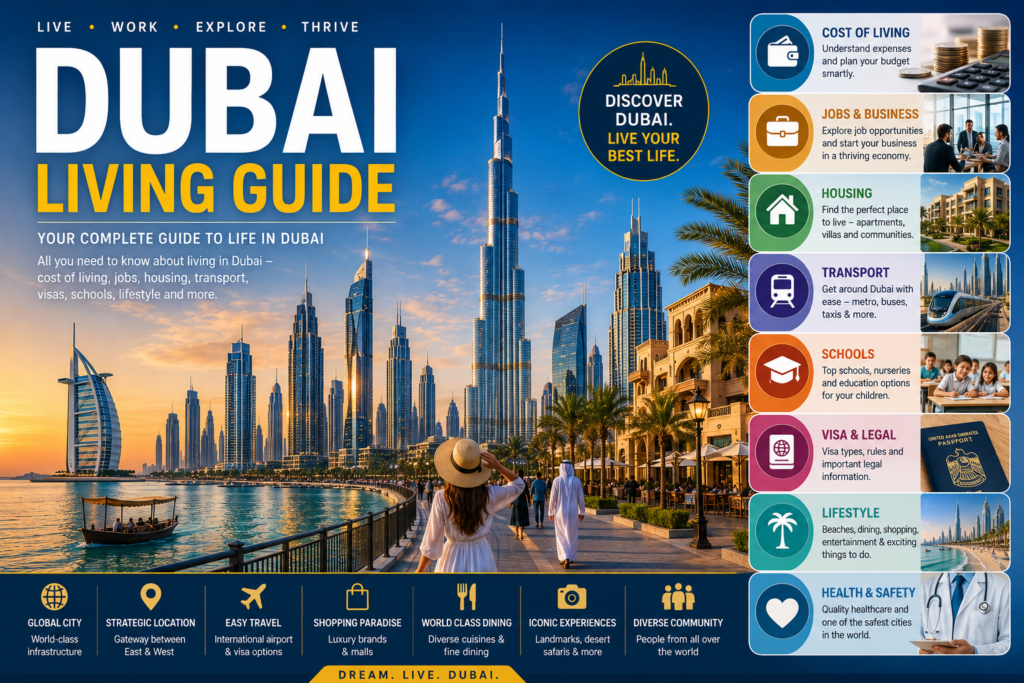
Dubai has become one of the world’s most popular destinations for professionals, entrepreneurs, families, investors and international residents. Known for its modern infrastructure, impressive skyline, multicultural population, business opportunities and high standard of living, the city offers a unique combination of career growth and lifestyle experiences.
- Why Live in Dubai?
- Complete Overview For Guide to Living in Dubai
- How to Save Money in Dubai
- Best Areas to Live in Dubai
- Renting a Home in Dubai
- Working and Finding Jobs in Dubai
- Tips for Finding a Job in Dubai
- Dubai Visa and Residency Options
- Opening a Bank Account in Dubai
- Public Transportation in Dubai
- Healthcare in Dubai
- Schools and Education in Dubai
- Shopping, Dining and Entertainment
- Weather and Everyday Life
- Culture and Social Life in Dubai
- Family Life in Dubai
- Business and Entrepreneurship in Dubai
- Safety and Quality of Life
- Essential Tips for New Residents
- Is Dubai a Good Place to Live?
- Final Thoughts on Living in Dubai
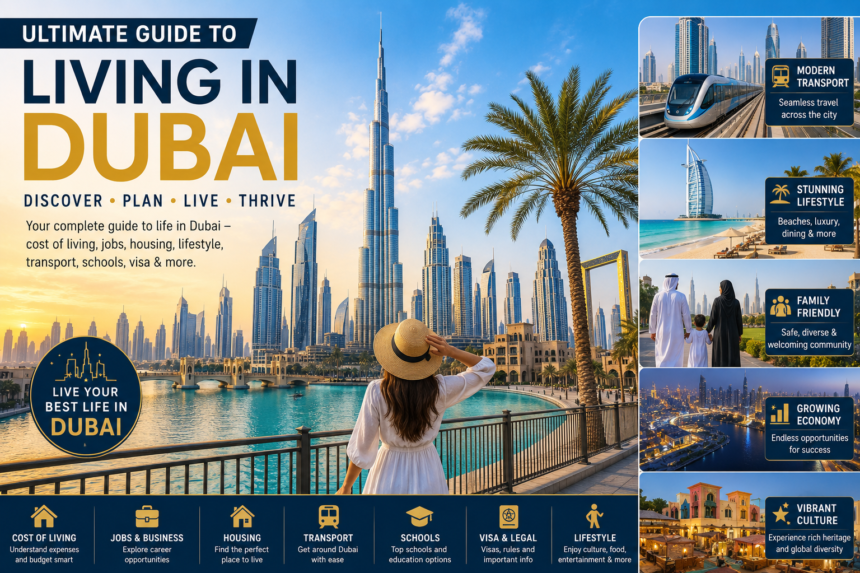
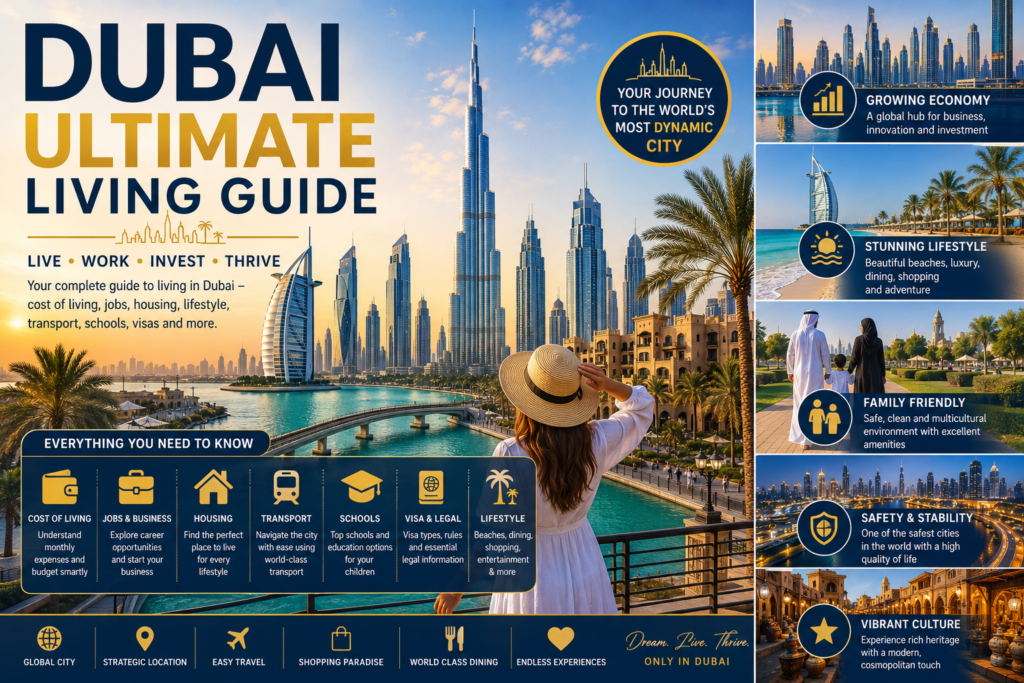
However, guide to living in Dubai is about much more than skyscrapers, luxury shopping malls and famous attractions. Anyone planning to move to the city needs to understand housing, employment, transportation, healthcare, schools, visas, daily expenses, local customs and the realities of everyday life.
This ultimate guide to living in Dubai explains the most important things you should know before moving to Dubai or starting a new life in the city.
Why Live in Dubai?
Dubai attracts residents from around the world because of its strong economy, international connectivity and diverse lifestyle. The city is home to people from many nationalities, making English widely used in business and everyday interactions alongside Arabic, the official language of the UAE.
For professionals, Dubai offers opportunities in industries including finance, technology, tourism, real estate, logistics, healthcare, construction, retail, hospitality and professional services. Entrepreneurs also benefit from a well-developed business ecosystem and access to regional and international markets.
One of Dubai’s major attractions is its infrastructure. The city has modern roads, a large public transportation network, international schools, hospitals, shopping centers, residential communities and entertainment destinations.
The UAE also does not levy personal income tax on individuals, although residents still encounter consumption taxes and other fees. The standard VAT rate is 5%.
Complete Overview For Guide to Living in Dubai
One of the first questions people ask before relocating is: Is Dubai expensive to live in?
The answer depends heavily on your lifestyle, income, family size and choice of neighbourhood. Dubai can be expensive compared with many cities, particularly when it comes to rent, international schools, dining and premium entertainment. At the same time, residents can manage their budgets effectively by selecting affordable housing, using public transportation and planning their spending.
Your major monthly expenses may include:
- Rent or mortgage payments
- Electricity, water and cooling
- Groceries
- Transportation
- Health insurance
- School fees
- Mobile phone and internet
- Dining and entertainment
- Shopping
- Household expenses
Housing is normally one of the biggest expenses for residents. A person living alone in a smaller apartment in a less expensive area can have a very different budget from a family renting a large villa in a premium community.
Before moving, create a realistic monthly budget that includes both fixed and unexpected expenses.
How to Save Money in Dubai
Living comfortably in Dubai does not necessarily mean spending excessively. Residents can reduce expenses by:
- Choosing housing close to work or public transport
- Cooking regularly instead of dining out
- Comparing supermarket prices
- Using public transportation
- Taking advantage of annual sales and promotions
- Reviewing mobile and internet packages
- Planning entertainment expenses
- Comparing insurance and financial products
- Building an emergency fund
The most important principle is to avoid judging affordability based solely on salary. Your disposable income depends on rent, family responsibilities and lifestyle choices.
Best Areas to Live in Dubai
Dubai has a wide variety of residential neighborhoods, ranging from waterfront communities and luxury districts to affordable apartment areas.
Some popular areas to consider include:
1. Downtown Dubai: Downtown Dubai is ideal for people who want to live close to major attractions, restaurants, offices and shopping destinations. It offers high-rise apartments and convenient access to the Dubai Metro.
2. Dubai Marina: Dubai Marina is popular with young professionals and residents who enjoy waterfront living. The neighborhood has restaurants, cafés, walking areas and access to public transportation.
3. Jumeirah: Jumeirah is known for villas, beaches and a relaxed residential environment. It can appeal to families and residents who prefer larger homes and proximity to the coast.
4. Business Bay: Business Bay is a major residential and commercial district located close to Downtown Dubai. It offers numerous apartment buildings and is convenient for professionals working in central Dubai.
5. Dubai Silicon Oasis: Dubai Silicon Oasis can appeal to professionals, families and technology-sector workers looking for residential options away from the most expensive central districts.
6. Jumeirah Village Circle: Jumeirah Village Circle, commonly known as JVC, offers a large selection of apartments and villas and has become a popular choice for residents seeking a balance between affordability and accessibility.
When choosing where to live in Dubai, consider more than rent. Check commuting time, parking, schools, supermarkets, healthcare facilities, public transportation and community amenities.
Renting a Home in Dubai
Most newcomers initially rent rather than purchase property. Before signing a rental agreement, carefully review the contract and understand the payment schedule, deposit, maintenance responsibilities and other charges.
Dubai’s Ejari system is used to register tenancy contracts. The Dubai Land Department provides online and other official channels for registering or renewing tenancy contracts.
Important things to check before renting include:
- Annual rent
- Number and timing of rental payments
- Security deposit
- Agency fees
- Maintenance responsibilities
- Parking availability
- Utility costs
- Building amenities
- Contract renewal conditions
- Early termination terms
- Ejari registration
The Dubai Land Department also states that the minimum Ejari lease term is one year.
Always use legitimate property agents and verify the property and landlord information before making large payments.
Working and Finding Jobs in Dubai
Dubai is one of the region’s major employment centers. Its economy provides opportunities across traditional and emerging industries.
Popular employment sectors include:
- Information technology
- Artificial intelligence
- Banking and finance
- Real estate
- Construction
- Healthcare
- Tourism and hospitality
- Retail
- Marketing and advertising
- Logistics
- Aviation
- Education
- Engineering
- Professional services
The job market can be competitive, particularly for highly paid positions. Candidates with specialized skills, relevant experience, professional qualifications and strong communication abilities may have an advantage.
Networking is also important. Many opportunities are discovered through professional connections, industry events, recruitment agencies and online professional platforms.
Tips for Finding a Job in Dubai
If you are planning to move to Dubai for employment:
- Prepare a professional CV tailored to your industry.
- Build a strong LinkedIn profile.
- Research employers before applying.
- Apply through reputable recruitment platforms.
- Network with professionals in your field.
- Prepare for video and in-person interviews.
- Understand your employment contract before accepting an offer.
- Never pay suspicious fees for a promised job.
Foreign employees normally require an appropriate work and residence arrangement. The UAE government explains that standard employment visas are generally sponsored by employers, while other residence pathways exist for eligible professionals, freelancers, investors and entrepreneurs.
Dubai Visa and Residency Options
Understanding residency requirements is essential before moving to Dubai.
The appropriate visa depends on your circumstances. Common pathways include employment residence, family sponsorship, study, investment, retirement, remote work and long-term residence categories.
The UAE’s Green Visa, for example, is available to eligible skilled workers, freelancers, self-employed individuals, investors and business partners and provides renewable five-year residency without the traditional requirement for an employer sponsor.
There is also a virtual work residence visa for eligible people who work for companies outside the UAE. The official UAE government currently lists a one-year virtual work residence visa and requirements including health insurance, a medical fitness test, proof of employment outside the UAE and a minimum monthly salary requirement.
Residence visa procedures can change, so applicants should always check the latest requirements through official UAE and Dubai authorities before making travel or relocation decisions. Visa applications and related services can be accessed through official channels including ICP and GDRFA Dubai.
Opening a Bank Account in Dubai
Having a local bank account makes everyday life significantly easier.
Residents commonly use UAE bank accounts to receive salaries, pay rent and utilities, make purchases and manage recurring expenses.
Banks generally request documents such as:
- Passport
- Residence visa
- Emirates ID
- Salary certificate or employment documentation
- Proof of address, depending on the bank
The exact requirements vary between financial institutions.
It is wise to compare account fees, minimum balance requirements, digital banking services, international transfer costs and available financial products before choosing a bank.
Public Transportation in Dubai
Dubai has a sophisticated transportation network that includes the Metro, buses, tram, taxis and marine transport.
The Dubai Metro is particularly useful for residents who live and work near stations. The system is driverless and connects important areas of the city.
The nol card is used across several RTA transportation services, including Metro, buses, tram and marine transport. Dubai’s public transport network is organized across seven zones, with fares calculated according to the zones traveled.
Public transportation can help residents reduce car-related expenses, particularly fuel, parking and maintenance.
Driving in Dubai
Many residents eventually choose to drive because Dubai is spread across a large metropolitan area.
If you plan to own a car, consider:
- Vehicle purchase or financing
- Insurance
- Fuel
- Parking
- Salik and road-related costs
- Maintenance
- Registration
- Traffic during peak hours
For people who live near Metro stations or work in well-connected areas, a combination of Metro, taxis and occasional car rentals can sometimes be practical.
Healthcare in Dubai
Dubai has a large healthcare sector consisting of public and private hospitals, clinics, pharmacies and specialist medical centers.
The Dubai Health Authority regulates and oversees healthcare services in the emirate, including healthcare facilities, health policies and health insurance.
Health insurance is an important part of living in Dubai. Dubai has a mandatory health insurance framework covering residents, with regulated insurance arrangements and basic healthcare requirements.
When selecting insurance, check:
- Hospital network
- Outpatient coverage
- Emergency treatment
- Prescription coverage
- Maternity benefits
- Dental and optical coverage
- Deductibles and co-payments
- Geographic coverage
- Annual limits
Healthcare costs can vary considerably, so comprehensive insurance can provide important financial protection.
Schools and Education in Dubai
Dubai is a major international education hub, offering schools following different curricula.
Parents can find options including British, American, Indian, International Baccalaureate and other educational systems.
When choosing a school, consider:
- Curriculum
- Location
- KHDA rating
- Tuition fees
- Transportation
- Class sizes
- Extracurricular activities
- Admission requirements
- Facilities
- Special educational support
The Knowledge and Human Development Authority regulates Dubai’s private education sector and provides guidance for parents on school selection and fees.
For the 2026–27 academic year, Dubai confirmed a freeze on private school tuition fees, while the emirate continues to offer a wide range of curricula and school choices.
Parents should also review each school’s official fee information carefully because tuition is only one part of the total education cost.
Shopping, Dining and Entertainment
One of the biggest advantages of living in Dubai is the variety of entertainment available throughout the year.
The city is home to major shopping malls, restaurants, cafés, cinemas, beaches, cultural attractions, sporting facilities and family entertainment destinations.
Dubai’s dining scene is especially diverse. Residents can find everything from affordable local and international restaurants to high-end dining experiences.
Entertainment options include:
- Beaches
- Shopping malls
- Desert activities
- Parks
- Museums
- Art galleries
- Live events
- Sports
- Cinemas
- Restaurants and cafés
- Cultural festivals
You do not need a luxury lifestyle to enjoy Dubai. The city has options for different budgets, although premium experiences can become expensive quickly.
Weather and Everyday Life
Dubai has a hot desert climate. Summers are particularly hot, with very high temperatures and humidity, while the cooler months are generally more comfortable for outdoor activities.
During the hottest period, residents spend more time indoors or in air-conditioned environments.
For much of the year, however, Dubai offers numerous opportunities for outdoor activities, including beach visits, walking, cycling, desert trips and outdoor dining.
New residents should also prepare for the summer climate by staying hydrated, using appropriate sun protection and limiting prolonged outdoor activity during the hottest parts of the day.
Culture and Social Life in Dubai
Dubai is highly multicultural, but residents are still expected to respect UAE laws, customs and cultural norms.
People from different backgrounds live and work together, creating a diverse social environment. English is widely used, but learning a few Arabic expressions can be useful and appreciated.
Residents should pay attention to appropriate behavior in public spaces, particularly regarding dress, photography, social conduct and interactions with government authorities.
Respect for local culture is an important part of successfully settling into life in Dubai.
Family Life in Dubai
Dubai can be attractive to families because of its residential communities, schools, healthcare facilities, parks, shopping centers and family-oriented attractions.
Families should consider the location of their home carefully. A neighborhood close to a preferred school can significantly reduce daily commuting time.
Other factors worth considering include:
- School transportation
- Nearby healthcare facilities
- Parks and playgrounds
- Supermarkets
- Community pools
- Childcare
- Traffic conditions
- Public transport
- Weekend activities
A family budget should also include school fees, childcare, healthcare and larger housing requirements.
Business and Entrepreneurship in Dubai
Dubai is also a major destination for entrepreneurs and investors.
The city offers opportunities across technology, e-commerce, consulting, tourism, logistics, finance, real estate, healthcare and professional services.
Entrepreneurs should research the appropriate business structure, licensing authority, business activity, office requirements, ownership rules and tax obligations before starting a company.
The UAE’s business environment has evolved considerably, and corporate taxation applies to businesses within the relevant rules even though individuals are not subject to personal income tax.
Professional legal, accounting and business setup advice can be useful when establishing a company.
Safety and Quality of Life
Safety is an important consideration for anyone moving abroad. Dubai has extensive public infrastructure, regulated services and a highly developed urban environment.
However, residents should still follow normal safety practices, understand local laws and take responsibility for personal belongings and financial information.
Quality of life also depends on factors such as work-life balance, commute, housing quality, access to healthcare and education and the strength of your social network.
A high salary alone does not guarantee a good experience. Choosing the right neighborhood and building a realistic lifestyle can make a major difference.
Essential Tips for New Residents
Moving to Dubai becomes easier when you organize the important tasks before arrival.
Before moving:
- Research your visa category.
- Calculate your expected monthly expenses.
- Research neighborhoods.
- Compare rental options.
- Understand your employment contract.
- Research schools if you have children.
- Arrange suitable health insurance.
- Prepare important documents.
- Research transportation options.
- Keep an emergency fund.
After arriving:
- Complete your residency procedures.
- Obtain your Emirates ID when eligible.
- Set up a local bank account.
- Register your tenancy through the appropriate process.
- Arrange utilities and telecommunications.
- Find a suitable healthcare provider.
- Explore your neighborhood.
- Learn public transport routes.
- Understand local rules and customs.
Taking these steps systematically can reduce stress during the first few weeks.
Is Dubai a Good Place to Live?
For many professionals, families and entrepreneurs, Dubai can be an excellent place to live. Its combination of international connectivity, modern infrastructure, business opportunities, entertainment and multicultural communities makes it an attractive global city.
At the same time, prospective residents should have realistic expectations.
Dubai can be expensive, particularly for housing, private education and premium lifestyle services. The climate can also be challenging during the hottest months. Work environments may be highly competitive, and residents need to comply with local laws and regulations.
The best experience usually comes from balancing income with expenses and choosing a lifestyle that matches your priorities.
Final Thoughts on Living in Dubai
The Ultimate Guide to Living in Dubai shows why the city continues to attract people from around the world. From career opportunities and modern housing to public transportation, healthcare, international schools, entertainment and a diverse community, Dubai provides many of the features associated with a major global city.
For newcomers, successful relocation begins with preparation. Understanding the cost of living in Dubai, finding the right neighborhood, choosing suitable transportation, arranging healthcare, understanding visa requirements and researching schools can make the transition considerably easier.
Dubai’s tax environment is also a major attraction for many residents because the UAE does not impose personal income tax, although VAT and other taxes and fees still apply in relevant situations.
Ultimately, living in Dubai is about finding the right balance between work, finances and lifestyle. Whether you are moving for a new job, starting a business, raising a family, studying or simply seeking an international lifestyle, careful planning can help you make the most of everything Dubai has to offer.
With its ambitious development plans, global business connections and continuously evolving infrastructure, Dubai is likely to remain one of the world’s most prominent destinations for people looking to live, work, invest and thrive in the UAE.
Do follow us on Instagram
Read More – Cost of Living in Dubai Complete Ultimate 2026 Guide For You