



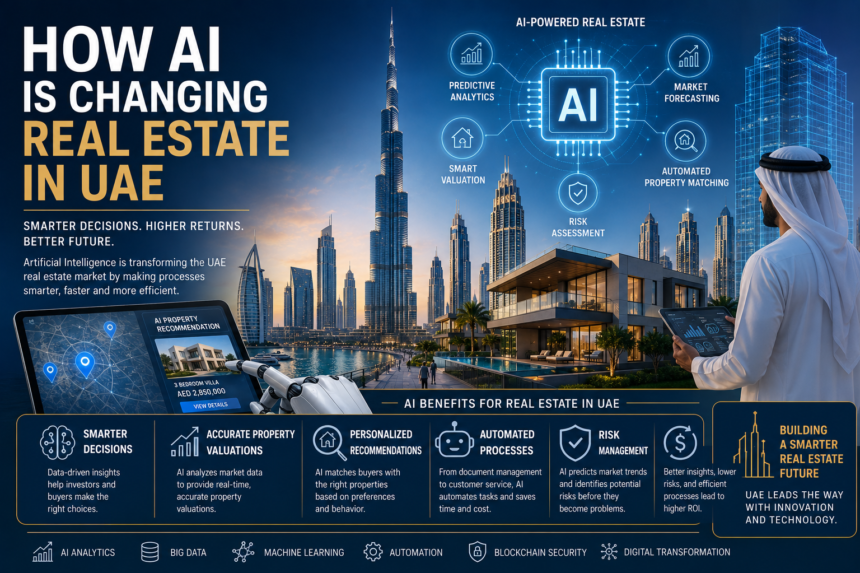
How AI Is Changing Real Estate in UAE: The Future of Property
Artificial intelligence is rapidly changing the way the real estate industry in the UAE operates. From property valuation and market analysis to digital transactions, customer service, advertising and investment decisions, AI is helping developers, brokers, investors, landlords, tenants and government authorities work with more data and greater efficiency.
- What Is AI in Real Estate?
- Why AI Is Important for UAE Real Estate
- AI-Powered Property Valuation in the UAE
- AI and Property Price Prediction
- AI Is Making Property Searches Smarter
- AI and Personalized Real Estate Recommendations
- AI and Real Estate Investment Decisions
- AI Is Improving Real Estate Advertising
- AI and the Dubai Smart Rent Index
- AI for Property Developers
- AI in Real Estate Marketing
- AI Chatbots and Virtual Real Estate Assistants
- AI and Real Estate Transactions
- AI and Fraud Detection
- AI and Smart Buildings in the UAE
- AI and Sustainable Real Estate
- AI for Real Estate Brokers and Agents
- Benefits of AI in UAE Real Estate
- Challenges of Using AI in UAE Real Estate
- Will AI Replace Real Estate Agents?
- The Future of AI in UAE Real Estate
- What AI Means for UAE Property Buyers
- What AI Means for UAE Property Investors
The UAE has positioned artificial intelligence as a major part of its long-term development strategy. The country’s AI strategy was launched in 2017 as part of the broader vision toward the UAE Centennial 2071, while more recent national AI policies emphasize innovation, safety, sustainability, economic diversification and human-centered technology.
Dubai is particularly advanced in applying AI to real estate. The Dubai Land Department (DLD) has introduced AI-powered valuation, smart rental systems, advertising governance and investor-focused digital services. In 2025, DLD also announced a collaboration with Google Cloud to introduce an AI Investor Assistant designed to turn large volumes of real estate information into analytical insights for investors.
As the UAE’s property market becomes increasingly digital, artificial intelligence is moving beyond being an experimental technology. It is becoming part of the everyday infrastructure supporting the country’s real estate ecosystem.
What Is AI in Real Estate?
Artificial intelligence in real estate refers to the use of computer systems that can analyse large amounts of information, identify patterns, make predictions, automate processes and assist people with decisions.
Traditional real estate decisions often depend on historical transactions, professional experience, market research and manual analysis. AI can combine these approaches with enormous datasets and process information much faster.
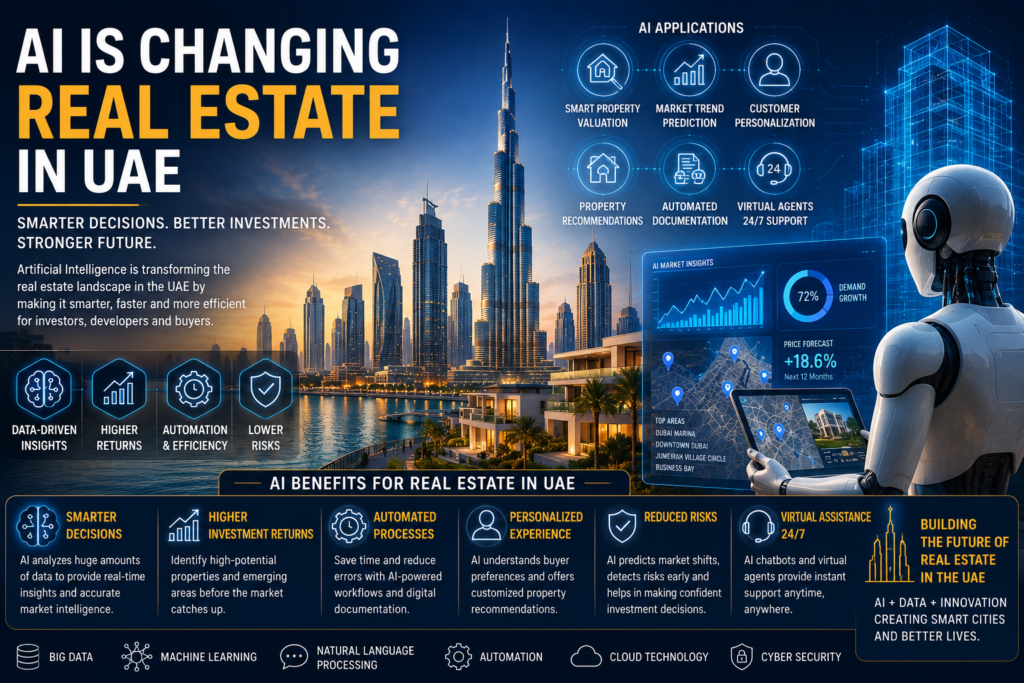
AI is changing real estate in UAE can analyse information such as:
- Property prices
- Rental values
- Historical transactions
- Property locations
- Building characteristics
- Supply and demand
- Market trends
- Economic indicators
- Customer preferences
- Online property searches
- Advertising data
- Infrastructure developments
The result is a real estate environment where decisions can increasingly be supported by data-driven insights rather than intuition alone.
Why AI Is Important for UAE Real Estate
The UAE is home to highly competitive and rapidly developing property markets, particularly in Dubai and Abu Dhabi. Thousands of residential, commercial and hospitality properties are marketed to local and international buyers every year.
This creates enormous quantities of data.
AI can help organize and analyze that information to identify trends, improve services and automate repetitive tasks. For investors, it can make market research more efficient. For developers, it can provide insights into demand. For brokers, it can improve property matching and customer communication.
For government authorities, AI can help strengthen regulation, transparency and service delivery.
The UAE’s national AI framework also emphasizes using artificial intelligence to improve government services, innovation, sustainability and quality of life.
AI-Powered Property Valuation in the UAE
One of the clearest examples of AI in UAE real estate is automated and smart property valuation.
Dubai Land Department introduced an AI-based Smart Valuation initiative to estimate property values using advanced algorithms and large quantities of transaction data. The system was designed to simplify the valuation process and reduce the time required to deliver valuation services.
DLD later expanded its Smart Valuation initiative to include villas and buildings. The department stated that the system could provide immediate valuations and was designed to significantly accelerate the customer experience.
Modern smart valuation systems can consider factors such as:
- Recent transaction prices
- Property type
- Location
- Building characteristics
- Rental information
- Market conditions
- Geographic data
- Comparable properties
DLD’s more recent valuation guidance describes smart valuation as an approach involving updated transaction data, statistical models, machine learning, geographic information systems and automated valuation models. It also emphasizes that professional human oversight remains important when reviewing AI-generated valuation results.
This human-plus-AI model is important because real estate valuation involves legal, physical and market considerations that may require professional judgment.
AI and Property Price Prediction
One of the biggest opportunities created by artificial intelligence is the ability to analyze market patterns and generate forecasts.
AI systems can examine historical prices, transaction volumes, rental data, neighborhood development, infrastructure projects and other indicators to identify potential market trends.
For example, an AI-powered property analytics platform could help identify:
- Areas experiencing rising demand
- Neighborhoods with increasing rental activity
- Property types attracting buyers
- Changes in transaction volumes
- Potential price trends
- Emerging investment locations
However, AI predictions should not be treated as guaranteed outcomes. Real estate markets are influenced by economic conditions, interest rates, regulations, supply, employment, investor sentiment and geopolitical developments.
AI is therefore best viewed as a decision-support tool rather than a replacement for professional investment research.
AI Is Making Property Searches Smarter
Property searches are also becoming more personalized.
Traditional property portals typically allow users to filter properties by price, location, bedrooms and other basic criteria. AI can take this further by analyzing search behavior and preferences.
An AI-powered property platform could understand that a buyer is looking for:
- A family-friendly community
- Proximity to schools
- Access to public transport
- A specific investment budget
- High rental potential
- Waterfront properties
- Modern amenities
- Short commuting times
Instead of showing thousands of listings, AI can potentially rank properties according to the user’s priorities.
This creates a more personalized experience for buyers and tenants while helping brokers identify properties that are more relevant to individual customers.
AI and Personalized Real Estate Recommendations
Personalization is becoming increasingly important in the UAE property market.
International investors may have very different requirements from local buyers. A first-time homebuyer may prioritize affordability, while an experienced investor may focus on rental yields, capital appreciation or liquidity.
AI can analyze customer profiles and preferences to recommend relevant properties.
For example, an investor interested in Dubai apartments could receive recommendations based on:
- Investment budget
- Preferred location
- Property size
- Expected rental income
- Historical market activity
- Investment horizon
- Risk tolerance
- Property type
This can reduce the amount of manual research required to identify potential opportunities.
AI and Real Estate Investment Decisions
Real estate investors deal with large amounts of information. AI can make the research process faster by bringing relevant information together and identifying patterns.
In October 2025, Dubai Land Department announced its collaboration with Google Cloud to introduce the DLD Investor AI Assistant, powered by Google Gemini. DLD said the service was designed to transform real estate data into analytical insights and support investors through the investment journey.
This illustrates an important shift in the industry. AI is increasingly being used not only to automate administrative work but also to support higher-level investment research.
AI can help investors compare:
- Property prices
- Rental trends
- Neighborhood performance
- Market activity
- Property characteristics
- Investment opportunities
- Potential risks
Investors should still independently verify information and seek professional advice when making significant financial decisions.
AI Is Improving Real Estate Advertising
Artificial intelligence is also changing how property advertising is monitored and managed.
Dubai Land Department introduced an AI-powered Real Estate Advertising Governance Platform to improve transparency and credibility in property advertisements.
According to DLD, the platform had monitored more than 279,000 real estate advertisements across major platforms since launch, with 29% of monitored listings automatically modified using AI as of April 2025.
This type of technology can help authorities identify inconsistencies and improve the quality of information presented to consumers.
For a property market with a large number of listings, automated monitoring can be particularly valuable.
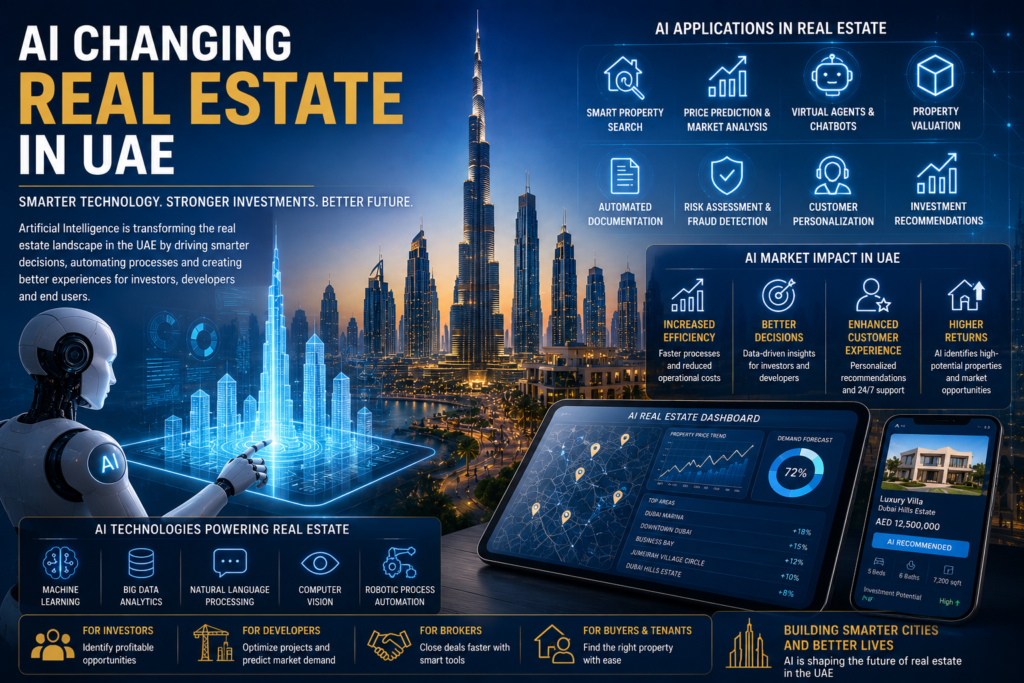
AI can potentially help identify:
- Incorrect property information
- Inconsistent listing details
- Duplicate advertisements
- Misleading information
- Pricing inconsistencies
- Advertising compliance issues
Improved advertising governance can strengthen trust between consumers, brokers, developers and regulators.
AI and the Dubai Smart Rent Index
Artificial intelligence is also being used in rental-market management.
Dubai Land Department’s Smart Rent Index uses AI to help determine rental values and applies data related to rental contracts, area values and building classifications. DLD says the system is designed to improve transparency, fairness and confidence in Dubai’s rental market.
Building classification can consider factors such as:
- Construction quality
- Architectural design
- Energy efficiency
- Building services
- Location
The latest DLD information describes the Smart Residential Rent Index as an advanced system that uses AI and building classifications to determine rental values according to comprehensive criteria.
This represents an important development because AI is being used not simply by private companies but also as part of public-sector real estate services.
AI for Property Developers
Developers can also benefit significantly from artificial intelligence.
Before launching a new project, developers need to understand demand, buyer preferences, competition, location and potential pricing.
AI can analyze historical and current market information to support these decisions.
Developers can use AI for:
- Demand forecasting
- Location analysis
- Market segmentation
- Project planning
- Pricing strategies
- Customer research
- Construction management
- Sales forecasting
- Marketing optimization
AI can also help developers understand which property features are becoming more attractive to consumers.
For example, data may reveal increasing demand for smart homes, energy-efficient buildings, wellness facilities, flexible spaces or properties near public transportation.
AI in Real Estate Marketing
Real estate marketing requires substantial time and resources. AI is increasingly being used to automate and personalize marketing activities.
AI tools can assist with:
- Property descriptions
- Digital advertising
- Customer segmentation
- Email marketing
- Social media content
- Lead scoring
- Campaign analysis
- Image enhancement
- Virtual property presentations
- Customer communication
A real estate company can use AI to identify which potential buyers are most likely to be interested in a particular property.
This can allow brokers to spend more time on high-value customer interactions rather than manually sorting every lead.
AI Chatbots and Virtual Real Estate Assistants
Customer service is another area undergoing major change.
AI-powered chatbots and virtual assistants can answer common questions around the clock. They can provide information about property availability, prices, locations, amenities and basic transaction procedures.
Potential benefits include:
- 24/7 customer support
- Faster responses
- Automated lead qualification
- Appointment scheduling
- Property recommendations
- Frequently asked questions
- Multilingual communication
For international investors who may be contacting UAE real estate companies from different time zones, 24-hour digital assistance can be particularly useful.
However, complex legal, financial and contractual questions may still require qualified human professionals.
AI and Real Estate Transactions
Property transactions involve substantial documentation and administrative work.
AI and automation can help organize documents, identify missing information and streamline repetitive processes.
Dubai is already moving toward more integrated digital real estate services. DLD’s Tamallak+ initiative combines services including AI-driven property valuation, instant sales registration, developer self-registration, first-time homebuyer support and real estate asset tokenization. DLD reported that the initiative reduced service completion time by 88% and enabled fully digital property registration without in-person visits.
This demonstrates how AI works alongside other technologies rather than operating independently.
The future of real estate transactions is likely to combine:
- Artificial intelligence
- Cloud computing
- Digital identity
- Blockchain
- Data integration
- Electronic signatures
- Automated workflows
Together, these technologies can make transactions faster and more convenient.
AI and Fraud Detection
Real estate transactions involve significant financial values, making fraud prevention extremely important.
AI can analyze transaction patterns and identify unusual behavior or inconsistencies.
Potential applications include:
- Detecting suspicious transactions
- Identifying duplicate listings
- Monitoring unusual payment patterns
- Checking documentation
- Flagging irregular advertising
- Supporting compliance monitoring
AI does not eliminate fraud, but it can help organizations identify potential risks earlier and direct human investigators toward transactions that require closer examination.
AI and Smart Buildings in the UAE
The influence of AI extends beyond buying and selling property.
Smart buildings can use AI to manage building systems and improve operational efficiency.
AI-powered building management can optimize:
- Air conditioning
- Lighting
- Energy consumption
- Security
- Predictive maintenance
- Occupancy management
- Water usage
This is particularly relevant in the UAE because of its hot climate and high demand for cooling.
A smart building can analyze occupancy and environmental data and adjust systems according to real-time conditions.
Over time, this can potentially reduce energy waste and operating costs while improving occupant comfort.
AI and Sustainable Real Estate
Sustainability is becoming an increasingly important part of UAE urban development.
Artificial intelligence can support sustainable real estate by analyzing energy use, identifying inefficiencies and helping optimize building operations.
AI can contribute to:
- Energy efficiency
- Smart cooling
- Water management
- Predictive maintenance
- Waste reduction
- Renewable energy integration
- Building performance monitoring
The UAE’s broader AI policy framework also identifies sustainability and environmental protection among the potential outcomes of responsible AI adoption.
As investors and consumers increasingly consider environmental performance, AI could become an important tool for developing and operating more efficient properties.
AI for Real Estate Brokers and Agents
Real estate agents are not being replaced by AI; instead, many of their tasks are becoming increasingly automated.
An agent can use AI to save time on repetitive work such as:
- Lead qualification
- Property matching
- Market research
- Listing creation
- Customer follow-ups
- Appointment scheduling
- Data analysis
- Report generation
This allows agents to focus more heavily on negotiation, relationship management and complex customer needs.
The most successful real estate professionals in the UAE may increasingly be those who know how to combine technology with strong market knowledge and interpersonal skills.
Benefits of AI in UAE Real Estate
The adoption of artificial intelligence can create benefits across the entire property ecosystem.
1. Faster Decision-Making: AI can process large amounts of information much faster than traditional manual analysis.
2. More Accurate Data Analysis: Machine learning models can identify patterns across large datasets and provide useful market insights.
3. Improved Customer Experience: Personalized recommendations and AI-powered assistants can make property searches easier.
4. Greater Operational Efficiency: Automation can reduce repetitive administrative work and save time.
5. Better Market Transparency: AI-powered monitoring can help improve the quality and consistency of property information.
6. Smarter Valuation: Automated valuation tools can provide rapid estimates based on market data and property characteristics.
7. Improved Risk Management: AI can identify patterns associated with potential market, transaction or compliance risks.
8. Better Investment Research: Investors can use AI to organize and analyze information before making decisions.
Challenges of Using AI in UAE Real Estate
Despite its advantages, AI also presents challenges.
Data Quality: AI systems are only as useful as the information they receive. Inaccurate, outdated or incomplete data can produce unreliable results.
Privacy: Real estate platforms can handle sensitive personal and financial information. Protecting this data is essential.
Algorithmic Bias: AI systems can produce biased results if their training data or underlying models are biased.
Cybersecurity: Greater digitalization can increase exposure to cyber threats.
Human Oversight: AI-generated valuations, predictions or recommendations should not automatically be treated as definitive decisions.
Regulatory Compliance: Real estate companies must ensure their use of AI complies with applicable UAE laws and industry requirements.
The UAE’s AI framework emphasizes responsible development, human commitment, safety, ethics and compliance with applicable laws.
Will AI Replace Real Estate Agents?
One of the most common questions about AI and UAE real estate is whether artificial intelligence will replace property agents.
The more likely scenario is that AI will change the role of agents rather than eliminate it.
Real estate transactions involve emotions, negotiations, legal considerations and personal preferences. Buyers and sellers often need advice that requires human understanding.
AI can provide data and recommendations, while agents can provide:
- Negotiation
- Local market expertise
- Relationship management
- Property inspections
- Contract guidance
- Personalized advice
- Problem-solving
The future agent is likely to be more technology-enabled, data-driven and productive.
The Future of AI in UAE Real Estate
The next stage of AI adoption is likely to involve deeper integration between government data, private platforms, smart buildings and digital transaction systems.
Future developments may include:
- AI-powered investment platforms
- More advanced automated valuations
- Predictive rental analytics
- AI property search assistants
- Digital twins of buildings and communities
- Autonomous property management
- Smart building optimization
- Advanced fraud detection
- AI-powered urban planning
- Automated transaction workflows
- More personalized investment recommendations
Dubai’s collaboration with Google Cloud is an example of this broader direction. DLD described its AI Investor Assistant as part of an effort to transform large volumes of real estate information into useful investment insights.
DLD’s continued investment in AI has also received recognition. In June 2026, the department announced that it had won the Gold Category of the Global AI Award 2025 for its work using AI and digital innovation to improve real estate services, operational efficiency and customer experience.
These developments suggest that AI is becoming an important part of Dubai’s long-term real estate strategy.
What AI Means for UAE Property Buyers
For buyers, artificial intelligence can make the property search process more efficient.
Instead of manually reviewing hundreds of listings, buyers may increasingly use AI-powered systems to identify properties that match their requirements.
AI can help buyers compare:
- Prices
- Locations
- Property sizes
- Amenities
- Market trends
- Rental potential
- Neighborhood characteristics
However, buyers should always verify property information independently and conduct appropriate legal and financial due diligence.
What AI Means for UAE Property Investors
For investors, AI can become an important research assistant.
It can process large quantities of market data and identify trends that may deserve further investigation.
Investors can use AI to explore:
- Rental-market trends
- Property price movements
- Neighborhood demand
- Transaction activity
- Investment opportunities
- Potential risks
But no AI system can guarantee investment returns. Real estate remains subject to market volatility and economic conditions.
The best approach is to combine AI-generated insights with official data, professional advice and independent research.
Conclusion
AI is changing real estate in the UAE by transforming property valuation, market analysis, investment research, advertising, customer service, transactions and building management. Dubai is at the forefront of this transformation, with the Dubai Land Department already using artificial intelligence in smart valuation, rental-market management, advertising governance and investor services.
The most important change is that real estate is becoming increasingly data-driven. Buyers can receive more personalized property recommendations, investors can access faster market insights, developers can analyze demand more efficiently and brokers can automate repetitive tasks.
At the same time, AI should not be viewed as a replacement for human expertise. Property transactions involve significant financial and legal decisions, making professional judgment, transparency, data security and regulatory compliance essential.
The UAE’s commitment to artificial intelligence suggests that this transformation will continue. As AI becomes more integrated with cloud technology, digital government, smart buildings, big data and automated transactions, the country’s real estate industry could become one of the world’s most technologically advanced property markets.
For buyers, investors, developers and real estate professionals, understanding how AI is changing real estate in the UAE is therefore becoming increasingly important. The future of property in the UAE is likely to be shaped by a combination of human expertise and intelligent technology—creating a market that is faster, more connected, more personalized and increasingly data-driven.
Do follow Gulf Prime on Instagram
Read More – Know How Artificial Intelligence (AI) Is Transforming the UAE