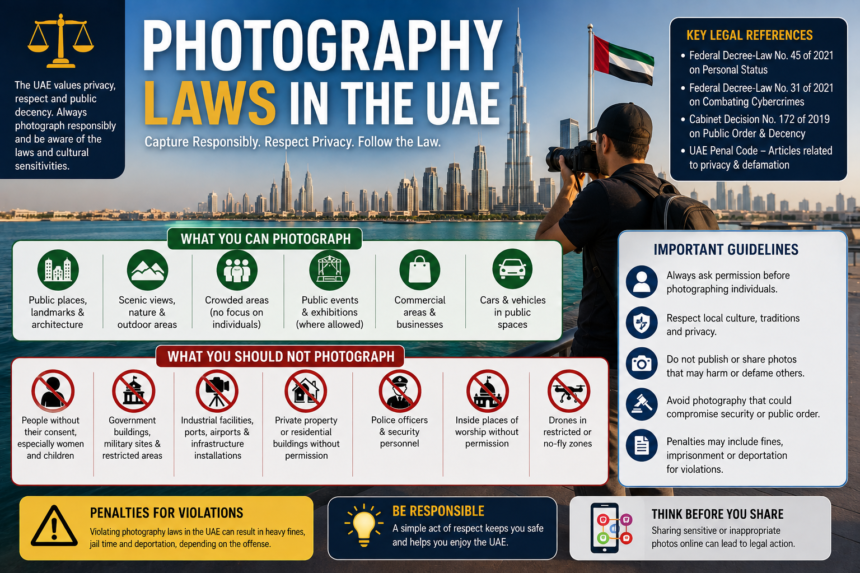
Photography Laws in the UAE: Rules, Restrictions, Privacy and Penalties
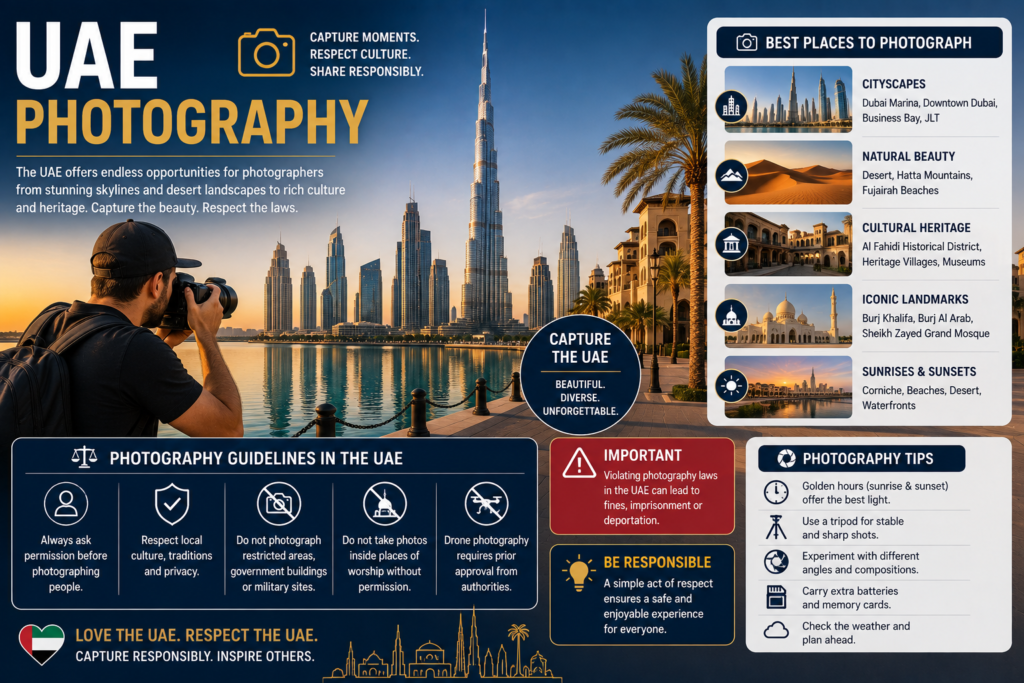
Photography is one of the best ways to document the UAE’s architecture, landscapes, culture and everyday life. From the Dubai skyline and Abu Dhabi’s landmarks to desert landscapes, beaches and traditional markets, the country offers countless opportunities for photographers. However, photography laws in the UAE are important to understand because taking or sharing a photograph can raise privacy, security, copyright, media and public-conduct issues.
- Are You Allowed to Take Photos in the UAE?
- Why Photography Laws Matter in the UAE
- Photography and Privacy in the UAE
- Do You Need Permission to Photograph People?
- Taking Photos in Public Places
- Photography of Government Buildings
- Photography of Military Installations
- Can You Photograph Airports and Aircraft in the UAE?
- Photography at Airports
- Photography of Police and Security Personnel
- Photography During Accidents and Emergencies
- Social Media and Photography Laws in the UAE
- Can You Photograph Children in the UAE?
- Photography on Private Property
- Commercial Photography in the UAE
- Photography for Advertising and Social Media Businesses
- Drone Photography Laws in the UAE
- Photography and Copyright in the UAE
- Can You Photograph Buildings and Landmarks?
- Photography in Mosques and Cultural Sites
- Photography Etiquette for Tourists
- Penalties for Breaking Photography Laws
- How to Photograph Safely and Legally in the UAE
- Photography Laws in Dubai and Abu Dhabi
- Tips for Professional Photographers
- Frequently Asked Questions About UAE Photography Laws
The UAE generally welcomes photography and has many locations where residents and tourists can take photographs. However, photography is not unrestricted. Certain government buildings and military installations cannot be photographed, photographing aircraft and plane spotting are prohibited according to the UAE government’s visitor guidance, and people should not be photographed without their permission.
The rules become particularly important when photography involves other people, private spaces, sensitive locations, commercial activities, drones or publication on websites and social media. UAE laws can impose significant penalties for certain privacy violations, unauthorized use of personal data or inappropriate publication of images.
This UAE photography laws guide explains the major rules photographers, tourists, content creators, journalists and businesses should understand before taking or publishing photographs in the country.
Are You Allowed to Take Photos in the UAE?
Yes, photography is allowed in many places across the UAE, but there are important restrictions.
Tourists routinely photograph public attractions, city skylines, architecture, beaches, restaurants and cultural sites. The important distinction is between photographing ordinary public scenery and photographing people, restricted facilities or sensitive locations.
The official UAE government advises visitors that photography of certain government buildings and military installations is not allowed. It also states that photographing aircraft and plane spotting are illegal and advises people not to photograph others without their permission.
A simple rule for visitors is:
If a location is clearly restricted, a person is identifiable, or the photograph could affect privacy or security, ask for permission or avoid taking the photograph.
This approach is especially important when using professional cameras, long lenses, video equipment or drones.
Why Photography Laws Matter in the UAE
Photography can involve more than simply creating an image. A photograph may contain a person’s face, location, personal activities, private property or other information that can identify someone.
UAE legislation provides strong protections for privacy and personal information.
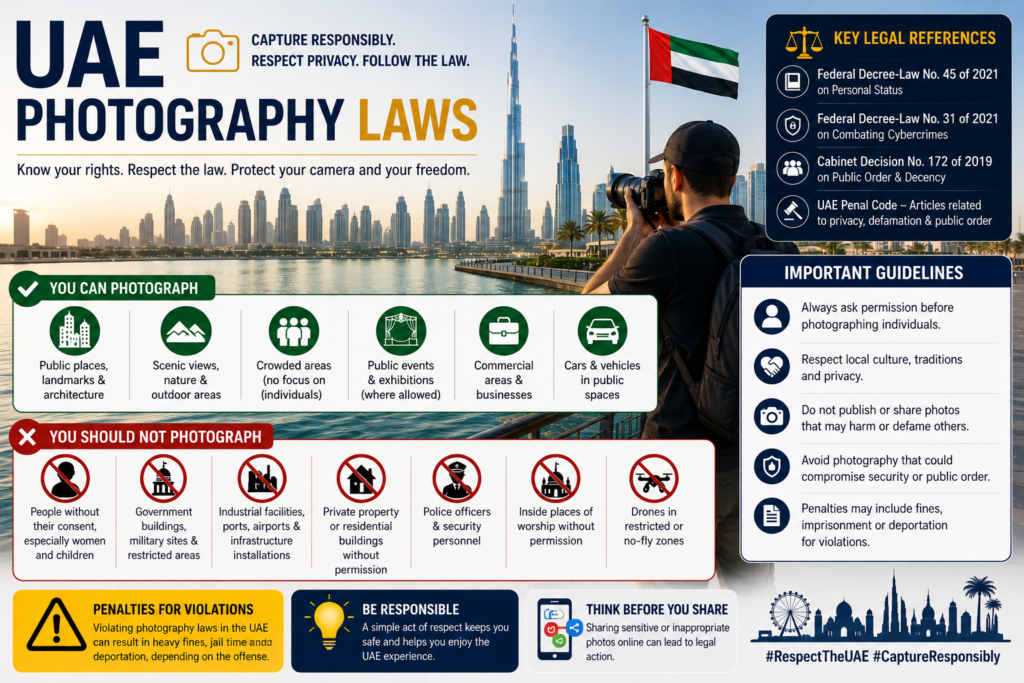
Under Federal Decree-Law No. 34 of 2021 on Countering Rumours and Cybercrimes, Article 44 addresses revealing secrets and invasion of privacy. Among other acts, it covers using information technology to take photographs of third parties in public or private places without consent, as well as preparing, transferring, disclosing, copying or keeping electronic photographs in circumstances covered by the article. The article provides for imprisonment of at least six months and/or a fine of AED 150,000 to AED 500,000 for the specified conduct.
This is why photographers should not assume that being in a public place automatically means everyone can be photographed and the image freely published.
Photography and Privacy in the UAE
Privacy is one of the most important aspects of UAE photography laws.
The UAE’s Personal Data Protection Law, Federal Decree-Law No. 45 of 2021, defines personal data broadly. The definition includes information that can identify a natural person directly or indirectly, including an individual’s image. The law generally prohibits processing personal data without consent, subject to specified exceptions.
This means photographers and content creators should think carefully before photographing identifiable people, particularly when the images will be stored, processed, published or used commercially.
Examples where extra caution is appropriate include:
- Photographing strangers in a way that makes them the main subject
- Taking close-up portraits without permission
- Photographing people inside private spaces
- Photographing children
- Recording people during sensitive or embarrassing situations
- Publishing someone’s image without appropriate authorization
- Using someone’s photograph for advertising
- Sharing photographs that reveal private information
A wide-angle photograph of a busy public place is different from deliberately focusing on an identifiable individual. Nevertheless, when in doubt, permission is the safest approach.
Do You Need Permission to Photograph People?
The safest practice in the UAE is to ask permission before taking a recognizable person’s photograph, particularly when the person is the primary subject.
The official UAE government specifically advises visitors not to photograph people without their permission.
Permission becomes even more important when the photograph will be:
- Published online
- Used by a company
- Used in advertising
- Included in a commercial campaign
- Sold as a product
- Used in promotional material
- Shared on social media in a way that could affect the person
Photographers working professionally should consider obtaining written releases or other clear authorization when appropriate.
Taking Photos in Public Places
Public photography in the UAE is common, especially at tourist attractions and popular city locations. However, “public place” should not be interpreted as unlimited permission to photograph anyone or anything.
For example, photographing the Dubai skyline is generally very different from intentionally photographing a person in a sensitive situation.
When taking photographs in public:
- Respect people’s personal space.
- Avoid intrusive close-up photographs.
- Ask permission for portraits.
- Avoid photographing private activities.
- Be careful when children appear prominently in an image.
- Follow signs and instructions from security staff.
- Do not photograph restricted facilities.
- Avoid using photography equipment in prohibited areas.
- Check venue-specific photography policies.
A location can also have its own rules. Shopping malls, hotels, museums, attractions and private venues may impose photography restrictions even if the surrounding area is public.
Photography of Government Buildings
Photography of certain government buildings in the UAE is prohibited. The UAE government’s official social responsibility guidance specifically warns visitors against photographing certain government buildings.
The safest practice is to avoid photographing:
- Security facilities
- Sensitive government installations
- Restricted government compounds
- Security checkpoints
- Military facilities
- Police facilities where photography is prohibited
- Sensitive infrastructure
If you are unsure whether a particular building can be photographed, ask the relevant authority or security personnel before taking pictures.
Do not assume that a building is safe to photograph simply because it is visible from a public road.
Photography of Military Installations
Military installations and sensitive defense facilities are particularly restricted.
The official UAE government advises that photography of military installations is not allowed.
Photographers should therefore avoid taking pictures of military bases, defense facilities, military equipment and other clearly sensitive locations.
This applies to both tourists using smartphones and professional photographers using high-end cameras.
The same principle should be followed when photographing from elevated locations or using equipment that provides a detailed view of sensitive facilities.
Can You Photograph Airports and Aircraft in the UAE?
This is an area where photographers need to be particularly careful.
The UAE government’s visitor guidance states that photographing aircraft and plane spotting are illegal.
The General Civil Aviation Authority also maintains detailed regulations governing aviation operations and aerial work in the UAE.
The lesson for photographers is simple: avoid aircraft photography or plane spotting unless you have verified that the specific activity is legally authorized.
This is especially important around airports, military airfields and aviation facilities.
Photography at Airports
Airports contain security-sensitive areas and operational infrastructure. A photographer should not assume that because passengers can use a particular public area, every type of photography is permitted.
Avoid photographing:
- Security screening operations
- Security personnel without authorization
- Restricted airport areas
- Aircraft operations where prohibited
- Security equipment
- Sensitive airport infrastructure
- Other passengers without permission
The GCAA issued a July 2026 safety alert specifically warning aviation operational and maintenance personnel about photography, filming and social media use during operational activities, including aircraft, flight decks, cabins, ramps and restricted security areas.
This illustrates how seriously photography and recording can be treated in aviation environments.
Photography of Police and Security Personnel
Photographing police officers, security personnel or security operations can create unnecessary legal and practical risks, particularly if the photograph interferes with official duties or captures sensitive information.
If you encounter an emergency, accident or police operation, it is generally better to keep a safe distance and follow instructions rather than attempting to document the scene.
Do not obstruct authorities simply to obtain a photograph.
Photography During Accidents and Emergencies
UAE privacy law specifically addresses photographs of injured people, deceased individuals and victims of accidents or disasters.
Article 44 of Federal Decree-Law No. 34 of 2021 includes taking, transmitting or publishing photographs of injured persons, deceased persons or victims of accidents or disasters without permission or consent among the conduct covered by the privacy provision.
This is an especially important rule for photographers and social media users.
If you witness an accident:
- Do not photograph victims for entertainment or social media.
- Do not approach injured people simply to obtain images.
- Do not publish identifiable images of victims without proper authorization.
- Give priority to emergency responders and public safety.
- Follow instructions from police and other authorities.
Respect for victims is both a legal and ethical responsibility.
Social Media and Photography Laws in the UAE
Taking a photograph and publishing it are not necessarily the same legal question.
A photograph stored privately may create one set of considerations, while uploading it to Instagram, TikTok, Facebook, X, YouTube or a website can introduce additional issues.
Federal Decree-Law No. 34 of 2021 contains privacy and electronic-content provisions that can apply to images shared through information technology. Article 44 specifically addresses several forms of electronic privacy invasion and publication.
The UAE Media Council’s media content standards also require respect for privacy and the private lives of individuals. They further address public morals, national identity, social cohesion, security and other content considerations.
Before posting a photograph online, ask:
- Is anyone identifiable?
- Did I have permission to photograph them?
- Could the image embarrass or harm someone?
- Does the image reveal private information?
- Was the photograph taken in a restricted area?
- Does the image contain sensitive security information?
- Am I using the photograph commercially?
- Do I have the necessary rights to publish it?
Can You Photograph Children in the UAE?
Photographers should exercise particular caution when photographing children.
Parents, guardians, schools and event organizers may have specific requirements concerning photography. Publishing identifiable photographs of children without appropriate consent can create privacy concerns.
Professional photographers should obtain appropriate parental or guardian authorization before conducting child-focused photography sessions.
This is especially important for:
- School photography
- Advertising campaigns
- Family events
- Sports events
- Commercial shoots
- Social media campaigns
- Editorial projects
Avoid taking intrusive photographs of children who are not part of your intended subject.
Photography on Private Property
Private property has its own rules.
A hotel, shopping mall, restaurant, residential development, office building, private beach or other privately controlled location may establish photography policies.
Even if photography is technically possible, management can restrict professional equipment, tripods, lighting, filming or commercial photography.
Before conducting a professional shoot, ask the property management or venue for permission.
This can prevent problems involving:
- Security
- Privacy
- Commercial activity
- Customer disruption
- Intellectual property
- Venue policies
Commercial Photography in the UAE
Professional photography is subject to additional regulatory considerations.
Federal Decree-Law No. 55 of 2023 Regulating Media identifies photography activities as a media activity. Article 13 provides that the competent authority issues permits for land, aerial or marine photography activities, with the executive regulation setting the relevant controls and procedures.
The UAE Media Council also provides a Land Photography Permit inside the UAE as an official media service.
Therefore, professional photographers should not automatically assume that a normal tourist photograph and a commercial photo shoot are regulated in exactly the same way.
If you are conducting photography for a company, advertising campaign, magazine, production, property marketing campaign or professional project, check the applicable permit requirements before beginning.
Depending on the project, additional approvals from the relevant authorities or property owners may also be necessary.
Photography for Advertising and Social Media Businesses
Commercial content creators should also understand UAE media regulations.
The UAE Media Council states that individuals who engage in advertising activities on social media generally require an Advertiser Permit, subject to the applicable rules and exemptions. The Council says the permit applies to advertising activities whether compensation is financial or non-financial.
The Council also states that permit holders must comply with media content standards and obtain approvals from relevant authorities where required by applicable laws.
This can be relevant when photography is part of an advertising campaign.
For example, a photographer creating images for a restaurant, hotel, property developer, fashion brand or tourism company should consider both photography permissions and the rules governing the eventual advertising content.
Drone Photography Laws in the UAE
Drone photography is subject to much stricter rules than ordinary camera photography.
The UAE’s General Civil Aviation Authority regulates unmanned aircraft systems and has specific requirements for registration, operation, flying zones and security approvals.
However, there is an important current 2026 development that photographers must know.
GCAA Safety Decision 2026-03, Issue 03, dated April 27, 2026, states that operations of unmanned aircraft systems, light sport aircraft and balloons within UAE airspace were temporarily suspended, with operation, launch or flight prohibited during the suspension period unless specifically exempted through written GCAA authorization.
Therefore, anyone considering drone photography in the UAE should check the latest GCAA decision before flying. Do not rely on older articles, social media posts or previous drone rules.
Under the ordinary regulatory framework, GCAA requires drone registration and sets requirements concerning approved flying zones, line of sight, altitude and proximity to airports and other areas. Professional operations involving photography can require additional approvals.
Important drone rules include:
- Check the current GCAA status before every operation.
- Register the drone when required.
- Use only approved flying areas.
- Follow applicable security requirements.
- Never fly near restricted aviation areas.
- Respect privacy laws.
- Do not use a drone to spy on people or private property.
- Obtain required operational approvals.
- Follow GCAA instructions concerning cameras and recording equipment.
Drone rules can change in response to security and aviation conditions, so current official information should always take priority.
Photography and Copyright in the UAE
Privacy is not the only legal issue photographers need to understand. Copyright also matters.
Federal Decree-Law No. 38 of 2021 on Copyright and Neighboring Rights contains provisions concerning photographs and audio or video recordings of third parties.
Article 45 provides specific rules for situations where an agreement has been made with a person to capture a photograph or make an audio or video recording. It states that the person who made the recording may not keep, display or publish the original or copies without authorization from the person concerned, unless otherwise agreed, subject to specified exceptions.
The law includes exceptions involving publicly occurring incidents, certain government events and activities organized for the public at a public place, and situations permitted by competent authorities for the public interest, while also requiring consideration of the person’s honor and reputation.
Photographers should therefore understand who owns the photograph, who has rights to use it and whether a model or subject has granted permission for commercial use.
Can You Photograph Buildings and Landmarks?
Many UAE landmarks are popular photography subjects. However, the fact that a building is famous does not automatically mean every type of photography is permitted from every location.
For ordinary tourism photography:
- Follow signs at the attraction.
- Respect security instructions.
- Check venue rules.
- Avoid restricted areas.
- Do not obstruct visitors.
- Ask permission for professional shoots.
- Avoid photographing people without permission.
Large-scale commercial shoots may require additional permissions from the attraction, property owner, local authority or media regulator.
Photography in Mosques and Cultural Sites
Mosques, heritage locations and cultural institutions can have specific photography rules.
Visitors should respect religious and cultural sensitivities. Some locations may allow photography in designated areas, while others may restrict photography altogether.
Before photographing inside a mosque or cultural site:
- Look for photography signs.
- Follow staff instructions.
- Ask permission when necessary.
- Avoid photographing worshippers without consent.
- Do not disturb prayers or religious activities.
- Respect cultural practices and dress requirements.
The UAE government’s visitor guidance emphasizes respect for local culture, religious traditions and appropriate behavior.
Photography Etiquette for Tourists
Visitors can enjoy photography in the UAE by following a few simple principles.
Do:
- Photograph public scenery where permitted.
- Ask before taking someone’s portrait.
- Follow venue rules.
- Respect cultural traditions.
- Check signs before photographing.
- Keep professional equipment under control.
- Ask permission for commercial shoots.
- Verify drone rules before flying.
- Respect security instructions.
Do not:
- Photograph military installations.
- Photograph restricted government facilities.
- Photograph aircraft or engage in plane spotting.
- Photograph people without appropriate permission.
- Publish sensitive or private images.
- Photograph accident victims for social media.
- Use drones without the required authorization.
- Assume public visibility means unlimited photography rights.
Penalties for Breaking Photography Laws
Penalties depend on the specific conduct and the law involved.
For certain privacy violations under Article 44 of Federal Decree-Law No. 34 of 2021, the stated penalty is imprisonment of at least six months and/or a fine of AED 150,000 to AED 500,000. The same article also provides for higher penalties for certain acts involving modification or processing of photographs or scenes with the intention of defaming or insulting another person.
Other laws can create additional consequences depending on the circumstances.
For example, violations involving unauthorized media activities may result in administrative sanctions under UAE media regulations. The media framework also allows for penalties such as administrative fines, closure of media institutions or cancellation of media licences or permits in applicable cases.
Drone violations can also lead to legal consequences under UAE aviation legislation and applicable regulations. GCAA’s current suspension decision states that violations are subject to applicable legal measures.
Because penalties depend on the facts, photographers should not rely on a single generic “photography fine” figure.
How to Photograph Safely and Legally in the UAE
Following the law does not mean giving up photography. It simply means photographing responsibly.
A practical approach is to follow these steps:
1. Check the Location: Before taking photographs, determine whether you are inside a mall, hotel, government facility, cultural attraction, airport or other controlled location.
2. Look for Signs: Photography restrictions are often communicated through signs or venue policies.
3. Ask Permission: If a person is the main subject, ask before photographing them.
4. Respect Security Instructions: If security personnel ask you to stop photographing, comply and clarify the applicable rule rather than arguing.
5. Separate Personal and Commercial Photography: A professional photo shoot may require permits that ordinary tourist photography does not.
6. Check Current Drone Regulations: Drone rules can change. In 2026, GCAA has issued a temporary suspension affecting drone operations, making it especially important to verify the current status before flying.
7. Think Before Publishing: An image that seems harmless while stored on your camera can create privacy or other legal concerns once uploaded to social media or used commercially.
Photography Laws in Dubai and Abu Dhabi
Photography rules can involve both federal legislation and local requirements.
Dubai and Abu Dhabi have extensive tourism, commercial and media activities, and specific locations can have their own photography policies.
For professional shoots, photographers should identify:
- The emirate where the shoot takes place
- The property owner
- The relevant local authority
- Applicable media permit requirements
- Venue permissions
- Security approvals
- Drone permissions, if applicable
Federal laws provide an important foundation, but local requirements and venue-specific rules can also apply.
Tips for Professional Photographers
Professional photographers working in the UAE should treat compliance as part of the production process.
Before a shoot, prepare:
- Location permissions
- Model releases where appropriate
- Property permissions
- Media permits where applicable
- Commercial approvals
- Drone approvals where applicable
- Client authorization
- Copyright agreements
- Usage rights
- Insurance where appropriate
Keeping documentation organized can make a professional shoot much easier to manage.
Frequently Asked Questions About UAE Photography Laws
Q1. Is photography allowed in the UAE?
Ans: Yes. Photography is permitted in many locations, but there are restrictions involving privacy, sensitive facilities, government and military installations, aircraft and certain professional or commercial activities. The UAE government specifically advises against photographing people without permission.
Q2. Can I photograph strangers in Dubai?
Ans: You should not assume that you can photograph identifiable strangers without permission. The UAE government advises visitors not to photograph people without their permission, and privacy laws can impose serious penalties for specified unauthorized electronic photography and publication.
Q3. Can I take photos of Dubai landmarks?
Ans: Many landmarks are photographed by tourists every day, but individual venues may impose their own rules. Always follow signs, security instructions and venue policies.
Q4. Can I photograph government buildings?
Ans: Certain government buildings are prohibited from being photographed. Avoid sensitive government facilities unless you have verified that photography is permitted.
Q5. Can I photograph military buildings?
Ans: No. The UAE government’s official visitor guidance states that photography of military installations is not allowed.
Q6. Is plane spotting legal in the UAE?
Ans: The official UAE government visitor guidance states that photographing aircraft and plane spotting are illegal.
Q7. Can I use a drone for photography?
Ans: Drone use is heavily regulated. More importantly, GCAA issued a temporary suspension of UAS/drone operations in 2026, with flight prohibited during the suspension unless specifically exempted by written authorization. Check GCAA’s latest official decision before any drone operation.
Q8. Do professional photographers need permits?
Ans: Photography activities are regulated as media activities under Federal Decree-Law No. 55 of 2023. The law provides for permits for land, aerial and marine photography activities, and the UAE Media Council provides photography-related permit services.
Final Thoughts
Understanding photography laws in the UAE is essential for tourists, residents, photographers, journalists, influencers and businesses. The UAE offers extraordinary opportunities for photography, from modern skylines and luxury architecture to deserts, beaches, heritage areas and cultural attractions.
The key is to balance creativity with privacy, security and local regulations.
The safest photography practices are straightforward: ask permission before photographing identifiable people, avoid sensitive government and military facilities, do not photograph aircraft or engage in plane spotting, follow venue rules, obtain required permits for professional photography and check the latest drone regulations before using aerial equipment.
Privacy deserves particular attention because UAE legislation provides significant penalties for certain forms of unauthorized electronic photography and publication.
Professional photographers should also understand the UAE’s media regulations, copyright requirements and relevant permits before undertaking commercial projects. Federal media legislation specifically recognizes land, aerial and marine photography as regulated media activities.
Ultimately, responsible photography is the best approach. By respecting people, culture, privacy, security requirements and applicable laws, photographers can enjoy the UAE’s remarkable visual landscape while avoiding unnecessary legal problems.
Note: This article is intended for general informational and SEO purposes and is not legal advice. UAE laws, regulations, permits and aviation restrictions can change. For a professional or high-risk photography project, verify the latest requirements with the relevant UAE authority before shooting or publishing.
Do follow us on Instagram
Read More – Dubai Public Behaviour Rules Explained Know Everything About It