



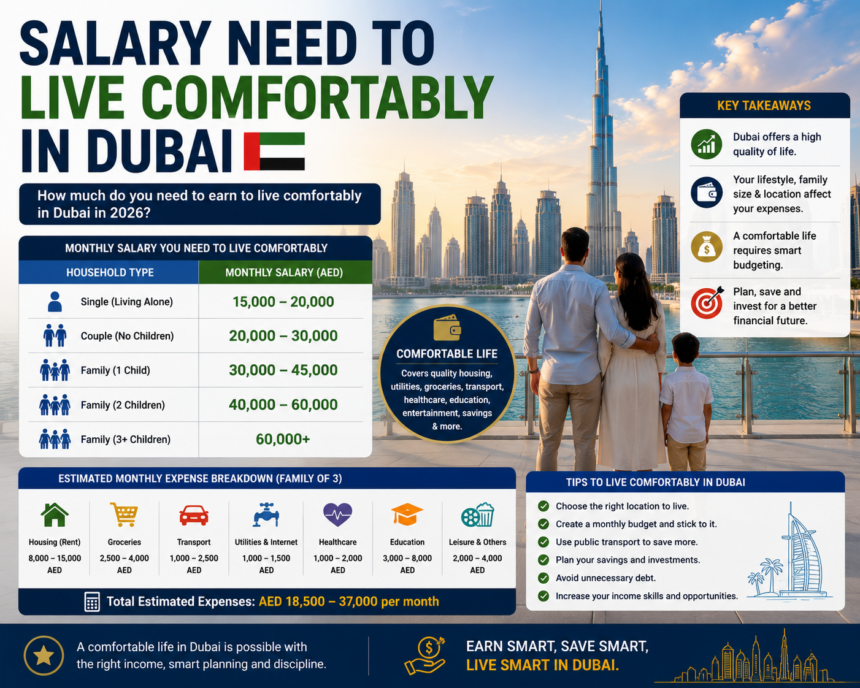
Complete Guide for Salary Need to Live Comfortably in Dubai in 2026
Dubai is one of the world’s most popular destinations for professionals, entrepreneurs, families, and expatriates. The city offers excellent career opportunities, modern infrastructure, international schools, world-class healthcare, luxury entertainment, and a high standard of living. However, living comfortably in Dubai requires more than simply earning enough to cover rent and food.
- What Does “Living Comfortably” Mean in Dubai?
- How Much Salary Need to Live Comfortably in Dubai?
- Is AED 15,000 a Good Salary in Dubai?
- Is AED 20,000 a Good Salary in Dubai?
- Is AED 30,000 Enough to Live Comfortably in Dubai?
- Is AED 40,000 a Good Salary for a Family in Dubai?
- Is AED 50,000 a Good Salary in Dubai?
- Dubai Rent: The Biggest Part of Your Budget
- Cost of Groceries in Dubai
- Transportation Costs in Dubai
- Healthcare and Insurance
- Education Costs for Families
- Salary Packages Matter More Than Basic Salary
- Dubai Has No Personal Income Tax
- How Much Should You Save While Living in Dubai?
- Comfortable vs Luxury Lifestyle in Dubai
- Best Areas to Consider for a Comfortable Budget
- How to Live Comfortably in Dubai on a Moderate Salary
- Example Budget for a Single Person Earning AED 20,000
- Example Budget for a Family Earning AED 40,000
- How to Increase Your Income in Dubai
- Common Salary Mistakes to Avoid in Dubai
- How Much Salary Is Enough for a Single Person in Dubai?
- How Much Salary Is Enough for a Couple?
- How Much Salary Is Enough for a Family?
One of the most frequently asked questions by people planning to move to the UAE is: What salary need to live comfortably in Dubai?
The answer depends on your lifestyle, accommodation, family size, location, transportation choices, education costs, savings goals, and spending habits. A single professional may live reasonably well on AED 15,000 to AED 20,000 per month, while a family with children may need AED 30,000 to AED 60,000 or more for a comfortable lifestyle.
Dubai does not impose personal income tax on individuals, which means employees generally do not have a UAE personal income-tax deduction from their salary. However, residents still face living costs and consumption taxes, including the UAE’s 5% VAT on applicable goods and services.
This guide explains the salary needed to live comfortably in Dubai in 2026, typical expenses, housing costs, salary requirements for singles and families, and practical ways to make your Dubai income go further.
What Does “Living Comfortably” Mean in Dubai?
Before deciding how much salary you need, it is important to define what “comfortable” actually means.
For some people, comfortable living means renting a good apartment, eating out occasionally, owning a car, traveling several times a year, and saving money every month. For others, it may mean living in a premium neighbourhood, sending children to an international school, dining frequently at restaurants, and enjoying Dubai’s luxury lifestyle.
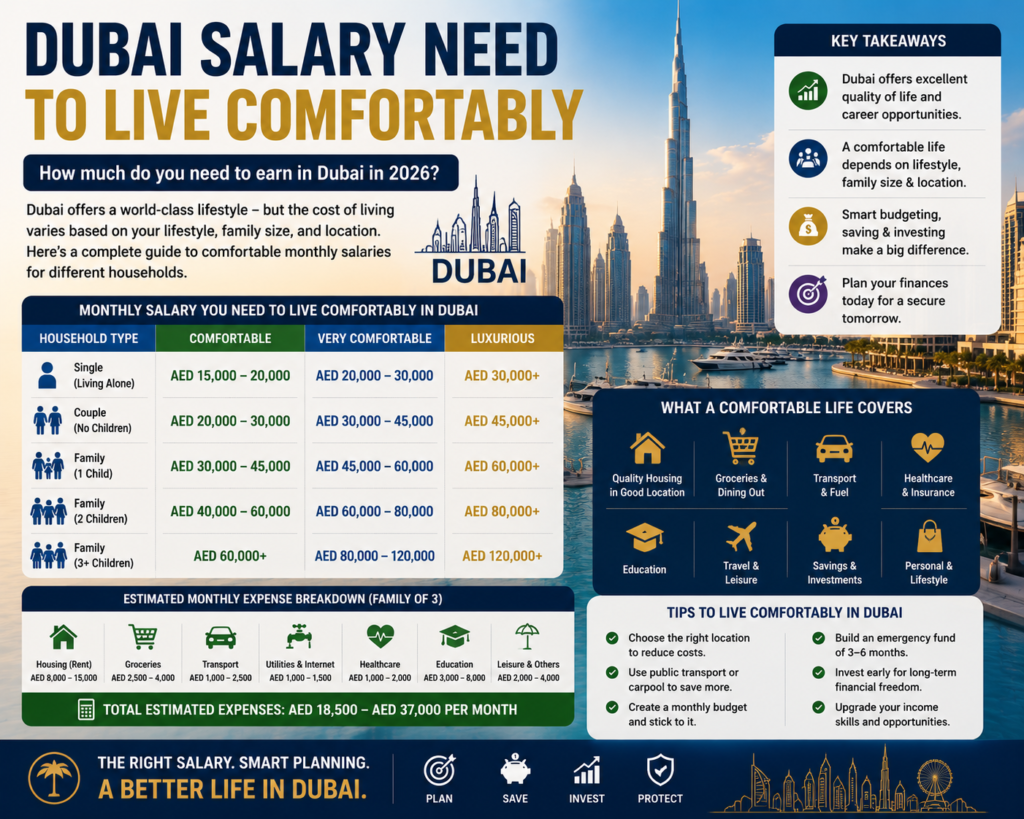
For this guide, a comfortable lifestyle generally means being able to afford:
- Good-quality accommodation.
- Groceries and regular dining out.
- Transportation.
- Utilities and internet.
- Healthcare and insurance.
- Entertainment.
- Occasional travel.
- Personal spending.
- Emergency savings.
- Long-term savings or investments.
- Some financial flexibility for unexpected expenses.
This is different from a luxury lifestyle, which can require substantially more income.
How Much Salary Need to Live Comfortably in Dubai?
As a broad 2026 planning guide, the following ranges can be useful:
| Household | Approximate Comfortable Monthly Salary |
|---|---|
| Single person | AED 15,000–20,000 |
| Couple, no children | AED 20,000–30,000 |
| Family with 1 child | AED 30,000–45,000 |
| Family with 2 children | AED 40,000–60,000 |
| Larger family | AED 60,000+ |
These are planning ranges, not official salary thresholds. Your actual requirement can be significantly different depending on where you live, whether your employer provides housing or insurance, whether you own a car, and whether you pay private-school fees.
Housing is particularly important. Current crowd-sourced Dubai data shows substantial differences between rents in central and non-central areas. For example, Numbeo’s July 2026 data lists average one-bedroom rent at roughly AED 8,409 per month in the city centre and AED 5,381 outside the centre, while three-bedroom apartments average roughly AED 16,577 and AED 11,231 respectively.
That difference alone can significantly change the salary required for a comfortable lifestyle.
Is AED 15,000 a Good Salary in Dubai?
For a single person, AED 15,000 per month can provide a reasonably comfortable lifestyle if expenses are managed carefully.
A person earning AED 15,000 might be able to afford:
- A modest one-bedroom apartment or shared accommodation.
- Groceries.
- Public transportation or a reasonably priced car.
- Dining out occasionally.
- Entertainment.
- Basic travel.
- Regular savings.
However, living in an expensive central neighborhood, driving a luxury car, eating at high-end restaurants frequently, or spending heavily on entertainment can make AED 15,000 feel much less comfortable.
The key is housing. Choosing an affordable location and keeping rent under control can make a significant difference.
Is AED 20,000 a Good Salary in Dubai?
For a single professional, AED 20,000 per month can provide a comfortable lifestyle in many circumstances.
With good budgeting, this income can potentially cover:
- Quality accommodation.
- Transportation.
- Dining and entertainment.
- Healthcare and insurance.
- Regular shopping.
- Travel.
- Savings and investments.
For a couple without children, AED 20,000 can also work, although housing and lifestyle choices will determine how much money remains for savings.
The important point is that a AED 20,000 salary does not mean AED 20,000 of spending power after lifestyle expenses. Rent, utilities, transportation, food, insurance, and other costs can quickly consume a large portion of income.
Is AED 30,000 Enough to Live Comfortably in Dubai?
For many professionals and small families, AED 30,000 per month can provide a comfortable lifestyle, particularly if housing and education costs are controlled.
A couple with no children may have considerable flexibility at this income level.
A family with one child may also manage comfortably, but private-school fees can change the calculation significantly.
At AED 30,000, a sensible financial plan could include:
- 35%–40% for housing and essential household expenses.
- 15%–20% for food and transportation.
- 10%–15% for lifestyle and entertainment.
- 15%–20% for savings and investments.
- The remainder for insurance, education, debt repayment, and other expenses.
These percentages are examples rather than fixed rules.
Is AED 40,000 a Good Salary for a Family in Dubai?
For a family, AED 40,000 per month can provide a comfortable lifestyle in Dubai if expenses are managed carefully.
However, family costs can vary dramatically.
A family with two children may need to budget for:
- Larger accommodation.
- School fees.
- School transportation.
- Healthcare.
- Groceries.
- A family vehicle.
- Activities for children.
- Family holidays.
- Insurance.
- Household help, depending on lifestyle.
Education can become one of the largest expenses for families. Therefore, parents should calculate school costs before accepting a Dubai salary package.
A salary of AED 40,000 may feel very comfortable for one family and much tighter for another.
Is AED 50,000 a Good Salary in Dubai?
AED 50,000 per month can support a very comfortable family lifestyle for many households, assuming there is no unusually large debt burden or exceptionally expensive lifestyle.
At this income level, families may have greater flexibility to choose better accommodation, private education, family transportation, travel, entertainment, and savings.
However, high income can also lead to lifestyle inflation.
A family earning AED 50,000 should not automatically spend AED 50,000 every month. Building savings and investments is important because high income during working years does not guarantee long-term financial security.
Dubai Rent: The Biggest Part of Your Budget
Housing is often the most important factor when calculating the salary needed to live comfortably in Dubai.
The UAE government notes that rent varies depending on the property’s location and size. In Dubai, tenants also pay a Dubai Municipality housing fee calculated at 5% of annual rent, which is added to monthly electricity and water bills.
Current Dubai rental data demonstrates how wide the range can be. In July 2026, Numbeo reported average one-bedroom rent of about AED 8,409 per month in the city centre versus approximately AED 5,381 outside the centre. Three-bedroom apartments averaged about AED 16,577 in the centre and AED 11,231 outside the centre.
These figures illustrate why choosing the right location can make a major difference.
Before renting, consider the complete housing cost:
- Annual rent.
- Housing fee.
- Security deposit.
- Agency fees where applicable.
- Utilities.
- Internet.
- Parking.
- Maintenance.
- Commuting costs.
A cheaper apartment far from your workplace may not necessarily be cheaper if you spend considerably more on fuel, taxis, or commuting time.
Cost of Groceries in Dubai
Food costs vary according to household size and lifestyle.
A single person who cooks regularly can keep grocery spending relatively controlled. A family purchasing imported foods, premium products, and eating out frequently will spend much more.
A realistic monthly food budget should include both groceries and dining out.
You can reduce food expenses by:
- Planning weekly meals.
- Buying groceries in bulk when practical.
- Comparing supermarkets.
- Cooking at home.
- Limiting food delivery.
- Using restaurant promotions selectively.
- Avoiding unnecessary food waste.
Food delivery can be particularly expensive when service fees and frequent restaurant orders become a regular habit.
Transportation Costs in Dubai
Transportation is another major factor in determining the salary you need.
Dubai has an extensive public transportation network, including the Metro, buses, taxis, and other options. For some residents, public transportation can significantly reduce monthly expenses.
Car owners need to consider more than the monthly finance payment.
The total cost can include:
- Car loan or lease.
- Fuel.
- Insurance.
- Registration.
- Maintenance.
- Parking.
- Salik and other road-related costs.
- Repairs.
- Depreciation.
If you live close to work and public transportation is convenient, avoiding a car can potentially save a substantial amount of money.
Healthcare and Insurance
Healthcare costs should be included in your Dubai salary calculation.
Your employer may provide health insurance, but you should understand exactly what the policy covers and whether dependents are included.
Families should consider:
- Employee health insurance.
- Spouse coverage.
- Children’s coverage.
- Dental treatment.
- Specialist consultations.
- Prescription costs.
- Deductibles and co-payments.
- Additional insurance needs.
Never assume that employer-provided benefits cover every healthcare expense.
Education Costs for Families
Education can dramatically change the salary required to live comfortably in Dubai.
Families with children may need to budget for:
- School tuition.
- Registration fees.
- School transportation.
- Uniforms.
- Books.
- Technology.
- Activities.
- Trips.
- Additional educational programs.
The cost depends heavily on the school, curriculum, and child’s age.
This is why parents should not simply compare salaries. A job offering AED 40,000 with education allowances can potentially be more valuable than a job offering AED 45,000 without such benefits.
Salary Packages Matter More Than Basic Salary
When comparing Dubai job offers, look beyond the headline salary.
A complete compensation package may include:
- Basic salary.
- Housing allowance.
- Transportation allowance.
- Health insurance.
- Annual airfare.
- Education allowance.
- Performance bonus.
- End-of-service benefits.
- Other allowances.
For example, consider two offers:
Offer A: AED 30,000 salary with no housing allowance.
Offer B: AED 27,000 salary plus housing support, family medical insurance, and education assistance.
Offer B could potentially provide greater overall financial value to a family.
Always calculate the entire compensation package before accepting a position.
Dubai Has No Personal Income Tax
One major financial advantage of working in Dubai is that the UAE does not levy personal income tax on individuals. The official UAE government confirms that individuals are not subject to UAE income tax.
This means an employee earning AED 20,000 generally does not have a UAE personal income-tax deduction in the same way an employee might experience in some other countries.
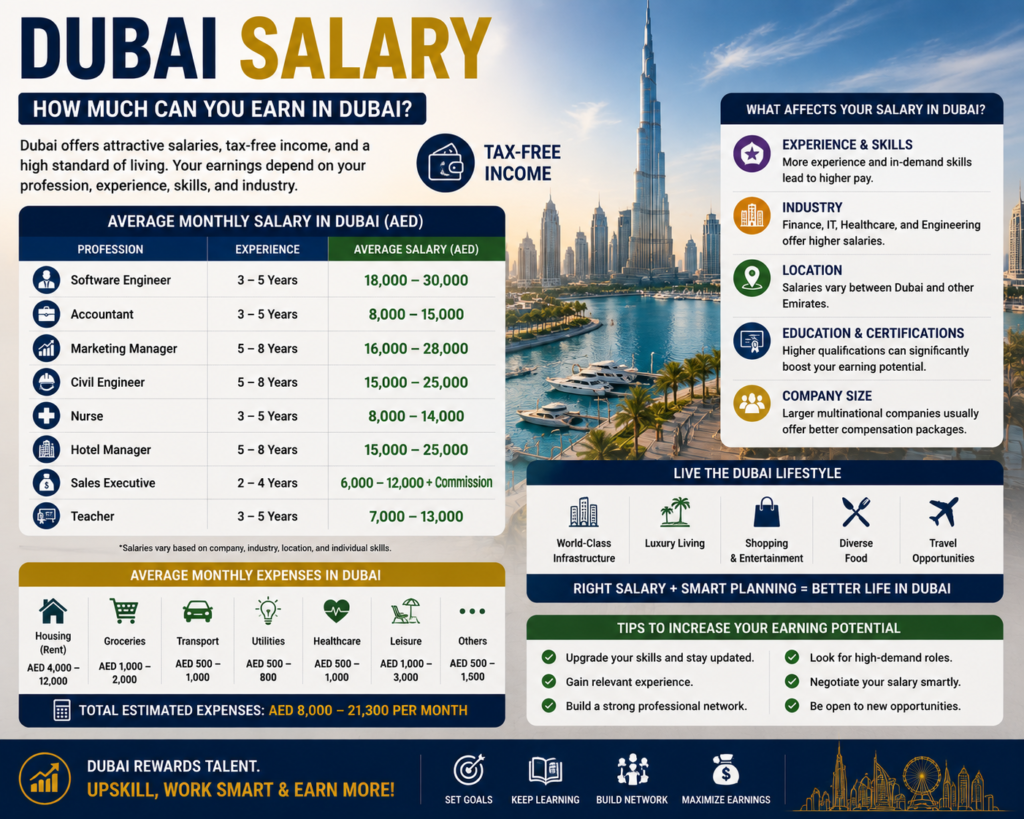
However, this does not mean everything is tax-free.
The UAE applies a 5% VAT to applicable goods and services, and residents may also encounter other fees and charges depending on the product or service.
Expats should also consider their tax obligations in their home country or another jurisdiction if they maintain financial or residency connections there.
How Much Should You Save While Living in Dubai?
Earning a good salary is only one part of financial success.
A comfortable Dubai lifestyle should ideally allow you to save regularly.
A useful starting target is 10%–20% of take-home income, although people with higher salaries and lower obligations may be able to save considerably more.
For example:
| Monthly Salary | 10% Savings | 20% Savings |
|---|---|---|
| AED 15,000 | AED 1,500 | AED 3,000 |
| AED 20,000 | AED 2,000 | AED 4,000 |
| AED 30,000 | AED 3,000 | AED 6,000 |
| AED 40,000 | AED 4,000 | AED 8,000 |
| AED 50,000 | AED 5,000 | AED 10,000 |
| AED 60,000 | AED 6,000 | AED 12,000 |
Your first savings priority should generally include an emergency fund. Many residents aim to maintain several months of essential expenses in accessible savings.
Comfortable vs Luxury Lifestyle in Dubai
It is useful to distinguish between comfortable and luxury living.
A comfortable lifestyle may involve:
- A good apartment.
- A reliable vehicle or public transport.
- Regular dining out.
- Occasional entertainment.
- Annual holidays.
- Quality healthcare.
- Regular savings.
A luxury lifestyle may involve:
- Premium neighborhoods.
- Large villas.
- Luxury vehicles.
- High-end restaurants.
- Frequent international travel.
- Private clubs.
- Premium schools.
- Household staff.
- Designer shopping.
Luxury living can require significantly more than AED 50,000 or AED 60,000 per month, depending on the household.
Therefore, when someone asks whether a salary is “enough” in Dubai, the answer depends largely on their definition of comfort.
Best Areas to Consider for a Comfortable Budget
Choosing the right neighborhood can make your salary go further.
Popular areas vary considerably in rent and lifestyle. Residents should compare areas based on both housing cost and commuting requirements.
When choosing a location, consider:
- Distance from your workplace.
- Public transport availability.
- Rental prices.
- School access.
- Supermarkets.
- Healthcare facilities.
- Parking.
- Community facilities.
- Traffic during commuting hours.
Saving AED 2,000 in rent may not be beneficial if your daily commute adds AED 1,500 in transportation costs and several hours of travel time.
How to Live Comfortably in Dubai on a Moderate Salary
You do not necessarily need an extremely high salary to enjoy Dubai.
The key is controlling your largest expenses.
1. Choose housing carefully: Rent is often the biggest expense, so compare different neighborhoods before signing a lease.
2. Avoid unnecessary car expenses: A premium vehicle can consume a large portion of monthly income.
3. Cook more often: Regular restaurant and delivery spending can quickly add up.
4. Use public transportation when practical: Dubai’s public transportation options can help reduce vehicle-related costs.
5. Set a monthly entertainment budget: Dubai offers countless entertainment options, but frequent premium experiences can become expensive.
6. Automate savings: Transfer money into savings immediately after receiving your salary.
7. Avoid excessive debt: High credit-card balances and unnecessary personal loans can significantly reduce disposable income.
8. Take advantage of employer benefits: Housing, medical insurance, transportation, education support, and other benefits can materially improve the value of your compensation package.
Example Budget for a Single Person Earning AED 20,000
Here is an illustrative monthly budget:
| Expense | Example Monthly Amount |
|---|---|
| Rent and housing | AED 6,000 |
| Utilities and internet | AED 800 |
| Groceries | AED 1,500 |
| Transportation | AED 1,000 |
| Dining and entertainment | AED 1,500 |
| Insurance/healthcare | AED 500 |
| Shopping/personal expenses | AED 700 |
| Savings/investments | AED 4,000 |
| Miscellaneous | AED 4,000 |
This is only an example, and the final AED 4,000 category could instead be allocated to additional savings, debt repayment, travel, or other goals.
The important principle is to create a budget before deciding what salary is sufficient.
Example Budget for a Family Earning AED 40,000
A family might have expenses such as:
- Rent and housing: AED 10,000–12,000.
- Groceries: AED 3,000–4,000.
- Transportation: AED 2,000.
- Utilities and internet: AED 1,000–1,500.
- Healthcare and insurance: AED 1,000–2,000.
- Education: AED 3,000–8,000 or more.
- Entertainment and dining: AED 2,000–3,000.
- Savings and investments: AED 5,000–8,000.
- Other expenses: remaining income.
The biggest variable is education. A family paying significantly higher private-school fees may need a substantially larger salary.
How to Increase Your Income in Dubai
If your current salary does not provide the lifestyle you want, reducing expenses is only one option. Increasing your income can have an even greater long-term impact.
Consider:
- Developing high-demand technical skills.
- Obtaining industry certifications.
- Improving English and communication skills.
- Building professional networks.
- Negotiating salary during job changes.
- Exploring management positions.
- Developing digital skills.
- Considering freelance opportunities where legally permitted.
- Building a business where appropriate.
- Applying for roles in higher-paying industries.
Dubai’s employment market is competitive, so continuous professional development can help improve your earning potential.
Common Salary Mistakes to Avoid in Dubai
Many people make financial mistakes after receiving a higher Dubai salary.
Common problems include:
- Spending too much on rent.
- Buying an expensive car immediately.
- Eating out excessively.
- Taking unnecessary personal loans.
- Using credit cards for lifestyle spending.
- Saving nothing for emergencies.
- Ignoring retirement planning.
- Sending money home without creating a personal budget.
- Choosing a job based only on salary.
- Ignoring benefits and allowances.
A higher salary can improve your quality of life, but only if you manage it effectively.
How Much Salary Is Enough for a Single Person in Dubai?
For a single professional, a reasonable 2026 planning range is approximately AED 15,000–20,000 per month for a comfortable lifestyle, assuming moderate spending and sensible housing choices.
AED 20,000–30,000 can provide significantly greater flexibility, particularly for someone who wants better accommodation, frequent travel, dining, entertainment, and stronger savings.
Above AED 30,000, a single professional can potentially enjoy a very comfortable lifestyle, although luxury spending can still consume the entire amount.
How Much Salary Is Enough for a Couple?
For a couple without children, AED 20,000–30,000 per month can be a reasonable comfortable-lifestyle range.
The couple can potentially live well by sharing housing and transportation costs.
If they choose premium accommodation, own expensive vehicles, travel frequently, and dine at high-end restaurants, they may need AED 30,000–45,000 or more.
How Much Salary Is Enough for a Family?
Families require significantly more financial planning.
A family with one child may consider AED 30,000–45,000 per month as a broad comfortable-lifestyle planning range.
For two children, AED 40,000–60,000 or more may be more appropriate depending on school fees, accommodation, and lifestyle.
Large families or households choosing premium schools and luxury housing may require substantially more.
Final Thoughts
So, what salary do you need to live comfortably in Dubai in 2026?
For a single professional, AED 15,000–20,000 per month can provide a comfortable lifestyle when housing and discretionary spending are managed carefully. A couple may want AED 20,000–30,000, while families with children may need AED 30,000–60,000 or more depending on education, accommodation, and lifestyle.
There is no universal Dubai salary that guarantees a comfortable life. Your rent, family size, school fees, transportation, lifestyle, debt, and savings goals can make a major difference.
Dubai’s lack of personal income tax is a significant advantage for many workers, but the city still has substantial living costs. Housing deserves particular attention because rental prices vary considerably by location and property size, and tenants should also account for applicable housing fees and other accommodation costs.
The best approach is to look beyond the headline salary. Compare the complete employment package, calculate your expected monthly expenses, maintain an emergency fund, and aim to save consistently.
Ultimately, a good Dubai salary is not simply one that allows you to pay your bills. The ideal salary is one that lets you enjoy the city, support your family, manage unexpected expenses, and still save and invest for the future.
Do follow us on Instagram
Read More – Ultimate Guide to Living in Dubai