


From AI to New Alliances: The Future of Global Politics Explained
International relations once seemed relatively easy to describe. Countries built alliances, negotiated trade agreements, competed for military power and used institutions such as the United Nations to manage international disputes. That system still exists, but the forces shaping it are changing rapidly.
- Why the Future of International Relations Is Changing
- 1. The World Is Moving Toward a More Multipolar System
- Middle Powers Could Become More Important
- 2. US-China Competition Could Define the Next Era
- 3. Artificial Intelligence Is Becoming Geopolitical Power
- 4. Economic Security Is Replacing Pure Globalization
- Trade Could Become a Diplomatic Weapon
- 5. Traditional Alliances Could Become More Flexible
- 6. The United Nations Faces Pressure to Reform
- 7. Multilateralism Will Survive, but It May Change
- 8. Climate Change Will Become a Security Issue
- Water Could Become Increasingly Geopolitical
- 9. Energy Security Will Remain Central
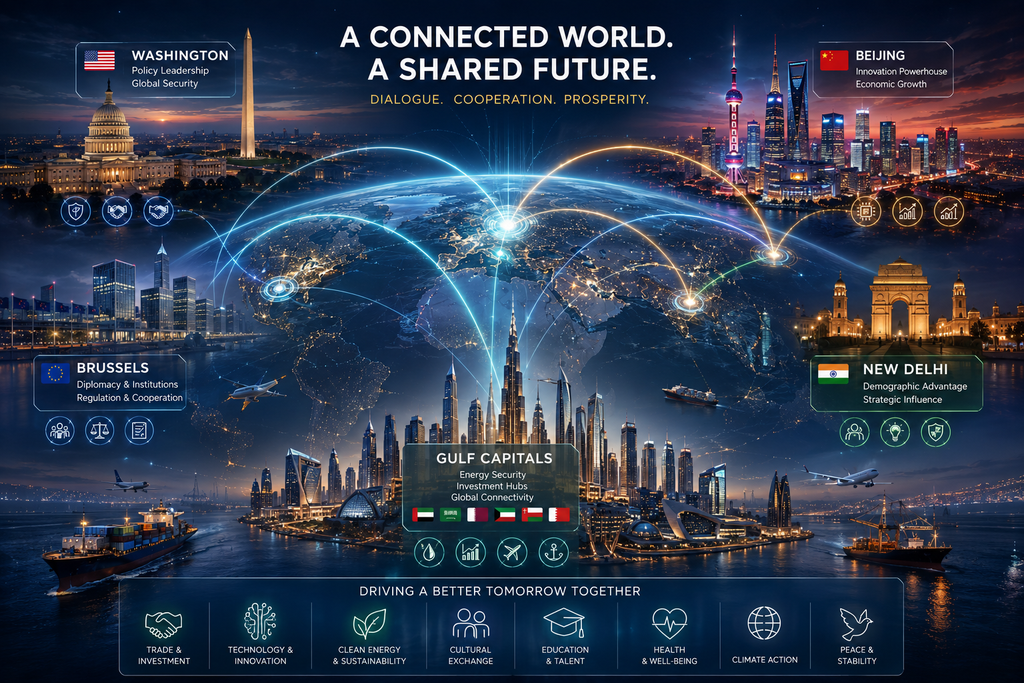
- Gulf Countries Could Gain Greater Diplomatic Influence
- 10. Cybersecurity Will Become Foreign Policy
- 11. Space Could Become Another Diplomatic Frontier
- 12. Private Companies Are Becoming International Actors
- 13. Cities and Regions Could Play Bigger International Roles
- 14. Public Opinion Will Influence Diplomacy Faster
- Disinformation Could Become a Major Diplomatic Weapon
- 15. Developing Countries Will Demand Greater Influence
- Could BRICS Become More Important?
- What Skills Will Future Diplomats Need?
- The Biggest Forces Shaping International Relations
- What Could International Relations Look Like by 2035?
- Will Globalization End?
- Will There Be a New Cold War?
- Can International Institutions Still Work?
- FAQs About the Future of International Relations
- Conclusion
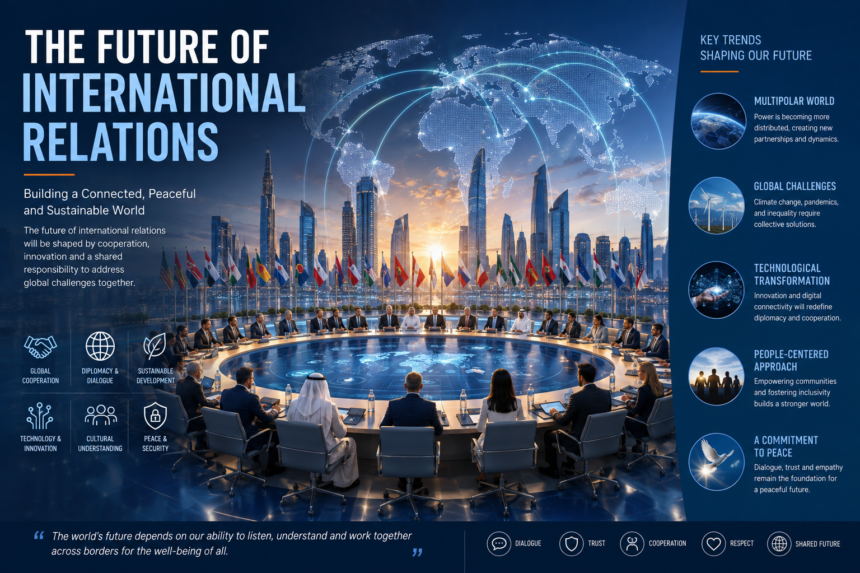
The Future of International Relations will increasingly be influenced not only by military strength but also by artificial intelligence, semiconductors, energy security, critical minerals, supply chains, climate change, digital infrastructure and control over data.
The world is simultaneously becoming more connected and more politically fragmented.
The World Economic Forum’s Global Risks Report 2026 identifies geoeconomic confrontation as the leading risk most likely to trigger a material global crisis in 2026, ahead of state-based armed conflict. It also warns that declining trust and greater protectionism are placing existing multilateral relationships under increasing strain.
Meanwhile, the United Nations acknowledges that the international system created after the Second World War needs significant reform to remain effective and representative in the twenty-first century.
The coming decades could therefore produce a world that is less dominated by one or two powers and increasingly shaped by competing coalitions, influential middle powers and issue-based partnerships.
Why the Future of International Relations Is Changing
The international system has always changed when the distribution of power changes.
The end of the Second World War created one global order.
The collapse of the Soviet Union created another.
Technology, economic globalization and China’s rise then transformed international competition again.
Today, several transitions are happening simultaneously.
Countries are dealing with:
- competition between major powers,
- continuing armed conflicts,
- artificial intelligence,
- economic protectionism,
- climate change,
- energy security,
- migration,
- cybersecurity,
- new military technologies,
- and calls to reform international institutions.
These issues are interconnected.
A dispute over advanced computer chips can affect national security.
A conflict in an energy-producing region can increase inflation internationally.
Climate change can contribute to migration and political instability.
An AI breakthrough can affect both economic productivity and military capabilities.
International relations is therefore becoming less about foreign ministries dealing only with diplomacy and more about entire governments managing technology, finance, resources and security simultaneously.
1. The World Is Moving Toward a More Multipolar System
One of the most important changes is the movement toward a more multipolar world.
For much of the period after the Cold War, the United States occupied an unusually dominant international position.
That system is changing.
China has become a major economic, technological and military power.
India’s economic and diplomatic influence is expanding.
The European Union remains one of the world’s largest economic blocs.
Gulf countries are becoming more active diplomatic and investment powers.
Countries such as Brazil, Türkiye, Indonesia and South Africa increasingly seek greater influence over international decision-making.
This does not necessarily mean the United States will stop being one of the world’s most powerful countries.
It means global influence will be distributed among more actors.
The IMF has described this development as a potential “middle power moment,” arguing that countries such as India and other midsize powers can increasingly shape the global order through smaller, flexible coalitions.
That could make diplomacy more complicated.
Countries may no longer automatically choose one permanent bloc.
Instead, they may cooperate with different partners depending on the issue.
Middle Powers Could Become More Important
International politics is often presented as competition between superpowers.
But the countries between them may become increasingly influential.
Consider India.
It maintains important relationships with the United States and Europe while also engaging Russia, Gulf countries and developing economies.
Saudi Arabia and the UAE similarly maintain extensive relationships with Western governments while deepening trade and investment links with Asia.
Türkiye participates in NATO while pursuing its own regional policies.
These countries can become valuable diplomatic bridges.
Instead of a world divided cleanly into two rival camps, the future could involve multiple overlapping partnerships.
A country might cooperate with Washington on defence, Beijing on trade and another regional partner on energy.
That makes international politics more flexible but also more transactional.
2. US-China Competition Could Define the Next Era
The relationship between the United States and China is likely to remain one of the most important forces shaping The Future of International Relations.
Their rivalry extends far beyond traditional military competition.
It now includes:
- artificial intelligence,
- semiconductors,
- critical minerals,
- trade,
- manufacturing,
- maritime security,
- space technology,
- telecommunications,
- and global infrastructure.
The AI race is becoming particularly important.
In August 2026, Reuters reported that Washington was preparing to tell international partners participating in US-led AI cooperation that alignment with competing Chinese initiatives could affect future collaboration.
This is a major development.
Technology partnerships are beginning to resemble traditional strategic alliances.
A country may increasingly need to consider not only which weapons systems it uses but also:
Whose AI infrastructure does it depend on?
Where are its chips manufactured?
Who controls its cloud platforms?
Where do its critical minerals come from?
These questions could become central to future diplomacy.
3. Artificial Intelligence Is Becoming Geopolitical Power
AI may be one of the biggest changes international relations has faced since nuclear technology.
Countries leading in advanced artificial intelligence could gain advantages in:
- defence,
- intelligence,
- economic productivity,
- scientific research,
- cybersecurity,
- logistics,
- healthcare,
- and advanced manufacturing.
That means AI is no longer simply a commercial competition between technology companies.
Governments increasingly treat it as strategic infrastructure.
The UN Secretary-General’s Scientific Advisory Board said in its 2026 Horizon Scanning report that science and technology are now structural drivers of global risk, opportunity and power. It also highlighted governance gaps as a major source of international risk as AI capabilities move faster than regulation.
International diplomacy may therefore increasingly involve negotiations over:
- AI safety,
- advanced chips,
- computing power,
- AI export controls,
- military AI,
- data,
- intellectual property,
- and global standards.
The next arms-control negotiations may not focus only on missiles.
They could also involve algorithms.
4. Economic Security Is Replacing Pure Globalization
For decades, one basic assumption shaped the global economy:
Companies should buy and manufacture wherever production is cheapest and most efficient.
Geopolitical tensions are changing that logic.
Governments increasingly care about who produces strategically important goods.
Semiconductors are an obvious example.
So are batteries, medicines, energy technology and critical minerals.
The result is greater emphasis on concepts such as:
- friend-shoring,
- near-shoring,
- supply-chain resilience,
- strategic autonomy,
- and economic security.
The UN’s 2026 Financing for Sustainable Development Report warned that global fragmentation, rising trade barriers and geopolitical tensions are weakening international economic cooperation. It concluded that the previous model of economic hyper-globalization is increasingly difficult to sustain.
This does not mean globalization will disappear.
Countries remain deeply economically connected.
But efficiency may increasingly compete with national security.
A slightly more expensive domestic supplier may be preferred to a cheaper supplier located in a strategic rival.
Trade Could Become a Diplomatic Weapon
Trade policy was once discussed mainly through economics.
Increasingly, it is being used as a political instrument.
Countries can use:
- tariffs,
- sanctions,
- export restrictions,
- investment controls,
- technology bans,
- and access to critical materials
to influence other governments.
This is known as geoeconomic competition.
The World Economic Forum’s 2026 risk assessment places geoeconomic confrontation at the top of its near-term global risk ranking.
That means companies may need to understand foreign policy almost as carefully as governments do.
A diplomatic dispute could suddenly affect where a company can manufacture products, which technology it can purchase or which markets it can enter.
International relations and business strategy are becoming increasingly connected.
5. Traditional Alliances Could Become More Flexible
Formal military alliances will remain important.
NATO is unlikely to suddenly become irrelevant.
Neither will longstanding bilateral security relationships.
But another form of international cooperation is growing: small coalitions built around specific problems.
Countries can cooperate on one issue without agreeing on everything else.
Examples may involve:
- maritime security,
- semiconductor supply chains,
- climate technology,
- artificial intelligence,
- critical minerals,
- regional transport,
- or counterterrorism.
These flexible arrangements are sometimes described as minilateral or plurilateral cooperation.
They can move faster than large international organizations because fewer countries need to reach agreement.
The IMF has argued that middle powers could increasingly work through such plurilateral coalitions as geopolitical rivalry reshapes the world economy.
The diplomatic world of the future may therefore look less like fixed camps and more like a network of overlapping partnerships.
6. The United Nations Faces Pressure to Reform
The UN remains the world’s most important universal diplomatic institution.
But its structure reflects the world that existed after 1945.
Global power has changed dramatically since then.
Countries across Africa, Asia and Latin America have increasingly argued that major international institutions do not adequately represent today’s distribution of population, economic power and political influence.
The UN itself has acknowledged this problem.
The Pact for the Future, adopted by member states in September 2024, calls for reforming global governance and making the international system more representative, inclusive and effective.
The Pact specifically identifies reform of the UN Security Council as an urgent priority.
The challenge is political.
Most countries may agree that reform is necessary.
They do not necessarily agree on what the new system should look like.
Questions include:
- Should more countries receive permanent Security Council seats?
- Should veto powers change?
- Should Africa receive stronger representation?
- Should international financial institutions give developing economies more influence?
These debates could become central to the future global order.
7. Multilateralism Will Survive, but It May Change
International organizations are under significant pressure.
The World Economic Forum describes the current environment as one in which multilateralism is retreating amid lower trust, protectionism and geopolitical rivalry.
The United Nations has issued similar warnings about fragmentation.
Yet international cooperation cannot simply disappear.
Consider climate change.
No country can control global temperatures independently.
Pandemics can cross borders.
Cyberattacks can originate anywhere.
Financial crises spread internationally.
Ocean pollution does not respect national boundaries.
The future may therefore involve reformed multilateralism rather than the end of multilateralism.
Large institutions such as the UN may increasingly work alongside:
- regional blocs,
- private companies,
- scientific organizations,
- city networks,
- development banks,
- and smaller coalitions.
Diplomacy could become more networked.
8. Climate Change Will Become a Security Issue
Climate change has traditionally been treated primarily as an environmental issue.
That distinction is becoming increasingly unrealistic.
Climate effects can influence:
- food security,
- water availability,
- migration,
- health,
- infrastructure,
- conflict,
- and economic stability.
Consider a severe drought.
It may reduce agricultural production.
Food prices rise.
Rural communities lose income.
Migration increases.
Political pressure grows.
Climate stress therefore has the potential to affect international security.
The UN’s Pact for the Future places climate alongside sustainable development, peace and security, digital cooperation and global governance as one of the major challenges requiring international coordination.
Future diplomats may therefore need as much understanding of climate science and energy systems as previous generations needed knowledge of military alliances.
Water Could Become Increasingly Geopolitical
Water deserves particular attention.
Many major rivers cross national borders.
Countries upstream and downstream depend on the same water sources.
Population growth and climate change can increase competition.
Potential areas of diplomatic tension include:
- river management,
- dams,
- irrigation,
- groundwater,
- desalination,
- and food security.
But water can also encourage cooperation.
Countries that depend on the same river often have strong incentives to negotiate rather than escalate.
Future international relations could therefore involve more sophisticated forms of environmental diplomacy.
9. Energy Security Will Remain Central
The clean-energy transition will not make geopolitics disappear.
It will change what countries compete over.
Traditional international politics has often revolved around oil and gas.
Renewable technologies depend on different materials.
These include:
- lithium,
- cobalt,
- nickel,
- copper,
- rare earth elements,
- and advanced manufacturing components.
Countries controlling mining, refining or processing capacity may gain strategic importance.
Meanwhile, oil and gas will remain important during the transition.
This means governments may simultaneously compete over fossil-fuel supply and clean-energy supply chains.
Energy diplomacy will therefore become more complex, not less.
Gulf Countries Could Gain Greater Diplomatic Influence
The Gulf is particularly interesting in this changing system.
Saudi Arabia, the UAE and Qatar are increasingly active beyond traditional energy diplomacy.
Their influence now extends into:
- investment,
- mediation,
- technology,
- artificial intelligence,
- renewable energy,
- logistics,
- aviation,
- development finance,
- and international sports and culture.
The Gulf also occupies a strategic geographic position between Asia, Europe and Africa.
Countries in the region maintain important relationships with the United States while expanding economic links with China, India and other Asian economies.
This allows Gulf states to pursue more flexible foreign policies.
Their influence may increasingly come from the ability to connect competing parts of the international system rather than joining one side exclusively.
10. Cybersecurity Will Become Foreign Policy
Cyberattacks have created a new form of international conflict.
A country can potentially damage another state’s infrastructure without sending conventional soldiers across a border.
Targets can include:
- electricity grids,
- banks,
- hospitals,
- government systems,
- military networks,
- telecommunications,
- and transportation.
Determining who launched a cyberattack can also be difficult.
This creates complicated diplomatic questions.
What counts as an act of war in cyberspace?
When can a government retaliate?
How should countries respond to cybercriminal groups operating inside another state?
Should states be responsible for attacks launched from their territory?
These questions remain only partially resolved.
The future of diplomacy will increasingly require cyber norms and international agreements governing digital conflict.
11. Space Could Become Another Diplomatic Frontier
International relations no longer takes place only on Earth.
Satellites support:
- communication,
- GPS,
- military intelligence,
- banking,
- weather forecasting,
- transportation,
- and disaster response.
Space infrastructure therefore has enormous strategic importance.
As more countries and private companies launch satellites, international rules become increasingly necessary.
Questions include:
- Who controls lunar resources?
- How should space debris be managed?
- Can weapons be deployed in space?
- What happens if one country destroys another’s satellite?
- How should private companies be regulated?
Space diplomacy may become a significant field within international relations over the next two decades.
12. Private Companies Are Becoming International Actors
Governments once dominated international relations.
Today, large technology companies sometimes possess resources and infrastructure comparable with those of smaller states.
Private companies control:
- social media platforms,
- satellites,
- cloud infrastructure,
- artificial intelligence systems,
- telecommunications,
- financial networks,
- and enormous datasets.
That gives them political influence.
A cloud company may host government infrastructure.
A satellite company may provide connectivity during a war.
An AI company may develop technology with national-security implications.
Governments therefore increasingly need relationships not only with other governments but also with corporations.
The traditional idea that international relations involves only state versus state is becoming outdated.
13. Cities and Regions Could Play Bigger International Roles
Another interesting shift involves cities.
Global cities such as Dubai, London, Singapore, New York and Paris increasingly build their own international networks around:
- investment,
- climate action,
- technology,
- tourism,
- transport,
- and business.
Mayors attend international summits.
Cities sign cooperation agreements.
Regional governments build trade offices.
This does not replace national foreign policy.
But it creates another layer of diplomacy.
International relations may therefore become more decentralized.
14. Public Opinion Will Influence Diplomacy Faster
Social media has changed how international events are experienced.
A conflict, humanitarian crisis or diplomatic incident can become globally visible within minutes.
Governments no longer control the flow of international information in the way they once did.
Citizens can watch events through:
- smartphones,
- livestreams,
- independent journalists,
- satellite images,
- and social platforms.
This can create enormous political pressure.
Governments may be forced to respond more quickly because domestic audiences are following international developments in real time.
The future diplomat will therefore operate in an environment where every statement can immediately become global public content.
Disinformation Could Become a Major Diplomatic Weapon
The same technologies that improve access to information can also make manipulation easier.
AI can generate realistic:
- images,
- videos,
- audio,
- documents,
- and social media content.
That creates opportunities for foreign influence campaigns.
Fake recordings could be released during elections.
False military footage could escalate tensions.
Fabricated statements from political leaders could create financial-market panic.
The UN’s 2026 science and technology assessment identifies governance gaps, misuse of data and declining trust as major concerns as advanced technology spreads.
Diplomacy will therefore increasingly involve protecting the information environment itself.
15. Developing Countries Will Demand Greater Influence
Another major trend is the growing demand from developing economies for more influence in international institutions.
Many global governance systems were created when much of Africa and Asia had far less political or economic power.
That reality has changed.
Emerging economies want stronger representation in organizations responsible for:
- international security,
- development finance,
- global trade,
- climate policy,
- and technology governance.
The UN’s Pact for the Future explicitly calls for a system that gives developing countries greater voice and representation in international decision-making.
This demand will be difficult for existing powers to ignore indefinitely.
Could BRICS Become More Important?
Groupings outside traditional Western-led institutions are also becoming more significant.
BRICS is one example.
Its expansion reflects interest among several emerging economies in building additional platforms for political and economic cooperation.
However, large coalitions can contain countries with very different interests.
Membership does not automatically create a unified geopolitical bloc.
The importance of groups such as BRICS may therefore lie less in becoming a direct replacement for Western institutions and more in providing emerging powers with additional diplomatic options.
That reflects the broader trend toward multipolarity.
What Skills Will Future Diplomats Need?
Diplomats of the future will need a wider skill set than traditional political negotiation alone.
Important areas may include:
- artificial intelligence,
- cybersecurity,
- economics,
- climate policy,
- energy,
- data governance,
- technology regulation,
- communication,
- regional expertise,
- and crisis management.
Language skills will remain important.
So will cultural understanding.
But technical literacy could become essential.
A diplomat negotiating AI regulations needs to understand at least the fundamentals of the technology.
Someone working on climate diplomacy needs to understand energy systems.
A trade diplomat needs knowledge of semiconductor supply chains.
International relations is becoming increasingly multidisciplinary.
The Biggest Forces Shaping International Relations
| Global Trend | Potential Impact |
|---|---|
| Multipolarity | More countries influence major decisions |
| US-China competition | Technology and security blocs may deepen |
| AI | New source of economic and military power |
| Geoeconomic rivalry | Trade becomes more political |
| Middle powers | Flexible coalitions become more important |
| UN reform | Greater pressure for representation |
| Climate change | Environmental issues become security issues |
| Cybersecurity | Digital conflict becomes foreign policy |
| Energy transition | Competition shifts toward new resources |
| Private technology companies | Businesses gain geopolitical influence |
| Disinformation | Trust becomes strategically important |
| Global South influence | Developing economies demand stronger representation |
These forces are not separate.
They interact constantly.
What Could International Relations Look Like by 2035?
The world of 2035 could be neither fully globalized nor divided cleanly into rival blocs.
Instead, we may see a networked multipolar system.
The United States could remain a major global power.
China could exercise even greater economic and technological influence.
India may become more important across diplomacy and trade.
The European Union could continue pursuing strategic autonomy.
Gulf states may strengthen their roles as investors, mediators and technology partners.
African economies could demand greater representation in international institutions.
Middle powers may move between different coalitions instead of committing permanently to one camp.
International cooperation will still exist.
But it may become more selective.
Countries will cooperate where interests overlap and compete where they do not.
Will Globalization End?
Probably not.
Modern economies are too interconnected for complete economic separation without enormous costs.
A smartphone might rely on:
- American software,
- Taiwanese semiconductors,
- Korean memory,
- Chinese manufacturing,
- African minerals,
- European equipment,
- and Gulf energy.
That illustrates how difficult complete economic separation would be.
Instead, globalization may become more politically managed.
Governments will allow deep integration in some sectors while restricting it in industries considered strategically sensitive.
This creates a more complicated version of globalization.
Will There Be a New Cold War?
Comparisons with the original Cold War are understandable, particularly regarding US-China competition.
But the situation is different.
The US and Soviet economies were much less economically connected than the United States and China are today.
Modern technology supply chains also connect dozens of countries.
Many middle powers do not want to choose one permanent side.
The future may therefore resemble competitive coexistence more than a simple replay of the twentieth-century Cold War.
Countries could remain economic partners while simultaneously competing strategically.
That contradiction may become normal.
Can International Institutions Still Work?
Yes, but reform will be important.
The UN’s Pact for the Future represents an explicit attempt by member states to modernize international cooperation. It covers peace and security, sustainable development, digital cooperation, future generations and reform of global governance.
The problem is implementation.
International organizations can make agreements only when governments are willing to cooperate.
That means institutional reform must be accompanied by political trust.
Without it, even well-designed systems can struggle.
The future of international organizations will therefore depend on whether they can demonstrate that cooperation still produces practical benefits.
FAQs About the Future of International Relations
What is The Future of International Relations likely to look like?
International relations is likely to become more multipolar, technologically driven and economically competitive. Major powers will remain important, but middle powers, regional organizations and private technology companies could gain greater influence.
What is a multipolar world?
A multipolar world is an international system where significant power is distributed among several major countries or blocs rather than dominated primarily by one or two superpowers.
How will AI affect international relations?
AI will influence economic competitiveness, military capabilities, intelligence, cybersecurity and scientific research. The US-China AI rivalry already demonstrates how technology partnerships can become strategic alliances.
Will the United States remain a global power?
The United States is likely to remain one of the world’s most influential countries, but it may operate within a system where China, India, the EU and other powers exercise greater influence.
Why are middle powers becoming important?
Countries such as India and other midsize economies can build flexible coalitions and maintain relationships with competing powers, giving them increased diplomatic leverage.
Will the United Nations be reformed?
There is growing international pressure for reform. The UN’s Pact for the Future calls for a more representative multilateral system and specifically identifies Security Council reform as an urgent priority.
How will climate change affect foreign policy?
Climate change can influence food, water, migration, energy security and conflict, meaning environmental policy is increasingly becoming part of national-security and diplomatic strategy.
Will globalization disappear?
Complete deglobalization is unlikely, but trade and investment may become more politically managed as governments prioritize supply-chain resilience and national security.
Conclusion
The Future of International Relations is unlikely to be defined by one country, one alliance or one ideology.
Instead, the international system is becoming more complex.
Power is spreading across more countries.
Middle powers are becoming more assertive.
Trade is increasingly influenced by geopolitics.
Artificial intelligence and advanced technology are becoming sources of strategic power.
Climate change, cybersecurity and energy security are expanding the traditional definition of national security.
At the same time, the institutions created to manage international cooperation are under pressure.
The United Nations itself acknowledges that the multilateral system must become more representative, effective and capable of addressing twenty-first-century challenges.
Yet fragmentation does not eliminate the need for cooperation.
Climate change cannot be solved nationally.
Pandemics cannot be contained permanently behind borders.
Global financial instability spreads quickly.
AI governance will require international norms.
Cybersecurity increasingly requires cooperation between governments.
The real question is therefore not whether international relations will become more competitive.
It already is.
The question is whether countries can build new forms of cooperation strong enough to function inside a more competitive world.
The future may be multipolar, technologically driven and increasingly unpredictable.
But diplomacy will remain essential.
In fact, as global power becomes more fragmented and interconnected at the same time, effective diplomacy may become more important than at any point in recent history.
follow us on Instagram
Read More – Cultural Attractions in Dubai: 12 Amazing Heritage Places to Visit