

From UAE to Saudi Arabia: The Gulf’s Most Powerful Banks
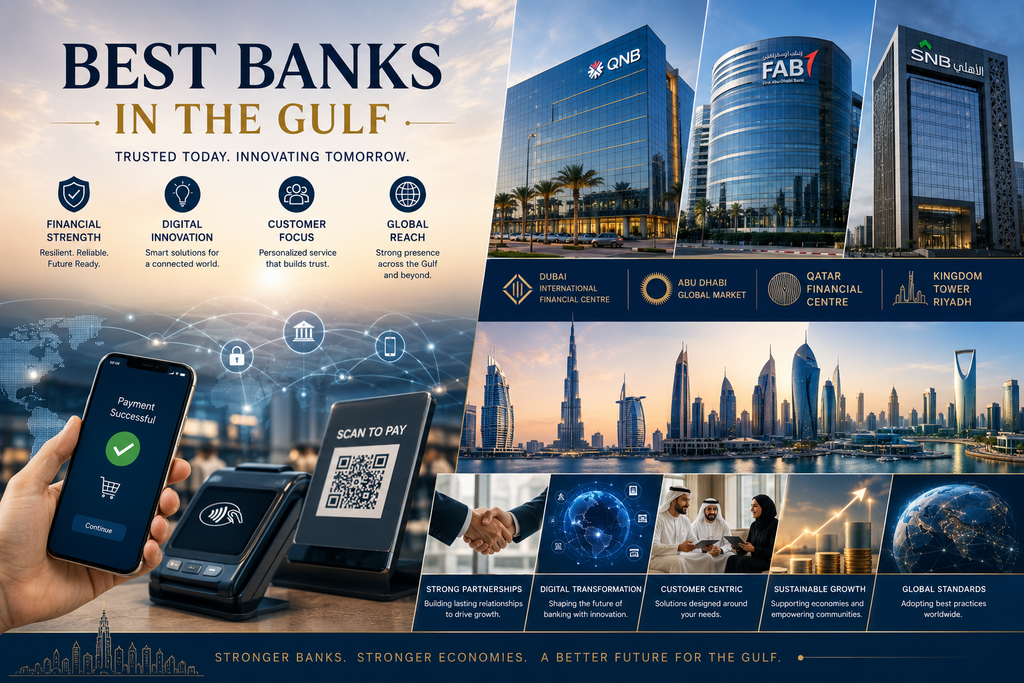
The Gulf banking sector is changing rapidly. Traditional banking giants are becoming technology companies, digital-only banks are gaining customers, Islamic finance continues to expand, and institutions across the UAE, Saudi Arabia, Qatar, Kuwait and Bahrain are competing for regional influence.
- What Makes a Bank One of the Best in the Gulf?
- 1. First Abu Dhabi Bank, UAE
- 2. Qatar National Bank, Qatar
- 3. Saudi National Bank, Saudi Arabia
- 4. Emirates NBD, UAE
- 5. Al Rajhi Bank, Saudi Arabia
- 6. Mashreq, UAE
- 7. Abu Dhabi Islamic Bank, UAE
- 8. National Bank of Kuwait, Kuwait
- 9. Al Salam Bank, Bahrain
- 10. KFH Bahrain and the Kuwait Finance House Network
- Best Banks in the Gulf at a Glance
- Which Is the Largest Bank in the Gulf?
- Which Bank Is Best for Digital Banking?
- Which Gulf Bank Is Best for Retail Customers?
- Which Bank Is Best for Islamic Banking?
- What Is Driving Gulf Banking Growth?
- AI Is Becoming a Major Banking Technology
- Open Finance Could Change Customer Relationships
- Islamic Finance Is Becoming More Digital
- Sustainability Is Entering Mainstream Banking
- Cybersecurity Is Critical for Gulf Banks
- How to Choose the Best Gulf Bank for You
- Major GCC Banking Strengths by Country
- Are Gulf Banks Safe?
- The Future of Banking in the Gulf
- FAQs About the Best Banks in the Gulf
- Conclusion
Choosing the Best Banks in the Gulf therefore depends on what “best” actually means.
A bank can be the largest by assets without offering the strongest retail experience. Another may lead in digital banking but have a smaller balance sheet. Some institutions dominate corporate finance, while others specialize in Islamic banking, wealth management or cross-border services.
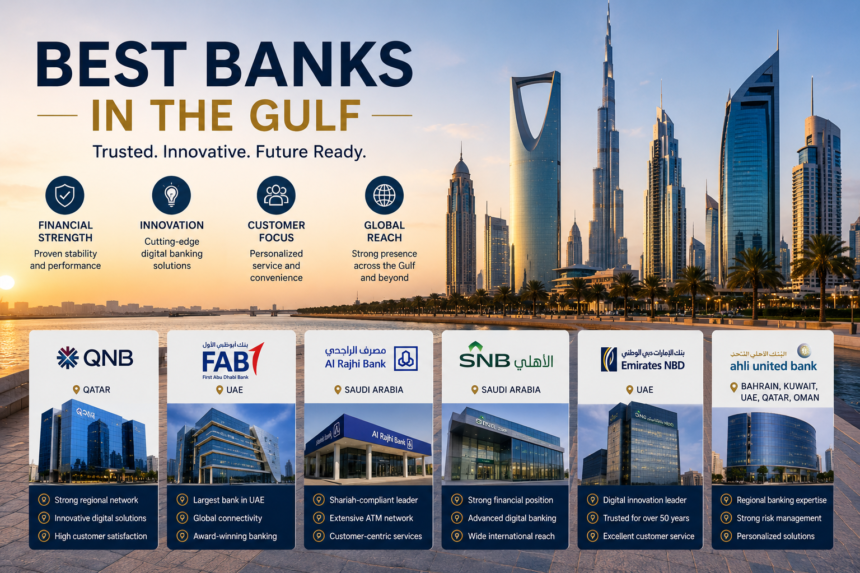
The latest 2026 industry rankings illustrate this diversity. S&P Global Market Intelligence ranked UAE-based First Abu Dhabi Bank as the largest bank in the Middle East and Africa by assets, with $382.2 billion at the end of 2025. Qatar National Bank followed closely with $381.6 billion. Saudi National Bank, Emirates NBD and Al Rajhi Bank completed the region’s top five.
Meanwhile, Euromoney named Mashreq the Middle East’s best bank and best digital bank for 2026, while Emirates NBD won regional awards for retail banking and customer experience.
So rather than pretending there is one universal winner, this guide looks at 10 of the Gulf’s strongest banking institutions and explains what each does particularly well.
What Makes a Bank One of the Best in the Gulf?
Ranking banks is more complicated than comparing size.
A useful assessment should consider several factors.
These include:
- total assets,
- financial strength,
- digital banking,
- customer experience,
- retail banking,
- corporate banking,
- regional presence,
- Islamic finance capabilities,
- wealth management,
- technology investment,
- and international recognition.
A bank serving multinational companies has different priorities from one focused on everyday retail customers.
Similarly, an Islamic bank should not be judged using exactly the same criteria as a conventional investment bank.
The strongest GCC banking institutions tend to combine scale, technology, trust and diversification.
That combination is becoming particularly important as the region develops more digital and internationally connected financial systems.
1. First Abu Dhabi Bank, UAE
First Abu Dhabi Bank, commonly known as FAB, begins this list because of its extraordinary scale.
According to S&P Global Market Intelligence’s 2026 ranking, FAB became the largest bank in the Middle East and Africa by assets, reaching approximately $382.2 billion at the end of 2025.
The bank has expanded beyond the UAE and maintains operations across more than 20 markets.
Its importance is particularly strong in:
- corporate banking,
- investment banking,
- institutional finance,
- international transactions,
- wealth management,
- and government-related banking.
FAB also received Euromoney’s Middle East’s best bank for sustainable finance award for 2026.
That combination of size and sustainable finance capabilities makes FAB especially significant for large businesses and institutional clients.
Best for: Large corporates, institutional clients, international banking and high-net-worth customers.
Why it stands out: It currently leads the wider Middle East and Africa banking market by total assets.
2. Qatar National Bank, Qatar
Qatar National Bank, widely known as QNB, is another regional giant.
S&P Global ranked QNB second in the Middle East and Africa in 2026, with assets of approximately $381.6 billion at the end of 2025.
That puts it almost level with FAB in terms of scale.
QNB has developed a broad international footprint and has long played a major role in Qatar’s financial system.
Its strengths include:
- corporate banking,
- retail banking,
- international banking,
- wealth management,
- institutional services,
- and regional expansion.
Euromoney also named QNB the Middle East’s best bank for diversity and inclusion in 2026.
This demonstrates that modern banking rankings increasingly consider organizational culture alongside purely financial performance.
Best for: International businesses, Qatar-based customers and corporate banking.
Why it stands out: It remains one of the Gulf’s largest and most internationally connected financial institutions.
3. Saudi National Bank, Saudi Arabia
Saudi National Bank is one of the most important institutions in the Gulf’s largest economy.
S&P Global ranked it as the third-largest bank in the Middle East and Africa by assets in 2026.
Its scale gives it a central position in Saudi Arabia’s ongoing economic transformation.
The Kingdom is investing heavily in:
- infrastructure,
- tourism,
- technology,
- real estate,
- entertainment,
- logistics,
- and industrial diversification.
Large banks play an essential role in financing these projects.
Saudi National Bank serves both individual and institutional customers while participating in major corporate and development financing.
Its position is therefore closely connected with Saudi Vision 2030.
Best for: Saudi retail customers, corporates and large financing requirements.
Why it stands out: It is one of the largest financial institutions supporting the transformation of the Saudi economy.
4. Emirates NBD, UAE
Emirates NBD is one of the strongest choices when discussing both scale and everyday banking.
S&P Global ranked Emirates NBD fourth among Middle East and Africa banks by assets in 2026.
Euromoney separately named it UAE’s best bank for 2026, highlighting strong financial performance alongside investment in digital transformation, wealth management and corporate banking. The bank’s assets surpassed AED 1 trillion during the review period.
At regional level, Emirates NBD also won:
- Middle East’s best retail bank,
- Middle East’s best bank for customer experience,
- Middle East’s best bank for ESG.
That combination makes it one of the most balanced names on this list.
It is large enough to serve major corporations but also has extensive retail capabilities for everyday customers.
Best for: UAE residents, retail banking, customer experience and wealth services.
Why it stands out: Few Gulf banks combine large-scale operations with such strong recognition in retail and customer experience.
5. Al Rajhi Bank, Saudi Arabia
Al Rajhi Bank is particularly important because of its position in Islamic banking.
S&P Global ranked Al Rajhi as the fifth-largest bank in the Middle East and Africa by assets in 2026.
Its scale is remarkable for a bank closely identified with Sharia-compliant finance.
Islamic banking operates according to principles that avoid conventional interest-based structures and instead use approved financing and investment arrangements.
Al Rajhi has built a major franchise around:
- Islamic retail banking,
- consumer finance,
- corporate banking,
- digital banking,
- investment products,
- and payments.
Saudi Arabia’s large domestic market gives the institution a significant customer base.
It is therefore particularly relevant for people comparing conventional and Islamic banking options in the GCC.
Best for: Sharia-compliant banking, Saudi customers and Islamic finance.
Why it stands out: It combines Islamic finance leadership with the balance-sheet scale of a major regional banking group.
6. Mashreq, UAE
Mashreq demonstrates why size is not the only factor that determines the Best Banks in the Gulf.
Euromoney named Mashreq the Middle East’s best bank for 2026. It also received the award for Middle East’s best digital bank and best bank for corporates.
Those awards reveal where the institution is particularly competitive.
Mashreq has invested heavily in technology and digital banking.
That matters because customer expectations have changed.
Modern users increasingly expect to:
- open accounts digitally,
- transfer money through apps,
- receive instant notifications,
- access customer support online,
- manage cards,
- and complete routine banking without visiting branches.
For corporate customers, digital banking can be even more important because businesses need cash-management, payments and financial-management tools operating at scale.
Best for: Digital banking, corporate clients and technology-focused customers.
Why it stands out: Euromoney’s 2026 awards recognize it simultaneously for overall banking, digital capabilities and corporate services.
7. Abu Dhabi Islamic Bank, UAE
Abu Dhabi Islamic Bank, or ADIB, is another major name in Gulf Islamic finance.
Global Finance selected ADIB as its best bank in the UAE for 2026 in its World’s Best Banks regional programme.
The bank recorded strong customer growth in 2025, adding more than 283,000 new customers, according to Global Finance.
It has also been expanding digital capabilities across:
- mobile account management,
- payments,
- analytics,
- international transfers,
- customer service,
- and open finance.
Its strategy combines these technologies with Sharia-compliant products.
This creates a useful example of how Islamic banks are modernizing.
Customers no longer have to choose between traditional Islamic banking and digital convenience.
Leading institutions are attempting to deliver both.
Best for: Islamic banking, digital retail services and UAE customers.
Why it stands out: It combines Sharia-compliant banking with a rapidly developing digital ecosystem.
8. National Bank of Kuwait, Kuwait
National Bank of Kuwait, commonly known as NBK, is one of the Gulf’s longest-established and most influential financial institutions.
Global Finance selected NBK as the best bank in Kuwait for 2026, highlighting continued investment in technology and customer engagement.
Euromoney also named it the Middle East’s best bank for corporate responsibility in 2026.
NBK has been upgrading both core banking infrastructure and digital services.
Global Finance noted initiatives including:
- digital deposit features,
- mortgage products,
- more than 100 new digital features,
- and facial-recognition technology for digital identity verification.
The bank also has an international presence beyond Kuwait.
That makes it particularly relevant to companies and customers needing cross-border financial services.
Best for: Kuwait customers, corporate banking and international connectivity.
Why it stands out: It combines an established conventional banking franchise with significant ongoing digital investment.
9. Al Salam Bank, Bahrain
Bahrain has a long history as a regional financial centre, and Al Salam Bank has become one of its increasingly important institutions.
Euromoney named Al Salam Bank Bahrain’s best bank for 2026.
Its recent growth has been supported by expansion and acquisition.
Euromoney reported that Al Salam’s acquisition of Kuwait Finance House’s existing Bahrain operations increased its balance sheet by 28.7%.
The bank also developed its investment and asset-management capabilities through Al Salam Capital.
Assets under management at that business reached $5.7 billion in 2025.
The bank therefore demonstrates how consolidation is reshaping parts of the GCC banking market.
Best for: Bahrain customers, Islamic banking and wealth-related services.
Why it stands out: Rapid expansion has strengthened its position within Bahrain’s competitive financial sector.
10. KFH Bahrain and the Kuwait Finance House Network
Kuwait Finance House represents one of the most recognizable Islamic banking groups in the region.
Its Bahrain operation was rebranded as KFH Bahrain in 2025 following the wider integration involving Ahli United Bank.
Global Finance named KFH Bahrain its best bank in Bahrain for 2026.
The bank completed more than 90 digital releases across different business lines while modernizing its technology platforms.
One notable innovation was the KFH Gold Account, which allows customers to buy and sell gold digitally through the banking application. Global Finance described it as the first account of this type in Bahrain.
This illustrates how Islamic banks are expanding beyond traditional deposits and financing toward more sophisticated digital products.
Best for: Islamic banking, digitally delivered Sharia-compliant products and Bahrain customers.
Why it stands out: It benefits from the scale of the wider Kuwait Finance House franchise while modernizing its digital offering.
Best Banks in the Gulf at a Glance
| Bank | Country | Main Strength |
|---|---|---|
| First Abu Dhabi Bank | UAE | Scale and corporate banking |
| Qatar National Bank | Qatar | International reach |
| Saudi National Bank | Saudi Arabia | Large domestic and corporate franchise |
| Emirates NBD | UAE | Retail banking and customer experience |
| Al Rajhi Bank | Saudi Arabia | Islamic banking |
| Mashreq | UAE | Digital and corporate banking |
| Abu Dhabi Islamic Bank | UAE | Digital Islamic banking |
| National Bank of Kuwait | Kuwait | Established regional banking |
| Al Salam Bank | Bahrain | Growth and Islamic finance |
| KFH Bahrain | Bahrain/Kuwait group | Digital Islamic products |
This table should not be interpreted as a strict one-to-ten ranking.
The better question is:
Which bank is strongest for the service you actually need?
Which Is the Largest Bank in the Gulf?
By total assets, First Abu Dhabi Bank currently holds the lead.
S&P Global’s April 2026 ranking placed FAB at approximately $382.2 billion in assets, slightly ahead of Qatar National Bank at $381.6 billion.
The difference is remarkably small.
That demonstrates how competitive the top of the GCC banking market has become.
Saudi National Bank, Emirates NBD and Al Rajhi Bank followed.
The UAE also had the largest combined asset base among countries represented in S&P’s Middle East and Africa sample, at approximately $1.191 trillion.
Scale matters because larger banks can often:
- finance bigger projects,
- invest more heavily in technology,
- serve multinational clients,
- expand internationally,
- and manage diversified businesses.
But scale should not automatically be confused with customer experience.
Which Bank Is Best for Digital Banking?
Digital banking is becoming one of the most competitive areas in Gulf finance.
Euromoney named Mashreq the Middle East’s best digital bank for 2026.
Other institutions are investing heavily too.
Emirates NBD has received strong recognition for customer experience.
ADIB continues expanding mobile and AI-supported services.
NBK has introduced numerous new digital features.
Bahrain also has an interesting digital-banking story.
Euromoney named ila Bank Bahrain’s best digital bank for consumers in 2026. It reported that the mobile-only institution had captured more than 35% of Bahrain’s bankable population within five years of launch and maintained a 4.8 out of 5 app rating.
That illustrates another important trend.
The future competition may not always be big bank versus big bank.
Traditional institutions are increasingly competing with digital-first platforms.
Which Gulf Bank Is Best for Retail Customers?
Euromoney named Emirates NBD the Middle East’s best retail bank in 2026 and also awarded it best customer experience.
That makes it a strong benchmark for retail banking.
However, individual customers should still compare:
- minimum salary requirements,
- account fees,
- ATM access,
- branch availability,
- international transfer charges,
- credit card benefits,
- savings rates,
- customer support,
- and mobile banking.
The best retail bank for a high-income professional may not be the best for a student or new expatriate.
Bank selection should therefore begin with personal needs rather than awards.
Which Bank Is Best for Islamic Banking?
The GCC is one of the world’s most important centres for Islamic finance.
Several banks on this list operate entirely or substantially according to Sharia-compliant principles.
Major names include:
- Al Rajhi Bank
- Abu Dhabi Islamic Bank
- Kuwait Finance House
- Al Salam Bank
- KFH Bahrain
Al Rajhi stands out because it combines Islamic banking with enormous scale, ranking fifth in S&P Global’s wider Middle East and Africa asset ranking.
ADIB stands out for digital transformation.
Kuwait Finance House brings a large regional franchise.
The right choice depends on country, product requirements and whether the customer needs retail, corporate, investment or wealth services.
What Is Driving Gulf Banking Growth?
Several forces are transforming GCC banking.
Economic Diversification
Saudi Arabia, the UAE and other Gulf economies are investing beyond hydrocarbons.
New industries require financing.
Banks benefit when companies build:
- hotels,
- infrastructure,
- factories,
- logistics networks,
- technology businesses,
- housing,
- and renewable-energy projects.
Population and Business Growth
Growing cities and expanding private sectors create demand for:
- mortgages,
- consumer banking,
- business accounts,
- credit,
- payments,
- and investments.
Government Megaprojects
Large infrastructure and development programmes require enormous financing capacity.
Regional banks can participate through loans, capital markets and advisory services.
Digitalization
Mobile banking lowers the need for customers to visit branches.
It also enables banks to serve larger populations more efficiently.
AI Is Becoming a Major Banking Technology
Artificial intelligence is increasingly becoming part of GCC banking.
Global Finance’s 2026 review of Middle Eastern banks identifies AI, fintech partnerships and open-finance frameworks as major drivers of banking innovation.
AI can support:
- fraud detection,
- customer service,
- credit analysis,
- personalization,
- compliance,
- document processing,
- and financial forecasting.
Generative AI could push this further.
Imagine asking your bank:
“How much did I spend on restaurants over the last three months, and how can I reduce it?”
An AI-powered banking assistant could potentially analyse authorized account information and provide useful insights immediately.
Corporate clients could use similar technology to analyse cash flows and financial risks.
The banks able to use AI effectively without compromising privacy or security could gain an important advantage.
Open Finance Could Change Customer Relationships
Open finance is another important trend.
Traditionally, banks controlled most of the financial information generated by their customers.
Open-finance systems can allow customers to authorize regulated third parties to access specific financial information securely.
That could lead to more connected services.
A customer might eventually manage:
- current accounts,
- savings,
- investments,
- insurance,
- and other financial products
through more integrated digital platforms.
Global Finance specifically highlighted the UAE’s AlTareq Open Finance framework when discussing ADIB’s strategy.
This could gradually change the competitive environment.
Banks may need to compete not only on products but also on how easily their services connect with the wider financial ecosystem.
Islamic Finance Is Becoming More Digital
Islamic banking is sometimes incorrectly viewed as a traditional segment resistant to technological change.
The Gulf tells a different story.
Al Rajhi, ADIB, Al Salam and KFH are all investing heavily in digital services.
KFH Bahrain’s digital gold account is one example.
ADIB has introduced cross-border digital transfer capabilities alongside AI, cloud and open-finance initiatives.
This matters because younger customers may want both:
Sharia-compliant finance + modern digital experience
Banks that can provide both could capture significant growth.
Sustainability Is Entering Mainstream Banking
Banks increasingly influence sustainability through financing.
A bank can help fund:
- solar projects,
- green buildings,
- low-carbon infrastructure,
- electric transportation,
- and sustainable businesses.
Euromoney named FAB the Middle East’s best bank for sustainable finance and Emirates NBD the best for ESG in 2026.
This shows that sustainability is becoming more than a corporate-reporting exercise.
Banks are developing financial products around it.
The Gulf’s major renewable-energy and infrastructure ambitions could make this area even more important.
Cybersecurity Is Critical for Gulf Banks
Digital banking creates convenience.
It also creates risk.
Banks remain attractive targets for:
- phishing,
- account theft,
- fraud,
- malware,
- identity theft,
- and sophisticated cyberattacks.
As banking becomes increasingly mobile and cloud-based, cybersecurity becomes essential.
Customers should never evaluate digital banking only by how many features an app offers.
Security matters equally.
Strong banks need:
- identity verification,
- transaction monitoring,
- secure authentication,
- fraud detection,
- encryption,
- and rapid incident response.
AI may improve these systems, but criminals can use AI too.
Cybersecurity investment will therefore remain a major part of the Gulf’s banking future.
How to Choose the Best Gulf Bank for You
Do not select a bank solely because it appears at the top of a ranking.
Ask practical questions.
For Personal Banking
Check:
- salary requirements,
- account fees,
- ATM network,
- app quality,
- credit cards,
- transfer costs,
- customer support.
For Businesses
Compare:
- transaction fees,
- trade finance,
- business lending,
- cash management,
- international transfers,
- corporate digital banking.
For Islamic Banking
Confirm that the products you need are Sharia compliant and understand how the financing structure works.
For International Customers
Pay particular attention to:
- overseas branches,
- currency services,
- international transfers,
- correspondent banking,
- and wealth-management capabilities.
The bank with the largest assets may not offer the best package for your specific situation.
Major GCC Banking Strengths by Country
| Country | Banking Strength |
| UAE | Large banks, digital innovation and international banking |
| Saudi Arabia | Scale, Islamic banking and Vision 2030 financing |
| Qatar | Large banking groups and international reach |
| Kuwait | Established banking franchises |
| Bahrain | Islamic finance and digital innovation |
| Oman | Growing financial modernization and domestic banking |
Different Gulf financial centres have developed different advantages.
That diversity strengthens the region as a whole.
Are Gulf Banks Safe?
GCC countries operate regulated banking systems overseen by national central banks and monetary authorities.
However, no financial institution anywhere should be considered completely free from risk.
Customers should look at:
- regulatory status,
- financial strength,
- capital position,
- reputation,
- deposit-protection arrangements,
- and cybersecurity.
Large assets alone do not guarantee that every product is appropriate.
For major financial decisions, customers should review official bank documentation and local regulatory protections rather than relying exclusively on rankings.
The Future of Banking in the Gulf
The next decade could transform Gulf banking even further.
Several developments are likely to become increasingly important:
AI-powered banking
Customers may interact more with intelligent assistants.
Open finance
Banking products may become more connected.
Digital-only institutions
Branchless banks could capture younger customers.
Islamic fintech
Technology could expand access to Sharia-compliant financial services.
Cross-border payments
Transfers across GCC countries could become faster.
Wealth management
Growing regional wealth may increase demand for investment services.
Sustainable finance
Banks could play a major role in financing the Gulf’s energy transition.
The strongest institutions will probably be those able to combine trusted banking infrastructure with technology that makes financial services simpler.
FAQs About the Best Banks in the Gulf
What are the Best Banks in the Gulf in 2026?
Major institutions include First Abu Dhabi Bank, QNB, Saudi National Bank, Emirates NBD, Al Rajhi Bank, Mashreq, ADIB, National Bank of Kuwait and other leading GCC banks. The best choice depends on whether the customer prioritizes scale, digital banking, Islamic finance or retail services.
What is the largest bank in the Gulf?
First Abu Dhabi Bank was the largest bank in the Middle East and Africa by assets in S&P Global’s 2026 ranking, with approximately $382.2 billion at the end of 2025.
What is the best bank in the UAE?
Different rankings use different methodologies. Euromoney named Emirates NBD the UAE’s best bank for 2026, while Global Finance selected Abu Dhabi Islamic Bank in its own country awards.
Which Gulf bank is best for digital banking?
Euromoney named Mashreq the Middle East’s best digital bank for 2026.
Which is the best Gulf bank for retail customers?
Euromoney named Emirates NBD the Middle East’s best retail bank and best bank for customer experience in 2026.
Which Gulf banks offer Islamic banking?
Major Sharia-compliant institutions include Al Rajhi Bank, Abu Dhabi Islamic Bank, Kuwait Finance House and Al Salam Bank.
Which is bigger, FAB or QNB?
Based on S&P Global’s 2026 asset ranking, FAB was slightly larger, with $382.2 billion compared with QNB’s $381.6 billion at the end of 2025.
Are digital-only banks growing in the Gulf?
Yes. Bahrain’s ila Bank is one example. Euromoney reported that it had captured more than 35% of Bahrain’s bankable population within five years of launch.
Conclusion
The Best Banks in the Gulf are no longer competing only on branch networks, lending or balance-sheet size.
The industry is becoming more complex.
First Abu Dhabi Bank currently leads the Middle East and Africa by assets, narrowly ahead of Qatar National Bank. Saudi National Bank, Emirates NBD and Al Rajhi Bank also rank among the region’s largest financial institutions.
But size tells only part of the story.
Euromoney’s 2026 awards named Mashreq the Middle East’s best bank and best digital bank, while Emirates NBD led retail banking and customer experience.
Islamic finance is simultaneously becoming more sophisticated. Al Rajhi remains a regional heavyweight, ADIB is expanding digital services, and institutions such as KFH and Al Salam continue modernizing Sharia-compliant banking.
Across the wider industry, artificial intelligence, open finance, cybersecurity, sustainable finance and digital-only banking are beginning to reshape how financial institutions compete.
For customers, that means choosing the best bank should never depend on one ranking alone.
The right bank is the one that combines financial strength, suitable products, fair costs, strong digital services and reliable customer support for your individual needs.
For the Gulf itself, the bigger story is clear.
Its banks are moving from being primarily national financial institutions toward becoming increasingly digital, regional and globally connected financial platforms.
follow us on Instagram
Read More – Hidden Gems in Dubai: 10 Amazing Places Most Tourists Miss