



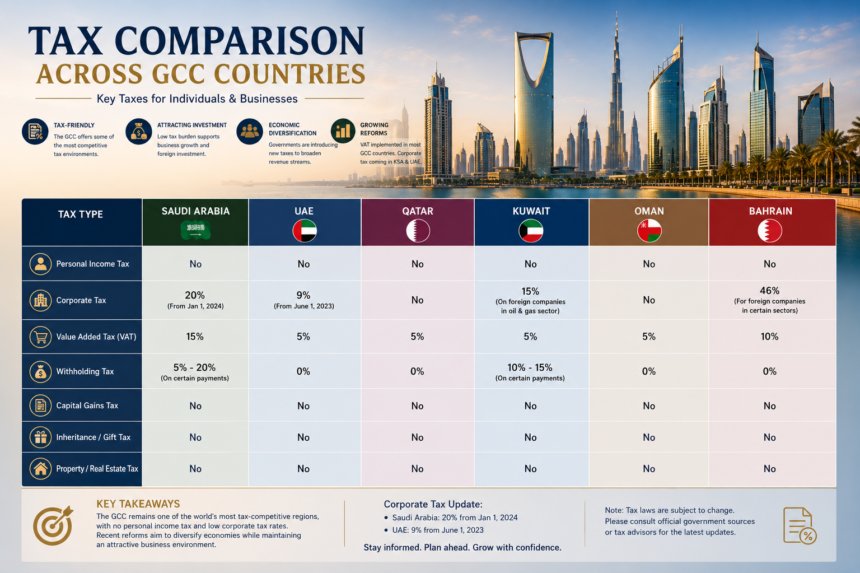
6 Gulf Tax Systems Compared: The Differences May Surprise You
The Gulf has long attracted entrepreneurs, multinational companies and international professionals partly because of its comparatively business-friendly tax environment. But describing the GCC simply as a “tax-free region” is no longer accurate.
- Why GCC Tax Systems Are Changing
- GCC Tax Comparison at a Glance
- 1. UAE Tax System: Low Corporate Tax With 5% VAT
- UAE VAT Remains at 5%
- Is There Personal Income Tax in the UAE?
- 2. Saudi Arabia: Highest VAT Rate in the GCC
- Saudi Corporate Income Tax Is More Complicated Than One Rate
- Saudi Arabia and Foreign Investors
- 3. Qatar: 10% Standard Income Tax and No General VAT Yet
- Does Qatar Have Personal Income Tax?
- Does Qatar Have VAT?
- 4. Oman: 15% Corporate Tax, 5% VAT and Personal Income Tax Ahead
- Oman Will Introduce Personal Income Tax in 2028
- Could Other GCC Countries Introduce Personal Income Tax?
- 5. Bahrain: 10% VAT but No Broad Corporate Tax Yet
- Bahrain’s Corporate Tax Landscape Is Changing
- Why Bahrain’s Tax Changes Matter
- 6. Kuwait: No General VAT but New Rules for Large Multinationals
- Kuwait’s Tax System Remains Different for Domestic and Foreign Businesses
- Does Kuwait Tax Personal Salaries?
- GCC VAT Comparison
- What Does VAT Mean for Consumers?
- GCC Corporate Tax Comparison
- Which GCC Country Has the Lowest Tax?
- The Global Minimum Tax Is Changing the GCC
- Tax Competition in the GCC Is Becoming More Sophisticated
- Personal Income Tax Could Become the Next Big GCC Debate
- Tax Matters for Expats Differently Than for Businesses
- The Importance of Double-Tax Treaties
- Free Zones Make UAE Comparisons More Complicated
- Which Country Is Best for a Startup?
- Businesses Should Avoid Comparing Only Headline Rates
- Key GCC Tax Changes to Watch
- FAQs About Tax Comparison Across GCC Countries
- Conclusion
A Tax Comparison Across GCC Countries reveals significant differences between the UAE, Saudi Arabia, Qatar, Oman, Bahrain and Kuwait. Several countries now impose value-added tax, corporate income taxes differ substantially, large multinational companies face new global minimum-tax rules, and Oman is preparing to introduce the GCC’s first broad personal income tax from 2028.
Saudi Arabia currently applies a 15% standard VAT rate, while the UAE and Oman generally apply 5%. Bahrain applies 10%. Qatar and Kuwait, meanwhile, had not implemented a general VAT system as of 2026 despite the existence of the GCC Unified VAT Agreement. Saudi Arabia’s tax authority confirms that the regional agreement provides a common framework but requires each member state to transpose it into domestic legislation.
Corporate taxation is equally varied.
The UAE generally applies 0% corporate tax on taxable income up to AED 375,000 and 9% above that threshold, while Oman generally applies 15% and Qatar applies 10% to taxable income under its standard regime.
For businesses, investors and professionals, understanding these differences has become increasingly important.
Why GCC Tax Systems Are Changing
Historically, Gulf governments relied heavily on revenue from oil and gas.
That allowed several GCC countries to maintain tax systems with little or no personal income taxation and relatively limited consumption taxes.
Economic diversification is gradually changing the model.
Governments are investing heavily in:
- infrastructure
- tourism
- healthcare
- education
- technology
- renewable energy
- transportation
- and large economic-development programmes
These projects require sustainable government revenue.
At the same time, international tax rules are changing. The OECD-led global minimum-tax framework has encouraged Gulf governments to introduce or adjust taxation for large multinational groups.
The result is not a move toward European-style taxation across the Gulf.
Instead, GCC countries are developing different combinations of consumption taxes, corporate taxes, excise duties and international minimum-tax rules.
GCC Tax Comparison at a Glance
The following table gives a simplified overview of some of the most important headline tax features in 2026.
| Country | Standard VAT | Main Corporate Tax Position | Broad Personal Salary Tax |
|---|---|---|---|
| UAE | 5% | 0% up to AED 375,000 taxable income; 9% above | No broad federal salary income tax |
| Saudi Arabia | 15% | Generally 20% on relevant non-Saudi ownership; Zakat rules apply to qualifying Saudi/GCC ownership | No broad salary income tax |
| Qatar | Not generally implemented | Generally 10% taxable income | Salaries and wages generally exempt |
| Oman | 5% | Generally 15% | 5% PIT from 2028 above qualifying OMR 42,000 threshold |
| Bahrain | 10% | No broad general corporate income tax in 2026; special regimes apply | No broad personal income tax |
| Kuwait | Not generally implemented | Special corporate rules; 15% DMTT applies to qualifying large MNEs | No broad individual income tax |
Important: This is a general comparison, not tax advice. Free zones, ownership structure, industry, residency, treaty status and business activity can materially change the actual tax treatment.
1. UAE Tax System: Low Corporate Tax With 5% VAT
The UAE remains one of the Gulf’s most internationally attractive business jurisdictions, but it is no longer accurate to describe the country as having no corporate taxation.
The federal corporate tax system generally applies:
- 0% on taxable income up to and including AED 375,000
- 9% on taxable income exceeding AED 375,000
The Federal Tax Authority also states that qualifying free-zone persons can receive a 0% rate on qualifying income, while non-qualifying taxable income is generally subject to 9%.
The system therefore creates an important distinction between:
Free-zone status
and
Qualifying free-zone income
Simply incorporating in a free zone does not automatically mean every dirham of income is permanently taxed at zero.
Businesses must satisfy the relevant requirements.
UAE VAT Remains at 5%
The UAE’s standard VAT rate is 5%.
The Federal Tax Authority confirms that VAT generally applies at 5% to transactions involving goods and services unless they are specifically zero-rated or exempt.
Examples of areas with different VAT treatment can include:
- certain exports
- qualifying international transportation
- some financial services
- residential property
- specified healthcare or education-related supplies
The exact treatment depends on the transaction.
For ordinary consumers, however, 5% is the headline rate most commonly visible on taxable purchases.
This makes UAE VAT substantially lower than Saudi Arabia’s current 15% rate and Bahrain’s 10%.
Is There Personal Income Tax in the UAE?
For most employed residents, the biggest attraction remains the absence of a broad federal tax on salary income.
That does not mean residents never pay taxes.
People still encounter:
- VAT
- municipality-related charges
- property-related fees
- excise taxes on certain goods
- and other government charges
But ordinary employment salary is not generally taxed through a federal personal income tax system comparable with those used in countries such as the UK, Germany or India.
For high-earning international professionals, this remains an important part of the UAE’s appeal.
2. Saudi Arabia: Highest VAT Rate in the GCC
Saudi Arabia has one of the most developed tax systems in the GCC, and its tax structure differs significantly from the UAE.
The most visible difference for consumers is VAT.
Saudi Arabia currently applies a 15% standard VAT rate.
ZATCA confirms that the country increased VAT from 5% to 15% on July 1, 2020, and its 2026 guidance continues to list the standard rate at 15%.
For a taxable purchase worth SAR 1,000 before VAT:
VAT at 15% = SAR 150
The total becomes:
SAR 1,150
Compare that with the UAE, where a similarly taxable AED 1,000 purchase would generally carry AED 50 of VAT.
This difference can matter significantly for consumer-facing businesses.
Saudi Corporate Income Tax Is More Complicated Than One Rate
Saudi Arabia cannot be summarized using a single corporate-tax percentage because taxation depends partly on ownership.
ZATCA states that the income-tax law generally applies to resident capital companies in relation to shares held by non-Saudi partners and to certain non-residents doing business in the Kingdom.
The standard income-tax rate for the relevant tax base is generally 20%.
Saudi and qualifying GCC ownership can instead fall within the Zakat system.
ZATCA’s 2026 guidance states that Zakat is generally calculated at 2.5% of the Zakat base, although the base is not the same thing as accounting profit.
This distinction is essential.
It would be misleading to compare:
Saudi Zakat 2.5%
directly with
UAE corporate tax 9%
because they apply to different bases and under different legal frameworks.
Saudi Arabia and Foreign Investors
For international investors, ownership structure therefore matters enormously.
A mixed company can potentially have:
- a Zakat obligation related to qualifying Saudi or GCC ownership
- and an income-tax obligation related to foreign ownership
This makes Saudi tax planning more complex than simply taking annual profit and multiplying it by 20%.
Businesses should also consider:
- withholding tax
- transfer pricing
- permanent establishment rules
- VAT
- excise tax
- industry-specific treatment
Saudi Arabia’s large market can still make the additional complexity worthwhile for businesses targeting the Kingdom.
3. Qatar: 10% Standard Income Tax and No General VAT Yet
Qatar has a comparatively straightforward headline income-tax rate.
The General Tax Authority states that under its income-tax law the standard applicable rate is 10% of taxable income.
That makes Qatar’s headline rate:
- higher than the UAE’s 9% rate above its threshold
- lower than Oman’s 15%
- lower than Saudi Arabia’s 20% standard income-tax rate for relevant foreign ownership
However, the comparison requires context.
Qatar provides exemptions in various circumstances, including aspects of Qatari ownership.
The General Tax Authority explains that profits of resident legal persons can be exempt proportionally according to qualifying Qatari ownership.
Oil and petrochemical activities can also face significantly higher rates, with the GTA stating that applicable taxation for those sectors is at least 35%.
Does Qatar Have Personal Income Tax?
Qatar’s Ministry of Finance has stated that salaries and wages of citizens and residents are not subject to income tax under the country’s income-tax framework.
For salaried expatriate professionals, this keeps Qatar competitive with other GCC employment destinations.
Like elsewhere in the Gulf, however, “no salary tax” does not mean “no taxes whatsoever.”
Businesses and consumers can encounter excise duties, fees and other charges.
Does Qatar Have VAT?
Qatar is a party to the GCC VAT framework, but a general domestic VAT system had not been implemented as of 2026.
This creates an interesting difference within the GCC.
A consumer buying an ordinarily taxable product in Saudi Arabia may face 15% VAT.
In Bahrain, 10%.
In the UAE and Oman, 5%.
Qatar currently has no equivalent broad VAT charge in force.
For consumers, that can make everyday taxation appear lighter.
For businesses, it means the tax-compliance structure differs materially from neighbouring VAT jurisdictions.
4. Oman: 15% Corporate Tax, 5% VAT and Personal Income Tax Ahead
Oman is currently undergoing one of the GCC’s most important tax transitions.
Its standard corporate income-tax rate is generally 15% of net taxable income.
The Oman Tax Authority also provides a reduced 3% rate for qualifying small enterprises, subject to specified conditions.
VAT is generally 5%, putting Oman alongside the UAE at the lower end of GCC VAT rates currently in force.
But the most important change is yet to arrive.
Oman Will Introduce Personal Income Tax in 2028
Oman has enacted the GCC’s first broad personal income-tax law.
Royal Decree No. 56/2025 introduces a 5% personal income tax on qualifying taxable income for individuals whose total annual income exceeds OMR 42,000, subject to the detailed provisions of the law.
The system will enter into force at the beginning of 2028.
This is historically significant for the Gulf.
For decades, the absence of personal income taxation has been one of the region’s defining characteristics.
Oman’s new system does not create a broad tax on everyone.
The relatively high income threshold means it is designed primarily around higher-income individuals meeting the legal criteria.
Still, it creates an important precedent.
Other GCC governments will be watching closely.
Could Other GCC Countries Introduce Personal Income Tax?
There is no automatic reason to assume they will.
Each GCC economy has different fiscal needs, political structures and revenue sources.
However, Oman’s decision demonstrates that personal income taxation is no longer theoretically impossible in the region.
Future governments could consider combinations of:
- consumption taxes
- corporate taxes
- property-related charges
- personal income tax
- or other revenue sources
as they diversify beyond hydrocarbons.
For expatriates considering long-term Gulf careers, tax policy may therefore become an increasingly important part of country comparison.
5. Bahrain: 10% VAT but No Broad Corporate Tax Yet
Bahrain presents another distinctive model.
Its standard VAT rate is 10%.
The National Bureau for Revenue confirms that Bahrain originally introduced VAT at 5% in January 2019 and increased the standard rate to 10% from January 1, 2022.
That places Bahrain between:
UAE/Oman: 5%
and
Saudi Arabia: 15%
for standard VAT.
Bahrain’s Corporate Tax Landscape Is Changing
As of 2026, Bahrain does not operate a broad conventional corporate income tax across ordinary domestic businesses comparable with the UAE’s 9% or Oman’s 15%.
However, that position is evolving.
Large multinational groups within the international minimum-tax framework are already subject to Bahrain’s 15% domestic minimum top-up tax regime where applicable.
More importantly, Bahrain announced a proposed 10% tax on certain domestic corporate profits, intended for implementation in 2027 subject to the legislative process.
The National Bureau for Revenue said the proposal would target companies with annual revenues above BHD 1 million or annual net profits above BHD 200,000, with the tax applying to profits exceeding BHD 200,000.
That means businesses comparing Gulf tax systems should distinguish carefully between:
Current 2026 rules
and
planned 2027 changes.
Why Bahrain’s Tax Changes Matter
Bahrain has historically marketed itself as a major Gulf financial centre with a comparatively light tax framework.
Introducing broader corporate taxation would represent a meaningful change.
At the same time, Bahrain needs to balance several objectives:
- attracting international investment
- maintaining competitiveness
- supporting public finances
- encouraging private-sector employment
- complying with international tax standards
Its proposed corporate-tax structure specifically includes measures linked to Bahraini employee costs, reflecting how tax policy can also be used to influence labour-market behaviour.
6. Kuwait: No General VAT but New Rules for Large Multinationals
Kuwait remains unusual among GCC countries because it has not introduced a broad VAT system.
Consumers therefore do not currently face a general VAT charge equivalent to Saudi Arabia, Bahrain, Oman or the UAE.
However, Kuwait’s corporate tax environment is changing significantly for multinational businesses.
From January 1, 2025, Kuwait implemented a Domestic Minimum Top-up Tax, or DMTT, for qualifying multinational enterprise groups.
The Ministry of Finance says the system applies to multinational groups with global annual revenues of at least €750 million, subject to the detailed eligibility rules, and ensures a minimum effective tax rate of 15% on relevant income in Kuwait.
This is part of the international OECD Pillar Two framework.
Kuwait’s Tax System Remains Different for Domestic and Foreign Businesses
Kuwait historically imposed income tax on foreign corporate activity rather than applying one universal domestic corporate-tax model to every company.
The arrival of the DMTT changes the position for qualifying large multinational groups.
The Ministry of Finance states that for eligible MNEs the new minimum tax replaces several existing tax obligations that would otherwise apply to those groups.
This demonstrates a broader GCC trend:
Tax systems are becoming increasingly differentiated according to company size, ownership and international structure.
A small domestic business and a multinational technology company may face completely different tax frameworks even when operating in the same country.
Does Kuwait Tax Personal Salaries?
Kuwait continues to operate without a broad personal income tax on individual salary earnings.
Its 2026/2027 government budget records zero revenue under taxes on income, profits and capital gains from individuals.
That keeps Kuwait broadly aligned with most other GCC jurisdictions for employees.
Oman will become the major exception once its personal income-tax law takes effect in 2028.
GCC VAT Comparison
VAT is one of the easiest taxes to compare directly because consumers see it on everyday purchases.
| GCC Country | Standard VAT Rate in 2026 |
| UAE | 5% |
| Saudi Arabia | 15% |
| Bahrain | 10% |
| Oman | 5% |
| Qatar | Not generally implemented |
| Kuwait | Not generally implemented |
Saudi Arabia clearly has the highest standard VAT rate among GCC countries currently operating VAT.
ZATCA confirms its 15% standard rate.
Bahrain follows at 10%.
The UAE and Oman are both at 5%.
What Does VAT Mean for Consumers?
Imagine an ordinary fully taxable product priced before VAT at the equivalent of 1,000 local currency units.
Ignoring currency differences, the tax impact would be:
| Country | Pre-VAT Price | VAT | Total |
| UAE | 1,000 | 50 | 1,050 |
| Oman | 1,000 | 50 | 1,050 |
| Bahrain | 1,000 | 100 | 1,100 |
| Saudi Arabia | 1,000 | 150 | 1,150 |
The calculation is simple, but the economic impact can be substantial.
For households, VAT affects everyday consumption.
For businesses, it creates:
- registration requirements
- invoicing obligations
- filing deadlines
- input-tax recovery rules
- record keeping
- and compliance costs
Businesses should therefore evaluate the administrative burden as well as the headline percentage.
GCC Corporate Tax Comparison
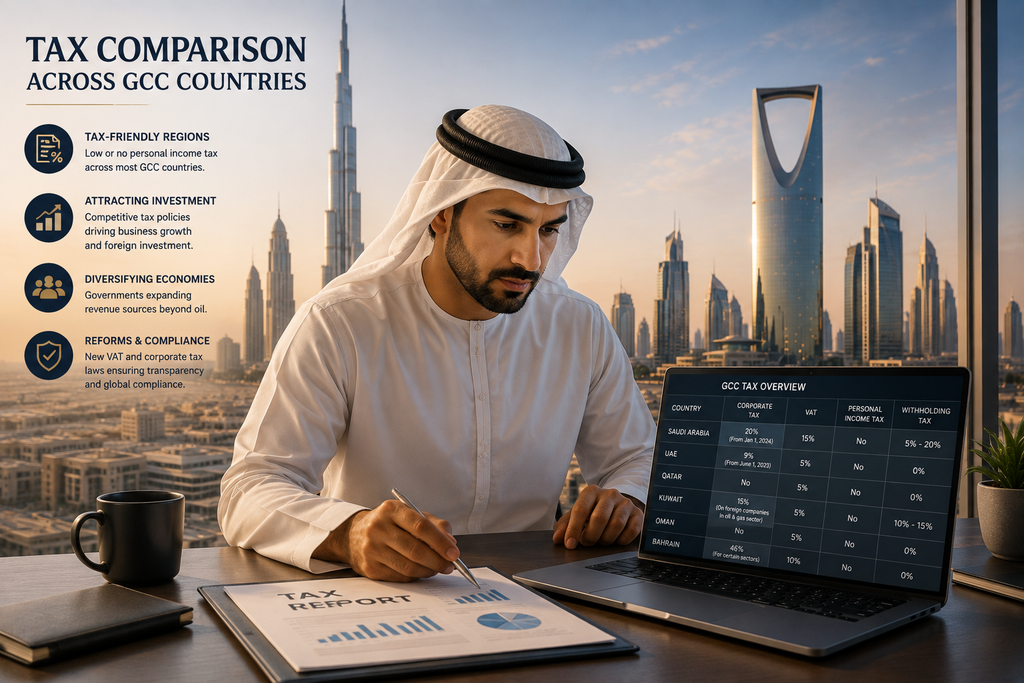
Corporate taxation is much more difficult to compare.
A simplified view looks like this:
| Country | General Headline Position |
| UAE | 0% to AED 375,000 taxable income, 9% above |
| Saudi Arabia | Generally 20% for relevant non-Saudi taxable ownership; Zakat rules for qualifying Saudi/GCC ownership |
| Qatar | Generally 10% |
| Oman | Generally 15% |
| Bahrain | No broad standard corporate tax in 2026; DMTT and sector-specific rules apply |
| Kuwait | Special foreign-company rules; 15% DMTT for qualifying MNE groups |
The table immediately reveals why online claims such as “Country X has the lowest corporate tax in the GCC” can be misleading.
The answer depends on:
- ownership
- taxable income
- free-zone status
- multinational-group size
- industry
- exemptions
- tax residence
- and the structure of the transaction
Which GCC Country Has the Lowest Tax?
There is no universal answer.
For a salaried individual in 2026, several GCC jurisdictions still have no broad personal salary income tax.
For a consumer, Qatar and Kuwait currently have an advantage because they have not implemented broad VAT.
For an ordinary taxable business, the UAE’s 9% federal corporate-tax rate can appear attractive compared with Oman’s 15% or Qatar’s 10%.
But a qualifying free-zone business in the UAE may have different treatment.
A Saudi-owned company may be subject to Zakat rather than standard income tax on that ownership portion.
A multinational group may face a 15% minimum effective rate under international rules.
The question should therefore be:
Lowest tax for whom, doing what, under which structure?
The Global Minimum Tax Is Changing the GCC
One of the biggest recent developments receives less attention from ordinary consumers because it mainly affects very large companies.
The OECD Pillar Two framework seeks to ensure that major multinational groups face a minimum effective corporate tax rate of 15% in relevant jurisdictions.
GCC countries have responded through domestic minimum top-up tax systems and related legislation.
Kuwait’s Ministry of Finance explicitly states that its DMTT is designed to ensure qualifying multinational groups pay a minimum 15% effective tax on relevant Kuwait income.
Bahrain has implemented a similar system for large multinational groups.
The practical consequence is significant.
Gulf countries can no longer compete for the world’s largest companies solely by offering extremely low corporate taxation.
Competition increasingly shifts toward:
- infrastructure
- regulation
- access to markets
- talent
- quality of life
- logistics
- technology
- and business ecosystems
Tax Competition in the GCC Is Becoming More Sophisticated
The old model was relatively simple:
Lower tax = greater investment appeal
The modern model is more complicated.
A company may willingly pay a slightly higher tax rate if the country provides:
- better infrastructure
- stronger legal protections
- skilled employees
- faster licensing
- large customers
- easier capital access
- reliable banking
- and efficient digital government
Saudi Arabia demonstrates this clearly.
Its VAT rate is the Gulf’s highest, and relevant foreign corporate income can face a 20% tax rate.
Yet companies continue investing because the Kingdom provides access to the GCC’s largest domestic market and enormous Vision 2030 projects.
The UAE similarly combines corporate taxation with highly developed business infrastructure and international connectivity.
Personal Income Tax Could Become the Next Big GCC Debate
Oman’s 2028 personal income-tax law has changed the regional conversation.
The tax will apply at 5% under the law to qualifying taxable income of natural persons whose total annual income exceeds OMR 42,000.
This raises an obvious question:
Will other GCC countries eventually follow?
There is currently no basis for assuming a regional personal tax is inevitable.
But governments everywhere face pressure to diversify revenue.
Possible approaches could include:
- higher VAT
- wider corporate taxation
- selective personal taxation
- property taxation
- environmental taxes
- fees
- and excise duties
Each option has different economic and political consequences.
Tax Matters for Expats Differently Than for Businesses
An expatriate employee usually focuses on:
- salary tax
- housing costs
- VAT
- education costs
- remittance costs
- and everyday expenses
A business cares more about:
- corporate tax
- VAT registration
- withholding tax
- customs
- permanent establishment
- transfer pricing
- double-tax treaties
- and compliance deadlines
That means a country attractive to employees is not automatically the best location for a particular company.
A complete GCC comparison must separate the two perspectives.
The Importance of Double-Tax Treaties
International businesses should also look beyond domestic headline rates.
GCC countries maintain networks of double-tax treaties designed to reduce the risk that the same income is taxed twice.
Treaties can influence:
- withholding tax
- permanent establishment
- business profits
- dividends
- interest
- royalties
- capital gains
- and tax residence
Qatar’s General Tax Authority, for example, specifically manages international tax agreements as part of its tax framework.
Saudi Arabia likewise applies double-tax treaty provisions alongside domestic law.
For multinational businesses, treaty access can sometimes be more important than a one-percentage-point difference in the headline corporate rate.
Free Zones Make UAE Comparisons More Complicated
The UAE deserves special attention because of its extensive free-zone ecosystem.
A qualifying free-zone person can receive 0% corporate tax on qualifying income, while non-qualifying taxable income can be taxed at 9%.
This creates opportunities but also compliance obligations.
Businesses must not assume:
Free Zone = Zero Tax
without analysing:
- qualifying income rules
- substance requirements
- transactions with mainland businesses
- transfer pricing
- ownership
- and other conditions
For international investors, the UAE can remain highly competitive, but the tax system now requires more careful planning than it did before federal corporate tax.
Which Country Is Best for a Startup?
Tax alone should not determine startup location.
A technology startup might consider:
UAE
Strong investor ecosystem, free zones, international talent and 9% standard federal corporate tax above the threshold.
Saudi Arabia
Large customer market and major government-backed technology investment, despite higher VAT and different corporate tax rules.
Bahrain
Smaller market but established financial regulation and FinTech ecosystem.
Qatar
Low headline standard income-tax rate and significant investment capacity.
Oman
Lower VAT combined with developing diversification opportunities.
Kuwait
Strong purchasing power and no general VAT, although business structures and taxation need careful analysis.
The cheapest jurisdiction can become expensive if it lacks the customers, employees or investors a startup needs.
Businesses Should Avoid Comparing Only Headline Rates
A business seeing:
UAE: 9%
and
Saudi Arabia: 20%
may immediately conclude that the UAE is cheaper.
That may be true in a specific structure.
But the calculation is incomplete.
You also need to consider:
- market size
- licensing fees
- rent
- employee costs
- customs
- withholding taxes
- VAT
- incentives
- tax exemptions
- free zones
- financing costs
- and compliance obligations
Tax is one component of the total cost of doing business.
The correct decision requires analysing the whole operating model.
Key GCC Tax Changes to Watch
The most important developments over the next few years include:
Oman’s personal income tax
Effective from the beginning of 2028.
Bahrain’s proposed corporate tax
Targeted for 2027 subject to the legislative process.
Global minimum tax rules
Increasingly relevant across GCC countries for major multinational groups.
Potential VAT expansion
Qatar and Kuwait remain important jurisdictions to watch because the GCC VAT framework already exists even though general VAT has not been implemented there.
Digital tax administration
Gulf tax authorities are increasingly moving registration, returns, invoicing and compliance online.
The direction is clear: GCC tax systems are becoming more mature and more sophisticated.
FAQs About Tax Comparison Across GCC Countries
Which GCC country has the highest VAT rate?
Saudi Arabia currently has the highest standard VAT rate at 15%. Bahrain applies 10%, while the UAE and Oman generally apply 5%.
Which GCC countries do not currently have general VAT?
Qatar and Kuwait had not implemented a broad domestic VAT system as of 2026, although both are part of the GCC framework under which member states agreed to introduce VAT through domestic legislation.
What is the corporate tax rate in the UAE?
The UAE generally applies 0% to taxable income up to AED 375,000 and 9% to taxable income exceeding that amount. Different rules apply to qualifying free-zone persons and certain other taxpayers.
What is Saudi Arabia’s corporate income tax rate?
The standard income-tax rate is generally 20% for relevant taxable persons and non-Saudi ownership. Saudi and qualifying GCC ownership can instead fall within the Zakat regime.
What is Qatar’s corporate tax rate?
Qatar generally applies a 10% income-tax rate to taxable income, subject to exemptions and special sector rules.
What is Oman’s corporate tax rate?
Oman’s general corporate income-tax rate is 15%, with a reduced 3% rate available to qualifying small enterprises under specified conditions.
Will Oman introduce personal income tax?
Yes. Oman has enacted a 5% personal income tax applying under specified conditions to individuals whose annual income exceeds OMR 42,000. The law will take effect at the beginning of 2028.
Does Bahrain have corporate tax?
Bahrain does not have a broad standard corporate income tax across ordinary domestic businesses in 2026, although special regimes including the 15% minimum tax for qualifying multinational groups apply. A broader 10% domestic corporate-profit tax has been proposed for 2027, subject to legislation.
Does Kuwait tax large multinational companies?
Yes. Kuwait’s Domestic Minimum Top-up Tax applies to qualifying multinational enterprise groups meeting the €750 million global revenue threshold and is designed to produce a minimum 15% effective tax on relevant Kuwait income. It has applied from financial years beginning on or after January 1, 2025.
Conclusion
A Tax Comparison Across GCC Countries makes one thing clear: the Gulf no longer has one simple regional tax model.
The UAE combines 5% VAT with a federal corporate-tax system generally ranging from 0% to 9% depending on taxable income.
Saudi Arabia applies the region’s highest standard VAT rate at 15%, while relevant foreign corporate ownership is generally subject to 20% income tax and qualifying Saudi/GCC ownership can fall under Zakat.
Qatar generally taxes taxable income at 10% while salaries and wages remain outside its ordinary income-tax charge.
Oman applies 5% VAT and a standard 15% corporate income-tax rate, while preparing for the most important regional change: a 5% personal income tax beginning in 2028 for individuals meeting the law’s income threshold and conditions.
Bahrain combines 10% VAT with an evolving corporate-tax environment, while Kuwait has introduced a 15% minimum-tax regime for qualifying major multinational groups.
The broader trend is unmistakable.
Gulf economies are still relatively tax competitive internationally, particularly for individuals, but their systems are becoming more sophisticated as governments diversify revenue and align with global tax standards.
For businesses and investors, this means the old question:
“Which Gulf country has no tax?”
is becoming less useful.
The better question is:
“Which GCC tax system best fits my income, ownership structure, business activity and long-term plans?”
That answer will increasingly determine where Gulf businesses choose to establish, invest and expand.
follow us on Instagram
Read More – Best Banks in the Gulf: 10 Powerful Banking Leaders in 2026