


Why Dubai Education Innovation Could Change the Future of Schools
Dubai is looking at new ways to reshape education for future generations as Sheikh Hamdan bin Mohammed bin Rashid Al Maktoum, Crown Prince of Dubai, Deputy Prime Minister and Minister of Defence of the UAE, continues to stress the need for innovation in schools.
- Why Sheikh Hamdan Is Calling for Innovation in Dubai Education
- Dubai Is Exploring New School Models
- Artificial Intelligence Could Play a Bigger Role in Dubai Schools
- Teacher Wellbeing and Retention Are Becoming Major Priorities
- Dubai Wants Schools Closer to the Communities That Need Them
- Dubai Is Adding More School Places as Student Numbers Rise
- Skills for Life Could Change How Dubai Defines Education
- Future Schools Could Look Very Different From Today’s Classrooms
- What Dubai’s Education Changes Could Mean for Parents and Students
- Dubai Education Innovation at a Glance
The message was highlighted by Aisha Miran, Director General of Dubai’s Knowledge and Human Development Authority, who said Sheikh Hamdan has repeatedly emphasised that children and grandchildren should not simply attend the same kind of schools that previous generations experienced.
Dubai is therefore exploring new school models, different approaches to learning, greater use of technology and new ways of planning schools around the needs of communities. KHDA has already approved an innovative licensing policy and is examining how alternative educational models can operate while still meeting standards for academic quality, child safeguarding and student wellbeing.
The changes form part of a wider transformation of Dubai’s education system under the Education 33 Strategy, known as E33. Recent initiatives have also focused on lifelong skills, affordable school places, teacher wellbeing, artificial intelligence, school planning and attracting high-quality educators.
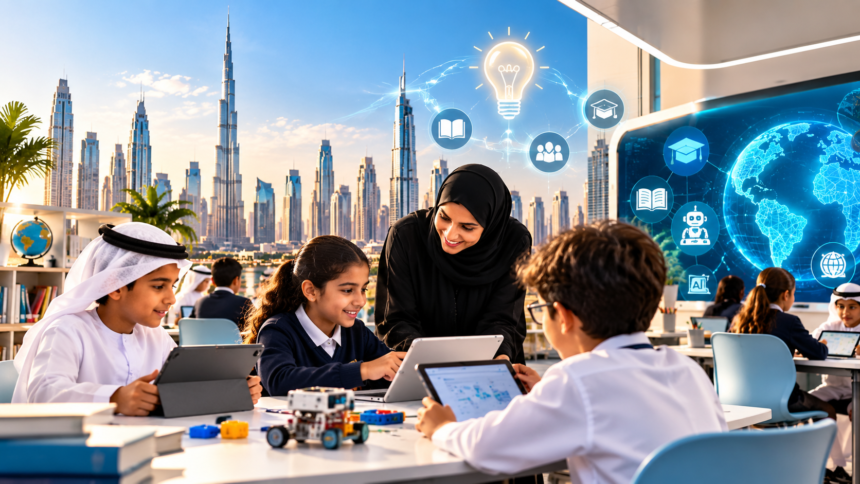
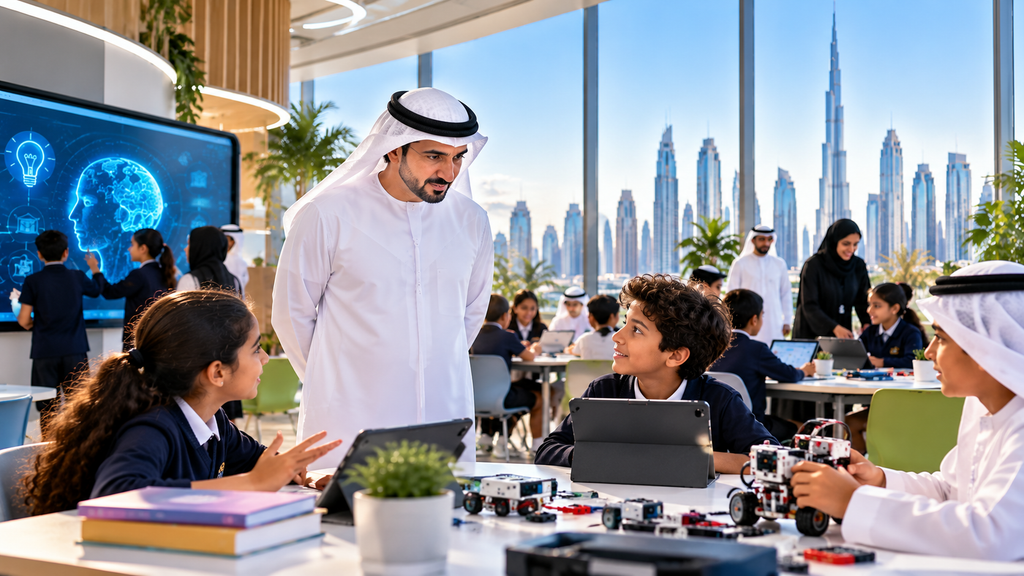
The aim is not simply to introduce technology into classrooms. Dubai’s education authorities are looking more broadly at how students learn, where schools are located, how teachers are supported and how future schools can respond to rapidly changing skills and employment needs.
Why Sheikh Hamdan Is Calling for Innovation in Dubai Education
The central idea behind Dubai’s education push is that future generations should not automatically inherit the same education model used in previous decades.
KHDA Director General Aisha Miran said Sheikh Hamdan has consistently encouraged the authority to rethink education rather than simply continuing traditional approaches.
She explained that Dubai’s leadership wants schools to evolve as society, technology and the economy change.
This is significant because the world students are preparing for is changing rapidly.
Artificial intelligence, automation and digital platforms are already transforming industries and professions.
Future graduates may need skills such as:
- Critical thinking
- Communication
- Creativity
- Digital literacy
- Problem-solving
- Collaboration
- Adaptability
Traditional academic knowledge remains important, but education systems around the world are increasingly trying to combine subject knowledge with practical capabilities.
Dubai’s Education 33 Strategy reflects this wider approach.
KHDA’s Skills for Life initiative, launched in July 2026 under Sheikh Hamdan’s directives, focuses on helping learners develop practical, personal and social skills from early childhood through adulthood.
The initiative views education as something that continues beyond school.
That means students are expected to develop not only academic knowledge but also skills that can help them adapt throughout their lives and careers.
Dubai Is Exploring New School Models
One of the most important developments is Dubai’s willingness to experiment with alternative school structures.
KHDA has confirmed that it has already approved an innovative licensing policy designed to create space for new educational approaches.
The authority is considering models that may differ substantially from traditional schools.
One example mentioned by KHDA is the Alpha model, which uses personalised and AI-supported mastery learning to deliver core academic subjects within a concentrated part of the school day.
The idea is that technology can help students move through lessons at a pace more closely matched to their abilities.
This could potentially free up more time for:
- Projects
- Creativity
- Physical activity
- Teamwork
- Practical skills
KHDA has also said that other new educational models are currently being tested in Dubai, although details have not yet been publicly disclosed.
Aisha Miran described Dubai as a testing ground for innovation and said the authority is open to experimenting with different models.
However, innovation will not mean that schools can ignore basic education standards.
KHDA says any new model will still need to protect:
- Child safety
- Academic achievement
- Student wellbeing
- Personal development
The challenge will therefore be balancing experimentation with accountability.
Artificial Intelligence Could Play a Bigger Role in Dubai Schools
Artificial intelligence is becoming another major part of Dubai’s education discussions.
KHDA is currently preparing clearer rules for how AI, mobile phones and other digital tools should be used in schools.
Aisha Miran said in October 2026 that KHDA expects to have new technology and AI policies and standards ready by next year.
The challenge is not whether technology should exist in education.
It already does.
The bigger question is how it should be used responsibly.
Possible educational uses of AI
AI tools can potentially help with:
- Personalised learning
- Language support
- Revision
- Immediate feedback
- Research assistance
- Lesson planning
But there are also concerns around:
- Cheating
- Data privacy
- Overdependence
- Accuracy
- Critical thinking
- Screen time
Dubai’s approach appears to be focused on balancing innovation with safeguarding.
That means students may gain greater access to advanced digital tools while schools maintain clearer boundaries around when and how those tools should be used.
AI-supported learning
The Alpha model discussed by KHDA is particularly significant because it demonstrates how AI could move beyond being a classroom tool and become part of the structure of learning itself.
Instead of every student moving through the same material at the same speed, personalised systems can potentially adjust lessons according to individual progress.
However, human teachers are still likely to remain central.
Their role may increasingly involve:
- Mentoring
- Discussion
- Emotional support
- Critical thinking
- Project supervision
rather than simply delivering information.
Teacher Wellbeing and Retention Are Becoming Major Priorities
School innovation depends heavily on teachers.
Dubai is therefore also examining how educators can be supported more effectively.
KHDA is working on an educator wellbeing strategy designed to improve:
- Retention
- Motivation
- Professional development
- Work-life balance
The strategy is intended to cover the entire teacher journey, from recruitment through long-term retention.
Why teacher retention matters
When experienced teachers leave during the school year, students can face disruption.
A replacement may be qualified but may not have:
- The same subject expertise
- The same understanding of students
- The same teaching approach
KHDA is therefore examining ways to reduce mid-semester resignations.
The authority is collecting data as it considers policies aimed at encouraging teachers to remain through the academic term.
Attracting strong educators
Dubai competes internationally for teachers.
That means salary alone may not be enough.
Educators may also consider:
- Career development
- Recognition
- Professional training
- Workload
- Housing
- Lifestyle
KHDA says professional development, recognition and work-life balance are among the areas being examined as Dubai works to become more attractive to high-quality teachers.
Dubai has also introduced Golden Visa recognition for selected outstanding educators, adding another route to reward long-term contribution to the education sector.
Dubai Wants Schools Closer to the Communities That Need Them
Innovation is not limited to what happens inside classrooms.
Dubai is also examining where schools should be built.
KHDA is working on an education master plan that will look at:
- School locations
- Community demand
- Curriculum choices
- Fee levels
- Transport
The aim is to reduce situations where families have to travel long distances simply to find a school offering the right curriculum and price point.
Aisha Miran gave an example of a community where families might want a British-curriculum school within a certain fee range.
Instead of making those families travel 45 minutes to an hour, the goal would be to provide the right type of school closer to where they live.
Why school location matters
Long school commutes can affect:
- Students
- Parents
- Traffic
- Family schedules
Children spending significant time travelling every day may have less time for:
- Sleep
- Homework
- Exercise
- Family
Better planning could therefore improve quality of life as well as education access.
KHDA says it is working with:
- Developers
- Zoning authorities
- Dubai Municipality
- Roads and Transport Authority
to better match school development with community needs.
Dubai Is Adding More School Places as Student Numbers Rise
Dubai’s private education sector continues to expand.
At the beginning of the 2026-27 academic year, private school enrolment had reached approximately 406,563 students, compared with about 388,731 in June 2026.
That represents growth of roughly 4.6%.
Population growth is therefore creating continued demand for school places.
KHDA says seven new schools opened during the current academic year, while 11 applications are under review for the next two years.
Affordable education is also receiving significant attention.
Dubai is planning to add around 18,000 affordable private-school places over the next two academic years.
Earlier in 2026, the Dubai Government also announced measures aimed at increasing affordable school capacity.
Around 9,000 affordable places had already been introduced during the academic year, while incentives were being prepared to add approximately 7,500 additional places over the following two years.
The Knowledge Fund Establishment is separately working on educational capacity expansion.
Its 2026-2028 strategic plan aims to enable more than 35,000 new student seats through the allocation of more than 30 educational assets by 2028.
This combination of new schools, alternative school models and better geographic planning suggests that Dubai is trying to expand both the quantity and variety of education.
Skills for Life Could Change How Dubai Defines Education
Another major shift is the growing focus on learning beyond traditional academic subjects.
The Skills for Life initiative was launched in July 2026 under Sheikh Hamdan’s directives.
It is designed to support learners from early childhood through adulthood and help them build practical, personal and social skills.
This reflects a broader change in how education is being defined.
Traditionally, schools have focused heavily on:
- Exams
- Grades
- Academic qualifications
Those remain important.
But modern education systems are increasingly recognising that students also need to know how to:
- Communicate
- Make decisions
- Manage money
- Work with others
- Adapt to technology
Learning beyond the classroom
Skills for Life is based on the idea that learning is a lifelong process.
People may need to continuously develop new abilities as:
- Jobs change
- Technology advances
- Industries evolve
This is particularly relevant in Dubai, where the economy includes rapidly changing sectors such as:
- Artificial intelligence
- Finance
- Tourism
- Technology
- Logistics
- Creative industries
Education therefore needs to prepare students for careers that may look very different by the time they enter the workforce.
Future Schools Could Look Very Different From Today’s Classrooms
The biggest implication of Dubai’s education strategy is that the traditional school model may gradually evolve.
Future schools could potentially involve:
- Smaller learning groups
- AI-supported personalisation
- Flexible schedules
- Project-based learning
- More skills training
This does not mean conventional classrooms will disappear.
But the balance between teacher-led instruction, technology and independent learning could change.
Dubai Future Week, scheduled for November 18 to 21, 2026, will also include discussions about how education and human learning may evolve in the age of artificial intelligence.
One track, called “How We’ll Think”, is expected to examine future schools and universities, critical thinking, media literacy, AI and the changing relationship between people and knowledge.
This wider conversation shows that education reform is linked to Dubai’s broader planning for future cities and economies.
Technology will not be the only factor
Future education may also require changes in:
- Teacher training
- School design
- Assessment
- Curriculum
A school with advanced technology but an outdated learning model may still struggle to prepare students for new challenges.
That is why Dubai’s current strategy appears to cover multiple areas at the same time.
What Dubai’s Education Changes Could Mean for Parents and Students
For parents, the biggest impact may eventually be greater choice.
Instead of selecting only between different curricula and fee levels, families could eventually compare schools based on different educational models.
They may need to consider questions such as:
- How much technology does the school use?
- How personalised is learning?
- How is student wellbeing supported?
- How are practical skills taught?
This could make choosing a school more complicated, but it could also allow parents to find environments better suited to individual children.
More local options
The education master plan could also reduce the need for long school journeys by encouraging the right types of schools to open in areas where demand exists.
More focus on wellbeing
Both teacher and student wellbeing are becoming more visible priorities within Dubai’s education strategy.
Clearer technology rules
The planned KHDA AI and technology standards could also help parents understand how devices and artificial intelligence should be used in classrooms.
More affordable options
The planned expansion of affordable school places may provide more choices for families who currently struggle to find the right combination of:
- Curriculum
- Location
- Fee level
Dubai Education Innovation at a Glance
| Area | Current Direction |
|---|---|
| New school models | Innovative licensing and pilot models |
| Artificial intelligence | New AI and technology standards planned |
| Teacher wellbeing | Retention and professional development strategy |
| School locations | Community-based education master plan |
| Affordable education | Around 18,000 additional seats planned |
| Skills | Skills for Life initiative |
| Private school enrolment | 406,563 students |
| Future planning | E33 Education Strategy |
Dubai’s education system is entering a period of significant experimentation.
Sheikh Hamdan’s repeated call for innovation is encouraging education authorities to question whether the traditional school model is still the best approach for future generations.
KHDA is now exploring new school models, preparing AI and technology standards, strengthening teacher wellbeing and developing a master plan designed to place schools closer to the communities that need them.
The scale of the system is also increasing.
Private-school enrolment has reached more than 406,000 students, while thousands of additional affordable school places are being planned.
At the same time, Skills for Life is expanding the definition of education beyond classrooms and exams toward practical capabilities that learners may need throughout their lives.
The result may be an education system that looks increasingly different from the one today’s parents experienced.
The key challenge will be ensuring that innovation improves learning rather than simply introducing new technology for its own sake.
Dubai’s current approach suggests that future school models will still be expected to deliver strong academic outcomes while protecting student wellbeing and child safety.
For families, teachers and education providers, the next few years could therefore bring some of the most significant changes Dubai’s school sector has seen.
Do follow us on Instagram
Read More – Best Countries for Startups in 2026