

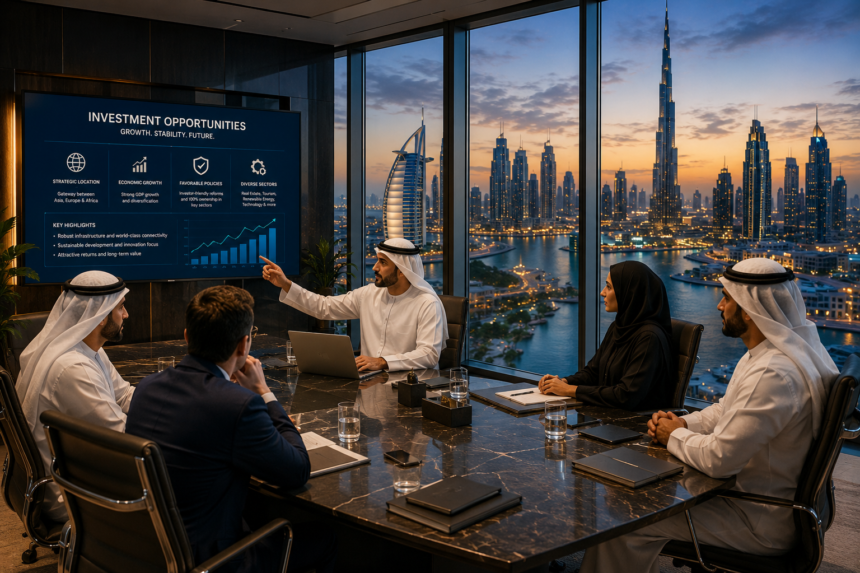
The Gulf Is Changing: These Investment Opportunities Stand Out
The Gulf is no longer an investment story built mainly around oil and gas. Across the UAE, Saudi Arabia, Qatar, Kuwait, Bahrain and Oman, governments are directing capital toward technology, tourism, advanced manufacturing, renewable energy, logistics, healthcare and new urban development.
- Why GCC Investment Opportunities Are Expanding
- 1. Artificial Intelligence and Digital Infrastructure
- 2. Advanced Manufacturing
- 3. Renewable Energy and Green Hydrogen
- 4. Real Estate and Urban Development
- 5. Tourism and Hospitality
- 6. Logistics and Supply Chains
- 7. Healthcare and Life Sciences
- 8. FinTech and Financial Services
- 9. Cybersecurity
- 10. Food Security and Agritech
- Best Investment Opportunities by GCC Country
- UAE: Best for Global Connectivity and Technology
- Saudi Arabia: Best for Scale
- Qatar: Best for High-Value Niche Opportunities
- Oman: Best for Green Energy and Industrial Growth
- Kuwait: Major Infrastructure and Diversification Potential
- What About Bahrain?
- Startups vs Large Investors
- Why Government Policy Matters So Much
- Risks Investors Should Not Ignore
- Diversification Matters
- Do Not Invest Only Because a Sector Is Trending
- How to Evaluate an Investment Opportunity
- Real Estate Investors Should Focus on Cash Flow
- Startup Investors Need to Think About Exits
- Investment Opportunities at a Glance
- FAQs About Investment Opportunities in the GCC
- Conclusion
That shift is creating a much broader range of Investment Opportunities for companies, entrepreneurs and investors looking at the GCC in 2026.
The momentum is particularly visible in foreign direct investment. The UAE attracted AED 177.3 billion in FDI inflows during 2025, while 1,562 greenfield projects were announced with combined capital expenditure of $34.1 billion. Manufacturing represented 30% of those greenfield investments, communications 29% and real estate 7%.
Globally, foreign direct investment rose 6% to $1.6 trillion in 2025, although UN Trade and Development warned that investment remains highly concentrated and that geopolitical tension, trade uncertainty and high financing costs continue to cloud the 2026 outlook.
For the Gulf, this creates both opportunity and risk.
The region is spending heavily to diversify its economies, but investors still need to understand where real demand exists, which sectors are supported by policy and infrastructure, and where valuations may already reflect aggressive growth expectations.
Here are 10 of the most important GCC investment themes to watch.
Why GCC Investment Opportunities Are Expanding
Several forces are changing the Gulf investment landscape at the same time.
Governments want to reduce reliance on hydrocarbons.
Populations are growing.
Tourism is expanding.
Artificial intelligence is becoming a strategic industry.
New infrastructure is connecting cities, ports and industrial zones.
Renewable energy projects are scaling.
Private-sector participation is increasingly encouraged across areas previously dominated by governments.
Official investment agencies now actively promote a broad range of sectors.
The UAE identifies fintech, e-commerce, agritech, healthcare, education, tourism, space, logistics, ICT and manufacturing among its promising foreign-investment sectors.
Saudi Arabia promotes technology, energy, manufacturing, tourism, entertainment, healthcare, mining, agriculture, financial services, logistics and real estate through Invest Saudi.
Qatar highlights opportunities in areas such as agritech, cybersecurity, e-commerce, waste management, trading, food and beverage and advanced manufacturing.
Kuwait’s Vision 2035 investment priorities include infrastructure, renewable energy, healthcare, housing, logistics, transport, tourism, financial services and technology.
The opportunity is therefore increasingly regional rather than sector-specific.
1. Artificial Intelligence and Digital Infrastructure
Artificial intelligence is one of the strongest investment themes across the Gulf.
The opportunity extends far beyond building consumer AI applications.
AI requires:
- data centres
- cloud infrastructure
- semiconductors
- cybersecurity
- enterprise software
- high-performance computing
- energy
- data management
- technical talent
The UAE provides one of the clearest examples.
Communications represented 29% of the country’s announced greenfield FDI capital expenditure in 2025, with major digital infrastructure investment helping drive that share.
This creates opportunities for investors across several layers.
At the infrastructure level, there is demand for data centres and computing.
At the software level, businesses need AI tools for finance, healthcare, logistics, government, marketing and customer service.
At the services level, companies need implementation, cybersecurity and data-governance expertise.
Best suited to: Technology companies, venture capital, infrastructure funds and enterprise software investors.
2. Advanced Manufacturing
Manufacturing is becoming one of the Gulf’s most important diversification sectors.
The UAE’s 2025 greenfield investment data placed manufacturing first, representing 30% of capital expenditure in announced projects.
Saudi Arabia is also pushing industrial expansion aggressively.
Invest Saudi data show manufacturing as the largest FDI sector in its displayed 2024 inflow ranking, ahead of wholesale and retail, construction and financial services.
Opportunities can include:
- machinery
- food processing
- pharmaceuticals
- chemicals
- automotive components
- aerospace
- building materials
- electronics
- renewable-energy components
- advanced materials
Manufacturing matters because Gulf governments want more value to be created locally instead of importing finished products.
That creates opportunities not only for factory owners but also for:
- industrial logistics
- maintenance
- automation
- robotics
- supply-chain software
- workforce training
3. Renewable Energy and Green Hydrogen
Energy remains central to the Gulf economy, but the type of energy investment is changing.
Solar power, green hydrogen, energy storage and low-carbon industrial technologies are receiving greater attention.
Oman’s Vision 2040 reporting shows the scale of this opportunity. The country had eight green-hydrogen projects under development and expected investment in the sector to reach around OMR 6.5 billion by 2030.
Kuwait also identifies renewable energy as a priority investment sector under Vision 2035.
Potential opportunities include:
- solar projects
- hydrogen production
- battery storage
- grid infrastructure
- energy-efficiency technology
- carbon management
- water-energy systems
- green manufacturing
For investors, the most attractive opportunities may not always be the giant power projects themselves.
Supporting businesses can also benefit.
A hydrogen project needs engineering, software, transport, storage and specialist equipment.
4. Real Estate and Urban Development
Real estate remains one of the Gulf’s most visible investment sectors.
But the opportunity is increasingly broader than buying an apartment and hoping prices rise.
Urban growth is creating demand across:
- residential development
- logistics property
- hospitality
- offices
- retail
- industrial zones
- mixed-use communities
- data centres
- student housing
- senior living
The UAE’s 2025 greenfield data showed real estate accounting for 7% of announced FDI capital expenditure, supported partly by international wealth migration and demand from global talent.
Saudi Arabia is also expanding residential and urban development through Vision 2030-linked programmes. The Kingdom’s long-term plans include large-scale residential communities and major entertainment and tourism districts.
Kuwait identifies integrated housing and urban development as a target investment sector, while Oman is attracting foreign participation into new city development projects.
Investor caution: Real estate is highly location-sensitive. National growth does not guarantee every project will perform equally well.
5. Tourism and Hospitality
Tourism is one of the biggest diversification stories in the GCC.
Dubai already operates as a global tourism hub.
Saudi Arabia is building entirely new destinations.
Qatar continues expanding its tourism economy after major infrastructure investment.
Oman is positioning itself around nature and cultural tourism.
Bahrain combines events, hospitality and regional travel.
Tourism investment can involve much more than hotels.
Opportunities include:
- resorts
- restaurants
- attractions
- tour companies
- travel technology
- booking platforms
- cultural experiences
- adventure tourism
- wellness
- entertainment
Saudi Arabia provides one of the strongest long-term tourism cases.
Vision 2030 projects such as Qiddiya are designed around entertainment, sport, arts and tourism, creating opportunities across construction, operations, hospitality and services.
Qatar also highlights food and beverage as a growth area, with Invest Qatar projecting its F&B services market to reach $2.89 billion by 2029.
6. Logistics and Supply Chains
The Gulf’s location is one of its most durable investment advantages.
The region sits between:
- Asia
- Europe
- Africa
Major ports, airlines and logistics hubs already connect these markets.
But global supply chains are changing.
Companies are diversifying suppliers, moving production closer to customers and investing in resilience.
That creates opportunities in:
- warehousing
- cold storage
- freight technology
- ports
- air cargo
- fulfilment
- last-mile delivery
- customs technology
- supply-chain analytics
Qatar explicitly identifies the trading-hub opportunity, pointing to changing global supply chains and demand for warehousing and logistics infrastructure.
Kuwait also lists storage and logistics, as well as air, maritime and rail passenger transport, among its Vision 2035 investment sectors.
Oman’s Vision 2040 reporting likewise highlights foreign investment in transport and logistics projects.
7. Healthcare and Life Sciences
Healthcare demand is expanding across the GCC.
Several forces support this trend:
- population growth
- ageing
- medical tourism
- chronic disease
- rising income
- private healthcare expansion
- digital health adoption
The UAE identifies healthcare and medical tourism as promising foreign-investment sectors.
Saudi Arabia also lists healthcare among its core investment sectors.
Kuwait similarly includes healthcare within its targeted Vision 2035 sectors.
Investment opportunities can include:
- hospitals
- clinics
- diagnostics
- pharmacies
- healthcare software
- telemedicine
- AI diagnostics
- rehabilitation
- elder care
- medical devices
- pharmaceutical manufacturing
One particularly attractive area may be healthcare technology.
Hospitals want to improve efficiency while maintaining patient safety.
That creates demand for systems involving:
- electronic records
- scheduling
- remote monitoring
- AI-assisted diagnostics
- cybersecurity
8. FinTech and Financial Services
The GCC is one of the most active financial-technology regions in the Middle East.
The opportunity comes from a combination of:
- high smartphone penetration
- established banking systems
- large expatriate populations
- cross-border payments
- digital government
- wealthy consumer markets
The UAE specifically identifies fintech as a promising foreign-investment sector.
Saudi Arabia includes financial services among its target investment areas.
Kuwait includes banking, financial services and insurance among its priority sectors.
Potential investment themes include:
- digital payments
- remittances
- wealth technology
- Islamic FinTech
- RegTech
- InsurTech
- SME financing
- open finance
- banking infrastructure
The strongest opportunities may come from solving regional problems rather than copying successful Western applications.
Cross-border payments are a good example.
Millions of Gulf expatriates regularly send money internationally, creating demand for faster and cheaper remittance technology.
9. Cybersecurity
Every digital investment creates a corresponding security requirement.
Governments are digitizing services.
Banks operate through mobile applications.
Hospitals store patient data electronically.
Retailers process online payments.
Companies move infrastructure to the cloud.
All of that creates cybersecurity demand.
Qatar’s investment agency identifies cybersecurity as a major opportunity and says cybersecurity spending in the country was projected to exceed $1.64 billion by 2026.
Investment opportunities can include:
- security software
- identity management
- cloud security
- threat intelligence
- compliance
- managed security services
- AI security
- incident response
Cybersecurity has another attractive characteristic.
It is not tied to one economic sector.
Banks need it.
Governments need it.
Hospitals need it.
Oil companies need it.
Startups need it.
That gives cybersecurity companies access to multiple customer groups.
10. Food Security and Agritech
Agriculture might not be the first industry associated with the Gulf.
That is precisely why the investment opportunity is interesting.
Hot temperatures and limited freshwater create serious food-production challenges.
Technology can help.
Qatar highlights agritech as an investment area involving robotics, AI, IoT, blockchain, vertical farming and hydroponics.
The UAE similarly identifies agritech as a promising foreign-investment sector.
Potential opportunities include:
- vertical farms
- hydroponics
- water-efficient agriculture
- controlled-environment farming
- food processing
- cold chains
- agricultural robotics
- smart irrigation
Food security is particularly attractive because demand is structural.
People need food regardless of economic cycles.
The challenge is creating production systems that can compete economically with imports.
Best Investment Opportunities by GCC Country
| Country | Major Opportunity Areas |
|---|---|
| UAE | AI, fintech, logistics, manufacturing, real estate, tourism |
| Saudi Arabia | Manufacturing, tourism, mining, technology, real estate, healthcare |
| Qatar | Cybersecurity, agritech, e-commerce, logistics, food and advanced manufacturing |
| Oman | Green hydrogen, logistics, manufacturing, technology, tourism |
| Bahrain | Financial services, fintech, tourism, logistics, technology |
| Kuwait | Infrastructure, renewable energy, healthcare, logistics, housing, technology |
No country dominates every sector.
The best jurisdiction depends on the investor’s strategy.
UAE: Best for Global Connectivity and Technology
The UAE remains one of the GCC’s most diversified investment environments.
Its government identifies 15 opportunity areas through the Investor Navigator, including healthcare, agritech, e-commerce, education, smart mobility, manufacturing, ICT, space, logistics, fintech, tourism, gaming, renewables and the creative economy.
The country also attracted AED 177.3 billion of FDI in 2025.
Advantages include:
- international connectivity
- mature financial markets
- free zones
- global talent
- startup ecosystem
- established logistics
Potential disadvantages include high competition and expensive valuations in some areas.
Saudi Arabia: Best for Scale
Saudi Arabia’s biggest advantage is market size.
The Kingdom’s domestic population, government spending and Vision 2030 investment pipeline create opportunities difficult to reproduce elsewhere in the GCC.
Invest Saudi promotes opportunities across technology, energy, manufacturing, tourism, entertainment, healthcare, mining, agriculture, financial services, logistics and real estate.
Manufacturing already leads Saudi FDI inflows in the official sector ranking displayed by Invest Saudi.
The attraction is scale.
A successful Saudi business does not necessarily need to expand internationally immediately because the domestic market itself can be significant.
Qatar: Best for High-Value Niche Opportunities
Qatar has a smaller population than Saudi Arabia but substantial purchasing power and infrastructure.
Its opportunity strategy is particularly interesting in specialized sectors.
Invest Qatar highlights:
- agritech
- cybersecurity
- e-gaming
- e-commerce
- trading
- waste management
- food and beverage
- aerospace additive manufacturing
This makes Qatar attractive for specialist technology or B2B companies seeking high-value customers rather than mass-market scale.
Oman: Best for Green Energy and Industrial Growth
Oman is becoming particularly interesting for investors focused on:
- hydrogen
- logistics
- manufacturing
- industrial zones
- technology
- tourism
Its Vision 2040 report states that foreign direct investment in national development portfolio projects reached around OMR 2.8 billion by the end of 2024 across more than 60 projects involving hydrogen, logistics, technology, food manufacturing and energy.
Oman also has a strategic geographic advantage outside the Strait of Hormuz on parts of its coastline.
That gives its ports and logistics infrastructure additional significance.
Kuwait: Major Infrastructure and Diversification Potential
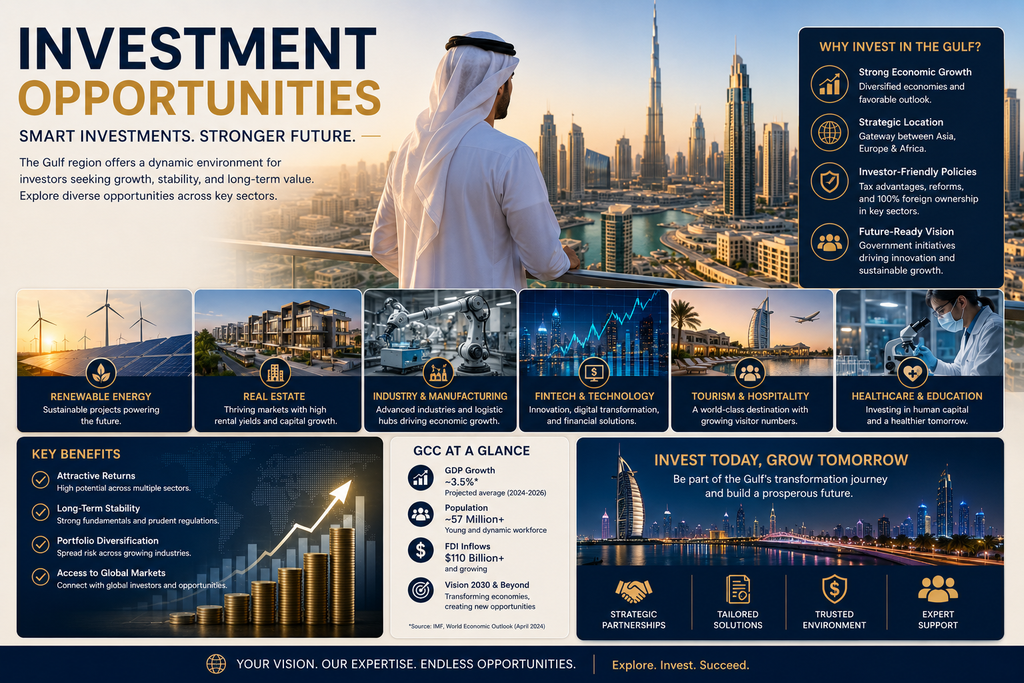
Kuwait’s investment story is increasingly tied to Vision 2035.
KDIPA lists targeted sectors including:
- infrastructure
- renewable energy
- healthcare
- integrated housing
- financial services
- logistics
- transport
- tourism
- media
- technology
The country’s opportunity differs from Dubai’s.
Kuwait is less tourism- and startup-driven but has significant government resources and infrastructure requirements.
KDIPA emphasizes large financing needs across power, water, transport, housing, healthcare, cleantech and ICT.
What About Bahrain?
Bahrain is particularly strong in financial services.
Its relatively compact market means investors often use it as a specialized regional base rather than targeting huge domestic scale.
Areas commonly associated with Bahrain’s investment proposition include:
- banking
- fintech
- logistics
- manufacturing
- tourism
- professional services
Its established regulatory experience in financial services can make it particularly relevant to FinTech and Islamic finance.
Startups vs Large Investors
The best Investment Opportunities depend heavily on capital size.
Startup Investor
May prioritize:
- AI
- fintech
- e-commerce
- SaaS
- cybersecurity
- HealthTech
Property Investor
May focus on:
- residential demand
- hospitality
- logistics
- commercial property
- tourism-related development
Institutional Investor
May consider:
- infrastructure
- energy
- industrial projects
- data centres
- private equity
- large real estate portfolios
Strategic Corporate Investor
May seek:
- manufacturing
- local production
- supply-chain localization
- joint ventures
- market-entry acquisitions
The same GCC economy can therefore provide very different opportunities for different investors.
Why Government Policy Matters So Much
Gulf investment markets are closely connected with national strategy.
Vision 2030 in Saudi Arabia.
Vision 2040 in Oman.
Vision 2035 in Kuwait.
National diversification and digital-economy strategies across the UAE and Qatar.
Investors should therefore ask:
Does this sector align with government priorities?
Alignment can create advantages such as:
- infrastructure investment
- regulatory support
- incentives
- public-private partnerships
- government procurement
- talent programmes
But policy support does not eliminate commercial risk.
A government may want an industry to grow.
That does not guarantee every company in that industry will become profitable.
Risks Investors Should Not Ignore
The GCC offers strong growth opportunities, but no investment market is risk-free.
Important risks include:
- geopolitical tension
- oil-price volatility
- interest rates
- property cycles
- regulatory changes
- currency exposure
- competition
- project delays
- valuation risk
Current markets provide a reminder.
In August 2026, Gulf stock markets were affected by renewed regional geopolitical uncertainty, with investors reacting cautiously to tensions involving Iran.
This does not mean investors should avoid the region.
It means geopolitical risk should be included in valuation and portfolio decisions.
Diversification Matters
Investors should avoid treating “the Gulf” as one investment.
Buying:
- Dubai property
- Saudi shares
- a UAE startup
- an Oman energy project
creates exposure to very different risks.
Likewise, putting all capital into one sector can be dangerous even when that sector has a strong growth story.
Diversification can involve:
- different GCC countries
- different industries
- public and private markets
- real estate and financial assets
- different time horizons
A strong economic story does not remove the need for portfolio discipline.
Do Not Invest Only Because a Sector Is Trending
AI is popular.
That does not mean every AI startup deserves investment.
Dubai property is popular.
That does not mean every apartment is priced attractively.
Saudi tourism is expanding.
That does not mean every hospitality concept will work.
The investor still needs to examine:
- revenue
- costs
- competition
- management
- regulation
- valuation
- demand
- exit options
A growing market can actually attract too much capital.
When everyone wants the same opportunity, prices can become disconnected from realistic returns.
How to Evaluate an Investment Opportunity
Before investing, ask seven basic questions.
- What problem does the investment solve?
- Is demand real or mainly speculative?
- Who are the competitors?
- What regulation applies?
- How will the investment generate returns?
- What could cause losses?
- How can I exit?
These questions apply whether you are considering:
- property
- stocks
- startups
- private companies
- infrastructure
- funds
The asset changes.
The discipline does not.
Real Estate Investors Should Focus on Cash Flow
Property investors sometimes focus only on expected price appreciation.
Rental cash flow matters equally.
Important questions include:
- What is the realistic rent?
- What are service charges?
- What vacancy rate should I assume?
- What financing cost applies?
- What maintenance is required?
- How liquid is the resale market?
A property rising 10% in price can still be a poor investment if transaction and holding costs consume most of that gain.
Startup Investors Need to Think About Exits
Gulf startup ecosystems are developing quickly.
The UAE’s 2025 startup funding environment showed larger average deal sizes, with the average funding round reaching $9.2 million, nearly double the prior level.
That indicates maturation.
But startup investors still need to ask:
Who will eventually buy this company?
Possible exits include:
- acquisition
- IPO
- secondary sale
- founder buyback
Without a realistic path to liquidity, a successful company can still become a difficult investment to monetize.
Investment Opportunities at a Glance
| Sector | Why It Matters |
| AI | Strategic government and corporate demand |
| Digital infrastructure | Data centres and cloud growth |
| Manufacturing | Localization and diversification |
| Renewable energy | Solar, hydrogen and net-zero investment |
| Real estate | Population and urban expansion |
| Tourism | New destinations and visitor growth |
| Logistics | GCC’s global geographic position |
| Healthcare | Population and private-sector demand |
| FinTech | Digital payments and financial innovation |
| Cybersecurity | Protection of digital economies |
| Agritech | Food security and water efficiency |
FAQs About Investment Opportunities in the GCC
What are the best Investment Opportunities in the GCC in 2026?
AI, advanced manufacturing, renewable energy, real estate, tourism, logistics, healthcare, FinTech, cybersecurity and agritech are among the strongest current themes. Official GCC investment agencies actively promote many of these sectors.
Which GCC country attracts the most foreign investment?
The UAE remains a major regional FDI destination. It attracted AED 177.3 billion in FDI inflows during 2025 and announced 1,562 greenfield projects worth $34.1 billion in capital expenditure.
What sectors are attractive in Saudi Arabia?
Invest Saudi highlights technology, energy, manufacturing, tourism, entertainment, healthcare, mining, agriculture, financial services, logistics and real estate.
What investment opportunities exist in Qatar?
Qatar promotes opportunities in areas including cybersecurity, agritech, e-commerce, trading, waste management, food and beverage and advanced manufacturing.
Is Oman attractive for green-energy investment?
Yes. Oman has built a substantial green-hydrogen pipeline, with Vision 2040 reporting eight existing green-hydrogen projects and expected sector investment of around OMR 6.5 billion by 2030.
Which sectors is Kuwait targeting under Vision 2035?
Kuwait highlights infrastructure, renewable energy, healthcare, housing, financial services, logistics, transport, tourism, media and technology among its targeted investment areas.
Is GCC real estate still a good investment?
It can be, but performance depends heavily on city, property type, supply, financing cost and purchase price. Investors should evaluate cash flow and total ownership costs rather than assuming regional growth guarantees appreciation.
Are GCC investments risky?
Yes. Risks include geopolitical tension, regulation, valuation, property cycles, interest rates and sector-specific competition. Regional markets were visibly affected by geopolitical uncertainty again in August 2026.
Conclusion
The strongest Investment Opportunities across the Gulf in 2026 reflect one broad transformation: GCC economies are becoming more diversified.
Technology and AI are attracting capital.
Manufacturing is expanding.
Renewable energy and green hydrogen are developing new industrial value chains.
Tourism is creating hotels, attractions and service businesses.
Logistics is benefiting from the Gulf’s position between Asia, Europe and Africa.
Healthcare, cybersecurity, FinTech and agritech are solving structural problems that will remain relevant long after individual trends disappear.
The UAE’s investment figures demonstrate how far this shift has already progressed. The country attracted AED 177.3 billion in FDI during 2025, while manufacturing and communications dominated new greenfield capital expenditure.
Saudi Arabia is simultaneously using Vision 2030 to create investment opportunities across technology, tourism, manufacturing, real estate and other sectors.
Oman is developing green hydrogen and logistics.
Qatar is targeting specialized digital and technology opportunities.
Kuwait is using Vision 2035 to create space for private investment across infrastructure, renewables and services.
But investors should avoid one dangerous assumption:
A fast-growing region does not make every investment a good investment.
The strongest opportunities are those where economic growth, policy support, real customer demand and sensible valuation come together.
That means researching the country, understanding the sector, evaluating the asset and considering the risks before committing capital.
The Gulf may offer some of the world’s most ambitious growth stories.
The investors most likely to benefit will be those who distinguish a powerful story from a genuinely strong investment.
follow us on Instagram
Read More – Sending Money from the Gulf: 7 Smart Ways to Save