


Dubai Insurance Explained: What Residents Really Need in 2026
Living in Dubai comes with opportunities, convenience and a highly developed financial system, but it also creates risks that can become expensive quickly. A hospital visit, car accident, damaged apartment or unexpected job loss can create a financial problem far larger than most people expect.
- Why Insurance Matters in Dubai
- Which Insurance Is Mandatory in Dubai?
- 1. Health Insurance in Dubai
- What Does Basic Dubai Health Insurance Cover?
- Check the Hospital Network Before Buying
- Pre-Existing Conditions Need Careful Attention
- 2. Motor Insurance in Dubai
- Third-Party Insurance
- Comprehensive Insurance
- Agency Repair vs Non-Agency Repair
- Look at the Excess
- 3. ILOE Unemployment Insurance
- ILOE Is Not the Same as a Full Emergency Fund
- 4. Travel Insurance
- Medical Coverage Is the Most Important Travel Benefit
- Annual Travel Insurance Can Make Sense for Frequent Travellers
- 5. Home Insurance
- Building Insurance vs Contents Insurance
- Personal Liability Can Be Valuable
- 6. Life Insurance
- Term Life Insurance
- Insurance and Investment Are Different Goals
- 7. Personal Accident Insurance
- 8. Business Insurance in Dubai
- Professional Indemnity
- Cyber Insurance Is Becoming More Relevant
- What Insurance Do Dubai Expats Usually Need Most?
- How to Compare Insurance Policies Properly
- Exclusions Matter as Much as Benefits
- Understand Deductibles and Co-Payments
- Check Whether the Insurer Is Regulated
- Keep Your Policy Documents
- Know How to Make a Claim
- What If an Insurance Claim Is Rejected?
- Cheap Insurance vs Good Insurance
- Common Insurance Mistakes in Dubai
- A Practical Insurance Checklist for New Dubai Residents
- When Should You Review Your Insurance?
- Dubai Insurance at a Glance
- FAQs About Insurance Guide in Dubai
- Conclusion
That is why this Insurance Guide in Dubai focuses on one simple question: which types of insurance actually matter for residents, expatriates, families and business owners?
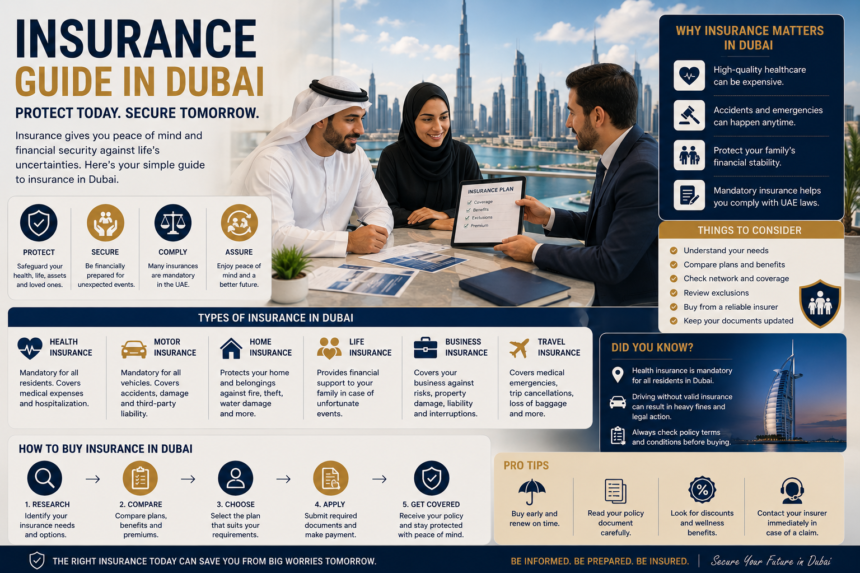
Health insurance is mandatory for Dubai residents under the emirate’s insurance framework, while vehicle owners need appropriate motor insurance. UAE employees in the private sector and federal government are also generally required to participate in the Involuntary Loss of Employment scheme. Other protection, such as travel, home, life and business insurance, depends more heavily on individual circumstances.
Dubai’s health insurance system alone covered more than 4.9 million beneficiaries in 2025, according to the Dubai Health Authority, showing just how central insurance has become to everyday life in the emirate.
Understanding what a policy covers before you need to claim is therefore far more important than simply buying the cheapest plan.
Why Insurance Matters in Dubai
Insurance exists to transfer financial risk.
You pay a relatively predictable premium so that a much larger unpredictable expense does not fall entirely on you.
Consider some examples.
A serious medical condition can involve hospital bills running into tens of thousands of dirhams.
A major road accident can damage several vehicles.
Water damage inside an apartment can destroy furniture and electronics.
A family breadwinner’s death can suddenly remove the household’s primary source of income.
Insurance does not stop these events from happening.
It reduces the financial consequences.
The UAE insurance industry is supervised by the Central Bank of the UAE, which regulates insurance companies and aims to protect policyholders while maintaining a stable insurance market.
Which Insurance Is Mandatory in Dubai?
Not every type of insurance is legally compulsory.
The most important mandatory or widely compulsory protections include:
| Insurance | General Position |
|---|---|
| Health insurance | Mandatory for Dubai residents |
| Motor insurance | Required for vehicles operating under UAE rules |
| ILOE | Mandatory for most private-sector and federal government employees |
| Travel insurance | Usually optional, except where destination or visa rules require it |
| Home contents insurance | Generally optional |
| Life insurance | Generally optional |
| Business insurance | Depends on activity, licence, employees and contractual obligations |
The word mandatory matters.
It means failing to maintain required cover can create legal, visa, employment or registration problems.
Optional insurance should instead be evaluated according to financial risk.
1. Health Insurance in Dubai
Health insurance is the most important policy for most Dubai residents.
Dubai operates a mandatory health insurance framework under Health Insurance Law No. 11 of 2013.
The Dubai Health Authority states that health insurance is mandatory for residents and that Dubai’s system includes nationals, expatriates and other covered categories.
The Dubai Health Insurance Corporation supervises the system and applies the relevant health insurance legislation.
For employees, employers are generally responsible for arranging required employee health coverage.
Dependants may need separate coverage depending on the employment arrangement and sponsorship situation.
What Does Basic Dubai Health Insurance Cover?
Dubai’s basic healthcare framework includes core services such as:
- inpatient treatment
- outpatient treatment
- emergency medical treatment
- maternity care
- prescribed medication
- preventive services
- vaccinations and immunisation within applicable rules
The DHA’s current basic package information lists an annual aggregate claims limit of AED 150,000 and emergency medical treatment coverage across the UAE, subject to the policy terms.
However, not every plan provides the same network, limits or benefits.
A low-cost policy may meet regulatory requirements but still provide much narrower access than a premium corporate plan.
Check the Hospital Network Before Buying
One of the biggest mistakes people make is comparing only premiums.
Suppose:
Policy A: AED 900 annually
Policy B: AED 1,800 annually
Policy A appears clearly cheaper.
But Policy A may offer a restricted clinic network, while Policy B includes hospitals near your home and specialists you actually use.
Important questions include:
- Which hospitals are covered?
- Which clinics are included?
- Is direct billing available?
- Do I need referrals?
- Is dental included?
- Is maternity included?
- What is the annual limit?
- What are the co-payments?
The cheapest health plan can become very inconvenient if its network does not match your needs.
Pre-Existing Conditions Need Careful Attention
People with existing medical conditions should read policy wording especially carefully.
Depending on the plan and regulatory requirements, insurers may apply specific rules around:
- waiting periods
- disclosure
- limits
- treatment approvals
- medication
- chronic conditions
Never hide relevant medical information when completing an insurance application.
Incorrect disclosure can create serious problems later when a claim is reviewed.
2. Motor Insurance in Dubai
If you own a car in Dubai, motor insurance is a core requirement.
UAE law provides a framework requiring insurance policies for licensed vehicles, while the Central Bank maintains unified motor insurance regulations and policy structures.
Two broad forms are commonly discussed:
Third-party liability insurance
and
comprehensive motor insurance
They are very different.
Third-Party Insurance
Third-party cover is generally designed to protect against your legal liability for injury or damage caused to other people or their property.
It does not generally provide the same level of protection for your own vehicle.
For an inexpensive older car, some drivers may decide that this level of cover suits their risk tolerance.
Comprehensive Insurance
Comprehensive policies normally provide broader protection.
Depending on the specific contract, they may cover:
- damage to your car
- third-party liability
- theft
- fire
- natural events
- roadside assistance
- agency repairs
- replacement vehicles
But exclusions matter.
Do not assume the word comprehensive means absolutely everything is covered.
Agency Repair vs Non-Agency Repair
This can significantly affect both premium and claims experience.
Agency repair generally means repairs through an authorised dealer.
Non-agency repair may use an insurer-approved garage network.
Newer or higher-value vehicles may justify agency repair.
Older vehicles may not.
Check whether the benefit is included automatically or available only as an extra.
Look at the Excess
The excess, sometimes called a deductible, is the amount the insured may need to pay toward a claim before insurance responds according to policy terms.
A lower-premium policy may have a higher excess.
That is not necessarily bad.
But you need to know it before buying.
For example:
Policy A premium: AED 1,500
Excess: AED 1,000
Policy B premium: AED 1,900
Excess: AED 350
The cheaper annual premium may expose you to more out-of-pocket cost when a claim occurs.
3. ILOE Unemployment Insurance
Dubai residents working in the relevant employment categories should also understand the UAE’s Involuntary Loss of Employment, or ILOE, scheme.
The official ILOE platform states that subscription is mandatory for employees in the private sector and federal government sector, subject to the scheme’s rules and exemptions.
The scheme is designed to provide limited financial support when eligible workers lose employment because of termination rather than resignation or disciplinary dismissal.
Official ILOE information states that eligible compensation can reach up to 60% of the average basic salary over the six months before job loss, for up to three months per claim, subject to policy conditions and eligibility requirements.
ILOE Is Not the Same as a Full Emergency Fund
This distinction is important.
The ILOE scheme provides limited protection.
It is not designed to replace several months of complete household expenses indefinitely.
A resident should still consider keeping emergency savings for:
- rent
- family expenses
- travel
- loan payments
- relocation
- job searching
Think of unemployment insurance as one layer of financial protection rather than the entire plan.
4. Travel Insurance
Travel insurance is usually optional for ordinary Dubai residents, but it can become extremely valuable once you leave the UAE.
Travel policies can provide protection for risks such as:
- overseas medical emergencies
- trip cancellation
- missed connections
- lost baggage
- travel delays
- emergency evacuation
- personal liability
The Central Bank’s insurance framework recognises travel insurance as a legitimate insurance class available in the UAE market.
Some destinations or visa applications can also require proof of qualifying medical or travel insurance.
Always check destination requirements separately before travelling.
Medical Coverage Is the Most Important Travel Benefit
A lost suitcase is frustrating.
A major overseas medical emergency can be financially devastating.
Before travelling, check:
- overseas medical limit
- emergency evacuation
- repatriation
- pre-existing-condition rules
- sports exclusions
- destination exclusions
A very cheap travel policy may provide minimal medical limits.
That can be a poor trade-off for international travel.
Annual Travel Insurance Can Make Sense for Frequent Travellers
Dubai residents often travel frequently because of the city’s global aviation connections.
If you make several international trips each year, compare:
single-trip insurance
with
annual multi-trip insurance
An annual plan may be more convenient and potentially more economical for frequent travellers.
However, check:
- maximum trip length
- covered destinations
- age limits
- adventure-sport exclusions
before assuming it suits every journey.
5. Home Insurance
Many tenants and homeowners focus heavily on insuring their health and car but ignore the contents of their home.
Imagine replacing:
- televisions
- laptops
- phones
- furniture
- jewellery
- clothing
- appliances
after a major fire, water leak or other insured event.
The total can become substantial.
The UAE insurance framework includes comprehensive household insurance as a recognised insurance product.
Home insurance can involve several different areas.
Building Insurance vs Contents Insurance
These terms should not be confused.
Building insurance generally protects the physical structure.
Contents insurance protects belongings inside the property.
For tenants, the landlord may have building coverage.
That does not automatically insure the tenant’s personal belongings.
This is why renters should not assume:
“The building is insured, so my laptop and furniture are covered.”
They may not be.
Personal Liability Can Be Valuable
Some home policies include personal or occupier liability.
Imagine a water leak from your apartment damages the unit below.
Depending on circumstances, liability can become complicated and expensive.
A policy with appropriate liability protection may provide useful financial protection in such situations.
Check the actual wording.
6. Life Insurance
Life insurance is usually not mandatory simply because you live in Dubai.
But it can be important for anyone whose family depends financially on their income.
Ask a difficult but useful question:
If my income disappeared permanently tomorrow, how would my family manage?
If the answer is uncertain, life cover deserves consideration.
Potential financial responsibilities include:
- mortgage
- rent
- children’s education
- family living expenses
- outstanding debt
- support for parents
The amount of cover required depends on individual circumstances.
Term Life Insurance
Term life insurance provides coverage for a specified period.
If the insured dies during the covered term and the claim is valid, the policy pays according to its terms.
It is often relatively straightforward compared with products combining insurance and investment.
Insurance and Investment Are Different Goals
Some products combine life protection with long-term investment or savings.
The UAE regulatory framework recognises life insurance and fund accumulation as part of insurance business.
But consumers should understand:
- fees
- surrender charges
- investment risk
- lock-in periods
- insurance benefits
- expected returns
before buying.
Do not purchase a complicated long-term product simply because the salesperson describes it as both “protection” and “investment.”
Understand each part separately.
7. Personal Accident Insurance

Personal accident insurance generally focuses on injuries resulting from accidents.
Depending on the policy, benefits may include payments for:
- accidental death
- permanent disability
- temporary disability
- certain medical expenses
The UAE insurance regulatory framework recognises personal accident insurance as a form of miscellaneous accident coverage.
This type of insurance may be relevant for people with:
- physically demanding jobs
- extensive travel
- limited employer benefits
- high financial dependants
However, always check whether similar protection already exists through employer or other insurance policies.
Duplicate insurance does not always create double compensation.
8. Business Insurance in Dubai
Business owners face a different set of risks.
The right protection depends heavily on industry.
A consultancy faces different risks from a restaurant.
A construction company faces different risks from an e-commerce startup.
Possible business insurance categories include:
- professional indemnity
- property insurance
- employer liability
- worker-related insurance
- public liability
- cyber insurance
- marine cargo
- business interruption
- directors and officers cover
The Central Bank’s insurance framework expressly recognises professional indemnity, employer liability, property, cargo and other commercial insurance categories.
Professional Indemnity
Professional indemnity can be particularly relevant for businesses providing advice or specialist services.
Examples include:
- consultants
- accountants
- engineers
- legal professionals
- financial professionals
- healthcare professionals
A client may claim that incorrect professional advice caused financial loss.
Professional indemnity is designed for this type of risk, subject to policy terms.
Cyber Insurance Is Becoming More Relevant
Businesses increasingly depend on:
- cloud platforms
- customer databases
- payment systems
- websites
- digital communications
A cyberattack can create:
- business interruption
- data loss
- legal costs
- incident response costs
- reputational damage
Cyber insurance may provide an additional layer of protection.
But businesses should not treat insurance as a replacement for cybersecurity.
Weak passwords and poor security controls do not become safe simply because a policy exists.
What Insurance Do Dubai Expats Usually Need Most?
A typical employed expatriate might prioritize:
- Health insurance
- ILOE where applicable
- Motor insurance if owning a car
- Travel insurance for international travel
- Home contents insurance
- Life insurance if supporting dependants
The order changes based on circumstances.
Someone without a car does not need motor insurance.
Someone without financial dependants may place less emphasis on life insurance.
A business owner may need several commercial policies instead.
How to Compare Insurance Policies Properly
Do not compare insurance the way you compare supermarket prices.
The cheapest policy may provide much less protection.
Create a table like this:
| Feature | Policy A | Policy B |
| Annual premium | Compare | Compare |
| Coverage limit | Compare | Compare |
| Deductible / excess | Compare | Compare |
| Provider network | Compare | Compare |
| Key exclusions | Compare | Compare |
| Claims process | Compare | Compare |
| Add-ons | Compare | Compare |
Then ask:
What am I actually receiving for the premium?
Exclusions Matter as Much as Benefits
Insurance advertisements emphasize what is covered.
Policy documents also tell you what is not.
Common exclusions may involve:
- undeclared medical conditions
- intentional damage
- illegal activities
- certain extreme sports
- commercial use of personal vehicles
- war-related events
- specific natural hazards
- high-value items beyond declared limits
The exact exclusions differ by policy.
Read them.
A policy is only useful if it covers the risk you think you bought it for.
Understand Deductibles and Co-Payments
Insurance does not always pay 100% of every claim.
You may be responsible for part of the cost.
In health insurance, this could appear as:
- consultation co-pay
- medicine co-pay
- diagnostic co-pay
In motor or property insurance, it may appear as an excess.
A policy with a low premium may shift more cost onto you during a claim.
There is nothing inherently wrong with higher deductibles if you have sufficient emergency savings.
But the trade-off should be deliberate.
Check Whether the Insurer Is Regulated
The Central Bank of the UAE regulates and supervises the insurance sector. Its framework includes licensing, solvency and policyholder-protection requirements.
Consumers should use appropriately authorised insurance providers and intermediaries.
Be cautious if someone offers:
- an unusually cheap policy
- payment to a personal bank account
- insurance documents only through social media
- pressure to pay immediately
- incomplete policy wording
Verify the insurer and intermediary through official channels before transferring money.
Keep Your Policy Documents
When you buy insurance, save:
- policy schedule
- full wording
- insurance card
- premium receipt
- emergency contact number
- claims instructions
Store digital copies where you can access them easily.
This is especially important for travel and motor insurance.
You do not want your first interaction with the policy wording to happen at the roadside after an accident.
Know How to Make a Claim
Claims processes differ, but common steps include:
- Notify the insurer promptly.
- Provide required documents.
- Obtain police or official reports where required.
- Keep receipts and evidence.
- Follow approved treatment or repair procedures.
- Respond to insurer requests.
- Keep copies of correspondence.
Do not wait several weeks to report a claim if the policy requires prompt notification.
What If an Insurance Claim Is Rejected?
First, understand the reason.
Possible reasons include:
- policy exclusion
- missing documents
- non-disclosure
- expired coverage
- treatment outside network
- unpaid premium
- claim outside the insured event
If you disagree, use the insurer’s formal complaint process.
UAE law requires banks and insurance companies to process customer complaints and claims according to contractual terms and legislation, while the Central Bank framework also provides for independent customer complaint mechanisms.
Keep communication in writing where possible.
Cheap Insurance vs Good Insurance
Cheap insurance is not always bad.
Expensive insurance is not automatically good.
A useful policy is one that provides the right protection at a reasonable price.
You may be overinsured if you pay heavily for benefits you do not need.
You may be underinsured if a major event would still leave you with an unaffordable bill.
The ideal position is:
Enough coverage to protect your finances without paying unnecessarily for irrelevant benefits.
Common Insurance Mistakes in Dubai
Avoid these mistakes:
- Choosing only by price
- Ignoring exclusions
- Not checking hospital networks
- Assuming employer insurance covers dependants
- Driving with insufficient motor protection
- Buying travel insurance after a problem occurs
- Failing to declare relevant information
- Forgetting policy renewal dates
- Assuming landlord insurance covers tenant belongings
- Buying complicated products without understanding fees
Most insurance problems begin before the claim.
They begin when people buy a policy they never properly understood.
A Practical Insurance Checklist for New Dubai Residents
When moving to Dubai:
Step 1: Confirm employee health insurance.
Step 2: Check whether spouse and children are included.
Step 3: Subscribe to ILOE if you fall within the mandatory categories.
Step 4: Arrange motor insurance before owning or operating a car under applicable requirements.
Step 5: Review travel insurance before international trips.
Step 6: Consider contents insurance after furnishing your home.
Step 7: Review life cover if people depend on your income.
Step 8: Reassess insurance every year.
Your insurance needs change as your life changes.
When Should You Review Your Insurance?
At least once a year is sensible.
Also review after major life events such as:
- marriage
- having a child
- buying property
- changing jobs
- salary increase
- starting a business
- buying a new car
- taking on debt
A policy appropriate when you were single may no longer be enough when you have a spouse, children and mortgage.
Dubai Insurance at a Glance
| Insurance Type | Who Should Consider It? | Mandatory? |
| Health | Dubai residents | Yes, under applicable framework |
| Motor | Vehicle owners | Yes, required vehicle coverage |
| ILOE | Eligible employees | Yes |
| Travel | International travellers | Usually optional |
| Home contents | Tenants and homeowners | Usually optional |
| Life | People with financial dependants | Usually optional |
| Personal accident | Higher-risk workers / individuals | Usually optional |
| Business | Business owners | Depends on business and risk |
FAQs About Insurance Guide in Dubai
Is health insurance mandatory in Dubai?
Yes. Dubai operates a mandatory health insurance framework for residents. The Dubai Health Authority supervises the system through the Dubai Health Insurance Corporation.
How many people are covered by Dubai’s health insurance system?
DHA reported that coverage exceeded 4.9 million beneficiaries during 2025, up approximately 6.5% from 2024.
Is car insurance compulsory in Dubai?
Vehicles operating under UAE licensing rules require appropriate motor insurance, and the Central Bank maintains the regulatory framework governing vehicle insurance policies.
Is unemployment insurance mandatory in Dubai?
The ILOE scheme is mandatory for employees in the UAE private sector and federal government sectors, subject to the applicable rules and exemptions.
How much can ILOE pay?
Eligible workers may receive monthly compensation of up to 60% of their average basic salary during the six months before job loss, for up to three months per claim, subject to scheme conditions.
Do tenants need home insurance in Dubai?
Home contents insurance is generally optional, but tenants should consider it because a landlord’s building insurance does not necessarily protect the tenant’s furniture, electronics and personal belongings.
Is travel insurance mandatory for Dubai residents?
Not generally for everyday residency, but some destination visas or countries may require qualifying insurance. Even where optional, it can provide useful protection for overseas medical emergencies and trip disruption.
Who regulates insurance companies in the UAE?
The Central Bank of the UAE regulates and supervises the UAE insurance sector.
Conclusion
A good Insurance Guide in Dubai is not about buying every policy available.
It is about identifying the financial risks that could seriously affect your life and making sure the right protection is in place.
For most Dubai residents, health insurance is the starting point. Dubai’s mandatory framework now supports a system that covered more than 4.9 million beneficiaries in 2025.
Car owners also need appropriate motor insurance, while eligible employees must understand their obligations under the UAE’s ILOE scheme.
Travel, home, life and personal accident insurance require a more individual decision.
A frequent traveller has different risks from someone who rarely leaves the UAE.
A parent supporting three children has a different need for life insurance from a young single professional.
A tenant with expensive electronics has different property risks from someone living in furnished company accommodation.
The smartest approach is therefore simple:
Identify the risk. Understand the policy. Compare coverage, not only price. Read the exclusions. Use regulated providers. Review your protection regularly.
Insurance may feel like money spent on something you hope never to use.
But that is precisely its purpose.
When a serious unexpected event happens, the right policy can protect not only your health, car or home, but also the financial stability you spent years building.
follow us on Instagram
Read More – Personal Finance Tips: 12 Powerful Money Habits for 2026