


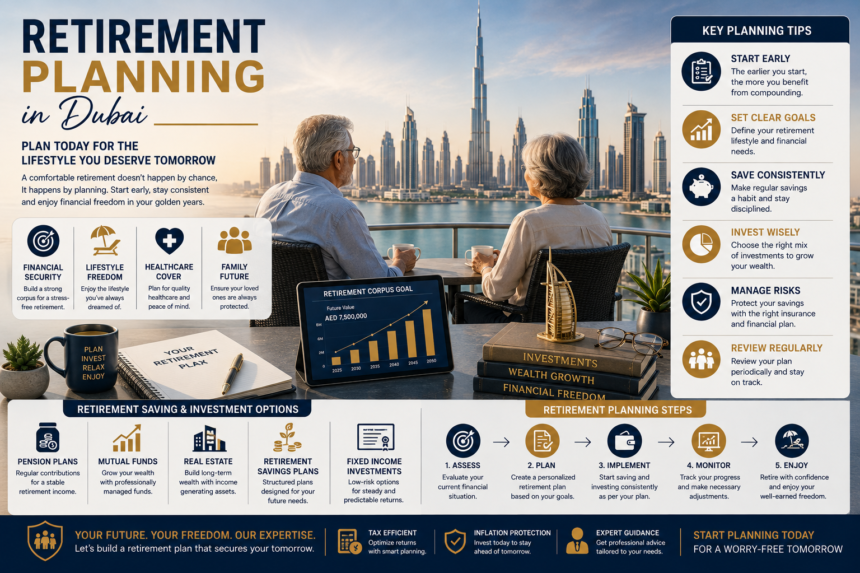
Retirement in Dubai: How Much Money Could You Really Need?
Dubai can be an excellent place to build a career, grow a business and earn an international salary. But working in Dubai for many years does not automatically create a comfortable retirement.
- Why Retirement Planning in Dubai Is Different
- 1. Understand What Your Employer Actually Provides
- UAE Alternative End-of-Service Savings Scheme
- Why This Matters for Retirement
- 2. Do Not Treat End-of-Service Benefits as Your Entire Retirement Plan
- 3. Calculate Your Retirement Number
- Build Three Retirement Budgets
- 4. Decide Where You Actually Want to Retire
- Dubai Has a Retirement Residence Route
- Do Not Build Your Entire Retirement Around Visa Rules
- 5. Build Retirement Savings Automatically
- Increase Contributions With Salary Growth
- 6. Invest According to Time Horizon
- Diversification Matters
- Currency Risk Matters for Expats
- 7. Keep an Emergency Fund Separate From Retirement
- 8. Plan for Healthcare Before Retirement
- Retirement Residence Requires Health Planning
- 9. Decide Whether Property Belongs in Your Retirement Plan
- Property and Dubai Retirement Residency
- Renting in Retirement Can Also Make Sense
- 10. Create a Retirement Income Strategy
- Think in Terms of Income Buckets
- The DIFC Workplace Savings Model
- UAE Alternative Savings Scheme Can Continue After Employment
- What Age Should You Start Retirement Planning?
- Retirement Planning in Your 20s
- Retirement Planning in Your 30s
- Retirement Planning in Your 40s
- Retirement Planning in Your 50s
- How Much Should You Save for Retirement?
- Do Not Forget Inflation
- Example Retirement Calculation
- Avoid These Retirement Mistakes
- Should You Retire in Dubai?
- Dubai Retirement Residence at a Glance
- A Simple Retirement Planning Checklist
- Review Your Plan After Major Life Changes
- FAQs About Retirement Planning in Dubai
- Conclusion
For expatriates especially, Retirement Planning in Dubai requires deliberate action. Unlike UAE nationals covered by applicable pension systems, expatriate workers generally do not receive a traditional UAE state pension simply because they worked in the country. The UAE Government states that expatriate workers are typically entitled to end-of-service benefits rather than a UAE pension.
That means retirement security often depends on what you personally build through savings, investments, property, employer benefits and retirement arrangements in your home country or elsewhere.
The good news is that Dubai now offers more options than before. Employees may benefit from traditional end-of-service gratuity, alternative savings schemes, workplace savings programmes and long-term residence options for qualifying retirees.
The key is to start early and treat retirement as a financial project rather than something to think about in your final working years.
Why Retirement Planning in Dubai Is Different
Retirement planning in Dubai can be very different from retirement planning in countries with mandatory state pension systems.
Many expatriates arrive in the UAE in their twenties, thirties or forties.
They may earn higher salaries than they did at home and benefit from relatively low personal taxation.
But they may also spend heavily on:
- housing,
- cars,
- private education,
- travel,
- family remittances,
- lifestyle,
- and supporting relatives overseas.
Years can pass quickly.
Someone can work in Dubai for 15 years, earn a strong salary and still reach their fifties with limited retirement savings if they never created a structured plan.
The biggest danger is assuming:
“My end-of-service gratuity will take care of retirement.”
For most people, it will not.
1. Understand What Your Employer Actually Provides
The first step in Retirement Planning in Dubai is understanding your existing employment benefits.
Ask your HR department:
- Am I under traditional end-of-service gratuity?
- Is my employer enrolled in an alternative savings scheme?
- Do I have a workplace retirement plan?
- Does my employer contribute separately to retirement savings?
- What happens if I change jobs?
- What benefits are portable?
Expatriate employees in the UAE are generally entitled to end-of-service benefits rather than a public pension.
However, alternative arrangements are becoming more important.
UAE Alternative End-of-Service Savings Scheme
The UAE introduced an alternative end-of-service benefits system that allows participating employers to make monthly contributions into approved investment funds instead of relying solely on the traditional gratuity model.
MOHRE describes the scheme as a voluntary alternative for employers designed to invest employee end-of-service benefits and potentially generate sustainable returns.
Under the current rules, participating employers generally contribute:
- 5.83% of monthly basic salary for employees with fewer than five years of service
- 8.33% of monthly basic salary after five years of service
Employees can also make voluntary contributions, subject to scheme rules.
This creates an important difference.
Traditional gratuity is usually calculated when employment ends.
The alternative scheme invests contributions during employment.
Why This Matters for Retirement
Investment-based end-of-service schemes can potentially create a more visible retirement asset.
Employees may be able to see accumulated contributions and investment performance rather than treating gratuity as an abstract future amount.
But investment returns are not guaranteed in the same way as a fixed savings account.
Employees should understand:
- investment choice,
- fees,
- withdrawal rules,
- risk level,
- and what happens when employment ends.
2. Do Not Treat End-of-Service Benefits as Your Entire Retirement Plan
Even a substantial gratuity may cover only a limited number of retirement years.
Imagine you retire with AED 300,000 in end-of-service benefits.
That sounds large.
But if your retirement expenses are AED 15,000 per month:
AED 300,000 ÷ AED 15,000 = 20 months
That is less than two years.
Retirement may last 20, 25 or 30 years.
This is why gratuity should usually be considered one part of a broader retirement portfolio.
A stronger structure could include:
Emergency savings + investments + employer benefits + home-country pension + property + end-of-service benefits
The exact combination will vary.
3. Calculate Your Retirement Number
You cannot plan effectively without knowing what you are trying to achieve.
Your retirement target depends on your expected lifestyle.
Start by estimating your future annual expenses.
Include:
- housing,
- food,
- utilities,
- healthcare,
- insurance,
- transport,
- travel,
- family support,
- hobbies,
- inflation,
- and unexpected costs.
Suppose you expect to need AED 180,000 per year in retirement.
If retirement lasts 25 years, simply multiplying gives:
AED 180,000 × 25 = AED 4.5 million
But real retirement calculations are more complicated because:
- investments may continue earning returns,
- inflation increases expenses,
- spending changes with age,
- pension income may reduce required withdrawals,
- healthcare costs may rise.
This is why financial planners often use sustainable withdrawal assumptions rather than simple multiplication.
Still, even a rough estimate is much better than having no target.
Build Three Retirement Budgets
Create three scenarios.
Basic Retirement
Covers essentials with limited luxury.
Comfortable Retirement
Includes travel, dining and recreational spending.
Premium Retirement
Includes higher-end housing, frequent travel and larger discretionary spending.
This helps you understand how lifestyle choices affect the amount of capital required.
4. Decide Where You Actually Want to Retire
Retirement planning becomes much easier when you know the likely destination.
You might retire:
- in Dubai,
- elsewhere in the UAE,
- in your home country,
- between two countries,
- or in a completely different destination.
Each choice changes the financial calculation.
Retiring in Dubai may require significantly more money than retiring in a lower-cost location.
But Dubai may offer:
- familiar lifestyle,
- healthcare,
- international connectivity,
- safety,
- family proximity,
- and quality infrastructure.
The correct choice is personal.
Dubai Has a Retirement Residence Route
Dubai allows qualifying retired foreigners to obtain a five-year residence permit without a local sponsor or host.
GDRFA states that the permit is renewable under the same conditions.
Current eligibility generally requires the applicant to:
- be at least 55 years old
- have completed at least 15 years of service before retirement
- and satisfy applicable financial conditions
One route is based on fixed annual income of at least AED 240,000, equivalent to AED 20,000 per month. Other qualifying routes can involve property and financial-deposit conditions under the applicable rules.
These rules can change, so retirement planning should use current official requirements when you actually apply.
Do Not Build Your Entire Retirement Around Visa Rules
Immigration regulations can change over a 10- or 20-year planning horizon.
A retirement visa available today may have different requirements later.
Your financial plan should therefore remain flexible enough to work even if:
- income thresholds change,
- property requirements change,
- healthcare rules change,
- residency categories change.
Treat residency as one planning component, not the foundation of the entire strategy.
5. Build Retirement Savings Automatically
Retirement saving works best when it happens without repeated decisions.
If you wait until the end of each month, there is always something else to spend money on.
Instead:
Salary arrives → retirement contribution happens automatically
For example:
Monthly salary: AED 25,000
Automatic retirement investment: AED 4,000
Annual contribution:
AED 48,000
Over 15 years, before considering investment growth:
AED 720,000
The habit itself matters enormously.
Increase Contributions With Salary Growth
A useful strategy is to increase retirement contributions each time income increases.
Suppose your salary rises by AED 3,000.
Instead of spending all of the increase, you might direct:
- AED 1,500 to retirement
- AED 750 to lifestyle
- AED 750 to another goal
This helps prevent lifestyle inflation.
Your quality of life improves, but so does your retirement future.
6. Invest According to Time Horizon
Retirement savings held entirely in cash may lose purchasing power over long periods because of inflation.
But investing everything aggressively can create unnecessary risk, especially close to retirement.
The right investment mix depends on:
- age,
- time until retirement,
- risk tolerance,
- other assets,
- future income,
- and personal goals.
Common asset classes may include:
- diversified global equities,
- bonds,
- sukuk,
- cash,
- property,
- diversified funds.
Someone 30 years from retirement may tolerate more volatility than someone retiring in three years.
Diversification Matters
Avoid building your retirement entirely around one asset.
Examples of concentration risk include:
All retirement wealth in Dubai property
All wealth in one employer’s shares
All wealth in cryptocurrency
All wealth in cash
Every asset class carries different risks.
Diversification reduces dependence on one market.
Currency Risk Matters for Expats
Expatriates often earn in dirhams but expect retirement expenses in another currency.
Suppose you plan to retire in India, the UK, Europe or another country.
Your future spending currency may be:
- INR,
- GBP,
- EUR,
- or another currency.
Your retirement investments should therefore consider currency exposure.
Someone saving entirely in assets linked to one currency may face changes in purchasing power when moving countries.
7. Keep an Emergency Fund Separate From Retirement
Retirement investments should not become your emergency bank account.
Keep separate reserves for:
- job loss,
- urgent family travel,
- medical expenses,
- relocation,
- vehicle repairs,
- unexpected housing costs.
For expatriates, job loss can sometimes also affect residency and insurance arrangements.
That makes financial resilience particularly important.
A commonly used emergency-fund range is approximately three to six months of essential expenses, although some expats may prefer more depending on job stability.
The goal is to avoid withdrawing retirement assets every time life becomes difficult.
8. Plan for Healthcare Before Retirement
Healthcare can become one of the largest retirement expenses.
During employment, health insurance may be provided by your company.
After retirement, that employer benefit may disappear.
This creates a major planning question:
Who will pay for your health insurance after you stop working?
Dubai offers high-quality healthcare, but private insurance costs may rise with age.
Retirement planning should therefore include:
- insurance premiums,
- deductibles,
- medication,
- dental care,
- specialist treatment,
- chronic conditions,
- long-term care.
Do not estimate retirement costs using only your current household budget.
Your healthcare profile at 65 may look very different from your profile at 40.
Retirement Residence Requires Health Planning
Residency and healthcare are connected.
Someone retiring permanently in Dubai needs to understand:
- residency requirements,
- health insurance requirements,
- age-related insurance pricing,
- hospital networks.
A strong retirement plan should therefore treat healthcare as a core expense rather than an optional extra.
9. Decide Whether Property Belongs in Your Retirement Plan
Property can play several roles in retirement.
It may provide:
- housing,
- rental income,
- capital appreciation,
- diversification.
But property can also create:
- mortgage payments,
- service charges,
- maintenance,
- vacancies,
- transaction costs,
- liquidity problems.
Owning a Dubai apartment does not automatically mean you are financially ready to retire.
Property and Dubai Retirement Residency
Current GDRFA rules allow property to form part of the qualifying conditions for retired foreign residents.
The authority currently references a minimum property-related value of AED 1 million within applicable retirement residence conditions.
However, property should still make financial sense independently of immigration benefits.
Ask:
- Is the rental yield attractive?
- Can I afford maintenance?
- Is the location suitable for retirement?
- Is the property liquid?
- Would I rather rent?
Renting in Retirement Can Also Make Sense
Owning property creates stability.
Renting creates flexibility.
A retiree who wants to travel frequently or divide time between countries may prefer renting.
Do not buy property solely because retirement planning advice suggests home ownership is always necessary.
Your retirement housing strategy should match your lifestyle.
10. Create a Retirement Income Strategy
Building assets is only half of retirement planning.
Eventually you need to turn those assets into income.
Potential retirement income sources may include:
- investment withdrawals,
- rental income,
- home-country pension,
- employer retirement benefits,
- annuity-type products,
- dividends,
- business income.
A good retirement plan asks:
How much income will arrive every month?
not only:
How much money have I accumulated?
Think in Terms of Income Buckets
One useful framework is:
Essential Income
Used for:
- housing,
- food,
- healthcare,
- utilities.
Lifestyle Income
Used for:
- travel,
- restaurants,
- hobbies.
Emergency Reserve
Held separately for unexpected major expenses.
This helps prevent discretionary spending from threatening essential retirement security.
The DIFC Workplace Savings Model

Employees working in the Dubai International Financial Centre operate under a different workplace benefit model from traditional UAE gratuity arrangements.
DIFC introduced a defined-contribution workplace savings structure known as DEWS, designed to replace traditional end-of-service gratuity with funded contributions.
The broader trend is important even for employees outside DIFC.
UAE employment benefits are increasingly moving toward funded savings and investment structures rather than relying only on lump-sum gratuity calculations.
This can encourage employees to think about retirement earlier.
UAE Alternative Savings Scheme Can Continue After Employment
MOHRE scheme guidance states that when employment ends, employees are entitled to employer subscription amounts and applicable returns, and they may also have the option to continue investing rather than immediately withdrawing everything.
This is potentially valuable.
One common retirement mistake is receiving a large end-of-service payment and immediately spending it on:
- cars,
- holidays,
- luxury purchases,
- or unrelated expenses.
If the money is meant for long-term financial security, treat it like retirement capital.
What Age Should You Start Retirement Planning?
The best answer is:
As soon as you earn enough to save consistently.
Starting at 25 gives more time for investment growth.
Starting at 35 is still valuable.
Starting at 45 is better than waiting until 55.
Someone who begins late may need to:
- save a higher percentage,
- work longer,
- reduce retirement spending,
- or combine several strategies.
Time cannot be recreated.
That is why starting early can reduce future pressure.
Retirement Planning in Your 20s
Priorities:
- build emergency fund,
- avoid expensive debt,
- start investing,
- develop earning power.
At this stage, small contributions can have decades to grow.
Retirement Planning in Your 30s
Priorities:
- increase contributions,
- manage family costs,
- protect income,
- diversify investments.
This is often when income rises but family obligations also increase.
Retirement Planning in Your 40s
Priorities:
- calculate retirement target,
- accelerate saving,
- review asset allocation,
- reduce unnecessary debt.
Retirement begins to feel more concrete.
Retirement Planning in Your 50s
Priorities:
- finalize retirement destination,
- reduce portfolio risk where appropriate,
- calculate healthcare costs,
- review residency options,
- build income strategy.
At this stage, planning shifts from accumulation toward implementation.
How Much Should You Save for Retirement?
There is no universal percentage.
Someone starting at 25 may be able to reach goals with a lower contribution rate than someone starting at 45.
A common approach is to aim for a consistent percentage of income and increase it as earnings rise.
For example:
| Monthly Income | Example Retirement Saving |
|---|---|
| AED 10,000 | AED 1,500 |
| AED 20,000 | AED 3,000–4,000 |
| AED 30,000 | AED 5,000–7,000 |
| AED 50,000 | AED 8,000+ |
These are examples, not recommendations.
The correct amount depends on your actual retirement target.
Do Not Forget Inflation
Retirement may be decades away.
AED 10,000 today will not necessarily buy the same lifestyle in 20 years.
If prices rise by 2.5% annually, an expense costing AED 10,000 today would cost more than AED 16,000 after 20 years.
That is why retirement calculations need to consider inflation.
Planning around today’s prices alone can significantly underestimate future needs.
Example Retirement Calculation
Suppose someone is 40 years old.
They want to retire at 60.
Current retirement portfolio:
AED 300,000
Monthly investment:
AED 6,000
Annual investment:
AED 72,000
Over 20 years, contributions alone add:
AED 1.44 million
Combined with current savings:
AED 1.74 million
And that is before considering any investment returns.
This demonstrates why consistent monthly contributions can become powerful over time.
Avoid These Retirement Mistakes
Depending Only on Gratuity
End-of-service benefits are useful but may not support decades of retirement.
Starting Too Late
Less time means higher required contributions.
Investing Too Aggressively Near Retirement
Large market falls become more damaging when withdrawals are about to begin.
Holding Everything in Cash
Long-term purchasing power may decline.
Ignoring Healthcare
Medical expenses often increase with age.
Buying Property Without Considering Liquidity
A valuable property does not automatically provide easy monthly cash flow.
Spending End-of-Service Money Immediately
Treat retirement-related benefits as long-term capital.
Forgetting Currency Risk
Especially important when retirement will happen outside the UAE.
Should You Retire in Dubai?
Dubai can appeal to retirees because of:
- infrastructure,
- healthcare,
- international flights,
- safety,
- warm weather,
- dining,
- lifestyle,
- long-term residency options.
But it can also be expensive.
Housing and healthcare need careful budgeting.
A retirement plan that works comfortably in another country may not support the same lifestyle in Dubai.
Before deciding, compare:
Dubai annual retirement cost
with
home-country retirement cost
Then assess which lifestyle you genuinely prefer.
Dubai Retirement Residence at a Glance
Current GDRFA information states that qualifying retired foreign nationals can receive a five-year renewable residence permit without a sponsor.
| Requirement | Current General Position |
| Minimum age | 55 |
| Prior service | At least 15 years |
| Permit validity | 5 years |
| Renewal | Available if conditions remain satisfied |
| Income route | AED 240,000 fixed annual income |
| Property/deposit route | Subject to applicable AED 1 million requirements |
Always confirm current GDRFA rules when applying, because requirements can change.
A Simple Retirement Planning Checklist
Use this framework:
- Calculate current net worth
- Estimate retirement expenses
- Choose a likely retirement age
- Choose likely retirement location
- Review employer benefits
- Build emergency savings
- Automate retirement investments
- Diversify assets
- Plan healthcare
- Review residency and estate planning
Repeat the review annually.
Retirement planning is not a one-time exercise.
Review Your Plan After Major Life Changes
Update your retirement strategy after:
- marriage,
- divorce,
- childbirth,
- salary increase,
- job change,
- property purchase,
- inheritance,
- major investment change,
- moving countries.
A plan created at age 32 may not suit your life at 42.
FAQs About Retirement Planning in Dubai
Do expatriates receive a UAE pension?
Expatriate workers generally do not receive a UAE pension simply because they work in the country. UAE Government information states that expatriate workers are generally entitled to end-of-service benefits instead.
What is the UAE alternative end-of-service savings scheme?
It allows participating employers to make regular contributions into approved investment funds instead of relying solely on traditional end-of-service gratuity arrangements.
How much does an employer contribute under the alternative savings scheme?
Current MOHRE guidance generally states 5.83% of monthly basic salary for employees with less than five years of service and 8.33% after five years.
Can I retire permanently in Dubai?
Qualifying foreign retirees can apply for a renewable five-year retirement residence permit subject to current GDRFA requirements.
What age is required for Dubai retirement residency?
GDRFA currently states that applicants must generally be at least 55 years old and have completed at least 15 years of service before retirement.
How much income is required for a Dubai retirement residence permit?
One current eligibility route requires fixed annual income of at least AED 240,000, equivalent to AED 20,000 per month. Other property and deposit routes also exist under the applicable conditions.
Is end-of-service gratuity enough for retirement?
Usually not by itself. Its adequacy depends on salary, service period, retirement spending and other assets. Most expatriates benefit from building separate long-term savings and investments.
Should I buy property for retirement in Dubai?
Property can provide housing or rental income, but it also creates costs and reduces liquidity. Buy only when the investment and lifestyle case makes sense, not solely because property can support certain residency routes.
Conclusion
Retirement Planning in Dubai requires a different mindset from simply saving whatever remains after monthly expenses.
Expatriates generally do not build a UAE state pension automatically through years of employment. Instead, retirement security may depend on end-of-service benefits, workplace savings, personal investments, property, home-country pensions and disciplined long-term saving.
The UAE is gradually creating more structured savings options. Under the alternative end-of-service scheme, participating employers can contribute monthly into approved investment funds, while employees may also make voluntary contributions under the applicable rules.
Dubai also provides a pathway for qualifying retirees who want to remain in the emirate. Current GDRFA rules provide a renewable five-year retirement residence permit for eligible applicants aged at least 55 who satisfy the required service and financial conditions.
But residency is only one part of retirement.
The more important questions are financial:
How much will you spend?
Where will your income come from?
How will healthcare be paid for?
How will inflation affect your lifestyle?
What happens if markets fall?
Will your savings last for 25 or 30 years?
The strongest retirement strategy is built gradually.
Save consistently.
Invest according to your time horizon.
Protect yourself with emergency reserves and appropriate insurance.
Understand your employer benefits.
Keep retirement money separate from lifestyle spending.
And review the plan as your career, family and future goals change.
Dubai can provide excellent earning opportunities during your working years.
The real financial success comes when those years produce something lasting: the freedom to stop working without having to worry about whether your money will last.
follow us on Instagram
Read More – Insurance in Dubai: Avoid These Costly Coverage Mistakes