



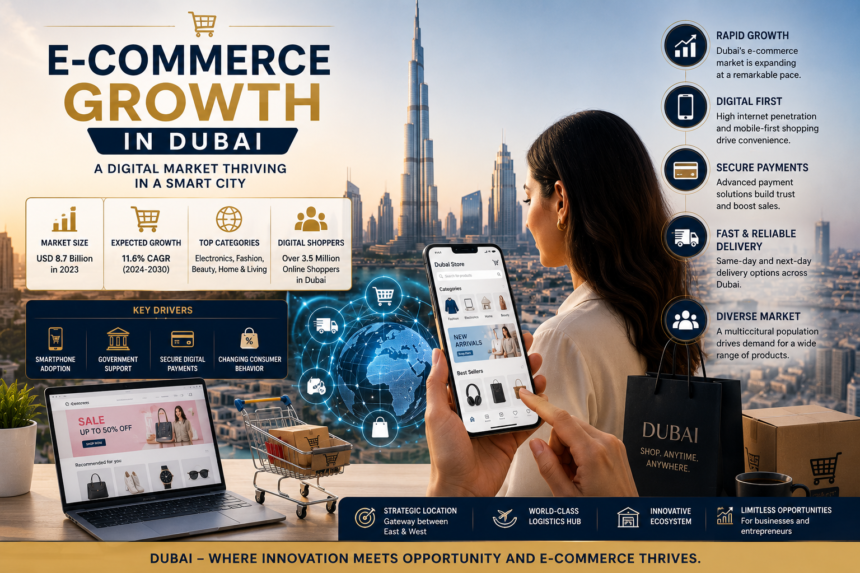
10 Amazing Trends Driving Dubai’s E-commerce Boom
Dubai’s shopping culture is no longer limited to malls, souqs and physical stores. Increasingly, the purchase journey begins on a smartphone, moves through a digital payment platform and ends with a package arriving at the customer’s door.
- Why E-commerce Growth in Dubai Is Accelerating
- 1. UAE E-commerce Spending Continues to Rise
- 2. Mobile Shopping Is Becoming the Default
- 3. Dubai Is Helping SMEs Move Online
- 4. Marketplace Selling Is Lowering Entry Barriers
- 5. Cross-Border E-commerce Is Becoming More Important
- 6. Logistics Is Becoming a Competitive Advantage
- 7. Quick Commerce Is Changing Expectations
- 8. Fashion and Electronics Remain Major Categories
- 9. Social Commerce Is Blurring Content and Shopping
- 10. AI Is Entering E-commerce
- Dubai’s Digital Commerce Ecosystem Is Becoming Bigger
- E-commerce Opportunities in Dubai at a Glance
- Starting an E-commerce Business in Dubai
- Do Not Start With the Website
- Calculate the True Cost Per Order
- Returns Can Destroy Margins
- Customer Acquisition Cost Matters
- Repeat Customers Are Valuable
- Digital Payments Need to Feel Simple
- Cybersecurity Is Becoming More Important
- Omnichannel Retail Is Growing
- Why Dubai Works Well for Cross-Border Sellers
- Challenges Facing Dubai E-commerce
- Common E-commerce Mistakes in Dubai
- What Could Drive the Next Phase of Growth?
- FAQs About E-commerce Growth in Dubai
- Conclusion
That shift is accelerating E-commerce Growth in Dubai and creating opportunities not only for large retailers but also for small businesses, logistics companies, payment providers, technology startups and independent online sellers.
Dubai Chambers estimates the UAE’s retail e-commerce market at around $10.8 billion in 2026, up from $8.5 billion in 2024 and $9.5 billion in 2025. Its longer-term outlook places the market at approximately $12.8 billion by 2028.
Dubai is also actively helping smaller sellers participate. The Dubai Traders programme onboarded more than 2,400 new e-commerce sellers in its first year, while providing growth support to another 1,000 existing sellers.
These developments show that digital commerce is becoming an important part of Dubai’s wider economic strategy rather than simply another retail channel.
Why E-commerce Growth in Dubai Is Accelerating
Several forces are pushing Dubai’s digital retail market forward at the same time.
They include:
- high smartphone usage,
- digitally confident consumers,
- advanced logistics,
- strong payment infrastructure,
- multicultural demand,
- startup support,
- cross-border trade,
- fast delivery expectations,
- government digital-economy initiatives.
Dubai’s broader economy also provides a strong foundation.
Wholesale and retail trade remained the emirate’s largest economic sector in the first quarter of 2026, generating AED 50.9 billion in real gross value added and accounting for roughly 22% of Dubai’s GDP.
Online commerce increasingly sits inside this wider retail ecosystem.
1. UAE E-commerce Spending Continues to Rise
The most straightforward evidence of growth is market size.
Dubai Chambers’ economic outlook estimates UAE retail e-commerce at:
| Year | Estimated Retail E-commerce Market |
|---|---|
| 2021 | $5.1 billion |
| 2022 | $6.3 billion |
| 2023 | $7.6 billion |
| 2024 | $8.5 billion |
| 2025 | $9.5 billion |
| 2026 | $10.8 billion |
| 2027 | $12.1 billion |
| 2028 | $12.8 billion |
That means the market is projected to more than double between 2021 and 2028.
The UAE already represented about 35% of the total GCC e-commerce market in 2023, according to the same Dubai Chambers analysis.
Dubai plays a central role because it combines population, tourism, logistics, payments and major retail brands in one market.
2. Mobile Shopping Is Becoming the Default
For many consumers, e-commerce no longer means sitting at a computer.
It means opening an app.
Customers increasingly use smartphones to:
- search for products,
- compare prices,
- read reviews,
- make payments,
- track deliveries,
- contact customer support.
This creates a major requirement for businesses.
A website may look excellent on desktop but still lose customers if the mobile experience is slow or difficult.
Successful online businesses increasingly need:
- fast mobile pages,
- simple checkout,
- clear product images,
- digital wallets,
- responsive customer service.
Mobile-first commerce is becoming less of a competitive advantage and more of a basic expectation.
3. Dubai Is Helping SMEs Move Online
One of the most important aspects of E-commerce Growth in Dubai is that participation is spreading beyond large companies.
Dubai Traders, launched under the Dubai Economic Agenda D33, onboarded over 2,400 new online sellers within 12 months through partnerships involving major marketplace platforms.
The programme also supported 1,000 existing sellers.
Among participating noon sellers:
- 42% expanded into new categories,
- 63% introduced new SKUs,
- one in three increased monthly GMV significantly within one month of onboarding.
This demonstrates how digital marketplaces can help smaller companies enter the retail market without immediately building their own large distribution network.
4. Marketplace Selling Is Lowering Entry Barriers
Starting an online business once required substantial investment in:
- website development,
- payments,
- warehousing,
- marketing,
- delivery infrastructure.
Marketplaces can simplify several of these areas.
A new seller may gain access to:
- existing customers,
- fulfilment systems,
- advertising tools,
- product listings,
- payment processing.
This does not make e-commerce easy.
Marketplace sellers still face:
- commissions,
- competition,
- advertising costs,
- returns,
- pricing pressure.
But the initial barrier to reaching customers can be significantly lower.
Dubai Traders itself uses partnerships with major platforms to provide sellers with onboarding, advertising support, product placement and account management.
5. Cross-Border E-commerce Is Becoming More Important
Dubai has always been a trading city.
Digital commerce extends that role online.
The UAE’s non-oil foreign trade reached approximately AED 1.937 trillion in the first half of 2026, representing 13.1% annual growth.
Dubai businesses can use the emirate as a base for selling into:
- GCC markets,
- South Asia,
- Africa,
- Europe,
- other Middle Eastern markets.
Dubai Traders data already show early signs of this. Around 15% of participating sellers had expanded internationally, while another 40% were preparing to do so.
For small businesses, this changes the opportunity significantly.
An online brand does not necessarily need to remain a Dubai-only business.
6. Logistics Is Becoming a Competitive Advantage
Online shopping depends heavily on what happens after the customer presses “buy.”
A successful e-commerce system needs:
- warehousing,
- inventory management,
- packaging,
- sorting,
- delivery,
- returns.
Dubai’s logistics infrastructure provides a strong foundation for this.
Its combination of airports, ports, free zones and fulfilment networks allows businesses to move products relatively efficiently across domestic and international markets.
Fast delivery has also changed customer expectations.
People increasingly expect:
same day
or even
within hours
for certain categories.
That forces retailers to position stock closer to customers and use more sophisticated inventory systems.
7. Quick Commerce Is Changing Expectations
Quick commerce focuses on extremely fast delivery, particularly for everyday products.
This can include:
- groceries,
- beauty products,
- medicine where permitted,
- household supplies,
- convenience products.
Dubai Traders reported that more than 300 Emirati-owned businesses participating in the initiative had been onboarded onto noon Minutes, highlighting the growing importance of rapid-delivery channels.
This creates a new competitive question.
Customers no longer compare only:
price vs price
They may compare:
price + delivery time + convenience
A slightly more expensive product may still win if it arrives in 20 minutes instead of tomorrow.
8. Fashion and Electronics Remain Major Categories
Dubai Chambers’ UAE e-commerce category data show the importance of fashion and electronics.
In its 2024 breakdown, retail e-commerce spending included approximately:
- Fashion: $3.1 billion
- Appliances and electronics: $3.0 billion
- Food: $1.2 billion
- Home products: $0.4 billion
- Health and beauty: $0.3 billion
This suggests that fashion and electronics together represent a very large part of online retail spending.
But these categories are also extremely competitive.
New sellers need differentiation through:
- brand,
- price,
- product quality,
- delivery,
- exclusivity,
- customer experience.
9. Social Commerce Is Blurring Content and Shopping
Consumers increasingly discover products through:
- Instagram,
- TikTok,
- YouTube,
- creators,
- influencers.
This means the traditional purchase journey is changing.
Previously:
Advertisement → website → purchase
Now it might be:
Reel → creator review → product page → mobile checkout
The distinction between entertainment and shopping is becoming less clear.
For Dubai businesses, this is especially important because the city has a large creator economy and highly visual consumer culture.
Social-first brands can use short-form video to demonstrate:
- fashion,
- beauty,
- food,
- home products,
- lifestyle products.
The challenge is converting attention into profitable sales rather than simply collecting views.
10. AI Is Entering E-commerce
Artificial intelligence is becoming increasingly relevant to online retail.
Businesses can use AI for:
- product recommendations,
- customer service,
- fraud detection,
- demand forecasting,
- inventory planning,
- marketing automation,
- translation.
Dubai’s wider digital economy is already attracting significant technology activity.
The Dubai Chamber of Digital Economy supported 1,690 digital startups during 2025, up 39.7% from the previous year. AI businesses represented approximately 15% of those companies, while e-commerce, SaaS and mobility technology together represented 20%.
This matters because e-commerce companies increasingly compete partly through technology.
A retailer that predicts customer demand accurately can reduce excess stock.
A retailer that personalizes recommendations effectively may increase conversion.
Dubai’s Digital Commerce Ecosystem Is Becoming Bigger
Dubai is increasingly positioning digital commerce as a strategic economic sector.
At WORLDEF Dubai 2026, government officials described digital commerce as an important pillar of UAE economic development and Dubai’s global competitiveness. The event was hosted through Dubai CommerCity, a free zone dedicated specifically to digital commerce.
That ecosystem includes:
- sellers,
- marketplaces,
- payment providers,
- logistics companies,
- software firms,
- digital advertisers.
Growth therefore creates opportunities beyond opening an online store.
E-commerce Opportunities in Dubai at a Glance
| Opportunity | Why It Matters |
|---|---|
| Online retail | Growing digital consumer spending |
| Marketplace selling | Easier customer access |
| Quick commerce | Demand for faster delivery |
| Logistics | Essential for fulfilment |
| Digital payments | Supports frictionless checkout |
| Social commerce | Product discovery through content |
| AI | Personalisation and automation |
| Cross-border trade | Access to regional markets |
| SaaS | Tools for online sellers |
| Direct-to-consumer brands | Greater control over customer relationships |
Starting an E-commerce Business in Dubai
A new online seller should begin with the business model.
Ask:
What exactly am I selling?
Then:
Why will someone buy it from me instead of an existing seller?
Possible models include:
- own-brand products,
- marketplace reselling,
- subscription commerce,
- direct-to-consumer,
- B2B e-commerce.
Each requires different levels of capital and operational complexity.
Do Not Start With the Website

This sounds strange, but it is important.
A beautiful website does not create product demand.
Before spending heavily on design, validate:
- product,
- pricing,
- target customer,
- competition,
- fulfilment cost.
A simple functioning store with strong products can outperform an expensive website selling something nobody really wants.
Calculate the True Cost Per Order
New e-commerce entrepreneurs often focus on sales revenue.
Profit is what matters.
Suppose a product sells for AED 200.
Costs might include:
- product: AED 70
- advertising: AED 40
- platform fee: AED 20
- delivery: AED 20
- packaging: AED 5
- returns allowance: AED 10
Your true profit may be far less than the AED 130 difference between selling price and product cost.
Always calculate the fully loaded cost per order.
Returns Can Destroy Margins
This is particularly relevant for fashion.
A retailer may achieve strong sales but still struggle financially if:
- return rates are high,
- delivery is expensive,
- returned goods cannot be resold easily.
Better:
- sizing information,
- product photos,
- descriptions,
- customer reviews
can reduce unnecessary returns.
Customer Acquisition Cost Matters
Advertising platforms make it easy to spend money.
They do not guarantee profit.
Calculate:
Marketing spend ÷ new customers = customer acquisition cost
If you spend AED 20,000 and gain 400 new customers:
CAC = AED 50
If your profit per new customer is only AED 30, the campaign is losing money unless repeat purchases improve the economics.
This is why customer retention matters.
Repeat Customers Are Valuable
Winning a new customer usually requires:
- advertising,
- discounts,
- trust building.
A returning customer already knows the brand.
Businesses can improve retention through:
- reliable delivery,
- good support,
- product quality,
- loyalty programmes,
- useful communication.
Long-term e-commerce brands are rarely built only through constant paid advertising.
Digital Payments Need to Feel Simple
Every extra step in checkout creates another chance for a customer to abandon the purchase.
Successful stores should make payment:
- fast,
- secure,
- mobile-friendly.
Customers increasingly expect:
- cards,
- digital wallets,
- familiar local payment options.
Security remains essential.
A smooth checkout means nothing if customers do not trust the website.
Cybersecurity Is Becoming More Important
E-commerce businesses collect valuable information.
This may include:
- names,
- addresses,
- phone numbers,
- transaction information.
That makes retailers targets for:
- phishing,
- account takeover,
- payment fraud,
- data theft.
Businesses need:
- secure payment systems,
- strong passwords,
- access controls,
- software updates,
- staff training.
A cybersecurity incident can damage customer trust long after the technical problem is fixed.
Omnichannel Retail Is Growing
Physical retail and e-commerce are not necessarily competitors.
Many businesses increasingly combine them.
A customer may:
discover online
visit the store
purchase through an app
or the opposite.
This is known as omnichannel retail.
Dubai is particularly suited to this because physical shopping remains strong while digital commerce continues expanding.
Dubai’s wholesale and retail sector accounted for roughly 22% of GDP in Q1 2026, showing that physical and digital commerce are both significant parts of the economy.
Why Dubai Works Well for Cross-Border Sellers
Dubai has several structural advantages:
- international logistics,
- free zones,
- multilingual population,
- regional connectivity,
- established trade infrastructure.
Dubai Chamber member exports and re-exports reached a record AED 356.5 billion in 2025, up 15.1% year on year.
This broader trading ecosystem can support e-commerce businesses that want to move beyond the domestic UAE market.
Challenges Facing Dubai E-commerce
Growth does not remove problems.
Businesses still face:
- intense competition,
- rising advertising costs,
- returns,
- customer expectations,
- logistics expenses,
- inventory risk.
The ease of launching an online store also means competitors can enter quickly.
That makes brand loyalty more important.
Common E-commerce Mistakes in Dubai
Avoid these:
- Selling products without testing demand
- Ignoring delivery costs
- Competing only on price
- Spending heavily on ads before understanding margins
- Ignoring mobile users
- Offering weak product information
- Underestimating returns
- Holding too much inventory
- Providing slow customer service
- Ignoring cybersecurity
Successful e-commerce is a combination of marketing, operations and finance.
What Could Drive the Next Phase of Growth?
Several trends are likely to shape Dubai’s market.
AI personalisation
Stores become better at predicting what customers want.
Faster fulfilment
Same-day and rapid delivery expand.
Cross-border selling
More Dubai businesses sell internationally.
Social commerce
Creators become stronger sales channels.
Automation
Warehouses become increasingly technology-driven.
SME digitisation
More traditional businesses move online.
These trends suggest the next phase will be about more than simply increasing online transaction volumes.
The quality and speed of the digital shopping experience will become increasingly important.
FAQs About E-commerce Growth in Dubai
How big is the UAE e-commerce market in 2026?
Dubai Chambers’ outlook estimates UAE retail e-commerce at approximately $10.8 billion in 2026, rising toward $12.8 billion by 2028.
Is e-commerce growing in Dubai?
Yes. Dubai’s government and business ecosystem continue to support online sellers, while the Dubai Traders programme onboarded more than 2,400 new e-commerce businesses in its first year.
Which e-commerce categories are biggest in the UAE?
Dubai Chambers’ 2024 category data placed fashion and appliances/electronics at the top, at roughly $3.1 billion and $3.0 billion respectively.
Is Dubai good for starting an e-commerce business?
Dubai offers strong logistics, digital payments, access to marketplaces and a large international consumer base. However, entrepreneurs still need to understand licensing, margins, customer acquisition and fulfilment costs.
Can small businesses sell online in Dubai?
Yes. Dubai Traders has specifically focused on helping SMEs and homegrown businesses enter major online platforms and expand their digital presence.
Is cross-border e-commerce growing from Dubai?
Yes. Dubai Traders reported that 15% of participating businesses had already expanded internationally, while another 40% were preparing to do so.
Why is logistics important for Dubai e-commerce?
Online retail depends on warehousing, fulfilment and last-mile delivery. Dubai’s established trade and logistics infrastructure gives sellers a strong base for both local and international delivery.
How important is AI for e-commerce?
AI can improve recommendations, inventory planning, fraud detection and customer service. Dubai’s broader startup ecosystem is also seeing strong AI growth, with AI firms representing about 15% of digital startups supported by Dubai Chamber of Digital Economy in 2025.
Conclusion
E-commerce Growth in Dubai is becoming one of the clearest signs of how the emirate’s retail economy is changing.
UAE retail e-commerce is projected by Dubai Chambers to reach approximately $10.8 billion in 2026, compared with $5.1 billion in 2021.
At the same time, Dubai is deliberately widening access to digital commerce.
The Dubai Traders programme onboarded more than 2,400 new sellers in its first year, helped existing sellers grow and supported businesses looking to expand internationally.
The broader environment is also supportive. Dubai’s wholesale and retail trade sector remains the largest part of its economy, while the city’s digital startup ecosystem continues to expand.
But the next phase of e-commerce will not simply be about putting more products online.
Competition is shifting toward:
faster delivery, better mobile experiences, stronger brands, smarter AI, efficient logistics and easier cross-border trade.
That means the businesses most likely to succeed will not necessarily be those with the largest product catalogue.
They will be the ones that understand what customers want, deliver it efficiently and create enough trust for those customers to return.
Dubai already built itself into one of the world’s major physical trading hubs.
Now, the same combination of trade, technology, logistics and entrepreneurship is helping it build a much larger digital marketplace.
follow us on Instagram
Read More – Best Banks in Dubai: Top Choices for Smarter Banking