


Gulf Salary Comparison Reveals the Best Paying GCC Countries
A job offer in Dubai, Riyadh or Doha can look attractive on paper, but the monthly salary tells only part of the story. Across the Gulf, compensation varies according to profession, experience, nationality, company size, allowances and the cost of living in each city.
- Gulf Salary Comparison Across the Six GCC Countries
- UAE Salaries Remain Competitive for International Professionals
- Saudi Arabia Salaries Are Supported by Strong Project Demand
- Qatar Salaries Can Be Strong for Specialist Careers
- Kuwait Salaries Show Why National Averages Can Be Misleading
- Bahrain Can Be Attractive for Finance and Specialist Roles
- Oman Offers Competitive Opportunities in Selected Industries
- Gulf Salary Comparison Changes Dramatically by Profession
- Your Total Salary Package Matters More Than Basic Pay
- Cost of Living Can Completely Change the Winner
- End of Service Benefits Should Also Be Compared
- Experience Has a Major Impact on Gulf Salaries
- Which Gulf Country Pays the Best Salary in 2026
- Frequently Asked Questions
- Conclusion
That makes a Gulf salary comparison especially useful for professionals deciding where to work in 2026.
The six GCC countries are the UAE, Saudi Arabia, Qatar, Kuwait, Bahrain and Oman. All offer opportunities to international professionals, but their employment markets are different. The UAE has a large international private sector, Saudi Arabia is creating demand through major transformation projects, and Qatar remains attractive for specialist careers. Kuwait, Bahrain and Oman can also offer competitive packages in specific industries.
There is also no single reliable official average salary that can be directly compared across all six countries because governments publish wage statistics differently. For example, the UAE does not publish one economy wide official average wage, while Kuwait publishes detailed wage information that shows major differences between Kuwaiti and non Kuwaiti workers.
For job seekers, comparing actual roles and complete compensation packages is therefore more useful than relying on one national average.
Gulf Salary Comparison Across the Six GCC Countries
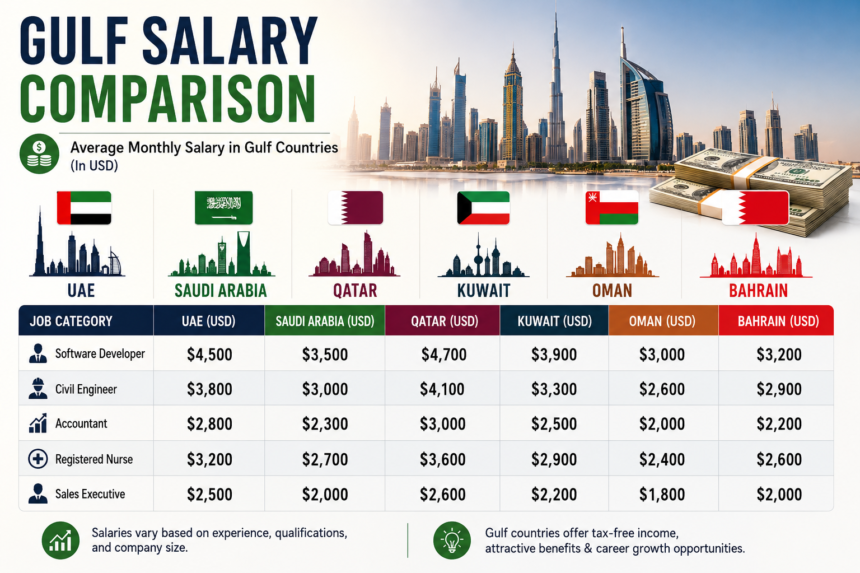
Current salary benchmarks show substantial differences depending on occupation.
For mid level professional roles, UAE market estimates place construction project managers at roughly AED 22,000 to AED 30,000 monthly, registered nurses at AED 10,000 to AED 14,000, HR managers at AED 21,000 to AED 28,000 and financial analysts at AED 14,000 to AED 20,000.
Comparable estimates for Saudi Arabia put construction project managers around SAR 18,000 to SAR 26,000, registered nurses around SAR 9,000 to SAR 13,000 and financial analysts around SAR 13,000 to SAR 19,000. Qatar can also compete strongly for specialised professional positions.
These figures should be treated as market benchmarks rather than guaranteed salaries.
The employer, city, qualifications and individual negotiating power can change the final offer significantly.
UAE Salaries Remain Competitive for International Professionals
The UAE continues to be one of the most popular Gulf destinations for international workers.
Dubai and Abu Dhabi offer opportunities across finance, technology, healthcare, aviation, real estate, hospitality, logistics and professional services.
The UAE can be especially attractive for mid level and senior professionals.
Current benchmarks show that experienced managers and specialists can receive strong packages, particularly in sectors where international talent remains highly valued.
But higher salaries come with an important consideration.
Living costs in Dubai and Abu Dhabi can be substantial.
Housing in particular can significantly reduce the amount a professional is able to save.
A UAE offer therefore needs to be evaluated alongside accommodation, transport, insurance and other benefits.
Saudi Arabia Salaries Are Supported by Strong Project Demand
Saudi Arabia has become one of the Gulf’s most important employment markets.
Large developments and economic diversification have created demand across engineering, construction, hospitality, tourism, technology, healthcare and professional services.
This is particularly important for experienced professionals.
Employers involved in major projects may need people with specialised international experience, creating opportunities for candidates who can bring knowledge that is difficult to find locally.
Saudi salaries may sometimes appear lower than comparable UAE figures in certain mid level occupations, but the complete package can change the comparison.
Housing, transportation and other employer provided benefits can substantially increase the real value of a Saudi employment offer.
Qatar Salaries Can Be Strong for Specialist Careers
Qatar remains an important market for energy, engineering, healthcare, aviation and infrastructure professionals.
In some skilled roles, Qatar can compete closely with or exceed neighbouring markets.
For example, 2026 recruitment benchmarks estimate registered nurse salaries around QAR 10,000 to QAR 15,000 monthly and construction project managers around QAR 20,000 to QAR 28,000.
Trade level benchmarking also places Qatar near the top of several GCC salary comparisons for specialised technical workers.
The limitation is market size.
Qatar has fewer employers than the UAE or Saudi Arabia, meaning there may be fewer vacancies even when individual packages are attractive.
Current regional economic conditions should also be considered carefully when assessing offers in 2026.
Kuwait Salaries Show Why National Averages Can Be Misleading
Kuwait provides one of the clearest examples of why salary statistics require context.
Official wage information reported for March 2026 shows an average monthly wage of around KWD 1,592 for Kuwaitis compared with approximately KWD 352 for non Kuwaitis, excluding domestic workers.
That is an enormous difference.
It demonstrates why job seekers should never assume that a national salary average represents what an expatriate worker will earn.
Kuwait can still provide attractive opportunities in energy, finance, healthcare, engineering and specialist technical roles.
The correct comparison should be based on your profession, experience and employment category rather than a broad country average.
Bahrain Can Be Attractive for Finance and Specialist Roles
Bahrain has a smaller employment market, but it remains an established financial centre.
Banking, insurance, fintech and professional services are important areas for international talent.
Current mid level benchmarks estimate HR managers around BHD 1,800 to BHD 2,400 monthly, financial analysts around BHD 1,400 to BHD 2,000 and hospitality general managers around BHD 2,200 to BHD 3,200.
The number of vacancies may be smaller than in Dubai or Riyadh, but professionals with the right experience can still find competitive opportunities.
Bahrain may also appeal to workers who prefer a smaller market while remaining connected to the wider Gulf business environment.
Oman Offers Competitive Opportunities in Selected Industries
Oman has a smaller employment market compared with the UAE and Saudi Arabia.
However, opportunities remain across energy, logistics, engineering, healthcare, tourism and hospitality.
For some workers, Oman can also offer a different lifestyle and cost structure.
Salary alone should therefore not determine whether an Oman offer is competitive.
Someone earning slightly less while spending considerably less on housing and daily life could potentially save more than someone earning a larger salary elsewhere.
This is one reason a Gulf salary comparison should always include expenses.
Gulf Salary Comparison Changes Dramatically by Profession
Country matters, but profession can matter even more.
A software engineer in Dubai cannot meaningfully compare their salary with an engineer working on a major Saudi infrastructure project without considering experience and responsibility.
The same applies to healthcare.
A general practitioner, specialist physician and consultant surgeon can have completely different salary ranges even when working in the same country.
Technical trades also show significant differences.
A 2026 GCC blue collar benchmarking study found Qatar and the UAE generally paying premiums across many skilled trades, while Saudi Arabia’s larger workforce market moderated salaries for several comparable positions.
This demonstrates why occupation specific salary research is essential.
Your Total Salary Package Matters More Than Basic Pay

One of the most important lessons for anyone considering a Gulf job is understanding the difference between basic salary and total compensation.
An employment package can include:
- Basic salary
- Housing allowance
- Transportation allowance
- Medical insurance
- Annual flights
- Schooling support
- Performance bonus
- End of service benefits
Imagine receiving AED 20,000 per month in Dubai with no housing support.
Another employer may offer the equivalent of a smaller monthly salary elsewhere but provide accommodation and transportation.
The second offer could potentially create greater savings.
Never compare two Gulf job offers using basic salary alone.
Cost of Living Can Completely Change the Winner
A higher salary does not automatically mean a better financial outcome.
Dubai can provide excellent professional salaries, but accommodation and lifestyle costs can be high.
Saudi cities may offer different housing structures.
Doha can provide competitive professional compensation but has its own cost profile.
Bahrain and Oman may offer lower headline salaries in some professions while potentially reducing certain living expenses.
For expatriates, the most useful calculation is:
Monthly income minus monthly expenses equals realistic monthly savings.
That number may matter more than the salary printed on the contract.
End of Service Benefits Should Also Be Compared
Another often overlooked part of Gulf compensation is the end of service benefit.
Rules vary across GCC countries.
In the UAE, eligible employees generally accrue gratuity based on basic salary, with different calculations applying according to service length. Saudi Arabia, Kuwait, Oman and other Gulf countries operate under their own labour law frameworks.
Someone planning to stay with an employer for several years should understand these rules before signing a contract.
Long term compensation is not limited to monthly income.
Experience Has a Major Impact on Gulf Salaries
Two people with the same job title may receive very different offers.
A project manager with three years of experience cannot expect the same package as someone who has managed billion dollar developments for fifteen years.
Employers typically consider:
professional experience
GCC experience
technical qualifications
leadership responsibility
industry knowledge
professional network
language ability
commercial results
GCC experience can be particularly valuable because employers often prefer candidates who already understand the region’s customers, regulations and business culture.
Which Gulf Country Pays the Best Salary in 2026
There is no single winner across every profession.
For international corporate careers, the UAE remains highly competitive.
Saudi Arabia can offer particularly attractive opportunities connected with major projects and economic transformation.
Qatar can perform strongly in specialist and technical professions.
Kuwait remains important in energy and selected professional sectors.
Bahrain is particularly relevant for finance.
Oman offers opportunities across energy, logistics and selected specialist industries.
The best paying country is therefore the one that values your specific skills most highly.
Frequently Asked Questions
Which Gulf country has the highest salaries?
It depends on occupation and seniority. The UAE and Qatar can offer strong professional salaries, while Saudi Arabia can provide attractive packages for experienced professionals involved in major projects. Role specific comparisons are more reliable than national averages.
Are salaries the same across GCC countries?
No. Salaries vary substantially according to country, profession, employer, nationality, experience and benefits.
Is Dubai better than Saudi Arabia for salary?
Dubai can pay more for some corporate and professional positions, while Saudi Arabia may provide attractive packages in construction, engineering, technology and major project roles.
Does Qatar pay well?
Qatar can offer competitive salaries for specialist professionals, particularly in sectors such as energy, healthcare and engineering.
Should I compare basic salary or total package?
Always compare the total package. Housing, transportation, insurance, bonuses and other benefits can significantly change the actual value of an offer.
Conclusion
A useful Gulf salary comparison goes far beyond asking which country pays the most.
The UAE offers a diverse international employment market. Saudi Arabia provides exceptional project driven opportunities. Qatar can reward specialist expertise, while Kuwait, Bahrain and Oman remain valuable markets for professionals whose skills match their strongest industries.
But the highest salary is not necessarily the best offer.
The real question is how much you earn, what benefits you receive, how much it costs to live there and what the job can do for your future career.
In 2026, professionals who compare all four factors will be in a much stronger position to choose the Gulf opportunity that offers not only impressive pay, but also meaningful long term value.
follow us on Instagram
Read More – Best Countries to Work in the Gulf: 6 Amazing Choices in 2026