

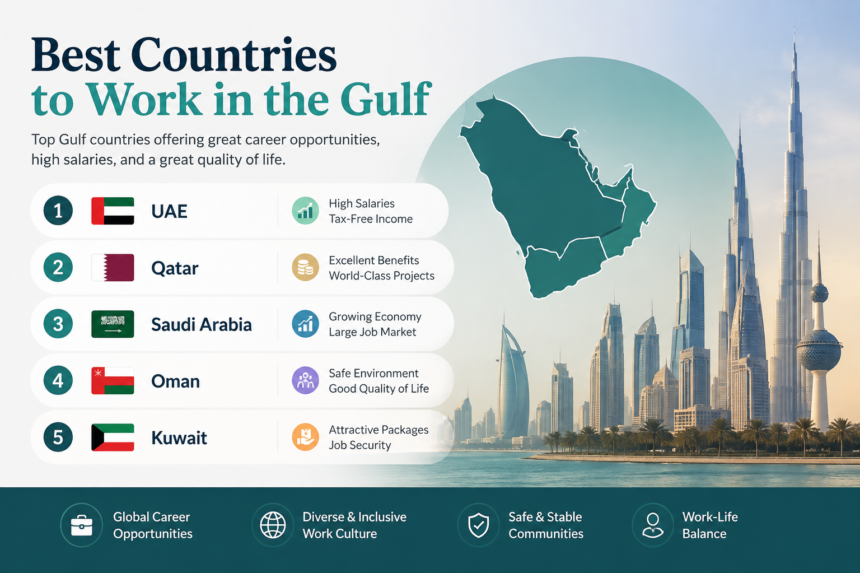
Best Countries to Work in the Gulf for a Successful Career
For millions of professionals, working in the Gulf can mean more than earning a better salary. It can provide international experience, access to major projects, exposure to multinational companies and an opportunity to build a career in some of the fastest changing economies in the world.
- Best Countries to Work in the Gulf at a Glance
- 1. UAE Remains One of the Best Countries to Work in the Gulf
- 2. Saudi Arabia Offers Enormous Career Growth Potential
- 3. Qatar Can Be Excellent for Specialist Professionals
- 4. Bahrain Is an Interesting Choice for Finance Professionals
- 5. Oman Offers Careers With a Different Lifestyle
- 6. Kuwait Remains Strong in Traditional High Value Industries
- Which Gulf Country Is Best for Your Profession?
- Salary Should Not Be Your Only Comparison
- Cost of Living Can Change the Real Value of Your Salary
- Understand Nationalisation Policies Before Applying
- How to Choose the Best Gulf Country for You
- Why the UAE and Saudi Arabia Stand Out in 2026
- Frequently Asked Questions
- Conclusion
But choosing among the best countries to work in the Gulf is not as simple as selecting the country with the highest salary.
The UAE may be ideal for someone working in finance or technology. Saudi Arabia can offer exceptional opportunities for professionals connected with large projects and transformation. Qatar remains attractive for specialised roles, while Bahrain, Oman and Kuwait each offer advantages in particular industries.
In 2026, the right destination depends heavily on your profession, experience, family situation, employment package and long term career plans. The GCC countries also have separate work permit and employment systems, so there is no single work visa covering the entire Gulf.
Here is how the six GCC countries compare.
Best Countries to Work in the Gulf at a Glance
| Country | Particularly Strong For | Major Advantage | Main Consideration |
|---|---|---|---|
| UAE | Technology, finance, aviation, healthcare, hospitality, sales | Diverse international job market | Higher living costs in major cities |
| Saudi Arabia | Engineering, construction, healthcare, technology, hospitality | Huge project pipeline | Nationalisation policies affect some roles |
| Qatar | Energy, engineering, aviation, healthcare | Strong specialised packages | Smaller job market |
| Bahrain | Banking, fintech, insurance, technology | Established financial sector | Smaller number of vacancies |
| Oman | Energy, logistics, tourism, healthcare | Lifestyle and lower costs | Smaller employment market |
| Kuwait | Energy, finance, healthcare | Strong specialist sectors | Localisation policies and narrower market |
There is therefore no universal number one destination. The UAE provides perhaps the broadest mix of opportunities, while Saudi Arabia stands out for scale and major projects. Qatar can be particularly attractive when a professional secures the right specialist package.
1. UAE Remains One of the Best Countries to Work in the Gulf
For many international professionals, the United Arab Emirates remains the most balanced choice.
Dubai and Abu Dhabi have developed highly diversified economies with opportunities far beyond traditional oil and gas.
Important sectors include:
- Finance
- Technology
- Artificial intelligence
- Aviation
- Healthcare
- Real estate
- Hospitality
- Logistics
- Consulting
- Media and marketing
This diversity is one of the UAE’s biggest advantages.
Someone can arrive for one position and later find opportunities across different companies or industries.
The UAE also has a mature expatriate infrastructure. Housing, banking, international schools and professional services have developed around a highly international population.
Dubai is particularly attractive to professionals interested in private sector careers, entrepreneurship and international business.
Abu Dhabi offers major opportunities in finance, energy, government related industries, healthcare and advanced technology.
The main disadvantage is cost.
A high salary does not automatically create high savings, particularly when housing, schooling and lifestyle costs are significant. Comparing the complete employment package is therefore essential.
Best for: Professionals seeking the widest variety of international career opportunities.
2. Saudi Arabia Offers Enormous Career Growth Potential
Saudi Arabia has become impossible to ignore when discussing Gulf careers.
The Kingdom’s economic transformation has created demand across infrastructure, tourism, hospitality, technology, healthcare, entertainment, engineering and construction.
Large projects create opportunities not only for engineers and construction professionals but also for:
project managers
consultants
finance professionals
technology specialists
hospitality leaders
design professionals
marketing experts
healthcare specialists
Saudi Arabia can be especially attractive for experienced professionals who want to participate in large scale projects.
In some positions, employment packages may also include housing, transportation or other allowances, potentially improving savings compared with markets where employees pay more expenses themselves.
However, applicants need to understand Saudisation policies.
Certain occupations and employment categories prioritise Saudi nationals, which can influence opportunities available to expatriates.
Professionals should therefore research demand within their exact occupation rather than assuming the entire Saudi job market is equally open.
Best for: Engineering, construction, healthcare, technology, project management and large scale transformation roles.
3. Qatar Can Be Excellent for Specialist Professionals
Qatar is significantly smaller than Saudi Arabia or the UAE.
But smaller does not necessarily mean less attractive.
The country remains important in industries including:
- Energy
- LNG
- Engineering
- Aviation
- Healthcare
- Education
- Infrastructure
- Hospitality
For specialists who secure the right position, employment packages can be highly competitive.
The important difference is market size.
Dubai provides a large ecosystem where professionals can apply across many employers.
Qatar’s market is more concentrated.
This means it can make more sense to move to Qatar after securing a strong offer rather than arriving without a clear employment plan.
Current circumstances also matter. Qatar’s economy in 2026 has faced disruption connected with regional conflict and its energy sector, demonstrating why professionals should consider current economic and security conditions alongside long term career potential.
Despite short term challenges, Qatar’s long term importance in global energy continues to support specialist career opportunities.
Best for: Energy professionals, engineers, aviation specialists, healthcare workers and experienced technical professionals.
4. Bahrain Is an Interesting Choice for Finance Professionals
Bahrain does not receive the same global attention as Dubai, Riyadh or Doha.
But it has an important advantage.
Finance.
The country has a long established banking and financial services ecosystem.
Professionals can find opportunities across:
- Banking
- Insurance
- Investment services
- Fintech
- Accounting
- Technology
- Financial regulation
Bahrain can therefore be particularly interesting for professionals who want Gulf experience without necessarily working in one of the region’s largest cities.
The smaller market can also create a more manageable environment for some expatriates.
However, the number of available roles is naturally lower than in the UAE or Saudi Arabia.
This means applicants need to target their search carefully.
For professionals whose experience matches Bahrain’s financial and technology sectors, the country can offer a valuable regional career platform.
Best for: Banking, fintech, insurance and financial services professionals.
5. Oman Offers Careers With a Different Lifestyle
Not every professional moving to the Gulf wants the pace of Dubai or Riyadh.
For some, Oman may provide a more attractive balance.
The country has opportunities across:
- Energy
- Logistics
- Tourism
- Hospitality
- Healthcare
- Engineering
- Education
Oman generally has a smaller employment market, meaning professionals cannot expect the same volume of vacancies available in the UAE or Saudi Arabia.
But living costs can also be lower.
For families and professionals who value a quieter environment, this can influence the overall attractiveness of an employment offer.
The country’s logistics position and investments in areas such as green hydrogen also create interesting long term possibilities.
Applicants should nevertheless understand Omanisation policies, which prioritise citizens in parts of the labour market.
Best for: Professionals prioritising lifestyle alongside careers in logistics, energy, tourism and selected specialist sectors.
6. Kuwait Remains Strong in Traditional High Value Industries
Kuwait is another established Gulf employment market.
Its strongest opportunities remain closely connected with sectors such as:
- Oil and gas
- Engineering
- Finance
- Healthcare
- Construction
- Professional services
For experienced specialists, Kuwait can still provide attractive employment packages.
However, its private sector employment ecosystem is smaller and less diversified than Dubai’s.
Kuwaitisation policies can also affect opportunities available to expatriates in certain occupations.
This means Kuwait may work best for professionals who already have expertise aligned with the country’s major industries rather than those looking for the widest possible range of career choices.
Best for: Energy, engineering, healthcare and finance professionals.
Which Gulf Country Is Best for Your Profession?

Choosing a country based on reputation alone is one of the easiest mistakes to make.
A better approach is matching the destination with your profession.
Technology and AI
The UAE is one of the strongest choices because Dubai and Abu Dhabi are investing heavily in digital industries. Saudi Arabia is another major market as digital transformation expands.
Engineering and Construction
Saudi Arabia offers enormous scale, while the UAE and Qatar also provide significant opportunities.
Finance and Banking
The UAE is particularly strong through Dubai and Abu Dhabi, while Bahrain remains an important specialist financial hub.
Energy
Saudi Arabia, Qatar, the UAE, Kuwait and Oman all offer opportunities, but the strongest destination depends on whether your expertise involves oil, gas, LNG, renewables or energy infrastructure.
Healthcare
The UAE and Saudi Arabia provide particularly broad healthcare markets, while Qatar, Kuwait and Oman also recruit specialist professionals.
Hospitality and Tourism
The UAE remains highly developed, while Saudi Arabia’s tourism expansion is creating significant new demand.
Salary Should Not Be Your Only Comparison
One of the biggest mistakes professionals make when comparing Gulf jobs is focusing only on monthly salary.
Imagine receiving two offers.
The first pays more but requires you to cover expensive accommodation, transportation and schooling.
The second offers a slightly smaller salary but includes housing, health insurance and transport.
The second offer could leave you with greater savings.
Compare the entire package, including:
- Basic salary
- Housing allowance
- Transportation
- Medical insurance
- Schooling support
- Annual flights
- Performance bonus
- End of service benefits
Current Gulf employment comparisons repeatedly emphasise that package quality can matter more than the country name itself.
Cost of Living Can Change the Real Value of Your Salary
Dubai may offer an excellent salary, but housing can consume a significant portion of income.
A professional earning less in another GCC city may sometimes save more.
This is why salary comparisons need context.
Housing is usually the largest expense.
Families also need to consider international schooling, healthcare coverage and transportation.
Single professionals may have very different priorities.
The question should therefore not simply be:
How much will I earn?
It should be:
How much will I realistically keep after living expenses?
That calculation gives a much clearer picture of whether an international move makes financial sense.
Understand Nationalisation Policies Before Applying
All Gulf employment markets are evolving.
Governments want expatriate talent while also creating more opportunities for their own citizens.
Saudi Arabia has Saudisation.
The UAE has Emiratisation.
Other GCC countries have their own localisation policies.
These programmes can influence which jobs are available to foreign workers.
The impact is not identical across industries.
Highly specialised technical, healthcare, engineering and leadership skills can remain in demand even when other occupations become more restricted.
Applicants should therefore research the current rules affecting their specific profession before relocating.
How to Choose the Best Gulf Country for You
Instead of asking which country is universally best, ask five practical questions.
Where is my profession in demand?
Look at real vacancies, not general social media claims.
What is the complete salary package?
Calculate allowances and benefits.
What will my living costs be?
Compare rent, transport, food and schooling.
Can this role improve my career?
A slightly lower salary at a respected employer may provide better long term opportunities.
Does the lifestyle suit me?
A country can offer excellent career opportunities and still not match your personal priorities.
The strongest choice is where career opportunity, financial benefit and lifestyle align.
Why the UAE and Saudi Arabia Stand Out in 2026
For professionals comparing the best countries to work in the Gulf, the UAE and Saudi Arabia currently stand out because of their scale and economic diversification.
But they offer different advantages.
The UAE is more established as an international expatriate business hub.
Saudi Arabia offers exceptional scale and transformation driven opportunities.
Qatar can offer strong specialist packages.
Bahrain provides a niche financial market.
Oman can appeal to professionals seeking a calmer lifestyle.
Kuwait remains relevant for specialists in established industries.
The right answer therefore changes according to the worker.
Frequently Asked Questions
Which is the best Gulf country to work in?
For many international professionals, the UAE offers the broadest combination of jobs, infrastructure and international business exposure. Saudi Arabia can be stronger for professionals targeting major projects and large scale transformation.
Which Gulf country is best for engineering jobs?
Saudi Arabia, the UAE and Qatar can all offer strong engineering opportunities. The best choice depends on specialisation and project experience.
Which Gulf country is best for finance jobs?
The UAE is a major regional financial centre, while Bahrain has a long established banking and financial services sector.
Is Qatar good for jobs in 2026?
Qatar remains an important specialist market, particularly in energy and related sectors, but current regional and economic conditions should be considered carefully before relocation.
Which Gulf country has the most job opportunities?
For diversified international employment, the UAE and Saudi Arabia generally provide the strongest breadth or scale. The UAE has a particularly broad private sector market, while Saudi Arabia offers significant project driven demand.
Conclusion
The best countries to work in the Gulf offer very different career experiences.
The UAE stands out for diversity, international business and professional mobility. Saudi Arabia offers scale and ambitious development. Qatar remains attractive for specialised talent. Bahrain has strengths in finance, Oman combines selected opportunities with a different lifestyle, and Kuwait remains important in energy and other established industries.
The smartest decision is not chasing the country with the biggest salary headline.
Look for the destination where your skills are genuinely needed, the employment package makes financial sense and the experience can strengthen your long term career.
For many professionals in 2026, that may be the UAE or Saudi Arabia.
For others, the best opportunity could be waiting in one of the Gulf’s smaller markets.
follow us on Instagram
Read More – Highest Paying Jobs in the Gulf: 10 Amazing Careers in 2026