



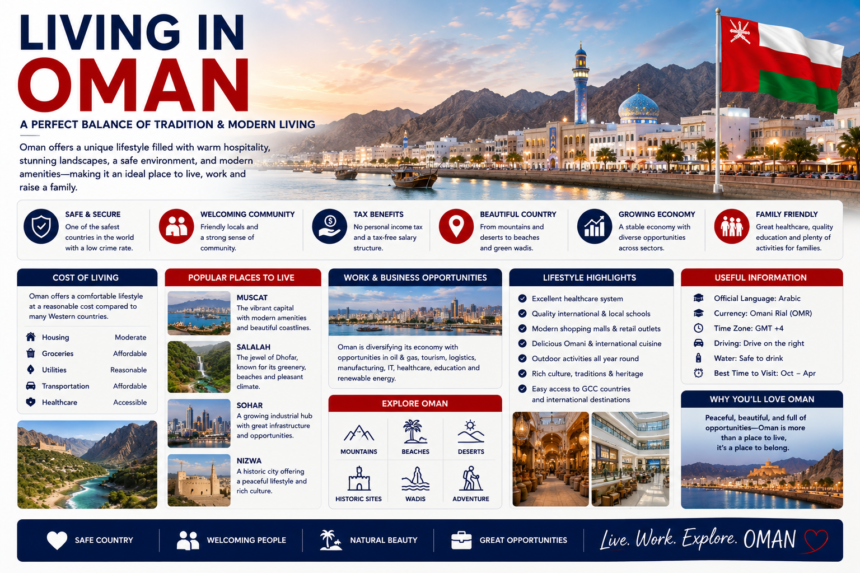
Living in Oman for Expats, Families and Professionals in 2026
Living in Oman offers a different experience from many of the Gulf’s larger and faster-paced cities. The Sultanate combines modern infrastructure and employment opportunities with mountains, beaches, deserts, historic towns and a lifestyle that can feel calmer than some neighbouring destinations.
- Living in Oman for Expats and Families in 2026
- Why Expats Choose Oman
- Living in Muscat
- Living in Salalah
- Living in Sohar
- Living in Nizwa
- Cost of Living in Oman
- Housing and Rent in Oman
- Best Places to Live in Muscat
- Working in Oman
- Omanisation and the Job Market
- Residence Cards for Expats
- Long-Term Residency in Oman
- Healthcare in Oman
- Medical Requirements for Residency
- Education and Schools in Oman
- Transport and Driving in Oman
- Weather and Climate in Oman
- Outdoor Lifestyle in Oman
- Food and Dining in Oman
- Shopping and Everyday Life
- Culture and Social Etiquette
- Language in Oman
- Safety and Security
- Living in Oman for Indian Expats
- Living in Oman for Families
- Living in Oman for Singles
- Personal Income Tax in Oman
- Weekend Activities in Oman
- Advantages of Living in Oman
- Challenges of Living in Oman
- How to Prepare Before Moving to Oman
- Common Mistakes New Expats Should Avoid
- Frequently Asked Questions About Living in Oman
- Conclusion
For expatriates, professionals and families considering a move to the Gulf, Oman deserves serious attention. Muscat provides the country’s largest urban and employment centre, while places such as Salalah, Sohar and Nizwa offer very different lifestyles.
Oman’s population also demonstrates how important expatriates are to the country. Official statistics for May 2026 recorded a total population of about 5.39 million, including approximately 2.33 million expatriates. Muscat alone had more than 1.5 million residents.
The country’s appeal goes beyond employment. Oman offers dramatic natural landscapes, established international communities, modern private healthcare, international schools and relatively strong regional connectivity.
However, moving to any country requires realistic planning. Salary, accommodation, schooling, transport, insurance and residency conditions can dramatically affect the quality of expatriate life.
This complete guide explores what Living in Oman is really like in 2026.
Living in Oman for Expats and Families in 2026
Oman attracts expatriates from India, other parts of South Asia, Southeast Asia, Europe, the Middle East and beyond.
People relocate for different reasons.
Some arrive for employment in oil and gas, engineering, healthcare, education, hospitality, logistics or construction. Others establish businesses, invest or join family members already living in the country.
The experience can differ significantly depending on income.
A senior professional receiving accommodation, schooling and health insurance benefits may experience Oman very differently from an employee responsible for all these expenses personally.
Before accepting an employment offer, therefore, calculate the complete package rather than focusing only on monthly salary.
Why Expats Choose Oman
One of Oman’s biggest attractions is its combination of urban convenience and natural beauty.
Muscat has shopping centres, international restaurants, private hospitals, schools and modern residential developments, but residents can also reach beaches, mountains and outdoor destinations without needing an international holiday.
The country has more than 2,000 kilometres of coastline according to government-backed residential information, while its climate provides pleasant outdoor conditions during the cooler months.
Oman’s culture also gives the country a distinctive identity.
Traditional architecture, souqs, forts and local communities remain highly visible alongside modern development.
For expatriates who want Gulf employment without living entirely inside a high-rise metropolitan environment, this balance can be attractive.
Living in Muscat
Muscat is the natural starting point for most expatriates.
It is Oman’s capital and its largest concentration of employment, housing, schools, healthcare and international services.
Popular residential districts cater to very different budgets and lifestyles. Some residents prefer apartments close to offices and shopping areas, while families may look for villas in quieter neighbourhoods.
Muscat also stretches across a large area rather than functioning around one compact downtown.
That means location matters.
A home that appears relatively close to your workplace on a map can still create an inconvenient daily commute.
Before renting, drive between the property and workplace during normal commuting hours.
Families should do the same for schools.
Living in Salalah
Salalah provides a completely different Oman experience.
Located in Dhofar in southern Oman, the city is particularly famous for the Khareef season.
Between roughly June and September, monsoon conditions transform the landscape around Salalah, bringing cooler weather, mist and greenery. Oman’s official residential information describes the Khareef as one of the country’s most distinctive climatic experiences.
For residents, Salalah offers beaches, natural landscapes and a slower urban environment than Muscat.
Employment opportunities, however, are not as broad as those in the capital.
It may be particularly relevant to people working in tourism, hospitality, logistics, government-related sectors and regional businesses.
Living in Sohar
Sohar is an important industrial and logistics centre.
Its economic activity is connected with the port, manufacturing, logistics and industrial development.
Professionals working in these sectors may find Sohar more practical than commuting from Muscat.
The lifestyle is generally quieter than the capital.
Housing may also offer different value compared with premium Muscat neighbourhoods.
For families, the main question should be whether suitable schools, healthcare and everyday services match their requirements.
Living in Nizwa
Nizwa is particularly appealing for people interested in Oman’s history and traditional character.
The city is associated with cultural attractions, traditional markets and the mountainous interior.
It does not offer the same employment diversity as Muscat, but it can provide an attractive lifestyle for people whose jobs or businesses are based there.
Nizwa can also appeal to professionals in education, tourism and regional services.
Anyone relocating outside Muscat should evaluate career opportunities carefully because changing jobs later may require relocating again.
Cost of Living in Oman
The cost of living in Oman depends strongly on household size and lifestyle.
Housing will normally be one of the largest expenses.
Families may also spend significantly on international schools.
Other major expenses can include:
Groceries
Electricity and water
Internet
Mobile services
Transport
Car payments
Health insurance
Dining
Entertainment
Domestic travel
Flights home
Childcare
The real question is therefore not whether Oman is cheap or expensive.
It is whether your salary and benefits comfortably cover the lifestyle you expect.
Housing and Rent in Oman
Housing options range from basic apartments to premium villas and integrated residential communities.
Before renting, check what is included.
Some properties are furnished.
Others are completely unfurnished.
Ask about:
Air conditioning
Maintenance
Parking
Security
Water
Electricity
Internet availability
Building facilities
Contract duration
Deposit
Notice period
Repair responsibilities
Inspect the air conditioning carefully because it is essential during Oman’s hot months.
Families should also check nearby supermarkets, schools and clinics.
Best Places to Live in Muscat
The right neighbourhood depends on your routine.
Central areas can be practical for professionals working around Muscat’s major commercial districts.
Families may prefer quieter villa communities.
Premium residential developments can offer landscaped surroundings, security and community facilities but normally at higher prices.
Do not choose a neighbourhood only because it is popular with expatriates.
Your workplace should be one of the strongest factors.
Someone working close to the airport may need a completely different residential location from someone employed farther west.
Working in Oman
Employment remains the main reason many expatriates move to Oman.
The economy offers opportunities across areas including:
Oil and gas
Engineering
Construction
Healthcare
Education
Tourism
Hospitality
Logistics
Manufacturing
Technology
Financial services
Retail
Professional services
Job availability varies by profession, experience and current labour-market regulations.
Applicants should obtain the correct employment and residency authorisation rather than travelling under an inappropriate visa with the assumption that employment can begin immediately.
Omanisation and the Job Market
Anyone considering a long-term career in Oman should understand Omanisation.
Omanisation policies are designed to increase employment opportunities for Omani nationals. As a result, some professions and industries can have restrictions or workforce targets affecting expatriate recruitment.
This does not mean expatriates cannot find good careers.
Rather, specialised qualifications, management experience, technical skills and expertise that employers genuinely need can become increasingly important.
Before relocating, professionals should research whether their occupation remains open to expatriate recruitment and what permits are required.
Residence Cards for Expats
Foreigners residing in Oman need the appropriate residence documentation.
The government’s current residence-card service requires documents including the applicant’s passport and employment-related documentation, with medical examination requirements applying in the employment process.
Royal Oman Police also states that expatriates residing in Oman should obtain their residence card within 30 days of entering the country.
New residents should complete these formalities promptly.
Your residence documentation becomes important for many aspects of everyday life, including government and private services.
Long-Term Residency in Oman
Oman also provides longer-term residency routes for qualifying investors and business owners.
The country’s Golden Residency programme currently offers 10-year residency for eligible applicants through routes including business investment, qualifying property ownership, bonds or listed shares, fixed-term deposits and certain other investment criteria.
Property-related residency options also exist under specific conditions.
Foreigners considering property ownership should distinguish between ordinary residential property and designated investment zones where foreign ownership and residency provisions apply.
Investment decisions should be based on financial and legal analysis rather than residency benefits alone.
Healthcare in Oman
Healthcare is another important consideration when Living in Oman.
The country operates public healthcare alongside a growing private medical sector.
Government-backed residential information states that public hospitals and health centres provide coverage for Omani nationals, while expatriates have access to an established private healthcare network.
For expatriates, health insurance can therefore be an important part of an employment package.
Before accepting a job, check whether insurance covers:
Hospitalisation
Outpatient appointments
Specialists
Prescription medicines
Emergency treatment
Maternity
Dental care
Optical care
Dependants
Pre-existing conditions
A salary can look attractive until a family discovers it needs to purchase expensive additional medical coverage.
Medical Requirements for Residency
Medical fitness procedures can also form part of residency documentation.
As of July 2026, Oman’s government service lists a medical fitness certificate for completing resident-card procedures. The stated examination fee is OMR 30 for non-catering workers and OMR 40 for workers in food-service roles.
Applicants should use the officially recognised process rather than relying on unverified agents.
Immigration and medical requirements can change, so confirm the current rules when applying.
Education and Schools in Oman
Families moving to Oman have access to private and international education.
Muscat has schools offering curricula including British, American, International Baccalaureate and Indian programmes. Government-backed information on living in Oman specifically identifies these curriculum choices as part of the international school network.
School choice should be made before choosing a home whenever possible.
Consider:
Curriculum
Annual tuition
Registration fees
Transport
School location
Class availability
Extracurricular activities
University pathways
Sibling discounts
Families should calculate the complete annual education expense rather than tuition alone.
Books, uniforms, transport, activities and registration charges can increase the total.
Transport and Driving in Oman
Cars play a major role in everyday life.
Muscat is spread out, and a private vehicle can make commuting and family life significantly easier.
Oman has an extensive road network connecting major cities and regions. Government-backed information describes the country’s road infrastructure as a major strength and highlights further regional connectivity projects.
Residents should budget for:
Car purchase or lease
Insurance
Fuel
Registration
Maintenance
Parking
Taxis and ride services can be useful, but relying on them for every family journey may become less practical than owning a vehicle.
Weather and Climate in Oman
Climate should be taken seriously when planning life in Oman.
Summer can be extremely hot, particularly in lowland areas.
Air conditioning is therefore central to daily life.
The cooler season is much more comfortable for outdoor activities.
Official information describes Muscat’s October to April period as warm and dry, with typical conditions suitable for outdoor living.
Mountain regions provide another option.
Jebel Akhdar and other higher areas can be considerably cooler, making them popular escapes.
Salalah’s Khareef adds yet another climate experience.
This variety makes Oman unusual within the Gulf.
Outdoor Lifestyle in Oman
Outdoor life is one of Oman’s strongest advantages.
Residents can explore:
Beaches
Mountains
Wadis
Deserts
Camping areas
Hiking routes
Historic villages
Coastal roads
Diving locations
Natural pools
During cooler months, weekends can become opportunities to explore the country rather than staying inside shopping centres.
A short road trip can take residents from Muscat’s urban areas to mountains, coastlines or desert landscapes.
This makes Oman particularly attractive to people who enjoy outdoor travel.
Food and Dining in Oman
Oman’s food scene combines traditional Omani cuisine with the influence of its large expatriate population.
Residents can find:
Omani food
Indian cuisine
Pakistani food
Lebanese restaurants
Turkish cuisine
Persian food
Asian restaurants
International chains
Fine dining
Seafood
Casual cafeterias
Traditional Omani dishes and local coffee culture provide opportunities to experience the country’s heritage, while international restaurants make everyday life familiar for expatriates.
Food budgets can vary dramatically depending on how often you eat out.
Shopping and Everyday Life
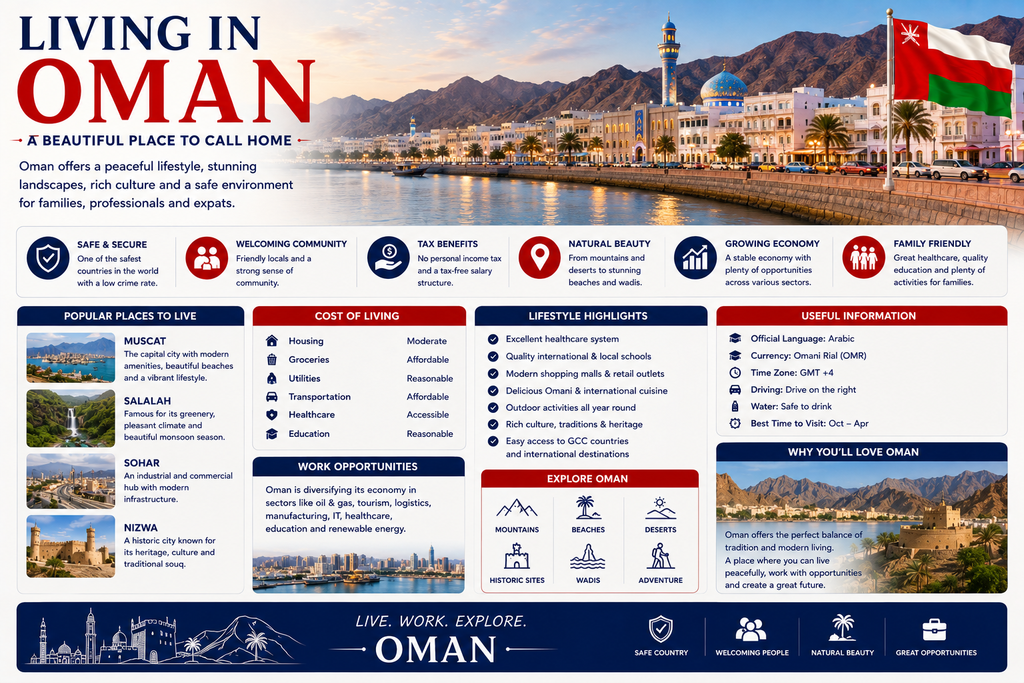
Muscat offers modern shopping centres, supermarkets and traditional markets.
International grocery products are widely available, although imported goods can cost more than local alternatives.
Families should identify supermarkets near their home before renting.
Traditional souqs also remain part of Omani life.
Mutrah Souq is one of the most famous examples and provides a completely different experience from a modern shopping mall.
This combination of traditional and contemporary retail is part of Oman’s appeal.
Culture and Social Etiquette
Understanding local culture can make Living in Oman considerably easier.
Oman is a Muslim country with strong cultural traditions.
Residents should dress respectfully, particularly in government buildings, traditional areas and religious locations.
Public behaviour should also reflect local expectations.
During Ramadan, routines and business hours can change significantly.
Expatriates who make an effort to understand Omani customs generally find it easier to build relationships with colleagues and neighbours.
Respect is particularly important when photographing people or entering culturally sensitive locations.
Language in Oman
Arabic is the official language.
However, English is widely used in business, hospitality, healthcare and many expatriate environments.
Large expatriate communities also mean languages such as Hindi, Urdu, Malayalam and other South Asian languages are commonly heard.
Learning basic Arabic can still improve everyday interactions.
Simple greetings and polite expressions can help residents connect more naturally with local communities.
Safety and Security
Safety is one of the reasons Oman attracts families and international professionals.
Government-backed relocation information describes the country as having a strong safety and stability record.
Residents should still use ordinary precautions.
Keep valuables secure.
Follow road rules.
Respect local laws.
Store copies of important documents.
Families should also know the national emergency number. Oman’s government portal lists 9999 for emergencies.
Living in Oman for Indian Expats
Indian expatriates form an important part of Oman’s international community.
For Indian families and professionals, this can make settling in easier.
Indian schools, restaurants, grocery products, community networks and cultural connections are well established.
Employment opportunities have historically attracted Indian professionals and workers across healthcare, engineering, retail, construction, education, finance and other sectors.
However, prospective employees should always verify job offers, salaries, accommodation conditions and visa arrangements before travelling.
Never rely solely on an unofficial recruitment agent.
Living in Oman for Families
Oman can be attractive to families because of its combination of residential communities, international education, healthcare and outdoor activities.
However, family relocation requires careful budgeting.
A family should calculate:
Rent
School fees
Medical insurance
Car expenses
Groceries
Utilities
Flights home
Childcare
Leisure
Emergency savings
An employment package that works comfortably for one person may be insufficient for a family once schooling and housing are included.
Living in Oman for Singles
Singles may have greater flexibility.
A professional living alone can choose a smaller apartment and reduce housing expenses.
Living close to work can also reduce the need for a long commute.
Young professionals should consider their preferred social environment before choosing a neighbourhood.
Some areas offer more restaurants and activities, while quieter neighbourhoods may provide larger or more affordable accommodation.
Sharing accommodation should only be done in accordance with applicable rental and residency rules.
Personal Income Tax in Oman
Tax is an area where future residents need current information.
Oman currently does not operate the new personal income tax regime yet. However, Royal Decree 56/2025 introduced a Personal Income Tax Law that is scheduled to take effect at the beginning of 2028.
The Oman Tax Authority states that the law will apply at a rate of 5 percent to taxable income under the law for natural persons whose total annual income exceeds OMR 42,000, subject to the law’s specific conditions and exemptions.
This is important because older guides describing Oman simply as a permanently personal-income-tax-free country are becoming outdated.
For 2026 residents, the new tax has not yet taken effect, but high-income professionals planning a long-term stay should understand the 2028 change.
Weekend Activities in Oman
Weekends can be one of the best parts of Living in Oman.
Instead of repeating the same mall and restaurant routine, residents can explore the country’s landscapes.
Popular types of weekend experiences include:
Beach days
Mountain trips
Wadi exploration
Camping
Diving
Snorkelling
Desert trips
Historic forts
Traditional villages
Road trips
Souqs
Museums
Nature photography
The best outdoor season is generally during the cooler months.
During summer, residents can shift outdoor activities to mornings, evenings or cooler mountain areas.
Advantages of Living in Oman
Oman has several advantages for expatriates.
The pace of life can feel more relaxed than some major Gulf commercial centres.
Natural landscapes are easily accessible.
International communities are well established.
Modern healthcare and international education are available.
Road infrastructure makes domestic exploration relatively easy.
Muscat also provides international flight connectivity, while the country’s position between Asia, the Middle East and Africa is convenient for international professionals.
For families, the combination of lifestyle, safety and outdoor space can be particularly appealing.
Challenges of Living in Oman
No relocation destination is perfect.
Oman’s summer heat can be difficult for newcomers.
A car may become necessary for everyday life.
Certain imported products can be expensive.
International schooling can become a major family expense.
Job opportunities for expatriates can also be affected by Omanisation policies.
Professionals may find that career switching is less flexible in certain occupations.
Social life can also feel quieter for people accustomed to extremely busy cities.
Whether these are disadvantages depends heavily on personal expectations.
How to Prepare Before Moving to Oman
Preparation can prevent many relocation problems.
Before moving, confirm your employment and residence arrangements.
Research housing close to work.
If you have children, shortlist schools early.
Understand your health insurance.
Calculate your monthly budget.
Check whether you need a car.
Prepare important documents.
Bring certified education and professional documents where required.
Keep digital copies of passports, employment contracts and certificates.
Most importantly, do not assume that a salary that sounds high in your home currency automatically guarantees a comfortable Gulf lifestyle.
Calculate expenses in Omani rials.
Common Mistakes New Expats Should Avoid
One common mistake is renting immediately without understanding Muscat’s geography.
Another is accepting a salary without calculating school or housing expenses.
New residents should also avoid:
Ignoring insurance limits
Buying a car too quickly
Choosing a home far from work
Not understanding employment conditions
Failing to keep emergency savings
Depending on unofficial visa agents
Ignoring local customs
Spending heavily during the first few months
The first months should be used to understand the country before making large financial commitments.
Frequently Asked Questions About Living in Oman
Is Oman a good country for expats?
Oman has a large expatriate population, international schools, private healthcare, modern infrastructure and a wide variety of residential and lifestyle options. Official May 2026 statistics recorded more than 2.3 million expatriates in the country.
Is Living in Oman expensive?
It depends on housing, school fees, family size and lifestyle. Housing and education can be major expenses for expatriate families.
Where do most expats live in Oman?
Muscat has the largest expatriate concentration and widest selection of jobs, international schools, hospitals and housing. Salalah, Sohar and other cities also have established expatriate communities.
Do expats need a residence card?
Yes. Foreign residents require residence documentation, and Royal Oman Police states that expatriate residents should obtain a Residence Card within 30 days of entry.
Does Oman have personal income tax?
The new Personal Income Tax Law is scheduled to begin in 2028, not 2026. It provides for a 5 percent rate on taxable income under the law for people whose total annual income exceeds OMR 42,000, subject to applicable conditions.
Is Oman suitable for families?
It can be. International schools, private healthcare and family-oriented residential communities are available, but parents should calculate education and housing costs before relocating.
Do you need a car in Oman?
For many residents, particularly families, a car makes everyday life considerably easier because Muscat and other areas are geographically spread out.
Is healthcare available for expatriates?
Yes. Oman has a private healthcare network used by expatriates, while employment and residency processes can also involve medical requirements.
Conclusion
Living in Oman can provide a rewarding combination of professional opportunity, family life, culture and outdoor adventure.
The country offers something different from the image many people have of Gulf life.
Muscat provides modern urban infrastructure without completely separating residents from nature. Salalah offers a unique seasonal climate and coastal environment. Sohar provides opportunities connected with industry and logistics, while Nizwa brings residents closer to Oman’s historic and traditional character.
For expatriates, the most important factor is preparation.
Understand your employment contract.
Check your residency requirements.
Calculate rent and school fees.
Review healthcare coverage.
Choose housing according to commute rather than appearance alone.
Plan transport realistically.
And understand that long-term financial conditions are evolving, including the personal income tax regime scheduled to begin in 2028.
Oman’s large international community also means newcomers are not entering an unfamiliar environment alone. Official statistics show expatriates account for more than two million residents, making international communities an established part of modern Oman.
At the same time, successful expatriate life involves engaging with Omani culture rather than living entirely inside an expatriate bubble.
Explore local food.
Visit traditional towns.
Learn basic Arabic phrases.
Travel through the mountains.
Experience the wadis.
Spend time on the coast.
Understand Ramadan and local customs.
Build relationships with Omani colleagues and neighbours.
The strongest reason to consider Living in Oman is therefore not one individual advantage. It is the balance between modern life and tradition, employment and outdoor experiences, international communities and a distinctive local identity.
For professionals and families whose priorities match that balance, Oman can become much more than a temporary work destination. It can become a place where career, family life and a slower, more grounded Gulf lifestyle come together.
Follow us on Instagram
Read More – Best Areas to Live in Bahrain: 10 Excellent Choices for 2026