


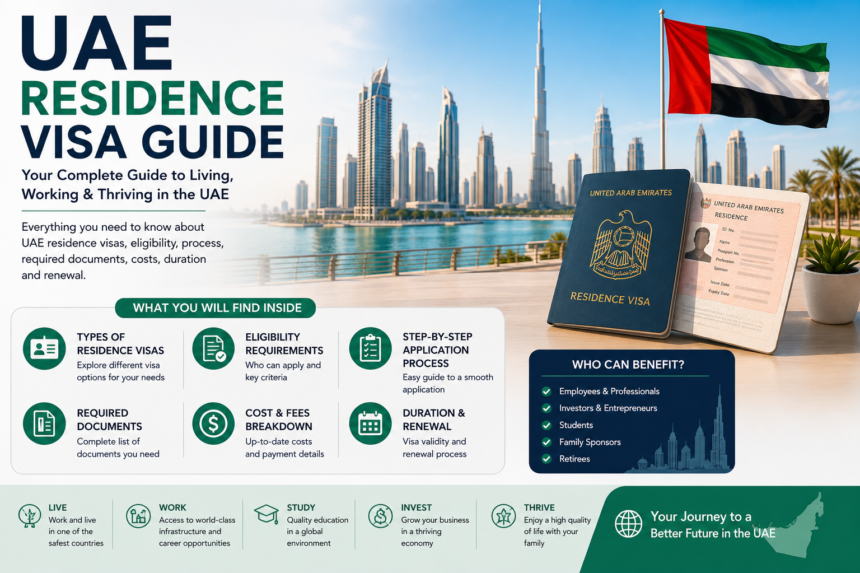
UAE Residence Visa Guide 2026 Key Requirements, Types, Process, Costs & Renewal
The UAE Residence Visa allows eligible foreign nationals to live in the United Arab Emirates for an extended period while working, studying, investing, running a business, or living with family. The UAE has become one of the world’s most popular destinations for professionals, entrepreneurs, investors, students, and families because of its strong economy, modern infrastructure, international business environment, and diverse lifestyle.
- What Is a UAE Residence Visa?
- Who Can Get a UAE Residence Visa?
- Main Types of UAE Residence Visas
- UAE Residence Visa Requirements
- UAE Residence Visa Application Process
- Medical Fitness Test for UAE Residence Visa
- Emirates ID and UAE Residence
- UAE Residence Visa Validity
- UAE Residence Visa Renewal
- Documents Commonly Needed for Renewal
- UAE Residence Visa Cancellation
- Can UAE Residents Sponsor Their Family?
- UAE Residence Visa for Children
- UAE Residence Visa for Spouse
- Residence Visa and Working in the UAE
- Residence Visa for Property Owners
- UAE Residence Visa Costs
- Dubai vs Abu Dhabi Residence Visa
- How Long Can You Stay Outside the UAE?
- Common Reasons UAE Residence Visa Applications Face Problems
- UAE Residence Visa for Expats
- Benefits of UAE Residence
- Tips for a Smooth UAE Residence Visa Application
- UAE Residence Visa FAQs
Whether you are planning to move to Dubai, Abu Dhabi, Sharjah, or another emirate, understanding the UAE residence visa process is an important part of relocating. Residence options differ according to the purpose of your stay, and requirements can vary depending on your circumstances.
This UAE Residence Visa Guide 2026 explains the main residence visa categories, eligibility requirements, application process, documents, validity, sponsorship, renewal, cancellation, and other important considerations for people planning to live in the UAE.
Important: UAE immigration rules, fees, eligibility conditions, and application procedures can change. Always confirm the latest requirements with the UAE’s official immigration authorities before submitting an application.
What Is a UAE Residence Visa?
A UAE residence visa is an immigration status that allows a foreign national to legally reside in the UAE for an approved period. It is generally connected to a specific eligibility basis, such as employment, family sponsorship, investment, business ownership, education, or specialized skills.
In many cases, the residence process involves obtaining an entry permit or changing status inside the UAE, completing required medical procedures, registering biometric information where applicable, and receiving the relevant Emirates ID.
A residence visa is different from a tourist or visit visa. A tourist visa is intended for short-term visits, while residence status is designed for people who have an approved reason to live in the country for a longer period.
Who Can Get a UAE Residence Visa?
Foreign nationals may qualify for UAE residence under several categories. The appropriate option depends on their personal and professional circumstances.
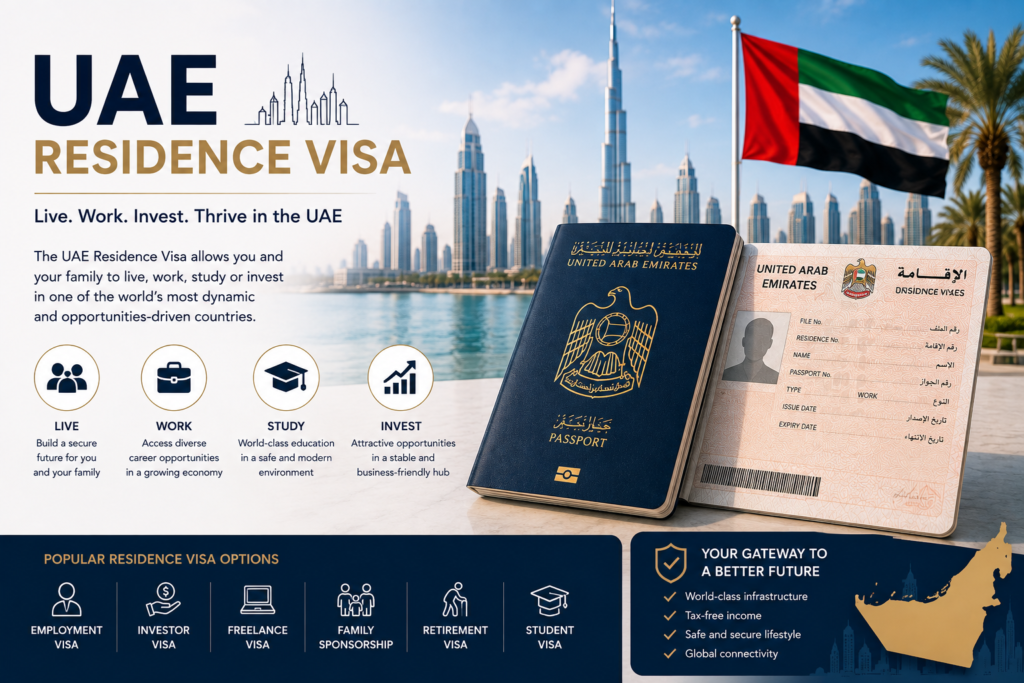
Common categories for UAE Residence Visa include:
- Employees sponsored by UAE employers
- Business owners and investors
- Property investors meeting applicable requirements
- Entrepreneurs
- Highly skilled professionals
- Students
- Family members sponsored by eligible residents
- Retirees who meet the relevant conditions
- Remote workers who qualify under applicable programs
- Individuals eligible for long-term residence programs
The exact eligibility requirements depend on the visa category.
Main Types of UAE Residence Visas
The UAE offers several residence pathways rather than one single type of residence visa. Understanding the main categories can help you identify the option that best matches your situation.
Employment Residence Visa
The employment residence visa is one of the most common options. A UAE-based employer generally sponsors an employee who has been hired to work in the country.
The employer normally handles much of the immigration and work permit process. The employee may need to complete medical fitness procedures and other formalities before residence status is finalized.
Employment residence visas are commonly used by professionals working in sectors such as:
- Finance
- Technology
- Healthcare
- Construction
- Hospitality
- Education
- Engineering
- Retail
- Logistics
- Professional services
The exact validity and renewal arrangements depend on the employment and applicable regulations.
Family Residence Visa
Eligible UAE residents can generally sponsor certain family members, subject to the applicable conditions.
Depending on the sponsor’s circumstances and current rules, family sponsorship can allow eligible relatives such as a spouse and children to live in the UAE.
Family residence applications generally require documentation proving the family relationship and meeting applicable income, accommodation, insurance, and other requirements.
Common documents may include:
- Sponsor’s Emirates ID
- Sponsor’s residence documentation
- Passport copies
- Passport photographs
- Attested marriage certificate, where applicable
- Attested birth certificates for children
- Proof of accommodation
- Other documents requested by the authorities
Requirements can vary depending on the family member and circumstances.
Golden Visa
The UAE Golden Visa is a long-term residence program designed for eligible investors, entrepreneurs, talented individuals, professionals, researchers, students, and other qualifying categories.
Depending on the category, Golden Visa holders may receive long-term residence without relying on a traditional employer sponsorship arrangement.
Eligibility is based on specific criteria, which can include professional qualifications, investments, achievements, specialized skills, academic performance, or other recognized contributions.
Because Golden Visa rules can vary by category, applicants should verify their eligibility through the relevant UAE authority before applying.
Green Residence
The UAE Green Residence is a longer-term residence pathway aimed at certain skilled professionals, freelancers, investors, and entrepreneurs.
One of its notable characteristics is that eligible individuals can obtain residence under qualifying categories without relying on the traditional employer sponsorship structure.
Eligibility conditions differ according to the category. Applicants should review current income, professional qualification, employment, freelance, investment, or business requirements before applying.
Student Residence Visa
International students enrolled in eligible UAE educational institutions may qualify for student residence arrangements.
The educational institution may assist with the application process, depending on its policies and the relevant immigration authority.
Students generally need:
- Valid passport
- Admission or enrollment confirmation
- Passport photographs
- Educational documents where required
- Medical fitness documentation where applicable
- Health insurance or other required coverage
- Institution-related sponsorship documents
Students should contact their university or college for the latest application requirements.
Retirement Residence
The UAE also has residence options for eligible retirees who meet specific financial or property-related criteria.
Retirement residence requirements may involve proof of financial resources, income, savings, investment, or property ownership depending on the applicable program.
Because eligibility conditions can change, prospective retirees should verify the current requirements before making relocation or investment decisions.
Remote Work Residence
Certain UAE residence programs are designed for individuals who work remotely for companies outside the UAE and meet the applicable conditions.
This option can appeal to digital professionals who want to live in the UAE while continuing to work for an overseas employer or business.
Applicants may need to provide evidence of employment, income, health insurance, and other documentation.
UAE Residence Visa Requirements
Residence visa requirements depend on the category, but most applications involve several basic documents and procedures.
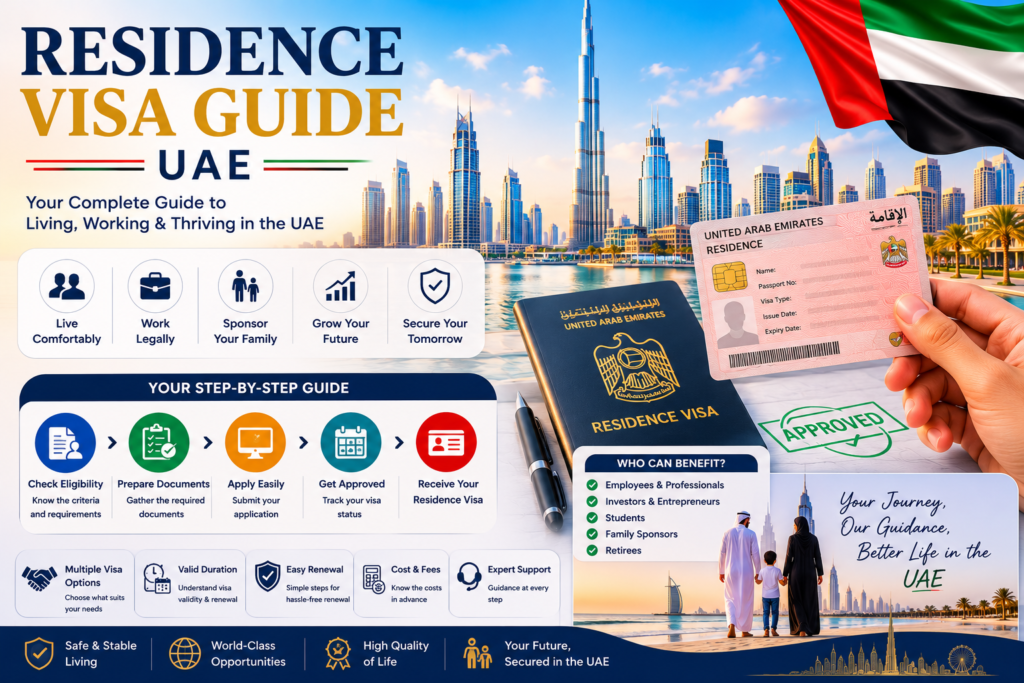
Typical requirements for UAE Residence Visa can include:
- Valid passport
- Recent passport photographs
- Entry permit or approved status
- Medical fitness test, where applicable
- Health insurance, where required
- Emirates ID application
- Sponsorship documents
- Employment or income evidence
- Educational or professional documents, depending on visa category
- Proof of relationship for family sponsorship
- Property or investment documents for relevant categories
Applicants should ensure that passports and supporting documents remain valid for the required period.
UAE Residence Visa Application Process
The process differs depending on the type of residence visa, but the general process can be understood through several steps.
Step 1: Determine Your Eligibility
First, identify the residence category that applies to you. An employee, investor, student, family member, and entrepreneur may each follow different procedures.
Step 2: Obtain Sponsorship or Eligibility Approval
If your residence depends on an employer or family sponsor, the sponsor generally initiates the relevant process.
For independent residence categories, you may need to submit evidence demonstrating that you meet the eligibility criteria.
Step 3: Apply for an Entry Permit or Change of Status
Applicants outside the UAE may need an entry permit before entering for residence purposes. People already in the UAE may be able to change their status without leaving the country, depending on the applicable rules.
Step 4: Complete Medical Fitness Requirements
Applicants in relevant age groups and categories may need to complete a medical fitness examination at an approved center.
The medical process generally includes screening required by UAE authorities.
Step 5: Apply for Emirates ID
The Emirates ID is a key identification document for UAE residents. Applicants typically submit an Emirates ID application as part of the residence process.
Biometric information may also be required depending on the applicant.
Step 6: Complete Residence Formalities
Once the required procedures are completed and approved, residence status is issued according to the applicable system and visa category.
Medical Fitness Test for UAE Residence Visa
Medical fitness testing is an important part of many UAE residence applications.
Applicants subject to the requirement usually need to visit an authorized medical fitness center. The examination is intended to determine whether the applicant meets the health requirements established for residence.
The exact procedures can vary according to the applicant’s category and the current regulations.
It is important to use an approved center and bring the required identification documents.
Emirates ID and UAE Residence
The Emirates ID is an essential identification document for residents. It is used for many government and private-sector services.
It can be required for activities such as:
- Opening bank accounts
- Accessing government services
- Obtaining mobile services
- Signing rental agreements
- Healthcare-related services
- Identification purposes
- Various financial and commercial transactions
Keeping your Emirates ID information updated is important, particularly when renewing or changing your residence status.
UAE Residence Visa Validity
Residence validity depends on the type of visa and the applicant’s eligibility.
Some residence categories may have relatively short validity periods, while long-term programs can provide residence for several years.
For example, certain long-term residence categories can provide multi-year validity, subject to meeting the relevant conditions.
Always check the exact expiry date associated with your residence status rather than assuming all UAE residence visas have the same duration.
UAE Residence Visa Renewal
Residents who want to continue living in the UAE generally need to renew their residence status before it expires.
The renewal process depends on the category and sponsor.
Employees generally coordinate renewal through their employers, while family-sponsored residents may have their renewal handled by the sponsor.
Long-term visa holders may have different renewal requirements.
It is advisable to begin the renewal process before the expiry date so there is sufficient time to resolve documentation or approval issues.
Documents Commonly Needed for Renewal
Although requirements differ, renewal applications may involve:
- Passport
- Existing Emirates ID
- Current residence information
- Medical fitness documentation where applicable
- Health insurance documentation where required
- Sponsor’s documents
- Employment documentation
- Updated photographs
- Other category-specific paperwork
Applicants should check the current requirements before submitting the renewal application.
UAE Residence Visa Cancellation
Residence status may need to be cancelled when a resident leaves employment, changes sponsorship, permanently leaves the UAE, or moves to another residence category.
Employment-sponsored residents generally have their residence status cancelled by the employer when employment ends.
Family members may also need to have their residence status cancelled or changed when the sponsor’s residence is cancelled.
The process should be handled correctly because an expired or improperly cancelled residence status can create immigration and administrative complications.
Can UAE Residents Sponsor Their Family?
Eligible residents can generally sponsor qualifying family members if they meet the relevant conditions.
Family sponsorship is particularly important for expatriates moving to the UAE with spouses and children.
The sponsor may need to demonstrate:
- Appropriate income
- Suitable accommodation
- Valid residence status
- Valid identification documents
- Proof of family relationship
- Other applicable requirements
The exact requirements can vary, so families should confirm current regulations before submitting applications.
UAE Residence Visa for Children
Parents who are eligible to sponsor their children can apply for residence arrangements for qualifying dependents.
Birth certificates and other relationship documents may need to be authenticated or attested according to the applicable requirements.
Parents should also consider schooling, healthcare, insurance, transportation, and other costs when planning a family move to the UAE.
UAE Residence Visa for Spouse
A spouse may be sponsored by an eligible UAE resident subject to applicable requirements.
Typically, the applicant will need to provide proof of the marriage relationship along with identification and sponsorship documentation.
Foreign-issued marriage certificates may need appropriate authentication or attestation before they can be accepted.
Residence Visa and Working in the UAE
Having UAE residence status does not automatically mean that a person can work in every circumstance. Employment generally requires the appropriate work authorization or permit under UAE labor and immigration rules.
For employer-sponsored employees, the employer normally handles the relevant employment authorization process.
People holding other residence categories should ensure that their employment arrangement complies with applicable regulations before starting work.
Residence Visa for Property Owners
Property ownership can be connected with certain UAE residence pathways if the applicant meets the relevant eligibility criteria.
However, simply owning any property does not automatically guarantee residence.
Eligibility may depend on factors such as:
- Property value
- Ownership status
- Financing arrangements
- Location
- Documentation
- Applicant’s financial circumstances
- Current government requirements
Anyone purchasing property primarily to qualify for residence should confirm the latest rules before making the investment.
UAE Residence Visa Costs
The total cost of obtaining UAE residence depends on the visa category, emirate, sponsor, processing method, medical examination, Emirates ID, insurance, and other factors.
Potential costs can include:
- Entry permit
- Status adjustment
- Medical fitness examination
- Emirates ID
- Residence processing
- Health insurance
- Document attestation
- Translation
- Service or typing-center charges
- Delivery fees
There is no single universal price for every UAE residence visa.
Applicants should obtain an official fee breakdown for their specific category before beginning the process.
Dubai vs Abu Dhabi Residence Visa
The overall residence framework is federal, but immigration services are administered through relevant authorities and channels depending on the emirate and circumstances.
Dubai residents commonly deal with the General Directorate of Residency and Foreigners Affairs – Dubai (GDRFA Dubai) for applicable immigration services.
In Abu Dhabi and several other emirates, applicants may use the Federal Authority for Identity, Citizenship, Customs & Port Security (ICP) and relevant service channels.
The exact authority depends on where the application is processed and the type of residence status involved.
How Long Can You Stay Outside the UAE?
Residence status can be affected by extended periods spent outside the UAE. However, the rules can differ for different categories, particularly certain long-term residence holders.
Traditional residence arrangements may have specific absence-related restrictions, while some long-term residence categories can have greater flexibility.
If you expect to spend extended periods outside the UAE, verify the rules applicable to your specific visa before traveling.
Common Reasons UAE Residence Visa Applications Face Problems
Applications can be delayed or rejected for various reasons. Common issues can include incomplete documents, incorrect information, expired passports, missing attestations, failed medical requirements, or failure to meet category-specific eligibility criteria.
To reduce problems:
- Check eligibility before applying.
- Use current forms and information.
- Make sure documents are valid.
- Complete required attestations.
- Provide accurate information.
- Use approved medical centers.
- Keep copies of submitted documents.
- Check application status regularly.
Professional assistance may be useful for complicated applications, particularly when multiple dependents or business structures are involved.
UAE Residence Visa for Expats
The UAE is home to a large expatriate population, and residence options are designed to accommodate different professional and personal circumstances.
Expats moving to the country should consider more than immigration requirements. Before relocating, it is useful to research housing, employment conditions, education, healthcare, transportation, banking, and the overall cost of living.
Your residence category can also affect your ability to sponsor family members, change employment arrangements, or remain in the UAE independently of an employer.
Benefits of UAE Residence
Obtaining valid UAE residence status provides access to many aspects of everyday life in the country.
Depending on your category and circumstances, benefits may include:
- Legal residence in the UAE
- Ability to obtain an Emirates ID
- Access to banking services
- Renting residential property
- Access to healthcare services
- Sponsoring eligible family members
- Access to government services
- Ability to establish or operate qualifying businesses
- Education and other resident services
The specific rights and privileges depend on your residence category and applicable laws.
Tips for a Smooth UAE Residence Visa Application
Preparing your documentation carefully can make the process easier.
Before applying:
- Confirm which visa category fits your circumstances.
- Check the latest eligibility criteria.
- Make sure your passport is valid.
- Prepare required photographs and documents.
- Complete document attestation where necessary.
- Use approved medical testing centers.
- Keep digital and physical copies of important documents.
- Check fees before submitting the application.
- Monitor application and Emirates ID status.
- Keep track of your residence expiry date.
If your circumstances change, such as changing jobs, getting married, having a child, or establishing a business, review whether your residence status needs to be updated.
UAE Residence Visa FAQs
Q1. How long does a UAE Residence Visa last?
Ans: The validity depends on the visa category. Some residence permits have shorter validity periods, while eligible long-term residence programs can provide multi-year status.
Q2. Can I sponsor my family in the UAE?
Ans: Eligible residents can generally sponsor qualifying family members if they satisfy the applicable requirements.
Q3. Do I need a medical test?
Ans: Many residence applicants are required to complete a medical fitness examination, depending on their category and circumstances.
Q4. Is an Emirates ID required?
Ans: Residents generally receive an Emirates ID, which serves as an important form of identification and is used for numerous government and private-sector services.
Q5. Can I work while holding a UAE Residence Visa?
Ans: Residence status alone does not necessarily provide unrestricted employment authorization. You must have the appropriate work authorization for your employment situation.
Q6. Can I apply for residence while inside the UAE?
Ans: Depending on your visa category and current status, you may be able to change your status from inside the UAE. The applicable process and fees depend on the circumstances.
Q7. Can property owners get UAE residence?
Ans: Certain property owners may qualify for residence if they meet the applicable eligibility criteria. Property ownership alone does not automatically guarantee residence.
Q8. What happens when my UAE Residence Visa expires?
Ans: Residents should renew their residence status before expiry when they intend to remain in the UAE. Overstaying or failing to complete required procedures can result in penalties or immigration complications.
Final Thoughts
The UAE Residence Visa is an essential part of living in the United Arab Emirates for foreign nationals who intend to stay for an extended period. With multiple pathways available, the right option depends on whether you are moving for employment, family, education, investment, entrepreneurship, retirement, remote work, or another qualifying purpose.
The application process generally involves establishing eligibility, preparing documents, obtaining the appropriate approval or sponsorship, completing medical requirements where applicable, applying for an Emirates ID, and finalizing residence formalities.
Because UAE immigration policies can change, applicants should always verify the latest information, eligibility requirements, processing procedures, and government fees before applying. Choosing the correct UAE residence visa category from the beginning can make relocation considerably easier.
For anyone planning to move to the UAE in 2026, understanding the UAE Residence Visa requirements, types, application process, costs, renewal rules, and sponsorship options is an important first step toward establishing a successful life in the country.
Do follow us on Instagram
Read More – UAE Visa Guide 2026 Best Things Need to Know Before Travel