


Dubai’s Clean Energy Transformation Is Bigger Than You Think
Dubai is famous for turning ambitious ideas into large-scale infrastructure. Today, some of that ambition is being directed toward an equally important challenge: producing energy more sustainably.
- Why Green Energy Projects Dubai Matter
- Mohammed bin Rashid Al Maktoum Solar Park Is at the Centre of Dubai’s Energy Transition
- How Dubai Turned Desert Sunshine Into an Energy Asset
- The Solar Park Is Also an Investment Model
- Green Hydrogen Could Become Dubai’s Next Major Energy Opportunity
- Why Green Hydrogen Matters
- Energy Storage Is Critical to the Renewable Transition
- Innovation Is Becoming Part of Dubai’s Clean-Energy Infrastructure
- Dubai Could Become a Clean-Energy Technology Testing Ground
- Solar-Powered Desalination Could Connect Energy and Water
- Sustainable Mobility Will Increase Demand for Clean Electricity
- Buildings Are Another Major Part of Dubai’s Energy Challenge
- AI Could Make Dubai’s Energy Grid Smarter
- Clean Energy Could Create New Business Opportunities
- Green Energy Jobs in Dubai Could Become More Diverse
- What Are Dubai’s Biggest Green Energy Projects and Technologies?
- Challenges Dubai Must Overcome
- What Could Dubai’s Energy System Look Like by 2030?
- What Could Dubai Look Like by 2050?
- FAQs About Green Energy Projects Dubai
- Conclusion
Green Energy Projects Dubai are becoming central to the emirate’s long-term development plans. From one of the world’s largest single-site solar developments to green hydrogen, energy storage and cleaner technologies, Dubai is investing in infrastructure designed to reduce its dependence on conventional energy sources.
At the centre of this transition are the Dubai Clean Energy Strategy 2050 and Dubai Net Zero Carbon Emissions Strategy 2050, which target 100% of Dubai’s energy production capacity from clean sources by 2050.
One project demonstrates the scale of that ambition particularly clearly. The Mohammed bin Rashid Al Maktoum Solar Park has already reached 3,860MW of production capacity, while its planned 2030 capacity has been increased to more than 8,000MW.
But solar power is only part of the story.
Dubai’s clean-energy transition is increasingly connecting renewable generation with hydrogen, research, energy storage, sustainable mobility and smarter infrastructure.
Why Green Energy Projects Dubai Matter
Dubai’s economic growth creates enormous energy requirements.
Homes need electricity. Hotels operate around the clock. Data centres require reliable power. Transport networks, airports, commercial districts and industrial facilities all depend on energy infrastructure.
The challenge is meeting growing demand while reducing environmental impact.
That is where renewable and clean-energy projects become strategically important.
Dubai’s approach is built around several connected priorities:
- increasing clean-energy generation,
- developing renewable-energy infrastructure,
- testing emerging technologies,
- encouraging private-sector investment,
- improving energy efficiency,
- supporting sustainable mobility,
- and reducing carbon emissions.
This is not a short-term environmental campaign.
It is a multi-decade infrastructure transformation.
The Dubai Clean Energy Strategy 2050 has evolved to target 100% clean energy production capacity by 2050. DEWA has also incorporated achieving net zero by 2050 into its strategic vision.
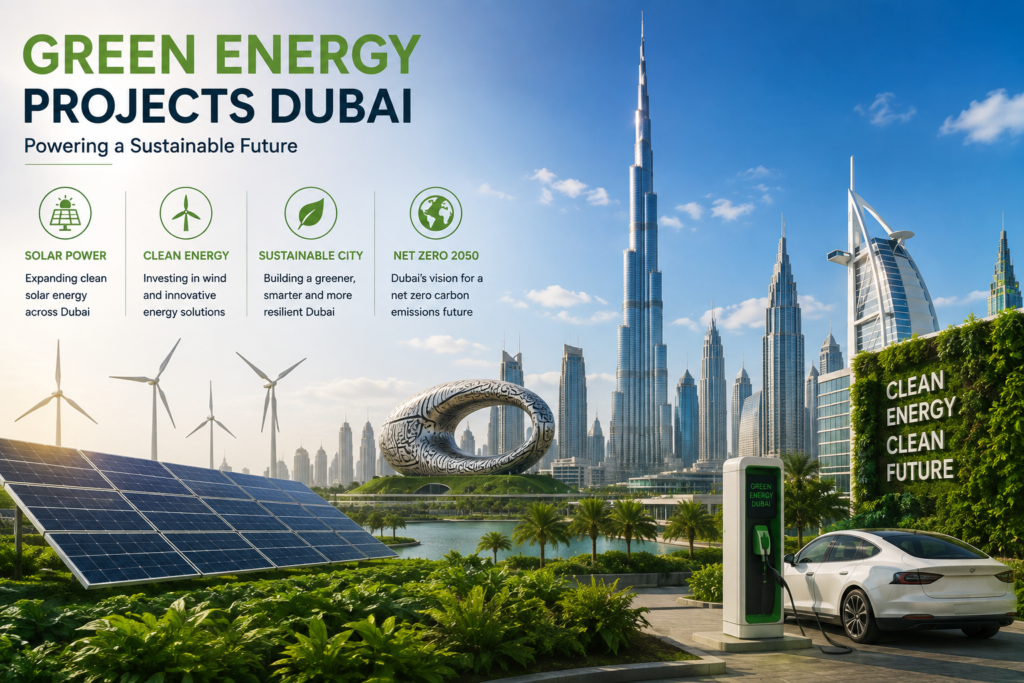
Suggested image placement: Dubai skyline connected visually to solar panels and clean-energy infrastructure.
Mohammed bin Rashid Al Maktoum Solar Park Is at the Centre of Dubai’s Energy Transition
No discussion of Green Energy Projects Dubai is complete without the Mohammed bin Rashid Al Maktoum Solar Park.
Launched in 2012 and implemented by Dubai Electricity and Water Authority (DEWA), the project has become the centrepiece of Dubai’s renewable-energy expansion.
DEWA describes it as the world’s largest single-site solar park based on the Independent Power Producer model.
The scale has continued to increase.
DEWA’s latest project information says:
| Solar Park Metric | Current/Planned Scale |
|---|---|
| Current production capacity | 3,860MW |
| Planned capacity by 2030 | More than 8,000MW |
| Clean-energy share of DEWA capacity | More than 21.5% |
| Target clean-energy share by 2030 | 36% |
| Expected annual emissions reduction | More than 8.5 million tonnes |
These updated figures are particularly significant because the original plan had targeted 5,000MW by 2030.
In other words, Dubai is not simply continuing its original solar plan. It has expanded the ambition.
How Dubai Turned Desert Sunshine Into an Energy Asset
Dubai has one obvious renewable resource: sunlight.
Instead of viewing the desert climate purely as an environmental challenge, solar-energy infrastructure allows the emirate to turn intense sunshine into electricity.
The Mohammed bin Rashid Al Maktoum Solar Park combines different solar technologies across its development.
These include photovoltaic solar panels and concentrated solar power.
Photovoltaic technology converts sunlight directly into electricity.
Concentrated solar power works differently. Mirrors concentrate solar radiation to produce thermal energy, which can then be used for power generation.
Using different technologies allows Dubai to explore how solar power can become a more dependable part of its overall energy system.
The solar park has expanded through multiple phases, moving from a relatively modest beginning into a utility-scale clean-energy complex.
Its first phase had a capacity of just 13MW when it became operational in 2013.
The contrast with today’s multi-gigawatt capacity demonstrates just how quickly the project has expanded.
The Solar Park Is Also an Investment Model
The technology receives much of the attention, but the financing structure is equally important.
The Mohammed bin Rashid Al Maktoum Solar Park uses the Independent Power Producer, or IPP, model.
Instead of government alone developing every phase, the model creates partnerships involving DEWA and private-sector energy developers.
This approach has attracted major international energy companies and investors.
It also demonstrates how renewable energy can become an investment opportunity rather than simply a government sustainability expense.
That matters for the wider Gulf.
Large renewable-energy transitions require enormous amounts of capital. Public-private partnerships can help governments build infrastructure while bringing technical expertise and investment from the private sector.
Dubai’s solar programme therefore offers lessons that extend beyond electricity generation.
Green Hydrogen Could Become Dubai’s Next Major Energy Opportunity
Solar energy works extremely well when the sun is shining.
But the global energy transition requires technologies capable of supporting industries and applications where direct electrification can be difficult.
Hydrogen could potentially fill part of that gap.
Dubai has already begun experimenting with the technology.
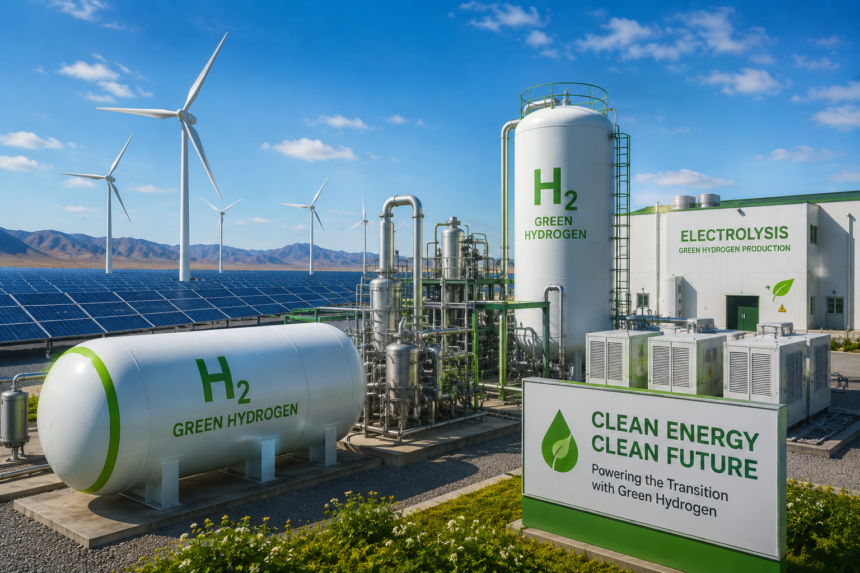
DEWA’s Green Hydrogen project at the Mohammed bin Rashid Al Maktoum Solar Park is the first project of its kind in the Middle East and North Africa to produce green hydrogen using solar energy.
The project was developed in collaboration with Expo 2020 Dubai and Siemens Energy.
Its operating concept is relatively straightforward.
Renewable electricity powers electrolysis, which separates hydrogen from water. Because the electricity comes from renewable energy, the resulting hydrogen is considered green hydrogen.
The pilot produces approximately 20 kilograms of hydrogen per hour and includes storage capacity equivalent to up to 12 hours of production.
That hydrogen can also be used for nighttime electricity generation through a hydrogen gas motor with a capacity of around 300kW.
Suggested image placement: Green hydrogen facility at the Mohammed bin Rashid Solar Park.
Why Green Hydrogen Matters
Hydrogen is attracting global attention because some industries are difficult to decarbonize using batteries alone.
Potential applications include:
- heavy transport,
- shipping,
- aviation-related fuels,
- industrial processes,
- electricity generation,
- and long-term energy storage.
Dubai’s existing Green Hydrogen project is still relatively small compared with industrial-scale hydrogen production.
Its importance lies in experimentation.
The facility gives researchers and energy specialists an opportunity to understand production, storage and potential applications under local environmental conditions.
The project has already produced meaningful results.
DEWA reported in December 2024 that approximately 90 tonnes of green hydrogen had been produced since the project’s launch in May 2021. Most of it was used to generate more than 1GWh of green energy, avoiding approximately 450 tonnes of CO2 emissions.
That makes the project more than a theoretical demonstration.
It is generating operational knowledge that could help determine where hydrogen fits into Dubai’s future energy system.
Energy Storage Is Critical to the Renewable Transition
Renewable energy introduces an obvious challenge.
The sun does not shine at night.
Electricity demand, however, does not disappear after sunset.
That means a renewable-energy system needs flexibility.
Energy storage allows electricity generated during periods of high renewable production to be stored and used later.
Dubai’s clean-energy strategy therefore goes beyond installing more solar panels.
Technologies such as concentrated solar power with thermal storage, batteries and potentially hydrogen can help balance electricity supply and demand.
This is important because the real measure of a successful renewable-energy transition is not simply how much solar capacity exists.
It is whether clean electricity can remain reliable when people actually need it.
Innovation Is Becoming Part of Dubai’s Clean-Energy Infrastructure
Renewable-energy projects can quickly become outdated if they are built without investment in research.
Dubai has attempted to address this by connecting its solar infrastructure with research and innovation.
The Mohammed bin Rashid Al Maktoum Solar Park includes both an Innovation Centre and a Research and Development Centre.
These facilities support work around clean and renewable technologies while building local knowledge and technical capabilities.
Research is particularly important in the Gulf environment.
Solar panels in Dubai operate under conditions involving:
- extreme heat,
- dust,
- desert winds,
- high solar radiation,
- and limited rainfall.
Understanding how different technologies perform in these conditions can help improve efficiency and reduce maintenance costs.
It can also produce knowledge relevant to other hot and arid countries.
Dubai Could Become a Clean-Energy Technology Testing Ground
Dubai’s energy transition creates an interesting opportunity beyond electricity production.
It can become a real-world testing environment for technologies designed for hot climates.
This includes areas such as:
- solar-panel performance,
- automated panel cleaning,
- energy storage,
- green hydrogen,
- smart grids,
- artificial intelligence for energy management,
- water desalination,
- and electric mobility.
Companies developing clean technologies need environments where systems can be tested at meaningful scale.
Dubai’s combination of infrastructure investment, strong solar resources and large urban energy demand creates those conditions.
The result could be a clean-energy ecosystem connecting government infrastructure with universities, startups, engineers and international technology companies.
Solar-Powered Desalination Could Connect Energy and Water
Water and energy are deeply connected in the Gulf.
Dubai depends heavily on desalination to produce potable water.
Traditional desalination can be energy intensive, which means making water production more efficient can also contribute to sustainability goals.
DEWA has been moving toward seawater reverse osmosis, a technology that generally requires less energy than conventional thermal desalination.
Dubai’s longer-term strategy includes plans for large-scale solar-powered desalination infrastructure at Hassyan. DEWA has highlighted this as part of its broader roadmap toward net zero.
This illustrates an important point.
Dubai’s green transition cannot be separated into isolated sectors.
Electricity affects water.
Water affects cities.
Transport affects electricity demand.
Buildings affect cooling demand.
A sustainable city requires these systems to work together.
Sustainable Mobility Will Increase Demand for Clean Electricity
Electric vehicles do not produce tailpipe emissions, but their broader environmental benefit depends partly on how the electricity charging them is generated.
As more electric vehicles appear on Dubai’s roads, clean electricity becomes increasingly important.
This creates a connection between renewable-energy projects and sustainable transport.
Solar generation can contribute to a cleaner electricity mix, while charging networks make electric mobility more practical.
Green hydrogen could potentially complement batteries in certain heavy-duty transportation applications in the future.
DEWA specifically notes that its Green Hydrogen project supports the Dubai Green Mobility Strategy 2030 and is designed to accommodate future applications in transport as well as energy and industry.
The transition therefore involves more than replacing one type of power station with another.
It is about changing the wider energy system.
Buildings Are Another Major Part of Dubai’s Energy Challenge
Dubai’s skyline is one of its greatest economic assets.
It is also a major source of energy demand.
Buildings require electricity for:
- air conditioning,
- lighting,
- elevators,
- appliances,
- water systems,
- and digital infrastructure.
Cooling is particularly important because of Dubai’s climate.
That means energy efficiency can sometimes be as valuable as generating additional electricity.
A building that requires less power reduces pressure on the electricity grid regardless of where the energy comes from.
Smart-building technology can help manage this demand.
Sensors and automated systems can adjust cooling, lighting and equipment according to occupancy and real-time conditions.
AI could make these systems even more efficient by predicting demand before it occurs.
This creates another important principle of the clean-energy transition:
The greenest unit of electricity can sometimes be the one that never needs to be generated.
AI Could Make Dubai’s Energy Grid Smarter
Artificial intelligence is likely to play a growing role in clean-energy systems.
Traditional electricity networks were largely designed around predictable power generation.
Renewable sources are more variable.
AI can analyse weather information, historical demand and real-time electricity consumption to predict how much energy will be required and how much renewable power is likely to be available.
Potential applications include:
- electricity-demand forecasting,
- solar-generation forecasting,
- predictive maintenance,
- grid optimization,
- battery management,
- equipment monitoring,
- and identifying unusual consumption patterns.
The combination of AI + renewable energy + smart grids could therefore become increasingly important to Dubai’s sustainability strategy.
Clean Energy Could Create New Business Opportunities
Green-energy investment does not benefit only utility companies.
It can create an entire economic ecosystem.
Potential opportunities include:
- solar engineering,
- clean-energy consulting,
- energy auditing,
- sustainable construction,
- battery technology,
- electric vehicle infrastructure,
- hydrogen technology,
- AI energy systems,
- carbon management,
- environmental consulting,
- and green finance.
The transition also creates demand for professionals who understand both technology and sustainability.
Engineers need renewable-energy expertise.
Architects increasingly need to understand energy-efficient design.
Financial professionals may work on green investment.
Data specialists can help optimize energy systems.
Policy professionals need to understand climate and energy regulation.
This makes green energy an economic story as much as an environmental one.
Green Energy Jobs in Dubai Could Become More Diverse
As clean-energy infrastructure expands, career opportunities could develop across different skill levels.
Potential roles include:
- solar engineers,
- electrical engineers,
- hydrogen specialists,
- sustainability consultants,
- energy analysts,
- environmental engineers,
- project managers,
- data scientists,
- AI specialists,
- ESG professionals,
- clean-energy researchers,
- and sustainable-building specialists.
Not every green-energy job requires designing solar panels.
The sector also needs finance, legal, operations, communications, policy and project-management professionals.
That creates opportunities for people from a wide range of professional backgrounds.
What Are Dubai’s Biggest Green Energy Projects and Technologies?
| Project / Area | Role in Dubai’s Transition |
| Mohammed bin Rashid Solar Park | Large-scale solar electricity generation |
| Green Hydrogen Project | Testing renewable hydrogen production and applications |
| Concentrated solar power | Solar generation combined with thermal-energy capabilities |
| Solar photovoltaic power | Large-scale renewable electricity |
| Energy storage | Balancing renewable generation and demand |
| Smart grids | More efficient electricity management |
| Solar-powered desalination | Connecting clean energy with water production |
| Green mobility | Supporting cleaner transportation |
| R&D and Innovation Centre | Developing and testing clean technologies |
| Energy-efficient buildings | Reducing overall electricity demand |
Together, these projects show that Green Energy Projects Dubai extend far beyond solar panels.
They are gradually creating an interconnected clean-energy system.
Challenges Dubai Must Overcome
The scale of Dubai’s ambition does not eliminate the challenges.
One major issue is intermittency.
Solar generation changes according to time of day and weather conditions.
Storage solutions must therefore continue improving.
Another challenge is electricity demand.
Dubai continues to grow, meaning clean-energy capacity must expand while simultaneously meeting additional demand from new residents, buildings, businesses and infrastructure.
Other challenges include:
- the cost of emerging technologies,
- energy-storage requirements,
- integrating renewable power into existing grids,
- maintaining equipment in desert conditions,
- developing specialized talent,
- and decarbonizing difficult industrial sectors.
Green hydrogen also remains more expensive than many conventional energy sources in many applications.
That means technologies must continue improving before every clean-energy solution becomes commercially competitive at scale.
What Could Dubai’s Energy System Look Like by 2030?
The next few years could significantly change Dubai’s electricity landscape.
The Mohammed bin Rashid Al Maktoum Solar Park is now expected to exceed 8,000MW of production capacity by 2030, according to DEWA’s latest project information.
DEWA also says clean energy currently represents more than 21.5% of its total production capacity, with the share targeted to reach 36% by 2030.
Those numbers suggest a future in which solar power is no longer an alternative or experimental source.
It becomes a substantial part of mainstream electricity generation.
At the same time, technologies such as hydrogen, storage, smart grids and cleaner desalination could help make that renewable capacity more useful across the economy.
What Could Dubai Look Like by 2050?
The 2050 vision is much larger.
Dubai’s official strategy targets 100% of energy production capacity from clean energy sources by 2050.
Reaching that target would require transformation across multiple sectors.
Electricity generation would need to become significantly cleaner.
Buildings would need greater efficiency.
Transportation would need further electrification and alternative fuels.
Water production would need cleaner technologies.
Energy storage would become increasingly important.
Industrial operations would also need lower-carbon solutions.
By that point, clean energy may no longer be discussed as a separate category.
It could simply become the normal way Dubai’s infrastructure operates.
FAQs About Green Energy Projects Dubai
What are the major green energy projects in Dubai?
The Mohammed bin Rashid Al Maktoum Solar Park is Dubai’s flagship renewable-energy development. Other important initiatives include the Green Hydrogen project, energy storage, smart-grid technologies, sustainable mobility and cleaner desalination projects.
What is the biggest solar project in Dubai?
The Mohammed bin Rashid Al Maktoum Solar Park is Dubai’s largest solar-energy project. DEWA describes it as the world’s largest single-site solar park based on the Independent Power Producer model.
How much electricity does the Mohammed bin Rashid Solar Park produce?
According to DEWA’s latest project information, its production capacity has reached 3,860MW. Capacity is planned to exceed 8,000MW by 2030.
Does Dubai produce green hydrogen?
Yes. DEWA operates a Green Hydrogen pilot at the Mohammed bin Rashid Solar Park. It produces around 20kg of hydrogen per hour using solar energy.
What is Dubai’s clean-energy target for 2050?
Dubai’s Clean Energy Strategy and Net Zero Carbon Emissions Strategy target 100% of energy production capacity from clean sources by 2050.
Why is solar energy suitable for Dubai?
Dubai receives abundant sunlight, making solar power a natural renewable resource. Large areas of available desert land can also support utility-scale solar developments.
Will green energy create jobs in Dubai?
Clean-energy expansion can create opportunities across engineering, project management, sustainability, hydrogen, solar technology, energy efficiency, AI, data analytics, green finance and environmental services.
Conclusion
Green Energy Projects Dubai are gradually changing the way the emirate thinks about electricity, infrastructure and long-term economic development.
At the centre of this transformation is the Mohammed bin Rashid Al Maktoum Solar Park.
What began with a 13MW first phase in 2013 has developed into a multi-gigawatt renewable-energy complex. Its current production capacity has reached 3,860MW, and DEWA now expects capacity to exceed 8,000MW by 2030.
Around that solar infrastructure, Dubai is experimenting with technologies that could become increasingly important in the decades ahead.
Green hydrogen could support sectors that are difficult to electrify. Energy storage could make renewable electricity more dependable. Smart grids and AI could improve efficiency. Cleaner desalination could connect the city’s energy transition with water security.
All of these initiatives support a much bigger objective: providing 100% of Dubai’s energy production capacity from clean sources by 2050.
There are significant technical and economic challenges ahead, and not every emerging technology will develop at the same speed.
But Dubai’s approach demonstrates that its energy transition is no longer based on a single renewable project.
It is increasingly becoming an interconnected clean-energy ecosystem built around generation, storage, innovation, efficiency and infrastructure.
The skyscrapers may define Dubai’s skyline today.
The energy systems powering them could define the city’s next chapter.
follow us on Instagram
Read More – E-commerce Growth in the GCC: How Online Shopping Is Reshaping Gulf Retail