Best Career Opportunities for Expats and Professionals in 2026
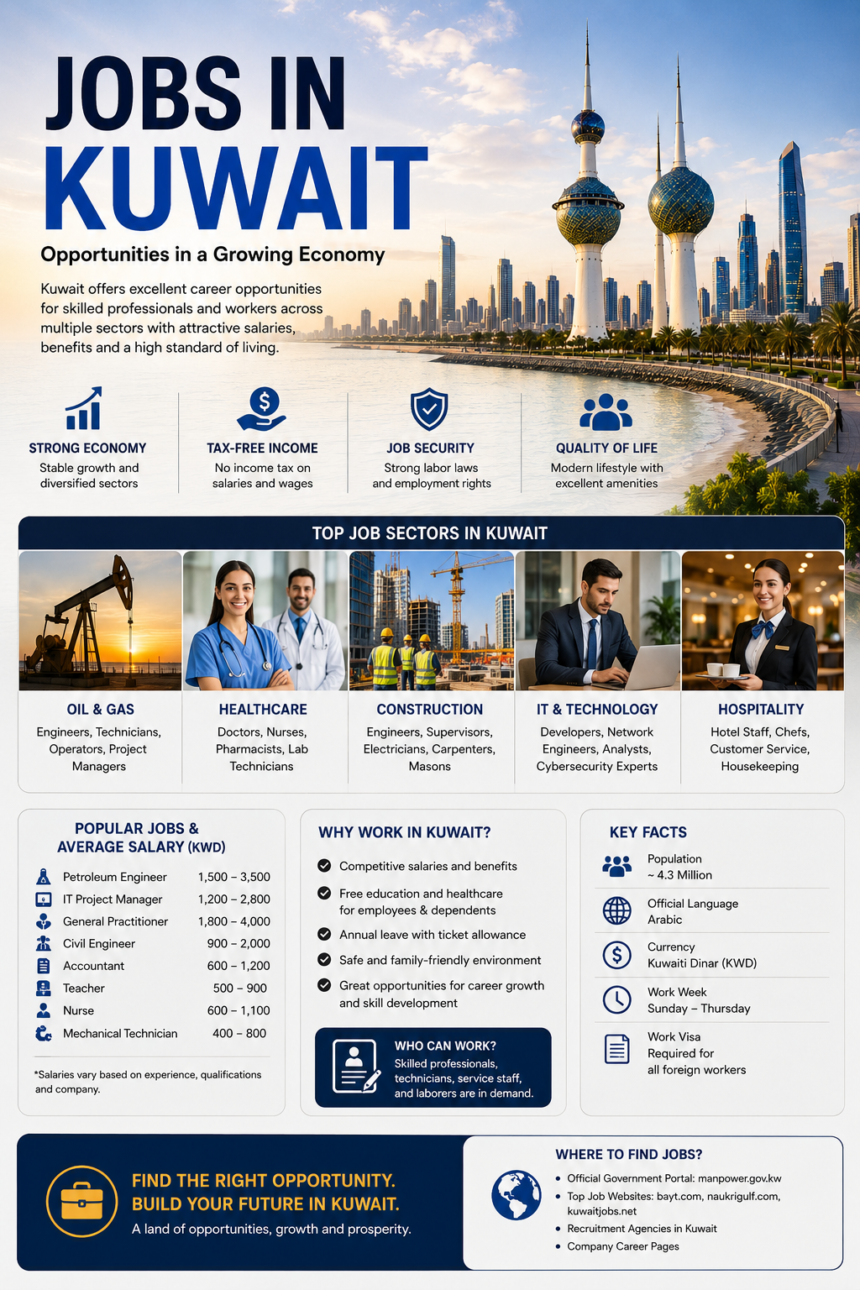
Finding Jobs in Kuwait remains an attractive option for thousands of professionals and workers looking to build careers in the Gulf. Kuwait has a large expatriate workforce, a high-income economy and established industries ranging from oil and gas to healthcare, construction, finance, education, technology and logistics.
- Jobs in Kuwait for Expats and Skilled Professionals in 2026
- 1. Oil and Gas Jobs in Kuwait
- 2. Engineering Jobs in Kuwait
- 3. Healthcare Jobs in Kuwait
- 4. Nursing Jobs in Kuwait
- 5. IT and Technology Jobs in Kuwait
- 6. Cybersecurity Jobs in Kuwait
- 7. Construction Jobs in Kuwait
- 8. Finance and Banking Jobs in Kuwait
- 9. Accounting Jobs in Kuwait
- 10. Teaching Jobs in Kuwait
- 11. Logistics and Supply Chain Jobs
- 12. Hospitality and Restaurant Jobs
- 13. Sales and Marketing Jobs in Kuwait
- 14. Retail Jobs in Kuwait
- 15. Skilled Trade and Technical Jobs
- Jobs in Kuwait for Foreigners
- Jobs in Kuwait for Indians
- Kuwait Work Visa for Private-Sector Jobs
- Documents Required for Kuwait Employment
- How to Find Jobs in Kuwait
- Do Not Pay for Fake Kuwait Jobs
- Salary Is Only Part of a Kuwait Job Offer
- Skills That Can Help You Get a Job in Kuwait
- Understanding Kuwaitization
- How Kuwait Vision 2035 Could Affect Jobs
- Infrastructure Projects and Future Employment
- Private-Sector Jobs Will Become More Important
- Is Kuwait Good for Jobs in 2026?
- Should You Move to Kuwait Without a Job?
- Future of Jobs in Kuwait
- Final Thoughts on Jobs in Kuwait
The employment market is also changing.
Kuwait is working toward a more diversified economy under Kuwait Vision 2035, with greater emphasis on private-sector development, infrastructure, human capital and non-oil economic activity.
For expatriates, this transformation creates opportunities but also greater competition.
Employers increasingly look for candidates with professional qualifications, technical expertise, digital skills, industry experience and the ability to adapt to changing business requirements.
At the same time, Kuwait continues policies aimed at increasing employment opportunities for Kuwaiti nationals.
According to the International Monetary Fund’s 2026 assessment, expatriates still fill the vast majority of private-sector positions, while Kuwait’s long-term economic strategy is focused on developing a stronger private sector and improving labour-market productivity.
For anyone planning to work in Kuwait, understanding which industries are hiring and how the employment and visa system works is essential.
This guide explores Jobs in Kuwait in 2026, including some of the strongest career sectors, opportunities for foreigners, work permits, job-search strategies and skills that can improve your chances of employment.
Jobs in Kuwait for Expats and Skilled Professionals in 2026
Kuwait’s labour market has traditionally had a clear division.
Kuwaiti nationals have historically been concentrated in government employment, while expatriates have played a major role in private-sector jobs.
The IMF reported in 2026 that expatriates continue to fill the vast majority of private-sector employment in Kuwait.
However, the country is pursuing labour-market reforms and private-sector development as part of its wider economic transformation.
For foreign professionals, this means Kuwait remains an important employment destination, but applicants should expect stronger competition and increasing demand for specialised skills.
Candidates with expertise in healthcare, engineering, technology, finance, construction and technical professions can be particularly valuable where employers require specific experience.
1. Oil and Gas Jobs in Kuwait
Oil and gas remain central to Kuwait’s economy.
The sector creates employment directly and indirectly through engineering, maintenance, logistics, construction, safety, inspection and technical services.
Potential positions include:
Petroleum engineers
Mechanical engineers
Electrical engineers
Chemical engineers
Process engineers
HSE professionals
Project managers
Maintenance technicians
Instrumentation engineers
Welders
Inspectors
Drilling professionals
Geologists
Experienced professionals with specialised oil and gas qualifications can have an advantage.
However, applicants should understand that large energy projects frequently involve contractors and specialist service providers in addition to major national companies.
2. Engineering Jobs in Kuwait
Engineering remains one of the most important professional categories for Kuwait’s development.
Major infrastructure investment planned through 2030 creates continued relevance for engineers across construction, housing, transportation, electricity and water.
The IMF reported in 2026 that Kuwait had announced major public investment projects concentrated in housing, electricity, water and transportation.
This can create opportunities throughout the wider project ecosystem.
In-demand engineering disciplines can include:
Civil engineering
Mechanical engineering
Electrical engineering
Structural engineering
Project engineering
Industrial engineering
Environmental engineering
MEP engineering
Quantity surveying
Planning engineering
Engineering candidates with GCC experience and recognised professional certifications may have an advantage.
3. Healthcare Jobs in Kuwait
Healthcare provides opportunities for doctors, nurses, pharmacists, technicians and other medical professionals.
Kuwait Vision 2035 identifies high-quality healthcare as one of the country’s development pillars.
Potential careers include:
Doctors
Specialist physicians
Nurses
Dentists
Pharmacists
Physiotherapists
Radiographers
Laboratory technicians
Medical technicians
Healthcare administrators
Dietitians
Healthcare professionals normally need to meet licensing and qualification requirements before practising.
Applicants should therefore investigate professional recognition and licensing before accepting a position.
4. Nursing Jobs in Kuwait
Nursing deserves particular attention because hospitals and healthcare facilities require skilled clinical staff across many departments.
Opportunities can exist in:
Emergency nursing
ICU
Operating theatres
Paediatrics
Maternity
Outpatient departments
Medical wards
Surgical wards
Home healthcare
Private clinics
Candidates with specialist experience may have stronger opportunities than newly qualified applicants.
Nurses should confirm whether accommodation, transportation, medical insurance and annual flights are included in the employment package.
5. IT and Technology Jobs in Kuwait
Digital transformation is creating new career possibilities.
Businesses, banks, telecom companies, government entities and other organisations increasingly depend on technology infrastructure.
Potential jobs include:
Software developers
Cybersecurity professionals
Network engineers
Cloud specialists
Data analysts
Database administrators
IT support professionals
Artificial intelligence specialists
ERP consultants
Systems administrators
Digital transformation consultants
Technology professionals should continuously update their skills.
Cloud computing, cybersecurity, AI, automation and data analysis are becoming particularly valuable across modern organisations.
6. Cybersecurity Jobs in Kuwait
As organisations become more digital, cybersecurity becomes more important.
Banks, government institutions, energy companies, healthcare organisations and large businesses all need to protect sensitive systems and information.
Potential cybersecurity roles include:
Security analysts
Security engineers
SOC analysts
Network security specialists
Cloud security professionals
Penetration testers
Information security managers
Governance and compliance professionals
Cybersecurity certifications can strengthen a candidate’s profile.
Employers may also value professionals who understand international security frameworks and regulatory compliance.
7. Construction Jobs in Kuwait
Construction remains important because of housing and infrastructure development.
The IMF’s 2026 Kuwait assessment highlights significant public investment planned for housing and infrastructure between 2025 and 2030.
This creates potential employment not only for engineers but throughout the construction supply chain.
Jobs can include:
Project managers
Site engineers
Civil engineers
Quantity surveyors
Safety officers
Electricians
Plumbers
Carpenters
Welders
Heavy-equipment operators
Foremen
Construction supervisors
Architects
Workers should be cautious about recruitment fraud.
Never pay large unofficial fees to individuals promising guaranteed jobs or visas.
8. Finance and Banking Jobs in Kuwait
Kuwait has an established banking and financial-services industry.
The country’s long-term objective of becoming a stronger financial and commercial centre increases the importance of skilled finance professionals.
Possible positions include:
Accountants
Financial analysts
Auditors
Risk professionals
Compliance specialists
Investment professionals
Relationship managers
Credit analysts
Treasury professionals
Tax specialists
Internal auditors
Candidates with internationally recognised qualifications may have stronger prospects.
Digital finance skills are also becoming increasingly relevant as banking services become more technology-driven.
9. Accounting Jobs in Kuwait
Accounting remains necessary across almost every industry.
Companies need professionals to manage financial reporting, budgeting, payroll, auditing and compliance.
Common positions include:
Accountant
Senior accountant
Cost accountant
Management accountant
Financial controller
Internal auditor
Accounts payable specialist
Accounts receivable specialist
Payroll officer
Finance manager
Qualifications such as ACCA, CPA, CMA or CA can strengthen a professional profile, particularly for senior positions.
Experience with ERP systems and modern accounting software can also improve employability.
10. Teaching Jobs in Kuwait
Education provides another career path for expatriates.
Private and international schools employ teachers across different curricula.
Opportunities may exist for:
English teachers
Mathematics teachers
Science teachers
Primary teachers
Early-years educators
Special education professionals
School counsellors
Department heads
Academic coordinators
School administrators
Universities and training organisations can also employ lecturers, researchers and professional trainers.
Teachers should compare complete employment packages carefully.
Housing and school benefits can significantly affect the real value of an offer.
11. Logistics and Supply Chain Jobs
Kuwait’s position in the Gulf and its commercial economy support employment in logistics and supply-chain management.
Potential careers include:
Supply-chain managers
Procurement specialists
Warehouse managers
Inventory controllers
Logistics coordinators
Fleet managers
Freight professionals
Customs specialists
Purchasing officers
Operations managers
Digital logistics platforms and automation are changing the sector.
Professionals who combine operational experience with data and technology skills may have stronger long-term prospects.
12. Hospitality and Restaurant Jobs
Hotels, restaurants, catering companies and food businesses provide employment opportunities for expatriates.
Jobs include:
Chefs
Restaurant managers
Waiters
Baristas
Hotel receptionists
Housekeeping staff
Food and beverage managers
Catering professionals
Sales executives
Marketing professionals
Hotel operations managers
Experience in premium hospitality can be particularly useful when applying to international hotel groups.
Language and customer-service skills are also important.
13. Sales and Marketing Jobs in Kuwait
Almost every private-sector business needs customers.
This creates demand for sales and marketing professionals across real estate, technology, healthcare, retail, automotive, hospitality and professional services.
Potential positions include:
Sales executives
Business development managers
Account managers
Digital marketers
Social media specialists
Content creators
SEO professionals
Performance marketers
Brand managers
Marketing managers
E-commerce specialists
Modern employers increasingly want candidates who can demonstrate measurable results.
A marketer who can show traffic growth, qualified leads or revenue impact may stand out more than someone listing only job responsibilities.
14. Retail Jobs in Kuwait
Kuwait has a strong retail environment supported by shopping centres, international brands and consumer spending.
Retail positions include:
Sales associates
Cashiers
Store supervisors
Store managers
Visual merchandisers
Inventory staff
Customer-service representatives
Retail operations managers
Luxury retail professionals
E-commerce coordinators
Candidates with strong Arabic and English communication skills may have an advantage in customer-facing positions.
Retail salaries vary considerably depending on brand, position and experience.
15. Skilled Trade and Technical Jobs
Not every strong career opportunity requires a university degree.
Technical workers remain essential to construction, maintenance, manufacturing, facilities management and industrial operations.
Opportunities can exist for:
Electricians
HVAC technicians
Plumbers
Welders
Mechanics
Machine operators
Maintenance technicians
Heavy-equipment operators
Automotive technicians
Industrial technicians
Certification and genuine technical experience are extremely important.
Workers should maintain proper documentation of training and employment history.
Jobs in Kuwait for Foreigners
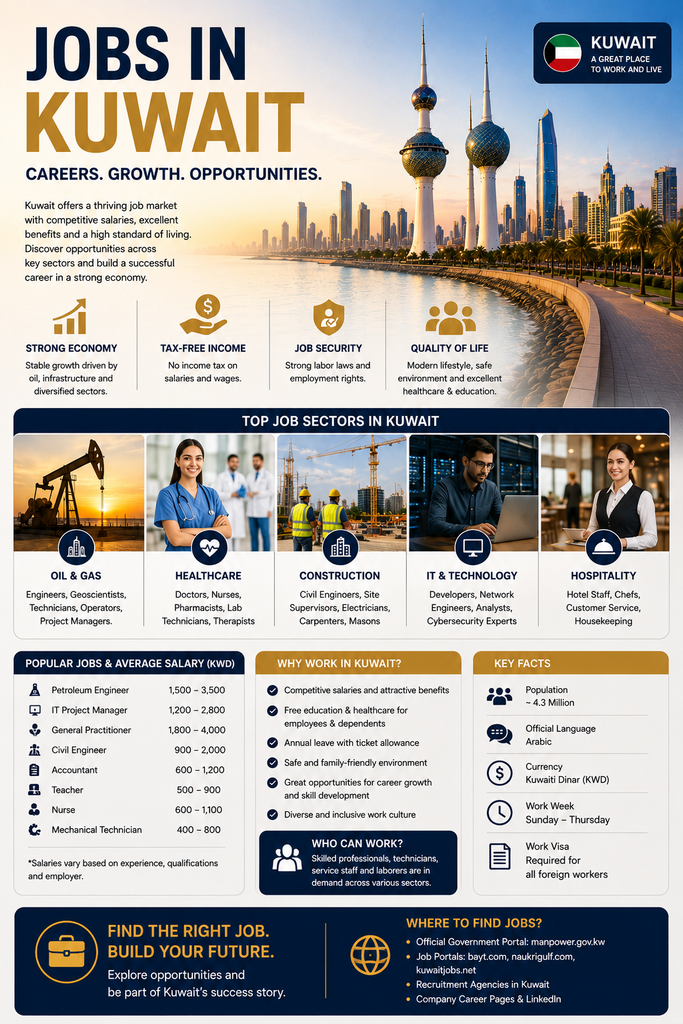
Foreign workers continue to play a major role in Kuwait’s private sector.
The IMF’s February 2026 report describes Kuwait’s labour market as highly segmented, with expatriates filling the vast majority of private-sector jobs.
This means opportunities remain available to foreigners, particularly where companies need technical or professional skills.
However, expatriates should understand that Kuwaitization policies encourage greater participation of Kuwaiti nationals in employment.
The best strategy for foreign candidates is therefore to develop skills that employers genuinely need.
Specialisation can provide greater career security than depending on general administrative roles.
Jobs in Kuwait for Indians
Indian professionals and workers have historically formed an important part of Kuwait’s expatriate workforce.
Opportunities can be found across:
Healthcare
Engineering
Construction
IT
Finance
Retail
Hospitality
Logistics
Technical trades
Education
Sales
Before travelling from India for employment, candidates should verify the employer, contract and work-visa process carefully.
Do not travel based only on WhatsApp messages or informal recruitment promises.
Kuwait Work Visa for Private-Sector Jobs
Foreign nationals coming to Kuwait for private-sector employment require the appropriate work and residency procedures.
Kuwait Government Online currently states that a private-sector work entry visa requires a work permit issued by the Public Authority for Manpower, along with the required application documents and a valid passport.
The official government process also requires sponsor involvement.
After entry, the employee must complete the appropriate residency procedures.
Private-sector employment residency is generally processed under Article 18.
Workers should understand an important principle:
A job offer and a legal work permit are not the same thing.
Employment should follow the official immigration and labour process.
Documents Required for Kuwait Employment
The exact documents vary according to profession and visa category.
Common requirements can include:
Valid passport
Employment contract
Work permit
Entry visa
Educational certificates
Professional qualifications
Experience certificates
Police clearance where required
Medical examination
Passport photographs
Professional licence for regulated occupations
Attestation may be required for certain documents.
Always confirm the current requirements with the employer and relevant government authority before travelling.
How to Find Jobs in Kuwait
Finding employment requires a focused strategy.
Start with a strong CV.
The first page should quickly communicate:
Your profession
Years of experience
Key skills
Major achievements
Certifications
Industry experience
Current location
Contact information
Candidates should tailor applications rather than sending the same generic CV to hundreds of positions.
Use established recruitment websites, professional networking platforms, company career pages and reputable recruitment agencies.
Networking can also be useful, particularly for senior professional positions.
Do Not Pay for Fake Kuwait Jobs
Job scams remain a risk whenever people are eager to work abroad.
Be suspicious when someone:
Guarantees employment without an interview
Requests large payments to a personal bank account
Uses unofficial email addresses
Refuses to provide a proper contract
Promises unrealistic salaries
Asks for sensitive information unnecessarily
Creates artificial urgency
Verify the company independently.
A legitimate employer should be able to provide clear employment documentation.
Official work procedures should also align with Kuwait’s government requirements.
Salary Is Only Part of a Kuwait Job Offer
A salary figure alone does not tell you whether a job is good.
Evaluate the complete package.
Important benefits can include:
Housing
Housing allowance
Transportation
Health insurance
Annual flights
Overtime
Bonuses
Family medical insurance
Education allowance
Paid leave
End-of-service benefits
For example, an employee receiving a slightly lower salary with free accommodation may have more disposable income than someone earning more but paying full rent.
Calculate actual monthly savings.
Skills That Can Help You Get a Job in Kuwait
Kuwait’s economic transformation makes specialised skills increasingly important.
Useful areas include:
Artificial intelligence
Cybersecurity
Data analytics
Cloud computing
Project management
Engineering
Healthcare
Financial analysis
Digital marketing
Supply-chain management
Risk and compliance
Renewable energy
Automation
Technical maintenance
Professional certifications can help candidates demonstrate competence.
But experience matters too.
Employers want people who can solve real business problems.
Understanding Kuwaitization
Kuwaitization refers broadly to policies designed to increase employment participation among Kuwaiti citizens.
Foreign workers should not interpret this as meaning expatriate employment is disappearing.
The private sector still relies heavily on expatriate workers.
However, the direction of policy means certain occupations may become more competitive for foreigners.
The IMF has highlighted the need for Kuwait to reform its divided labour market and increase Kuwaiti participation in private-sector employment.
Foreign professionals should therefore focus on developing specialised expertise rather than assuming that every traditional expatriate role will remain equally accessible.
How Kuwait Vision 2035 Could Affect Jobs
Kuwait Vision 2035 aims to transform the country into a regional financial and commercial hub with a more dynamic private sector.
Its development priorities include:
A diversified sustainable economy
Developed infrastructure
High-quality healthcare
Creative human capital
Effective government
A sustainable living environment
Stronger global positioning
These priorities can support employment across infrastructure, finance, technology, healthcare, logistics, construction and professional services.
The objective is not simply to create more jobs.
It is to create a more productive and diversified economy.
Infrastructure Projects and Future Employment
Infrastructure investment can be an important source of future job creation.
The IMF reported in 2026 that Kuwait’s announced investment projects in housing, electricity, water and transportation are expected to significantly increase public investment through 2030.
Large projects create employment beyond construction sites.
They require:
Engineers
Consultants
Project managers
Procurement professionals
Finance teams
Legal professionals
Safety specialists
Technology providers
Logistics companies
Facilities managers
This creates broader economic opportunities throughout the project lifecycle.
Private-Sector Jobs Will Become More Important
One of Kuwait’s biggest economic objectives is increasing the role of the private sector.
Kuwait Vision 2035 explicitly identifies private-sector leadership as central to the country’s future economic model.
This is significant for expatriates because private businesses already employ a large share of foreign workers.
Future opportunities may increasingly come from companies involved in technology, finance, healthcare, infrastructure, logistics and professional services rather than government-related employment alone.
Is Kuwait Good for Jobs in 2026?
Kuwait can still be an attractive employment destination, particularly for candidates with relevant qualifications and experience.
The strongest opportunities are likely to depend on profession.
Healthcare professionals may benefit from continued healthcare development.
Engineers can benefit from infrastructure and industrial investment.
Technology professionals can benefit from digital transformation.
Finance professionals can participate in financial-sector development.
Technical workers remain important across maintenance, construction and industrial operations.
However, competition is real.
Applicants should arrive with realistic expectations.
Should You Move to Kuwait Without a Job?
For most foreign workers, securing legitimate employment before relocating is the safer approach.
Kuwait’s work entry process is tied to official employment and sponsorship procedures.
Kuwait Government Online states that private-sector work visas require a Public Authority for Manpower work permit.
Therefore, applicants should focus on obtaining a verified job offer and ensuring the employer completes the correct process.
Never assume that entering under another visa category automatically allows you to work legally.
Future of Jobs in Kuwait
Kuwait’s employment market is likely to become more skill-focused over the coming years.
Economic diversification means employers will increasingly require workers capable of supporting modern industries.
At the same time, labour-market reforms and Kuwaitization will continue influencing recruitment.
For expatriates, this creates a clear message.
General skills may face greater competition.
Specialised skills will become more valuable.
Professionals who continue learning, gaining certifications and developing technical expertise will be better positioned for the changing employment market.
Final Thoughts on Jobs in Kuwait
Jobs in Kuwait in 2026 continue to offer opportunities for expatriates across oil and gas, healthcare, engineering, technology, finance, construction, education, logistics, hospitality, sales and technical professions.
Foreign workers remain particularly important to the private sector. The IMF’s latest assessment confirms that expatriates fill the vast majority of private-sector jobs, even as Kuwait works to increase national participation and improve labour-market productivity.
At the same time, Kuwait Vision 2035 is pushing the economy toward diversification, private-sector development, stronger infrastructure and greater investment in human capital.
That means the employment market is changing.
For job seekers, success will increasingly depend on qualifications, experience, technical knowledge and specialised skills.
Before accepting an offer, verify the employer.
Understand your salary and benefits.
Confirm the work permit.
Read your employment contract.
Calculate your expected living costs.
And never pay unofficial agents promising guaranteed employment.
For qualified candidates who approach the market carefully, Kuwait can remain an important Gulf destination for building professional experience, increasing earnings and developing a long-term international career.
Follow us on Instagram
Read More – Cost of Living in Kuwait: Complete 2026 Guide