



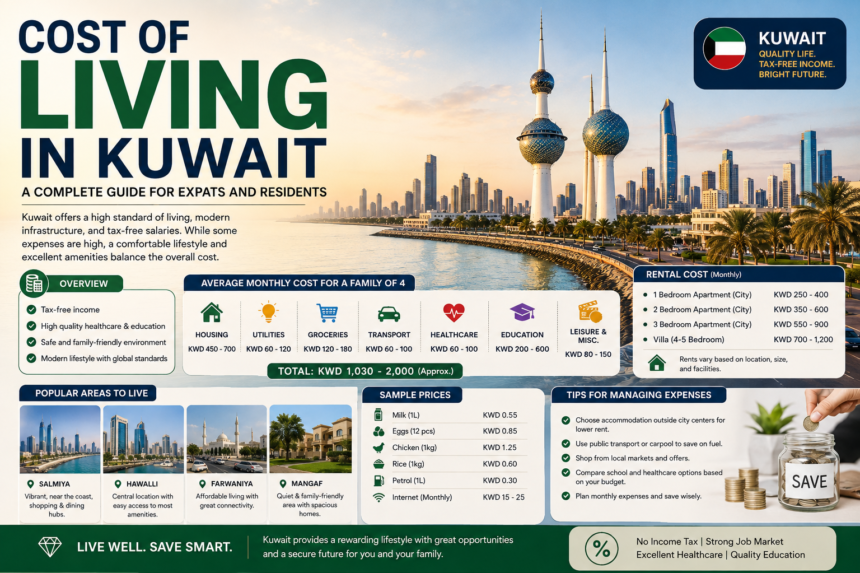
Cost of Living in Kuwait for Expats, Singles and Families in 2026
Understanding the Cost of Living in Kuwait is essential for anyone planning to move to the country for work, business or family life. Kuwait can offer attractive employment opportunities and comparatively manageable everyday expenses, but the amount you actually need each month depends heavily on accommodation, family size, transportation and lifestyle.
- Cost of Living in Kuwait for Expats, Singles and Families in 2026
- How Expensive Is Kuwait in 2026?
- Housing and Rent in Kuwait
- Rent for Single Expats
- Rent for Families
- Cost of Utilities in Kuwait
- Internet and Mobile Costs
- Grocery Costs in Kuwait
- Monthly Food Budget for a Single Person
- Monthly Food Budget for Families
- Eating Out in Kuwait
- Transportation Costs in Kuwait
- Public Transport Costs
- Taxi Costs
- Healthcare Costs in Kuwait
- Education Costs for Families
- Childcare Costs in Kuwait
- Entertainment and Leisure Costs
- Clothing and Shopping
- Cost of Living for a Single Expat in Kuwait
- Cost of Living for a Couple in Kuwait
- Cost of Living for a Family of Four
- How Salary Changes Your Lifestyle in Kuwait
- How to Reduce the Cost of Living in Kuwait
- Is Kuwait Affordable for Indian Expats?
- Kuwait Cost of Living vs Dubai
- Is Kuwait Expensive for Families?
- How Much Money Do You Need to Live Comfortably in Kuwait?
- Monthly Budget Before Moving to Kuwait
- Is the Cost of Living in Kuwait Worth It?
- Final Thoughts on the Cost of Living in Kuwait
Housing is usually the biggest expense.
For families, private education can become another major cost. For single professionals, the biggest difference often comes down to whether accommodation and transportation are provided by an employer.
Current 2026 cost data illustrates just how much budgets can vary. Expatistan estimates total monthly expenses at around KD657 for a single person and KD1,117 for a family of four, although it warns that its Kuwait dataset is relatively limited. Other databases calculate expenses differently, particularly depending on whether rent is included.
That is why there is no single answer to the question: “How much money do you need to live in Kuwait?”
A worker sharing accommodation may live on a relatively modest budget.
A professional renting a private apartment will spend considerably more.
A family paying for a three-bedroom home, international education, multiple vehicles and regular entertainment may require a much larger monthly income.
This guide breaks down the Cost of Living in Kuwait in 2026 and explains the major expenses expatriates should consider before relocating.
Cost of Living in Kuwait for Expats, Singles and Families in 2026
Kuwait’s living costs should always be evaluated against your complete employment package.
Two employees receiving exactly the same salary can have completely different financial situations.
Imagine that one employee receives:
Employer accommodation
Health insurance
Transportation
Annual flight allowance
Family benefits
The second employee receives only salary.
Their disposable incomes will be very different even if their salaries are identical.
For this reason, anyone considering a Kuwait job offer should calculate the value of allowances and benefits before deciding whether the salary is attractive.
Housing is particularly important because current estimates suggest accommodation can represent the largest share of monthly expenditure.
How Expensive Is Kuwait in 2026?
Kuwait can be relatively manageable compared with some premium Gulf lifestyles, but it is not automatically cheap.
The biggest variable is accommodation.
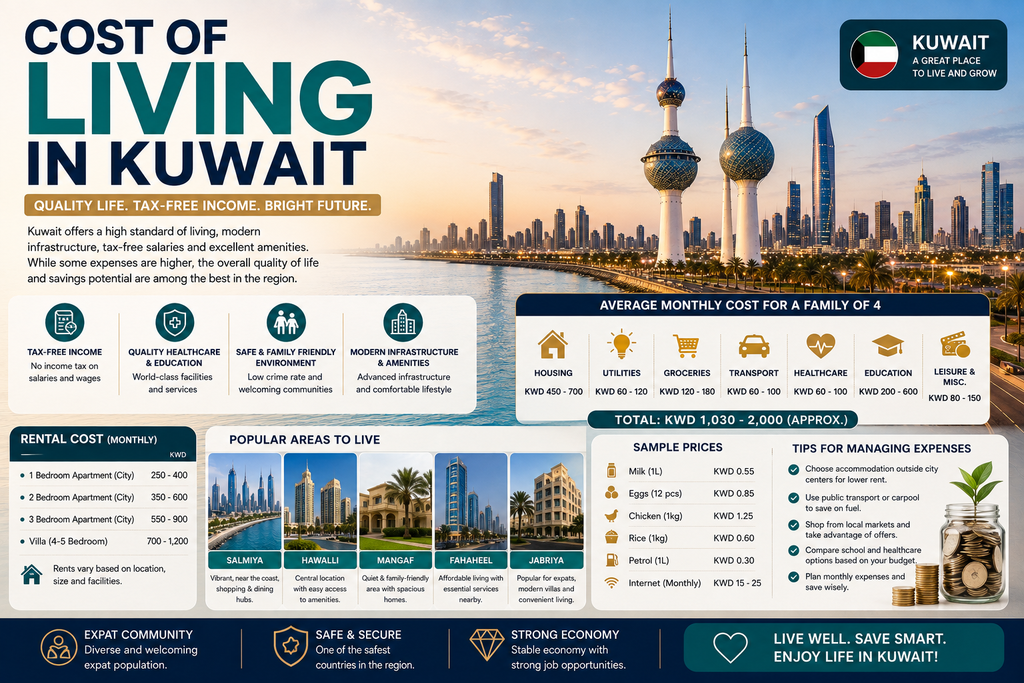
Current June 2026 crowd-sourced data puts the average monthly rent for a one-bedroom apartment at roughly KD255 in a city-centre location and KD189 outside the centre.
A three-bedroom apartment averages around KD564 in central locations and KD407 outside central areas.
Actual prices can be lower or higher depending on neighbourhood, building age, property quality, furnishings and facilities.
Food can remain manageable for residents who cook regularly.
Fuel is relatively inexpensive, while public transport is affordable.
However, lifestyle spending can quickly increase a household budget.
Frequent restaurant meals, premium cafés, shopping, private education and expensive accommodation can significantly change the picture.
Housing and Rent in Kuwait
Rent is usually the first expense newcomers should calculate.
Accommodation varies from relatively simple apartments to large luxury residences.
Popular expatriate locations include areas such as Salmiya, Hawally, Jabriya, Salwa, Fintas and Mahboula.
The amount residents pay depends on:
Location
Number of bedrooms
Building age
Parking
Furnishing
Sea views
Gym or swimming pool
Security
Maintenance
Access to major roads
Proximity to schools and offices
Current Kuwait-wide data from Numbeo estimates a one-bedroom apartment outside central areas at about KD189 per month, compared with around KD255 in central areas.
For three-bedroom properties, the difference becomes larger.
Families should therefore compare neighbourhoods carefully before committing to a lease.
Rent for Single Expats
Single professionals have more flexibility.
Someone willing to share accommodation can reduce housing expenses substantially.
Those who prefer complete privacy will need to allocate more of their monthly salary toward rent.
A small apartment or studio can provide a middle ground.
August 2026 Expatistan data estimates a furnished 45-square-metre studio in a normal area of Kuwait City at around KD211 per month, compared with approximately KD357 in a more expensive area.
These figures should be treated as indicative rather than guaranteed rental prices because individual properties vary significantly.
Newcomers should inspect the property before signing a contract.
Rent for Families
Families usually require larger accommodation.
A couple with two children may prefer a two- or three-bedroom apartment.
Current June 2026 figures put the average three-bedroom apartment at approximately KD407 outside central locations, rising to about KD564 in the city centre.
Premium properties can cost considerably more.
Families should avoid choosing accommodation based solely on rent.
School location can be equally important.
Saving KD50 each month on rent may not be worthwhile if it creates a long school and workplace commute every day.
Cost of Utilities in Kuwait
Utilities are another essential monthly expense.
Electricity use can be substantial during summer because air conditioning is essential.
However, electricity and water costs can remain relatively manageable compared with housing.
June 2026 crowd-sourced estimates put basic utilities for an 85-square-metre apartment at around KD16.56 per month, with reported prices generally ranging from approximately KD12 to KD30.
Actual bills depend on consumption, property size, tariff arrangements and whether some costs are included in rent.
Kuwait’s Ministry of Electricity, Water and Renewable Energy also provides an official tariff calculator that residents can use to estimate electricity and water charges according to consumption and tariff category.
Internet and Mobile Costs
Internet access is another regular household expense.
Broadband prices depend on provider, speed and package.
Numbeo’s June 2026 data estimates broadband internet at approximately KD10.66 per month, while mobile packages with calls and at least 10GB of data average around KD6.60.
Actual telecom plans vary considerably.
Residents should compare packages based on:
Data allowance
Speed
Contract length
5G availability
International calling
Roaming
Home internet bundles
Promotional deals
Choosing an appropriate package can prevent unnecessary monthly spending.
Grocery Costs in Kuwait
Food expenses depend heavily on shopping habits.
People who cook at home can generally control their monthly spending much more effectively than those who rely on restaurants and food delivery.
Current Kuwait City price estimates include approximately:
Milk: around KD0.50 per litre
12 eggs: around KD0.69
Tomatoes: around KD0.72 per kilogram
Apples: around KD0.94 per kilogram
Potatoes: around KD0.76 per kilogram
These are indicative August 2026 figures and individual supermarkets or imported brands can differ.
Imported premium foods are naturally more expensive than local or regional alternatives.
Families can reduce grocery spending by comparing supermarkets and avoiding excessive reliance on imported speciality products.
Monthly Food Budget for a Single Person
A single professional who cooks regularly can keep food spending relatively controlled.
A realistic food budget depends on whether the person:
Cooks daily
Orders delivery
Buys imported products
Eats lunch at work
Visits restaurants regularly
Drinks premium coffee frequently
Small daily purchases can have a surprisingly large monthly effect.
For example, spending KD3 on lunch every working day can exceed KD60 over a month.
Add coffee, dinner deliveries and weekend restaurants, and food spending can quickly rise.
Cooking remains one of the simplest ways to reduce the Cost of Living in Kuwait.
Monthly Food Budget for Families
Families naturally spend more on groceries.
Households with children may need milk, snacks, school lunches, household supplies and speciality products in addition to ordinary meals.
A family can reduce costs by:
Planning weekly meals
Buying larger packages
Comparing supermarkets
Using promotions
Cooking at home
Limiting food delivery
Choosing regional alternatives to expensive imported brands
Food waste should also be considered.
Buying large quantities during promotions does not save money if much of the food is eventually discarded.
Eating Out in Kuwait
Kuwait has a strong restaurant culture.
Residents can find Kuwaiti, Indian, Pakistani, Lebanese, Turkish, Egyptian, Iranian, Filipino, American, Italian, Japanese and many other cuisines.
Restaurant prices range from inexpensive local establishments to premium hotel dining.
Current 2026 data puts a fast-food combo meal at around KD2.4, while a basic lunch in a business district is approximately KD3.2 according to Expatistan.
Eating out occasionally is relatively manageable.
Eating out several times every week is a different matter.
For budget-conscious expatriates, restaurant spending should be treated as entertainment rather than an everyday necessity.
Transportation Costs in Kuwait
Transportation can be relatively affordable, particularly for residents who own fuel-efficient vehicles.
Kuwait’s urban environment means cars remain an important part of everyday life for many households.
Current June 2026 data places gasoline at around KD0.11 per litre.
Vehicle ownership involves more than fuel, however.
Residents should budget for:
Vehicle purchase
Insurance
Registration
Maintenance
Tyres
Repairs
Parking
Fuel
Depreciation
A cheap fuel bill does not mean owning a car has no other costs.
Public Transport Costs
Public buses provide a cheaper alternative.
Current crowd-sourced data estimates a regular monthly public transport pass at approximately KD15, with reported prices generally ranging between KD11 and KD20.
Public transportation may work well for some workers depending on their route.
However, families and professionals with complicated daily schedules may find private vehicles more convenient.
Housing should therefore be selected with transportation in mind.
Taxi Costs
Taxis and ride services provide another transportation option.
Numbeo’s June 2026 estimates put the standard taxi starting fare at approximately KD1, although actual fares depend on service and journey.
Occasional taxi use may be affordable.
Daily taxi journeys can become a substantial monthly expense.
Before deciding not to purchase a vehicle, workers should calculate the expected cost of commuting throughout the month.
Healthcare Costs in Kuwait
Healthcare costs depend heavily on residency status, insurance and whether residents use government or private facilities.
Foreign workers should understand exactly what medical coverage their employer provides.
Ask whether the policy covers:
Outpatient consultations
Hospital admission
Emergency treatment
Specialists
Diagnostic tests
Medicines
Dental treatment
Maternity
Children
Chronic conditions
A medical insurance card is useful only if the facilities and treatments you actually require are included.
Families should pay particular attention to paediatric and maternity coverage.
Education Costs for Families
Education can become one of the biggest expenses for expatriate families.
Foreign residents frequently use private schools.
Fees vary significantly according to curriculum, reputation, grade level and facilities.
June 2026 crowd-sourced Kuwait data estimates international primary-school tuition at around KD2,175 annually per child, with reported costs ranging from approximately KD1,200 to KD3,500.
Some premium schools may fall outside these averages.
Parents should also budget for:
Registration fees
Uniforms
Books
School transport
Activities
Meals
Technology
Trips
Examination fees
Education should be calculated before accepting an employment offer.
Childcare Costs in Kuwait
Families with younger children may require nursery or kindergarten services.
Numbeo’s June 2026 data estimates private full-day preschool or kindergarten at around KD100 per month per child, with a reported range of KD50 to KD150.
Individual nurseries can differ substantially.
Working parents should also consider location.
A nursery close to home or work may be worth slightly higher fees if it reduces daily transportation time.
Entertainment and Leisure Costs
Entertainment is where lifestyle choices become particularly important.
Kuwait has shopping malls, cinemas, gyms, cafés, restaurants, family attractions and sports facilities.
Current 2026 estimates put an international cinema ticket at approximately KD3.50.
A monthly fitness club membership averages around KD33.60, although reported prices range widely from KD15 to KD60.
Someone who uses free outdoor activities during cooler months will spend far less than a resident who frequently shops, visits premium restaurants and pays for multiple subscriptions.
Lifestyle inflation can quickly reduce savings.
Clothing and Shopping
Kuwait has a strong retail culture.
International brands are widely available through shopping centres.
Current estimates put branded jeans at around KD13, a high-street summer dress around KD15 and mid-range branded running shoes around KD32.
Shopping is a discretionary expense.
For expatriates who moved to Kuwait primarily to save money, setting a monthly shopping budget can be useful.
Without one, frequent small purchases can become surprisingly expensive over a year.
Cost of Living for a Single Expat in Kuwait
A single expatriate’s budget varies dramatically according to housing.
A cost-conscious professional might build a monthly budget around:
Shared or modest accommodation
Groceries and home cooking
Mobile and internet
Public transport or economical vehicle use
Basic entertainment
Healthcare-related expenses
Personal spending
Someone renting a premium private apartment, eating out regularly and shopping frequently will naturally spend considerably more.
Current independent estimates differ significantly because of these assumptions. Expatistan estimates overall single-person expenditure at around KD657 monthly, while Numbeo’s figures allow individual categories to be calculated separately.
Treat online averages as planning tools rather than guaranteed budgets.
Cost of Living for a Couple in Kuwait
Couples can benefit from sharing major expenses.
Rent, internet and utilities do not necessarily double when a second person joins the household.
Food and transportation will increase, but shared accommodation can make the per-person cost lower than living alone.
A couple’s biggest decisions usually involve:
Apartment size
Neighbourhood
Number of cars
Restaurant habits
Travel
Entertainment
Insurance
If both partners work, household disposable income can be considerably stronger.
Cost of Living for a Family of Four
A family of four requires a much larger budget.
Major expenses can include:
Three-bedroom accommodation
Groceries
Two vehicles or transportation
School fees
Healthcare
Internet and mobile services
Utilities
Children’s activities
Clothing
Entertainment
Travel
Expatistan’s August 2026 estimate puts total monthly costs for a family of four at approximately KD1,117, but the source explicitly warns that its estimate is based on limited data.
Families should therefore build their own budget based on actual school and housing choices rather than relying on one headline number.
How Salary Changes Your Lifestyle in Kuwait
Salary alone does not determine living standards.
Benefits matter enormously.
Consider a worker receiving KD800 with free accommodation and transportation compared with someone receiving KD1,000 but paying KD300 rent and maintaining a car.
The higher salary does not automatically produce more disposable income.
When evaluating a Kuwait employment offer, calculate:
Cash salary
Housing allowance
Transport allowance
Insurance
School allowance
Annual flights
Bonuses
End-of-service benefits
Other employer support
Then subtract realistic monthly expenses.
That provides a much clearer picture.
How to Reduce the Cost of Living in Kuwait
The easiest place to start is housing.
Do not rent more space than you need.
Choose a neighbourhood based on work rather than prestige.
Cook more meals at home.
Compare supermarkets.
Limit frequent food delivery.
Use a fuel-efficient vehicle.
Avoid unnecessary debt.
Compare telecom packages.
Set entertainment limits.
Use employer benefits fully.
Families should compare school fees carefully.
Most importantly, create an automatic monthly savings target.
Saving whatever happens to remain at the end of the month rarely works as effectively.
Is Kuwait Affordable for Indian Expats?
For Indian expatriates, Kuwait’s affordability depends primarily on salary, accommodation and employer benefits.
Indian food products and restaurants are widely available, making everyday life relatively convenient.
Workers receiving company accommodation can substantially reduce their biggest potential monthly expense.
Those supporting families in both Kuwait and India should budget differently.
Monthly remittances need to be treated as a fixed financial commitment rather than optional spending.
The best employment offer is therefore not necessarily the one with the highest headline salary.
It is the package that produces the highest realistic disposable income after living expenses.
Kuwait Cost of Living vs Dubai
Many expatriates naturally compare Kuwait with Dubai.
The comparison depends heavily on lifestyle, but housing is often one of the reasons Kuwait can appear more manageable.
Kuwait also offers relatively inexpensive fuel.
Dubai, however, provides a different scale of entertainment, tourism, public transportation and lifestyle infrastructure.
Neither city is universally cheaper for every person.
Someone living modestly in Kuwait can keep expenses controlled.
Someone pursuing a premium lifestyle in either destination can spend considerably more.
The right comparison should use the same housing quality, family size and lifestyle assumptions.
Is Kuwait Expensive for Families?
Kuwait can become expensive for families primarily because of housing and education.
A family receiving employer-provided housing and school allowances may have a very comfortable financial position.
A family paying both independently may need a substantially larger salary.
This is why expatriate parents should never relocate before researching actual school fees.
Children’s education can transform the household budget.
Families should also maintain emergency savings rather than assuming every unexpected expense will be covered by insurance or the employer.
How Much Money Do You Need to Live Comfortably in Kuwait?
There is no universal figure.
Comfort depends on what the individual considers normal.
For one person, comfort means a private apartment and car.
For another, shared accommodation is perfectly acceptable.
For one family, international schooling and annual overseas holidays are essential.
Another family may have very different priorities.
Current market data suggests housing alone can range from under KD200 for some one-bedroom properties outside central areas to more than KD500 for typical three-bedroom accommodation in central locations.
Therefore, build a personal budget rather than searching for one universal salary number.
Monthly Budget Before Moving to Kuwait
Before accepting a job, create a simple monthly calculation.
Start with net salary and regular allowances.
Subtract:
Rent
Food
Transportation
Utilities
Internet
Mobile
Healthcare
Schooling
Debt
Family support
Entertainment
Personal expenses
Travel savings
Emergency savings
Then calculate what remains.
This number is much more useful than the headline salary.
If your primary reason for moving to Kuwait is financial, decide your target monthly savings before accepting the offer.
Is the Cost of Living in Kuwait Worth It?
For many expatriates, it can be.
Kuwait offers employment opportunities, relatively inexpensive fuel, established expatriate communities and a wide variety of housing and food options.
The financial advantage is strongest when an employer provides major benefits such as accommodation, transportation, medical insurance or education support.
The situation becomes less attractive when a modest salary must independently cover premium housing, family schooling and significant lifestyle expenses.
Financial planning should therefore begin before relocation.
Final Thoughts on the Cost of Living in Kuwait
The Cost of Living in Kuwait in 2026 depends far more on personal circumstances than on one average number.
For single professionals, housing is usually the biggest variable.
For families, housing and education can dominate the budget.
Transportation can remain relatively manageable, particularly because fuel prices are low by international standards. Everyday grocery expenses can also be controlled through sensible shopping and home cooking.
Current market data indicates that a one-bedroom apartment averages roughly KD189 outside central locations and KD255 in central areas, while a three-bedroom property averages approximately KD407 outside the centre and KD564 centrally.
But these figures are only benchmarks.
The most important calculation is your own.
Before relocating, determine your expected rent, school costs, transportation, insurance and everyday expenses. Then compare the total against your salary and employer benefits.
A strong employment package can make Kuwait financially attractive.
A poorly structured package can make even a reasonable salary difficult to manage.
For expatriates planning carefully, controlling lifestyle spending and selecting accommodation wisely, Kuwait can provide a manageable cost of living while still offering opportunities to save and build long-term financial goals.
Follow us on Instagram
Read More – Living in Kuwait: Essential Guide for Expats, Families and Professionals in 2026