



Powerful Career Opportunities for Teachers in 2026
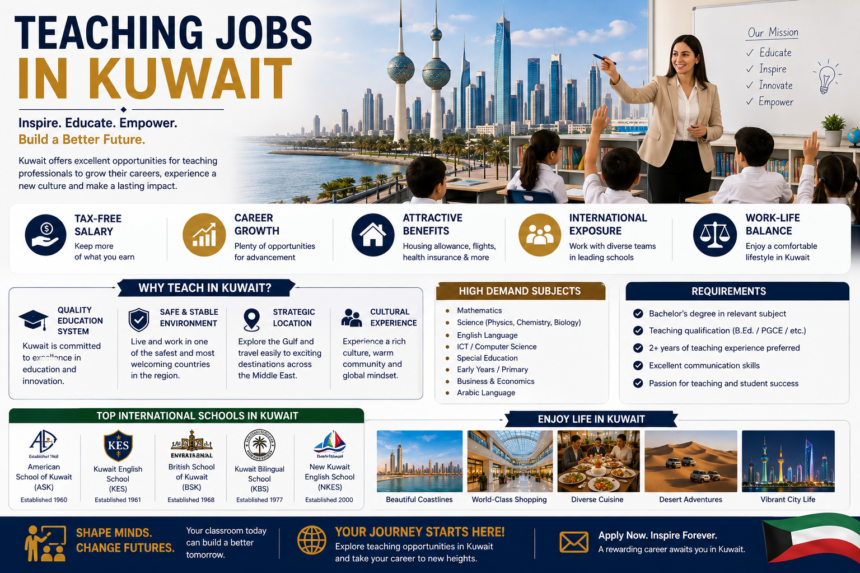
Teaching Jobs in Kuwait continue to attract educators looking for international experience, professional growth and an opportunity to work in one of the Gulf’s established education markets.
- Teaching Jobs in Kuwait Offer Opportunities Across Different Schools
- 1. English Teacher Jobs
- 2. Mathematics Teacher Jobs
- 3. Science Teacher Jobs
- 4. STEM Teacher Jobs
- 5. Primary School Teacher Jobs
- 6. Early Years Teacher Jobs
- 7. ICT and Computer Teacher Jobs
- 8. Social Studies Teacher Jobs
- 9. Special Education Teacher Jobs
- 10. Physical Education Teacher Jobs
- 11. Art Teacher Jobs
- 12. Music Teacher Jobs
- 13. School Counsellor and Student Support Roles
- 14. Department Head and Academic Leadership Jobs
- 15. Gifted Education Opportunities
- Qualifications for Teaching Jobs in Kuwait
- Documents Teachers May Need
- Salary for Teaching Jobs in Kuwait
- Benefits for International Teachers
- Work Visa for Teachers in Kuwait
- International Schools in Kuwait
- When Do Schools Recruit Teachers
- How to Find Teaching Jobs in Kuwait
- How to Prepare for a Teaching Interview
- Challenges of Teaching in Kuwait
- Why Kuwait Appeals to International Teachers
- Final Thoughts on Teaching Jobs in Kuwait
Kuwait has a diverse school system that includes government schools, private Arabic schools, bilingual schools and international schools following British, American and other international curricula. This creates opportunities for teachers across different subjects and age groups.
English, mathematics, science, STEM, ICT and primary education remain important areas, while schools also recruit teachers for subjects including geography, social studies, physical education, music and early years education.
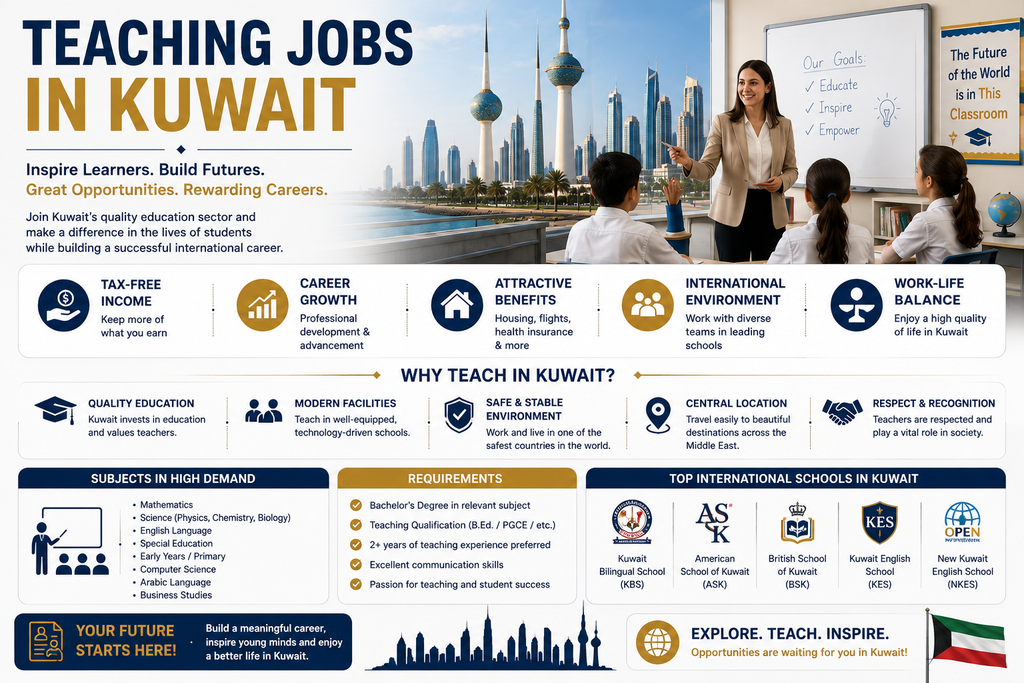
For expatriate educators, international and private schools are generally the most accessible part of the market. Packages can include salary, accommodation or housing support, medical insurance, annual flights and visa assistance, although benefits differ significantly between employers.
Finding a good position requires more than simply sending a CV.
Qualifications, teaching credentials, classroom experience, document attestation, subject specialization and interview performance can all influence recruitment.
This complete guide explains 15 Teaching Jobs in Kuwait worth exploring in 2026, along with qualifications, benefits, recruitment procedures and practical application advice.
Teaching Jobs in Kuwait Offer Opportunities Across Different Schools
Kuwait’s education market is more diverse than many first-time applicants expect.
International schools represent one of the most visible employment options for foreign teachers.
These schools may follow British, American, International Baccalaureate or other recognized educational programs.
Bilingual schools are another major part of the market. They combine Arabic and English language education and regularly recruit teachers for core academic subjects.
Private schools also employ educators across different levels.
Government education provides another employment pathway, although recruitment procedures and eligibility can differ from the international school sector.
Current vacancies for the 2026–27 academic year demonstrate demand across primary, middle and secondary education.
For teachers, the key is identifying the school system that best matches their qualifications and experience.
1. English Teacher Jobs
English teachers are consistently important across Kuwait’s education sector.
International and bilingual schools require teachers for language arts, English literature, reading, writing and communication.
Secondary schools may prefer applicants with a degree directly related to English along with a recognized teaching qualification.
Classroom experience is particularly valuable.
English teachers are expected to do much more than explain grammar.
Modern international schools want educators who can develop critical thinking, reading comprehension, writing ability, communication and confidence.
Teachers may also participate in debating, drama, school publications and extracurricular activities.
Applicants with strong classroom management and experience teaching an international curriculum can be particularly competitive.
2. Mathematics Teacher Jobs
Mathematics is another important recruitment area.
Schools need qualified mathematics teachers across middle and secondary levels.
Depending on the curriculum, teachers may cover general mathematics, algebra, geometry, statistics, calculus and advanced mathematics.
Schools usually look for candidates with strong subject knowledge and an appropriate teaching qualification.
Experience with international curricula can strengthen an application.
Modern mathematics education increasingly emphasizes problem solving rather than memorization.
Teachers who can make mathematical concepts practical and engaging can therefore stand out during interviews.
Technology skills are also becoming more useful as schools introduce digital platforms and interactive learning tools into classrooms.
3. Science Teacher Jobs
Science teachers can find opportunities across primary, middle and secondary education.
At higher levels, schools often recruit specialists in biology, chemistry and physics.
Laboratory experience can be particularly important.
Science teachers are responsible not only for explaining theory but also for helping students understand experimentation, evidence and scientific thinking.
Schools may expect teachers to organize laboratory activities safely and effectively.
STEM focused education is also increasing the connection between science and technology.
Applicants who can combine traditional science education with experiments, projects and digital tools may have an advantage.
Current Kuwait school vacancies continue to include science positions, demonstrating the importance of this subject area.
4. STEM Teacher Jobs
STEM education combines science, technology, engineering and mathematics.
It has become increasingly important as Gulf countries place greater emphasis on innovation, technology and future skills.
STEM teachers may work across traditional subject boundaries.
Students might design a simple machine, build a robot, conduct an experiment or solve a practical engineering problem.
This requires teachers who are comfortable with project based learning.
A strong STEM educator needs subject knowledge, creativity and the ability to encourage students to experiment.
Experience with coding, robotics, engineering activities or makerspaces can strengthen an application.
Schools looking to modernize their academic programs increasingly value teachers who can make STEM practical rather than purely theoretical.
5. Primary School Teacher Jobs
Primary teachers work with children during some of their most important developmental years.
Instead of focusing exclusively on one subject, primary educators may teach several areas including English, mathematics, science and social studies.
This requires flexibility.
A good primary teacher needs strong classroom management, communication and lesson planning skills.
Understanding child development is also important.
Schools commonly prefer candidates with qualifications specifically connected to elementary or primary education.
Some international schools may also look for experience with a particular curriculum.
Primary teachers often build particularly close relationships with students because they spend significant time with the same class.
For educators who enjoy creating engaging, supportive learning environments, primary education can be one of the most rewarding Teaching Jobs in Kuwait.
6. Early Years Teacher Jobs
Early childhood education requires a very different teaching approach.
Young children learn through play, movement, stories, communication and exploration.
Early years teachers therefore need patience, creativity and a strong understanding of childhood development.
Nurseries, kindergartens and international schools recruit educators for this age group.
Relevant early childhood qualifications can significantly strengthen an application.
Teachers may be responsible for literacy foundations, basic numeracy, social development, creative activities and communication skills.
They also communicate regularly with parents.
The ability to create a safe and positive classroom environment is essential.
Early years teaching should never be viewed as simply easier primary education. It requires specialist skills and an understanding of how young children learn.
7. ICT and Computer Teacher Jobs
Technology is becoming central to modern education.
Schools need teachers who can introduce students to computing, digital literacy and responsible technology use.
Depending on the grade level, ICT teachers may cover basic computer skills, programming, coding, databases, web technologies or computer science.
Cybersecurity and artificial intelligence are also becoming increasingly relevant educational topics.
A strong technology teacher needs to keep learning.
Software and digital tools change quickly.
Teachers who rely entirely on knowledge learned years ago can quickly fall behind.
Applicants who combine educational experience with current technical skills can be particularly attractive to schools investing in future focused learning.
8. Social Studies Teacher Jobs
Social studies positions can cover history, geography, civics and related humanities subjects depending on the school’s curriculum.
Teachers need to help students understand societies rather than simply memorize facts.
That means encouraging discussion, research and critical thinking.
International school classrooms can include students from many nationalities.
This creates an interesting environment for social studies education because students bring different cultural experiences into discussions.
Teachers should therefore be culturally aware and capable of managing sensitive topics professionally.
Current recruitment for Kuwait’s 2026–27 academic year includes social studies and geography positions, showing continued demand within this area.
9. Special Education Teacher Jobs
Inclusive education has increased the importance of teachers who can support students with different learning needs.
Special education teachers may work directly with individual students, small groups or classroom teachers.
Their role can involve adapting lessons, developing learning plans and helping students build academic and social skills.
Relevant specialist qualifications are particularly valuable.
Patience and communication are essential because special education often involves collaboration with parents, teachers, counsellors and other professionals.
Educators with genuine training and experience in inclusive education can bring significant value to schools seeking to provide better support for diverse learners.
10. Physical Education Teacher Jobs
Physical education teachers help students develop fitness, coordination, teamwork and healthy habits.
International schools often offer sports programs beyond regular PE lessons.
Teachers may therefore become involved in football, basketball, swimming, athletics and other extracurricular activities.
Relevant qualifications and coaching experience can strengthen an application.
Safety is extremely important.
Teachers must understand how to manage activities according to student age, physical ability and environmental conditions.
Kuwait’s climate also affects sports scheduling, with indoor facilities becoming particularly important during hotter months.
For educators passionate about health and sport, PE can provide a dynamic teaching career.
11. Art Teacher Jobs
Creative education remains important even as schools increase their focus on technology and STEM.
Art teachers help students develop creativity, observation and visual communication.
Classes can include drawing, painting, sculpture, crafts and digital design.
Schools may look for candidates with a degree related to art or art education and relevant classroom experience.
An impressive portfolio can also help demonstrate creative ability.
Art teachers frequently contribute beyond regular lessons.
They may organize exhibitions, support school events or collaborate on performances and cultural programs.
Teachers who can combine traditional artistic skills with digital creativity can offer schools additional value.
12. Music Teacher Jobs
International schools also recruit music teachers.
Their responsibilities can include classroom music education, instruments, choirs and school performances.
A music teacher may work with students across several age groups.
Relevant academic qualifications and practical musical ability are important.
Schools may particularly value teachers who can lead performances or manage extracurricular music activities.
Patience is essential because students enter music classes with very different levels of experience.
A strong music teacher creates an environment where beginners feel comfortable while more advanced students continue developing.
Music can also play an important role in the cultural life of an international school.
13. School Counsellor and Student Support Roles
Education careers are not limited to classroom teachers.
International and private schools also need counsellors and student support professionals.
School counsellors may help students with emotional wellbeing, academic challenges and future education planning.
Older students may need support with university applications and career decisions.
Relevant professional qualifications are important for these positions.
Communication and confidentiality are essential.
Counsellors often work closely with teachers, parents and school leadership.
As schools place greater emphasis on student wellbeing, qualified support professionals are becoming increasingly important members of educational teams.
14. Department Head and Academic Leadership Jobs
Experienced teachers may eventually move into leadership.
Schools need heads of department, coordinators, supervisors, vice principals and principals.
Leadership roles require more than excellent classroom teaching.
A department head may manage curriculum planning, teacher development, assessment and academic standards.
Senior leaders can become responsible for staff management, school operations and strategic development.
International experience can be particularly valuable.
Teachers hoping to move into leadership should gradually build experience outside their own classroom.
Leading projects, mentoring colleagues and participating in curriculum development can prepare educators for future management positions.
15. Gifted Education Opportunities
One particularly interesting development in Kuwait in 2026 is the Ministry of Education’s gifted schools initiative.
The project is designed to create specialized schools for talented students.
The Ministry has established selection standards for teaching and administrative staff interested in working within these schools.
Requirements include an appropriate university qualification, relevant experience and strong professional performance.
Candidates can also be assessed through tests and personal interviews.
Experience working with gifted students can provide an advantage.
The initiative reflects a broader focus on identifying talented students and developing their academic and creative potential.
For experienced educators interested in specialized education, gifted learning could become an interesting career direction.
Qualifications for Teaching Jobs in Kuwait
Requirements vary between employers.
However, a bachelor’s degree is one of the most common expectations.
The degree should usually relate to the teaching role.
Primary teachers may need a degree in elementary education or a related qualification.
Secondary teachers generally benefit from a degree in their subject area.
A recognized teaching qualification or licence can also be required.
Examples may include a B.Ed., PGCE, QTS or an equivalent professional teaching credential depending on the school and curriculum.
English language teaching positions may sometimes value TEFL or TESOL qualifications.
Experience requirements differ.
Some schools prefer at least two or three years of classroom experience, while certain employers may consider newly qualified teachers.
Always check the specific vacancy rather than assuming every Kuwait school follows identical rules.
Documents Teachers May Need
International recruitment involves significant paperwork.
Teachers should prepare documentation early.
Commonly requested documents can include a passport, university degree, teaching qualification, academic transcripts, employment references and criminal background or police clearance documentation.
Educational certificates may need authentication or attestation.
Medical procedures can also form part of the employment and residency process.
Schools or recruitment teams should provide instructions according to the applicant’s nationality and position.
Do not leave document preparation until the final stage.
Attestation can take time, particularly when documents must pass through several authorities.
Keeping clear digital copies of all documents can also make applications easier.
Salary for Teaching Jobs in Kuwait
Teacher salaries vary significantly.
Factors include qualifications, years of experience, curriculum, school reputation, position and benefits.
Current international recruitment guides commonly show packages around KD 750 to KD 1,250 per month for international teachers, although individual offers can fall outside this range.
Senior teachers and school leaders may earn more.
Salary alone does not tell the full story.
Housing can make a major difference to the real value of a contract.
A slightly lower salary with good accommodation may sometimes provide better overall value than a higher salary where the teacher must cover expensive housing independently.
Candidates should therefore compare complete packages.
Benefits for International Teachers
International schools may provide benefits in addition to salary.
These can include furnished accommodation or a housing allowance, medical insurance, annual flight support and visa assistance.
School holidays are another important part of the teaching package.
Some schools may offer tuition support for teachers’ children, although policies vary considerably.
Teachers relocating with families should investigate dependent benefits carefully.
Do not assume that a benefit mentioned generally applies to every family member.
Ask for the complete employment package in writing before accepting a position.
This makes it easier to calculate the true value of the offer.
Work Visa for Teachers in Kuwait
Foreign teachers need appropriate authorization to work legally in Kuwait.
For private sector employment, the official government process requires a work permit issued through the Public Authority for Manpower as part of the employment entry visa process.
The employer or sponsor normally plays a central role in completing these procedures.
Teachers should never begin employment using a status that does not legally permit them to work.
A legitimate school should clearly explain the visa and residency process.
Applicants should also be cautious if someone asks for unusually large payments in exchange for a guaranteed teaching visa or job.
Employment should be based on a genuine contract and official procedures.
International Schools in Kuwait
International education represents one of the main pathways for expatriate teachers.
Kuwait has schools following different educational systems, particularly British and American curricula.
There are also bilingual schools and schools offering international programs.
Each curriculum creates slightly different recruitment expectations.
A teacher with British curriculum experience may be particularly attractive to a British school.
Similarly, American schools may prefer educators familiar with American standards and teaching methods.
International Baccalaureate experience can also be valuable where relevant.
Teachers should therefore tailor applications to the individual school rather than sending exactly the same CV everywhere.
When Do Schools Recruit Teachers
International schools often recruit several months before the beginning of the academic year.
However, vacancies can continue appearing close to August and September when schools need to fill remaining positions.
Current listings in Kuwait include positions starting in August and September 2026.
Recruitment can also happen during the academic year when a teacher leaves unexpectedly or a school expands.
Candidates should therefore monitor vacancies throughout the year.
Applying early usually provides more options.
Teachers targeting the next academic year can prepare their CV, references and documents months in advance.
This allows them to respond quickly when a suitable vacancy appears.
How to Find Teaching Jobs in Kuwait
Start with school career pages and established international education recruitment platforms.
Professional networking can also help.
LinkedIn allows teachers to follow schools and recruitment teams.
Candidates should create a professional CV focused on educational achievements.
Instead of simply listing responsibilities, show results.
Mention curriculum experience, grade levels taught, extracurricular activities, leadership responsibilities and relevant technology skills.
A short professional profile at the beginning of the CV can immediately explain your specialization.
Applications should always be tailored to the vacancy.
A mathematics teacher should emphasize mathematics education.
A primary teacher should highlight child development and multi-subject classroom experience.
How to Prepare for a Teaching Interview
A school interview is your opportunity to demonstrate how you actually teach.
Expect questions about classroom management.
Schools may ask how you support struggling students, challenge high achievers or communicate with parents.
You may also be asked about safeguarding, assessment and technology.
Prepare real examples from your classroom experience.
Avoid giving only theoretical answers.
Instead of saying you believe in differentiated learning, explain a situation where you changed a lesson to support students with different abilities.
International schools also want teachers who can adapt culturally.
Demonstrate professionalism, flexibility and respect for the community where you will be working.
Challenges of Teaching in Kuwait
International teaching can be rewarding, but moving countries requires adjustment.
Teachers need to understand local culture and school expectations.
Classroom environments may differ from their previous experience.
The climate is another major adjustment, particularly during summer.
Expatriates also need to manage residency procedures, housing and daily life in a new country.
Not every school provides the same working environment.
Researching an employer before signing a contract is therefore essential.
Read the contract carefully and clarify teaching hours, responsibilities, accommodation, probation, notice requirements and benefits.
A good international career decision should be based on the complete working environment rather than salary alone.
Why Kuwait Appeals to International Teachers
Kuwait offers an opportunity to gain international experience without being too far removed from the wider global education sector.
The country has a large expatriate community and numerous international schools.
Teachers can work alongside colleagues from different countries and teach multicultural student populations.
This experience can strengthen future applications elsewhere in the Gulf or internationally.
Kuwait’s location also provides access to the wider Middle East.
For educators who approach the experience with realistic expectations and choose their employer carefully, Kuwait can become an important stage in a longer international teaching career.
Final Thoughts on Teaching Jobs in Kuwait
Teaching Jobs in Kuwait offer opportunities across a surprisingly wide range of subjects.
English, mathematics and science remain important.
STEM and ICT reflect the growing focus on technology and innovation.
Primary and early years teachers support younger students, while art, music, PE and social studies create opportunities beyond traditional core subjects.
Special education and counselling demonstrate the growing importance of student support.
Experienced educators can pursue department leadership and management positions.
New initiatives around gifted education also show how Kuwait’s education sector continues evolving.
For international applicants, preparation is essential.
Build a professional CV.
Organize your qualifications and references.
Check document attestation requirements.
Research individual schools.
Understand the complete salary and benefits package.
Apply through legitimate channels.
And never accept a teaching position without understanding the contract and legal work authorization.
With the right qualifications, classroom experience and preparation, Kuwait can provide educators with an opportunity to develop their careers while gaining valuable international teaching experience in the Gulf.
Follow us on Instagram
Read More – Weekend Activities in Kuwait: 15 Amazing Things to Do in 2026