


Best Time for Accessible Travel in the Gulf
Travel should not depend on whether someone can climb stairs, walk long distances, hear an announcement or comfortably handle a crowded environment. Across the Gulf, tourism infrastructure is increasingly being designed around a wider range of travellers, including wheelchair users, people with reduced mobility, travellers with visual or hearing disabilities and people with non-visible accessibility needs.
- What Does Accessible Tourism Mean in the GCC?
- Accessible Tourism in GCC Countries at a Glance
- Accessible Tourism in Dubai
- Accessible Tourism in Abu Dhabi
- Accessible Tourism in Saudi Arabia
- Accessible Tourism in Qatar
- Accessible Tourism in Bahrain
- Accessible Tourism in Oman
- Accessible Tourism in Kuwait
- Accessible Airports Across the GCC
- Public Transport for Travellers With Reduced Mobility
- How to Choose an Accessible Hotel in the Gulf
- Accessible Museums, Attractions and Cultural Experiences
- Hidden Disabilities and Sensory Accessibility
- Beaches, Deserts and Outdoor Experiences
- Travelling With a Wheelchair or Mobility Equipment
- Best Time for Accessible Travel in the Gulf
- GCC Accessible Travel Planning Checklist
- What Still Needs to Improve?
- Final Thoughts on Accessible Tourism in GCC Countries
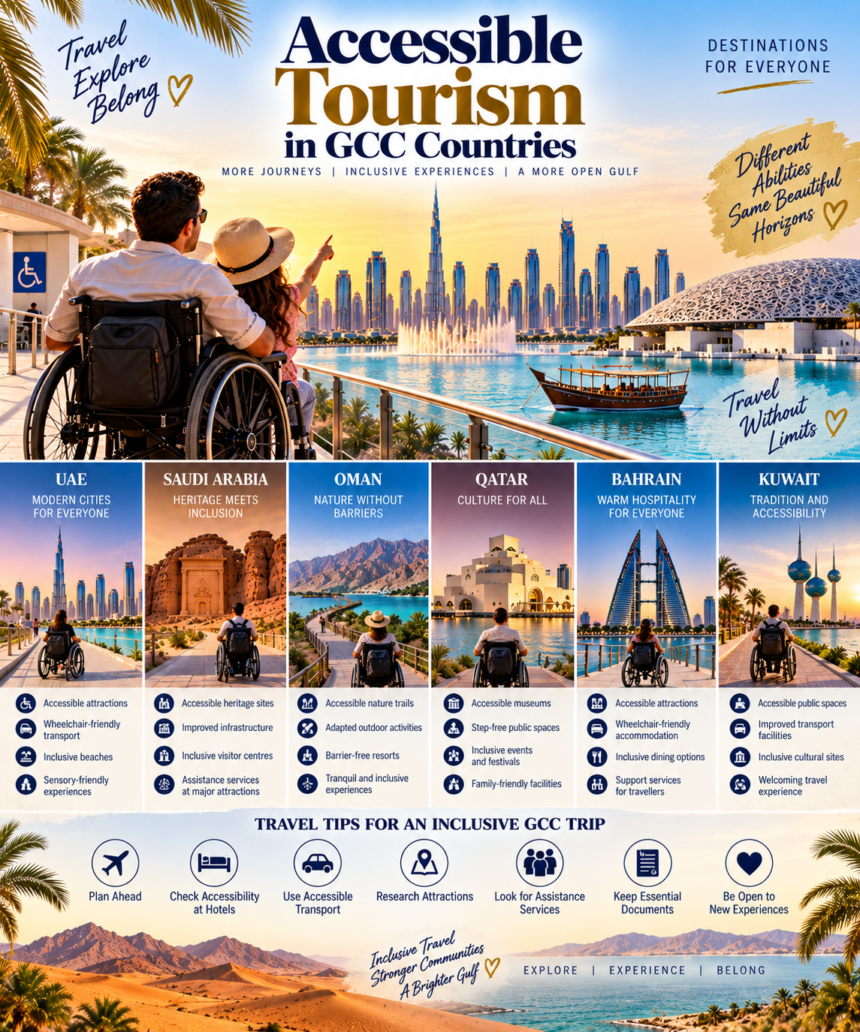
Accessible Tourism in GCC Countries is developing at different speeds across the UAE, Saudi Arabia, Qatar, Bahrain, Oman and Kuwait. Major airports provide mobility assistance, newer public transport networks incorporate step-free design, modern museums and shopping centres increasingly include accessible facilities, and some destinations now publish dedicated accessibility information before a visitor even arrives.
Dubai has gone particularly far in making accessibility information visible to tourists, including dedicated accessible itineraries and the Sanad Tourist Card for visitors with disabilities. Abu Dhabi publishes information on accessible hotels, buses, taxis and attractions, while Qatar Tourism directs visitors to the Accessible Qatar platform for venue-specific information. Bahrain’s entire public bus fleet is designed to accommodate wheelchairs and passengers with restricted mobility.
However, accessible tourism is not simply a yes-or-no label. One attraction may have ramps but no accessible transfer onto a ride. Another may be wheelchair-friendly indoors but difficult to reach from the surrounding pavement. Travellers should therefore verify the facilities that matter to them rather than relying only on a general “accessible” description.
What Does Accessible Tourism Mean in the GCC?
Accessible tourism covers much more than installing a wheelchair ramp.
For a wheelchair user, accessibility may mean step-free entrances, sufficiently wide doors, elevators, roll-in showers, accessible taxis and toilets with enough turning space. A traveller with a visual disability may need tactile guidance, Braille or audio interpretation. Someone who is deaf or hard of hearing may depend on visual announcements, captioning or accessible emergency communication.
Travellers with autism, anxiety, dementia or another non-visible disability may benefit from quiet rooms, predictable procedures, additional processing time or trained staff.
This distinction is important because a destination described as “wheelchair accessible” may still not satisfy every traveller’s requirements.
The UAE often uses the term People of Determination in official tourism material. Other GCC countries and transport operators may use terms such as persons with disabilities, passengers with reduced mobility or travellers requiring special assistance.
Before booking, travellers should describe the exact support they require rather than simply asking whether a hotel or attraction is accessible.
Accessible Tourism in GCC Countries at a Glance
| GCC Destination | Documented Accessibility Strength | Useful Feature for Travellers |
|---|---|---|
| Dubai, UAE | Dedicated accessibility tourism programme | Sanad Tourist Card and accessible itineraries |
| Abu Dhabi, UAE | Accessible transport, hotels and attractions | Wheelchair-accessible buses and specialist taxis |
| Saudi Arabia | Growing accessibility in major cities | Newer urban infrastructure and accessible visitor sites |
| Doha, Qatar | Strong Metro accessibility | Step-free stations, wheelchair spaces and tactile paths |
| Bahrain | Accessible public bus network | Low-floor buses with ramps |
| Muscat, Oman | Accessible modern cultural attractions | Wheelchair-friendly museums and major malls |
| Kuwait City | Airport assistance and modern venues | Wheelchair and meet-and-assist services |
The table should not be interpreted as a ranking. Accessibility can differ even between two attractions on the same street, while individual needs vary widely.
Accessible Tourism in Dubai
Dubai currently provides some of the clearest tourism-specific accessibility information in the GCC.
Visit Dubai has a dedicated accessibility section, guides to accessible hotels and attractions, and one-day, two-day and five-day itineraries designed for People of Determination. This makes pre-trip research considerably easier because travellers can build a route around facilities rather than discovering limitations after arrival.
The Sanad Tourist Card is particularly notable. It is designed for tourists with disabilities and provides access to benefits and services offered by government and private organisations in Dubai. Official information lists benefits including a parking permit, taxi discounts, public transport benefits and selected attraction and commercial discounts.
Major modern attractions also publish accessibility details. The Museum of the Future states that its facilities are accessible to wheelchair users, provides complimentary wheelchairs subject to availability and offers free admission for eligible People of Determination plus one caregiver.
Expo City Dubai goes beyond basic step-free design, listing wheelchair-accessible buggies, tactile and Braille signage, hearing enhancement systems and quiet rooms among its accessibility features.
This broader approach is important because genuinely inclusive tourism must account for sensory and communication needs as well as physical mobility.
Accessible Tourism in Abu Dhabi
Abu Dhabi has developed one of the region’s more detailed accessible travel guides, covering the journey from airport arrival to hotels, transport and attractions.
Zayed International Airport provides wheelchair assistance, accessible lounges, accessible washrooms, porters, dedicated lanes and pre-booked assistance. Abu Dhabi Tourism recommends informing the airline or travel agent about assistance needs around 48 hours before the flight.
Once inside the city, public transport becomes particularly useful. Abu Dhabi’s tourism authority states that the public bus network uses wheelchair-accessible vehicles, while specialised taxis and car-hire services are also available.
The free Experience Abu Dhabi Shuttle Bus is also wheelchair accessible and links several tourist locations. Public buses provide ramp access for wheelchair users.
Accommodation ranges from luxury resorts to more affordable airport hotels offering accessible rooms with features such as wide doorways, lower beds and roll-in showers. Official tourism guidance still recommends contacting the property directly to verify specific facilities before arrival.
Among major attractions, Louvre Abu Dhabi has step-free access, accessible facilities and complimentary wheelchair loans. Admission is also free for eligible People of Determination and one companion.
That combination of transport, accommodation information and attraction-specific details makes Abu Dhabi easier to research than destinations where accessibility information is scattered between individual operators.
Accessible Tourism in Saudi Arabia
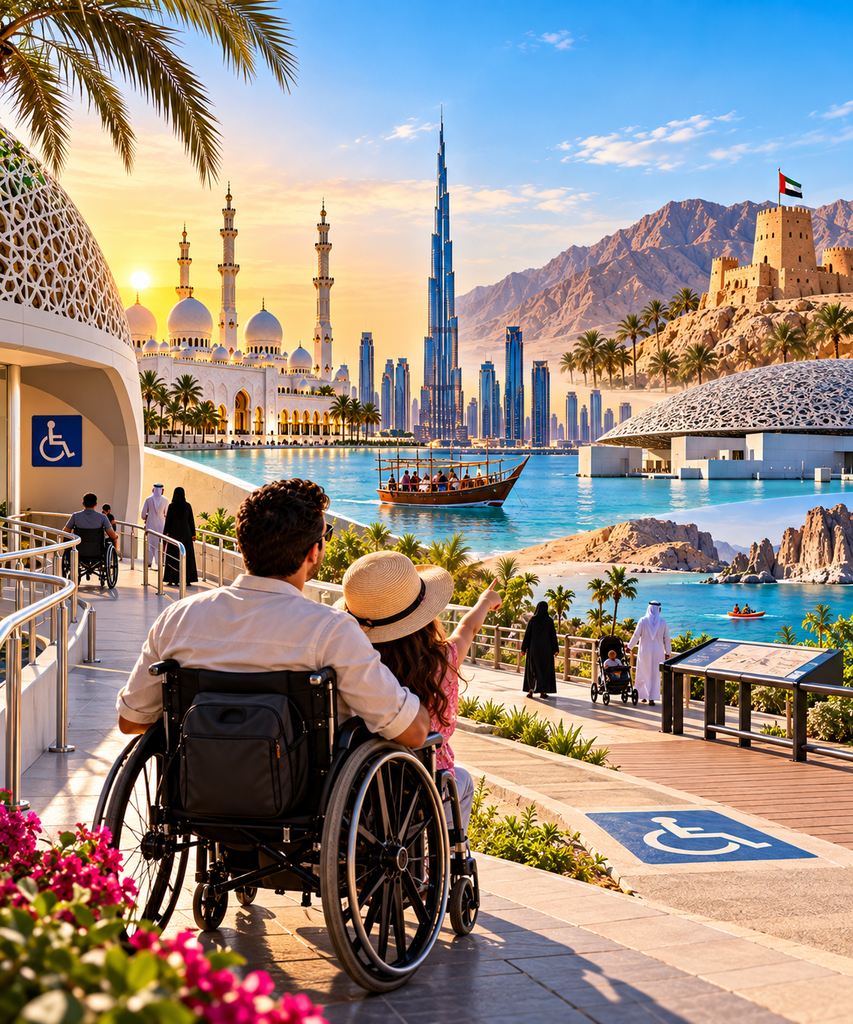
Saudi Arabia’s fast-changing tourism sector is creating opportunities to incorporate accessibility into newer hotels, entertainment districts, transport systems and public spaces from the planning stage.
Official Visit Saudi visitor guidance states that major cities such as Riyadh and Jeddah provide accessible ramps, hotels, tourist sites and other services for visitors with disabilities, while staff assistance is available at many large destinations.
Riyadh has also published an Accessibility Code covering elements of urban design. Requirements in the code include accessible alternatives at gates and turnstiles, illustrating how accessibility is increasingly being incorporated into the capital’s broader built environment.
However, Saudi Arabia also demonstrates why travellers should check individual experiences rather than assuming an entire destination is accessible.
AlUla, for example, combines modern venues with ancient desert landscapes. Some Visit Saudi experiences specifically state that they are not suitable for wheelchair users, while other facilities are wheelchair accessible. The Visit Saudi page for Maraya, for instance, identifies wheelchair accessibility, but a separate full-day AlUla tour covering heritage and natural sites says it is not suitable for wheelchair users.
That contrast is valuable for trip planning. A traveller may be able to enjoy major modern venues while needing an adapted itinerary for archaeological, hiking or desert experiences.
Saudi Arabia therefore deserves destination-by-destination research rather than a single national accessibility assumption.
Accessible Tourism in Qatar
Qatar has invested heavily in modern transport and visitor infrastructure, particularly in Doha.
Qatar Tourism recommends the Accessible Qatar smartphone platform, which provides information about accessibility and facilities at public and tourist venues. It also points visitors towards accessible tourism experiences developed through partnerships with specialist organisations.
Doha Metro is an especially important part of the accessible visitor experience.
Qatar Rail states that its network offers step-free access at all stations, spaces for manual and electric wheelchairs on trains and trams, designated seating, accessible drop-off areas and tactile navigation paths for travellers with visual impairments. Staff are trained in disability awareness and can assist passengers when required.
Guide dogs accompanying blind passengers and hearing dogs accompanying deaf passengers are permitted on the network under Qatar Rail’s conditions of carriage.
Qatar has also introduced specialised communication options for deaf people during emergencies. Visit Qatar lists video calling, SMS and email channels associated with the emergency support number 992.
Accessible beach infrastructure is also developing. West Bay Beach in Doha has introduced an accessibility ramp designed to help wheelchair users cross the sand and reach the water.
Doha can therefore be particularly practical for visitors whose itineraries are centred on Metro-connected museums, malls and modern districts.
Accessible Tourism in Bahrain
Bahrain’s compact geography can reduce some of the logistical pressure of accessible travel, but its strongest documented advantage is public transport.
The Bahrain Public Transport Company says its entire bus network is designed to accommodate wheelchairs and passengers with restricted mobility. Buses have low floors, wide doors, kneeling suspension and driver-operated ramps. Designated wheelchair spaces and priority seating are also provided.
The main bus terminals in Manama, Muharraq and Isa Town include accessible lanes and toilets, with accessible waiting areas available at Muharraq and Isa Town.
Bahrain International Airport also publishes extensive assistance information. Travellers can request wheelchairs in advance, use dedicated immigration counters and e-gates, and find accessible parking and washrooms.
The airport is notable for recognising non-visible disabilities as well. Its We See You programme uses the Hidden Disabilities Sunflower scheme, allowing eligible travellers to signal discreetly that they may require additional time or assistance. A sensory room is also available inside the terminal.
These services show why accessible tourism should not be measured only by wheelchair infrastructure.
Accessible Tourism in Oman
Oman’s greatest tourism attractions include mountains, wadis, forts and desert landscapes, which can create more physical barriers than highly urban destinations. However, several modern attractions in Muscat publish clear accessibility information.
Experience Oman identifies the National Museum as wheelchair accessible. It also lists accessible areas, Arabic Braille and personalised services for visitors with additional needs. Individuals with disabilities are granted free admission according to the tourism platform.
The same official tourism platform marks a number of other Muscat attractions as wheelchair accessible. Mall of Oman has ramps, elevators, designated parking and accessible facilities, while Mall of Muscat lists ramps, elevators and accessible restrooms.
Al Mirani Fort is also labelled wheelchair accessible by Experience Oman, showing that accessibility is not limited entirely to modern malls and museums.
The challenge comes when travellers move beyond Muscat.
Mountain trails, traditional villages, wadis and desert experiences can involve uneven terrain, gravel, sand and vehicle transfers. Travellers who require step-free access should therefore discuss the complete route with a tour operator rather than asking only whether transportation itself can accommodate a wheelchair.
Accessible Tourism in Kuwait
Kuwait’s publicly available tourism accessibility information is more fragmented, so travellers may need to confirm requirements directly with individual hotels, attractions and transport providers.
Kuwait International Airport provides wheelchair assistance as part of its passenger services, while paid meet-and-assist services can support travellers through immigration, baggage collection, transfers and the journey to the departure gate.
Modern indoor attractions can be easier to navigate than older or outdoor locations, but travellers should confirm details individually before booking.
The Scientific Center is one of Kuwait City’s best-known visitor attractions and combines an aquarium, science experiences and IMAX facilities. Its official site provides visitor information, although detailed accessibility specifications are not prominently presented in the same centralised format seen on Dubai or Abu Dhabi’s tourism portals.
For Kuwait, a useful planning approach is to contact each venue and hotel directly and ask for measurements or photographs where accessibility is essential.
Accessible Airports Across the GCC
The airport is often the first point where accessible tourism succeeds or fails.
Modern Gulf airports generally offer wheelchair and reduced-mobility assistance, but travellers should not assume that simply arriving at the terminal is enough.
Pre-booking matters.
Abu Dhabi Tourism recommends requesting airport and airline assistance about 48 hours before flying. Bahrain International Airport similarly advises travellers requiring wheelchairs or other assistance to contact the airline beforehand. Kuwait International Airport offers wheelchair support and optional meet-and-assist services.
Before flying, travellers should confirm:
| Airport Question | Why It Matters |
|---|---|
| Can my own wheelchair be used to the aircraft door? | Prevents unnecessary transfers |
| How will a powered wheelchair battery be handled? | Airline rules differ |
| Is an aisle chair required? | Important for aircraft boarding |
| Can assistance be pre-booked? | Reduces waiting on arrival |
| Are accessible taxis available at the destination? | Airport accessibility alone is not enough |
| Is support available during transit? | Essential when changing flights |
| Can a companion remain with me? | Procedures vary at security and immigration |
Travellers carrying powered mobility equipment should provide the airline with battery type, dimensions and weight well before departure.
Public Transport for Travellers With Reduced Mobility
Public transport is one of the clearest areas of progress across newer Gulf cities.
Doha Metro provides step-free stations, wheelchair spaces and tactile guidance. Bahrain’s bus fleet uses low-floor vehicles and ramps, while Abu Dhabi’s public bus network is equipped for wheelchair access.
However, the accessible journey begins before boarding.
A perfectly accessible bus is less useful if the pavement between the hotel and bus stop has high kerbs, construction barriers or no safe crossing. Likewise, a Metro station may be step-free while the final 500 metres to a heritage site are considerably more difficult.
When choosing accommodation, map the entire door-to-door journey, not simply the nearest station.
This is particularly important in summer. A five-minute outdoor journey may be manageable in January but much harder during extreme heat.
How to Choose an Accessible Hotel in the Gulf
The phrase “accessible room available” does not provide enough information.
Two hotels can both use that description while offering completely different facilities.
Before paying for a non-refundable booking, ask specific questions and request room photographs if necessary.
| Hotel Feature to Confirm | What to Ask |
|---|---|
| Door width | Can my chair comfortably pass through? |
| Bathroom | Is there a true roll-in shower? |
| Toilet | What is the height and transfer space? |
| Grab rails | Where are they positioned? |
| Bed | What is the mattress height? |
| Lift | Is it large enough for my mobility device? |
| Pool | Is there a pool lift or step-free entry? |
| Restaurant | Is every dining area step-free? |
| Shuttle | Can it carry a wheelchair without transfer? |
| Emergency plan | How are disabled guests assisted during evacuation? |
Abu Dhabi’s official tourism portal specifically advises contacting hotels before travel to confirm the accessibility facilities required by the individual guest.
That advice is useful throughout the GCC.
Accessible Museums, Attractions and Cultural Experiences
Museums are often among the easiest Gulf attractions for visitors with reduced mobility because many are newer, air-conditioned buildings designed around lifts and broad circulation spaces.
Louvre Abu Dhabi provides step-free access and wheelchair loans, Oman’s National Museum publishes accessibility and Braille information, while Dubai’s Museum of the Future states that all facilities are wheelchair accessible.
Heritage destinations require more research.
Historic forts, traditional markets and archaeological areas may contain narrow passages, old paving, steps or uneven surfaces that cannot easily be altered without affecting the site itself.
This does not always mean the entire attraction is impossible to visit. Sometimes an accessible route covers the main areas while other sections remain restricted.
Ask the venue which specific parts are accessible rather than asking only whether the attraction is “wheelchair friendly.”
Hidden Disabilities and Sensory Accessibility
Accessibility is increasingly expanding beyond mobility.
Bahrain International Airport’s Hidden Disabilities Sunflower initiative allows passengers with non-visible disabilities to indicate discreetly that they may need additional support. The airport also provides a dedicated sensory room.
Dubai’s Expo City lists quiet rooms and hearing enhancement systems alongside physical accessibility features.
Qatar provides specialised emergency contact methods for deaf people, including SMS and video communication.
These developments matter because crowded airports, flashing entertainment venues, loud theme parks and unfamiliar security procedures can be major barriers even when every entrance is step-free.
Travellers who benefit from quieter environments should ask attractions whether they offer sensory maps, quiet hours, low-stimulation areas or alternative queue arrangements.
Beaches, Deserts and Outdoor Experiences
Outdoor tourism remains one of the most challenging areas for accessibility across the Gulf.
Sand presents an obvious barrier for standard wheelchairs, while desert safaris may require transferring into high-clearance vehicles. Mountain destinations can involve gravel, steep surfaces and stairs.
Accessible infrastructure is beginning to appear in some beach environments. Doha’s West Bay Beach, for example, has introduced a ramp extending across the sand towards the water.
For desert activities, the phrase “accessible desert safari” needs careful clarification.
A traveller should ask whether the provider offers a wheelchair-accessible vehicle, whether transfer is required, whether the wheelchair can be carried safely and whether the desert camp has accessible toilets and step-free dining areas.
For someone who cannot safely transfer from a wheelchair, a scenic desert drive using an adapted vehicle may be more appropriate than conventional dune bashing.
Travelling With a Wheelchair or Mobility Equipment
Wheelchair users should treat the equipment itself as an essential part of travel planning.
Airlines need advance information about powered wheelchairs, particularly lithium-ion or other batteries. Travellers should photograph the chair before check-in and label removable components clearly.
A compact repair kit can also be useful, especially on multi-country GCC itineraries where the same replacement components may not be available everywhere.
For manual wheelchair users, the most important concern may be terrain. For powered-wheelchair users, battery charging and transport dimensions may matter more.
Never assume an accessible taxi can accommodate every powered wheelchair. Confirm the chair’s width, length, height and combined user-and-chair weight before reserving a specialised vehicle.
Best Time for Accessible Travel in the Gulf
For travellers who expect to spend significant time moving outdoors, November through March is generally the most comfortable period across much of the GCC.
Extreme heat can make accessible journeys harder because travellers may take longer to move between buildings, need additional rest periods or rely more heavily on outdoor ramps and pavements.
Qatar Tourism notes that summer temperatures can exceed 40°C, illustrating the type of conditions that can occur across the region during the hottest months.
Summer travel is still possible when an itinerary is concentrated around accessible hotels, malls, museums and indoor attractions.
However, transport should be organised carefully so that long waits outside are avoided.
For travellers who are particularly sensitive to heat, the cooler Gulf months provide much greater flexibility.
GCC Accessible Travel Planning Checklist
| Before Travel | What to Confirm |
|---|---|
| Airline | Wheelchair, battery and boarding assistance |
| Airport | Assistance booking and meeting point |
| Hotel | Room dimensions and bathroom configuration |
| Transport | Accessible taxi or step-free public transport |
| Attractions | Which areas are actually accessible |
| Tours | Vehicle transfer and terrain requirements |
| Beach | Boardwalk, beach wheelchair or water access |
| Medication | Documentation and storage requirements |
| Mobility device | Charger, adapter and repair essentials |
| Companion | Ticket or caregiver policies |
| Emergency needs | Accessible communication methods |
| Weather | Heat exposure between locations |
Create a daily itinerary with fewer transfers than a conventional sightseeing plan. Accessible trips often become much more enjoyable when extra time is left between attractions instead of trying to follow an aggressive schedule.
What Still Needs to Improve?
The Gulf has made visible progress, particularly in newer airports, museums, malls and transit infrastructure, but accessible tourism remains uneven.
One of the biggest remaining problems is information consistency.
A venue may have excellent physical access but provide almost no details online. Another may advertise itself as accessible without explaining whether that means a ramp at the entrance, fully adapted toilets, sensory assistance or complete step-free access.
Older heritage areas and natural attractions create another challenge. Retrofitting centuries-old forts, archaeological sites, mountain trails and desert environments is more complicated than designing accessibility into a new museum.
The next stage of accessible Gulf tourism therefore needs to focus not only on building ramps, but on publishing detailed, standardised information.
Travellers should be able to know before leaving home whether they can enter a venue independently, use its toilets, join a tour, access transport and evacuate safely in an emergency.
Final Thoughts on Accessible Tourism in GCC Countries
Accessible Tourism in GCC Countries is becoming a more visible part of how the region plans airports, transport networks, hotels and visitor attractions.
Dubai currently stands out for its dedicated accessible tourism information, Sanad Tourist Card and published itineraries. Abu Dhabi combines wheelchair-accessible public buses, specialised taxis, accessible hotels and major attractions such as Louvre Abu Dhabi.
Doha offers one of the region’s strongest public transport foundations through step-free Metro stations, wheelchair spaces and tactile paths, while Bahrain has designed its bus network around low-floor access and ramps.
Oman provides clearly identified accessible cultural locations such as the National Museum and several major Muscat attractions. Saudi Arabia is incorporating accessibility into rapidly developing cities and tourism infrastructure, although experiences in natural and archaeological environments must still be checked individually. Kuwait provides airport mobility assistance, while visitors should verify the exact facilities offered by hotels and attractions before arrival.
The most important lesson is that accessible travel should be planned around specific needs, not general labels. A wheelchair user, a deaf traveller and someone with a hidden disability may require completely different forms of support.
When destinations provide detailed information, trained staff, accessible transport and inclusive attractions, travellers gain something more important than convenience: the freedom to choose where they want to go rather than where their disability allows them to go.
Do follow us on Instagram
Read More – Best Gulf Destinations for Families With Children: 12 Amazing Picks