


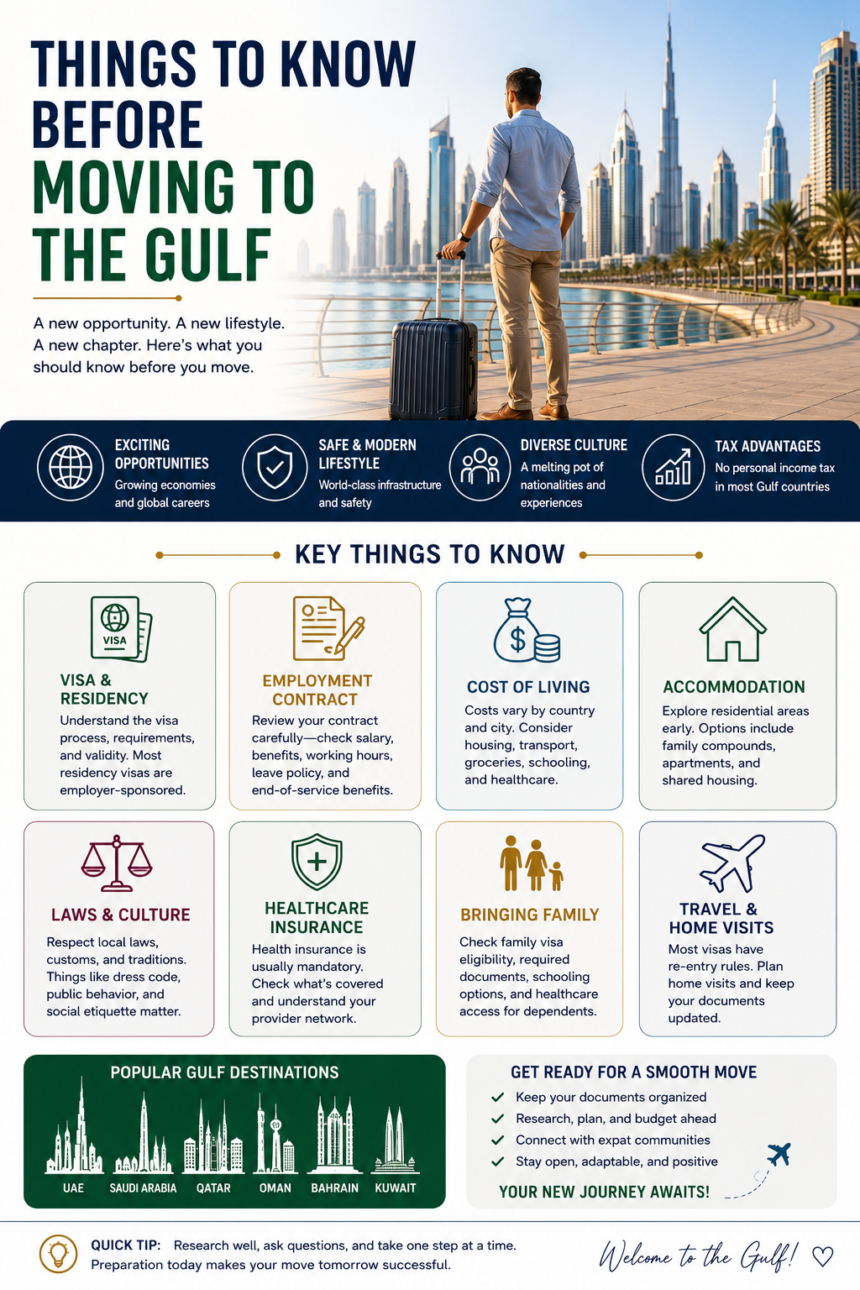
Things to Know Before Moving to the Gulf for Work and Family Life
Moving to the Gulf can be one of the biggest career and lifestyle decisions a person makes.
- Things to Know Before Moving to the Gulf at a Glance
- 1. Understand That Every Gulf Country Is Different
- 2. Never Move for Work Without Understanding Your Visa
- 3. Verify Your Job Offer Before Leaving Home
- 4. Read the Employment Contract Carefully
- 5. Understand Basic Salary Versus Total Salary
- 6. Calculate the Real Cost of Living Before Moving
- 7. Housing Can Change Your Entire Gulf Experience
- 8. Do Not Sign a Long Housing Contract Immediately
- 9. Healthcare and Insurance Matter More Than You Think
- 10. Families Need to Research School Costs Early
- 11. Public Transport Varies Significantly Across the Gulf
- 12. The Gulf Climate Requires Adjustment
- 13. Local Culture Should Be Respected
- 14. Learn the Local Laws Before You Arrive
- 15. Your Passport and Important Documents Need Preparation
- Moving to the UAE: What to Expect
- Moving to Saudi Arabia: What to Expect
- Moving to Qatar: What to Expect
- Moving to Bahrain: What to Expect
- Moving to Oman: What to Expect
- Moving to Kuwait: What to Expect
- How Much Money Should You Bring When Moving?
- Banking May Take Time to Set Up
- Your Home-Country Tax Responsibilities May Continue
- Driving Licence Rules Need Checking
- Building a Social Life Takes Effort
- What to Pack Before Moving to the Gulf
- A Pre-Move Gulf Checklist
- Common Mistakes People Make When Moving to the Gulf
- Is Moving to the Gulf Worth It?
- Final Thoughts on Things to Know Before Moving to the Gulf
The UAE, Saudi Arabia, Qatar, Bahrain, Oman and Kuwait attract millions of international workers, entrepreneurs and families every year. The region offers strong career opportunities, modern cities, high-quality infrastructure and, in many cases, the possibility of building substantial savings.
But moving to the Gulf is not the same as going on holiday.
Employment visas, housing contracts, healthcare, school fees, local laws, cultural expectations and everyday living costs can affect your experience far more than photographs of skyscrapers, beaches and luxury developments.
Dubai may offer an extremely international lifestyle, but housing can be expensive. Riyadh can provide major career opportunities, but the city and working environment may feel very different from what a newcomer expects. Doha is compact and highly developed, while Muscat offers a quieter pace of life. Bahrain and Kuwait provide their own distinct employment and family environments.
That is why preparation matters.
Before accepting a Gulf job or booking a one-way flight, understand how the country actually works.
Here are the most important Things to Know Before Moving to the Gulf in 2026.
Things to Know Before Moving to the Gulf at a Glance
The six GCC countries share many similarities, but they should not be treated as one single destination.
| Country | Major Expat Hubs | Main Strength | Lifestyle |
|---|---|---|---|
| UAE | Dubai, Abu Dhabi, Sharjah | Career variety and international lifestyle | Fast and highly international |
| Saudi Arabia | Riyadh, Jeddah, Al Khobar | Large economy and major projects | Rapidly changing |
| Qatar | Doha | Specialist careers and compact living | Modern and organised |
| Bahrain | Manama | Finance and smaller-city lifestyle | Social and manageable |
| Oman | Muscat | Balance, nature and relaxed living | Calm and scenic |
| Kuwait | Kuwait City | Established employment sectors | Traditional and urban |
This basic comparison helps, but choosing where to move requires much deeper research.
Your profession, employer, salary, family situation and preferred lifestyle should determine the final decision.
1. Understand That Every Gulf Country Is Different
One of the biggest mistakes new expatriates make is talking about “the Gulf” as if the entire region operates in exactly the same way.
It does not.
The UAE has seven emirates, and even Dubai and Abu Dhabi can provide noticeably different lifestyles.
Saudi Arabia is geographically enormous. Living in Riyadh is very different from living in Jeddah or Al Khobar.
Qatar is far smaller, with most expatriate life concentrated around Doha.
Oman has a more relaxed atmosphere and extensive natural landscapes, while Bahrain is compact enough that people can move around much of the country relatively easily.
Kuwait’s lifestyle and urban structure are different again.
Local laws, visa requirements, labour regulations, social expectations and business practices can also vary.
Before moving, research the specific country and city rather than relying on general advice about Gulf life.
2. Never Move for Work Without Understanding Your Visa
Your immigration status is one of the most important things to understand before relocation.
Across the GCC, standard employment residence is generally connected to a legitimate job and work-permit process.
In the UAE, employers can obtain work permits for employees recruited from overseas, while additional permit categories exist for transfers, part-time work, temporary employment, family-sponsored residents and certain other situations.
Saudi Arabia requires non-Saudi workers to obtain the appropriate work permit and normally be under contract with and the responsibility of an employer.
In Qatar, newcomers who want to live and work in the country normally require a Work Residence Permit connected with a Qatari employer.
Oman’s standard work visa is issued at the request and responsibility of the employer and normally requires the appropriate labour permit.
Kuwait’s private-sector work residence also involves a formal work permit and sponsorship process.
Never assume that entering as a visitor automatically gives you permission to start employment.
Visa rules should be understood before you begin working.
3. Verify Your Job Offer Before Leaving Home
A professional-looking offer letter does not automatically make a job genuine.
Fake recruitment agencies and employment scams can target people hoping to work in the Gulf.
Before resigning from your current job or spending money on travel, verify the employer.
Search for the company’s official website, registered office and professional presence.
Speak with the company’s HR department through independently verified contact information where possible.
In the UAE, official government guidance specifically allows workers to check the authenticity of certain employment offers through Ministry of Human Resources and Emiratisation channels.
Also pay attention to the way the recruiter communicates.
An employer offering an unusually high salary for an entry-level position while demanding immediate payment should raise concerns.
A genuine opportunity should provide clear information about the employer, job title, workplace, salary and legal employment process.
4. Read the Employment Contract Carefully
Your employment contract may become one of the most important documents you sign before moving.
Do not look only at the salary.
Read the entire document.
The contract should clearly explain your job title, basic salary, allowances, working hours, annual leave and other major conditions.
For expatriate workers, the exact contract structure depends on the country.
Saudi rules, for example, require a non-Saudi worker’s employment contract to be written and fixed-term under the applicable labour framework.
In the UAE, employment offers and contracts are formally connected with Ministry processes, and official employment documentation should reflect the agreed role.
If something was promised during the interview but does not appear anywhere in your formal documents, ask for clarification before relocating.
Major benefits should not depend entirely on verbal promises.
5. Understand Basic Salary Versus Total Salary
This detail causes confusion for many first-time Gulf workers.
An offer may include a basic salary plus several allowances.
For example, the package might contain:
Basic salary + housing allowance + transport allowance + other allowance
The total amount may look attractive, but the basic component can matter when employment benefits or end-of-service calculations are determined under applicable rules.
The structure also determines what you actually need to pay independently.
A worker receiving company accommodation has a very different financial position from someone receiving the same cash salary but paying rent personally.
Ask the employer for a complete compensation breakdown.
Never compare two job offers based only on the final monthly figure.
6. Calculate the Real Cost of Living Before Moving
The Gulf can provide excellent savings opportunities, but it can also be expensive.
Dubai is a perfect example.
A professional may receive a salary considerably higher than they earned at home, but rent, restaurants, transport and entertainment can quickly absorb the increase.
Housing is usually the first major expense to investigate.
Then calculate utilities, groceries, transport, mobile service, healthcare, clothing, entertainment and flights home.
Families need to add schooling and childcare.
Instead of asking, “Is AED 15,000 a good salary?” or “Is SAR 20,000 enough?”, build a personal budget.
The same salary can create completely different lifestyles depending on city, neighbourhood and family size.
7. Housing Can Change Your Entire Gulf Experience
Do not underestimate the importance of where you live.
Dubai offers everything from city-centre apartments to large suburban villa communities.
Abu Dhabi has island communities, central apartments and quieter family areas.
Riyadh is very spread out, so choosing a neighbourhood close to work can save considerable commuting time.
Doha’s compact layout makes some areas easier to manage, while Muscat’s long coastal shape means location also matters significantly.
A cheaper property is not always better.
If saving on rent forces you to spend two additional hours commuting every day, the financial saving may not be worth it.
Families should consider school location as well.
The best approach is usually:
Workplace first → school second → home third.
This prevents you from choosing accommodation that creates an exhausting daily routine.
8. Do Not Sign a Long Housing Contract Immediately
Moving into permanent accommodation on your first day can be risky.
You may not understand the city’s traffic patterns, neighbourhoods or commuting times yet.
A property that looked close to the office on a map may become inconvenient during peak traffic.
If practical, spend a short initial period in temporary accommodation while learning the area.
Visit potential neighbourhoods at different times of day.
Check supermarkets, schools, public transportation and access to major roads.
Ask existing residents about noise, parking and traffic.
A thoughtful housing decision can improve your entire relocation experience.
9. Healthcare and Insurance Matter More Than You Think
Healthcare standards across major Gulf cities can be very high, but expatriates need to understand how they will pay for treatment.
Employer-provided health insurance is common in many employment arrangements, but policies differ significantly.
One policy may include extensive private hospitals and specialist treatment.
Another may provide only a limited network.
Families should check whether spouses and children are covered.
Look carefully at:
- Hospital network
- Outpatient treatment
- Emergency services
- Dental care
- Maternity
- Prescriptions
- Specialist consultations
- Mental-health services
- Chronic-condition coverage
Do not simply accept the phrase “medical insurance provided” without understanding what the policy actually includes.
10. Families Need to Research School Costs Early
Education can become one of the largest expenses for an expatriate family.
Dubai has an enormous private-school market with British, American, Indian, International Baccalaureate and other curricula.
Abu Dhabi also offers substantial choice.
Doha, Riyadh, Jeddah, Manama, Muscat and Kuwait City have established international schools as well.
But fees vary significantly.
Some employers provide a school allowance.
Others provide nothing.
For a family with two or three children, this benefit can have a major financial value.
Parents should also investigate waiting lists.
Popular schools may not necessarily have an immediate place available.
Do not wait until after signing a housing contract to begin researching education.
11. Public Transport Varies Significantly Across the Gulf
Do not assume that every Gulf city requires a car.
Dubai has a highly developed public transport system including Metro, Tram, buses and taxis.
Someone living and working close to the Metro can potentially manage without owning a vehicle.
Doha also has a modern Metro system serving key parts of the capital.
Riyadh’s Metro has dramatically changed transport possibilities in the Saudi capital.
In cities such as Muscat and Kuwait City, a private car can still be considerably more useful for many residents.
Abu Dhabi has buses and taxis but does not offer the same Metro-based lifestyle as Dubai.
Transportation should therefore be included in your relocation budget.
Buying a car means paying for more than fuel.
Insurance, registration, servicing, parking and potentially finance payments all add to the cost.
12. The Gulf Climate Requires Adjustment
The climate is one of the biggest lifestyle changes newcomers face.
Summers can be extremely hot.
In some cities, outdoor daytime activities become difficult for extended periods.
This affects exercise, commuting, children’s activities and even simple tasks such as walking to the supermarket.
Cities are designed around this reality.
Air-conditioned malls, indoor entertainment, covered parking and climate-controlled workplaces become important parts of everyday life.
The cooler months can be completely different.
Winter brings outdoor dining, beaches, desert trips, camping, hiking and events.
Muscat also provides access to mountains and wadis, while Jeddah and other coastal cities offer water-based activities.
When planning your lifestyle, think in seasons rather than assuming every activity will be comfortable year-round.
13. Local Culture Should Be Respected
The Gulf is international, but it is not culturally identical to Europe, North America or other parts of Asia.
Islam has an important influence on society across the GCC.
New residents should approach local culture with respect.
Dress standards can vary significantly by place.
Beachwear may be normal at a hotel or beach club but inappropriate in certain public settings.
Public behaviour, photography and communication should also be approached thoughtfully.
During Ramadan, daily routines can change.
Working hours, restaurant schedules and public activity may operate differently.
For newcomers, the easiest approach is simple:
Observe how local residents and experienced expatriates behave and respect the culture of the country that is hosting you.
14. Learn the Local Laws Before You Arrive
Do not assume that behaviour legal in your home country is legal everywhere in the Gulf.
Rules concerning alcohol, drugs, public conduct, photography, online activity and financial disputes can differ.
The details vary considerably between the six GCC countries.
For example, alcohol rules are not identical in the UAE, Saudi Arabia, Qatar, Bahrain, Oman and Kuwait.
The same applies to public behaviour and certain online communications.
Social-media activity deserves particular care.
Publishing another person’s private information, photographs or accusations online can potentially create legal problems depending on the circumstances and jurisdiction.
If you are unsure about something that carries legal consequences, use official government guidance rather than relying on social-media comments.
15. Your Passport and Important Documents Need Preparation
Document preparation can delay a relocation if it is left until the final week.
Depending on your occupation and destination, you may need academic certificates, professional qualifications, marriage certificates, children’s birth certificates or police-clearance documents.
Certain documents may need official authentication or attestation.
Healthcare professionals, teachers and other regulated occupations may need additional professional approvals.
Passport validity also matters.
Different immigration services set documentary requirements, and some work processes require substantial remaining passport validity.
Keep electronic and physical copies of important documents.
A useful document folder should include:
| Document | Why You May Need It |
|---|---|
| Passport | Immigration and identification |
| Employment contract | Proof of job terms |
| Academic certificates | Employment or professional approval |
| Experience letters | Job verification |
| Marriage certificate | Family sponsorship |
| Birth certificates | Child residence and schooling |
| Police-clearance certificate | Certain immigration processes |
| Medical records | Ongoing healthcare |
| Vaccination records | Children and healthcare |
| Driving licence | Licence conversion or application |
| Passport photographs | Immigration and administrative processes |
Document requirements vary, so confirm the exact list before travelling.
Moving to the UAE: What to Expect
The UAE is often the easiest Gulf country for first-time expatriates to adjust to because of its highly international population.
English is widely used across workplaces, shops, restaurants and government-facing services.
Dubai has the strongest private-sector variety, while Abu Dhabi offers substantial opportunities across energy, finance, government-linked organisations and technology.
The UAE’s employment framework also provides multiple work-permit categories.
Current official guidance lists 13 types of permits under the Ministry of Human Resources and Emiratisation framework, including overseas recruitment, transfer, temporary, part-time and freelance permits.
The lifestyle can be very convenient.
However, convenience can become expensive.
Dubai in particular offers countless opportunities to spend money.
Anyone moving primarily to save should establish a monthly budget immediately.
Moving to Saudi Arabia: What to Expect
Saudi Arabia is becoming increasingly important for international workers.
Riyadh has become a major centre for finance, consulting, technology, construction and professional services.
Jeddah remains important for tourism, commerce and logistics.
The Eastern Province is especially relevant to energy and industrial professionals.
Saudi Arabia’s economic transformation means the lifestyle is also changing quickly.
Restaurants, entertainment districts, sporting events and cultural activities have expanded considerably.
However, newcomers should still understand Saudi employment rules carefully.
Non-Saudi workers require the appropriate work authorisation and employment contract.
Profession restrictions and localisation requirements can also affect which positions are available to foreign workers.
The Kingdom can be an excellent choice for professionals whose skills match sectors experiencing rapid investment.
Moving to Qatar: What to Expect
Most expatriate life in Qatar is concentrated around Doha.
That makes the country easier to understand geographically than much larger Gulf states.
Doha offers modern infrastructure, a Metro network, international schools, hospitals, malls and a substantial expatriate population.
Energy, aviation, healthcare, education, engineering and professional services remain important sectors.
A standard newcomer working in Qatar normally requires a Work Residence Permit through a Qatari employer.
Once a residence permit is obtained, it becomes central to accessing many services.
Strong employment packages can make Qatar particularly attractive.
Housing, family insurance and education support should therefore be evaluated carefully when comparing job offers.
Moving to Bahrain: What to Expect
Bahrain offers a smaller Gulf experience.
Manama has a long-established financial-services industry and international expatriate community.
The country is particularly relevant for professionals in banking, fintech, hospitality and professional services.
Its compact geography can be convenient.
Commuting distances may be easier to manage than in much larger metropolitan areas.
Bahrain is also connected to Saudi Arabia’s Eastern Province through the King Fahd Causeway.
The overall job market is smaller than Dubai or Riyadh, so workers should consider how many alternative employers exist in their profession before relocating.
For the right job, however, Bahrain can provide a comfortable balance between work and lifestyle.
Moving to Oman: What to Expect
Oman is particularly attractive to expatriates who prefer a slower pace.
Muscat’s mountains and coastline give it a completely different atmosphere from the skyscraper-heavy environments of Dubai and Doha.
Employment opportunities are available in sectors including energy, logistics, healthcare, tourism and education.
The standard Oman work visa is employer-driven.
Official Royal Oman Police guidance states that it is granted at the employer’s request and responsibility and normally requires a labour permit for non-government employment.
The lifestyle can be highly appealing.
Weekends can involve beaches, mountain roads, hiking and wadis.
However, a car is extremely useful for experiencing Oman fully.
Workers should also consider that the employment market is smaller, so job mobility may be more limited than in the UAE.
Moving to Kuwait: What to Expect
Kuwait has a long history of expatriate employment.
Energy remains extremely important, while professionals also work across healthcare, education, finance, retail and other industries.
Private-sector expatriate employment involves the appropriate work entry and residence procedures.
Current Kuwait Government guidance for private-sector work entry requires a work permit from the Public Authority for Manpower as part of the process.
First-time private-sector residence also involves documentation including the work entry visa, medical fitness requirements, passport and health-insurance documentation.
Kuwait’s entertainment environment is more understated than Dubai’s.
Social life is often centred around restaurants, cafes, shopping centres, family gatherings and waterfront activities.
For someone with a strong employment offer, the country can still provide attractive career and savings opportunities.
How Much Money Should You Bring When Moving?
New expatriates should not assume their first salary will arrive immediately.
Even with an organised employer, the first few weeks can involve significant spending.
Temporary accommodation, food, transport, deposits, furniture and mobile service can all require cash.
Housing can be especially demanding.
Depending on the market and contract, you may need deposits or advance payments.
Try to arrive with an emergency fund rather than relying entirely on your first salary.
A practical goal is to have enough available money to cover essential expenses during the initial settlement period.
The exact amount depends heavily on the city and whether your employer provides accommodation.
Banking May Take Time to Set Up
Opening a local bank account usually becomes easier after residence documentation and local identification have been issued.
Until then, your financial options may be more limited.
Bring at least one internationally usable payment method for your first weeks.
Also tell your home bank that you are relocating if needed to prevent legitimate international transactions being blocked.
Once your local account is active, compare remittance services before sending money home.
A small difference in exchange rate or transfer fee can become significant over repeated monthly transfers.
Your Home-Country Tax Responsibilities May Continue
The Gulf is often associated with tax-free salaries, but international taxation is more complicated than that phrase suggests.
Several GCC countries do not impose individual income tax on ordinary employment salaries.
However, this does not automatically mean that your home country stops considering you a tax resident.
Your nationality, residence status, property, investments and number of days spent in another country can all affect tax obligations.
People with substantial assets or complicated international finances should obtain professional tax advice.
Do this before relocation rather than discovering an unexpected obligation several years later.
Driving Licence Rules Need Checking
Do not assume you can permanently drive using your home-country licence.
Rules vary according to destination and nationality.
Some residents may be eligible to exchange recognised foreign licences.
Others may need training or testing.
The process can involve eye tests, residency documentation and other administrative steps.
If driving will be essential for work, investigate the licence rules before moving.
This is particularly important in cities where public transportation is limited.
Building a Social Life Takes Effort
Relocation is not only a financial or professional adjustment.
It is social.
Leaving friends and family can create a difficult period after the initial excitement disappears.
Fortunately, Gulf cities have highly international expatriate communities.
Sports clubs, gyms, professional associations, religious communities, cultural groups, coworking spaces and hobby organisations can help newcomers meet people.
Dubai has an especially large international social ecosystem.
Riyadh’s expat and professional communities are growing rapidly.
Doha, Bahrain, Muscat and Kuwait also have long-established expatriate networks.
Do not spend the first year moving only between your office and apartment.
Building a community can dramatically improve your quality of life.
What to Pack Before Moving to the Gulf
You do not need to bring everything you own.
Major Gulf cities have extensive shopping options.
However, certain documents and personal essentials deserve priority.
Bring original important certificates where required, prescription documentation, appropriate work clothing, basic personal items and anything difficult to replace immediately.
Do not pack only summer clothes.
Winters can be cool enough for jackets or layers, particularly during evenings and in northern or inland locations.
Offices and malls can also feel surprisingly cold because of powerful air conditioning.
If you take regular medication, check whether it can legally be brought into your destination and whether supporting medical documentation is required.
A Pre-Move Gulf Checklist
Before travelling, complete a final review.
| Area | Check Before Moving |
|---|---|
| Job | Employer verified |
| Contract | Salary and benefits confirmed |
| Visa | Correct work process confirmed |
| Passport | Validity checked |
| Documents | Attestation completed where required |
| Housing | Temporary or permanent plan arranged |
| Money | Emergency savings available |
| Healthcare | Insurance details understood |
| Family | School and dependant visas researched |
| Transport | Commute and licence options checked |
| Banking | International payment access available |
| Medication | Local rules checked |
| Culture | Basic local expectations understood |
| Emergency | Copies of important contacts and documents saved |
Completing these checks can prevent many of the most common relocation problems.
Common Mistakes People Make When Moving to the Gulf
One mistake is assuming a high salary automatically means high savings.
Another is accepting accommodation without checking the commute.
Some workers arrive without understanding their contract.
Families sometimes choose a home first and only later discover that the children’s school is far away.
Others rely on verbal promises about allowances that never appear in the formal offer.
Another common mistake is trying to recreate exactly the same lifestyle someone had at home.
Moving successfully requires some adaptation.
The Gulf can provide an excellent lifestyle, but newcomers generally enjoy it more when they understand the region rather than constantly comparing every local practice with their previous country.
Is Moving to the Gulf Worth It?
For many people, absolutely.
A Gulf move can provide international career experience, attractive earning potential, professional networking and exposure to rapidly developing economies.
Families can benefit from modern infrastructure, international schools and multicultural communities.
Entrepreneurs can access growing markets.
Professionals can build experience on major international projects.
But relocation is most successful when expectations are realistic.
The Gulf is not automatically an easy path to wealth.
Rent can be expensive.
Competition for good jobs can be intense.
Employment conditions vary enormously between employers.
The climate requires adjustment.
And living far from family can be emotionally challenging.
Knowing those realities before moving makes the positive parts of Gulf life much easier to appreciate.
Final Thoughts on Things to Know Before Moving to the Gulf
Moving to the Gulf can become an excellent career and lifestyle decision, but preparation should begin long before your flight.
Start by choosing the right country for your profession.
Then verify the employer.
Read the employment contract carefully and understand exactly how much of your package is basic salary, housing, transportation and other benefits.
Confirm that the correct legal work and residence process will be followed.
Calculate your real living costs instead of focusing only on salary.
Research housing based on your workplace and, if you have children, the location of their school.
Understand your health insurance.
Prepare important documents in advance.
Learn enough about local culture and laws to arrive with realistic expectations.
And bring an emergency fund.
The UAE, Saudi Arabia, Qatar, Bahrain, Oman and Kuwait can all provide excellent opportunities, but each country offers a different experience.
Dubai may suit an ambitious professional looking for an international lifestyle.
Riyadh may appeal to someone wanting exposure to major economic transformation.
Doha can be ideal for a specialist with a strong employer package.
Bahrain can work well for finance professionals.
Muscat can suit someone prioritising balance and nature.
Kuwait can be attractive for professionals entering established sectors with strong packages.
There is no single correct Gulf destination.
The best move is the one where your legal status, job, finances, family needs and lifestyle all fit together.
Prepare those five areas properly before relocating, and your first months in the Gulf are far more likely to become the beginning of a successful new chapter rather than an expensive surprise.
follow us on Instagram
Read More – How to Choose the Right Gulf Country to Work In: 12 Powerful Factors