


UAE vs Saudi Arabia vs Qatar: Which Gulf Country Offers the Best Expat Life?
Choosing where to live in the Gulf is no longer simply a question of finding the highest salary.
- UAE vs Saudi Arabia vs Qatar: Quick Comparison for Expats
- 1. UAE vs Saudi Arabia vs Qatar for Job Opportunities
- 2. Which Country Is Best for Salaries?
- 3. UAE vs Saudi Arabia vs Qatar Taxes
- 4. Which Country Has the Best Residence Visa Options?
- 5. UAE vs Saudi Arabia vs Qatar Cost of Living
- 6. Which Country Is Best for Housing?
- 7. UAE vs Saudi Arabia vs Qatar for Families
- 8. Which Country Has the Best Lifestyle?
- 9. UAE vs Saudi Arabia vs Qatar for Women Expats
- 10. Which Country Has Better Public Transport?
- 11. UAE vs Saudi Arabia vs Qatar for Healthcare
- 12. Which Country Is Best for Entrepreneurs?
- 13. Which Country Is Best for Long-Term Expats?
- 14. UAE vs Saudi Arabia vs Qatar for Travel
- 15. UAE vs Saudi Arabia vs Qatar: Which One Should You Choose?
- UAE vs Saudi Arabia vs Qatar for Different Types of Expats
- UAE vs Saudi Arabia vs Qatar Cost Comparison
- UAE vs Saudi Arabia vs Qatar for Single Professionals
- UAE vs Saudi Arabia vs Qatar for Families
- The Biggest Advantages of Living in the UAE
- The Biggest Advantages of Living in Saudi Arabia
- The Biggest Advantages of Living in Qatar
- So Which Gulf Country Is Best for Expats in 2026?
- Questions to Ask Before Moving
- Final Thoughts on UAE vs Saudi Arabia vs Qatar for Expats
The UAE, Saudi Arabia and Qatar have all developed into major destinations for international professionals, entrepreneurs and families, but the experience of living in each country can be very different.
The UAE offers highly international cities, extensive lifestyle choices and several long-term residency options. Saudi Arabia has one of the region’s largest economies and is undergoing enormous economic and social transformation. Qatar offers high earning potential in selected industries, a compact lifestyle and strong infrastructure centred primarily around Doha.
So which Gulf country is actually best for expats?
There is no universal winner.
A young professional looking for career mobility may reach a different conclusion from a family with school-age children. An entrepreneur may prioritize residency flexibility and business opportunities, while an engineer may care more about major projects, salary and housing benefits.
This UAE vs Saudi Arabia vs Qatar comparison looks at the factors that matter most in everyday expat life, including jobs, salaries, taxes, visas, housing, lifestyle, family life, transport, healthcare and long-term residency.
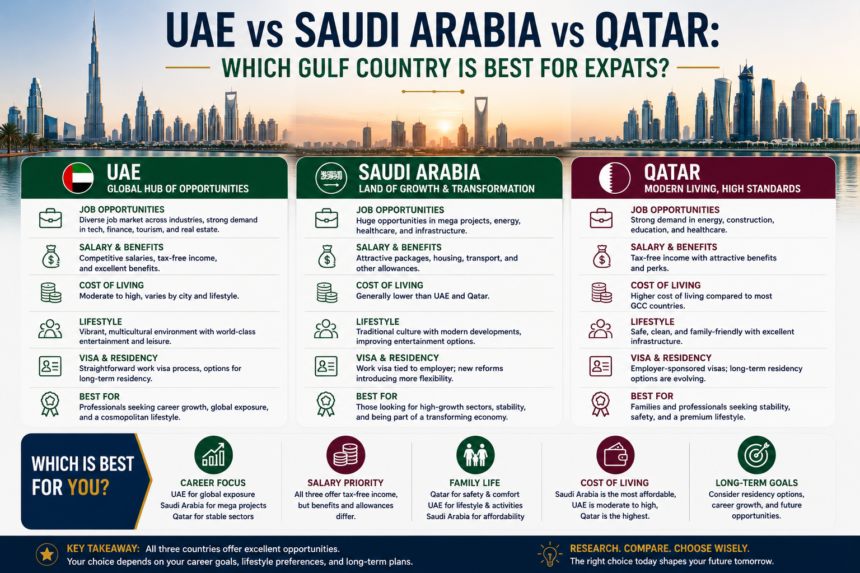
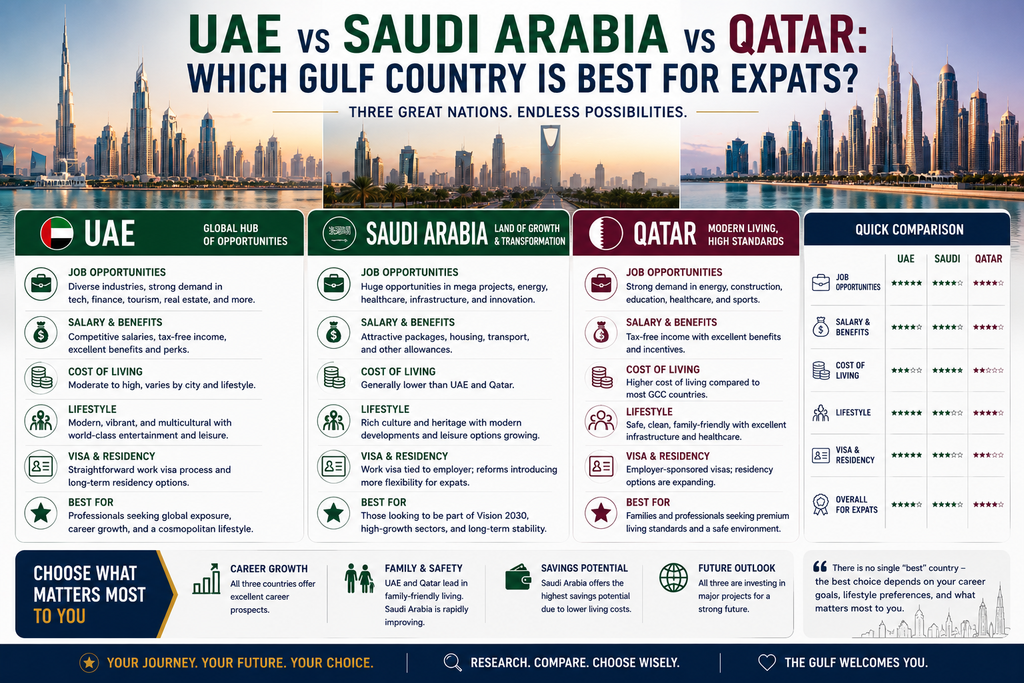
UAE vs Saudi Arabia vs Qatar: Quick Comparison for Expats
Before examining each country in detail, this table gives a broad overview.
| Category | UAE | Saudi Arabia | Qatar |
|---|---|---|---|
| Main expat hubs | Dubai, Abu Dhabi, Sharjah | Riyadh, Jeddah, Eastern Province | Doha |
| Personal tax on employment salary | No individual income tax | Generally no personal income tax on employment salary | Salaries and wages exempt |
| Standard work residence | Employer-linked | Employer-linked | Employer-linked |
| Long-term residency alternatives | Strong | Expanding rapidly | More limited |
| International lifestyle | Excellent | Growing rapidly | Very good |
| Job-market size | Large and diverse | Very large | Smaller and specialised |
| Public transport | Excellent in Dubai, expanding elsewhere | Rapidly improving | Strong in Doha |
| Family lifestyle | Excellent but can be expensive | Strong and improving | Strong |
| Entrepreneurship | Excellent | Major growth opportunity | Good but smaller market |
| Entertainment | Extensive | Rapidly expanding | Good |
| Best suited to | Professionals, entrepreneurs, families | Career growth, major projects, business | Specialists, families, compact living |
The table gives only a starting point. The real differences become clearer when each factor is examined individually.
1. UAE vs Saudi Arabia vs Qatar for Job Opportunities
Employment is the biggest reason many expatriates move to the Gulf.
All three countries offer opportunities, but the size and structure of their job markets differ considerably.
The UAE has one of the region’s most diversified employment environments. Dubai is particularly strong in finance, technology, hospitality, aviation, real estate, retail, logistics, marketing, media and professional services. Abu Dhabi adds significant opportunities in government-linked organisations, energy, finance, healthcare, technology and major development projects.
One major advantage of the UAE is the number of international companies operating there. Professionals can potentially move between employers and industries without leaving the country, although normal employment and residency procedures still apply.
Saudi Arabia operates on a much larger domestic scale.
Riyadh is attracting regional headquarters, financial institutions, technology companies and professional-services firms, while major projects and Vision 2030 programmes continue generating demand across construction, engineering, tourism, hospitality, entertainment and infrastructure.
Jeddah remains important for commerce, tourism and logistics, while the Eastern Province continues to be closely associated with energy and industry.
Qatar’s employment market is smaller because the country itself is much smaller.
However, that does not mean opportunities are weak.
Doha continues to attract international professionals in sectors including energy, aviation, hospitality, healthcare, education, engineering, finance and professional services.
For job-market variety, the UAE and Saudi Arabia generally offer a broader range of possibilities.
For highly specialised professionals with the right package, Qatar can still be extremely attractive.
2. Which Country Is Best for Salaries?
Comparing salaries between Gulf countries is difficult because job title alone tells only part of the story.
A senior engineer in Saudi Arabia may receive a very different package from someone with the same title in Dubai. A teacher in Qatar may receive housing as part of the employment package, while another employee in the UAE may receive a higher cash salary but pay rent independently.
Expats should therefore compare total compensation rather than headline salary.
Look at:
- Basic salary
- Housing allowance
- Transport allowance
- Health insurance
- School allowance
- Annual flight benefits
- Performance bonuses
- End-of-service benefits
- Relocation support
Saudi Arabia can be particularly competitive for senior professionals and people working on major projects.
The UAE offers enormous salary variation because its employment market ranges from lower-paid service roles to some of the region’s highest-paid executive positions.
Qatar can offer attractive packages in specialised sectors, especially where employers provide housing or other major benefits.
The best salary is therefore not necessarily the largest number shown on the employment contract.
What matters is how much remains after housing, schooling, transportation and normal living expenses.
3. UAE vs Saudi Arabia vs Qatar Taxes
Tax treatment is one of the Gulf’s biggest attractions for international workers.
The UAE does not impose income tax on individuals.
Saudi Arabia generally does not impose personal income tax on employment income earned by individuals.
Qatar’s income-tax framework specifically exempts salaries, wages and allowances from income tax.
This means salaried expatriates can potentially retain a larger proportion of their employment income than they would in many countries that impose substantial personal income taxes.
However, “tax-free salary” does not mean living without taxes or government charges.
The UAE, for example, has VAT on goods and services. Other charges can apply across all three countries depending on services, property, business activity and individual circumstances.
Expats also need to consider their tax obligations in their home country.
Nationality, tax residence, investments and the number of days spent in another jurisdiction can all affect personal tax responsibilities.
Anyone with complicated international finances should obtain professional tax advice rather than assuming Gulf residence automatically removes every overseas tax obligation.
4. Which Country Has the Best Residence Visa Options?
This is one area where the UAE currently has a major advantage for many expatriates.
Traditional Gulf employment residency has generally been linked closely to an employer.
That model still exists, but the UAE now provides several alternative residence categories.
Depending on eligibility, these can include options connected with skilled employment, investment, entrepreneurship, retirement, remote work and long-term Golden Visa residency.
The Golden Visa is particularly important because eligible residents can obtain long-term residency without the traditional employer sponsorship structure.
The UAE also offers Green Visa routes for eligible applicants.
Saudi Arabia is rapidly developing its own long-term residency system.
The Kingdom’s Premium Residency programme now includes seven options covering categories such as exceptional competence, talent, business investors, entrepreneurs and real-estate owners, alongside limited and unlimited-duration Premium Residency products.
This makes Saudi Arabia increasingly interesting for people who want a deeper long-term connection with the country.
Qatar’s normal employment system remains more directly centred around the Work Residence Permit.
A newcomer wishing to work and live in Qatar generally requires a Qatari employer to arrange the process.
Once the residence permit is issued, the expatriate can access services and, subject to the applicable conditions, may be able to sponsor immediate family members.
For overall residency flexibility, the UAE currently stands out.
Saudi Arabia is becoming significantly more competitive through Premium Residency, while Qatar remains particularly straightforward for expatriates arriving with a strong employer-sponsored package.
5. UAE vs Saudi Arabia vs Qatar Cost of Living
The cost of living can vary more between cities than between countries.
Dubai is generally expensive, particularly for housing in popular neighbourhoods, private schooling, dining and entertainment.
Abu Dhabi can also be expensive, although the actual cost depends heavily on neighbourhood and lifestyle.
Saudi Arabia can offer better value in certain categories, but Riyadh’s rapid growth has placed considerable pressure on housing in desirable areas.
Lifestyle spending can also rise quickly as the city adds more restaurants, entertainment districts and premium services.
Doha has a high-quality lifestyle but housing, international schooling and imported products can be expensive.
The biggest mistake is comparing only supermarket prices.
For most expatriate families, the largest expenses are usually:
- Housing
- Schooling
- Transportation
- Healthcare not covered by insurance
- Food
- Entertainment
- Travel
A single employer-provided housing or school allowance can therefore completely change which country offers the best financial outcome.
6. Which Country Is Best for Housing?
Housing choices are extensive across all three markets, but the experience differs.
Dubai offers enormous variety.
An expat can choose a high-rise apartment in Dubai Marina, an urban lifestyle in Downtown Dubai, a family villa in Arabian Ranches or a more affordable apartment in communities farther from the centre.
Abu Dhabi similarly offers everything from central apartments to large family-oriented island communities.
Riyadh is different.
The city has traditionally been more spread out, and villas and compounds have played a larger role in expatriate housing. New apartment and mixed-use developments are changing that landscape rapidly.
Jeddah provides another lifestyle, with coastal communities and a somewhat different urban character from Riyadh.
In Qatar, most international professionals live in or around Doha.
Popular residential environments range from high-rise apartments around West Bay to waterfront living at The Pearl-Qatar and family accommodation in suburban communities.
The UAE generally provides the greatest variety of neighbourhood types.
Saudi Arabia can provide more space in some locations, while Qatar’s compact geography can simplify the process of deciding where to live.
7. UAE vs Saudi Arabia vs Qatar for Families
All three countries can provide a high standard of family life.
The UAE has one of the broadest selections of international schools in the region.
Families can find British, American, Indian, International Baccalaureate and other curricula, particularly in Dubai and Abu Dhabi.
The disadvantage is cost.
Private-school fees can become one of the largest household expenses for expatriate parents.
Saudi Arabia also has a substantial international-school sector, especially in Riyadh, Jeddah and the Eastern Province.
The expansion of international companies and expatriate communities is creating further demand for high-quality education.
Qatar has well-established international schools and a highly international expatriate population.
Doha’s relatively compact structure can also be convenient for family routines, although school choice can significantly influence where a family decides to live.
For families comparing job offers, an education allowance can sometimes be worth more than a modest increase in salary.
8. Which Country Has the Best Lifestyle?
The UAE remains particularly strong in this category.
Dubai offers an enormous selection of restaurants, beaches, malls, sporting events, concerts, nightlife, family attractions and weekend activities.
Abu Dhabi combines city life with beaches, museums, major events and a slightly different pace.
The UAE’s international population also makes it relatively easy for newcomers to find communities connected with their language, nationality, profession or interests.
Saudi Arabia has changed dramatically.
Riyadh’s restaurant, entertainment and event scenes have expanded rapidly, while Jeddah offers a strong coastal identity.
Sports, concerts, festivals, tourism projects and entertainment destinations are becoming increasingly important parts of everyday life.
However, social rules and cultural expectations remain different from those in Dubai.
Qatar provides a quieter and more compact lifestyle.
Doha offers high-quality restaurants, museums, malls, beaches, hotels, sporting facilities and cultural attractions.
The city can be particularly comfortable for families and professionals who do not need the constant activity of a larger metropolis.
For sheer variety, the UAE wins.
For people excited by a country undergoing rapid transformation, Saudi Arabia can be fascinating.
For those wanting a smaller, organised environment, Qatar can be attractive.
9. UAE vs Saudi Arabia vs Qatar for Women Expats
Women work, drive, run businesses and build professional careers across all three countries.
The UAE has a highly international professional environment, particularly in Dubai and Abu Dhabi, with women visible across industries ranging from aviation and finance to entrepreneurship, healthcare and media.
Saudi Arabia has undergone substantial social and labour-market changes, with women’s participation becoming increasingly visible across professional sectors.
Women now work across business, hospitality, technology, tourism, healthcare, retail and numerous other industries.
Qatar also has a significant international female workforce, particularly across education, healthcare, aviation, hospitality, professional services and other sectors.
However, social expectations, dress norms and cultural environments are not identical.
Expats should research the everyday lifestyle of the particular city rather than treating the Gulf as one uniform culture.
10. Which Country Has Better Public Transport?
For expats who do not want to own a car, Dubai has a major advantage.
Dubai’s integrated public transport system includes Metro, Tram, buses, marine transport and taxis.
The Metro connects many major employment, residential and tourism districts.
Dubai is also expanding the network through projects such as the Blue Line, while further future rail development is planned.
Doha also performs strongly.
The Doha Metro provides modern rail connections across key parts of the capital, supported by buses and other transport services.
For a relatively compact city, this can make public transport highly practical depending on where someone lives and works.
Saudi Arabia has entered a new public-transport era with the Riyadh Metro and expanding bus systems.
This is a major change for a city that has historically depended heavily on cars.
However, the usefulness of public transport still depends greatly on the location of your home and workplace.
For someone who specifically wants to live without a car, Dubai is currently the easiest of the three in many circumstances.
11. UAE vs Saudi Arabia vs Qatar for Healthcare
All three countries have modern healthcare infrastructure.
The UAE has extensive public and private healthcare networks, particularly in Dubai and Abu Dhabi.
International hospital groups and specialist clinics make it relatively easy to find private medical treatment.
Health insurance is therefore a major part of the expatriate experience.
Saudi Arabia has a large healthcare system covering public and private facilities, with continuing investment in medical infrastructure and private-sector participation.
Major cities provide access to specialist hospitals and clinics.
Qatar has developed strong healthcare infrastructure for its comparatively small population, with public healthcare complemented by private hospitals and clinics.
For most expatriates, the more important question is not which country has hospitals.
All three do.
The key question is what your employer’s health-insurance policy actually covers.
Check:
- Hospital network
- Dental coverage
- Maternity
- Mental-health services
- Prescription medication
- Specialist consultations
- International treatment
- Dependants
A strong insurance package can make a major difference to the quality and cost of everyday healthcare.
12. Which Country Is Best for Entrepreneurs?
The UAE remains one of the Gulf’s strongest environments for international entrepreneurs.
Dubai and Abu Dhabi offer free zones, mainland company structures, startup ecosystems, international investors, professional services and access to regional markets.
Dubai is particularly attractive for entrepreneurs whose businesses depend on international clients, travel, networking or regional headquarters.
Saudi Arabia provides a different opportunity.
Its domestic market is much larger, and Vision 2030 is generating investment across numerous sectors.
For businesses connected with technology, tourism, construction, entertainment, logistics, professional services and consumer markets, the scale of opportunity can be substantial.
Premium Residency also provides new possibilities for eligible entrepreneurs and investors.
Qatar has a smaller domestic market but offers opportunities in areas connected with energy, technology, tourism, sports, logistics and professional services.
For international connectivity and ease of building a regionally focused lifestyle, the UAE remains extremely competitive.
For businesses targeting a large and expanding domestic market, Saudi Arabia may offer greater scale.
13. Which Country Is Best for Long-Term Expats?
Historically, many Gulf expatriates viewed their stay as temporary.
That is changing.
The UAE’s Golden Visa and other residence categories allow eligible residents to plan further into the future.
Property ownership opportunities and established international communities also make long-term life easier for many expatriates.
Saudi Arabia’s Premium Residency programme represents a similar shift.
Instead of relying exclusively on conventional employment-linked residence, eligible professionals, investors, entrepreneurs and property owners now have additional pathways.
Qatar also provides long-term and permanent-residency mechanisms for qualifying individuals, but these routes are more limited than standard employer-sponsored residency and eligibility conditions are stricter.
For an expat whose main priority is residency independence and long-term flexibility, the UAE currently offers the broadest ecosystem of the three.
14. UAE vs Saudi Arabia vs Qatar for Travel
The Gulf’s geographic position makes international travel one of its biggest lifestyle advantages.
The UAE is particularly strong because Dubai and Abu Dhabi are major global aviation hubs.
Residents can reach destinations across Europe, Asia, Africa and the Americas through extensive direct connections.
Saudi Arabia’s aviation network is expanding rapidly.
Riyadh, Jeddah and Dammam provide major domestic and international connections, while future aviation projects are expected to increase capacity further.
Qatar has an enormous advantage relative to its size because Doha is home to one of the world’s major international aviation hubs.
For expatriates who travel frequently for work or holidays, all three countries perform well.
Dubai and Doha are particularly convenient for international connections, while Saudi Arabia provides a much larger domestic travel market as well.
15. UAE vs Saudi Arabia vs Qatar: Which One Should You Choose?
The answer depends on your priorities.
Choose the UAE if you want:
- The widest international lifestyle
- Diverse employment opportunities
- Strong long-term residency options
- Excellent global flight connections
- Extensive entertainment
- A large expatriate community
- Strong entrepreneurial infrastructure
- The possibility of living without a car in selected Dubai areas
The UAE is probably the easiest all-round choice for many first-time Gulf expatriates.
Its biggest disadvantage is cost, particularly in Dubai.
Choose Saudi Arabia if you want:
- Exposure to a rapidly transforming economy
- Large-scale career opportunities
- Major infrastructure and development projects
- Access to a much larger domestic market
- Growing entrepreneurial opportunities
- Expanding long-term residency options
- A potentially strong compensation package
Saudi Arabia can be particularly attractive for ambitious professionals whose industries are benefiting from the Kingdom’s investment and transformation.
Choose Qatar if you want:
- A smaller and more manageable environment
- Strong opportunities in specialised sectors
- A family-oriented lifestyle
- Modern infrastructure
- Good international connectivity
- A relatively compact capital
- Attractive employer packages in selected industries
Qatar can be especially appealing to professionals who already have a strong employment offer and prefer a smaller city environment.
UAE vs Saudi Arabia vs Qatar for Different Types of Expats
The easiest way to compare the three countries is by asking what kind of expat you are.
| Expat Profile | Strongest Choice | Why |
|---|---|---|
| First-time Gulf expat | UAE | International environment and broad lifestyle options |
| Entrepreneur | UAE / Saudi Arabia | UAE for regional connectivity; Saudi for market scale |
| Engineer on major projects | Saudi Arabia | Huge development and infrastructure pipeline |
| Energy professional | Saudi Arabia / Qatar / UAE | All three have major energy opportunities |
| Finance professional | UAE / Saudi Arabia | Dubai, Abu Dhabi and Riyadh are major financial centres |
| Hospitality professional | UAE / Saudi Arabia | Large tourism and hotel expansion |
| Family with children | UAE / Qatar | Strong international-school and family ecosystems |
| Car-free professional | UAE | Dubai has the strongest established multimodal network |
| Long-term residency seeker | UAE | Broad range of independent residence pathways |
| Professional with excellent employer package | Qatar | Strong packages can make Doha highly attractive |
These are general comparisons rather than fixed rules.
An outstanding job offer in Qatar can easily be better than an average offer in Dubai. Similarly, a senior opportunity in Riyadh can provide greater career progression than a role elsewhere.
The employment package always matters.
UAE vs Saudi Arabia vs Qatar Cost Comparison
Rather than asking which country is simply “cheapest,” expats should compare the expenses that affect their particular household.
| Expense | UAE | Saudi Arabia | Qatar |
|---|---|---|---|
| Premium housing | High in major areas | Rising in Riyadh | High in prime Doha areas |
| International schooling | Can be expensive | Can be expensive | Can be expensive |
| Eating out | Huge price range | Growing range | Moderate to premium |
| Entertainment | Extensive spending opportunities | Rapidly expanding | Good but smaller selection |
| Public transport | Strong in Dubai | Improving rapidly | Strong in Doha |
| Need for a car | Depends on area | Often useful | Depends on location |
| Lifestyle choice | Very wide | Rapidly expanding | More compact |
Actual spending depends far more on lifestyle than nationality.
Someone living outside central Dubai, using public transport and cooking at home may spend less than someone living in a premium Riyadh compound with frequent restaurant and entertainment expenses.
UAE vs Saudi Arabia vs Qatar for Single Professionals
Single professionals often prioritise career development, networking and social life.
Dubai performs particularly strongly because of its enormous international community and extensive entertainment scene.
It is relatively easy to meet people through professional events, sports clubs, restaurants, gyms and social groups.
Riyadh is increasingly competitive.
The city’s social scene has changed considerably, with more restaurants, events, entertainment districts and international professionals arriving.
For someone working in a fast-growing sector, the professional opportunities can outweigh lifestyle differences.
Doha offers a smaller social environment.
Some people appreciate this because friendships and professional networks can become closely connected.
Others may find the city quieter after several years.
UAE vs Saudi Arabia vs Qatar for Families
Families should look beyond salary.
Schooling and housing can completely change the financial calculation.
A family receiving a housing allowance and school-fee support in Riyadh may have a significantly better standard of living than one receiving a slightly larger cash salary in Dubai without those benefits.
Similarly, a Qatar employment package that includes accommodation, flights and education can be extremely valuable.
Parents should compare the entire package before accepting a role.
They should also research the distance between home, school and work.
A beautiful villa loses some of its appeal if parents spend several hours each week driving across the city.
The Biggest Advantages of Living in the UAE
The UAE’s biggest strength is choice.
Expats can choose between the fast-moving environment of Dubai, the capital-city lifestyle of Abu Dhabi and more affordable or quieter environments in other emirates.
The country also offers an unusually broad mix of nationalities.
English is widely used in business and everyday services, making the transition relatively easy for many newcomers.
Its long-term residence options are another major advantage.
The biggest challenge is maintaining financial discipline.
Dubai in particular makes it extremely easy to spend money.
Luxury housing, restaurants, beach clubs, entertainment and frequent travel can quickly reduce the benefit of a tax-free salary.
The Biggest Advantages of Living in Saudi Arabia
Saudi Arabia’s biggest advantage is momentum.
The Kingdom is investing heavily in its economy, infrastructure, tourism, entertainment and cities.
For professionals in the right industries, that transformation can create opportunities that may not exist elsewhere at the same scale.
The country’s enormous domestic market also matters for entrepreneurs.
Saudi Arabia has a population of nearly 37 million according to 2025 World Bank data, compared with approximately 11.5 million in the UAE and 3 million in Qatar.
That difference creates a very different commercial environment.
Saudi Arabia may therefore be particularly attractive to professionals and businesses that want to participate directly in the region’s largest economy.
The Biggest Advantages of Living in Qatar
Qatar’s biggest advantage is that it combines high-quality infrastructure with a relatively compact environment.
Most expatriate life is concentrated around Doha.
That can make the country easier to understand than a larger market with several major cities.
The Doha Metro, international airport, cultural institutions, sporting facilities and modern residential developments provide a high standard of urban infrastructure.
Qatar can also be extremely attractive when the employment package is strong.
Housing or school benefits can substantially improve an expatriate family’s disposable income.
The main limitation is scale.
The employment market and entertainment landscape are naturally smaller than those of the UAE or Saudi Arabia.
So Which Gulf Country Is Best for Expats in 2026?
If one country must be selected as the strongest overall all-round option, the UAE has the advantage for many expatriates.
It combines employment diversity, international connectivity, lifestyle choice, entrepreneurship, established expatriate communities and increasingly flexible long-term residence options.
But that does not make it the automatic winner for every person.
Saudi Arabia may be the better choice for professionals focused on career acceleration, large projects, entrepreneurship and opportunities created by economic transformation.
Qatar may be better for someone with an excellent employer package who values a smaller, modern and family-friendly environment.
The practical ranking therefore looks more like this:
Best overall expat ecosystem: UAE
Best for large-scale emerging career opportunities: Saudi Arabia
Best for compact living with a strong specialist employment package: Qatar
Best for entrepreneurs targeting international markets: UAE
Best for entrepreneurs targeting a large domestic Gulf market: Saudi Arabia
Best for established long-term residency flexibility: UAE
Best for people who prefer a smaller capital-city lifestyle: Qatar
The most important lesson is that expats should compare job offers, not simply countries.
A QR salary in Doha, SAR salary in Riyadh or AED salary in Dubai means very little without understanding rent, school fees, insurance, transport and employer benefits.
Questions to Ask Before Moving
Before accepting an offer in any of the three countries, calculate your likely monthly savings.
Do not stop at salary.
Ask the employer exactly what is included.
Important questions include:
- Who pays for the residence permit?
- Is accommodation provided?
- Is there a housing allowance?
- Does health insurance cover dependants?
- Are school fees included?
- Are annual flights included?
- Is transport provided?
- What are the working hours?
- What is the annual-leave entitlement?
- What happens if employment ends?
- What end-of-service benefits apply?
- Can family members be sponsored?
- How far is the workplace from suitable residential areas?
These answers can be more important than the difference between two headline salaries.
Final Thoughts on UAE vs Saudi Arabia vs Qatar for Expats
The UAE, Saudi Arabia and Qatar are three of the Gulf’s most important destinations for expatriate professionals, but they offer distinctly different experiences.
The UAE provides perhaps the most complete international expat ecosystem. Dubai and Abu Dhabi combine large employment markets, international communities, global aviation links, extensive entertainment and several routes toward longer-term residence.
Saudi Arabia offers scale.
Its economy, population and enormous development agenda create opportunities across industries ranging from construction and tourism to finance, technology, entertainment and professional services. The expansion of Premium Residency also shows that the Kingdom is developing new ways for international professionals, entrepreneurs and investors to build longer-term connections with the country.
Qatar offers a more compact alternative.
Doha provides modern infrastructure, strong international connectivity and attractive opportunities in specialised industries. For an expatriate receiving housing, education and other employer benefits, a Qatar package can be extremely competitive.
So which Gulf country is best for expats?
For the broadest overall combination of lifestyle, career mobility and residency flexibility, the UAE has the edge.
For professionals seeking opportunities connected with one of the world’s most ambitious economic transformations, Saudi Arabia deserves serious consideration.
For specialists and families wanting a smaller, organised environment with the right employment package, Qatar can be an excellent choice.
The best country is ultimately the one where your career opportunity, compensation package and preferred lifestyle fit together.
Before moving, compare what you will save, how you will live and what opportunities the country can offer you three or five years from now.
That provides a much more useful answer than simply comparing salaries.
Follow us on Instagram
Read More – Underwater Activities in Dubai: 12 Amazing Experiences to Try in 2026