



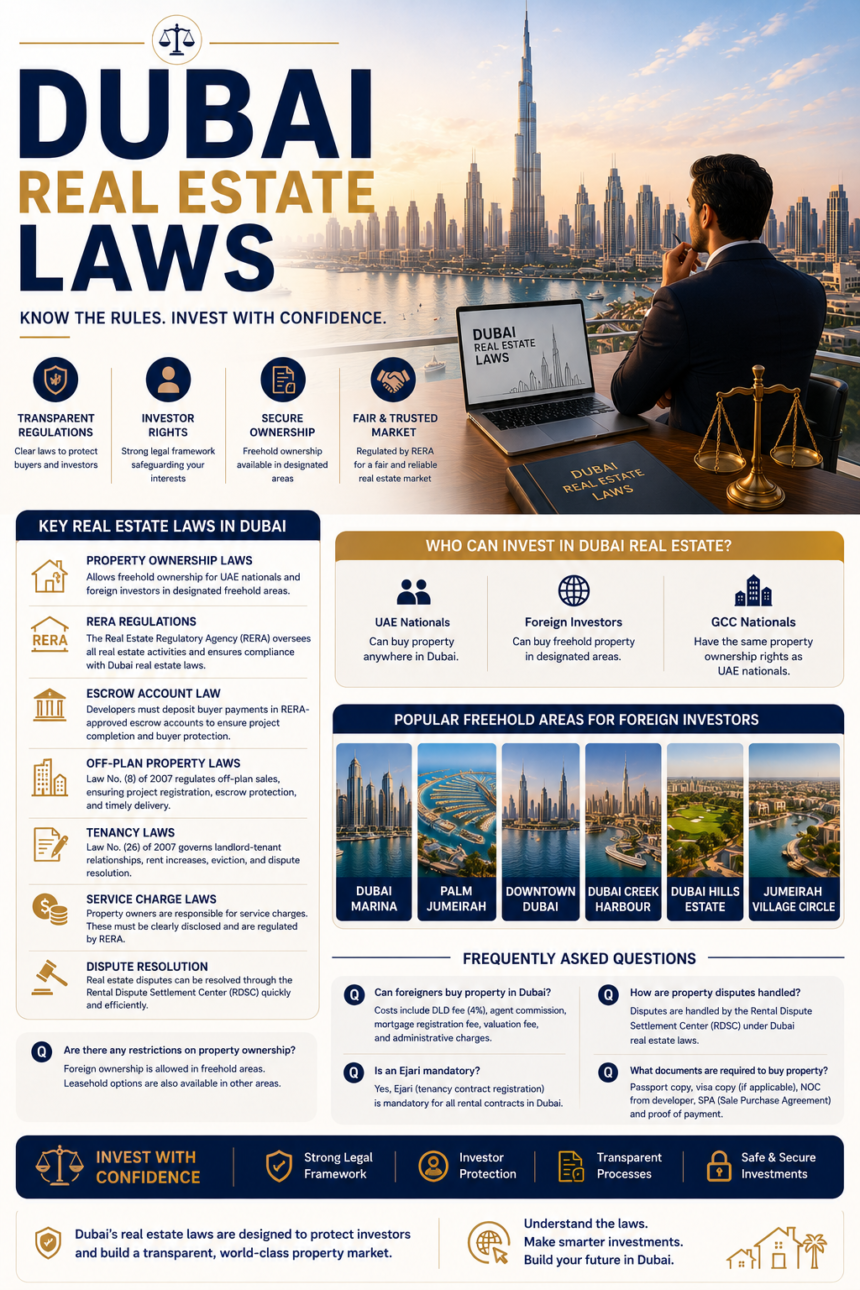
Can Foreigners Legally Buy Property in Dubai?
Dubai has built one of the Gulf region’s most active property markets, attracting residents, international investors, landlords, tenants and developers from around the world. But anyone buying, selling, renting or investing in property needs to understand that Dubai real estate operates within a detailed regulatory framework.
- What Are the Main Dubai Real Estate Laws Buyers Should Know?
- Can Foreigners Legally Buy Property in Dubai?
- Why Is Dubai Land Department Registration So Important?
- What Should Buyers Check Before Signing a Dubai Property Sale Contract?
- How Are Real Estate Brokers Regulated in Dubai?
- How Are Real Estate Advertisements Regulated in Dubai?
- What Laws Protect Buyers of Off Plan Property in Dubai?
- How Do Escrow Account Laws Protect Off Plan Buyers?
- Can Developers Advertise Any Off Plan Project They Want?
- How Are Mortgages Legally Registered in Dubai?
- What Are the Rules for Service Charges in Dubai?
- Why Is Ejari Important for Dubai Tenancy Contracts?
- Can Landlords Increase Rent Whenever They Want?
- Can a Landlord Evict a Tenant in Dubai?
- Can a Landlord Cut Utilities to Force a Tenant Out?
- Where Are Dubai Rental Disputes Resolved?
- What Happens if a Landlord Refuses to Accept Rent?
- What Legal Checks Should Buyers Make Before Purchasing Property?
- What Are the Biggest Legal Mistakes Dubai Property Buyers Make?
- Are Dubai Real Estate Laws Strong Enough for Property Investors?
- What Should You Remember Before Buying Dubai Property in 2026?
- What Are the Most Common Questions About Dubai Real Estate Laws?
Dubai Real Estate Laws cover much more than who can own a property. They regulate property registration, foreign ownership, off plan developments, escrow accounts, tenancy contracts, rental increases, eviction, mortgages, jointly owned buildings, real estate brokers and property advertising.
The Dubai Land Department, commonly known as DLD, plays a central role in registering property rights and transactions. The Real Estate Regulatory Agency, known as RERA, regulates many activities involving developers, brokers, owners associations and the wider property sector. Rental disputes are handled through Dubai’s Rental Disputes Center.
For buyers and investors, these regulations provide an important layer of protection. They also create responsibilities that should be understood before signing a reservation form, sale agreement or tenancy contract.
So, what are the most important Dubai Real Estate Laws in 2026, and how do they affect property buyers, owners, tenants and investors?
This guide explains the major rules in simple English.
What Are the Main Dubai Real Estate Laws Buyers Should Know?
Dubai property regulation is based on several laws, regulations and administrative decisions rather than one single property law.
One of the most important pieces of legislation is Law No. 7 of 2006 concerning Real Property Registration in Dubai. It establishes the framework for registering property rights and confirms the role of Dubai Land Department in maintaining Dubai’s Real Estate Register.
Other important laws include regulations covering foreign ownership, escrow accounts for property developments, off plan registration, tenancy relationships and jointly owned properties.
For most ordinary buyers and investors, the key areas to understand are:
- Property ownership and title registration
- Foreign freehold ownership
- Sale registration
- Off plan property rules
- Developer escrow accounts
- Real estate broker regulation
- Property advertising permits
- Mortgage registration
- Service charges
- Tenancy and Ejari
- Rental increases
- Tenant eviction
- Rental dispute procedures
Understanding these areas before completing a transaction can reduce the risk of disagreements later.
Can Foreigners Legally Buy Property in Dubai?
Yes. Foreign property ownership is permitted in areas designated for foreign ownership.
Under Dubai’s property framework, non UAE nationals may acquire freehold property rights in designated locations. Foreign buyers may also obtain usufruct rights or long term leasehold rights for periods of up to 99 years where applicable.
Freehold ownership generally gives the owner a registered property interest without a fixed ownership term. The ownership is recorded with Dubai Land Department and supported by an official title deed.
This system has allowed international buyers to purchase property in many of Dubai’s best known communities.
Foreign investors should still confirm the legal ownership status of the exact property they intend to buy rather than assuming that every area in Dubai follows the same ownership structure.
Important questions include:
- Is the property located in a designated freehold area?
- Will the buyer receive a DLD title deed?
- Is the property completed or off plan?
- Is the ownership freehold, usufruct or leasehold?
- Are there any restrictions connected with the master developer or community?
Foreign ownership is well established in Dubai, but the legal structure of the individual property should always be verified before payment.
Why Is Dubai Land Department Registration So Important?
Property ownership in Dubai is closely connected with registration.
Law No. 7 of 2006 provides the legal framework for registering real property rights with Dubai Land Department. DLD maintains the official Real Estate Register, and registered ownership is reflected through the title deed.
For buyers, registration is one of the most important parts of completing a sale.
DLD’s current property sale registration service requires identification documents and, in applicable freehold transactions, an electronic no objection certificate from the developer. Once the transaction is completed, electronic ownership documents are issued.
The official DLD service schedule currently lists a sale registration fee equal to 4 percent of the sale value, divided as 2 percent for the seller and 2 percent for the purchaser in the registration schedule. Additional trustee, title deed, map and administrative charges may also apply.
Buyers should therefore budget for transaction costs in addition to the property price.
What Should Buyers Check Before Signing a Dubai Property Sale Contract?
A property sale agreement should never be treated as a simple booking document.
Dubai’s regulated brokerage system uses standardised smart contracts for many transactions.
Contract A is used between the seller and the real estate brokerage. Contract B is used between the buyer and the broker. Contract F is the unified sale agreement between the seller and purchaser.
Before signing a sale agreement, buyers should carefully check:
- The exact property details
- Seller information
- Purchase price
- Deposit amount
- Completion deadline
- Mortgage conditions
- Developer NOC requirements
- Existing tenancy status
- Handover conditions
- Broker commission
- Penalties for failure to complete
- Furniture or fixtures included in the sale
- Additional terms added by either party
The agreement should reflect what the buyer and seller have actually negotiated.
Verbal promises from agents or sellers should not replace properly documented contractual terms.
How Are Real Estate Brokers Regulated in Dubai?
Real estate brokers operating in Dubai are regulated through RERA and DLD requirements.
DLD confirms that individuals seeking to work as registered brokers must meet qualification and registration requirements. Broker commission is generally determined by agreement between the parties. If it is not specified, applicable market custom may be considered under the brokerage framework.
This means buyers should not assume every property transaction has one legally fixed broker commission percentage.
The amount should be clearly agreed before completing the deal.
Investors can also verify real estate licences and permits through Dubai Land Department’s official verification services.
Before dealing with a broker, check:
- Brokerage company name
- Broker registration details
- Property advertising permit
- Whether the property is genuinely authorised for marketing
- Commission and VAT terms
- Any additional administrative charges
Using a properly registered broker provides greater transparency if a dispute later arises.
How Are Real Estate Advertisements Regulated in Dubai?
Dubai has introduced increasingly strict rules around property marketing.
Real estate advertisements require permits through the Trakheesi system for activities including online advertisements, newspaper advertisements, outdoor promotions, open houses, promotional campaigns and property platforms.
RERA also introduced the Madmoun QR code system for property advertisements.
Real estate companies are required to display the QR code on relevant property advertisements so buyers can verify that the advertisement is approved and genuine.
This is useful for buyers because misleading or duplicated online listings can otherwise create confusion.
Before responding to an advertisement, investors should:
- Scan or verify the QR code where provided
- Check whether the permit remains valid
- Confirm the broker and brokerage
- Verify the exact property details
- Avoid transferring money based only on social media messages
Dubai Land Department has also expanded technology based monitoring of real estate advertising to improve compliance and transparency.
What Laws Protect Buyers of Off Plan Property in Dubai?

Off plan property is one of Dubai’s largest real estate segments, which makes regulation especially important.
Law No. 13 of 2008 concerning the Interim Real Estate Register requires off plan disposals to be registered in the interim register maintained by Dubai Land Department. This includes relevant sales and other rights involving properties under construction.
Buyers often hear the term Oqood in connection with off plan transactions. It relates to provisional registration while the property is under development.
The important principle is that the buyer’s off plan interest should be formally recorded rather than existing only through a private contract with a developer.
Before purchasing an off plan unit, check:
- Whether the project is registered
- Whether the developer is registered
- Whether the sale is being properly recorded
- Whether the project has an approved escrow account
- Construction status
- Contractual handover date
- Payment schedule
- Rules for resale before completion
- Contract terms relating to delays or default
Off plan investment can provide opportunities, but the legal registration process should never be ignored.
How Do Escrow Account Laws Protect Off Plan Buyers?
Dubai’s escrow account system is one of the most important protections for off plan investors.
Law No. 8 of 2007 requires developers selling off plan units to maintain a separate project escrow account with an approved escrow agent.
Money paid by buyers for off plan units must be deposited into the relevant project escrow account and used for purposes connected with the development and permitted project financing.
DLD explains that escrow accounts are designed to regulate property construction and protect investor rights. The rules apply to developers selling off plan property in Dubai and receiving money from buyers or project financiers.
DLD also states that a percentage is retained after project completion for a defined period to help address certain defects that may emerge after handover.
For investors, this means payments should not simply be transferred to an unknown personal or business account.
Buyers should confirm the approved project payment instructions before transferring funds.
Can Developers Advertise Any Off Plan Project They Want?
No.
Dubai applies specific marketing requirements to off plan projects.
DLD’s current advertising permit conditions state that Dubai off plan properties cannot be showcased through certain regulated promotional activities if they are not registered with the Escrow Account Department.
DLD has also issued more recent compliance circulars reminding the market about Law No. 8 of 2007 and the marketing of development projects.
For investors, this makes advertisement verification particularly important when a project has only recently launched.
Before paying a reservation amount, confirm the project through approved channels and make sure the person collecting the payment is legally connected with the project.
How Are Mortgages Legally Registered in Dubai?
Mortgage financing also requires registration.
Dubai Land Department provides an official mortgage registration process, with registered financing interests reflected against the property or provisional off plan registration where applicable.
The current DLD mortgage registration fee is 0.25 percent of the mortgage value, along with applicable title deed, trustee and other administrative charges depending on the transaction.
Mortgaged properties can also be sold, but the process requires additional coordination with the lender.
DLD’s mortgaged property sale process protects the interests of the bank, buyer and seller by dealing with outstanding debt and requiring mortgage release before the final sale is completed.
Mortgage buyers should therefore confirm:
- Loan approval
- Property valuation
- Mortgage registration fees
- Early settlement rules
- Existing mortgage status
- Bank requirements for resale
- Insurance requirements
- Final DLD registration costs
Financing approval and property purchase approval are related but separate processes.
What Are the Rules for Service Charges in Dubai?
Owners of apartments and other properties within jointly owned developments normally contribute toward maintaining shared areas and facilities.
Law No. 6 of 2019 regulates jointly owned property in Dubai and includes rules relating to common areas, management and service charges.
An owner is generally responsible for their share of approved service charges relating to the management, operation, maintenance and repair of common parts.
DLD has also clarified that an owner remains responsible for service and usage charges under the jointly owned property framework unless applicable lease arrangements provide for certain tenant obligations.
The Mollak system supports regulated service charge management and budget approval for jointly owned properties.
Before buying an apartment, ask for information about:
- Current annual service charge
- Approved service charge budget
- Outstanding charges on the property
- Building reserve funds where relevant
- Major planned maintenance
- Community management quality
Service charges directly affect the true cost of owning an investment property.
Why Is Ejari Important for Dubai Tenancy Contracts?
Ejari is the official system used to register tenancy contracts in Dubai.
Dubai Land Department currently allows tenancy contracts to be registered or renewed through approved channels including the Ejari system, Dubai REST and Real Estate Trustee Centres.
Registration creates an official record of the landlord and tenant relationship.
The system is important because rental disputes, renewals and many tenancy related services rely on properly registered contract information.
Both landlords and tenants have responsibilities in ensuring tenancy information is correctly recorded. DLD states that tenants can initiate registration in certain circumstances, although landlord approval may be required to complete the process.
A landlord should also make sure the property is legally approved for the stated use. A residential unit, for example, should not simply be used as a commercial office without the appropriate classification and permissions.
Can Landlords Increase Rent Whenever They Want?
No.
Rental increases in Dubai are regulated.
Dubai Land Department introduced the Smart Rental Index in 2025 to create a more standardised method for determining rental values and allowable increases across residential areas, including special development zones and free zones.
The system considers factors such as rental values, location and building classification.
Rent increases are linked to the applicable rental index and legal notification requirements.
DLD states that if a landlord intends to increase the rent, the tenant should receive the required notification at least 90 days before the contract expires, and the increase must also be supported by the applicable Smart Rental Index.
The index provides a structured framework where permissible increases depend on how the existing rent compares with the relevant market benchmark.
Landlords therefore cannot simply choose any increase they want during renewal negotiations.
Can a Landlord Evict a Tenant in Dubai?
Yes, but eviction is regulated and depends on the reason and timing.
Dubai’s landlord and tenant relationship is primarily governed by Law No. 26 of 2007, as amended by Law No. 33 of 2008.
Dubai Land Department states that the law identifies multiple circumstances in which eviction may be requested, each subject to specific legal conditions.
Examples of issues that can lead to eviction before the end of a tenancy include non payment of rent after the required legal notification and unauthorised subletting.
Eviction at the end of a tenancy for reasons such as the landlord’s own use follows different requirements.
The Rental Disputes Center confirms that eviction for personal use requires a 12 month notice.
Because eviction rules depend heavily on the facts, landlords and tenants should not rely on informal WhatsApp messages when formal legal notice is required.
Can a Landlord Cut Utilities to Force a Tenant Out?
No.
Dubai Land Department states that landlords are prohibited from cutting services or interfering with a tenant in a way that prevents them from using the property.
A tenant facing this situation can take appropriate action, including seeking official proof of the interference and approaching the Rental Disputes Center.
This is an important distinction.
A rental disagreement does not automatically give either party the right to bypass legal procedures.
If there is a dispute over rent, eviction or contract renewal, the matter should be handled through the proper legal framework.
Where Are Dubai Rental Disputes Resolved?
Dubai has a specialised Rental Disputes Center.
The RDC was established to provide a dedicated judicial system for resolving landlord and tenant disputes in Dubai. It handles matters including eviction, rental claims, lease renewal and other tenancy disputes.
The centre also provides an amicable settlement process that allows parties to attempt to resolve disagreements within a formal legal framework before or alongside full litigation procedures.
If a tenant needs to bring a rental case, documents commonly required can include:
- Latest Ejari contract
- Identity documents
- Relevant notices
- Supporting correspondence
- Payment evidence
- Other documents supporting the claim
Rental claims should be supported by proper records rather than only verbal statements.
What Happens if a Landlord Refuses to Accept Rent?
A landlord refusing a rental payment does not necessarily leave the tenant without protection.
The Rental Disputes Center explains that a tenant may use an offer and deposit procedure to deposit rent through the RDC in accordance with the applicable process.
Once accepted through the appropriate legal procedure, the tenant may be treated as having fulfilled the rental payment obligation from the relevant acceptance date.
This is particularly important when there is a disagreement during renewal or another tenancy dispute.
Tenants should keep clear records showing their attempts to pay and should follow official procedures rather than simply holding the money without action.
What Legal Checks Should Buyers Make Before Purchasing Property?
Property due diligence should happen before signing the final agreement, not after payment.
A buyer should verify several important details.
| Check | Why It Matters |
|---|---|
| Title deed | Confirms registered ownership |
| Seller identity | Confirms who is legally selling |
| Mortgage | Shows whether finance is registered |
| Developer NOC | May be required for transfer |
| Service charges | Reveals ongoing ownership cost |
| Existing tenancy | Affects possession and rental income |
| Broker registration | Confirms authorised intermediary |
| Advertisement permit | Helps verify genuine listing |
| Off plan registration | Protects buyer interest |
| Escrow account | Important for project payments |
Buyers can also use official DLD channels to verify licences, permits and property related documentation.
The goal is simple. Do not rely on screenshots or assurances when an official record can be checked.
What Are the Biggest Legal Mistakes Dubai Property Buyers Make?
Dubai has a highly developed regulatory system, but buyers can still create problems by ignoring it.
Common mistakes include:
- Paying money before checking the project
- Using an unverified broker
- Signing contracts without reading additional clauses
- Assuming foreign ownership applies everywhere
- Ignoring existing mortgages
- Not checking service charges
- Buying off plan without confirming escrow details
- Relying on verbal promises about handover
- Ignoring an existing tenant
- Failing to register the transaction
- Assuming advertised rent increases are automatically legal
- Using informal eviction notices
- Not registering tenancy through Ejari
- Transferring money to unofficial accounts
A regulated market protects investors most effectively when investors also use the official processes available to them.
Are Dubai Real Estate Laws Strong Enough for Property Investors?
Dubai’s property framework has evolved considerably as the market has grown.
Foreign ownership is formally recognised in designated areas. Property rights are registered with DLD. Off plan purchases are supported by interim registration and escrow requirements. Brokers and property advertisements operate within a regulated system. Jointly owned properties have rules governing service charges, while tenancy relationships are supported by Ejari, rental regulation and a specialised dispute centre.
These systems do not remove every risk.
Property prices can still fall. Projects can still face delays. Buyers and sellers can still disagree about contracts. Tenants and landlords can still enter disputes.
The purpose of the laws is to create a structured framework for those situations.
For buyers in 2026, the best approach is to understand the legal process before committing money.
A property may look attractive because of its location, price or expected return, but legal verification should be treated as part of the investment itself.
What Should You Remember Before Buying Dubai Property in 2026?
Dubai Real Estate Laws provide a structured system for ownership, investment and renting, but buyers still need to perform due diligence.
Before completing a transaction, confirm the ownership structure, check DLD registration, verify the broker, examine the contract carefully and understand all fees.
For off plan purchases, confirm project registration and escrow arrangements.
For ready properties, check title ownership, mortgages, tenancy status and service charge liabilities.
For landlords, understand rent increase and eviction rules.
For tenants, make sure the lease is properly registered and keep records of rent payments and formal notices.
Dubai’s real estate market can provide significant opportunities, but understanding the rules is just as important as understanding property prices.
The strongest investment decision is one where the buyer understands not only what they are purchasing but also the legal rights and responsibilities that come with owning it.
What Are the Most Common Questions About Dubai Real Estate Laws?
Can foreigners legally own property in Dubai?
Yes. Foreigners can acquire freehold property in areas designated for foreign ownership. Other rights such as usufruct or long term leasehold may also be available depending on the property.
Do property sales have to be registered with Dubai Land Department?
Property rights and transfers should be properly registered through Dubai Land Department. The final ownership record is reflected through DLD registration and the title deed.
What is the Dubai property registration fee?
DLD’s current sale registration service lists a total registration charge of 4 percent of the sale value, allocated in the official fee schedule as 2 percent for the seller and 2 percent for the purchaser, along with additional transaction charges.
Can foreigners buy off plan property in Dubai?
Yes, foreigners may buy eligible off plan properties in designated ownership areas, subject to project, registration and development rules.
What is an escrow account in Dubai real estate?
An escrow account is a regulated project account into which relevant off plan buyer payments are deposited. The funds are intended to support the registered development in accordance with Dubai’s escrow framework.
What is Oqood in Dubai?
Oqood is associated with the provisional registration of off plan property interests before a final title deed can be issued after completion.
Is Ejari legally important?
Yes. Ejari provides the official registration system for Dubai tenancy contracts and is important when dealing with renewals and rental disputes.
Can a Dubai landlord increase rent every year?
Any permitted rent increase must comply with the applicable rental framework and notification requirements. The Smart Rental Index is used to determine eligibility for increases.
How much notice is required before a rent increase?
DLD states that the landlord should notify the tenant at least 90 days before the tenancy contract expires when seeking an increase, subject to the applicable index.
Can a landlord evict a tenant to use the property personally?
Yes, subject to the legal conditions. The Rental Disputes Center states that a 12 month notice is required for eviction based on personal use.
Can a landlord disconnect utilities during a dispute?
A landlord is prohibited from cutting services or interfering with a tenant’s use of the property as a way of forcing them out.
Where are Dubai landlord and tenant disputes handled?
Rental disputes are handled through Dubai’s Rental Disputes Center.
Is broker commission legally fixed in Dubai?
DLD states that brokerage commission is determined by agreement. If it is not specified, prevailing custom may apply under the brokerage rules.
How can buyers verify a Dubai real estate advertisement?
Buyers can check the advertising permit and use the RERA approved QR code system available on regulated property advertisements.
Do property owners have to pay service charges?
Owners of jointly owned properties generally have responsibility for approved service charges connected with the management and maintenance of common areas, subject to applicable rules and contractual arrangements.
Should buyers get legal advice before purchasing property?
For complex transactions, large investments, company purchases, unusual contract terms or disputes, independent professional legal advice can be valuable. This guide provides general information and should not replace advice based on the buyer’s specific circumstances.
Do follow us on Instagram
Read More – How to Buy Property in Dubai Complete Guide to Dubai Property Laws