


What Should Expats Check Before Renting in Dubai?
Dubai can feel like several different cities within one emirate. Someone living beside Dubai Marina may spend evenings walking along the waterfront and rely heavily on the Metro and Tram, while a family in Arabian Ranches may have a villa, garden and car-based suburban routine. A professional in Business Bay may choose a smaller apartment because being close to work matters more than space, while someone in Al Nahda may prioritise affordability and everyday convenience.
- What Are the Best Areas to Live in Dubai for Expats?
- Why Is Dubai Popular With Expats?
- Is Dubai Marina a Good Place for Expats?
- Who Should Live in Downtown Dubai?
- Is Business Bay Good for Working Professionals?
- Why Is Jumeirah Lakes Towers Popular With Expats?
- Is Jumeirah Village Circle Good for Affordable Living?
- Why Do Families Choose Dubai Hills Estate?
- Is Arabian Ranches One of Dubai’s Best Family Areas?
- Is Palm Jumeirah Worth the Higher Cost?
- Is Al Nahda a Good Affordable Area for Expats?
- Why Is Mirdif Popular With Families?
- Which Dubai Area Is Best for Your Lifestyle?
- How Much Does It Cost to Rent in Popular Dubai Areas?
- What Should Expats Check Before Renting in Dubai?
- Frequently Asked Questions About Living in Dubai
- Which Is the Best Area to Live in Dubai for Expats?
That diversity is one reason there is no single answer to the question of the best areas to live in Dubai for expats.
The right neighbourhood depends on salary, workplace, family size, preferred lifestyle, transport needs and whether you want an apartment or villa. Dubai’s rental market also covers an unusually wide spectrum. In the first half of 2026, Bayut reported continued demand across affordable, mid-tier, luxury and ultra-luxury communities, while rental growth became more moderate in several parts of the city.
For newcomers, the most important decision is therefore not simply finding a beautiful apartment. It is finding a neighbourhood that works for everyday life.
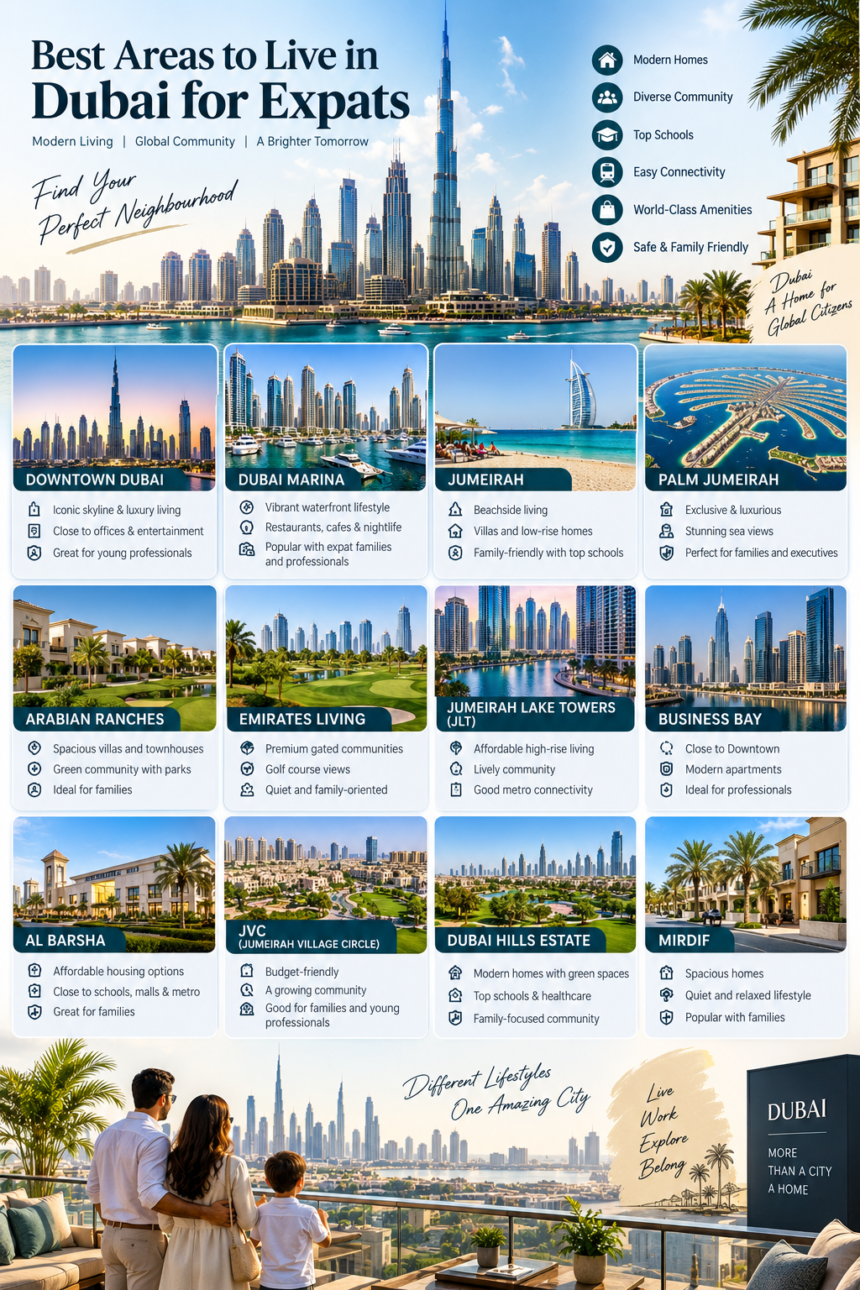
What Are the Best Areas to Live in Dubai for Expats?
For most expats, these ten communities provide a strong starting point.
| Area | Best suited to | Lifestyle | Typical housing |
|---|---|---|---|
| Dubai Marina | Young professionals, couples | Waterfront, social, walkable | Apartments |
| Downtown Dubai | Professionals, luxury seekers | Central, premium, urban | Apartments and penthouses |
| Business Bay | Professionals working centrally | Business-focused, modern | Apartments |
| Jumeirah Lakes Towers | Professionals, couples, small families | Walkable, practical, social | Apartments |
| Jumeirah Village Circle | Value-conscious renters, young families | Residential, quieter | Apartments and townhouses |
| Dubai Hills Estate | Families, long-term expats | Green, modern, premium | Apartments, townhouses and villas |
| Arabian Ranches | Families seeking space | Quiet, suburban | Villas |
| Palm Jumeirah | High-income expats | Waterfront, resort-style | Apartments and villas |
| Al Nahda | Budget-conscious families and professionals | Established, practical | Apartments |
| Mirdif | Families wanting larger homes | Suburban, established | Villas and apartments |
The differences become much clearer when each area is considered in terms of everyday living rather than reputation alone.
Why Is Dubai Popular With Expats?
Dubai has developed residential communities around very different lifestyles. There are business districts within walking distance of offices, waterfront towers close to restaurants and beaches, villa communities centred around parks, and established neighbourhoods offering comparatively affordable housing.
Infrastructure is another important factor. Dubai’s Metro Red and Green lines connect many of the city’s populated districts, while the Tram serves communities around Dubai Marina and JBR. Current RTA network information includes stations serving Downtown Dubai, Business Bay, Dubai Marina, JLT, Discovery Gardens and other major residential areas.
The result is that expats can often choose a community based on the type of life they actually want rather than simply living wherever employment happens to be located.
However, Dubai is geographically spread out. A neighbourhood that looks close on a map can still produce a frustrating daily commute during busy periods. New residents should therefore consider workplace location before lifestyle extras.
Is Dubai Marina a Good Place for Expats?
Dubai Marina remains one of the most recognisable residential districts in the city and one of the easiest recommendations for expats who want an active urban lifestyle.
The community is built around a roughly 3 km canal and contains high-rise residences, restaurants, cafés, retail, waterfront walkways and easy access to JBR and the beach. It is particularly popular among professionals and expatriates who value a cosmopolitan environment and the ability to do many everyday activities without driving.
Transport is one of Marina’s strongest advantages. The area is connected to both the Metro and Dubai Tram, making it more practical for people working around Dubai Internet City, Media City, JLT and other locations along the Red Line.
The trade-off is price and density. Marina can become busy, parking varies between buildings and traffic around popular access points can be frustrating.
Bayut’s H1 2026 rental report placed the average advertised rent for a one-bedroom apartment in Dubai Marina at approximately AED 103,000 per year, while two-bedroom apartments averaged around AED 157,000. Actual prices differ considerably depending on tower quality, furnishing, views and apartment size.
Best for: young professionals, couples and expats who prioritise walkability, restaurants, waterfront living and public transport.
Who Should Live in Downtown Dubai?
Downtown Dubai offers something very different. It places residents in the centre of one of Dubai’s most famous urban districts, close to Dubai Mall, Burj Khalifa and a large concentration of restaurants, hotels and entertainment.
For professionals working around Downtown, DIFC or Business Bay, the location can significantly reduce the amount of time spent crossing the city. The Burj Khalifa/Dubai Mall Metro station also connects the district to the wider Red Line network.
Living here, however, comes at a premium. Bayut’s H1 2026 figures put average advertised one-bedroom apartment rents at around AED 133,000 annually, with two-bedroom units averaging approximately AED 223,000.
Downtown therefore makes the most sense for people who are prepared to exchange additional space or lower housing costs for location. It can be particularly attractive to executives, couples and professionals who want restaurants, retail and entertainment immediately around them.
Families can live comfortably in Downtown, but those seeking gardens, quieter streets and larger houses generally find better options elsewhere.
Best for: professionals, executives and couples seeking central luxury living.
Is Business Bay Good for Working Professionals?
Business Bay is one of the strongest options for people who want to remain close to central Dubai without necessarily paying Downtown prices.
It combines offices, residential towers, hotels and Dubai Canal frontage and sits immediately beside Downtown. The Business Bay Metro station provides Red Line access, which makes the district particularly useful for professionals who work centrally.
The neighbourhood has changed considerably as more residential towers, restaurants and waterfront developments have opened. It remains busier and more business-oriented than communities designed primarily for families, but that can be exactly what professionals want.
According to Bayut’s H1 2026 rental data, studios averaged around AED 73,000, one-bedroom apartments approximately AED 104,000, and two-bedroom apartments around AED 148,000 per year.
Building selection matters. Some parts of Business Bay are highly walkable, while others are easier with a car or taxi. Prospective tenants should visit the exact tower at the time they would normally commute rather than judging the entire neighbourhood from a map.
Best for: singles, couples and professionals working in Business Bay, Downtown or DIFC.
Why Is Jumeirah Lakes Towers Popular With Expats?
Jumeirah Lakes Towers, usually called JLT, is one of Dubai’s most practical combinations of location, transport and lifestyle.
The district sits opposite Dubai Marina and combines residential towers, offices, restaurants, supermarkets and landscaped outdoor areas. Two Metro stations, DMCC and Sobha Realty, serve the wider JLT area, giving residents strong access to the Red Line.
That mixed residential and business character attracts professionals who work in JLT itself or nearby districts such as Marina, Media City and Internet City.
JLT can also offer better value than neighbouring Dubai Marina. Current Property Finder data puts the average annual rent for a one-bedroom apartment in JLT at roughly AED 91,900 to AED 94,000, although individual clusters and towers vary significantly.
Building quality is particularly important here because JLT contains towers from different periods and developers. Two apartments with similar rents may offer very different maintenance standards, layouts and amenities.
For expats who like Marina’s location but do not necessarily need to be directly on the marina waterfront, JLT is often one of the smartest alternatives.
Best for: professionals, couples, pet owners and renters looking for strong Metro connectivity.
Is Jumeirah Village Circle Good for Affordable Living?
Jumeirah Village Circle, or JVC, has become one of Dubai’s most prominent mid-market residential communities.
It offers a large supply of studios, one and two-bedroom apartments alongside townhouses and some villas. The neighbourhood has parks, supermarkets, restaurants, gyms and growing retail options, making it attractive to both professionals and small families.
Its biggest advantage is value. Bayut identified JVC as the leading mid-tier apartment rental choice in its H1 2026 market report. Average advertised rents were around AED 54,000 for studios, AED 79,000 for one-bedroom apartments and AED 113,000 for two-bedroom units.
The compromise is transport. Unlike Marina, JLT, Downtown and Business Bay, JVC does not have a Metro station inside the community. A car can therefore make daily life significantly easier, particularly for residents whose workplace is not nearby.
Traffic around community exits can also influence the commute, so apartment hunters should consider the exact location within JVC rather than treating the entire development as equally convenient.
Best for: renters wanting newer apartments and better space for their budget.
Why Do Families Choose Dubai Hills Estate?
Dubai Hills Estate has become one of the strongest choices for families who want newer housing, open space and access to schools without moving too far from central Dubai.
The community includes apartments, townhouses and large villas alongside parks, retail and Dubai Hills Mall. Its position between major road networks allows residents to reach several important parts of Dubai relatively easily by car.
Education is a major attraction. Families have access to a range of British and IB schools in and around the district, including several schools within short driving distance. Property Finder describes Dubai Hills as a family-centric community with strong access to international education.
The major limitation is public transport. Dubai Hills currently makes considerably more sense for households with a car than for residents expecting Marina-style Metro connectivity.
Villa living is also expensive. Bayut’s H1 2026 data placed average advertised four-bedroom villa rents in Dubai Hills Estate at around AED 359,000 annually, although property type and sub-community create significant variation.
The appeal is therefore not affordability. It is the combination of greenery, modern infrastructure, family amenities and access to larger homes.
Best for: established professional families planning to stay in Dubai for several years.
Is Arabian Ranches One of Dubai’s Best Family Areas?
Arabian Ranches remains one of Dubai’s classic family villa communities.
Instead of towers and dense city streets, the community offers villas, landscaped areas and a more suburban rhythm. It particularly appeals to families that want gardens, larger living spaces and a quieter atmosphere.
The lifestyle comes with a clear requirement: a car is almost essential. Residents do not have the direct Metro convenience available in Marina, JLT or Downtown, and daily routines can involve driving to work, school and other destinations.
The cost is also substantial. Bayut reported average advertised rents of roughly AED 404,000 for four-bedroom villas and AED 619,000 for five-bedroom villas in Arabian Ranches during H1 2026.
For families seeking the same general suburban idea at a different price point, newer communities such as Arabian Ranches 3 may be worth comparing. H1 2026 data showed three-bedroom villa rents there at around AED 170,000 on average, highlighting how dramatically pricing can vary between generations of neighbouring communities.
Arabian Ranches is therefore less about convenience for single professionals and more about building a settled family lifestyle.
Best for: families prioritising villas, privacy, greenery and community living.
Is Palm Jumeirah Worth the Higher Cost?
Palm Jumeirah occupies a very different part of Dubai’s residential market.
It is designed for people who place a high value on waterfront location, premium residences, hotels, restaurants and resort-style living. Housing ranges from apartments to large beachfront villas.
The location offers a distinctive lifestyle, but it is one of the city’s most expensive areas. Bayut’s H1 2026 report placed average advertised one-bedroom apartment rents at approximately AED 169,000, two-bedroom units at AED 249,000, and three-bedroom apartments at AED 382,000 per year.
For villas, the figures move into an entirely different range, with four-bedroom Palm Jumeirah villas averaging more than AED 1 million annually in the same report.
Palm Jumeirah makes sense when the lifestyle itself is part of the reason for choosing Dubai. Expats primarily focused on commute efficiency or value for money are likely to find more practical alternatives elsewhere.
Best for: high-income professionals, executives and families seeking luxury waterfront living.
Is Al Nahda a Good Affordable Area for Expats?
Not every expat moving to Dubai wants a new luxury tower or beachfront apartment.
Al Nahda remains important because it represents another side of the city’s housing market: established, practical and comparatively affordable residential living.
Bayut ranked Al Nahda as the most popular affordable apartment rental area in its H1 2026 analysis. Average advertised rents were around AED 44,000 for studios, AED 56,000 for one-bedroom apartments and AED 72,000 for two bedrooms.
The neighbourhood is particularly attractive to families and workers who want access to schools, shops and public transport while keeping housing costs under greater control.
The main consideration is workplace location. Someone commuting every day to Dubai Marina or Jebel Ali may find the journey tiring, even if the rent is considerably lower.
For people working around Deira, the airport, Al Qusais or northern parts of Dubai, however, Al Nahda can make much more sense.
Best for: budget-conscious families and professionals working in northern Dubai.
Why Is Mirdif Popular With Families?
Mirdif is another established community that often receives less international attention than Dubai’s waterfront districts but works extremely well for certain families.
It offers larger homes, schools, parks and shopping while remaining relatively convenient for Dubai International Airport and older parts of the city.
Its housing profile is particularly attractive to people who want villas without moving into the highest-priced luxury villa communities. Bayut’s H1 2026 report placed average advertised three-bedroom villa rents in Mirdif at around AED 142,000, four-bedroom villas at approximately AED 166,000, and five-bedroom homes around AED 193,000 annually.
That makes Mirdif worth comparing with newer master-planned villa developments, especially for families whose workplaces and schools are located on the eastern or northern side of Dubai.
As with Arabian Ranches and Dubai Hills, owning a car makes the community much easier to navigate.
Best for: families seeking space, established amenities and relatively accessible villa rents.
Which Dubai Area Is Best for Your Lifestyle?
The easiest way to narrow the search is to start with your daily routine.
| Your priority | Areas to consider first |
|---|---|
| Waterfront lifestyle | Dubai Marina, Palm Jumeirah |
| Central city living | Downtown Dubai, Business Bay |
| Metro access | Dubai Marina, JLT, Downtown, Business Bay |
| Good value for professionals | JLT, JVC |
| Family lifestyle | Dubai Hills Estate, Arabian Ranches, Mirdif |
| Villas and larger homes | Arabian Ranches, Dubai Hills, Mirdif |
| Luxury | Palm Jumeirah, Downtown Dubai |
| Lower rental budget | Al Nahda, JVC |
| Restaurants and social life | Marina, Downtown, Business Bay, JLT |
| Quiet suburban living | Arabian Ranches, Mirdif, Dubai Hills |
This is more useful than choosing an area simply because it appears frequently on social media. A spectacular sea view loses some of its appeal if the commute takes a large part of every day.
How Much Does It Cost to Rent in Popular Dubai Areas?
The following snapshot uses H1 2026 advertised rental averages from Bayut and current marketplace data. These should be treated as guides rather than fixed prices, because tower age, floor, furnishing, view, property condition and exact sub-community can change the rent significantly. Bayut also notes that its figures are based primarily on advertised asking prices rather than representing every completed transaction.
| Area | Example property | Approx. annual rent |
|---|---|---|
| Dubai Marina | 1-bedroom apartment | AED 103,000 |
| Downtown Dubai | 1-bedroom apartment | AED 133,000 |
| Business Bay | 1-bedroom apartment | AED 104,000 |
| JLT | 1-bedroom apartment | Around AED 92,000–94,000 |
| JVC | 1-bedroom apartment | AED 79,000 |
| Palm Jumeirah | 1-bedroom apartment | AED 169,000 |
| Al Nahda | 1-bedroom apartment | AED 56,000 |
| Mirdif | 3-bedroom villa | AED 142,000 |
| Dubai Hills Estate | 4-bedroom villa | AED 359,000 |
| Arabian Ranches | 4-bedroom villa | AED 404,000 |
Dubai’s rental market is also showing signs of greater balance in 2026. Property Finder’s outlook for the second half of the year points to slower rental growth in several apartment-heavy communities as additional supply gives tenants more choice, while established villa and waterfront communities have generally remained more resilient.
That means renters should compare several properties before agreeing to the first asking price.
What Should Expats Check Before Renting in Dubai?
The neighbourhood is only half of the decision. The building and individual property can have just as much impact on daily life.
An apartment five minutes from a Metro station may be much more useful than a cheaper apartment requiring taxis every day. Similarly, families should calculate school travel before signing a tenancy rather than assuming that two places described as “nearby” will produce an easy commute.
For apartments, check building maintenance, parking, noise, air-conditioning arrangements, gym and pool quality, nearby construction and traffic at peak times. In older towers, maintenance history can be more important than lobby design.
For villas, consider landscaping costs, maintenance responsibility, air-conditioning expenses, school distance and how far everyday shops are from the property.
Renters should also check official rental information rather than relying only on advertisements. Dubai Land Department provides a Rental Index service that allows users to check market rental information and rental-increase eligibility using property and tenancy details. The Smart Residential Rent Index considers factors including location, building classification and services.
The most practical approach is to shortlist communities first, then buildings, and only then individual properties.
Frequently Asked Questions About Living in Dubai
What is the best area in Dubai for young expats?
Dubai Marina is one of the strongest all-round options for young professionals because of its waterfront lifestyle, restaurants and public transport. JLT is a useful alternative for people who want a similarly convenient location at a potentially lower rental cost.
What is the best area in Dubai for families?
Dubai Hills Estate and Arabian Ranches are among the strongest premium family choices, particularly for households seeking larger homes and community amenities. Mirdif can provide a more affordable alternative for families wanting villas.
Where should expats live in Dubai without a car?
Dubai Marina, JLT, Downtown Dubai and Business Bay are among the more practical choices because they have direct access to Dubai’s rail network. The RTA Metro map confirms stations serving each of these major districts.
Where can expats live more affordably in Dubai?
Al Nahda is one of the strongest affordable choices among established communities, while JVC provides a mid-market option with newer residential stock. International City and Deira can also offer lower-priced alternatives depending on commute requirements. Bayut’s H1 2026 analysis placed Al Nahda, Deira and International City among Dubai’s popular affordable apartment areas.
Is Dubai Marina better than Downtown Dubai?
Neither is universally better. Marina offers waterfront living, a more relaxed coastal atmosphere and easy access to JBR. Downtown provides greater proximity to Dubai’s central business and entertainment districts. Marina’s H1 2026 apartment rents were also generally lower than Downtown’s in comparable bedroom categories.
Is JVC good for expats?
Yes, especially for people seeking modern apartments at mid-market rents. Its main disadvantage is the lack of a Metro station inside the community, making it considerably more convenient for residents with cars.
Is it better to live close to work in Dubai?
For many residents, yes. Dubai is geographically large, and peak-time traffic can significantly change commute times. Paying slightly more to reduce a daily cross-city commute can sometimes improve quality of life more than choosing a larger home farther away.
Which Is the Best Area to Live in Dubai for Expats?
There is no single neighbourhood that wins for every expat.
For a young professional who wants an active social life and strong public transport, Dubai Marina is difficult to beat. JLT offers many of the same practical advantages with a slightly different atmosphere and often better value.
For someone who wants to be at the centre of the city, Downtown Dubai and Business Bay provide excellent access to major commercial and lifestyle districts.
For renters seeking a better balance between housing quality and price, Jumeirah Village Circle remains one of the most important mid-market communities, while Al Nahda offers a more affordable option.
Families with larger budgets should look closely at Dubai Hills Estate and Arabian Ranches. Both provide a very different experience from central tower living, with more space and community-focused surroundings. Mirdif deserves consideration for families who want established villa living at a more accessible price.
At the top end, Palm Jumeirah remains one of Dubai’s signature luxury addresses for people who want a beachfront, resort-style lifestyle and have the budget to support it.
The key is to stop asking only, “Which neighbourhood is the most popular?” and instead ask, “Which neighbourhood will make my normal weekday easier?”
Calculate the commute. Check the nearest school or Metro station. Visit the neighbourhood in the evening. Compare several buildings. Look at the actual annual housing cost rather than only the monthly equivalent.
Dubai offers expats an unusually wide range of residential lifestyles, from beachfront apartments and skyscraper living to quiet villas and affordable established neighbourhoods. The best area to live in Dubai for expats is ultimately the one that balances location, budget, space and lifestyle without forcing you to compromise on the parts of everyday life that matter most.
Do follow us on Instagram
Read More – Best Areas to Live in Dubai for Expats Complete Guide