


Mortgage Guide for Gulf Buyers: What Banks May Not Explain
Buying a home is one of the biggest financial decisions most people will ever make. In the Gulf, the decision can become even more complicated because mortgage rules, property ownership regulations, financing structures and eligibility requirements differ between the UAE, Saudi Arabia, Qatar, Bahrain, Kuwait and Oman.
- Why Gulf Mortgage Markets Need to Be Understood Separately
- 1. Understand What a Mortgage Actually Costs
- A Lower Monthly Payment Is Not Always Cheaper
- 2. Understand the Down Payment
- What Does LTV Mean?
- UAE Mortgage Down Payment Rules
- UAE Mortgage LTV at a Glance
- 3. Save More Than Just the Down Payment
- 4. Understand Mortgage Eligibility
- Debt Burden Matters
- 5. Get Pre-Approval Before House Hunting Seriously
- Do Not Use the Maximum Pre-Approval as Your Budget
- 6. Fixed vs Variable Mortgage Rates
- Fixed Rate
- Variable Rate
- Look Beyond the Advertised Rate
- 7. Understand Islamic Home Finance
- Saudi Arabia’s Real Estate Finance Market
- Saudi Debt Affordability Rules Matter
- 8. Compare Mortgage Offers From Multiple Lenders
- 9. Choose the Mortgage Term Carefully
- 10. Stress-Test Your Mortgage Before Signing
- Keep an Emergency Mortgage Buffer
- Buying a Home vs Investment Property
- Calculate Net Rental Yield
- Off-Plan Mortgages Need Extra Care
- Expat Buyers Need an Exit Plan
- Do Not Assume Property Prices Always Rise
- Understand Property Valuation Risk
- Documents Commonly Needed for a Gulf Mortgage
- Mortgage Guide for Gulf Countries at a Glance
- How Much Mortgage Can You Comfortably Afford?
- Think About Retirement
- Common Gulf Mortgage Mistakes
- A Simple Mortgage Buying Checklist
- FAQs About Mortgage Guide for Gulf Buyers
- Conclusion
The most important lesson is simple: being eligible for a large mortgage does not necessarily mean you should take the maximum amount available.
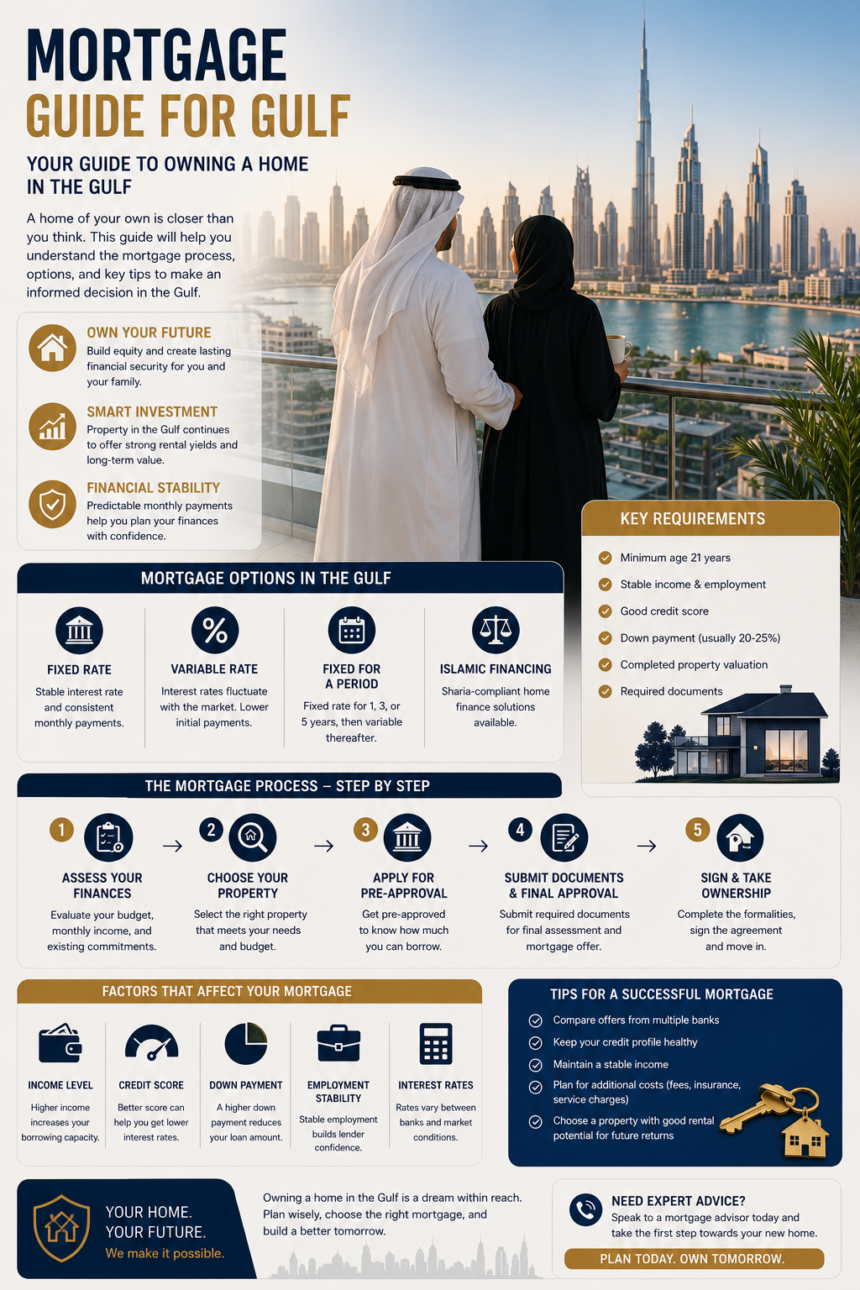
This Mortgage Guide for Gulf homebuyers explains the fundamentals in simple language, from down payments and loan-to-value ratios to fixed versus variable rates, Islamic home finance, additional buying costs and mortgage affordability.
A home should improve your long-term financial position, not leave your monthly budget under permanent pressure.
Why Gulf Mortgage Markets Need to Be Understood Separately
There is no single “GCC mortgage.”
Every country operates under its own banking, property and consumer-finance regulations.
The UAE Central Bank, for example, has specific mortgage loan-to-value limits for UAE nationals and expatriates. Saudi Arabia regulates real estate finance through the Saudi Central Bank, with its own financing and responsible-lending rules.
Banks also maintain their own lending criteria within regulatory limits.
That means two people earning similar salaries may receive different mortgage offers because of:
- nationality or residency status,
- employer,
- income,
- existing debt,
- credit history,
- property type,
- age,
- down payment,
- employment history,
- and lender risk policies.
Treat online mortgage calculators as estimates rather than guaranteed approvals.
1. Understand What a Mortgage Actually Costs
A mortgage allows you to finance a property over an extended period instead of paying the entire purchase price immediately.
Imagine a property costs AED 1 million.
If your mortgage covers AED 800,000, you need to fund the remaining AED 200,000 yourself, before considering transaction and other purchase costs.
You then repay the financed amount over an agreed period.
Each payment normally contains two important components:
Principal: the amount reducing your outstanding loan.
Interest or profit: the cost charged by the lender for providing finance.
This distinction matters because the amount borrowed is not the same as the amount eventually repaid.
A Lower Monthly Payment Is Not Always Cheaper
Suppose one mortgage runs for 15 years and another for 25 years.
The 25-year mortgage will normally have lower monthly payments if other factors are equal.
That can look attractive.
But you may pay financing costs for an additional ten years.
Always compare:
- monthly payment,
- annual percentage rate or equivalent financing measure,
- total finance cost,
- total amount repayable,
- fees,
- and early-settlement conditions.
Do not compare monthly instalments alone.
2. Understand the Down Payment
Your down payment is the amount you contribute from your own money.
If a home costs AED 2 million and the lender finances AED 1.6 million, your initial equity contribution is AED 400,000.
That represents 20%.
In practice, you may need additional cash for transaction costs.
The down payment is closely connected to the loan-to-value ratio, commonly called LTV.
What Does LTV Mean?
The basic calculation is:
Mortgage amount ÷ property value × 100 = LTV
For example:
Property value: AED 1,000,000
Mortgage: AED 800,000
LTV: 80%
Your equity or down payment represents the remaining 20%.
LTV rules are particularly important in the UAE.
UAE Mortgage Down Payment Rules
Under current UAE Central Bank regulations, expatriates buying their first owner-occupied home can receive financing of up to 80% when the property is valued at AED 5 million or below.
That effectively means at least 20% equity is required under the regulatory maximum.
For a first owner-occupied property above AED 5 million, the maximum expatriate LTV is 70%.
For second and subsequent homes or investment properties, the maximum is 60% for expatriates.
For UAE nationals, the maximum LTV for a first owner-occupied home is 85% for properties up to AED 5 million and 75% above AED 5 million.
Remember: these are maximum regulatory limits. A lender can still offer less financing after assessing the borrower and property.
UAE Mortgage LTV at a Glance
| Buyer / Property | Maximum LTV |
|---|---|
| UAE national, first home ≤ AED 5m | 85% |
| UAE national, first home > AED 5m | 75% |
| UAE national, second/investment property | 65% |
| Expat, first home ≤ AED 5m | 80% |
| Expat, first home > AED 5m | 70% |
| Expat, second/investment property | 60% |
| Off-plan property | 50% |
These limits come from the UAE Central Bank’s current consolidated mortgage regulations.
3. Save More Than Just the Down Payment
One of the most common mistakes made by first-time property buyers is saving exactly enough for the down payment.
The purchase itself can involve additional expenses.
Depending on the country and transaction, these may include:
- property registration,
- valuation,
- mortgage registration,
- bank processing,
- broker commission,
- legal costs,
- insurance,
- administrative charges,
- moving costs.
The exact charges differ by country, property and lender.
That means a buyer who has saved 20% of the property value should not automatically assume they are ready to purchase.
Keep your emergency fund separate from your property fund.
Emptying every bank account to complete a purchase can leave you financially vulnerable immediately after becoming a homeowner.
4. Understand Mortgage Eligibility
Banks do not approve mortgages simply because a buyer wants a particular property.
They want evidence that the borrower can repay.
A lender may examine:
- monthly salary,
- employment stability,
- employer profile,
- business income for self-employed applicants,
- existing loans,
- credit cards,
- age,
- credit history,
- residency,
- property value.
Self-employed applicants may need to provide more extensive financial documentation than salaried employees.
The lender also assesses the property because the home itself normally serves as security for the finance.
Debt Burden Matters
Your existing debt can reduce mortgage affordability.
Imagine two people both earn AED 25,000 monthly.
Buyer A has no debt.
Buyer B has:
- car finance,
- personal loan,
- several credit-card balances.
Buyer B may qualify for significantly less mortgage financing despite having the same salary.
In the UAE, mortgage regulations state that the debt burden ratio cannot exceed 50%, while maximum mortgage financing is generally capped at seven years of annual income for expatriates and eight years for UAE nationals.
The maximum UAE mortgage tenor is 25 years.
5. Get Pre-Approval Before House Hunting Seriously
Mortgage pre-approval can give you a clearer picture of what a lender may be prepared to finance.
This can help you avoid spending weeks viewing properties that are outside your realistic budget.
Pre-approval may involve reviewing:
- salary certificate,
- bank statements,
- identification,
- residency documents,
- credit history,
- existing liabilities.
For self-employed applicants, additional business documents may be requested.
But remember:
Pre-approval is not necessarily final approval.
The lender still needs to evaluate the selected property and complete its final checks.
Do Not Use the Maximum Pre-Approval as Your Budget
Suppose a bank says you may qualify for a property worth AED 2.5 million.
That does not automatically mean AED 2.5 million is financially comfortable.
Your personal budget may suggest AED 1.8 million is safer.
Consider your other goals:
- retirement,
- children’s education,
- travel,
- family support,
- emergency savings,
- investments.
The bank is deciding whether it is prepared to lend.
You are deciding whether you want to carry the debt.
Those are different questions.
6. Fixed vs Variable Mortgage Rates
One of the most important parts of a Mortgage Guide for Gulf buyers is understanding how the financing rate works.
Mortgages may offer:
fixed rates
or
variable rates
and some products combine both.
Fixed Rate
A fixed-rate period keeps the applicable mortgage rate unchanged for an agreed period.
This provides predictable monthly payments during that period.
Advantages include:
- easier budgeting,
- protection against immediate rate increases,
- predictable payments.
The disadvantage is that you may not benefit immediately if market rates fall.
Also, many “fixed” mortgages are fixed only for an introductory period rather than the entire mortgage term.
After that, the loan may move to a variable structure.
Variable Rate
A variable mortgage changes according to the applicable benchmark and lender margin.
Your payments may therefore rise or fall.
This creates interest-rate risk.
Before accepting one, ask:
What happens to my monthly payment if the rate rises by 1%?
Then ask the same question for a 2% increase.
If that scenario would seriously damage your budget, the mortgage may already be too large.
Look Beyond the Advertised Rate
A mortgage advertisement may show an attractive introductory rate.
You should also ask:
- How long is it fixed?
- What happens afterward?
- What benchmark is used?
- What margin does the bank add?
- Is there a minimum or floor rate?
- What are the processing fees?
- What does early repayment cost?
A low headline rate does not necessarily mean the cheapest mortgage over its entire life.
7. Understand Islamic Home Finance
Islamic finance plays an important role across GCC property markets.
Instead of conventional interest-based lending, Islamic financing structures follow Sharia principles.
Common structures can include concepts such as:
- Murabaha,
- Ijara,
- diminishing Musharaka.
The precise structure varies by institution and jurisdiction.
For the buyer, the practical question should still be:
What is the total cost of financing?
Compare:
- monthly payment,
- profit rate,
- effective annual cost,
- fees,
- early settlement,
- late-payment provisions,
- ownership structure.
A product being Islamic or conventional does not remove the need for careful comparison.
Saudi Arabia’s Real Estate Finance Market
Saudi Arabia has developed a substantial regulated real estate financing system.
The Saudi Central Bank supervises banks and licensed finance companies providing real estate finance under the Real Estate Finance Law.
Saudi regulations require financing providers to assess the borrower’s financial circumstances and ability to meet obligations before offering real estate finance. They must also explain important terms, conditions and risks.
For Saudi citizens buying a first home, SAMA increased the maximum financing-to-value ratio to 90%.
That can significantly reduce the upfront equity required for qualifying citizens.
However, 90% financing also means starting home ownership with relatively little equity.
Borrowers still need to consider affordability carefully.
Saudi Debt Affordability Rules Matter
Saudi Arabia’s responsible lending rules also place limits on monthly credit obligations depending on income and circumstances.
For some borrowers, total monthly finance obligations can reach defined percentages of total monthly income, with different treatment for eligible housing-support beneficiaries and higher-income consumers.
The broader principle is important throughout the Gulf:
Mortgage eligibility is based not only on property value but also on repayment capacity.
8. Compare Mortgage Offers From Multiple Lenders
A mortgage can last 20 or 25 years.
A small difference in financing cost can therefore become significant.
Do not automatically choose:
- your salary bank,
- the developer’s suggested bank,
- the first lender approving you.
Compare several options.
Create a table.
| Feature | Bank A | Bank B | Bank C |
|---|---|---|---|
| Initial rate | Compare | Compare | Compare |
| Fixed period | Compare | Compare | Compare |
| Rate after fixed period | Compare | Compare | Compare |
| Processing fee | Compare | Compare | Compare |
| Valuation fee | Compare | Compare | Compare |
| Early settlement | Compare | Compare | Compare |
| Monthly payment | Compare | Compare | Compare |
| Total estimated cost | Compare | Compare | Compare |
This can make the decision much clearer.
9. Choose the Mortgage Term Carefully
A longer term lowers monthly payments.
A shorter term generally means higher monthly payments but can reduce total financing costs.
Consider an illustrative loan of AED 1 million.
A 15-year mortgage requires larger monthly instalments than a 25-year mortgage.
But the 25-year borrower remains exposed to financing costs for an extra decade.
There is no universal best term.
The right balance depends on:
- income,
- age,
- job security,
- other investments,
- family expenses,
- expected retirement.
UAE regulations cap mortgage terms at 25 years.
If repayment extends beyond expected retirement age, lenders are also required to assess whether the remaining debt can continue to be serviced from post-retirement income within applicable debt-burden rules.
10. Stress-Test Your Mortgage Before Signing
This is one of the smartest things a buyer can do.
Do not ask only:
Can I afford the payment today?
Ask:
Could I still afford it if something went wrong?
Test scenarios such as:
- mortgage rate rises,
- salary falls,
- spouse stops working,
- unexpected child-related expenses arise,
- property service charges increase,
- rental income stops,
- you remain unemployed for several months.
A mortgage that works only when everything goes perfectly is risky.
Keep an Emergency Mortgage Buffer

Consider keeping several months of essential household expenses available after purchasing.
This can protect you during:
- job loss,
- medical emergencies,
- unexpected property repairs,
- family emergencies.
Avoid using your final dirham to complete the property purchase.
Home ownership should increase stability rather than eliminate your financial safety net.
Buying a Home vs Investment Property
The financial logic changes depending on your objective.
Owner-Occupied Property
You receive the benefit of living in the home.
Important considerations include:
- monthly payment,
- commute,
- schools,
- community,
- long-term suitability.
Investment Property
The property needs to perform financially.
Evaluate:
- realistic rent,
- vacancy,
- maintenance,
- service charges,
- management costs,
- financing,
- transaction costs,
- expected resale value.
Do not evaluate an investment property only by expected appreciation.
Calculate Net Rental Yield
A property rents for AED 100,000 annually.
That does not mean you earn AED 100,000.
Subtract costs such as:
- service charges,
- maintenance,
- management,
- vacancy,
- insurance,
- financing.
What remains is closer to the real return.
This is particularly important when buying with a mortgage because debt magnifies both potential gains and potential losses.
Off-Plan Mortgages Need Extra Care
Off-plan property can have different financing conditions from completed property.
In the UAE, the Central Bank’s maximum LTV for mortgage financing on off-plan property is 50%, regardless of buyer category, value or purpose.
This reflects additional development and completion risk.
Before buying off-plan, investigate:
- developer history,
- project registration,
- escrow arrangements,
- construction progress,
- payment schedule,
- financing availability,
- expected completion.
Never assume that a bank will finance the final payment simply because the developer’s sales representative says financing should be available.
Expat Buyers Need an Exit Plan
Expatriates should think carefully about career mobility.
Ask:
What happens if I leave the country?
You may:
- sell the property,
- rent it,
- continue servicing the mortgage from abroad,
- refinance,
- repay the loan.
Each option has costs and legal implications.
A property is far less liquid than a savings account.
Selling can take time.
This matters especially for professionals whose career could move between Dubai, Riyadh, Doha, London, Singapore or another market.
Do Not Assume Property Prices Always Rise
Gulf property markets can experience strong growth.
They can also experience:
- corrections,
- oversupply,
- slower demand,
- higher financing costs,
- economic shocks.
A mortgage magnifies your exposure.
Imagine:
Property purchase price: AED 1 million
Your down payment: AED 200,000
Mortgage: AED 800,000
If the property value falls 15%, it is now worth AED 850,000.
Most of your original equity has effectively disappeared before considering transaction costs or principal repayments.
This is why buyers should avoid treating short-term property appreciation as guaranteed.
Understand Property Valuation Risk
The bank does not necessarily use the price you agreed with the seller.
An independent valuation may be required.
UAE mortgage rules require an independent on-site property valuation before an irrevocable lending commitment.
Suppose:
Purchase price: AED 1.5 million
Bank valuation: AED 1.4 million
The lender may calculate the mortgage using the lower valuation rather than your agreed purchase price.
That can suddenly increase the cash you need.
Keep room in your budget for this possibility.
Documents Commonly Needed for a Gulf Mortgage
Exact requirements vary, but applicants may commonly need:
- passport,
- residency documents,
- national ID where applicable,
- salary certificate,
- employment contract,
- bank statements,
- credit report,
- proof of down payment,
- property documents.
Self-employed applicants may also need:
- trade licence,
- company bank statements,
- audited accounts,
- ownership documents,
- tax or financial records where applicable.
Prepare documents early.
Incomplete paperwork can delay approval.
Mortgage Guide for Gulf Countries at a Glance
| Country | Key Mortgage Consideration |
|---|---|
| UAE | Clear LTV and debt-burden rules for nationals and expats |
| Saudi Arabia | Large regulated home-finance market with strong first-home support for citizens |
| Qatar | Eligibility depends heavily on lender, residency and property rules |
| Bahrain | Conventional and Islamic property finance available |
| Oman | Bank and Islamic home-finance options available subject to local rules |
| Kuwait | Property ownership and financing eligibility require careful nationality and residency review |
Across the GCC, regulations and property ownership rights vary considerably.
Never assume that rules applicable in Dubai also apply in Riyadh, Doha, Muscat, Manama or Kuwait City.
How Much Mortgage Can You Comfortably Afford?
There is a difference between maximum eligibility and comfortable affordability.
Suppose your monthly household income is AED 30,000.
A lender’s regulations may permit a relatively high debt burden.
But you also spend:
- AED 5,000 on school,
- AED 3,000 supporting parents,
- AED 3,000 on household expenses,
- AED 2,000 on transport,
- AED 3,000 on savings and retirement.
A large mortgage could leave little flexibility.
Create your own affordability limit before speaking with lenders.
Think About Retirement
A 25-year mortgage taken at age 40 can extend to age 65.
That creates a retirement-planning issue.
Ask:
- Will I still be working?
- Will my income fall?
- Can I repay early?
- Will the property generate rental income?
- Will I sell before retirement?
The UAE mortgage framework specifically requires lenders to consider post-retirement repayment capacity where a mortgage continues beyond expected retirement age.
Your own planning should be at least as careful.
Common Gulf Mortgage Mistakes
Avoid these:
- Using every saving for the down payment
- Choosing a mortgage based only on the introductory rate
- Ignoring transaction costs
- Taking the maximum amount offered
- Not comparing lenders
- Ignoring variable-rate risk
- Buying investment property without calculating net yield
- Assuming property prices always rise
- Taking personal debt to fund a down payment
- Buying without an emergency fund
The UAE Central Bank specifically states that mortgage down payments should come from the borrower’s own resources rather than other borrowing such as personal loans or credit cards.
A Simple Mortgage Buying Checklist
Before signing:
- Set your personal property budget.
- Build the required down payment.
- Keep money for purchase costs.
- Maintain an emergency fund.
- Reduce expensive existing debt.
- Check your credit position.
- Get mortgage pre-approval.
- Compare several lenders.
- Understand fixed and variable rates.
- Stress-test future repayments.
- Review the property valuation.
- Read the entire financing agreement.
If something in the contract is unclear, ask before signing.
FAQs About Mortgage Guide for Gulf Buyers
How much down payment do expats need for a UAE mortgage?
For an expatriate’s first owner-occupied property valued at AED 5 million or below, the UAE Central Bank permits a maximum LTV of 80%, effectively requiring at least 20% equity under the maximum regulatory limit. Above AED 5 million, the maximum LTV falls to 70%.
What is the maximum UAE mortgage term?
The UAE Central Bank sets a maximum mortgage tenor of 25 years.
Can I borrow the mortgage down payment in the UAE?
The Central Bank states that the down payment should come from the borrower’s own resources rather than other borrowing, including personal loans and credit cards.
What is the maximum debt burden ratio for a UAE mortgage?
Under the Central Bank mortgage framework, the debt burden ratio cannot exceed 50%.
How much financing can Saudi first-time homebuyers receive?
SAMA raised the maximum financing-to-property-value ratio to 90% for the first home of Saudi citizens.
Are Islamic mortgages available in Gulf countries?
Yes. Islamic home financing is widely available across GCC markets alongside conventional mortgages. The structure and total financing costs should be carefully compared before choosing a product.
Should I choose a 15-year or 25-year mortgage?
A shorter mortgage generally means higher monthly payments but lower total financing costs, while a longer mortgage can reduce monthly payments but extend financing costs. The right choice depends on income, age and financial goals.
Should I get mortgage pre-approval before searching for property?
It is usually helpful because it gives you a more realistic purchasing range. However, pre-approval should not be confused with final approval, which may depend on the property valuation and final lender checks.
Conclusion
A good Mortgage Guide for Gulf buyers should make one point very clear: buying property is not simply about finding a home you like and asking a bank to finance it.
The mortgage itself can shape your finances for decades.
You need to understand the down payment, LTV, financing rate, repayment period, property valuation, transaction costs, insurance and what happens if your circumstances change.
In the UAE, expatriates buying a first owner-occupied property worth up to AED 5 million can receive a maximum LTV of 80%, while UAE nationals can receive up to 85%. Mortgage terms are capped at 25 years and the debt burden ratio is limited to 50%.
Saudi Arabia operates its own regulated real estate finance framework, including a maximum financing ratio of 90% for qualifying Saudi citizens purchasing a first home and responsible-lending requirements designed to ensure borrowers can meet their obligations.
Other Gulf markets have their own rules, lending practices and property ownership requirements.
But the core financial principles remain remarkably similar.
Buy within your means. Save more than the minimum down payment. Compare lenders. Understand the full financing cost. Keep emergency savings. And never assume property prices can only move upward.
A mortgage can be a powerful tool for building long-term property ownership.
Used carelessly, it can become a financial burden lasting decades.
The best mortgage is therefore not necessarily the largest loan or the lowest advertised monthly payment. It is the one that lets you own the right property while still having enough financial freedom to save, invest and live comfortably.
follow us on Instagram
Read More – Retirement Planning in Dubai: 10 Powerful Steps for 2026