



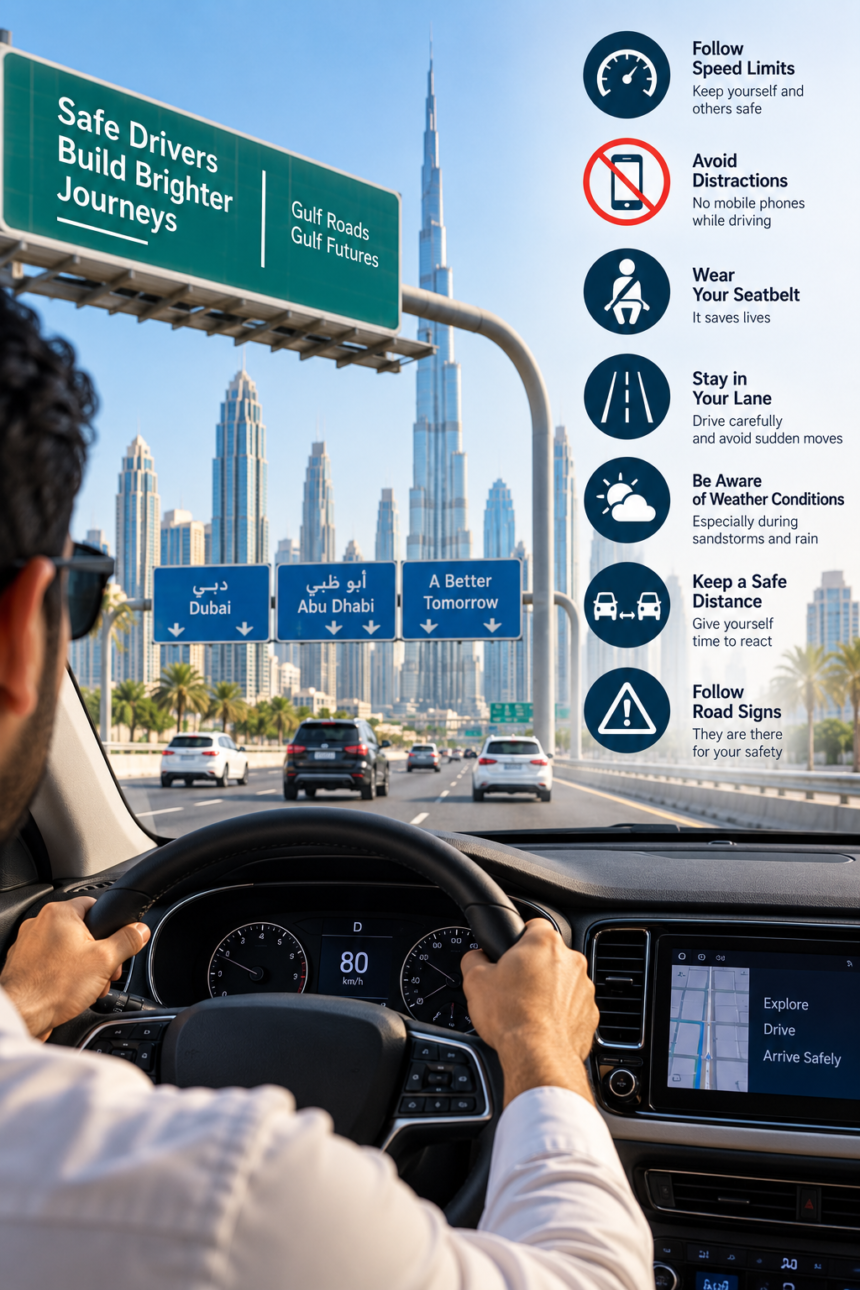
How Much Distance Should You Keep From the Vehicle Ahead?
Driving in the Gulf can be an exciting milestone for a new resident. Modern highways, extensive road networks and well-developed cities make travelling by car an important part of everyday life across the UAE, Saudi Arabia, Qatar, Kuwait, Bahrain and Oman.
- Why Is Driving in the Gulf Different for for New Drivers in the Gulf?
- What Are the Most Important Road Safety Tips for New Drivers?
- Why Should New Drivers Take Speed Limits Seriously?
- How Much Distance Should You Keep From the Vehicle Ahead?
- Why Is Lane Discipline So Important on Gulf Roads?
- How Should New Drivers Handle Motorways and High-Speed Roads?
- Why Should You Never Use a Mobile Phone While Driving?
- How Important Are Seat Belts and Child Restraints?
- How Should You Drive Safely in Fog, Rain and Sandstorms?
- How Does Extreme Heat Affect Driving Safety?
- What Should You Know About Tyres in Gulf Weather?
- How Should New Drivers Approach Roundabouts and Intersections?
- What Should You Do Around Trucks and Heavy Vehicles?
- How Can You Drive Safely at Night?
- What Should You Know About Long-Distance and Desert Roads?
- How Can New Drivers Avoid Aggressive Driving?
- What Should You Check Before a Long Journey?
- How Do Road Rules Differ Across GCC Countries?
- What Should You Do After a Breakdown or Accident?
- What Are the Most Common Mistakes New Drivers Make?
- Frequently Asked Questions About Driving in the Gulf
- Final Road Safety Checklist for New Gulf Drivers
But a driving licence does not automatically prepare someone for every situation they may encounter on Gulf roads.
A newcomer who previously drove mainly on smaller city roads may suddenly find themselves travelling on a six-lane motorway surrounded by vehicles moving at significantly different speeds. Another driver may be comfortable with highways but unfamiliar with sandstorms, extreme summer temperatures or sudden heavy rain.
Good driving therefore requires more than knowing how to operate a car. It means anticipating risk, understanding local road conditions and giving yourself enough time and space to react.
That matters everywhere. The World Health Organization says approximately 1.16 million people die in road crashes globally each year. It also notes that increasing average speed increases both the probability of a crash and the severity of its consequences.
For new drivers in the Gulf, the safest mindset is simple: do not try to match the most aggressive driver around you. Drive predictably, legally and defensively.
Why Is Driving in the Gulf Different for for New Drivers in the Gulf?
The GCC countries have highly developed road infrastructure, but their driving environments can be very different from those experienced by newcomers elsewhere.
Major cities such as Dubai, Abu Dhabi, Riyadh, Jeddah, Doha, Kuwait City, Manama and Muscat have wide arterial roads and major highways designed to move large numbers of vehicles. Drivers may regularly transition from slow residential streets to fast multilane roads within a few minutes.
The climate creates another challenge. Summer temperatures can place additional pressure on tyres, cooling systems and vehicle batteries. Fog can dramatically reduce visibility in parts of the UAE and other Gulf states, while dust and sand can create sudden visibility problems. Rain is less frequent than in many countries, but when it arrives, road surfaces can become hazardous.
New residents may also be adapting to unfamiliar road signs, exits, lane layouts and navigation systems at the same time.
None of these conditions needs to make driving intimidating. The key is understanding them before they become an emergency.
What Are the Most Important Road Safety Tips for New Drivers?
If you remember only a few rules, make them these.
| Safety habit | Why it matters |
|---|---|
| Follow the posted speed limit | Gives you more time to identify and react to hazards |
| Keep a safe following distance | Helps prevent rear-end crashes |
| Wear seat belts | Reduces the risk of serious injury in a collision |
| Keep phones away | Reduces distraction and delayed reactions |
| Signal before changing lanes | Helps other drivers predict your movement |
| Check mirrors and blind spots | Especially important on multilane highways |
| Slow down in bad weather | Visibility and grip can fall quickly |
| Maintain your tyres | Heat and speed make tyre condition critical |
| Never drive when exhausted | Fatigue reduces attention and reaction speed |
| Stay calm around aggressive drivers | Avoids turning another driver’s mistake into your accident |
These habits sound simple because they are. Road safety is often less about performing complicated manoeuvres and more about repeatedly making sensible decisions.
Why Should New Drivers Take Speed Limits Seriously?
Gulf highways can make speed feel deceptively comfortable.
A wide, smooth road with relatively little traffic may make 100 km/h or more feel slower than it actually is. The problem becomes obvious when something unexpected happens.
A car changes lane suddenly. Traffic stops ahead. An object appears on the road. Visibility deteriorates. A tyre develops a problem.
At higher speeds, both your stopping distance and the consequences of a crash increase.
WHO says every 1% increase in mean speed is associated with a 4% increase in fatal crash risk and a 3% increase in serious crash risk.
New drivers should also understand that speed regulations and enforcement practices are not identical throughout the GCC. Do not rely on what a friend tells you about camera tolerances or assumptions about how much you can exceed a displayed limit.
Treat the number displayed on the road as the instruction you are expected to follow.
It is also important to reduce speed when conditions require it. A posted maximum is not a requirement to drive at that speed during thick fog, heavy rain or poor visibility.
How Much Distance Should You Keep From the Vehicle Ahead?
Tailgating is especially dangerous on fast roads because the driver behind has almost no room for error.
If the car ahead brakes suddenly and you are travelling too close, excellent reflexes may still not be enough.
Rather than focusing only on the physical number of metres between vehicles, new drivers can use a time gap. Pick a fixed point ahead, such as a road sign. When the vehicle in front passes it, count the seconds before your vehicle reaches the same point.
Increase that distance when:
- Roads are wet
- Visibility is poor
- You are driving at night
- A heavy vehicle is ahead
- Traffic is unpredictable
- Your car is heavily loaded
- You are tired or less confident
If another driver enters the safety gap you created, do not immediately move closer to protect your space. Ease off and rebuild the gap.
Defensive driving sometimes means allowing impatient drivers to move ahead.
Why Is Lane Discipline So Important on Gulf Roads?
One of the biggest adjustments for new drivers is managing several lanes of fast-moving traffic.
Plan lane changes early.
Check your mirrors, use the indicator, check the blind spot and move only when sufficient space exists. Do not cross several lanes at the last moment because your navigation system announced an exit.
Missing an exit is inconvenient. A dangerous lane change can be life-changing.
Avoid remaining in the overtaking lane unnecessarily. At the same time, do not respond to a vehicle approaching quickly from behind by making a rushed manoeuvre. Maintain control and change lanes when it is safe.
Indicators are equally important even when the road appears empty. The driver you have not noticed is exactly the person who needs to understand what you are about to do.
How Should New Drivers Handle Motorways and High-Speed Roads?
Motorway driving becomes easier when you stop treating every vehicle around you as an immediate problem and start looking farther ahead.
Instead of staring only at the vehicle directly in front, scan the road.
Look for brake lights several cars ahead. Watch vehicles joining from slip roads. Notice when lanes are ending. Identify trucks that may need additional space. Read signs before you reach the exit.
When entering a highway, use the acceleration lane to build an appropriate speed before merging. Entering significantly slower than traffic can be dangerous because other vehicles may need to brake or change lanes unexpectedly.
When leaving, move into the correct lane early rather than suddenly reducing speed on the main carriageway.
Navigation applications are helpful, but audio instructions are safer than repeatedly looking down at the screen.
Why Should You Never Use a Mobile Phone While Driving?
A mobile phone creates more than visual distraction.
A phone conversation, message or notification can take your attention away from what is happening around the vehicle.
WHO says drivers using mobile phones are approximately four times more likely to be involved in a crash than drivers who are not using one. It also notes that mobile-phone use can slow reaction times and make maintaining lanes and following distances more difficult.
The safest solution is to prepare before moving.
Set the destination. Choose your music. Connect Bluetooth. Place the phone in a mount if navigation is necessary.
Then drive.
If an urgent message or complicated navigation problem requires attention, stop somewhere safe rather than solving it while moving.
Hands-free technology can reduce the need to physically handle a device, but it does not eliminate cognitive distraction. WHO notes that hands-free conversations are not necessarily much safer than holding a phone.
How Important Are Seat Belts and Child Restraints?
A short journey is still a journey.
Drivers and passengers should wear their seat belts before the vehicle moves, including people sitting in the rear.
WHO says wearing a seat belt can reduce the risk of death among vehicle occupants by up to 50%. It also reports that appropriate child restraints can reduce deaths among infants substantially.
Children should use appropriate restraint systems rather than being held by an adult.
In a sudden collision, an adult cannot reliably hold a child against the forces involved.
Child-seat requirements vary between Gulf countries, so parents should check the current rules for the country in which they are driving and ensure the restraint is appropriate for the child’s age, size and weight.
How Should You Drive Safely in Fog, Rain and Sandstorms?
Gulf weather can change the driving environment surprisingly quickly.
During fog
Reduce speed gradually and increase following distance. Use appropriate vehicle lighting and avoid relying on the car ahead as your only guide.
Do not repeatedly switch lanes trying to gain a few places. In dense fog, a stationary or slow vehicle may appear with little warning.
During rain
The first period of rainfall can make roads particularly slippery because water mixes with accumulated dust and road residue.
Slow down before turns, avoid harsh braking and increase the space between your vehicle and others.
Never drive through floodwater simply because another vehicle has done so. You may not know the depth, road condition or whether the other vehicle is better equipped.
During sand or dust
Visibility can deteriorate rapidly.
Reduce speed without braking aggressively, increase following distance and avoid unnecessary overtaking. If conditions become unsafe, follow local authority guidance and move to a genuinely safe stopping location rather than simply stopping within a live traffic lane.
The general principle is always the same: your speed must match what you can actually see and respond to.
How Does Extreme Heat Affect Driving Safety?
Gulf summers are not only uncomfortable. Heat can affect vehicles.
Before the hottest part of the year, drivers should pay particular attention to tyre condition, coolant, batteries and air-conditioning.
Never ignore dashboard warning lights suggesting overheating.
If the temperature gauge climbs abnormally, continuing to drive can turn a manageable mechanical issue into serious engine damage.
Drivers should also keep water in the vehicle, particularly before longer journeys outside urban areas. However, avoid leaving items that can become hazardous in very hot cars.
A parked vehicle can heat rapidly, making it especially dangerous for children and animals. Never leave them unattended inside a parked car.
What Should You Know About Tyres in Gulf Weather?
Tyres deserve far more attention than many new drivers give them.
They are the only parts of the vehicle making direct contact with the road, yet drivers often check them only after something goes wrong.
Inspect tyre pressure regularly and follow the vehicle manufacturer’s recommended specification rather than simply guessing from appearance.
Look for:
- Uneven wear
- Cracks
- Cuts
- Bulges
- Damaged sidewalls
- Low tread
- Slow pressure loss
Do not assume that a tyre with visible tread is automatically safe. Age and heat exposure also matter.
Check the spare tyre or emergency repair kit as well. Discovering that the spare is unusable after a puncture on a highway is avoidable.
How Should New Drivers Approach Roundabouts and Intersections?
Roundabouts can confuse drivers because traffic practices may differ from what they learned in another country.
Follow the lane markings and signs rather than assuming every roundabout operates in exactly the same way.
Choose the correct lane before entering when possible and signal appropriately when changing position or leaving.
Do not force entry because you believe another vehicle “should” give way. Even when you have priority, avoiding a collision matters more than proving that you were correct.
At signal-controlled intersections, resist the temptation to accelerate aggressively the moment a light changes.
A brief check for vehicles, cyclists or pedestrians entering unexpectedly can prevent a serious incident.
What Should You Do Around Trucks and Heavy Vehicles?
Gulf highways carry large numbers of commercial vehicles, particularly on major logistics and intercity routes.
Give trucks additional room.
A heavy vehicle needs more distance to slow down and may have larger blind spots than a passenger car.
Avoid spending unnecessary time directly beside a truck. If you need to overtake and conditions permit, do so predictably rather than remaining alongside it.
Do not cut closely in front immediately after overtaking. The space you consider sufficient may not provide the truck driver with enough stopping distance.
Be particularly cautious around trucks on bends, exits and merging areas.
How Can You Drive Safely at Night?
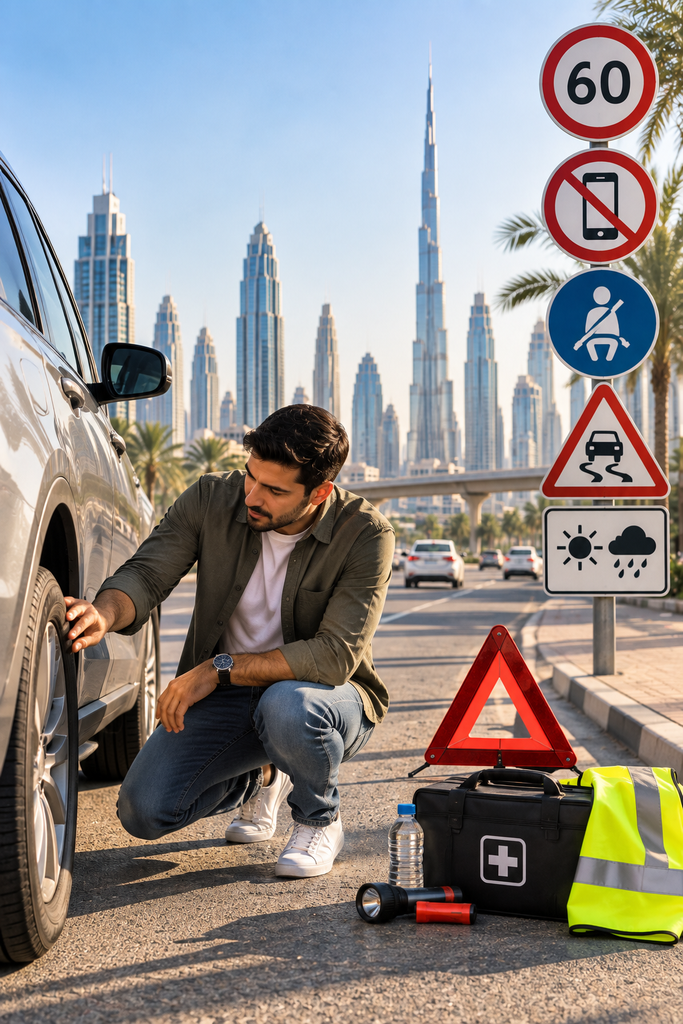
Night driving can appear easier because temperatures are lower and some roads are quieter, but visibility is naturally reduced.
Speed that feels comfortable in daylight may leave insufficient reaction time when only your headlights illuminate the road ahead.
Keep the windscreen clean, ensure lights are working and dim full beams when they could dazzle other drivers.
On roads outside major cities, be prepared for poorly illuminated sections and unexpected hazards.
Fatigue is another serious problem.
If you are fighting to keep your eyes open, opening a window or increasing the music volume does not make you safe. Stop somewhere appropriate and rest.
What Should You Know About Long-Distance and Desert Roads?
Saudi Arabia, Oman and the UAE in particular have long stretches of highway connecting cities and remote areas. Distances can be greater than new residents expect.
Before leaving, check fuel level, tyres, navigation and vehicle condition.
Do not assume fuel stations, workshops and restaurants will appear as frequently as they do inside major cities.
For remote trips, carrying water, a charged phone and charging equipment is sensible. Sharing your planned route with someone can also be useful.
Stay on recognised roads unless you have suitable equipment and off-road experience.
Driving onto dunes is not simply ordinary driving on softer ground. Off-road travel requires different tyre management, recovery equipment, techniques and vehicle capability. New drivers should not attempt remote desert driving alone.
How Can New Drivers Avoid Aggressive Driving?
Another driver’s impatience does not require your participation.
Someone may follow closely, flash headlights or attempt an aggressive overtake. Your safest response is usually to remain predictable and allow them to pass when it is safe.
Do not:
- Speed up to stop someone overtaking
- Follow another driver after an argument
- Brake suddenly to “teach them a lesson”
- Make gestures
- Block a faster vehicle deliberately
- Compete for position
Road rage turns a simple traffic situation into an unpredictable confrontation.
Your goal is not to win the road. It is to arrive safely.
What Should You Check Before a Long Journey?
A two-minute check can prevent hours of trouble.
Before leaving, check:
- Fuel or battery range
- Tyre condition and pressure
- Spare tyre or repair kit
- Engine warning lights
- Coolant condition where appropriate
- Windscreen washer fluid
- Headlights and indicators
- Navigation route
- Weather forecast
- Phone battery
- Water for longer journeys
- Vehicle insurance and required documents
For cross-border travel between GCC countries, additional documentation and insurance requirements may apply.
Do not assume that because your vehicle is legal to drive in one GCC state, every document or insurance arrangement automatically applies in another.
Check the requirements for your destination and any transit country before leaving.
How Do Road Rules Differ Across GCC Countries?
The six GCC countries share many familiar road-safety principles, but traffic legislation, penalties, speed limits, licence rules, vehicle registration requirements and enforcement systems can differ.
| Country | New drivers should pay particular attention to |
|---|---|
| UAE | Multilane motorways, frequent cameras, fog and busy urban traffic |
| Saudi Arabia | Long intercity distances and high-speed highway travel |
| Qatar | Fast urban highways and frequent merging around Doha |
| Kuwait | Dense urban traffic and multilane roads |
| Bahrain | Busy junctions and a compact road network |
| Oman | Mountain roads, long-distance routes and changing terrain |
This table describes driving environments, not the full law of each country.
Always use the country’s official police, traffic or transport authority for current regulations and penalties. Do not rely on social media posts or advice such as “everyone drives this much above the limit.”
Rules can change, and enforcement technology changes with them.
What Should You Do After a Breakdown or Accident?
The first priority is preventing a second collision.
If the vehicle develops a problem and can still be moved safely, try to reach an appropriate safe location away from moving traffic.
Switch on hazard lights when appropriate and avoid standing in a dangerous position beside live lanes.
If there are injuries or an immediate danger, contact the local emergency services.
For minor crashes, reporting procedures vary between Gulf countries and sometimes between different circumstances within the same country. Police apps and digital reporting systems are increasingly common, but drivers should check the procedure where they live.
Do not leave a serious collision scene or move an injured person unnecessarily unless remaining there creates an immediate danger.
Keep insurance and vehicle information accessible rather than searching for it for the first time after an accident.
What Are the Most Common Mistakes New Drivers Make?
The biggest mistakes are often caused by confidence developing faster than experience.
Driving too quickly too soon
A new driver may become comfortable controlling the vehicle before developing enough experience to anticipate what other drivers will do.
Following navigation instead of the road
Missing a turn is safer than suddenly crossing three lanes.
Tailgating
Leaving space can feel as though other drivers will simply take it, but that safety margin is exactly what allows you to respond.
Blindly copying other motorists
If several vehicles exceed the speed limit or perform a questionable manoeuvre, that does not make it safe or legal.
Ignoring the vehicle
Tyre pressure, warning lights and servicing are part of road safety.
Driving when tired
Long distances and straight highways can make fatigue particularly dangerous.
Becoming emotional
A driver who is angry is more likely to make aggressive and unnecessary decisions.
Frequently Asked Questions About Driving in the Gulf
Are Gulf roads difficult for new drivers?
Not necessarily. Major roads are generally well developed, but high speeds, multilane highways, dense traffic and unfamiliar exits can take time to learn. New drivers should initially choose familiar routes and avoid rushing.
What is the most important safety habit for a beginner?
Creating space. Safe speed, sufficient following distance and early planning give you more time to deal with other people’s mistakes.
Should I drive at the maximum speed allowed?
Not automatically. A speed limit is a legal maximum under applicable conditions, not a target during fog, rain, congestion or other unsafe conditions.
Are seat belts really necessary for rear passengers?
Yes. Unrestrained rear passengers can be seriously injured during a collision. WHO says seat belts can reduce the risk of death among vehicle occupants by up to 50%.
Can I check my phone briefly at a red light?
The safest approach is to keep your attention on traffic and follow the specific mobile-phone laws of the country where you are driving. Set navigation and other phone functions before beginning the journey.
What should I do if someone tailgates me?
Remain calm. Do not brake aggressively or start competing with the other vehicle. Allow it to pass when you can change position safely and legally.
Is rain really dangerous in the Gulf?
It can be. Drivers may have less experience in wet conditions, visibility can fall, and road grip changes. Heavy rain can also create standing or floodwater. Slow down and avoid flooded routes.
Do I need to check my tyres frequently?
Yes. High temperatures, motorway speeds and long journeys make tyre maintenance particularly important. Follow the vehicle and tyre manufacturers’ recommendations.
Can I use the same driving habits throughout the GCC?
Basic defensive-driving principles remain useful everywhere, but specific traffic laws vary between Bahrain, Kuwait, Oman, Qatar, Saudi Arabia and the UAE. Always check local rules when entering another country.
Final Road Safety Checklist for New Gulf Drivers
Learning to drive confidently in the Gulf is not about becoming faster or more aggressive. It is about becoming better at predicting risk.
A responsible new driver looks farther ahead, leaves space, understands the vehicle and accepts that other people will sometimes make mistakes.
Before every journey, remember five basic priorities:
- Seat belt on before moving.
- Phone away while driving.
- Stay within the posted speed limit and slow further when conditions require it.
- Maintain enough distance to react safely.
- Never let another driver’s behaviour pressure you into taking a risk.
Those habits are supported by the fundamentals of international road-safety guidance. WHO identifies speed, distraction, non-use of seat belts and child restraints, impaired driving, unsafe vehicles and inadequate enforcement among the major road-risk factors worldwide.
For new residents, there is one final lesson worth remembering. Driving conditions in the UAE, Saudi Arabia, Qatar, Kuwait, Bahrain and Oman may look similar from behind the wheel, but local traffic laws and enforcement practices are not identical.
Learn the rules of the country where you drive, prepare your vehicle for the Gulf climate and give yourself time to gain experience.
The safest driver on a Gulf highway is rarely the person travelling fastest. It is the person who leaves enough room to deal with whatever happens next.
Do follow us on Instagram
Read More – What Are the 10 Best Business Opportunities in Dubai in 2026?