


Saving Money While Living in Dubai, Doha or Riyadh: What Works Best?
Living in Dubai, Doha or Riyadh can offer excellent career opportunities, international lifestyles and the potential to build substantial savings. Yet these advantages do not guarantee that expatriates will actually save money. A higher salary can quickly be absorbed by rent, transportation, dining, shopping, travel and lifestyle upgrades.
- Saving Money in Dubai vs Doha vs Riyadh: Quick Comparison
- 1. Decide Your Savings Target Before Choosing Your Lifestyle
- 2. Housing Is Your Biggest Opportunity to Save
- 3. Saving on Housing in Dubai
- 4. Saving on Housing in Doha
- 5. Saving on Housing in Riyadh
- 6. Use Public Transport Where It Actually Saves Money
- 7. Stop Treating Taxis and Ride-Hailing as Invisible Spending
- 8. Reduce Food Delivery Without Giving Up Restaurants
- 9. Shop for Groceries With a Weekly Plan
- 10. Control the Weekend Spending Cycle
- 11. Use Free and Low-Cost Experiences
- 12. Avoid Buying a Car That Matches Your Salary Instead of Your Needs
- 13. Audit Your Subscriptions Every Three Months
- 14. Save on International Money Transfers
- 15. Create Separate Savings Goals
- Saving Money in Dubai: What Matters Most?
- Saving Money in Doha: What Matters Most?
- Saving Money in Riyadh: What Matters Most?
- Dubai vs Doha vs Riyadh: Where Can You Save the Most?
- The 24-Hour Rule for Non-Essential Purchases
- Try One No-Spend Weekend Every Month
- Create a Lifestyle Ceiling
- A 30-Day Dubai, Doha or Riyadh Savings Challenge
- Monthly Money Checklist
- How Much Should You Save Every Month?
- What to Do With the Money You Save
- Final Thoughts on Saving Money While Living in Dubai, Doha or Riyadh
The challenge is particularly noticeable during the first year. New residents often spend heavily on housing deposits, furniture, transportation and setting up everyday life. At the same time, moving to a new city creates the temptation to explore restaurants, malls, attractions and weekend experiences. Individual purchases may seem manageable, but together they can dramatically reduce the amount left at the end of the month.
The solution is not to stop enjoying Dubai, Doha or Riyadh. It is to identify which expenses genuinely improve your life and which ones are quietly preventing you from reaching your financial goals. Housing and transportation usually deserve more attention than small everyday purchases because even a modest reduction in these major categories can create significant annual savings.
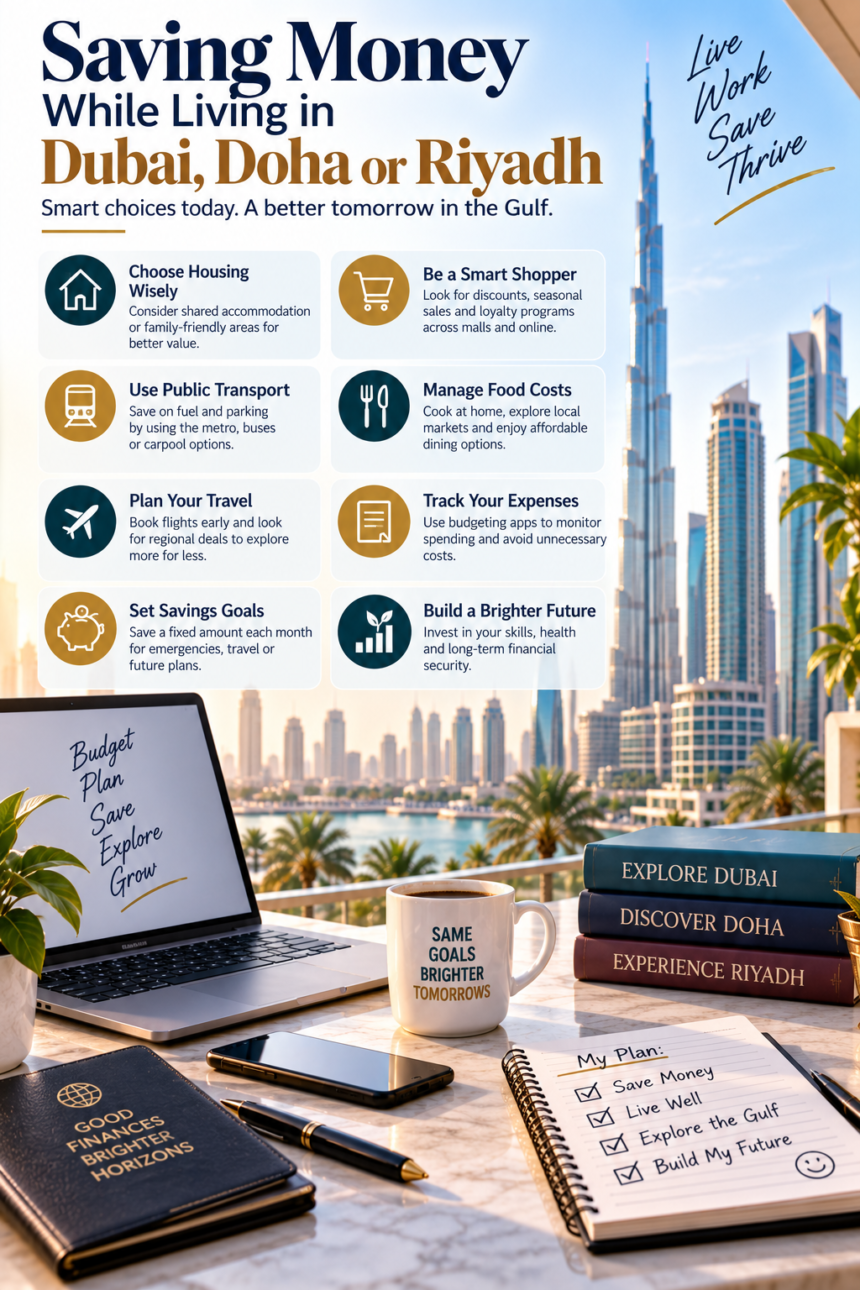
This guide explains 15 practical ways of Saving Money While Living in Dubai, Doha or Riyadh, with city-specific strategies for housing, transport, food, entertainment, remittances and long-term financial planning.
Saving Money in Dubai vs Doha vs Riyadh: Quick Comparison
Each city creates a different spending pattern. Your actual costs will depend heavily on salary, family size, neighbourhood, employer benefits and lifestyle, but this comparison highlights the areas worth examining first.
| Expense | Dubai | Doha | Riyadh |
|---|---|---|---|
| Housing | Major budget consideration | Major budget consideration | Location increasingly important |
| Public transport | Extensive Metro/bus network | Metro provides useful alternative | Metro and bus network expanding mobility options |
| Car dependence | Depends heavily on location | Common for many households | Common, though Metro changes the equation |
| Dining | Huge range from budget to luxury | Wide international choice | Rapidly expanding restaurant scene |
| Entertainment | Very large choice | Strong but smaller market | Rapidly expanding |
| Lifestyle temptation | Very high | Moderate to high | Increasing |
| Biggest saving opportunity | Housing + transport | Housing + transport | Housing + car/transport |
| Best strategy | Live near useful transport | Use Metro-friendly location | Compare Metro access against car costs |
The biggest lesson is that you should not automatically copy the lifestyle of colleagues earning similar salaries. Their housing benefits, family responsibilities, debts and savings goals may be completely different from yours.
1. Decide Your Savings Target Before Choosing Your Lifestyle
Many expatriates use the opposite approach. They choose an apartment, car, restaurants and lifestyle first, then attempt to save whatever remains.
Reverse the order.
If you earn 20,000 per month and want to save 4,000, treat your actual lifestyle budget as 16,000.
The basic formula becomes:
Income – Savings Target = Maximum Lifestyle Budget
Rather than:
Income – Lifestyle Spending = Whatever Is Left to Save
This simple change can completely alter your financial behaviour.
Set an automatic transfer for shortly after payday. Moving savings before normal spending begins prevents the entire salary from appearing available.
2. Housing Is Your Biggest Opportunity to Save
Saving on coffee will not compensate for choosing an apartment that costs thousands more every month than necessary.
Housing deserves attention because a relatively small monthly difference becomes significant over a year.
Suppose Apartment A costs 7,000 per month while Apartment B costs 6,000. The difference is 12,000 annually before considering any additional housing-related costs.
But rent should not be considered alone.
Calculate Your Real Housing Cost
Rent
- Utilities
- Internet
- Parking
- Commuting
- Furnishing
- Applicable housing costs
= Real Housing Cost
A cheaper property located far from your workplace can become more expensive once fuel, parking, road tolls and commuting time are included.
The financially smarter home is therefore the one offering the best combination of rent and location rather than simply the lowest advertised price.
3. Saving on Housing in Dubai
Dubai offers everything from premium waterfront apartments to more affordable residential communities, which means location can dramatically affect your budget.
Living next to your office may reduce transport expenses but increase rent. Moving farther away can lower housing costs while creating a longer and more expensive commute.
Before signing a tenancy contract, compare the combined cost.
For someone working near a Metro station, living near another station can potentially reduce the need for daily taxi journeys or even eliminate the need for a private car.
This is where Dubai’s transport network becomes a useful financial tool. The RTA’s Metro, Tram and bus services are integrated through the nol system, allowing residents to combine different modes during regular journeys.
Dubai Housing Decision
| Option | Potential Advantage | Possible Drawback |
|---|---|---|
| Near workplace | Lower commute | Higher rent |
| Near Metro | Lower transport costs | Metro-area rents may vary |
| Outer community | More space for money | Longer commute |
| Shared accommodation | Lower housing expense | Less privacy |
| Premium central area | Lifestyle/convenience | High annual cost |
Do not choose an address primarily because it looks impressive on social media. Choose it because it works for your actual daily life.
4. Saving on Housing in Doha
Doha’s smaller geographical scale changes the calculation, but neighbourhood still has a major effect on both rent and transportation.
Premium areas can offer attractive waterfront lifestyles, amenities and modern apartments, while other neighbourhoods may provide considerably better value for residents who prioritise savings.
If your workplace is accessible through the Doha Metro, include that in your property search.
A slightly different neighbourhood could allow you to reduce both housing and transportation expenses.
Families should also consider school location. Living far from both work and children’s schools can create complicated daily transportation patterns that increase fuel, taxi or driver costs.
The best Doha location may therefore be the point that balances work + school + housing + transport, rather than whichever apartment has the most attractive facilities.
5. Saving on Housing in Riyadh
Riyadh’s large geographical footprint makes location particularly important.
Two apartments with similar rent can produce completely different lifestyles if one requires a long daily drive across the city.
Historically, many Riyadh residents have depended heavily on private cars, but the development of the Metro and bus network gives residents additional options when evaluating where to live.
If your workplace and home are both conveniently connected to public transport, compare the cost against daily driving.
Fuel is only one component of car ownership.
Car Cost = Finance/Depreciation + Insurance + Fuel + Maintenance + Parking + Repairs
Someone choosing accommodation only according to rent can therefore underestimate the true cost of living far from work.
6. Use Public Transport Where It Actually Saves Money
You do not need to become completely car-free to save money.
The smarter approach is to identify journeys where public transport is genuinely convenient and use it strategically.
Dubai provides a particularly clear example. Current RTA Silver nol fares are AED 3 within one zone, AED 5 across two adjacent zones and AED 7.50 across more than two zones. Registered Silver card users can also purchase longer-duration passes.
A resident making regular Metro-friendly journeys can compare this directly with the total monthly cost of owning a car.
Doha’s Metro also offers inexpensive standard travel compared with relying entirely on taxis.
Riyadh’s Metro and bus system has similarly created another option for residents whose homes and workplaces are conveniently connected.
Before Buying a Car, Calculate This
☐ Monthly car payment or depreciation
☐ Insurance
☐ Fuel
☐ Maintenance
☐ Tyres
☐ Parking
☐ Road charges where applicable
☐ Unexpected repairs
Compare the total with your realistic public-transport and occasional-taxi budget.
You may still decide that a car is worth the convenience, but at least the decision will be based on the real cost.
7. Stop Treating Taxis and Ride-Hailing as Invisible Spending

Taxi and app-based journeys are individually convenient enough that they can feel inexpensive.
The problem becomes visible when you total an entire month.
A 30 or 40 unit journey may not seem significant, but repeated twice every working day it can become one of your largest expenses.
Review your previous month’s transport transactions.
Calculate:
Work rides + weekend rides + airport rides + delivery-related transport = Monthly Taxi/Ride-Hailing Cost
If the total surprises you, look for combinations rather than an extreme solution.
You might use Metro for commuting, taxis for late evenings and a rental car only when genuinely necessary.
The objective is not to eliminate convenience. It is to stop paying a premium for convenience automatically.
8. Reduce Food Delivery Without Giving Up Restaurants
Dubai, Doha and Riyadh all have highly developed food-delivery cultures. The ease of ordering can make delivery feel like an ordinary household expense rather than discretionary spending.
The real cost becomes clearer when you combine food prices, delivery charges and repeated orders.
Suppose you spend an additional 50 on delivery or restaurant food three times every week compared with preparing food at home.
That becomes approximately 600 per month and 7,200 over a year.
You do not need to stop eating out.
Create a deliberate dining budget instead.
Try the 3-Level Food System
Level 1: Home meals
Normal weekday food.
Level 2: Affordable dining
Casual meals with friends and family.
Level 3: Experience dining
Premium restaurants reserved for occasions.
Separating ordinary food from entertainment helps prevent every meal from becoming an expensive lifestyle event.
9. Shop for Groceries With a Weekly Plan
Food waste is an overlooked expense among expatriates, particularly people living alone.
Buying large quantities during supermarket promotions saves nothing if half the food eventually goes into the bin.
Before shopping, check what you already have and plan several meals for the week.
Create a simple list based around ingredients that can be used more than once.
For example, vegetables purchased for one dinner can also become part of lunch the next day. Chicken prepared in a larger batch can support several meals.
Grocery Rules That Actually Help
- Shop with a list.
- Compare unit prices, not only package prices.
- Avoid shopping when hungry.
- Use supermarket loyalty programmes if genuinely useful.
- Compare private-label products.
- Buy bulk only when you will use it.
- Check food already at home before shopping.
- Plan meals around what needs to be consumed first.
The objective is not to buy the cheapest possible food. It is to stop paying for food you never eat.
10. Control the Weekend Spending Cycle
One financial pattern appears repeatedly in major Gulf cities: disciplined weekdays followed by expensive weekends.
Friday or Saturday can quickly involve brunch, shopping, coffee, entertainment, taxis and dinner.
A single weekend may not look damaging. Four expensive weekends every month can transform your budget.
Create a monthly entertainment allowance and divide it across the month.
If your budget is 1,200, you effectively have approximately 300 per weekend.
Some weekends can cost more and others less.
The important part is having a boundary.
Mix Paid and Low-Cost Weekends
Paid weekend: restaurant + attraction
Lower-cost weekend: park + home meal
Paid weekend: event + coffee
Lower-cost weekend: beach + friends
You still experience the city without turning every weekend into a premium event.
11. Use Free and Low-Cost Experiences
Dubai, Doha and Riyadh are often marketed through luxury experiences, but luxury is only one part of life in these cities.
Beaches, parks, waterfront areas, cultural districts, public spaces, walking routes, seasonal events and community activities can provide entertainment without requiring a large budget.
The key is changing the question from:
“Where should we spend money this weekend?”
to:
“What should we do this weekend?”
The second question creates many more possibilities.
Families can particularly benefit from planning a mix of paid attractions and free activities rather than treating malls and commercial entertainment venues as the default weekend destination.
12. Avoid Buying a Car That Matches Your Salary Instead of Your Needs
Car culture is strong across all three cities, and upgrading vehicles after a salary increase can become a major source of lifestyle inflation.
A bank or finance company may be willing to finance a vehicle that consumes a substantial amount of your monthly income. That does not mean purchasing it is financially sensible.
Think about the entire ownership period.
A more expensive vehicle usually creates not only a larger payment but potentially higher insurance, maintenance, tyres and depreciation.
Before Upgrading Your Car, Ask:
Does my current vehicle still meet my needs?
How much will the upgrade increase my total monthly cost?
Could I invest the difference instead?
Am I buying reliability or status?
How many months of savings does the upgrade represent?
A reliable vehicle kept for several years can be one of the simplest ways to reduce long-term lifestyle costs.
13. Audit Your Subscriptions Every Three Months
Subscriptions are designed to become invisible.
Streaming services, cloud storage, fitness apps, premium memberships, delivery subscriptions, software and other small recurring charges can accumulate quietly.
Every three months, review your bank and credit-card statements specifically for recurring payments.
Create three categories:
| Category | Action |
|---|---|
| Use frequently | Keep |
| Occasionally useful | Reconsider |
| Forgotten/unused | Cancel |
A subscription does not need to be expensive to be wasteful.
Ten small services costing 30 each create 300 of monthly spending and 3,600 annually.
The biggest benefit of a subscription audit is not cancelling everything. It is making sure you are deliberately paying for what you actually use.
14. Save on International Money Transfers
For expatriates regularly sending money home, exchange rates and transfer costs can become important over time.
Do not evaluate a transfer provider only by the advertised fee.
The exchange rate can affect the amount your family ultimately receives.
The better comparison is:
Amount Sent → All Fees/Exchange Costs → Amount Received
Compare the final amount reaching the recipient.
Someone transferring money every month for ten years can lose a meaningful amount through consistently poor exchange rates even when individual differences appear small.
Planning transfers can also help. Instead of making several small transfers every month, consider whether fewer planned transfers make sense for your circumstances and fee structure.
15. Create Separate Savings Goals
One savings account labelled simply “savings” can easily become money for everything.
A holiday appears, and savings pay for it. Then a new phone arrives. Then an emergency happens.
Separate goals create clarity.
Useful Savings Buckets
| Goal | Purpose |
|---|---|
| Emergency fund | Job loss and genuine emergencies |
| Travel | Holidays and flights |
| Annual expenses | Insurance, school costs and renewals |
| Property | Future deposit or purchase |
| Investing | Long-term wealth |
| Relocation | Eventual move from the Gulf |
When each category has a purpose, you are less likely to spend emergency money on predictable lifestyle expenses.
Saving Money in Dubai: What Matters Most?
Dubai offers enormous lifestyle choice, which is both an advantage and a financial challenge.
You can eat inexpensively or spend hundreds on one meal. You can use the Metro or drive a premium vehicle. You can live in a modest apartment or choose a luxury waterfront tower.
That means Dubai does not automatically have one lifestyle cost. Your choices create much of your personal cost structure.
Transport is one area where residents can make particularly measurable decisions. Dubai RTA’s current regular Silver nol fare structure ranges from AED 3 to AED 7.50 depending on zones travelled, while registered cards can access weekly, monthly, quarterly and annual travel products.
For someone commuting along Metro and bus routes, the savings compared with daily taxi use can become substantial.
Housing remains equally important. Paying extra to live in an area that reduces transportation may sometimes make financial sense, while paying premium rent and still maintaining an expensive daily commute can create the worst combination.
Dubai Money Priorities
1. Control rent
2. Optimise Metro/car/taxi use
3. Set a dining budget
4. Watch lifestyle upgrades
5. Automate savings immediately after salary
Dubai becomes expensive very quickly when every category moves towards the premium end at the same time.
Saving Money in Doha: What Matters Most?
Doha’s compact geography can simplify some parts of financial planning, but housing, transportation and dining can still consume a significant percentage of an expatriate salary.
The Doha Metro provides a useful low-cost transportation option where journeys align with the network. Standard travel currently uses a straightforward fare structure, making it relatively easy for commuters to compare Metro costs against repeated taxi journeys or private-car expenses.
Housing decisions should also account for workplace and school location.
Families can lose both money and time when home, office and school are positioned far apart.
Instead of selecting a neighbourhood in isolation, map all three before signing the lease.
Doha residents should also pay attention to dining and entertainment because premium hotels and restaurants can make weekend spending rise quickly.
Mixing these experiences with lower-cost activities makes the lifestyle more sustainable.
Saving Money in Riyadh: What Matters Most?
Riyadh has undergone enormous changes in mobility and entertainment, giving residents considerably more choice in how they move around and spend their leisure time.
For personal finance, transportation deserves particular attention.
A resident who previously assumed a private vehicle was the only realistic commuting option may now have Metro or bus alternatives depending on home and workplace locations.
This can change the housing equation as well.
When comparing neighbourhoods, consider access to work and public transportation alongside rent.
The cheapest apartment is not necessarily the most economical if it creates a difficult daily commute.
Riyadh’s rapidly expanding entertainment and restaurant scene also creates the same lifestyle-inflation risk seen in Dubai. Setting an entertainment allowance prevents every new venue from becoming an automatic expense.
Dubai vs Doha vs Riyadh: Where Can You Save the Most?
There is no useful universal winner because salary packages and personal circumstances matter more than the city name.
Someone receiving employer-provided accommodation in Doha may save more than someone earning a larger salary in Dubai but paying premium rent.
A professional in Riyadh with housing and transportation support may have a completely different savings potential from someone financing everything independently.
The better comparison is:
Net Income + Employer Benefits – Real Living Costs = Potential Savings
Use this equation when comparing job offers.
Job Offer Comparison Example
| Factor | Dubai | Doha | Riyadh |
|---|---|---|---|
| Net salary | _____ | _____ | _____ |
| Housing support | _____ | _____ | _____ |
| Transport support | _____ | _____ | _____ |
| School benefits | _____ | _____ | _____ |
| Insurance | _____ | _____ | _____ |
| Estimated living costs | _____ | _____ | _____ |
| Potential monthly saving | _____ | _____ | _____ |
This tells you far more than comparing salary numbers alone.
The 24-Hour Rule for Non-Essential Purchases
Shopping is particularly easy in cities filled with malls, online stores and frequent promotions.
Introduce a waiting period.
For a non-essential purchase above an amount you consider significant, wait at least 24 hours before completing the transaction.
Ask:
Would I still buy this without the discount?
Do I already own something that serves the same purpose?
Will I use it regularly?
What financial goal could receive this money instead?
Many impulse purchases lose their appeal once the immediate excitement disappears.
For larger purchases, increase the waiting period to several days.
Try One No-Spend Weekend Every Month
A no-spend weekend does not mean sitting at home doing nothing.
It means deliberately planning activities that require little or no discretionary spending.
Use food already at home, visit free public spaces, exercise, meet friends at home, explore a walking area or spend time on hobbies.
Doing this once a month creates an interesting financial effect.
Instead of saving through dozens of tiny sacrifices throughout the month, you create one concentrated period where discretionary spending falls dramatically.
The money normally used that weekend can be transferred directly towards your emergency fund or another goal.
Create a Lifestyle Ceiling
One of the strongest ways to save during a successful Gulf career is deciding that your lifestyle does not need to increase indefinitely.
Suppose your salary grows from 15,000 to 20,000 and eventually 25,000.
If your lifestyle rises at exactly the same speed, your savings may barely improve.
Instead, create a comfortable lifestyle ceiling.
Once your monthly spending reaches a level that provides a good quality of life, direct most future salary increases towards investing, property goals, retirement or financial independence.
This is how career progression begins to create wealth rather than simply more expensive consumption.
A 30-Day Dubai, Doha or Riyadh Savings Challenge
If you want to improve your finances immediately, try this for one month.
Week 1: Track
Record every expense without changing your behaviour.
Week 2: Cut
Cancel unused subscriptions and reduce one unnecessary recurring cost.
Week 3: Optimise
Review housing, transport and food spending.
Week 4: Automate
Move the amount you saved into a separate account and create an automatic monthly transfer.
At the end of the month, calculate your savings rate:
Monthly Savings ÷ Net Monthly Income × 100 = Savings Rate
Then try to improve that percentage gradually rather than chasing an unrealistic target immediately.
Monthly Money Checklist
Use this quick check at the end of every month:
☐ Did I save immediately after payday?
☐ Did housing remain within budget?
☐ How much did I spend on taxis?
☐ How much did I spend on delivery?
☐ Did I stay within my entertainment allowance?
☐ Did I add unnecessary debt?
☐ Did I send money home according to plan?
☐ Did I make an impulse purchase I regret?
☐ Did my emergency fund increase?
☐ Did my net worth improve?
You do not need a complicated spreadsheet to manage money well.
You need visibility.
How Much Should You Save Every Month?
There is no perfect percentage for every Gulf expatriate.
A family paying private school fees and rent may not be able to save the same percentage as a single professional whose employer provides accommodation.
A useful approach is to establish a minimum percentage and increase it as your income grows.
| Situation | Possible Starting Goal |
|---|---|
| Tight monthly budget | 5–10% |
| Stable household | 15–20% |
| Strong salary relative to expenses | 20–30% |
| Employer provides housing | 30%+ may be possible |
| Aggressive wealth-building phase | As much as sustainably possible |
If you currently save nothing, moving immediately to 30% may be unrealistic.
Start with 5%.
Then reach 10%.
Then 15%.
The direction matters as much as the number.
What to Do With the Money You Save
Saving is only the first stage.
Your money should eventually have different jobs.
The first priority is usually an emergency fund covering several months of essential expenses according to your circumstances.
After establishing that foundation, savings can be directed towards short-term goals, long-term investments, retirement, property or other objectives.
Do not allow all savings to remain permanently mixed with everyday cash.
The goal should gradually evolve from:
Earn → Spend
to:
Earn → Save → Protect → Invest → Spend
That change is where a high Gulf salary can begin creating long-term financial value.
Final Thoughts on Saving Money While Living in Dubai, Doha or Riyadh
Dubai, Doha and Riyadh can all be expensive cities if you allow your lifestyle to expand without limits. They can also provide strong saving opportunities when income, employer benefits and spending are managed deliberately.
The most important savings decisions usually have nothing to do with skipping one coffee.
Choose housing carefully. Calculate transportation properly. Avoid financing a car simply to match your salary. Set boundaries around dining and weekend entertainment. Plan remittances and automate savings before discretionary spending begins.
At the same time, enjoy where you live.
Working abroad should not become an exercise in saving every possible dirham or riyal while experiencing nothing around you. Sustainable personal finance leaves room for restaurants, travel, friendships and entertainment while ensuring those experiences do not consume everything you earn.
Your salary may determine how much money enters your account each month, but your lifestyle determines how much stays there.
The most successful Gulf saving strategy is therefore not necessarily earning more.
It is creating a comfortable gap between what you earn and what you need to spend, then protecting and investing that gap year after year.
Do follow us on Instagram
Read More – How to Build an Emergency Fund While Working in the Gulf: 15 Powerful Steps